2013 #55
Tony Gilroy | 135 mins | Blu-ray | 2.40:1 | USA / English | 12 / PG-13
 As Jason Bourne flits around London and New York making trouble for what’s left of Treadstone, a group of shady men go about safeguarding their own secretive activities. When Bourne exposes Treadstone, a series of convoluted join-the-dots links means it could bring them down too, so they set about destroying their risky initiatives, including killing a bunch of medically-enhanced operatives. What they didn’t count on was one surviving…
That basic setup covers roughly the first 30-40 minutes of The Bourne Legacy. Normally I’d hate to describe so much of a film, but it’s not my fault that co-writer, director and Bourne series veteran Tony Gilroy takes that long to get his story up and running. And it’s another 20 minutes before the real meat-and-potatoes of the tale begins.
And it feels it, too. About 52 minutes in I paused it and went to the kitchen. Not for any particular reason; I just needed a break. There, I saw a slug crawling into my dog’s water bowl, drinking the water or something, I don’t know. I’d never seen that before. I ended up watching that slug slowly edge around the bowl for 15 minutes or more rather than go back to the film. It’s that engrossing.
Gilroy has written or co-written every Bourne film to date, so you’d think he knows his way around the franchise — and he does, but perhaps too well. Each Bourne sequel has basically relied on the same formula: “the conspiracy was bigger than you thought, and now the next level up want Bourne dead”. That was fine in Supremacy — indeed, it took characters left dangling from Identity and wrapped up their roles.  For my money, Ultimatum felt like it re-hashed this storyline, bringing in new characters to force a new level of backstory and hierarchy. (Clearly most viewers didn’t mind, as it’s widely regarded as the best Bourne film.)
And Legacy recycles this idea for a third time. Now, Treadstone and Blackbriar are just two of many such programmes run by the CIA and/or some shadowy higher organisation I’m not sure is real. On the bright side, they’re not after Bourne, but new escapee Aaron Cross. Not that it makes a huge amount of difference.
If such a repetitious story wasn’t bad enough, Gilroy spends a ludicrous amount of time setting it up. The beginning of Legacy overlaps with the end of Ultimatum, showing us in dully intricate detail what the numerous new CIA characters were doing during that time. And intercut with that we have our new hero wandering by himself across Alaska. For half an hour. This isn’t an art film meditation on isolation, it’s an action thriller — get a bloody move on!
What did Gilroy lose between Ultimatum and this? Well, co-creators. He co-wrote Identity and Ultimatum, and had two different directors across the first three films. Here he’s responsible for the story, co-writing (with his younger brother), and directing. He undoubtedly has some degree of talent, but maybe the other voices were essential to honing it. The other thing a fresh perspective could bring is fresh ideas. If Gilroy has rehashed the same basic plot three times now, surely they need someone with a new story to offer?
 Perhaps also, after four films, he’s too close. Clearly that has advantages for remembering the intricacies of the timeline and continuity, especially with the trilogy’s increasingly complex web of conspiracies and conspirators; but maybe Gilroy has become too deeply embroiled in that. After all, he thinks it’s OK to spend the first half hour of the film connecting up the dots between the previous story and his new plot — who really wants that? That’s for geeky fans to do later.
And yet, for all that, the timeline doesn’t quite make sense. If we assume Identity is set in 2002, because that’s when it was released, then Supremacy is two years later, in 2004. Ultimatum is six weeks after that, so late 2004 or early 2005, and Legacy is immediately after that (as I said, the start overlaps). So, it’s set seven years ago? But a character finds a moderately key plot point on YouTube as if it’s the most natural thing in the world… but the very first YouTube video wasn’t uploaded until April 2005. I guess the films operate on a sliding timeline now, much like long-running superhero comics or the Bond films. That or The Bourne Identity is really a sci-fi film set in the Future Year of 2009. Considering the ‘science’ brought to bear in Legacy, perhaps that is the idea.
This is also the first Bourne film that leaves its storyline truly open. The other sequels had threads to pick up on, obviously, but if the series had stopped after either Identity or Supremacy, you’d have still had a complete tale (or Ultimatum, of course). It’s ironic, because this is also the first time I’ve been left with no desire to see a follow-up. The ending reminded me a bit of Saw IV, actually. For those who don’t know their Saw films, that takes place concurrently to Saw III, following different characters and a different storyline.  At the end, the two films come together, adding a few seconds more story to what we saw at the end of IV, and ready to move on with unified purpose (well, sort of) in Saw V. Legacy feels like it concludes the same way: we’ve been introduced to new bad guys and a new hero, and the events that ended Ultimatum have been given a few seconds more development with a new twist; so now all is ready to rejoin where we left Bourne himself and continue afresh. Except Matt Damon seems to have ruled out that idea already. And, like I said, do we really want more of these characters and their increasingly ludicrous levels of conspiracy?
Legacy isn’t all bad. When it finally moves up to second gear (after a whole hour) there’s the occasional good action sequence. The requisite Bourne car chase is replaced by a bike chase, but I’d happily argue it’s at least the equal of any of the series’ other road chases — the only part of the film that can stand up to its predecessors, because the other fights and foot chases don’t have the same edge. Indeed, a rooftop/alleyway chase in Manila is just a rehash of Ultimatum’s Tangier sequence, but not as exciting. And through all that, the story remains resolutely uninvolving.
And don’t get me started on the cast. Jeremy Renner is fine as an action man but doesn’t deliver any other significant likeable qualities here (and I don’t think that’s his fault). Rachel Weisz is normally brilliant, but here is reduced to a snivelling plot piece. They’ve made her character a Clever Scientist, which is presumably supposed to make her a Strong Female Character too, but that’s not how it’s played at all. Edward Norton  is wasted staring at monitors; Albert Finney is literally wasted, his one meaningful moment relegated to the Blu-ray’s deleted scenes section; Zeljko Ivanek gets a pivotal character but is underdeveloped and so his talents are wasted; and some actors from previous Bourne movies appear to be credited merely for use of their photos, until they turn up for ten-second cameos near the end that you’d rather weren’t there because it means someone is planning on a Bourne 5.
After the muted reception Legacy got on release I was expecting it to be mediocre — or perhaps, if I was lucky, underrated — but I thought it was mostly just boring, worse than I’d heard, and not even close to any of the previous Bourne films. They’re exceptional examples of the action-thriller, of course, but this isn’t even good as a routine genre entry, because it’s quite spectacularly dull. I do believe they could have continued this series without the character of Jason Bourne — there’s potential in some of the ideas here. But this version just doesn’t work, as a compelling film or worthy successor.
The Bourne Legacy is on Sky Movies Premiere at 4pm and 8pm every day for the next week.
It featured on my list of The Five Worst Films I Saw in 2013, which can be read in full here.

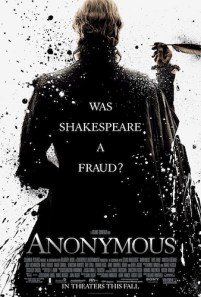 The director of Independence Day, The Day After Tomorrow, 2012, and other films which don’t imply a specific timeframe in their title, helms a film about Shakespeare? Oh yeah, that sounds like a good idea…
 which is what you should expect from the director of all those films I listed above but quite blatantly doesn’t sit right. And it’s over two hours long too, so it keeps going… and going…
 Battleship never sounded like a good idea. An adaptation of a board game that in no plausible way resembles real life? At least
  hobbling up a mountain on prosthetics to realise he’s still worth something as he saves the day. America, fuck yeah! And when the main battleship is ruined, our plucky heroes have no choice but to co-opt the museum piece (literally) WWII ship; and because most of their crew is dead, the museum guides — all of them septuagenarian WWII vets — have to man their ship once again. To defeat those invading scum, just like before!
 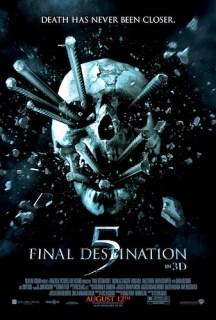 Final Destination 5 is the latest Final Destination film. Do you really need a plot description? They all have the same story.
 although on reflection it’s meaningless; a clever nod that isn’t really clever, but is neat. And perhaps means the series is finally going to rest.
 Bill Murray presumably needed some money, otherwise why else voice the titular food-loving sort-of-fourth-wall-breaking moggy in this juvenile adaptation of the long-running newspaper strip? Offering little in the way of laughs, the film’s main success is the cute (real) dog who co-stars as Garfield’s competriot, Odie. The real wonder is how they got him to interact with the CGI cat. Elsewhere, animals are live-action with CG mouths, giving an unsettled presentation of the film’s four-legged characters. Meanwhile, humans Breckin Meyer and Jennifer Love Hewitt engage in a charmless romantic subplot. Oddly, one for dog lovers (with fast-forward to hand) only.
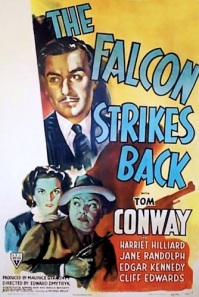 Directed by Edward Dmytryk (who, a couple of years later, would helm
  His eye for the ladies remains the same, although Conway feels a bit slicker and less whipped. Neither carry the same charisma as Sanders’ Saint.
 It’s funny what movies sometimes pique your interest. I saw a trailer for relationship drama Love and Other Impossible Pursuits (or, as it was retitled in America, The Other Woman) on some completely unrelated US Blu-ray earlier this year (I forget which film it was, but the only connection was the disc’s distribution company) and wondered why I’d never heard of it before — after all, it looked like a Worthy Drama, starring Oscar Winner Natalie Portman and Lisa Kudrow From
  As I was brought to the film by its trailer, it pays to say it’s actually very different. The advert hides the baby’s death but hints at it, as if it’s a Big Reveal they clumsily didn’t want to give away. But no, it’s brought up within the first five or so minutes and actually drives a lot of the film. The emphasised “other woman” facet is present, though in a slightly different way to normal: this is how such relationships continue as a long-term status quo, rather than the immediate impact of an affair.
 I can imagine that flashback working within the shape of a novel, where structure works differently. Indeed, I got the impression the book is probably very novelistic; maybe a character study, even. Those are two things that don’t always transfer well to film. I don’t think it’s about Being The Other Woman, despite the US title; nor do I think it’s about Being The Stepmother; nor is it about Losing A Baby. Those things are all in there, certainly, but rather than any of them be The Story, they’re elements in the exploration of the character of Emilia. I’m not sure that works for a movie; not for this one at any rate.
 Samuel L. Jackson and Tommy Lee Jones star in this military courtroom thriller from the director of
  That’s not all that’s bungled. There’s numerous instances of awkward editing by Augie Hess; a screenplay from Stephen Gaghan that clearly wants to be
  Conan was created by Robert E. Howard in 1932, but is probably best known to most thanks to
  or the filmmakers ignored his work in favour of familiar bits and bobs from other sources. Visually it’s just as non-inventive, which is what you get when you hire the director of
 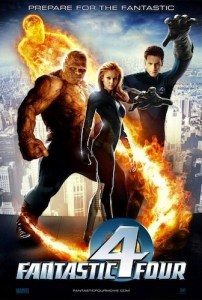 In the wake of highly successful franchise launches for
  which
which  100Films.co.uk