Babel (2006)

2009 #41
Alejandro González Iñárritu | 138 mins | TV (HD) | 15 / R

BabelMulti Oscar nominated and one of Ebert’s Great Movies, Babel is one of those films that comes with a lot of expectation riding on it. The fact that the only Iñárritu film I’ve previously seen is 21 Grams, which I thought was distinctly overrated, takes the shine off those expectations. Probably for the best.

The quickest way to assess Babel is to say that it is about something — or, About Something. The plots, such as they are, aren’t really the point; nor is how they connect, or what chronology they actually occurred in — this isn’t a Memento or a Rashomon, a narrative in odd pieces designed to be reconstructed by the viewer. Naturally, because it is About Something, the Something it is About isn’t made blindingly clear, though there are many contenders — loneliness, miscommunication, culture clashes, the ripple effect, children, and on. Perhaps this means it isn’t as focused as it could (or should?) be; perhaps Iñárritu revels in ambiguity, which isn’t necessarily a problem.

On a relatively surface level, then: the Japanese story barely connects to the others, which are all more directly woven together. Even if their connectedness isn’t the point, when the others are so clearly and directly related it leaves the Japanese thread feeling the odd one out, almost tacked on to the others. It’s probably a coincidence that it’s also the film’s best story, containing about as much incident and interest as the other three put together.

The central character in that particular thread is portrayed by Rinko Kikuchi, who justly earnt a Best Supporting Actress Oscar nomination for her work. The film’s only other Oscar acting nomination went to Adriana Barraza, in the same category, for her role as a Mexican nanny. Again, a deserved nod, as these are easily the two most compelling performances in Babel. (They lost to Jennifer Hudson in Dreamgirls. I’ve not seen Dreamgirls, but as the other nominees were Abigail Breslin (for Little Miss Sunshine) and Cate Blanchett (for Notes on a Scandal), I’m willing to bet she was the least deserving of all five.)

If the Japanese thread is the best then Brad Pitt and Cate Blanchett’s story is the weakest of the bunch, managing to underuse both those leads and a host of British talent too. The other two stories are equally slight, but at least muster up some genuine emotion.

Babel is the kind of film that it’s easy to overrate because, ooh, doesn’t it seem clever. Conversely, it’s easy to underrate because, ooh, doesn’t it seem pretentious. Naturally, therefore, I’m going to come down right in the middle (but note that the Japanese story on its lonesome would earn a 4).

3 out of 5

Dark Floors (2008)

2009 #26
Pete Riski | 82 mins | DVD | 15 / R

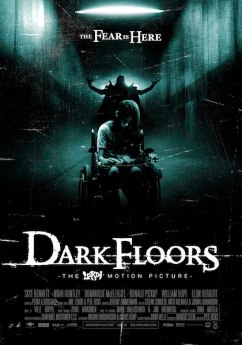
Dark FloorsYou may remember Lordi, the surprise winners of the 2006 Eurovision Song Contest. If that doesn’t help, they were the Finnish rockers all dressed up in monster suits. Here in the UK we gave them our highest number of points.

You’d be easily forgiven if you had forgotten them, but clearly someone hasn’t as they not only made this film, someone thought they were big enough to use in its promotion — it’s subtitled “The Lordi Movie” on posters, DVD covers and what have you. Maybe they’re still well-known in Europe. Or Finland. Yet despite the country of origin, Dark Floors is in English, with a predominantly British cast, and it appears to be set in America. On top of which, it has a surprising level of glossiness (albeit glossy gloominess) that, if you didn’t know better, would suggest a moderately budgeted US horror flick. Apart from the monster costumes.

In fact, expectations are gratifyingly knocked down at every turn. Riski’s direction and the cinematography are very slick, though some of the action/horror sequences lack much tension — the film effectively builds tension for these sequences, but rarely, if ever, delivers genuine scares on the back of it. While this isn’t always a bad thing, one begins to learn the tension being built isn’t likely to lead anywhere, robbing it of much impact. Effects, music and sound design also lend the project a higher budget feel than initial impressions suggest. As mentioned, Lordi’s costumes are the weakest bit, neutered either by familiarity — there’s no chance of genuine shock value if you recognise them from brightly-lit TV performances — or quite simply not having been designed for this kind of scrutiny or story. Riski does his best, hiding them with lighting, angles and special effects, but it’s not perfect.

Monsters aside, performances are pretty good. No one is outstanding but equally there’s nothing glaringly awful, always a plus for B-movie-level horror. At times the characters seem to accept the bizarre events that are occurring with too little reaction, though in fairness this is partly the fault of the script. What the latter occasionally lacks in believability (within a fantasy/horror context, obviously) it makes up for in efficiency. Admittedly this also means the whole cast are stereotypes, but it’s the world they find themselves in that’s of more interest.

Indeed, Dark Floors features more intriguing mysteries than it can keep a handle on, merrily setting them in motion but ultimately failing to pay many off. It’s packed with interesting imagery and good ideas, many of which aren’t hammered home, but equally many are never explained — key among these being… well, The Whole Thing. The final scenes seem to suggest there is some meaning, but it never comes close to a clear revelation. Having read around, it’s clear that it can be interpreted multiple ways (one of my favourites references an old Finnish children’s song), and so perhaps the makers are after a Cube vibe. Despite some surface similarities to that film’s awful first sequel, the overall effect thankfully sways closer to the original.

Some have called Dark Floors boring, but I think this is again a case of misaligned expectations — I found it never less than well-made and thought-provoking. There are undoubtedly weak spots, yet you’ll find weaker in plenty of major movies. That doesn’t excuse the flaws, but it shouldn’t be written off as a meritless B-movie because of them. One can’t help but think the project would have been better received if it hadn’t been conceived by and starred a slightly camp Finnish rock band who are never seen out of their monster costumes. It is, I feel, one of many cases where if you changed the credits to name certain other directors it might be beloved and endlessly debated by a certain sector of film fans rather than dismissed as “a glam rock band trying to be deep”.

It may even provide greater rewards on repeat viewings, especially if one wants to decipher the ending, because of its circular storytelling. Some elements of this are clear immediately (when Ben shoots up the stairwell, for example), others half-clear (it treats the audience with an above-average degree of intelligence in this respect), while other bits may only make sense (if they do, that is) with another viewing and/or some interpretation. Tobias and Sarah spend a lot of time repeating things or saying things out of context, for one — might these find a greater meaning second time through?

In a similar vein, I can’t help but wonder if in trying to be quite clever Dark Floors ultimately alienates the core horror audience who might pick it up; the people who’ll miss their straightforward scares and gratuitous gore and nudity. By so obviously billing it as “The Lordi Movie” and slapping on quite a lurid cover, the marketers have done nothing to suggest the film might actually benefit from the application of some brain power. True, this same problem can be alleged of the film itself — it’s only a horror film after all, and with somewhat ludicrous monster costumes at that — but I can’t help but wonder what might lurk within if people chose to look past these unfortunate style choices.

Naturally the counter argument goes that there’s not actually anything there, it’s just pretending there is instead of having a proper plot. I’m not certain which to believe.

Ultimately, an appreciation of Dark Floors comes down to its ending. The whole film is stylishly made — surprisingly so in fact — but there are no concrete explanations for what happened during it. If you like ambiguous endings there may be enjoyment in that very fact — and there are certainly plenty of theories floating around the ‘net for the interested to explore — but if you require your entertainment neatly wrapped up, I’m prepared to guarantee you’ll hate it. If, on another hand, you don’t care about the plot of your horror film as long as it’s scary… well, that all depends on your horror threshold, but if you’re a hardened horror fanatic I don’t imagine there are many chills to be had here.

I’m not entirely sure what to make of Dark Floors in the end, but err on the side of generosity because it’s well-made and has left me thinking — something I certainly never expected.

4 out of 5

La Antena (2007)

aka The Aerial

2009 #10
Esteban Sapir | 95 mins | TV | PG

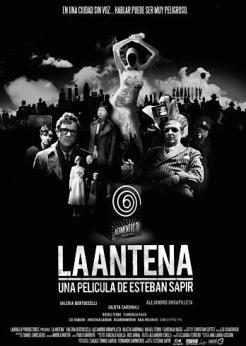
La AntenaLa Antena is a Silent Film. And by that I mean there is no dialogue, though there is music, and it’s in black and white with low-budget (looking, at least) effects, though it was made in the 21st Century — but it is entirely in the style of those films made in the era before sound was technically possible. It could sit comfortably alongside ‘real’ silent films to the extent that the uninitiated might reasonably be fooled into believing it was one.

In some respects this is neither here nor there, though it will undoubtedly put some viewers off. For those with a more open mind or who are fans of silent movies, however, it’s a joy. This is mainly because it’s incredibly imaginative, especially with its visuals, which are often pleasantly barmy. The setting is a dystopian future (or alternate reality) where people can no longer speak (thus justifying the silent film styling), and this world is wonderfully realised without a hint of realism or awkward attempts to explain why things are the way they are. These days it’s a rare filmmaker who doesn’t feel the need to explain everything and make it fit in relation to our world, but Sapir is one of the few who trusts us to accept what’s going on — much as the great silent film directors did.

Sadly it isn’t flawless. Some elements of the plot get forgotten as things roll on (what happened to Mr TV’s son, for example?), perhaps a victim of the 50 minutes of cuts they chose to make for pace. Most of the symbolism is also fairly heavy handed, though one could argue that’s in keeping with the style, and at least means it’s all nicely noticeable. Even then a few bits are unavoidably leaden — particularly, the use of the swastika and Star of David felt uncomfortably irreverent to me.

Ratings-wise, La Antena is borderline — the sort of film I give four stars to now but then beats most five-star films to a high place on my year-end top ten (like The Prestige or Hellboy II or the five others that have done it). In which case it seems only fair to run the risk of awarding it full marks.

5 out of 5

Oscar-winning modern silent movie The Artist is on BBC Two tonight, Saturday 24th January 2015, at 10pm, and is reviewed here.

Russian Ark (2002)

aka Russkiy Kovcheg

2008 #98
Alexander Sokurov | 96 mins | DVD | U

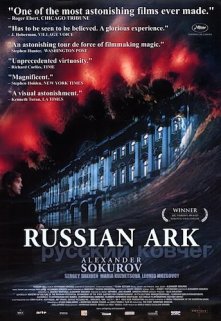
Russian ArkRussian Ark has received boundless praise from some quarters, and not just for being shot in a recording-smashing single take — to cite one review in particular, “anyone with an eye for beauty, a yearning for the past or a passion for pure cinema is going to be spellbound.”

Apparently some sort of artistic documentary on the history of Russia, told via a fantastical time-travelling-ish tour of a Russian museum, Russian Ark is certainly ‘artistic’. Unfortunately, it doesn’t teach you much and is at no point clear about what it’s covering. Perhaps a more detailed knowledge of Russian history would lend some meaning to the tableaus that are half-glimpsed as the Steadicam drifts by, though it spends as much time meandering down empty corridors in search of something to film as it does actually showing anything. When it does alight on something, the staging is occasionally spectacular, especially considering the self-imposed technical restrictions, but I gained little from this alone.

I freely admit this may say more about me than the film itself, but the most interesting parts were when the character whose point-of-view we inhabit and the French historian he encounters begin to discuss something that almost (almost) resembles a plot — how did they get there, how can the Frenchman speak Russian, can others see them, and so on. Sokurov merrily raises all these questions, in the process throwing a sci-fi dimension into his artistic-documentary-fantasy, but are there any answers offered? No, of course not — that’s not the point. Which does rather make you wonder why they’re vocalised at all…

Watching Russian Ark is a little like doing what the nominal lead characters do: wander aimlessly around an unfamiliar museum without any guide to what they see. Undoubtedly impressive, and worth seeing for the audacity of the single take, but I, unlike others, was far from spellbound.

2 out of 5

(Originally posted on 30th January 2009.)

The Cube Trilogy

Introduction

I watched the entire Cube trilogy in one night — boy was it a long’un.

“Three ninety minute films?”, some of you might think, “I’ve seen single films longer than that!” Yes indeed, this is true, and I’ve watched all of the extended Lord of the Rings in one day — but those are good, and the Cube sequels just aren’t.

Anyway, I’ve posted all three reviews at once — partly because things are lagging review-wise here and I want to get a wriggle on (17 days ’til 2009!) — and so here is a little summary of the trilogy, with a brief note on my thoughts on it as a whole at the end.

This is probably obvious, but in case not: click on each film’s title for the full review.


#83a
Cube
1997 | Vincenzo Natali | 87 mins | DVD | 15 / R

Cube manages to effectively juggle gruesome horror deaths, sci-fi mysteries, an awful lot of maths, and character-based drama. It’s a brilliant, low-budget, understated film [that] everyone interested in the more intelligent end of the sci-fi spectrum should see.”

5 out of 5


#84
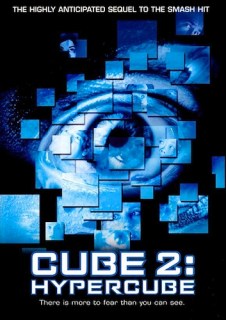
Cube²: Hypercube
2002 | Andrzej Sekula | 90 mins | DVD | 15 / R

“The new cube set is bigger, shinier, simpler, emptier, always one plain colour, and devoid of traps. Consequently, but perhaps inadvertently, it seems to symbolise the film itself… Hypercube feels like expensive tosh based on a faux-intellectual idea.”

2 out of 5


#85
Cube Zero
2004 | Ernie Barbarash | 93 mins | DVD | 15 / R

“an entirely different setup: the people who observe the cube!… until one of them goes inside, and then we’re right back in familiar territory… Derivative and, worst of all, quite irritating.”

2 out of 5


Final Thoughts

I first saw Cube many years ago, certainly before it had any sequels, and have always thought it excellent. I picked up the trilogy DVD set a few years back, despite hearing advice that went, roughly, “never ever watch the sequels. Ever.” My God was that good advice.

The first remains a masterpiece, provided you can ignore the two sequels and their weak additions to the mythos. Try to integrate all three into the same fictional universe and you’re just going to wreck much of what’s great about the original. Watch that, love that, and pretend that was all there ever was.

Cube Zero (2004)

2008 #85
Ernie Barbarash | 93 mins | DVD | 15 / R

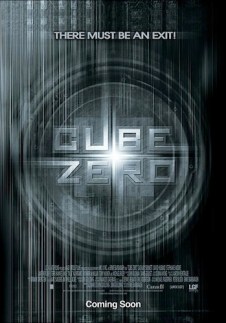
Cube ZeroI presume, from the title, that Cube Zero is meant to be one of them prequel things, going back before the original film to reveal more of the backstory and answer questions that probably didn’t need answering. It does some of this — there are unwelcome answers and an ending that explicitly links back round to the first film — but undermines it by apparently being set in some fantasy-future retro-industrial universe that doesn’t gel with the everydayness of the preceding entries. This design work is almost nice, reminiscent of films such as Brazil, The City of Lost Children, and even Blade Runner; but it’s all on a direct-to-DVD scale that feels oddly familiar from things I’m sure I haven’t seen. Derivative? Yes indeed.

One thing it isn’t especially derivative of — initially, anyway — is its two prequels. After the requisite gory opening, the camera pulls back to reveal an entirely different setup: the people who observe the cube! Except they’re still a small group (just two), confined to one room, with no idea about the people behind all this. They are, very literally, only one step removed… until one of them goes inside, and then we’re right back in familiar territory, except with an added outside perspective that sinks to new depths so low I don’t even want to explain them.

In the cube itself, we have the most gory deaths yet. Barbarash — here adding “director” to his list of crimes after producing and co-writing Cube² — lingers on the gruesome details, seeming to make the series bridge the gap between relatively old-style horror films and the new trend for sickening weirdness that Saw would kick off the same year. I’m sure gore-hounds will love it but, for me, Cube was never about how vile the deaths could be.

You have to admire them (albeit begrudgingly) for trying to do something different with the concept and give it some fresh spins. But, as ever, the series didn’t need those additions, and consequently it doesn’t need this sequel. It answers too many questions, which might be acceptable if the answers were remotely original or satisfying, but, of course, they aren’t: they’re derivative and, worst of all, quite irritating.

And that goes for the film too.

2 out of 5

For a brief overview of the Cube trilogy, please look here.

Cube Zero featured on my list of The Five Worst Films I Saw in 2008, which can be read in full here.

Cube²: Hypercube (2002)

2008 #84
Andrzej Sekula | 90 mins | DVD | 15 / R

Cube²: HypercubeThe new cube set is bigger, shinier, simpler, emptier, always one plain colour, and devoid of traps. Consequently, but perhaps inadvertently, it seems to symbolise the film itself.

Despite this simplified set, the concept behind the new cube — or ‘hypercube’, so we’re told — and the plot that results from it is incredibly complex. In fact, it seems to be too complex for the writers to grasp, so the viewer doesn’t stand a chance. It’s not the only overdone element either: Sekula’s direction is frequently as inappropriately elaborate as possible, twisting the camera round for no reason other than some misguided attempt at (inaccurately) conveying this cube’s mixed gravity. He also feels the need to illustrate characters’ backstories, something the original left to the dialogue, which is probably because the ragtag selection of flat stereotypes here are far more generic than the lot in the first film.

And there’s loads of them too, though it’s hard to tell if this is to cover for them all being one-dimensional, or a transparent attempt to keep things moving by constantly chucking more people into the mix. As if to underline the point, several are cloned from the first film, but with much weaker acting, and almost none of them are granted a plot thread that actually gets resolved. In fact, nearly every character is entirely pointless. Eventually some of them do get killed off, but every death is too reliant on some middling CGI and abstract ideas. Not a single one is as properly inventive or scary as those found in the original.

Hypercube should at least be applauded for trying something new, when it might have been easier to bung a new group of people into the same cube and come up with new ways of killing them or new puzzles to solve. It dives further into SF territory, dragging in parallel universes and varying timelines, and largely avoids rehashing the first film’s mysteries. In fact, it more picks up where that left off, drawing out questions and providing some answers about the reasons for, origins of, and people behind the cube. Unfortunately, these questions don’t need re-posing and the answers certainly aren’t required. Like other elements of the first film not carried over — the clever deaths, the claustrophobia — it’s nice that they’ve not been duplicated, but equally they didn’t need changing, expanding or explaining.

Even worse, the writers seem to have spent more time mulling over the behind-the-scenes complexities of constructing the cube — and put in all their characters and ideas about this — and not enough time actually crafting a plot. The more the clock ticks by the more obvious this becomes, to the extent that they don’t even seem to have an ending. What minimal logic there was is thrown out the window in favour of some crazy different-timeline horror that barely resolves anything and certainly cops out of almost everything.

Where the original Cube felt like the smart little sci-fi indie it was, Hypercube feels like expensive tosh based on a faux-intellectual idea. Much of the original’s brilliance lay in its simplicity, but the sequel is more complex from the off — and not in a way that rewards the attentive viewer, or even in a way the writers seem to understand. Bigger and shinier, but simpler and emptier, it’s consequently less engaging, less interesting, and far less enjoyable.

2 out of 5

For a brief overview of the Cube trilogy, please look here.

Cube²: Hypercube featured on my list of The Five Worst Films I Saw in 2008, which can be read in full here.

Cube (1997)

2008 #83a
Vincenzo Natali | 87 mins | DVD | 15 / R

CubeI’ve seen Cube a couple of times before, but, as I’ve watched it again immediately before taking on the two heavily-criticised sequels, I thought it might be worth throwing in my opinion on the original too.

Cube has a deceptively simple concept — a sci-fi/horror/mystery in which six strangers are trapped together trying to escape a series of cube-shaped rooms, some of which contain deadly traps — but within that it pulls a lot together. The major element, arguably, is the mystery of what the cube is — where is it, who built it, how does it work, why are those people there, is there a way out? Some of these questions are answered but, crucially, not all of them, and it’s partly due to this, ironically, that it’s a satisfying experience. In its series of careful, measured, necessary reveals, the film strikes a perfect balance between what it lets the viewer know — and the revelations are expertly paced throughout — and what it keeps hidden, either for the viewer to deduce or interpret for themselves, or simply because one doesn’t need to know.

Within the cube and its mystery there are the characters. Depending on your point of view they’re either well-drawn sketches interacting realistically in an unrealistic situation, or archetypes representing different facets of humanity, or simply chess pieces to move the clever construction — of both plot and setting — forward. At times the movie does work like a slasher-horror, picking off characters one by one, but after a few grisly deaths it rather transcends that. The scenes where characters debate and argue aren’t quite as engrossing as when they’re puzzling over the cube, but nor do they drag. Not all the performances are good — Maurice Dean Wint in particular lets the side down for much of the film — but the character arcs are never less than believable and well considered.

Cube manages to effectively juggle gruesome horror deaths, sci-fi mysteries, an awful lot of maths (don’t worry, you don’t need to understand it) and character-based drama. It’s a brilliant low-budget (not that it shows) understated film, which seems to have been somewhat forgotten these days, probably under the weight of the two widely derided and unnecessary follow-ups. But that remains for me to see. Whatever they may be like, everyone interested in the more intelligent end of the sci-fi spectrum should see Cube.

5 out of 5

For a brief overview of the Cube trilogy, please look here.

Fist of Legend (1994)

aka Jing wu ying xiong

2008 #77
Gordon Chan | 99 mins | TV | 18 / R

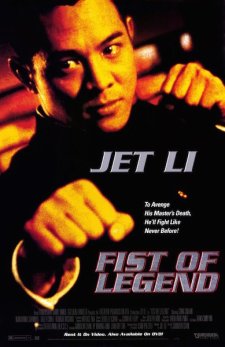
Fist of LegendI found myself watching Fist of Legend unintentionally following this year’s Children in Need appeal. The significance of this piece of trivia is that I watched it on TV, which means I had to watch it dubbed. Apparently, “it is regarded as one of the best martial arts films of all time, and almost universally viewed as Jet Li’s best” (thank you Wikipedia), but the dub does its utmost to obscure this.

Putting the audio aside (for the moment), the film has a lot to recommend it — primarily, the fights. At 2am, after seven hours of near-solid TV watching, it was these that drew me in. I’m no expert on martial arts, but I do like a good fight (on film) and Fist of Legend serves up plenty of those. In fact, there’s approximately one every five minutes, an impressively high ratio that consciously — and very pleasingly — fulfills what you want from this kind of film. This quantity doesn’t seem to have damaged quality either: all are generally impressive, but there are some particularly good ideas floating about too, such as a long fight where both participants are blindfolded.

There’s a plot too, which includes a few surprisingly surprising twists and an interesting undercurrent of Japanese/Chinese racial tensions thanks to the setting (1937, during a Japanese occupation of Shanghai). This adds an extra level to what could otherwise be a stock revenge plot.

So, that just leaves the soundtrack. The English audio is at least as bad as you’d imagine, and a reminder — if one were needed — about why dubbing foreign language films is so hated. Whatever the qualities of the film itself, the clichéd dub script and flat voiceover performances, awkwardly delivered to fit the actor’s mouth movements, make the film look cheap and poorly done. On the bright side, the main villain has an amusingly gravelly “I am playing a villain!” voice.

If you can look past the rubbish dub (which I should imagine is even easier on DVD, what with turning it off), Fist of Legend is very enjoyable. However, with the action being the primary source of pleasure, those who don’t like martial arts movies may want to imagine a lower score.

4 out of 5

The Diving Bell and the Butterfly (2007)

2008 #69
Julian Schnabel | 112 mins | download | 12A / PG-13
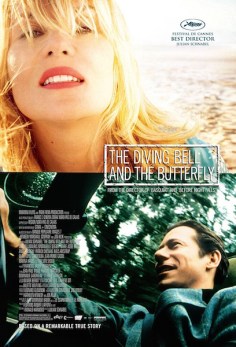
The Diving Bell and the ButterflyLe Scaphandre et le Papillon, as it’s titled in its original French, has until now been on my (unwritten) ‘List of Films to Avoid’, alongside the likes of Ichi the Killer, Hostel, Caligula, and Salo. Strange company for an Oscar-nominated drama I know, but whereas those others have visceral horror that I have no real desire to deal with, the situation of Diving Bell’s central character, Jean-Dominique Bauby, which is exacerbated by it being a true story, seemed too horrendous to bear. In a similar way to how one might struggle to think about death if one doesn’t believe in an afterlife, the idea of being paralysed but for one eye is an almost unimaginably tortuous fate. Nonetheless, in the wake of a huge amount of praise — and in the name of finding a film starring Mathieu Amalric for My Quantum of Solace Film Season — I resolved myself and hoped for the best.

The most striking thing about the film is that, for about the first 40 minutes, it takes place almost entirely within the head of Jean-Do, as Bauby is affectionately known. From the opening shot we literally see through his his eyes, blurry and limited as that is, and hear his thoughts, which brings us a lot closer to him than any character in the film can be as we soon realise he can’t speak. During this first third the film only ventures outside Jean-Do’s immediate vision for memories or imaginings — although the viewer might perceive them as breaks from the prison of his mind due to the change in imagery, we’re actually still stuck inside his head, just as he is. One begins to wonder if the whole film will be told this way, or, if it does break free, how Schnabel and writer Ronald Harwood are going to find a cinematically plausible way to achieve this after so long. (Pleasingly, when do they it doesn’t feel like a contrivance.)

Jean-Do’s situation is obviously far from everyday, so this device makes for a highly effective — and, indeed, affective — form of identification. As we can see all he sees and hear all he hears, and as he can’t feel anything, we’re being given access to his entire sensory experience and, through his voice over, we even have access to his thoughts. (I say “his entire sensory experience” — it’s never mentioned whether he can taste or smell; but as his paralysed mouth means he’s unable to eat I presume the former isn’t much of a consideration at least.) This style also creates some exceptionally uncomfortable moments, such as when Jean-Do’s right eye has to be sewn up so as it doesn’t dry out, even though it still works at the time. As we see from his vision, we see the eyelid being half-closed and the needle pushing through as if it were our own. Again, it brings the viewer a lot closer to his experience than watching the act objectively from a third-person perspective would.

It’s not just the effect on Jean-Do that we’re privy to, however. As the story progresses we encounter his family: an estranged wife, three children, a mistress, and a house-bound father. The pain these relatives feel is both varied and palpable, as is the added pain for Jean-Do. He can’t play with his kids, or even really communicate with them, and his mistress is too afraid to visit — in one scene, his disability means they have to communicate uncomfortably through his wife. Arguably most affecting of all is his father. Played by Max von Sydow, the couple of scenes featuring him are beautifully understated in both direction and performance, but it’s their attempt at a phone conversation, using only the awkward blinking system developed by Jean-Do’s speech therapist, that is absolutely heartbreaking.

Incidentally, the scenes where Jean-Do uses this method — which, put simply, involves him choosing one letter at a time — are quite odd to watch for an English viewer. Obviously the word is being spelt in French, but the subtitles unsurprisingly spell the word in English. It’s the only sensible way to convey the point, but it makes for an especially odd disjunct between original dialogue and the subtitle translation. It’s not so much a flaw as something that distracted me at times, but I can’t come up with a better solution.

As Jean-Do, Amalric is required to give a rather unusual performance — not just because he’s stuck with only the use of one eye, but because for much of the film Jean-Do is omnipresent while Amalric is nowhere to be seen. This in-his-head style means that the direction, cinematography, editing and sound design are as much part of the character as the work Amalric does. He rarely actually narrates anything — it’s sort of a half voiceover, with snippets of thoughts and the like. That said, it’s to the credit of his work with this slight material, and to those on the technical side, that when he does actually appear on screen it doesn’t seem unusual or disconnected.

I’m not sure where I got the notion that The Diving Bell and the Butterfly would be truly excruciating to watch, but, as anyone who has seen the film will surely be aware, it isn’t. Schnabel and Harwood employ a variety of techniques to make you understand the real-life horror of Jean-Do’s situation, but these don’t tip the film into sensationalism or terror. In fact, despite the measures taken to enable the viewer to identify with Jean-Do and make his a very personal drama, I found it was primarily interesting on a documentary level — understanding the hard, slow, awkward processes of recovery (as much as he can) and coping (to a degree); how it might feel to be in that situation, or stuck in similar aspects of human experience, such as in the visit from a former Beirut hostage.

In fact, if the film had a message it would surely be, “live every day as if it’s your last”. That might sound a bit corny — something which I certainly wouldn’t accuse the film of being — but it’s never been presented so starkly. Never mind dying, thereby having no chance to realise what you didn’t do — Jean-Do is a prisoner, tortured with all the things he never did or didn’t do enough, and the knowledge that he will never be able to do them again.

4 out of 5