Sumurun (1920)

aka One Arabian Night

2010 #7
Ernst Lubitsch | 104 mins | DVD | PG

SumurunSumurun seems completely different to any film yet seen in the Berlin box set, yet this is more in line with the style of film that would ultimately lead Lubitsch to Hollywood.

As the alternate title would suggest, this is primarily an Arabian Nights-style drama… but, while on the surface this looks entirely at odds with Lubitsch’s previous comedy work, it actually concerns itself with the same topic: romance, and the various entanglements and complications that lead to it. What’s different here is that instead of being wholly comic it’s often deadly serious (literally, as it turns out), and instead of one simple girl-meets-boy trajectory (as in the preceding three films) there’s two girls and four boys between them, in various combinations. It’s a many-stranded, relatively complex narrative: there’s a group of travelling minstrels, an old sheikh, a young sheikh, a cloth merchant, a bevy of harem girls — all of whom are connected and interact in varying ways with varying objectives, though most are related to love — or lust.

The change in style is no bad thing. Lubitsch was clearly versatile, turning his hand well to this type of storytelling. His comedies are all based around romance, one way or another, and so treating the subject with a little more seriousness seems no great leap. He keeps control of the plot, despite the numerous strands and complexities, and his comedy background allows the tropes of farce to be employed in furthering the story. His previous use of fantastical realms, like the dolls’ world of Die Puppe, aids a succinct establishment of Lubitsch’s version of Arabia and its specific rules. Indeed, with its fantastical setting and shortage of character names (only Sumurun, Nur al Din and his two slaves — Muffti and Puffti — are known by more than their title, job description or physical impairment), Sumurun may be as much of a parable as some of the comedies.

And still, comedy creeps in round the edges. Lubitsch is arguably showing restraint by not letting every sequence descend into it, but there is a fair amount of wit and humour lurking throughout. It’s mostly applied wisely though, furthering character, story or both: the ugly hunchback who smiles at a child only to make him cry; the harem girls giving their eunuch guardians the runaround (multiple times); the two wannabe-thieves accidentally stealing a pretend-dead body and desperately trying to hide or dispose of it — the last a subplot which ultimately plays a key part in the climax.

What’s a little unclear is why it should be called Sumurun. Perhaps it’s no more than a vestige from the source, because while the titular harem girl is quite significant, she’s no more so than several other characters. Pola Negri’s namless dancer in particular seems more central to the narrative — indeed, she connects most of the disparate groups and plot strands; certainly more of them (and more significantly) than anyone else. But then, Sumurun survives to the end, and — along with her man, Nur al Din the cloth merchant — is the purest, most righteous, most deserving of all the main characters. Conversely, all the ‘bad’ (and, as noted, nameless) characters meet their end: the sheikhs are both fickle, and the old sheikh clearly a nasty piece of work; the dancer is flirty and adulterous; the hunchback, however, is devoted to her, and his tragedy effectively balances the “and they all lived happily ever after” of the freed harem girls and Sumurun and Nur al Din finally getting each other. If this is a parable, there’s quite a clear message about fidelity.

Sumurun may lack the straightforward fun of Lubitsch’s comedies, but by creating a complex and engrossing Arabian epic he entertainingly demonstrates that there was more to him than just the talented comedian.

4 out of 5

Read more reviews from Lubitsch in Berlin here.

Die Austernprinzessin (1919)

aka The Oyster Princess / My Lady Margarine

2010 #6
Ernst Lubitsch | 61 mins | DVD | PG

Die AusternprinzessinDie Austernprinzessin seems to be one of, if not the, most respected and/or beloved of Lubitsch’s early films. It makes They Shoot Pictures, Don’t They?’s Doubling the Canon list, something no other film in this box set has managed (nor, I should clarify, are any on the main list); it’s the only one to make IMDb’s top films of the 1910s; and it has some Proper critical backing too (more on that later). But personally, it’s my least favourite Lubitsch so far.

Which isn’t to say it’s bad — far from it. Set in America, it’s packed with displays of ostentatious wealth: the titular ‘princess’ (played by Lubitsch muse Ossi Oswalda), actually the daughter of an oyster-selling businessman, lives in a huge palace of a home; the family has hundreds of servants to do everything, to a ridiculous degree; and there’s a pervasive “must have more” culture splashed across it. This isn’t praised though, as you might expect from a contemporaneous US film (or most US films, really), but is instead a satire/pisstake. It must have been particularly effective/galling in a Germany heading into severe post-war Depression.

To support his theme, Lubitsch stages numerous epic set pieces on gigantic sets: Ossi’s bath, where a stream of maids carry her to and fro, wash and dry her; a huge cast of choreographed waiters, kitchen staff and guests at the wedding dinner; a mad foxtrot sequence that follows it; or the ladies’ boxing match, where for the third time in as many films Lubitsch shows a gaggle of women fighting over a man. The foxtrot sequence seems the most praised of these, though I wasn’t sold — other sequences here are better staged with greater comic impact. The supple, enthusiastic band leader was quite entertaining though.

Occasionally, however, one feels the size of these sequences may have distracted the director from the task of making his film funny. Not that it isn’t or that these aren’t — Lubitsch still exploits almost every chance for a gag — but there’s sometimes the suspicion that the logistics of staging such big sequences, and so many of them, have derailed him from the primary goal. By extension, the story often feels like a series of sketches (even more so than the previous two films), with several — Ossi’s instruction in how to bathe a baby, for example — seeming wholly extraneous and not always hitting home as well as one might’ve liked.

Similarly (though, it may just be my imagination), Oswalda’s skill gets a little lost among all the hullabaloo. She rarely has a chance to display the comedic and romantic charm she showed so beautifully in Ich möchte kein Mann sein and Die Puppe, although a couple of scenes allow her to let loose. She’s part of the ensemble much of the time, little more than a prop at others (the bath sequence, for example). Obviously, the film doesn’t have to focus on her, and the rest of the cast entertain — in particular a heavily made-up Victor Janson as the consistently bored oyster entrepreneur — but having seen her abilities so well displayed in the preceding films, they feel slightly underused here.

But, as I say, maybe I imagined it; and perhaps I’m holding Die Austernprinzessin to unfeasibly high standards, buoyed by the success of the previous films and the aforementioned critical standing? I haven’t even mentioned all the plus-points, like some excellent individual gags — a drive-in wedding! — and a great score on this edition (sadly uncredited, as far as I can see).

Speaking of this particular release, Ignatiy Vishnevetsky again pens the essay that accompanies the film, ending it with quite a nice analogy about food and restaurants and stuff — I won’t spoil it for those yet to read it. In fact, the main reason I even mention it is to cite that Sight & Sound review I mentioned, which asserts that Vishnevetsky’s essays “seem designed merely to show off his range — very pseud’s corner”. Not a point I’d necessarily disagree with, but it does feel a little rich coming from Sight & Sound, the magazine that (for one handy example culled from the same issue) can produce a list of the 30 “most significant” films of the last decade in which I’ve not even heard of half the selections.

And the reviewer also calls Die Austernprinzessin Lubitsch’s “earliest masterpiece”, which obviously I’m going to disagree with. I’ll stick to playing with dolls, thanks.

4 out of 5

Read more reviews from Lubitsch in Berlin here.

Silent Week – #1: Lubitsch in Berlin

The idea behind Silent Week is simple: the films are silent, the blog is anything but.

Oh, that sounds like a cheesy marketing line that ITV would use (not that ITV would ever go anywhere near a silent film). Sorry. But still, the idea runs more or less thusly: I watch a silent film one day, I post a review of it the next (well, that was the idea…) That doesn’t necessarily mean seven films, but enough to justify it being a Week rather than, I dunno, a Weekend. However, as it’s turned out (at least for this inaugural entry), I watched (almost) all the films last week and intend to post all the reviews this week.

Why silent films? Because I’ve noticed I own quite a few that I haven’t seen. I could probably do the same thing with anime, or film noir, or Asian action movies, or any number of other such genres/categories, but silents attracted my attention for now.

The initial idea (that again…) had been to start with a random selection of the silents I own, but then I got the new Masters of Cinema Lubitsch in Berlin set a week in advance of its release (which, incidentally, is tomorrow) — I always love it when that happens, especially as it inspires me to actually watch stuff right away. And this set has seven films — what could be more perfect for a Silent Week? (OK, one film immediately breaks the rules by not being silent, but as it’s a documentary about silents I rule it eligible.)

As if to cement this more themed approach, as I listed the silents I own they began to fall into categories — Hitchcock, Chaplin, Murnau & Lang, plus the Feuillade serials Fantômas and Les Vampires. I could muddle these up into more random weeks, or go chronologically across them all, but why bother? As I’ve got through Lubitsch in Berlin OK (well, almost) I’ll try again sometime soon with another of these themes, and continue that way… until I run out and have a grab bag of remaining titles (currently: 4½).

I hasten to point out (he says, in paragraph six) that I’m no expert on silent cinema — these are all first-views, as per the rest of the blog, and informed by little more than that (the exception being DVDs with booklets, where there may be a bit more info at my disposal). Despite the lack of any specialism, it’s thanks primarily to a series of era-spanning degree modules with a filmic bent that I’ve found myself with enough of an interest in the silent era to accumulate a variety of films over the past few years… I just haven’t watched most of them, clearly.

But let’s bring things back on point: six films directed by Ernst Lubitsch, and one documentary about them. I begin today with reviews of the first two featured in the set:

2010 #4
Ich möchte kein Mann sein
aka I Wouldn’t Like to Be a Man
1918 | Ernst Lubitsch | 45 mins | DVD | PG

“Ossi Oswalda is obviously a skilled comedic actress, convincing as both a petulant tomboy and a boyish gent, capable of both drunken stumbling and coy giggling, by turns delightfully rebellious, sweetly put-upon and succinctly joyous. She’s even believable as a man (albeit a boyish one).”

4 out of 5

2010 #5
Die Puppe
aka The Doll
1919 | Ernst Lubitsch | 64 mins | DVD | PG

“It’s a constant array of delights, and nothing outstays its welcome; every sequence is mined for its full comic potential, but Lubitsch wisely moves on before it can become repetitive or stale.”

5 out of 5


Coming up: Die Austernprinzessin (aka The Oyster Princess), Sumurun (aka One Arabian Night), Anna Boleyn (aka Deception), Die Bergkatze (aka The Wildcat), and Ernst Lubitsch in Berlin: From Schönhauser Allee to Hollywood.

Die Puppe (1919)

aka The Doll

2010 #5
Ernst Lubitsch | 64 mins | DVD | PG

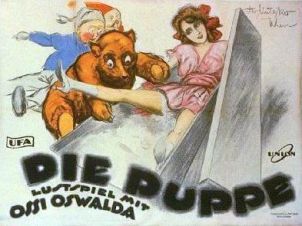
Die PuppeFrom the very start, Die Puppe sets out its stall (literally) as being something a bit special. The first sequence sees director Ernst Lubitsch himself unpack and assemble a doll’s house set and two dolls, which then become life-size and the dolls — now humans — the first characters we meet. It’s a neat framing device, a joke in itself, and some kind of early commentary on the role of a director.

From this point on, Die Puppe is a riot. Yes, some of it is distinctly old fashioned — an early chase scene, for example, sees Lancelot pursued by 40 desperate women, his mother, his uncle and the latter’s servant, back and forth and round in circles in a cartoonish fashion — and yet, even leaving aside allowances for it being 91 years old, there’s something wholly amiable about even these now-familiar proceedings.

And that’s just some of it, because Lubitsch doesn’t pass up any chance for a gag. Take the scene where Hilarius, the doll’s inventor, returns to his workshop to fetch the doll, who at that moment is actually his daughter in disguise. The point of the scene is conveyed — Hilarius accepts the deception. Except he also decides she needs more paint on her lips, which he dutifully applies. Or the pantomime horses that pull a carriage… but rather than ignore them, Lubitsch has the driver have to re-apply one’s tail. And so on. This constant expression of humour, working at every level from intellectual wit down to slapstick tomfoolery, means that even if one element has been done to death in the past near-century, there’ll be several other moments or scenes to compensate.

Even more so than in Ich möchte kein Mann sein, one could easily fill a whole review listing the great bits. Like when Lancelot is initially presented with an array of dolls, like a bizarre early-20th-century brothel with Autons for whores. Or the vulturous relatives, dividing up items while the Baron lies on his deathbed, and having the gall to accuse him of bad planning when they can’t decide who should have a vase that’s promptly broken. Or the broadly satirical monks with their ‘meagre’ meals, unwillingness to share, and incessant greed. And, in the vein of things-you-might-not-expect-from-this-era, there’s a great gag about an instruction manual. It’s a constant array of delights, and, also as in Ich möchte…, nothing outstays its welcome — every sequence is mined for its full comic potential, but Lubitsch wisely moves on before it can become repetitive or stale.

Lubitsch’s playfulness extends to the medium itself. He uses camera masks and wipes to focus on specific areas, breaking free of the 4:3 box to create different compositions, revealing parts of the frame on a delay, illustrating dream sequences, and more. There are ‘special effects’ that one could only achieve with a camera, like Hilarius’ hair changing colour, the balloon-flying sequence, a ghostly dream, and so on. And the irrepressibly cheeky young apprentice, played brilliantly by Gerhard Ritterband, routinely breaks the fourth wall to air his grievances to the audience.

And I haven’t even mentioned Ossi Oswalda, who gives another good comic turn as both the titular doll and her real-life inspiration. In his essay accompanying the Masters of Cinema edition, Ignatiy Vishnevetsky summarises her appeal (some of it, at any rate) so well that I may as well just quote from it: “Her comedy isn’t just funny to watch — it’s inviting, like a friend who cracks a joke and then asks you to tell one too. She begs a like-minded idiocy from the audience.” It is, I think, a point that’s even more applicable to Ich möchte kein Mann sein, but it stands well enough here.

Talking of this specific edition, I understand that Bernard Wrigley’s new score has come under fire from some sources (namely, Sight & Sound, though I’ve yet to read that review myself). Maybe their reviewer has a genuine complaint, but I thought that Wrigley’s score was for the most part perfectly lovely. It’s only flaw is that it often falls silent for a few uncomfortable seconds, reminding the viewer that ‘silent films’ should be anything but. Still, this is as minor a complaint as it sounds.

The Lubitsch in Berlin box set was a complete blind buy for me (as this series of reviews will attest), but these first two films alone easily justify it. Die Puppe, in particular, is simply outstanding.

5 out of 5

Read more reviews from Lubitsch in Berlin here.

Ich möchte kein Mann sein (1918)

aka I Wouldn’t Like to Be a Man

2010 #4
Ernst Lubitsch | 45 mins | DVD | PG

Die PuppeIch möchte kein Mann sein is the kind of silent film that might surprise some among a wider film-viewing audience, both in terms of the attitudes prevalent in what is occasionally assumed to be a highly prim era, and, even accepting that it really wasn’t, the things people were prepared to put on film then — the latter due to, I think, the perception of older films as wilfully innocent (a view no doubt influenced by the effect the Hays Code would later have on American movies).
But it’s anything but innocent: young ladies drinking, gambling and smoking, thinly veiled sex references, and multiple passionate — albeit drunken — kisses between two chaps. OK, so one of them’s a women in disguise, but when the truth is revealed at the end and the boy and girl (or, rather, man and girl) get together, one wonders if it’s such a perfect match after all… That it’s all played for laughs may be the key to making it permissible, and it is relentlessly comic. In a brisk 45-minute running time, Lubitsch allows nothing to outstay its welcome. Each little sketch within the narrative moves by as fast as it might today — in all likelihood faster, as the modern penchant seems to be to drag sketches out as long as possible, or at least until it’s stopped being funny. Twice over. This brevity may also be surprising to the uninitiated, refuting the assumption that overacting and labouring the point for an audience less accustomed to the shorthand of film were the order of the day.

Many memorable moments are produced throughout: the hypocritical early criticisms by Ossi’s uncle and governess; the men outside her window, rubbing their stomachs with ‘hunger’ in a shot framed from the waist down, not to mention the way they wave their canes around; similarly, the tailors stretching their tape measures as long as possible to impress our heroine; being squished on the train; the marauding horde of single women; the ‘gay’ kisses… Rarer is the sequence that doesn’t impress or linger in the memory.

Much of this is thanks to the film’s star, Ossi Oswalda. She’s obviously a skilled comedic actress, convincing as both a petulant tomboy and a boyish gent, capable of both drunken stumbling and coy giggling, by turns delightfully rebellious, sweetly put-upon and succinctly joyous. She’s even believable as a man (albeit a boyish one). It’s the kind of performance that’s infectious and makes you want to seek out more of her films (luckily, Lubitsch in Berlin contains two further examples). The rest of the cast fare well around her, particularly Margarete Kupfer as Ossi’s alternately stern and swooning governess.

Unfortunately, I can’t even attempt to put this in the context of the rest of Lubitsch’s work — shamefully, I’d barely heard of him prior to Masters of Cinema’s new set, never mind seen any of his films. MoC’s brand-new essays prove invaluable for me in this respect — immediately, this film’s, provided by Criterion’s Anna Thorngate, provides context of what the perception of Lubitsch’s Berlin work (vs his Hollywood work) is, and how Ich möchte kein Mann sein (amongst others) show this perception to be false — there is, in fact, a direct stylistic line between this and his better-known American films. Maybe when I see them I’ll spot it.

But, really, such knowledge and comparisons are entirely ancillary to one’s enjoyment of Ich möchte kein Mann sein. It’s all round a lot of fun, as well as no doubt offering some points of satire/debate about the differences between the sexes for those interested. Perhaps more pertinently, I can also see it serving as a good introduction to silent film: short, fast and funny, it has the potential to create converts.

4 out of 5

Read more reviews from Lubitsch in Berlin here.

Wallander: Mastermind (2005)

aka Mankell’s Wallander: Mastermind

2009 #88
Peter Flinth | 96 mins* | TV | 15

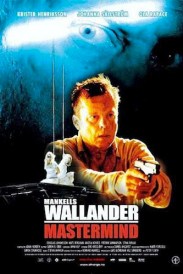
Sixth in the series of Wallander films starring Krister Henriksson as the titular Swedish detective, though only the second to be released theatrically.
Mastermind works to earn its status as a theatrical release, everyone upping their game to provide something more filmic than the other direct-to-DVD entries in the series. That’s not to say the other films in the series are bad — they’re certainly as well-produced as any other detective series on TV — but this episode seems to have been constructed from the outset with an eye on a standalone cinema release, rather than just randomly plucking an episode from the thirteen produced to receive such an honour.

From the start (literally) there are slicker opening titles, and longer end credits to bookend that. The direction is flashier too — still grounded in reality, unlike the heavily-stylised British Wallander, but with more filmic shot choices and editing. Take, for example, the Rear Window-inspired scene where Wallander looks out over the adjacent block of flats while listening to classical music that completely fills the soundtrack — not the kind of sequence you tend to find in TV drama. On-going subplots from the series go unreferenced — there’s no need to have seen a single other episode to follow the story without a hitch.

The main plot’s on a bigger scale — a serial murderer who has eyes and ears inside the police department — and This Time It’s Personal for good measure, with the villain targeting friends and family and (spoiler) a past connection to several characters. It’s not a realistic-scale case-of-the-week, but a once-in-a-career unusual case, the kind of plot that graces serial killer films (Se7en comes to mind, obviously) in a way those case-of-the-week plots rarely do. It stretches credibility a little, as these types of tale often do, which does at times leave it feeling a tad out of place in Wallander’s grounded world, which is usually about more realistic murders rather than megalomaniac super-powerful serial killers. Still, it ups the ante appropriately, making the events more action-packed and conforming to the theory that films should never have a “just another day at the office”-style plot.

With the extra effort afforded to make this series instalment appropriately cinematic, the Wallander team achieve their aim and produce one of the stand-out of all thirteen films. That said, some viewers of the whole series may find it a bit OTT when compared to the series’ regular style.

4 out of 5

* The running time is listed as 102 minutes on IMDb, but 96 is taken directly from the BBC’s iPlayer.

(Originally posted on 14th February 2010.)

Rock n Roll Nerd (2008)

2009 #92
Rhian Skirving | 89 mins | DVD

I don’t usually bother with plot summaries at the start of my reviews, working on the assumption most readers will know (or know of) the film and so don’t really need one. My assumption here is that most won’t have even heard of this film, though.
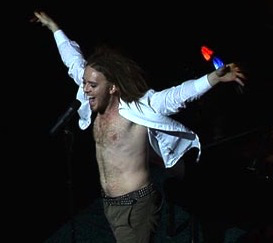
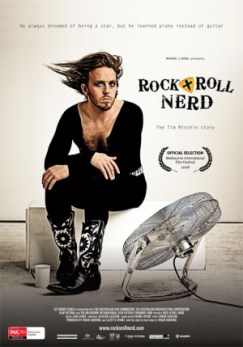
You may’ve heard of Tim Minchin, however, the Australian musician/stand-up who’s done a couple of tours, released a DVD or two, and popped up for guest spots on things like Never Mind the Buzzcocks and The Secret Policeman’s Ball. Back in 2005, no one knew who Minchin was — a struggling musician at the time, on the verge of quitting and finding himself a Real Job. He happened to live next door to aspiring filmmaker Rhian Skirving who, in more or less the same predicament, decided to film Minchin’s last ditch attempt at making it: trying his hand at comedy. They expected to film, at best, a small-scale suburban documentary about a wannabe failing to become a somebody, but what they wound up with was something rather different.

Almost as soon as filming began, Minchin was a hit at the Melbourne International Comedy Festival, where he was spotted by an Edinburgh producer and whisked off to the famous Fringe where (as the film’s own blurb describes it) he had “the most successful first season of any performer in the history of Edinburgh… walking away with the prestigious Perrier Newcomer Award, TV appearances, offers from Hollywood and the West End, the best management in the business and a gig at Albert Hall.” Not what either Minchin or Skirving had expected, that’s for certain!

What this tale creates is an unusual rockumentary. It’s obviously not a concert film, nor a tour film, nor a retrospective on someone’s career; instead, it’s the chronicle of someone’s relatively meteoric rise to fame, from two unique perspectives: the camera is there as it happens, not belatedly once Minchin’s become more widely known; and the writer/director/cameraperson is a close friend, not just any old filmmaker hoping to cash in. One almost has to wonder if Skirving has psychic powers, so perfectly timed was her idea.

Minchin is pretty honest with the camera in tow. When he’s a success, we see him struggle with things like management: does he owe it to the person who discovered him to make sure she’s cut in on the deal? Is it right to just abandon her and move on? Does she just see him as a potential cash cow rather than genuinely wanting to support him? And so on. His honesty extends to the awards — his show is so hyped he winds up half-expecting the near-impossible, to win the biggest award in his first year. He’s not even nominated, having to ‘settle’ for a win as Best Newcomer. His confounded expectations aren’t boastful or immodest, the viewer privy to how his hopes were unrealistically raised in spite of himself.
Alongside this, Skirving and Minchin allow us to see the toll his professional breakthrough takes on Minchin’s personal life. His wife — newly pregnant — is left behind in Australia while he’s becoming the toast of Edinburgh. The timing of some events in his personal life also couldn’t be worse, and Skirving documents them without ever becoming ghoulish or intrusive. It is, in a way, brave of both Minchin and his wife to allow their inclusion, but good filmmaking on the part of Skirving to know where to draw the line.

Documentaries such as this often rely on the viewer having a pre-existing affection for either the performer or their work. Though it seems impossible to believe, I’m sure there must be some who dislike Minchin (his show did get one bad review, after all) and it may be they wouldn’t engage with this film because of it. However, some stories are capable of transcending one’s feelings about the subject covered, and Rock n Roll Nerd may just be one of those: even if you don’t enjoy Minchin’s songs, or indeed comedy music in general, the tale of his success — and what it’s like for an ordinary person to live through such a thing — is a story whose unique interest extends beyond fans-only territory.

4 out of 5

Rock n Roll Nerd: The Tim Minchin Story is currently only available on an Australian Region 0 DVD, available from the distributor, your favourite Australian DVD retailer (y’know, like EzyDVD), or importers on Amazon. The film’s official website can be found here — sadly no trailer, but there are comments from Minchin and Skirving.

Rock n Roll Nerd placed 6th on my list of The Ten Best Films I Saw For the First Time in 2009, which can be read in full here.

Children of Heaven (1997)

aka Bacheha-Ye aseman

2009 #83
Majid Majidi | 82 mins* | TV | PG

Children of HeavenChildren of Heaven is an Iranian film, which means it’s in a Foreign Language and it’s Subtitled. And yet, it was on ITV. Sometimes the mind boggles. Still, it was relegated to a post-midnight showing, so some things never change. Indeed, the one thing that inspired me to watch it is that it’s referred to by Roger Ebert in his wonderfully evangelical (about film, not Christianity (thank God!)) article to commemorate reaching 100 entries in his Great Movies series. I recommend it, incidentally; Children of Heaven comes up for good reason about halfway through.

The film itself is a charming little number, with a simple story about a brother and sister that nonetheless runs itself on inventive incident — the amount of (pleasingly light-hearted) drama it can ring from one missing pair of shoes is, in many ways, quite extraordinary. It also contains moments of simple beauty and pleasure, like blowing bubbles while cleaning or sunlight glittering on the goldfish pool. This is more what I had in mind when someone described Slumdog Millionaire as “feel-good”.

Speaking of which, Children of Heaven adds depth with an amiable commentary on poverty: this poor family live in close proximity to such rich ones, but they can all get along. When Zahra sees another girl wearing her shoes, she doesn’t confront her or demand them back, even when the other girl’s dad buys her a brand new pair and the all-important pair are thrown away again. Halfway through, Ali and their father go up to town and we see how the other half live — enough glass-fronted skyscrapers, dozen-laned roads, tree-lined avenues and blindingly-white mansions to rival any metropolis. And yet they don’t get angry at their lot, and the film doesn’t shove the obvious comparison down your throat. It doesn’t go for the simplistic and oft-tried “poor have little, but have each other so are ultimately happy; rich have lots, but are lonely and so ultimately sad” conclusion (though it does, briefly, err along that path), and nor does it end with the family getting rich and managing to move up in the world.

In fact, the finale deals solely with the issue of the shoes (pun not intended). It’s a long-distance running competition in which Ali must come third in order to win a new pair of sneakers. It’s nail-biting and a beautifully conceived idea — he doesn’t need to win, he needs to come third. If only mainstream films were so simply innovative more often.

Unfortunately, several plot threads feel underdeveloped or unresolved, ultimately coming across as a pleasant but unnecessary aside — the elderly neighbours, for example, who Ali delivers soup to in one scene, or the persistent landlord. The viewer can read more into these if they wish — the neighbours representing the generosity of those with nothing, for example, while we can assume the landlord is eventually paid off now Ali’s father apparently has better employment — but the film itself does nothing with them. There’s a difference between not spelling things out and just abandoning them, and perhaps Children of Heaven falls on the wrong side of this divide. It’s most galling at the very end (after the race), when the film seems to just stop abruptly. IMDb notes that originally there was an epilogue explaining Ali’s future which is for some reason absent from the American-released version, and the presence of something like that is indeed missed. However, the interweb can also provide theories on how the foreshortened ending does have significance, with the goldfish being symbolic, if one chooses to look for them.

But no matter — it seems churlish to complain about such diversions. Children of Heaven is a beautifully simple and good-hearted film and, apparently, a great way to introduce children to the notion of having to read while watching a film.

4 out of 5

* This is timed from ITV’s broadcast. The listed running time is 89 minutes; with PAL speed-up this would be c.85; hopefully the remaining three are accounted for by snipping the closing credits.

(Originally posted on 6th February 2010.)

Wallander: Before the Frost (2005)

aka Mankell’s Wallander: Innan Frosten

2009 #74
Kjell-Åke Andersson | 93 mins | TV | 15

You’re likely familiar with Swedish police detective Kurt Wallander — in passing if not in detail — from the Kenneth Branagh-starring BBC series broadcast at the end of last year (a second series has just finished filming). For the sake of omitting excusatory clauses from the next paragraph, I’ll assume that’s all you know (not that I mean to sound like an expert, because, well, I’m not).

Wallander is adapted from a series of novels by Swedish author Henning Mankell, previously filmed in their original language, between 1994 and 2007, as a series of TV movies starring Rolf Lassgård. A different series of Swedish Wallander films began in 2005 — so, concurrent with the TV adaptations — featuring Krister Henriksson as the titular detective in original stories based on plots by Mankell. Three of these thirteen films received a theatrical release, the remainder going direct to DVD. It’s this latter series that BBC Four are currently halfway through showing, and it’s their theatrical releases that will see three of them reviewed as part of 100 Films 2009.

Before the Frost is the first of this series, and is actually an exception: where the others are original stories, this is adapted from a spin-off novel starring Wallander’s daughter, newly-qualified policewoman Linda Wallander. This leaves Kurt as something of a guest star in the first episode of his own series, but we still see enough of Henriksson to get a feel for his Wallander. Where Branagh is soul-searching, constantly staring silently into the distance, occasionally with a few tears for company, Henriksson is just a guy trying to do his job; struggling to be a good dad and maybe struggling with his health, but still a regular guy. Maybe the introspection and crying come later.

As the de facto lead, Johanna Sällström gets the best of the material. Linda’s troubled relationship with her father, including her decision to work in the same station as him when she could’ve gone anywhere but, are major threads. Sällström plays this central contradiction well, only occasionally (and, thankfully, briefly) slipping down into stroppy teenager histrionics, such as when she storms away from a crime scene early on. As Linda’s friend Anna, Ellen Mattsson also has daddy issues to contend with, though sadly they’re underwritten by comparison. Nonetheless, her significant role is finely portrayed.

Sadly, the majority of the detective story isn’t up to the personal relationships. The villains turn out to be Evil Christians — always a good enemy in my book — with a variety of nefarious plans that lead the story to touch (briefly) on hot-topic issues like abortion, single-parent artificial insemination, and same-sex marriage. While a British or American drama might feel the need to include more of a debate about the morals of such acts, here they seem accepted as a right that the Evil Christians want to steal. Though this arguably leaves them under-considered, it’s a refreshing change of pace.

More problematic is that the villains are never properly introduced or explored. Some events are undersold — a woman is murdered for no decent reason, a case of wrong-place-wrong-time, but once her body is discovered no thought or mention is given to her unfortunate luck or her family’s grief. Obvious deductions stare Wallander and his team in the face yet they fail to make them — the length of time it takes anyone to twig that the fundamental Christians might intend to attack the high-profile gay wedding is astounding. All of these faults rob a few plot twists of their full potential, though at least one still left me surprised and feeling like I should have spotted it (which, of course, is what a competent twist ought to do). Arguably, however, there’s too great a reliance on coincidence to connect all the dots.

Visually this Wallander is as different from the BBC’s as Henriksson is from Branagh. Where the British one seems to attempt an emulation of what our idea of Sweden might be — all cold, desaturated blues and greys, lingering shots of vast empty countryside, and so on — the Swedish version is more, well, normal. (That said, early on it contains a perversely beautiful shot of two swans in flight while engulfed in flames.) No doubt the differences between series are the product of the British version trying to create a Foreign Culture while the Swedish one is just content with filming it as-is, much the same as British-set British dramas do with Britain. On a broadly related note (in that they’re visual), the subtitles are mostly fine, though some jokes and language tricks are unfortunately lost in translation.

Before the Frost is, sadly, not all it could be. Whether this is the fault of Mankell’s novel or Stefan Ahnhem and Pelle Berglund’s adaptation I don’t know (I’ve never read a Mankell), but while it seems fine as it goes along a bit of reflection reveals all these niggling gaps. That might be a little harsh though, as there’s still much to admire and enjoy in the first of what could be a fine series.

4 out of 5

The second theatrical release, Mastermind, was on BBC Four last week and is available on iPlayer for another 24 hours. The third, The Secret (aka Hemligheten), is episode thirteen and will air later this year.

Ashes of Time Redux (1994/2008)

aka Dung che sai duk redux / Dong xie xi du zhongji ban

2009 #71
Wong Kar-wai | 90 mins | TV | 15 / R

Ashes of Time ReduxA wandering man with magic wine and no memory; a clan prince who’s also his beloved sister; a master swordsman who’s almost blind; his wife, who loves his best friend; a persistent peasant girl after revenge for her little brother, with only eggs for payment; a young swordsman with no shoes and a camel; a large gang of bandits with a left-handed member; and a desert-dwelling problem solver who connects them all. Oh if only Ashes of Time were as simple as that sounds.

Despite apparently being an Eastern action movie — it’s in the wuxia genre, which, for the uninitiated, also covers the likes of Crouching Tiger, Hidden Dragon and House of Flying DaggersAshes of Time isn’t what one would typically expect from such a billing. Reviews talk about it being a confusingly-plotted art film — and those are the positive ones — which, coupled with my relative dislike of Chungking Express, meant I didn’t really expect to like it a great deal. But I found myself surprised, because I really enjoyed it.

For one thing, I followed the plot right to the end, though the final fifteen minutes throw up a series of twists to rival any thriller. I don’t claim to understand every nuance of every character, the meaning of every event, exactly how everything is connected (assuming it is), or what it’s really all about… but based on what I’ve read, even following it is an achievement on a first viewing. I felt more or less the same way at the end of The Big Sleep, and the trick here is the same: pay attention. Yes, this requires some effort on the part of the viewer — I was aware of myself paying close attention throughout in order to follow and comprehend the story, more so than in most films (even discounting easily-followed mainstream-aimed efforts). An awareness of this need for hyper-attentiveness from the get-go (which, as I say, I had thanks to perusing a couple of reviews) is likely to aid the viewer (which, as I say, it did me).

The story itself, then, is quite episodic. There’s some overlap, but in general characters come and go from the problem solver’s home in a parade, rarely interacting with one another. Each individual piece explores a different facet of a similar theme — “anecdotes about chivalric swordsmen”, as the Radio Times puts it — which serves to tie them together, alongside other plot elements and character points — several have wives in love with others, for example, while others have left their wives at home and one has been followed by his.

Wong (again, so I read) broke ground within the genre by prioritising emotion over action. Therefore potential viewers shouldn’t expect the abundant martial arts/swordplay the genre often provides. If Hero was too arty for you (as it was for me first time round), then this will almost certainly be beyond the pale. Despite the paucity of action — despite several stories concerning assassination and death, the actual act isn’t the point in the slightest — when it does turn up (the first significant sequence is halfway through) it’s excellent; effectively, if differently, done.

Indeed, the film is beautifully shot; perhaps not as obviously as Hero’s colour-coded vibrancy, but there are frequent moments that dazzle and I can’t recall a single weak visual. Wong mucked about with the colours as part of his reduxing, to the reported distaste of cinematography Christopher Doyle, but it still looks stunning throughout.

Wong’s 2008 redux included not only these tweaks to the visuals, but also modifications to the audio and losing seven minutes from the original cut. I’ve never seen it so can’t compare, though some reports claim the changes helped clarify the plot. For the curious, a catalogue of differences can be found here. Equally, those after better-informed reviews might like to read DVD Times’ coverage, with Noel Megahey on the DVD and John White on the BD, and Heroes of the East’s review of both cuts.

Having pointed you toward those wise reviewers, let me just say that Ashes of Time Redux is not your typical wuxia film and not for everyone. My enjoyment of it came as something of a surprise, which is always nice.

4 out of 5

Film4 are showing Ashes of Time Redux tonight at 1:05am.