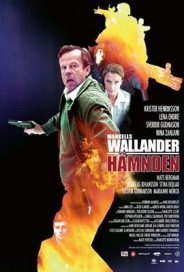
Wallander: The Revenge (2009)

aka Mankell’s Wallander: Hämnden

2010 #40
Charlotte Brändström | 89 mins | TV | 15

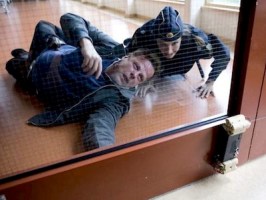
Krister Henriksson returns as the titular Swedish detective for a second — and final — series of feature-length investigations, though this time only this first has received a theatrical release (which means it’s likely the only one I’ll review, unless the series finale offers something that persuades me otherwise).

This Swedish series (there’s another, incidentally) is most often praised for its calmer, low-key, realist aesthetic, as opposed to the British adaptations’ tendency to turgidly-paced over-stylised over-emotion, but the handful of cinema-released entries tend away from this, no doubt in justification of their big-screen debuts. So rather than a thoughtful investigation into an ‘everyday’ murder, Wallander blazes back onto our screens with the explosive destruction of a power station, a bloody execution — no less than 17 shots fired — and the army rolling into town to handle the fall-out from an extended power cut. Epic, indeed.

What continues to mark Wallander out is the attention to character and detail it shows even while there are large-scale events going on all around. There’s clearly an effort to keep everything grounded and moderately realistic even as more bombs go off and more symbolic executions are, er, executed — the police still have to struggle with a waiting room packed with people wanting to complain about the odd abandoned car or just moan about the lack of power, for example.

The climax is a case in point. There’s no grand shoot-out or serious race-against-time-for-the-last-bomb, just Wallander and the criminal having a calm chat. OK, so there’s a kidnapped government minister, a gun, snipers and a big vest-bomb, but these are set dressing to the conversation. It’s proof if proof were needed (it isn’t) of Henriksson’s controlled skill in this role. As great as Branagh could be, it’s hard to imagine his introspective interpretation of a weepy Wallander slotting into this scene without making it unpleasantly histrionic.

In the series’ first season (and, therefore, the first three theatrical releases), Wallander’s policewoman daughter, Linda, played an equally important role — indeed, in several episodes, including the first, she had a much larger presence than her father. Actress Johanna Sällström sadly took her own life in 2007 and the role is wisely not re-cast; a passing reference is made to the fact Wallander has a daughter, though where she is now isn’t mentioned. It’s easy for one to imagine a future for Linda in the wake of the shocking events of the previous episode, so perhaps the understated style of this Wallander is to leave viewers to their own conclusions.

However, the departure of Linda and death of fellow lead character Stefan leaves a hole to fill. It’s partly done by the return of Martinsson, not seen since Mastermind, but also by adding two new recruits to Wallander’s team, Isabelle (Nina Zanjani) and Pontus (Sverrir Gudnason), and the introduction of prosecutor Katrina (Lena Endre). All are set up as key new characters for this run, though it’s clearly Only The Beginning here. Katrina is a little too blatantly a potential love interest for Wallander, while Isabelle and Pontus are… well, new characters. There’s little to say about them yet.

I suppose it’s this kind of thing that reminds one that The Revenge isn’t really a standalone Wallander movie, but the first episode of a 13-part series. Still, it can certainly be enjoyed in isolation, and it promises the new run will maintain the first’s high quality — perhaps even better it.

4 out of 5

The Man Who Sued God (2001)

2010 #3
Mark Joffe | 97 mins | TV | 15

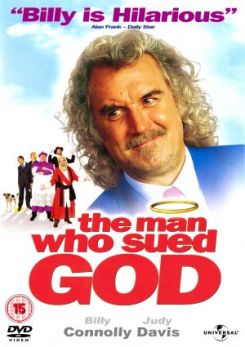
The Man Who Sued GodI always assumed this was British, probably because it stars Billy Connolly and has a suitably quirky premise — one can see it fitting in with the school of British comedy that’s brought us The Full Monty, Saving Grace, Kinky Boots and the like. But no: it’s actually very much Australian, which, considering its suitably quirky premise and that it stars Billy Connolly, isn’t that surprising either. And director Mark Joffe’s best-known/most-seen other work must be the first 10 episodes (ever) of Neighbours, which just cements the Anglo-Antipodean relation.

Country-of-origin is immaterial though, and what’s important is that The Man Who Sued God is funny, and righteous, and silly, and fantastical — in an “oh, if only it were true!” way — because in reality any such case would likely be laughed out of court and the insurance companies allowed to continue with their sorry and disreputable business. And some of these things which meant I loved it — the “only in a film” moral victories, the sillification of the church(es), and so on — will mean others hate it, or at least view it as a mediocre effort.

There’s a place for realist films — those that remind us of the constant victory of big nasty corporations, or obey the likelihood of the unjust justice system, and so on — but there’s also a place for the more life-affirming, the stories where the impossible happens and the ‘little man’ with a good point to make happens to encounter a like-minded system that means he can ultimately win through.

And putting the church in a position where their only sensible defence is to prove God doesn’t exist is always going to make for a good story.

4 out of 5

Exiled (2006)

aka Fong juk

2009 #68
Johnnie To | 104 mins | TV* | 15 / R

ExiledThere are times when one feels under-qualified to review a film in a way that gives it its due. This happens particularly frequently when one’s blog covers first-time viewings of films that are often classics/significant/beloved/etc. My appreciation for Exiled has been increased by two other, more qualified, reviews: one from DVD Times, the other from Heroes of the East.

Having never seen a Johnnie To film and not being sure quite what to expect — either from the director or from what appeared to be a gangster/action film being shown on arts-centric BBC Four — my first reactions to Exiled were a little muddled. Having pointed you in the direction of those other reviews — which I should say I agree with, in the sense that they’ve changed my perspective on the film and leave me with a desire to see it again in light of their comments — I’ve decided that, instead of my own review that tries to conglomerate my initial thoughts with the additional perspective I’ve since gained (and which is best presented in those other articles), I’ll once again turn my notes into sentences and offer it up for your consideration.

The length of the sentences and clauses in the above paragraph suggest I’ve read too many academic essays in the last 24 hours, so I’ll just clarify: What follows are, essentially, my notes after first viewing. I’m not wholly in agreement with some of it anymore; with the exception, of course, of the score.

Exiled features several impressive action scenes. They’re Leone-like in the way there’s often an extended pause, the threat of violence hanging in the air — then a sudden burst, over quickly. But within this style there’s a lot of visual flair — unlike Leone, slow motion makes the moments last minutes, underlined by the entire climatic shoot-out taking place in the time it takes for a can of Red Bull to be kicked in the air and drop back down. As many a teenage boy watching would no doubt say, “cool!”

Elsewhere in the coolness stakes, Anthony Wong owns the sunglasses-and-trenchcoat look, appearing as a cross between a middle-aged businessman and a stylish hitman. Francis Ng looks equally cool, but in a more ‘traditional’ way. Quite what the ‘cool’ aesthetic does for the film/story/characters I’m not sure, other than increase its accessibility.

Dialogue is kept to a minimum, appropriately. Whole character arcs and motivations pass by without a word of explanation, allowing the viewer to fill in the gaps. It works just fine — there’s no need to spell them out, and they’re not so obscured as to be baffling. There’s an audacious twist around halfway through, which removes the apparent point of the plot and suggests it’s all really about something other than the obvious. [This in itself should be a sign that a lot of what follows in my comments is rubbish…]

Is the story just an excuse to link the spectacle of action? [This, I think, is where my notes really lose the plot.] Yes and no. The story is hardly revelatory, nor is there a great deal of character exploration (or any, in most cases) to suggest To is aiming for a different angle on a familiar tale. But while the action set pieces are exciting and visually engaging, they’re not so unusual as to suggest someone conceived of them and then a story to connect the dots. Is it style over substance? [No.] Again, to an extent. I suppose there’s not a great deal of substance, and there is quite a bit of style; though, again, the latter isn’t as show-off-y as style-over-substance films usually are.

Alternatively, I suppose the plot is quite shallow [it isn’t really]: even things that suggest stories and development — such as Boss Fay weighing in on Boss Keung’s territory — don’t really develop into much, instead becoming a backdrop for who’s shooting at who when.

Whatever it is, it’s entertaining. Especially if you like people shooting at each other in cool ways and gangster-based thrillersome plots.

Note the dramatic device of the photos [which, I think, in themselves disprove my ponderings that the film lacks depth]: the first shows the characters when young, at the beginning of their ‘career’; the second is at the start of this story, effectively being the midpoint/bulk of said ‘career’; and the last one is at death, the end of this ‘career’ — though it’s the same group in each, they’ve all changed between every photo, even the last two taken just days apart. It’s a relatively subtle but effective motif.

So much for my unadulterated notes. Anyway:

4 out of 5

Director Johnnie To’s 2012 film Drug War is on Film4 tonight, Thursday 15th January 2015, at 1:15am.


* BBC Four showed this in 16:9, but the OAR is 2.35:1 — and it showed, with compositions often looking cropped. Shame. ^

M (1931)

2010 #20
Fritz Lang | 111 mins | Blu-ray | PG

M is a film of immense significance, not least because of its place on numerous Best Ever lists (even if it is a nightmare to find quickly on any list or website thanks to its single-letter title), and not to mention it being director Fritz Lang’s favourite among his own work (consequently he definitively moved away from his fantastical work on the likes of Die Nibelungen, Frau im Mond and (of course) Metropolis, choosing to largely direct crime pictures, including a significant contribution to film noir). As with any film of such acclaim, where near-endless essays and articles and whole books have been penned discussing every notable aspect, it’s unlikely I’m going to have much either new or significant to say after one viewing (never mind “ever”). Just so you know.

But I can sing some of its praises. Like Peter Lorre’s extraordinary performance as child killer Hans Beckert. He could have survived on his naturally unusual looks, which fit the role perfectly, but he also skillfully conveys the realistic complexities of such a character. Beckert’s psychology feels completely accurate, something you might not expect from an 80-year-old film. To show such care in making a conceivable human being out of a villain who has committed some of the most horrendous crimes imaginable, and not just going for the easy approach of showing an incomprehensible monster, is a vital step in creating a realistic crime movie — a step that’s often been ignored, and still can be today.

And Lang did set out with the express aim of making a realistic factual film, albeit still a fictional one — it’s ‘inspired by’ real cases, not specifically ‘based on’ them as some have claimed. Along with his writer (and wife) Thea von Harbou, Lang drew on innumerable press reports about murders and their investigations, spoke to police officers and psychoanalysts about their jobs and what they had learnt about such criminals, and generally researched every area he aimed to cover on screen. His intention was for the film to constantly shift its focus, examining every aspect of a high-profile serial killer case, and so it does: we see the victims and their families (before and during the crime, though not after it to any significant degree); the public reaction and hysteria; the police’s flailing investigations and increasing exasperation; the criminal underworld, who begin their own manhunt because police inquiries are “bad for business” (despite sounding like a filmic conceit, this element was directly inspired by a newspaper article); and the criminal himself — trying to lay low, but constantly having to fight his urges… and ultimately giving in to them again.

Such a diffuse set of perspectives could lead to a messy structure that revealed each facet in only half-hearted broad strokes, but Lang never allows this to happen. The opening sequence, depicting the latest in a long line of kidnap/murders, is exemplary: every shot and edit contributes to a growing sense that Something Horrible Is About To Happen… and when it does, not a glimpse is shown on screen. An empty place setting, a balloon caught in overhead wires, a ball bouncing to a stop… They, along with each viewer’s imagination of the worst possible fate for little Elsie Beckmann, convey all the terror — and a palpable and heartbreaking sense of absence — that’s required.

And then Lang shifts focus: public fury, paranoia. A series of scenes that each typify broader social reactions. People are accused for nothing more than following a girl up some stairs, attacked because they’ve been arrested, the crowd simply assuming they’re the killer. Such scenes remain disturbingly relevant and plausible — the bit where a surly bloke confronts a man who was merely giving a girl the time feels like something one might see occur on our streets today.

And then it’s the police: a distinctly procedural style as a long sequence describes the police’s investigative efforts — how they follow up leads and how they lead nowhere; how they search crime scenes with a fine-tooth comb; another sequence shows their methodology for staging a raid; and so on. Such precise and clinical methods ultimately pay off: it’s a pair of tiny clues, carefully reasoned and sought out, that reveal the killer’s identity — and if it weren’t for the criminals getting there first, they’d’ve surely caught him too. Indeed, were it not for this breakthrough then the film might hold a Life On Mars-esque observation that only the criminals and their, shall we say, alternative methods can finally catch Beckert when the police have failed.
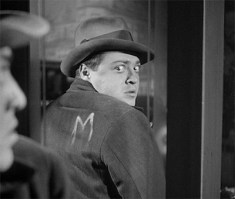
One of Lang’s aims in being factual — or, responsibilities he felt by being factual — was to present a debate on the morality of capital punishment. So Beckert murders children because that was the worst crime imaginable to Lang and von Harbou, and still when he’s dragged before a court (albeit an impromptu one made up of the criminal underworld) a debate is had on the merits of the death penalty — disguised, of course, in the decision of Beckert’s fate. The baying mob of criminals want him killed; his sole defence representative cites the law to show why such a punishment is wrong. Lang’s point — the one he wanted to make, even if he tried to present it as a debate — is that even in this instance the death penalty is wrong. Somewhat distressingly, the moral and legal points raised throughout the film remain highly relevant today.

Even leaving these aside, M is packed with beautiful moments of pure cinema: the shadow on the wanted poster; the intercutting of the police and criminals’ meetings; Inspector Lohmann dropping his cigar at the news the criminals were looking for the child killer (on his audio commentary, Peter Bogdanovich wonders how this would play to a modern audience, implying it wouldn’t really work — well, it did for me); the roving camera in the beggars’ market — a decade before Citizen Kane, Lang employs his camera in ways Welles seems to get all the credit for (I’m sure Welles pushed boundaries too, but some of his ‘innovative’ ideas — like tracking from outside to inside through a window within a single shot — are present here). M’s individual moments of brilliance go on — perhaps my favourite is when the police arrive just after the criminals have apprehended Beckert. We don’t even see an officer on screen, but the burglar’s reactions let us know who’s there. Its a funny moment (even if we’ve seen it dozens of times since) and a lovely shot too.

M was Lang’s first sound film, made at a time when the technology was still very new. So he uses — indeed, establishes — a variety of techniques: voiceover; selective hearing (e.g. the audio cutting out when a beggar covers his ears); silence (or only selected sound), used to represent how a space appears to sound rather than the genuine noise one would/could hear; conversations continuing across scenes (such as when a criminal begins a sentence and a police officer finishes it, in completely different rooms at different times); not to mention that the killer’s whistling is a vital clue, both in terms of the plot (it’s how the criminals first identify him) and for the viewer (indicating when he’s about his sorry business).

This is the longest existing version of M, restored from multiple negatives and prints held in several countries, which stands about seven minutes shorter than Lang’s original cut. IMDb’s alternate versions section claims the film originally showed the full trial at the end, implying this is among the lost minutes. In Masters of Cinema’s booklet, Anton Kaes instead details a scene early in the film pertaining to false confessors. Kaes has evidence that his scene existed, IMDb doesn’t present any; and in one of the audio commentaries Lang and others discuss the ending as-is — even if there was another ending at some point, it certainly wasn’t Lang’s intended one.

This definitive one, then, is suitably downbeat: Frau Beckmann — the mother from the opening sequence, her first appearance on screen for over an hour and a half bringing the tale full circle — bemoans that dispensing justice to the murderer won’t bring the children back, and warns viewers to watch out for their own. It’s not the triumphant “we got him!” that concludes most serial killer films, but a blunt warning that, though Beckert has been caught, there are always more out there, waiting to strike. History has sadly proven her right; but while the world has produced many men and women like M’s villain, it hasn’t produced many films quite like M.
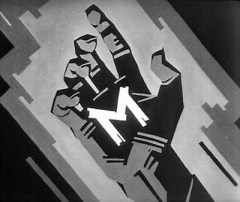
5 out of 5

Masters of Cinema’s new edition of M is released on DVD and Blu-ray on Monday. One of the special features is Zum Beispiel: Fritz Lang, which I’ve briefly reviewed here.

Zum Beispiel: Fritz Lang (1968)

aka For Example: Fritz Lang

2010 #20a
Erwin Leiser | 21 mins* | Blu-ray (SD)

A slightly odd little documentary (these days, it would be — and, indeed, is — ‘just’ a DVD extra, though almost 30 years before that format (or even Laserdisc) I presume it had a different outlet. Anyway:), in which Erwin Leiser ‘interviews’ Lang about his early directing career.

Lang certainly has interesting stories to tell, in particular a long anecdote (taking up most of the film’s second half) about Goebbels’ reaction to Das Testament des Dr. Mabuse. It’s worth watching for this alone. (Even if, as the Bogdanovich/Kaiser/Koerber/Lang commentary on M reveals, it may not be wholly/at all true.) Earlier tales are more fragmented, however. Most of Lang’s major German films are touched upon, but none to any significant degree — it feels like random excerpts from longer, more thorough interviews.

The whole thing feels distinctly staged too. The interviewer and interviewee sit or stand in odd relation to one another — cutting away to film clips ‘disguises’ a change of position, usually to an even more unnatural one — while Leiser’s questions barely provoke the answers they actually get. Lang’s anecdotes feel genuinely told, rather than scripted and rehearsed, but the film’s structure and style makes it feel like they were very pre-prepared.

And when it ends, almost as abruptly as the numerous cuts and topic changes within it, there’s a long hold on a black screen with some discordant ‘music’/typing sound effects. Erm, what? Maybe I’m missing something…

The interview snippets are interesting, then, though they leave one with a desire to hear Lang talk at greater length about each of the films touched upon; and, as I said, the Goebbels story is worth the bafflement of Leiser’s directorial choices.

4 out of 5

* This is the length as included on Masters of Cinema’s Blu-ray of M. IMDb lists running times of both 21 and 49 minutes; this comparison shows a German DVD with a version running 47 minutes; so maybe these are excerpts — as far as I can see, MoC don’t clarify anywhere.

Wallander: The Secret (2006)

aka Mankell’s Wallander: Hemligheten

2010 #12
Stephan Apelgren | 90 mins | TV | 15

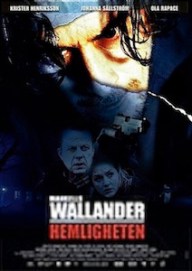
The third theatrical release to star Krister Henriksson as Henning Mankell’s detective is the thirteenth and final episode in the first series. It has a suitably Season Finale feel to it — “this time it’s personal” and all that — but also subtly constructs itself to work as the standalone piece necessary for a theatrical release schedule that skipped six whole episodes.
As with Mastermind (the sixth episode / second film), there’s no need to have seen any of the series to follow things. Though the characters aren’t introduced from scratch, there’s no explicit reference to any on-going plots — any that are relevant are re-established in a way that isn’t intrusive. A knowledge of what happened in the ten films not chosen for cinematic release is inessential, then, but it does deepen the viewer’s understanding of events to some degree: Linda and Stefan’s relationship was played out more fully across the whole series, for example, while Stefan’s suspension has been a gradual slide rather than an almost sudden revelation.

Indeed, while the emotional pay-offs are sufficiently handled within the film itself — for one, it centres on an issue that it’s hard to not find affecting (which, if I spell out, is sure to give away a revelation or two) — getting to know the characters over the 18 preceding hours surely adds a dimension to the effect the story, its revelations and its twists can have on the viewer. Think, for example, of Serenity: I know people who saw that film cold who found the deaths emotional, but not to the same degree as those who experienced the film on the back of 10 hours (and more, with repeated viewings) getting to know and love those characters. I’m not saying Wallander at any point achieves the giddy heights of Firefly and Serenity, mind you, but the theory is the same.

The Secret‘s own plot is suitably high-stakes, if not quite as filmic as the one in Mastermind. Making it personal for one of the team is always a good way to make A Bigger Story, and there are some particularly large revelations and twists involved here. Ola Rapace is finally given something significant to do besides be a bit grumpy, and he excels in an understated fashion — even his moodiness now has good meaning. None of the reasons for this shall I spoil for those yet to discover the series, but events here will undoubtedly have a lasting impact — though how much this will be felt in the forthcoming second series (which, I understand, only includes one theatrical release) remains to be seen. In particular, the tragic suicide of Johanna Sällström, who plays Linda Wallander, must surely hang over the new episodes to some degree.

It’s arguable how fully the issue behind the story is explored, as the film gets rather caught up in explaining its own conceits — flashbacks disguised as asides to the current action, for example — and complex plotting — when past relations between characters come out, there are some hoops to be jumped through so that it all makes sense. I wouldn’t go so far as to say any of this is poorly handled, but one wonders if screenwriter Stefan Ahnhem has ultimately bitten off more than he can comfortably chew. The later twists and complexities occasionally overshadow the depressingly grounded earlier events.

Unfortunately, the cinematography — though a small step up from the ‘regular’ episodes — also isn’t quite as filmic as in Mastermind. This one feels more like a TV episode granted an upgrade, whereas Mastermind was closer to ‘the real thing’ of a film — as much as that can be defined and/or justified these days, anyway. One might suppose this leaves more room for the actors — in particular Rapace, as already mentioned, but also Sällström — though I’m not convinced it makes a huge difference.

Some of these are minor points, perhaps, but a number of factors add up to mean The Secret doesn’t feel quite as distinctive as Mastermind. Perhaps I’m holding it to ill-conceived criteria — as the culmination of the series, it has several things going for it — but I remain unconvinced that it tackled the subject as well as it could have.

3 out of 5

Wallander 2 (or 6) and 3 (or 13)

If you read my review of the first episode/film of the Swedish Wallander, Before the Frost, back in November, you may have some idea what that title’s on about. For the rest, I’ll try to explain it succinctly:

There are multiple TV/movie series based on Henning Mankell’s detective Kurt Wallander. This particular one, begun in 2005, features an adaptation of one novel (Before the Frost) followed by twelve original stories. Of these thirteen feature-length episodes, three were released theatrically — episodes one, six and thirteen (the rest went direct to DVD, and later TV) — and, because of their initial cinema release, I’ve reviewed those three as part of my objective. Having published the first last November, this pair of reviews covers the second film (or sixth episode) and the third film (or thirteenth episode).

I hope that makes some kind of sense…

2009 #88
Wallander: Mastermind

Mastermind works to earn its status as a theatrical release, everyone upping their game to provide something more filmic than the other direct-to-DVD entries in the series.” Read more…

2010 #12
Wallander: The Secret

The Secret‘s not quite as filmic as Mastermind. Making it personal for one of the team is always a good way to make A Bigger Story, and there are some particularly large revelations and twists involved here.” Read more…


A second series of the Swedish Wallander comes to BBC Four soon. This time, only the first episode — The Revenge (Hämnden) — has received a theatrical release, though to date only nine (of thirteen) episodes have been released at all (according to IMDb, the remainder are due for release in Sweden in March, April, June and July; I don’t know if BBC Four are screening all thirteen in one go regardless). I will, of course, continue to cover the series’ cinema-released episodes as I see them.

Ernst Lubitsch in Berlin: From Schönhauser Allee to Hollywood (2006)

2010 #10
Robert Fischer | 109 mins | DVD

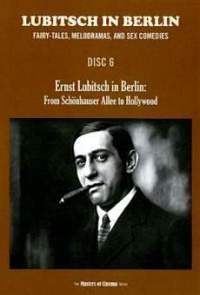
Ernst Lubitsch in BerlinPart biography, part making-of, part analytical retrospective, Robert Fischer’s documentary does what it says on the tin: tells the story of the life and work of actor/director Ernst Lubitsch from his formative years, living on Schönhauser Allee in Berlin, to when he made the move to America in the early 1920s.
Fischer devotes a large amount of time to Lubitsch’s early years — the life he had growing up, his years as a stage actor, and how he eventually shifted into becoming a film actor — attempting not only to tell the story of his upbringing, but to draw (or leave the viewer to draw) parallels with the films Lubitsch would go on to make. A use of ‘family history’ first- and second-hand accounts and analysis from authors, critics and admirers strikes a moderate balance here, though those primarily interested in his eventual film work may find it goes on a bit too long.

A lot is also made of (or, at least, implied about) Max Reinhardt’s influence on a young Lubitsch. The film implies Reinhardt had a greater significance generally, but lacks any context about why he was such a momentous figure. In fairness the film isn’t about him, but one feels a minute or two clarifying his importance may have been warranted.

When Lubitsch’s directing career is eventually arrived upon, Fischer uses the same mix of talking heads to cover both the behind-the-scenes story of Lubitsch’s career, spanning a half-dozen or so of his more significant German works, and provide a brief analysis of how they foreshadowed (or didn’t) his future career and what they might reveal about the man and his methods. With such a broad overview no one film is covered in particularly great depth, despite the feature-length running time, though recollections from actors Emil Jannings and Henny Porten provide some film-specific focus.

Illustrated with copious clips and photographs from Lubitsch’s work, the documentary incidentally instills a desire to see more of the director’s early work. Tantalising glimpses of and stories about films such as The Eyes of the Mummy Ma, Carmen, Madame DuBarry, Kohlhiesel’s Daughter and The Loves of Pharaoh all leave one longing they were included in the box set too — though considering the six films already allotted, it’s hardly an oversight that there aren’t even more. As IMDb/Wikipedia seem to suggest none of these are lost, perhaps there’s space for a Volume Two?

Given that I found the documentary interesting, the following score might seem a tad low. Judged in the world of DVD extras, Ernst Lubitsch in Berlin would likely fare better; bumping it up to the world of ‘Proper Films’, however, reduces that somewhat. As much as anything, while I’m sure it’s of interest to the already interested, it’s not compelling enough to warrant viewing by anyone else.

3 out of 5

Read more reviews from Lubitsch in Berlin here.

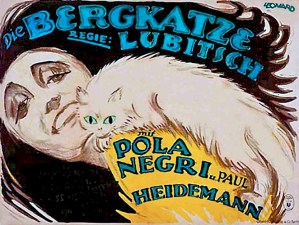
Die Bergkatze (1921)

aka The Mountain-Lion / The Wildcat

2010 #9
Ernst Lubitsch | 82 mins | DVD | PG

Die BergkatzeDie Bergkatze apparently rounds off Masters of Cinema’s Lubitsch in Berlin box set with appropriate heft: as the blurb asserts, this was “Lubitsch’s personal favourite work of all his German films, [it] represents a peak in both Lubitsch’s silent oeuvre and the silent cinema as a whole.” I wasn’t quite so enamoured with it.

Which, again, isn’t to say it’s bad. The setup takes some time to build up speed, but when it does the gags begin to flow more readily, even if it degenerates to a more stop-start pattern later on. But scenes like the Lieutenant leaving town to an army of toddlers crying “Adios, daddy!” are on the one hand simple but on the other inspired; the first battle sequence is full of marvellously surreal touches, like the robber-leader making coffee to be drunk mid-shoot-out; and the satire on the military (always welcome) is pleasantly thorough, taking pot-shots at numerous elements rather than picking one trait and exhausting it.

Lubitsch once again flips the roles of the sexes: the Lieutenant preens and prunes, spending ages tweaking his hair and clothes in the mirror, and one of the gang of robbers lies on a bed literally crying a river over his lost love; the titular robber’s daughter, however, leads a gang of men in thieving and fighting, living wild, free, and rather dirty, among them. A desired-by-all woman (Pola Negri, successfully branching out into comedy) and at least one mass of man-desiring women help round out a succession of familiar Lubitsch elements. Familiarity may be said to breed contempt, but Lubitsch’s reworking of similar sequences is more a recognisable touchstone than irritating repetition.

Location filming in snow-covered Alps adds a scale and breadth to the film’s imagined-kingdom setting that would be inimitable in a studio. Perhaps art director Ernst Stern was right that the realism of using genuine locations doesn’t quite sit with the highly stylised fort; on the other hand, a studio set simply wouldn’t have the same effect: this isn’t the card-and-wood world of Die Puppe, where clearly-fake trees and horses were all part of the illusion. Instead of seeming fake, then, the contrast of a hyper-real fort and genuine-but-exotic locations creates the sense of a proper fantastical realm rather than some fictional stage set. Stern’s design for the fort is beautiful, from the overall look to specific features in each room. It’s scale is quite astonishing, particularly considering it was built on location in the Alps.

Lubitsch’s love of camera mattes, seen with increasing frequency throughout Die Puppe, Die Austernprinzessin and, particularly, Anna Boleyn, is finally allowed free reign here, with shots that conform to the standard 4:3 frame seeming to be the irregularity amongst an unimaginable array of shapes and angles. At times it’s distracting, particularly at the start, but that’s more because it’s a technique we’re now almost entirely unused to rather than any flaw in Lubitsch’s application of it. That said, though he often uses the mattes to enhance or emphasise composition, or suggest something about a character or location, it’s not always clear why he’s choosing to vary the frame so much — other than the sheer fun of it, which, particularly in a comedy, may be reason enough.

Die Bergkatze was a flop on its release in Germany and consequently never distributed elsewhere. Maybe it was, as Lubitsch thought, an unwillingness on the part of German people to have the military satirised; maybe it was the extreme use of unusual framing techniques that left them cold; maybe they just didn’t like it. Though it’s far from my favourite film in the set, it didn’t and doesn’t deserve to be dismissed.

4 out of 5

Read more reviews from Lubitsch in Berlin here.

Anna Boleyn (1920)

aka Deception

2010 #8
Ernst Lubitsch | 118 mins | DVD | PG

Anna BoleynIn an age where Henry VIII is young, slim and sometimes irritatingly called “Henry 8”, not to mention more interested in shagging every young girl he can find than in, well, anything else, it’s somewhat refreshing to return to a time when he was always older, fatter and more interested in polishing off a huge slab of meat than seeing his wife. OK, so they call him “Heinrich VIII”, but at least that’s because this production team spoke a different language.

The Tudors may be more interested in political intrigue and sex than slavish historical accuracy, but, in fairness, Anna Boleyn isn’t actually much different. The sex isn’t even explicit in dialogue, never mind explicitly shown, but it’s still the cause of Anne’s downfall; and the political intrigue may handle in 10 seconds what The Tudors spent 10 hours (or more) dragging its way through; but it’s this speediness, not to mention Henry’s girth, that are the very things that also leave historical accuracy by the wayside. But, again like The Tudors, that’s not really the point. Some things never change.

Anna Boleyn is, once again for Lubitsch, a romance; though rather than a “happily ever after” ending it has more of a message. Sweet little Anne Boleyn believes King Henry’s eyes are wandering from his wife because he genuinely loves Anne, so she (eventually) goes along with it. He gets a divorce — if proof were needed that historical accuracy is immaterial, it takes about as long as it would today, skipping over a hugely significant part of British history in a heartbeat — and they get married. Anne fails to provide him with a son, and suddenly his lustful eye is roaming again. All it takes is the (false) accusation of a dalliance in the woods with her ex love and it’s off with her head. Poor Anne.

It’s odd to see Anne Boleyn depicted as such an innocent; a tragic figure caught up in the machinations of Henry — and, indeed, History — rather than the plotting, ultimately deserving temptress we’re used to from British (co-)productions. She’s every inch the victim, falling foul of Henry’s appetites — both when he captures her and when he goes after other women in exactly the same we he went for her — and, at the climax, there’s no question she’s being framed. The historical veracity of such a portrayal is, again, suspect. Whether Anne was truly as scheming as she’s commonly depicted, or whether this is the legacy of the nation’s love for Catherine and acceptance of the charges later levelled (or fabricated) against her, I don’t know — my historiography isn’t quite good enough for that I’m afraid — but one suspects she can’t have been as entrapped as suggested here.

On the other hand, Emil Jannings’ Henry is every inch the stereotype, a fat old man gorging himself on food and women, liable to explode with anger at any second. Just because it’s a stereotype doesn’t mean it’s wrong, of course, and Jannings’ performance is a strong one. Henry rages from joyous to furious in a heartbeat, swings from entertained to bored, loving to lustful, and every which way in between. Some of this is conveyed with grand theatrical gestures, but Jannings also pulls much of it off with just his eyes.

Among the rest of the cast, Aud Egede Nissen’s Jane Seymour takes on the typical Anne role as a seductive power-hungry mistress, which is an especially striking comparison to the near-saint recently seen in The Tudors. Ferdinand von Alten’s duplicitous Smeaton, meanwhile, looks and behaves like his surname should be Blackadder.

It’s been asserted that silent films should aspire to use as few intertitles as possible, with none therefore being the ultimate goal. This is clearly a theory Lubitsch never subscribed too. Normally that’s perfectly fine — his intertitles are mostly witty, loaded and never omnipresent. Here, however, there’s an abundance of wordy messages, and while I’m sure they could be worse, they rarely convey anything but plot. Indeed, bar the very occasional instance, the film is devoid of humour.

Lubitsch seems to feel the need to keep himself entertained in other ways, constantly playing with aspect ratio and framing, using dozens of shapes to encircle characters in close up, or isolate a group within a crowd, or just vary his composition with widescreen, tilted widescreen, or a kind of vertical widescreen. And he still knows how to stage a big sequence — the wedding and accompanying riots, packed with hundreds of extras, are quite spectacular. The following dinner scene recalls Die Austernprinzessin with its plethora of guests, waiters and dishes, although it makes for an unfortunate comparison as nothing in Anna Boleyn feels even half as inspired.

Sumurun took a more serious approach than any film thus far in this set, but still had plenty of touches that let you know Lubitsch was behind the camera (not least that he was also in front of it). Aside from some of the choice visual framing devices, or one or two familiar set-ups (the large banquet, four servants helping Henry get dressed), there’s no significant evidence here of Lubitsch’s touch. It’s not a bad film, it’s just not a particularly distinctive one.

3 out of 5

Read more reviews from Lubitsch in Berlin here.