
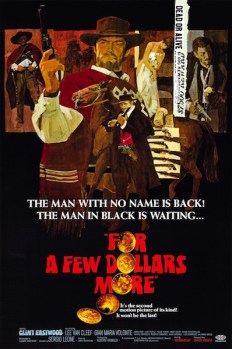
The man in black is waiting…
Original Title: Per qualche dollaro in più

Country: Italy, Spain & West Germany
Language: English and/or Italian
Runtime: 132 minutes
BBFC: X (cut, 1967) | 15 (1986)
MPAA: M (1969) | R (1989)
Original Release: 18th December 1965
UK Release: January 1967 (BBFC)
First Seen: DVD, 2003
Stars
Clint Eastwood (Dirty Harry, Unforgiven)
Lee Van Cleef (High Noon, Escape from New York)
Gian Maria Volontè (Investigation of a Citizen Above Suspicion, Le Cercle Rouge)
Klaus Kinski (Aguirre, Wrath of God, Fitzcarraldo)
Director
Sergio Leone (The Good, the Bad and the Ugly, Once Upon a Time in the West)
Screenwriters
Luciano Vincenzoni (Death Rides a Horse, The Good, the Bad and the Ugly)
Sergio Leone (A Fistful of Dollars, Once Upon a Time in America)
Scenario by
Sergio Leone (The Colossus of Rhodes, A Fistful of Dynamite)
Fulvio Morsella (My Name is Nobody, A Genius, Two Friends, and an Idiot)
The Story
A pair of bounty hunters team up, in spite of their mutual distrust, to capture the most wanted fugitive in the Wild West. That’s the short of it — the ins and outs get complicated.
Our Heroes
The Man With No Name (who this time is called Monco) is played as coolly as ever by Clint Eastwood. This time he teams up with The Man In Black — not Johnny Cash, but Colonel Douglas Mortimer. Much older than Monco, but played with equal amounts of cool by Lee Van Cleef.
Our Villain
El Indio, a murdering, raping, bank-robbing outlaw. Has his own gang; has greater loyalty to money. May also be the first character to smoke marijuana in a major film production.
Best Supporting Character
Klaus Kinski plays a hunchback. I mean, what more do you need to know?
Memorable Quote
“Where life had no value, death, sometimes, had its price. That is why the bounty killers appeared.” — title card
Memorable Scene
It’s a Leone film; there’s a tense climactic pistol duel — surely that’s all the recommendation you need.
Memorable Music
The score is by Ennio Morricone, of course, so of course it’s fantastic. His main theme for The Good, the Bad and the Ugly may be more famous, but personally I prefer this one.
Letting the Side Down
I suppose I should mention the dubbing, which is always skew-whiff in these movies. But it is what it is.
Making of
Leone felt that Gian Maria Volontè’s performance was too theatrical, so he often subjected the actor to multiple takes in an attempt to tire him out. Volontè eventually stormed off the set… but, unable to get a ride out of the desert, returned to filming.
Previously on…
A Fistful of Dollars, also starring Clint Eastwood and directed by Sergio Leone, started both the Man With No Name Trilogy (aka the Dollars Trilogy) and the entire Spaghetti Western subgenre.
Next time…
The Good, the Bad and the Ugly completes the trilogy — not that it was intended as such by Leone: US distributor United Artists invented the “Man with No Name” concept as a way to sell the three films together. Eastwood’s character actually has a name, and a different one in each film at that.
What the Critics Said
“For a Few Dollars More, like all of the grand and corny Westerns Hollywood used to make, is composed of situations and not plots [but] on a larger, more melodramatic scale, if that’s possible. […] The rest of the film is one great old Western cliché after another. They aren’t done well, but they’re over-done well, and every situation is drawn out so that you can savor it.” — Roger Ebert
 Score:
 94%
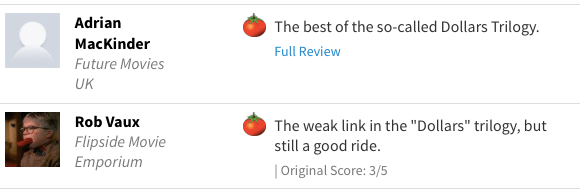
94%The Joys of Putting Different Reviews Right Next to Each Other
What the Public Say
“It’s a wacky and irreverent film, exactly the type of cheeky genre fare that you’d expect as the follow-up to a blatant act of plagiarism […] This irreverence is what makes the film fun, but it also never stops it from being intelligent. Like its predecessor was to a slightly lesser extent, For a Few Dollars More is a film about the value of life (often literally and monetarily) and the cost of our connections with other human beings (specifically men in this predominantly male society).” — Wes, Screening Notes

Sergio Leone defined the Spaghetti Western subgenre with A Fistful of Dollars, and some would argue perfected it with The Good, the Bad the Ugly, but in between those two he made this, my favourite of the trilogy. Leone’s trademark style tells a story whose scope is in the sweet spot between the first film’s one-town tale and the third’s epic narrative, with a pair of sparky heroes going up against a ruthless villain, and a nice twist in the tail.

#31 will be… Бонд зовут. Джеймс Бонд.
 When a warrior family are betrayed and killed, the surviving siblings seek vengeance.
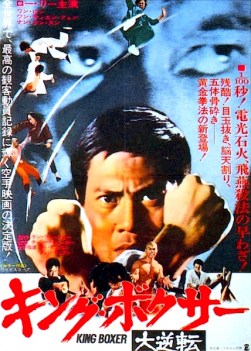 Released in the US as Five Fingers of Death, this popularised kung fu Stateside… before

 Some say The Five Venoms is
 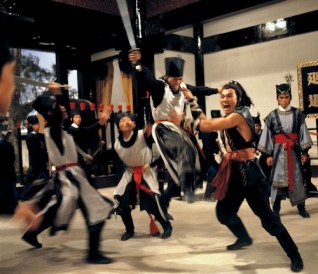 I keep reading things like “the concept of the five Venom styles is simply amazing”, or that “the mythology alone is exquisite”, but I just don’t buy it. There’s nothing wrong with it — it’s a decent setup — but to call it a “mythology” is bordering on grandiose. And whether it’s a full-blown mythology or just a high-concept setup, either way it’s not that incredibly mind-blowing a concept.
 I’ve observed before that the ’80s seem to be everywhere in film these days, and here’s another example: Turbo Kid is in every respect an homage to low-budget ’80s genre fare.
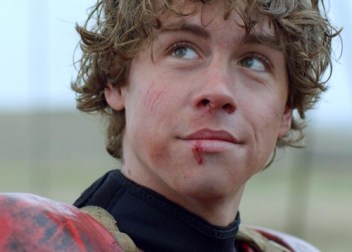 Then there’s the score, which is of course all ’80s synths, in a similar style to the score of
  After martial arts student Fang Cheng is killed protecting his master, the latter takes in Cheng’s infant son, Fang Kang, as his student. Years later, Fang Kang is bullied by his aristocratic classmates and treated as a servant by the master’s daughter, Pei, though he’s a better student than any of them. Eventually goaded into leaving, his fellows corner him, challenge him, accidentally lop off his sword arm, and leave him for dead. Kids, eh? Fortunately, Kang is found by orphan Xiao Man, who nurses him back to health. With the help of an old textbook, he learns to fight left-handed, which is handy because there’s a conspiracy underway to kill all of his master’s former pupils…
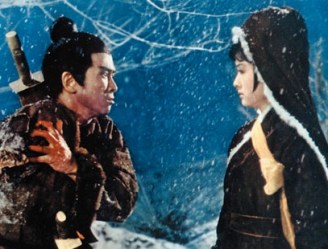 However, for me the film also worked very well as a drama, and even sometimes as a romantic drama. Fang Kang is an interesting protagonist. His lifestyle is torn from him, and rather than simplistically train to regain it or give up entirely, he battles with that decision. He returns to that way of life only to defend himself and his rescuer, and then out of a sense of loyalty to the master who raised him, but he’s also prepared to abandon the martial life to be a farmer… when the job is done, naturally. Jimmy Wang Yu, in a star-making turn, sells this character arc as well as anyone in a kung fu picture ever has. He’s also (somewhat) torn between two women, the kindly and supportive Xiao Man, and brat-with-a-heart Pei. While no one could truthfully call this a romantic picture, the love-triangle aspect also functions surprisingly well.
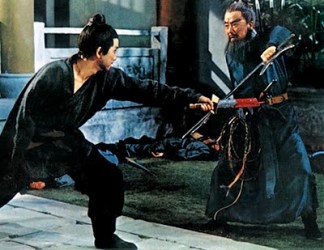 I disagree with that. Perhaps those lists are based on the abundance of action in these films, by which metric this probably has too much drama — though, as I said, it’s not devoid of fisticuffs and swordplay. Combine that with a solid story, engaging characters, and a brisk pace (even with its near-two-hour running time), and you have one of my favourite Shaw Brothers movies I’ve yet seen.

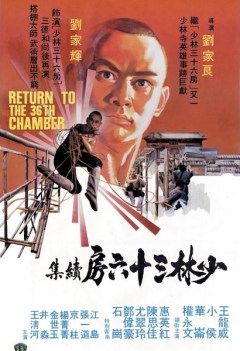 Con man Gordon Liu poses as San Te (Liu’s character from
  Most of mankind have become vampires, but the blood supply is running out and without it people mutate into monsters. Ethan Hawke’s scientist is developing a substitute, but when he encounters human resistance fighters he learns there may actually be a cure…
 100Films.co.uk