
Bennett Miller | 133 mins | streaming (HD) | 16:9 | USA / English | 12 / PG-13
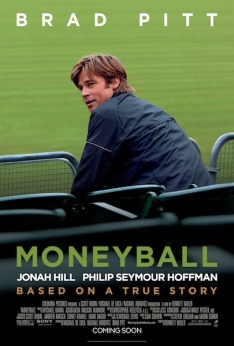 Based on a true story, Moneyball concerns the management of baseball team Oakland Athletics during the 2002 season. General manager Billy Beane (Brad Pitt) struggles to put a squad together due to a comparatively low budget for players, which has seen all his best ones drift off to richer contracts elsewhere. Fed up with the traditional scouting system, he recruits Peter Brand (Jonah Hill) to use statistical analysis to select a cheap team of quality players. The rest of his staff despair, including coach Art Howe (Philip Seymour Hoffman), who refuses to play the team as Beane and Brand suggest, which unsurprisingly leads to self-vindicating failure — until they force his hand…
So Moneyball is a movie about sports and statistics — a pair of topics that will bore some people to tears, while still others will enjoy one but not the other. Generally, I couldn’t care less about sport, but statistics? Well, maybe.
Unfortunately, despite what you might’ve heard, Moneyball is more about sport than statistics. Worse, it makes too few concessions to people who know fuck all about baseball. You can follow the general arc, but it’s like turning on a real game of any sport you know nothing about: you can discern some stuff, but the coverage is not being produced for you. At one point it cuts to a match and a caption informs us it’s the “bottom of the 9th”. I’m sure that means something to baseball fans, but I can tell you the rest of us haven’t got the foggiest. Is the “bottom” at the beginning or the end? Or somewhere in the middle? Or is it something to do with score rather than time? The 9th what? And is it the 9th of 9 or the 9th of 10? Or 12? Or 15? Or 18, or 25, or…? Or is it the fact it’s the 9th that’s significant here? Maybe there’s normally only 3 or 4 of whatever it is? For Moneyball as a movie in its own right, rather than some niche special interest thing, this attitude is a drawback.
 Problems extend beyond the sporting specifics. It’s quite some way into the movie before it gets stuck into the meat of the plan working, and before that it often throws in asides that meander around through Beane’s earlier playing career and current family life. The former has some bearing on the plot, though feels inadequately integrated — as one flashback it might work, but as a series of them it’s not enough to constitute a parallel story. The latter, his family life, provides character texture, but it’s slight, uninformative, and ultimately unnecessary. You could cut it and the film would lose nothing.
Moneyball was going to be directed by Steven Soderbergh, who apparently had some interesting ideas about how to present the wealth of statistical material — ideas that were too interesting for Sony, as it turned out, because they shut down production days before shooting was due to start and kicked Soderbergh out. He was replaced with Bennett Miller, who previously directed Capote, which was fine, and later did Foxcatcher, which I didn’t really like (I gave it 4 stars, but my review reads more like 3 and that’s how I remember it). I’m beginning to dislike the guy. According to IMDb his next project is A Christmas Carol, because we really need another version of that.
On the bright side, Soderbergh’s departure was when Aaron Sorkin came on to write a new version of the screenplay. Swings and roundabouts, eh? But this does not feel like a film written by Aaron Sorkin. Where’s the sparkling dialogue? Where’s the impressive structure? The former is perfunctory and functional; the latter is, if not a mess, then certainly lacking the rigour of his other work. Apparently Sorkin only agreed to do a re-write if previous screenwriter Steven Zaillian kept a credit, because Sorkin felt the script was great  and didn’t need any work, which probably explains why it’s not so Sorkin-y. Zaillian is not a bad writer — his credits include Schindler’s List and Gangs of New York, both of which are in my 100 Favourites, and the US remake of The Girl with the Dragon Tattoo, which I gave full marks — but I wouldn’t say he has a unique voice. Moneyball’s screenplay is fine for what it is, but it doesn’t have that frisson that Sorkin brings.
Baseball doesn’t interest me in the slightest, partly because I’m not interested in much sport, partly because I’m not American. So I watched Moneyball for three reasons: one, because it seemed like it might be more about the stats than a traditional sports movie. It’s not. Second, because it was written by Aaron Sorkin. But the screenplay displays little of his usual verve. And third, because it’s a Best Picture nominee from this millennium and I’m intending to tick all of those off eventually. In that respect, at least, it was a success — of course, it couldn’t fail to be.

 You wouldn’t think the 2008 financial crisis would make good fodder for a comedy-drama — it’s both too complicated and too grim — but
  The narrative is laden with concepts that are so complicated even people within the industry don’t properly understand all of them (however did the market fail?!), but the movie nonetheless attempts to explain them in an accessible way. It’s half successful: you kind of understand them at the time, about enough to follow along, but the chances of remembering them later are next to naught. One of McKay’s tricks to engage us with these explanations is to wheel in random celebrities to deliver analogies. It’s a fun idea, though it’s success is debatable — I mean, I’ve just about heard of Selena Gomez, and I guess the “famous chef” that turns up must have a TV show in America, or something, maybe? Yeah, the ‘names’ he’s chosen are going to date this movie far more than its 2008 setting ever will.
 Though the conceptual explanations may fade almost as soon as you’ve heard them, what does stick with you is how it all ends. Essentially, the financial industry that destroyed peoples’ lives in pursuit of never-ending profit not only got away with it, but they actually started doing the same stuff all over again, just with new acronyms. What’s even more sickening is that people are clearly aware it’s going on — I mean, we’ve been told as much in an Oscar-winning movie — but they’re still doing nothing about it.
 Unlikely stories can make great movies, or at least fun ones, and if this isn’t the former then it’s largely the latter.

 Score:



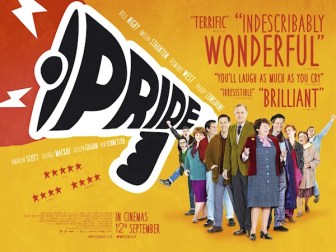 I don’t know if the true story behind Pride was big news back when it all actually happened in 1984, but I hadn’t heard of it until the film came along. For those who’ve still missed it, it’s about a group of gay activists deciding to form a group, LGSM, to support the striking Welsh miners — two groups who were poorly treated in one way or another by ’80s Britain.
 whose dancing display has to be seen to be believed. Bill Nighy and Paddy Considine are understated as quiet, hesitant characters who have inner steel, and Jessica Gunning makes a similar impact as a housewife who is completely emboldened by the activism.
 There are two stars in Mike Leigh’s biopic of famed British artist J.M.W. Turner: Timothy Spall, grunting his way through the title role with a deceptively layered realisation of an apparently simple but deeply complex man; and Dick Pope’s cinematography, which makes almost every frame look like a rich landscape painting, so that you feel you can almost see the brushstrokes.
 sometimes lack clear relevance (recognisable-off-the-telly actors turn up silently for what we’d call cameos if they were more famous). It creates a measured pace that is surely not to every taste, especially over the long running time, though personally I only found it sluggish towards the very end.
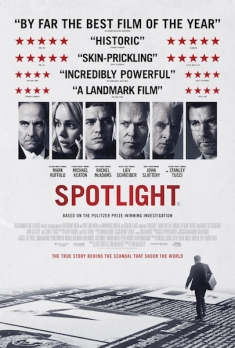 The most recent Best Picture Oscar winner tells of how the Boston Globe’s investigative journalism unit, the eponymous Spotlight team, exposed the widespread sexual abuse of children by the local Catholic Church — and, just as shockingly, the way the institution itself swept this under a rug for decades. As a film, this story is effectively a conspiracy thriller: a team of journalists expose a wide-reaching criminal cover-up within a respected and powerful institution. If it were fiction, you’d struggle to believe it, the scale of the conspiracy so vast that the very notion of it would be implausible. So it’s all the more astonishing — and horrifying — that it was real. And, as the closing title cards reveal, far larger than the Spotlight team realised even when they went to print.
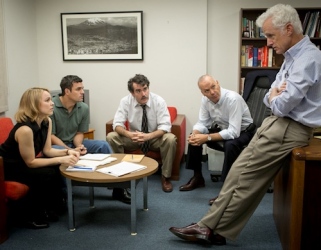 Instead, it lets the story and the events speak for themselves, with the screenplay being the real powerhouse here. On that scale the directing isn’t even in second place. That’d be the performances, as the actors carry the delivery of information while still feeling like human beings pursuing an investigation, rather than mere narrators of what they discovered. McCarthy’s work is therefore the kind of helmsmanship that wouldn’t attract awards attention, except maybe by association with the film’s overall acclaim (he did get nominations, but the cynical side of me doubts awards bodies genuinely appreciated the qualities of what they were watching). Nonetheless, awards are not the be-all-and-end-all, and the low-impact style was surely the right way to go. This is a tale bigger than auteurist showboating, and McCarthy handles it with appropriate respect.
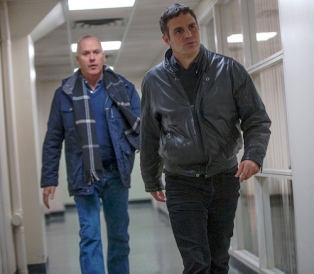 this is also perhaps where the film’s only egregious bum note comes in: Ruffalo’s shouty speech about how they need to go to press now, which was naturally used across all the trailers and clips. It feels like that is precisely what that speech was designed for — that it was written, directed, and acted with the “here’s our big dramatic trailer moment” in mind. It’s not entirely out of character in context, but it is a bit much.
 So was it the best film of last year? Perhaps that depends what you look for in movies. As much as I think the understatement fits, I also think it’s what stops it from being as cinematically exciting as, say, the visually-driven hyper-kinetic storytelling of
 The debut feature of Terrence “four films in 30 years” Malick comes with a tagline-cum-plot-description so good I’m just going to quote it wholesale:
 the leads start out from bleeds outwards into their time on the run, which Holly romanticises but feels constantly grotty. I suppose a film about killers shouldn’t be nice, but maybe this is why the time in the treehouse stood out for me — a little oasis of pleasantness; a break from the insalubriousness of the rest of the picture.
 Written by Aaron Sorkin and directed by Danny Boyle, with a name cast and plenty of awards buzz, this biopic of the eponymous tech genius was an inexplicable box office flop on its release last year — proof if proof were needed that box office does not equal quality, because I thought it was thoroughly excellent.
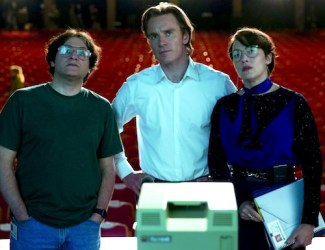 Boyle’s decision to use different film formats for each section — 16mm, then 35mm, then digital HD — helps delineate the eras and, in a way, reflect the products being launched (though I’ll instantly concede that last point may be a bit of a stretch). I imagine it’s too technical a concern to be noticed by your average filmgoer, but I’m sure it must have a subtle effect; and for those of us who are so minded to spot the change, it’s kinda fun and effective. Shot by Alwin H. Küchler, each section has its own charm, from the warm fuzziness of 16mm, to the gloss of 35mm, to the precision of digital. This is a mighty fine looking film, and while modern tech meant the 1080p Amazon Video stream I was watching looked darn near Blu-ray quality, I’m still miffed I didn’t just go straight for the disc, because now I’m going to have to pay for it again at some point.
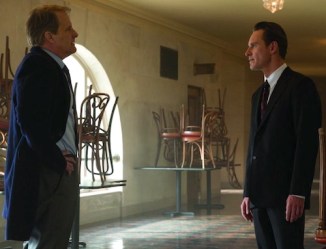 The dialogue they’re delivering is so Sorkin. Rearrange character names and you could drop this into
  In a similar vein, I suspect it would make a great companion piece to
 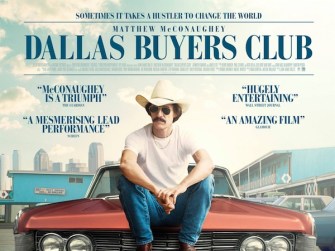 Every time I see a trailer for Dallas Buyers Club at the start of another Blu-ray I think, “that looks really good; I should watch it”. Then every time I get near watching it I think, “that sounds quite worthy and/or grim; maybe not right now”. So I guess kudos is due to Amazon UK for removing it from Prime Video
 That’s just some of what’s going on, anyway, because there’s also Ron’s growing acceptance of the community he finds himself a part of, especially after he’s ostracised from his former friends who assume he’s gay; there’s his business partner, trans woman Rayon (an also-Oscar-winning Jared Leto), who has drugs and familial problems of her own; and the doctor (Jennifer Garner) who battles her conscience over the drug trials and Ron’s less-than-scientific but effective methods. If this makes Dallas Buyers Club sound unfocused, it’s more that it’s got a lot of different aspects to examine. It’s not just about narrating what really happened, either, because Leto and Garner’s characters are fictional.
 McConaughey is very good as Ron, though I’d wager he won the Oscar as much for his extreme weight loss as his actual acting. He was up the same year as Chiwetel Ejiofor for
 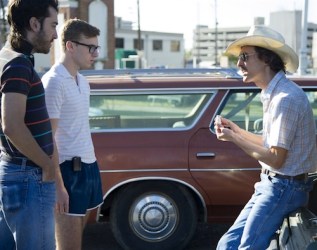 For all the heaviness of the topics it touches on, the film isn’t without the humour that made its trailer so attractive. That said, if you’ve seen the trailer you’ve seen most of that material, and in a more condensed and highlighted form, too. It almost makes it look like a heist movie — how this clever chappy pulled the wool over the authorities’ eyes with his vicar costumes and amusing way of filling out forms — but that’s just a small part of the film; and, actually, those tricks often go wrong or flat out don’t work, which is not the heist movie way.
  100Films.co.uk