
Christopher Cain | 102 mins | TV (HD) | 1.85:1 | USA / English | 18 / R
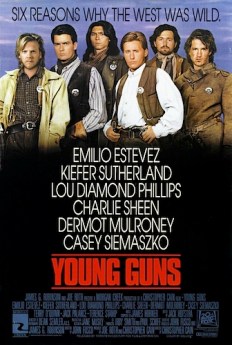 Way back in March, the ever-excellent Colin at Ride the High Country covered a series of films about Billy the Kid, including this late-’80s effort. To quote from the comments section: “I would have been in that target demographic too when I first saw it… around 20 years old or so… I wonder how it would play now to an audience of a similar age.” Well, as someone who watched it when closer to 20 than 30, I shall step up to the task.
Considering this is ‘the Brat Pack Western’, one might well expect a modernised, sanitised West; something like Wild Wild West or Jonah Hex; something rated PG-13. Instead the film seems to have begun life as a serious attempt at a Billy the Kid biography, right down to bloody violence that earns it an R in the US and even an 18 over here. This intention seems to survive — bar a music-video-styled opening, a couple of lines of dialogue, and the wailing ’80s guitar score — but how successful it was is another matter.
I don’t know about historical accuracy in this case, not knowing much more about Billy the Kid than I’ve gleaned from… well, this film, and Colin’s series. Playing loose with facts can work in a film’s favour — as many a filmmaker has noted in the past, they’re making entertainment not documentary — but it can be galling to one who knows the truth. In the way it presents events, this one feels accurate — things like characters appearing only to die immediately; the kind of thing that doesn’t sit well narratively but might be the truth. If it isn’t accurate, this is all the more dangerous: there’s a difference between changing facts so something works as a film narrative and presenting the wrong thing as the truth. 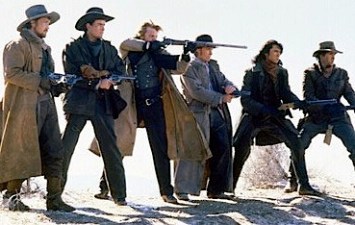 Though if someone was planning to use Young Guns to research the real-life facts of these events, more fool them in the first place. Wikipedia says (without citation) that “historian Dr. Paul Hutton has called Young Guns the most historically accurate of all prior Billy the Kid films”. We’ll leave it at that for now.
As a film in itself, then, the narrative is a bit scrappy. Our heroes wander around killing some people, racing about the country sometimes for no discernible reason and with chunks apparently missing. For instance, they head to Mexico just for the challenge of it — we’re told it’s a hard road, laden with bounty hunters out to get them — but the film cuts from their decision to make this journey to their arrival with a rapturous welcome. Eh? I have no idea if this stuff was shot and cut for time, or if someone needed to have a long hard look at the screenplay. Or even a quick glance.
The finale is also implausible. One assumes the characters who survive must have survived in reality and the others must’ve died, but the way it’s played here it doesn’t make a great deal of sense. How did they defeat those overwhelming odds? How did they pull off that escape? It might pass muster with The Hero Is Invulnerable movie logic, but not as a claim to depicting real-life events. 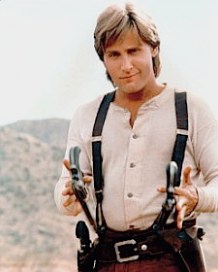 And that’s without mentioning the overuse of dated slow-motion that descends upon its eventual climax.
As for the Brat Pack themselves, Emilio Estevez’s version of Billy the Kid seems to descend during the film from above-himself hot-head out for revenge to giggling loon. This isn’t really character development, more as if halfway through Estevez realised how much fun it was to laugh and so kept doing it. Charlie Sheen gets the honour of (spoilers!) being killed off halfway through. As one of the most recognisable members of the ‘Brat Pack’, here playing the leader of the gang, it works as an effective surprise.
Kiefer Sutherland has the best part though. He’s given the only subplot that approaches anything meaningful and also almost all the best lines (not that there are many). The remainder go to Jack Palance, who isn’t around enough to create a great villain but makes a commendably good hash of it in his brief time. Equally brief is Terence Stamp’s part. I have to say I’m no fan of Stamp — everywhere I’ve seen him he seems awkwardly flat, often phoning it in — but here he’s not bad. This may be because his role’s quite small and relatively subdued as it is. Patrick Wayne appears as Pat Garrett for a knowing cameo; the kind of small role which any viewer can tell Means Something, but if you don’t know what he means there’s no explanation proffered (until the final scene, anyway, when Sutherland narrates a “what happened next” for the surviving characters).
 Young Guns is not a particularly likeable film, managing to miss both its potential target audiences: it’s not serious-minded enough for Western enthusiasts, let down by the Brat Pack cast and (it seems) historical accuracy; but it’s surely not fun or modernised enough to appeal to a younger (or younger-minded) crowd. Though clearly it did well enough as it spawned a sequel two years later. I didn’t hate it, I just didn’t particularly like it.

Young Guns is on Channel 5 tomorrow, Sunday 13th November, at 11:15pm.
Young Guns is on 5USA tonight, Tuesday 30th December 2014, at 9pm. It’s sequel, Young Guns II: Blaze of Glory, follows at 11pm.
After four years and three months doing 100 Films, this became the first new film I’ve seen which has a title beginning with the letter Y — the last unaccounted-for letter. Hurrah!
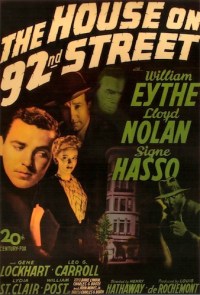 Here’s an unusual one from the pantheon of film noir. These days we’d probably call it a docu-drama, though thankfully there are no talking heads, but there is a factual voiceover narration. The story, we’re told, comes from the FBI’s files and is based on a real case —
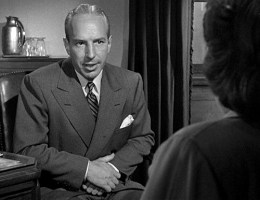
  how they really work and investigate a case. At the time I imagine this was a fascinating procedural; now, we’re all a bit more familiar with how such things go, but it still works as an historical document.
 Might be because no one ever knew they were making a film noir, eh? How can you expect something to conform to a set of rules that were only defined after the fact? Hathaway and co didn’t fail at making a noir, they just made a film that doesn’t fit the later-defined template as well as the films used to define said template. I know, four words from some other online critic hardly merit a whole paragraph, but it does bug me when people write daft things like that.
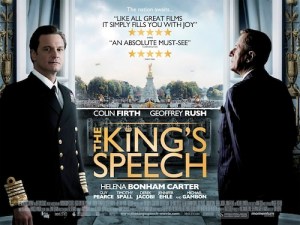 Britain seems to be having a grand time of it at the Oscars of late — following
  And if the authors of the book missed out on an on-screen credit, at least they’ve had plenty of tie-in promotion (including a featurette on the Blu-ray).
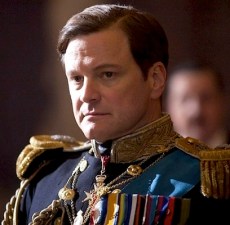 but Firth presents a much more convincing stammerer than you usually see (I have this on good authority from someone who knows several stammerers). It’s not just the Oscar bait element he nails though, as he also brings truth and gravitas to the rest of the role. It’s a complex part — he’s a man who has the throne unexpectedly thrust upon him, at a transitional time for the monarchy, as the nation is launched into one of its most difficult periods.
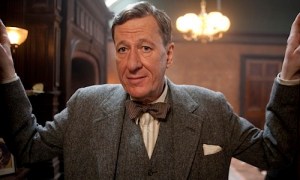 Guy Pearce as the youthful, playboy-ish David / King Edward VIII; Timothy Spall doing a decent Churchill impersonation, which sparks one nice moment just before the titular speech; plus
 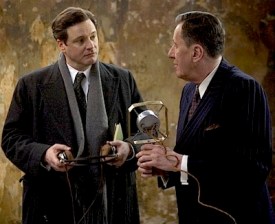 It looks odd, and to be honest I’m struggling to place my finger on what exactly is odd about it, but it’s slightly off-normal, slightly stylised, and I quite like it… but considering Momentum seem to have ballsed up the transfer to at least some degree, I’m not sure how much the oddness is a choice of Hooper and DoP Danny Cohen and how much a dodgy transfer/compression. Screen-grabs of the US release (which is at least 1080p, but not wholly praised in other areas, it seems) don’t help much. But as I said, I’m no real expert on Blu-ray quality, so don’t take my word as gospel by any means.
 Catfish is a documentary (probably — we’ll come to that) in which 20-something Nev falls in love with a girl somewhere else in America over the internet. He and his friends become suspicious that she’s not who she claims and set off to find out The Truth.
 Before I get spoilersome, then, let me say this: you will probably guess where it’s going. Even if you’ve not had it in some way revealed (however little of it) before you watch, early scenes will lead to the obvious conclusion: why am I being shown this if it doesn’t go somewhere? And what’s the obvious place it’s going to go? I think most viewers must guess. But I think many — probably even most — will not guess precisely where it ends up; the exact nature of the truth it finds. So this is not as much of a Thriller as it’s been sold in some quarters. It has suspense, certainly, and it has mysteries that have answers… but there’s not some dark secret at the heart of it all; instead, there’s a painful emotional situation. Already I’m saying too much.
 and/or satire, I still think most people fundamentally believe what they see in a documentary (or they read in a newspaper) to be the truth.
 The allegation that it can’t be real because they happened to film everything that happened is nonsense.
 (it’s still on track as the best film I’ve seen in 2011), Catfish probably has more to say about the actual impact of Facebook on our lives than Fincher/Sorkin’s biopic does.
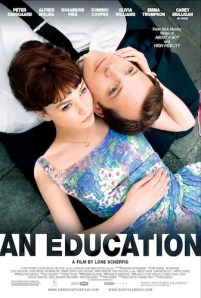 It seems that every year, come Oscar season, there’s a British-made film we’re led to back so thoroughly that it gains nothing but incessant praise from every (British) quarter. Just to look at recent years, from the 2006 selection it was
  Based on a true story, the film tracks 1960s schoolgirl Jenny (Carey Mulligan) as she falls for an older man (Peter Sarsgaard) who represents a culture- and glamour-filled escape from her drab suburban life and its focus on getting a place at Oxford. It’s a romance and a coming-of-age tale, albeit one with a more naturalistic bent than your regular offering; more down-to-Earth and British than either something Hollywoodised or American-indie-fied. There are, perhaps, few massive surprises in the plot — anyone who doesn’t guess this won’t end well has somehow failed to encounter a “schoolgirl falls for glamorous older man” story before — but Nick Hornby’s screenplay and Scherfig’s direction execute it all with admirable conviction. You don’t feel like you’re watching something familiar.
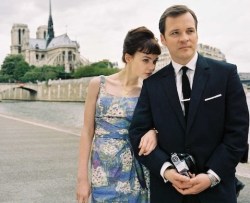 I’ve read some complain there’s no ending. I can only presume they walked out of the cinema or stopped their DVD before the film reached, y’know, the end. Sometimes I appreciate how people can criticise the lack of an ending, even when I disagree (see:
 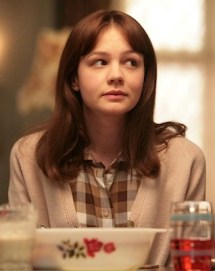 The film hangs on Carey Mulligan, justly nominated for her performance. Quite aside from whether the performance is awards-worthy or not, it’s effortlessly watchable. Mulligan is exceptionally easy to fall in love with — if you haven’t already when she was Ada Clare or Sally Sparrow, I’m sure Jenny Mellor will enchant you. On the other hand, some have found her character too pretentious or naïve — maybe your own background will dictate if you see these negative traits. Jenny is probably a little of both, but I wouldn’t say she’s wholly naïve and I wouldn’t say she’s pretentious, exactly — she’s clever, and she wants to experience the world. What’s wrong with that?
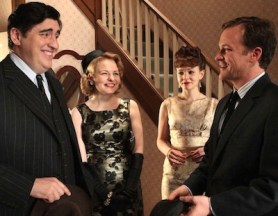 It’s slightly remiss of me not to mention Peter Sarsgaard, what with him being the other half of the film’s romantic relationship. He’s good, his Colin Firth-esque accent pitch-perfect, but while he’s spot on in the part — absolutely no complaints — I can’t think of any scenes where there isn’t someone else (usually Mulligan or Molina) grabbing the spotlight.
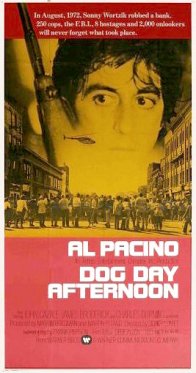 On August 22nd 1972, John Wojtowicz and Salvatore Naturile attempted to rob a Brooklyn bank to raise money for Wojtowicz’s male wife to have a sex change operation. The ensuing hostage situation was watched live on TV by millions of New Yorkers. If you made it up people wouldn’t believe it — especially in the ’70s — which is why this film, closely based on those events, strives so hard for naturalism. And it succeeds, and then some.
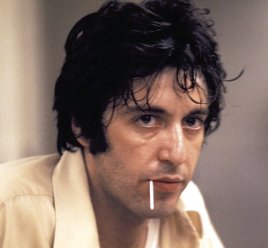 to try to circumvent built-in prejudices that would’ve adversely affected an audience’s reaction too soon. It still works now — it’s not a twist, per se, but it is likely to change one’s perspective on the film and its characters mid-flow, which is always interesting.
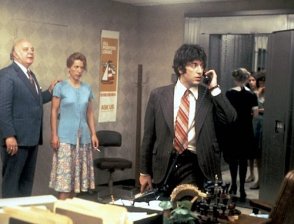 In trying to get a handle on the real Sonny when he was starting on the screenplay, Pierson talked to various people who knew him, but struggled to reconcile their conflicting accounts of the same man. The link he found was that Sonny was always trying to please people, and that’s what he used: in the film, he’s not just out for himself or his boyfriend, but also trying to placate and please his hostages, the police, the media, his partner, his mum, his other wife… Pierson and Pacino do indeed make him a different man to all of them, and this is one of the reasons Sonny is such a great character and a great performance: he’s genuinely three-dimensional. All of us behave differently, to some degree, when we’re with different people — we don’t necessarily realise it, because they’re all facets of the same us, but we do it — so to put that into a character is to make him real.
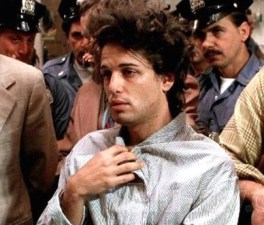 throughout the film trying to avoid turning any of these unusual characters into freaks, and Sarandon pitches it right. He plays the truth of a conflicted, confused character; a man who is perhaps easily led but hard to please, I think. As with the rest of the cast, the little touches he brings — such as starting a sure-to-be-emotional phone call to a man currently in the middle of a tense hostage situation with “so how are you?” — sell the reality of the piece.
 of today’s grainy shakycam stuff, this just feels real; the heart and truth of it come through, not the surface sheen of it being documentary footage. That’s more important.
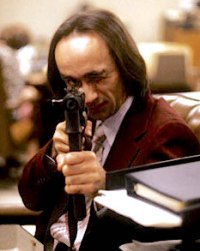 Pierson’s screenplay won at the Oscars. The film was also nominated for Best Picture, Actor, Supporting Actor and Editing, but this was the year of
  The film treads a delicate line between drama, comedy and thriller, but doesn’t once tip too far in any direction. It’s got several genuine laughs, but none compromise its serious side or claim to reality — it’s tense and touching too. Anyone else making a film about an extraordinary situation, be it a true story or from the mind of a crazed writer, would do well to look at Lumet’s work here.
 Fresh from winning three BAFTAs (out of six nominations), the Aaron Sorkin-written David Fincher-directed telling of the birth of Facebook arrives on DVD and Blu-ray in the UK today. Notice that Sorkin and Fincher have equal-sized billing on
 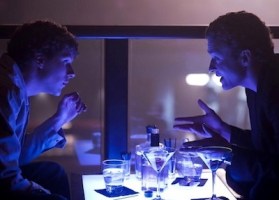 Conversely, look at all the film’s conversations. Let’s draw on one that’s discussed in the making-of material, the scene between Mark Zuckerberg and Sean Parker in the club: as Fincher says, he could’ve had a Steadicam endlessly circling them or something similar to make it seem Fast and Hip, but in reality you need to see the conversation, and especially Mark’s reactions, so instead it’s just a good old fashioned shot-reverse-shot. For all his visual prowess, it’s understanding this need for simplicity and (g)old standard techniques when appropriate that Fincher has had a handle on throughout his career.
 Also, that it’s going to be funny and exciting. That style colours the film: fast talk, complex talk, but funny. As people admit in the special features, this is a very dialogue-driven film. Don’t misunderstand me, though: the dialogue scenes are not one-note by any means — there are slow scenes, and even scenes without any dialogue — but anyone anticipating the full implications of “Screenplay by Aaron Sorkin” will not be disappointed.
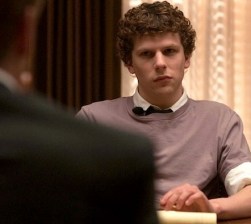
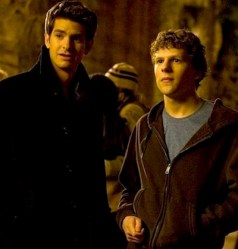 Nominated but unvictorious were stars Jesse Eisenberg and Andrew Garfield, for Best Actor and Best Supporting Actor respectively. They’re not the only ones deserving praise though, because every performance is bang on. Eisenberg manages the enviable feat of making Mark a plausible genius, an entertaining friend and an absolute bastard, not in different scenes but, often, all within the same line of dialogue. There are lines that made me laugh out loud while at the same time thinking “what a [four-letter name of choice]”. That’s Sorkin’s writing too, of course, but Eisenberg nails it.
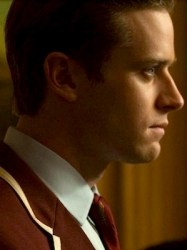 Then there’s Justin Timberlake. I can understand why people would be wary of such casting, and playing the bad boy/playboy part of Napster creator — and destructor — Sean Parker might not seem too much of a stretch. Actually, there are moments that require a little more than that, and Timberlake’s up to the task. Armie Hammer tackles the dual role of the Winklevoss twins. You can’t tell which is which, beyond that in any given scene one will be hotheaded and one calmer. I expect it’s always the same one that’s whichever, but as they both look exactly the same…
 it’s set to an addictive electronic rendition of In the Hall of the Mountain King, and though the whole sequence is a showpiece, that’s as much thanks to the music as the visuals. These are just two specific examples — throughout, the music excels.
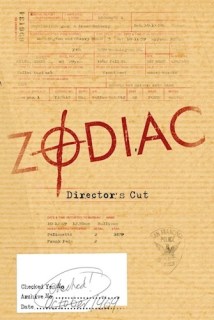 How time flies — I’ve been meaning to re-watch Zodiac ever since I
  As the changes have little impact on the film’s fundamental quality, the points in
  but the sheer weight of evidence the other way seems to leave little room for doubt. More so, then, is that the murders are done with before the halfway mark. That’s because it’s still following the story of the investigation, true, but a lesser filmmaker could have weighted it differently, rushing through Graysmith’s later enquiries in a speedy third act. Instead, Fincher’s focus throughout is on the people looking into the crime, and it’s as much the tale of their obsession — and what it takes to break their obsession, be it weariness or pushing through ’til the final answer — as it is the tale of a serial killer.
 and place-and-time subtitles too, but hey, sometimes you need specificity.
 There’s probably a worthwhile biopic to be made about Verity Lambert. In 1963, she became not only the youngest-ever producer of a BBC television programme, but the first female one too; the programme she was charged with launching was
  Before I set off really critiquing the film, let’s just remember this: it’s a student effort. In that context, I’ve seen far worse — heck, I’ve been involved in the production of worse. Cowell and Guy have set themselves an almost Herculean task by choosing a period tale, which obviously necessitates all sorts of extra effort in terms of costumes, locations, dialogue… And to make it worse, they’ve chosen the ’60s, evoked so faultlessly in almost 40 hours (and counting) of
  which he accepts with merely a muttered “damn” when she leaves. Sorry, what? There’s nothing believable in that scene, never mind accurate.
 Technically, the piece is just as much a mixed bag. Stephen Cheung’s direction picks out some decent angles, avoiding the flat point-and-shoot trap some student filmmakers are apt to fall into, while the sepia-ish wash helps the period tone and adds a small amount of welcome gloss. The editing is a little rough around the edges, particularly at scene changes and toward the end. YouTube claims it’s viewable in 1080p — whether something went wrong in shooting, editing or at YouTube’s end I don’t know, but it isn’t that high quality. (This last point doesn’t impact on my score at all, it’s just an observation.)
 Robin Williams surprised everyone when he started appearing in films as a serious actor in the early ’00s. Previously — and, if you’ve seen him on chat show in recent years, still — an outrageous funnyman, Williams turned in excellent straight performances in the likes of
  Still, Robin Williams is excellent, once again displaying his recently-found gift for serious acting. His character’s homosexuality is nicely handled too. It seems to have overshadowed the rest of the film for some viewers, but I’m confused as to why. Perhaps precisely because it doesn’t come out screaming “look, look, he’s gay! Isn’t that edgy!”, leaving it as just a fact of his character — and one that’s only important because his personal life is part of the story — means some viewers are so shocked by their own realisation of his sexual orientation that it gets in the way for them.
 this “but it happened!” logic seems to allow the filmmakers to get away with not offering adequate explanation. Then again (not sure how many “other hand”s I’m on now), it’s just like real-life: sometimes things can’t be explained in a rational way. Some people will have a problem with that from their films; sometimes I’m among them, but in this instance I think there are enough explanations and ambiguities. My problem was more that getting to them seemed to provide nothing, particularly as, being twist-free, they only confirmed one of the options that had been supposed an hour earlier.
 100Films.co.uk