
Sam Liu | 77 mins | Blu-ray | 1.78:1 | USA / English | 15 / R
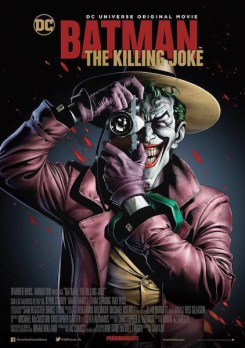 Alan Moore and Brian Bolland’s 1988 graphic novel The Killing Joke is one of the seminal works of superhero comic books’ move into seriousness in the ’80s, sitting just behind the likes of Watchmen, The Dark Knight Returns, and Batman: Year One in terms of significance. It’s also seen by many as the definitive story about Batman’s nemesis, the Joker, and has influenced the live-action interpretations of both Jack Nicholson & Tim Burton and Heath Ledger & Christopher Nolan. It is not without controversy, however, thanks in large part to its treatment of Barbara Gordon / Batgirl; and Moore has since semi-disowned it, saying it has no intrinsic value because it has nothing to say about real human beings, only commenting on the comic-book-y relationship between Batman and the Joker.
Now, it finally makes its way to our screens in animated form. What took so long? Well, it’s dark, and to do it justice the makers needed the potential to make it R-rated. Given permission to do so by Warner, they’ve done just that. So here we have a very faithful adaptation of the graphic novel… but it’s a bit short, so there’s a 28-minute prologue stuck on the front. Designed to ameliorate some of the issues people have with the original book, it’s actually only made things worse, containing brand-new controversial elements all of its own. Oh dear.
In this new segment, Batgirl (Tara Strong) and Batman (Kevin Conroy) find themselves on the trail of Paris Franz (say it aloud… or don’t), a young upstart who wants to take control of his uncle’s organised crime operation. Once that business is dealt with, 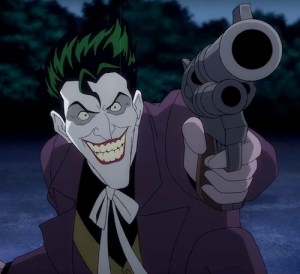 we get to the familiar meat of the story, where the Joker (Mark Hamill) decides to prove a point — in a violent and twisted fashion, naturally.
To really discuss where this adaptation of The Killing Joke goes awry, I’m going to have to stop being coy about spoiling a 28-year-old comic book that had lasting ramifications for Barbara Gordon’s place in the DC universe. Also, spoilers for this new film, too. You have been warned.
So, for those not in the know or who would like a recap, the Joker’s plan is to prove we’re all just one bad day away from going insane like him. The target of his experiment is Commissioner Gordon (Ray Wise), and he begins by shooting his daughter Barbara in the spine, paralysing her, then taking photos of her naked to torment the Commissioner with later. (The actual photo-taking isn’t depicted in the comic or this film, but the images are hinted at later on.) This is problematic for a number of reasons, not least Barbara’s lack of presence in the story as anything more than a pawn to torture her father.
The film’s solution is to begin with a standalone Batgirl adventure. Not an inherently bad idea — it could make her a more rounded character; someone we care about for herself, not just a minor victim in some other game. However, screenwriter Brian Azzarello (and, presumably, director Sam Liu and executive producer Bruce Timm) have tried to do this by making her horny for Batman, and have that infatuation actually consummated in an al fresco rooftop sex scene (not graphically shown, but the film is unequivocal about what happened). 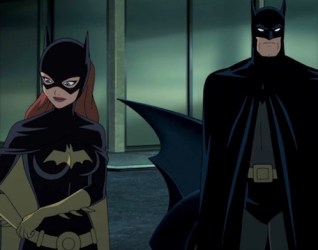 To say the least, this doesn’t seem like the best way to go about making her an independent, rounded human being — it comes off like fan service. No, worse: fan fiction. A scene earlier on where she explains her Bat-infatuation to her gay best friend is presumably meant to suggest a genuine motivation for the eventual sexy times, but it all comes across as a great big excuse.
To top it off, it in no way informs the adaptation of The Killing Joke that follows. It makes nods towards some of the thematic concerns of the main story, but, structurally, it’s not part of the same film at all — there’s a fade to black & fade back in that really signals the end of one production and the start of a new one; the end of an opening short film and the start of the feature presentation. Only the ‘feature’ is far too short (44 minutes before credits), so that ‘short’ is clearly there to bulk up the running time.
The titular adaptation that follows is arguably faithful to a fault. If you’re seeking to make it feature-length, would it not have been better to expand the story out and examine some of its points more fully, even if the points you illuminated were about plot logic rather than themes — the original comic is very short and arguably a little rushed in places, so I think there’s definite room for expansion. In fact, while it might make sense to expand the role of Barbara Gordon for reasons of taste and social mores that have (not wrongly) since been projected onto the comic, from a purely narrative point of view the character who needs expanding is Commissioner Gordon. In the comics he’s a regular cast member, so it can afford to take as read his status as an “ordinary man” — or perhaps even a paragon of virtue, 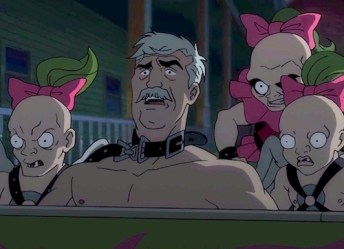 which brings its own problems to the story. But while he is a familiar figure in the Batman mythology, and so by extension to anyone who’s likely to watch this film, it’s also a standalone movie, not part of a series, and so it would be beneficial to establish his character somewhat before the Joker’s plan for him gets underway.
Heck, the film’s own special features even feature a psychologist talking about how it’s Jim Gordon’s story! While the Joker and Batman are the same characters at the beginning and the end, it’s Gordon who goes through a terrible ordeal and then has a choice to make. Yet in spite of that he’s treated as the fourth lead, at best, with the Joker and Batman taking precedence in the main adaptation and Barbara gaining masses of focus thanks to her half-hour preamble. It’s probably the twin desires to put the graphic novel on screen as-is and to in some way justify Barbara Gordon’s role in it that have led to this point. A less literal adaptation — one prepared to expand and elucidate the story, rather than just tack on an extra part at the start — could have found room to deepen both the Gordons.
Still, I suppose the literal faithfulness of the story adaptation will please purists. And reuniting the key voice acting cast from Batman: The Animated Series, arguably the all-time definitive screen interpretations of Batman and the Joker, is always fan-pleasing. Hamill, in particular, is fantastic, even when having to deliver Alan Moore’s typically verbose dialogue. However, one of the reasons the graphic novel is so beloved is Brian Bolland’s detailed, realistic, dynamic artwork. His draftsmanship transcends the actual narrative of Moore’s writing so that, however distasteful the tale being told, it looks incredible. Naturally, this animated adaptation loses that entirely, employing the standard “Saturday morning cartoon +” aesthetic of these DC direct-to-video movies. There are sound budgetary reasons for that, but it means the focus falls even more squarely on the narrative rather than the images.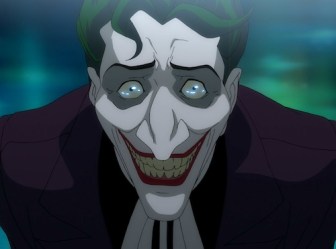 (It’s somewhat ironic, then, that (as ever) Alan Moore doesn’t receive an onscreen credit while Bolland does.) There are a handful of effective visuals here (the Joker’s gleeful face as he turns on the amusement park, its lights twinkling in his eyes), but they’re the exception to work which is adequate — good for what it is, even — but unremarkable.
For such a long-awaited adaptation, it’s difficult to conclude The Killing Joke is anything other than a disappointment. It didn’t have to be that way: I thought Warner made a good hash of adapting Year One, and an even better one of The Dark Knight Returns. While this adaptation does allow some of the book’s inherent quality to carry through, The Killing Joke was always going to be more problematic due to its content, and the filmmakers’ clumsy attempts to fix that have only made it worse. Shame.

Batman: The Killing Joke is out on DVD and Blu-ray in the UK today.
 The Batman v Superman Ultimate Edition has been available via various means for a month or more now, but has only hit disc in the UK this past week (and I waited for it, because I’m a good boy). This extended cut adds half-an-hour of material, give or take (comparing the two Blu-rays tells me the difference is just under 31 minutes;
  You may have read that the photographer with Lois in Africa is Jimmy Olsen, identified in the credits but not on screen in the theatrical cut. In this version he is named on screen, but that’s not the important part. More is done to establish why Lois is in Africa, what she’s hoping to achieve, and lay the seeds for why it’s all going to go wrong. This is achieved in such a short space of time that it seems ludicrous it was cut out, leaving theatrical viewers playing catch-up when a couple of extra moments would’ve explained it clearly. (Of course, there may be an element of re-viewing bias in this: I already know what’s happening so of course I cottoned on to everything sooner.) When things do go south, more material makes it explicit what happened — what the bad guys do to frame Superman, essentially. It’s possible some of this material was cut to achieve the PG-13 rating, but in doing so they left out bits and pieces that are referenced later, heightening the sense of confusion for theatrical viewers — how are we meant to know a woman testifying to a congressional hearing about “burned bodies” is a reference to events we just witnessed if we don’t see anyone burning any bodies?
 Less vital to the overall plot, but which certainly contributes to the titular conflict, is that Clark’s investigation into the Batman is seriously beefed up. It makes Clark/Superman feel like more of a leading character in a film that was, at least as originally conceived, his sequel. In some respects this storyline is a more understandable excision, because Superman’s dislike for the Batman and his methods isn’t entirely unclear in the theatrical cut. Equally, it does flesh it out better and connect up some of the dots, like why he intervened when Batman was trying to steal the Kryptonite at the docks (essentially: a Bat-victim’s girlfriend said Batman needed stopping. Maybe not a great reason, but hey, it’s a reason). It’s a case in point of how this film simply has too much going on. To create a workable version it’s had to be three hours long — that’s the length of two movies, and it does feel like two movies’ worth of material. Not back-to-back movies — you couldn’t cut it in two at the middle and be left with two independent films — but two movies that occur concurrently; intercut. I mean, there are even two big action climaxes, back to back.
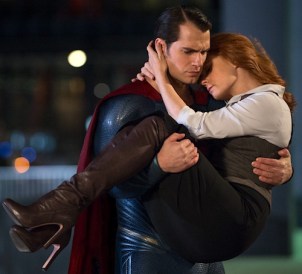 I don’t think it sinks to the level of spelling it all out slowly and carefully in case you missed it, but it does make it more explicit; and, as discussed, it does that by showing more of Lois’ investigation, so it feels like her role is more substantial too. She felt a little cursory in
 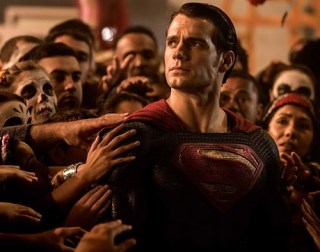 One thing that is pretty apparent about Snyder’s intentions is that he really wanted to make a Batman movie, and I suspect Man of Steel was his way in to getting to do that. Despite launching out of the events of Man of Steel, and engaging with issues of what it means to be Superman (therefore continuing MoS’s theme of “what would it be like if Superman was real?”), and having Lex Luthor as the main antagonist, BvS feels like a Batman-driven movie more often than it does a Superman one. Personally, I get it — I’m more of a Batman fan than a Superman fan too, so that approach warrants little complaint from me — but I can see why Supes’ fans would be miffed.
 Other, more minor changes in this cut include increased violence, though personally I barely noticed it. Some people seem adamant this should’ve upped it to a 15 certificate, but I think you can justify saying it stops just short of that. Quite what the MPAA saw that merited an R, I’m not entirely sure. More interesting to my weirdly-obsessed mind is that the film actually includes the “Ultimate Edition” title on screen, both during the opening credits and at the end (where it’s technically titled “Batman v Superman: Dawn of Justice Ultimate Edition” without any additional punctuation). How many other extended cuts actually change their title card to reflect that fact? Off the top of my head, I can’t think of any.

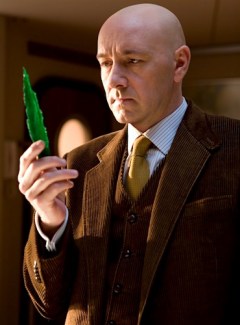
 The same summer that Christopher Nolan revitalised the Dark Knight with the critically acclaimed and commercially successful
 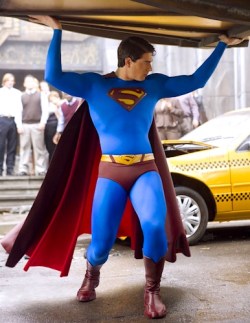 All of that was ten years ago now, since when plans for a sequel have been abandoned, the character has had
  often for good reason, but (a) sometimes a new telling is the right way to go, and (b) if you’re going to pick up a character mid-life, you still need to treat it as a new and standalone story if its immediate predecessor was released decades ago.
 that actually takes up the first half-hour-or-so. I can imagine an edit of the movie that begins on that plane: just a bunch of journalists observing the press demonstration of the new shuttle technology, when suddenly, inexplicably, it fails — they’re all going to die — then Superman turns up completely out of nowhere and saves them. Then you have the credits, which are immediately followed by Lex’s whole journey to the Fortress of Solitude, and only then do you get in to the stuff with Superman only having just returned, wondering what his places is now, and so on. Maybe lose the scene of him basically stalking Lois’ new family, though.
 The final thing this all makes me think of is the forthcoming Marvel Spidey movie,
 Finally done with most of these (still need to find time for the last two Legends of Tomorrows). One shouldn’t have that attitude to something one is choosing to watch, should one? I have a certain loyalty to Arrow, because they did a good job for seasons one and two, even if it’s waxed and waned since; but I’ve never really got on board with the adulation The Flash has received, and Legends of Tomorrow is mediocre to poor with regularity… though now and then they all exhibit flashes of worthwhileness. I rarely make the conscious choice to give up on a series (do it all the time by accident, though), but I’d consider abandoning a couple of these before the start of their next seasons… were it not for the ‘promise’ that they’re all about to be completely interconnected, at least for one almighty four-way crossover (with moving-to-the-same-network Supergirl).
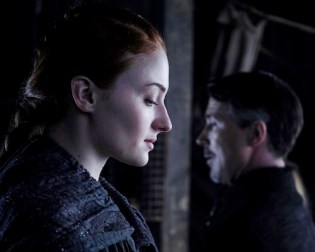 First up: The Door, surely one of Thrones’ best-ever episodes. That ending rather overshadows everything else (because wow, in so many ways), but before that there was Sansa being badass, proper development of Arya’s storyline, the hilarious play-within-a-play, a marvellous scene between Dany and Jorah, and a great moment for Varys, too. The week after’s Blood of My Blood was more about setting things up the second half of the season, which is an important role to fulfil but less dramatic in itself. A couple of surprise returns, though, including a big reveal for book readers (maybe).
 Sometimes it’s hard to separate what one might count as story development versus mere place-setting in Thrones, but at its best they can be one and the same, and episode seven managed that. Finally for now, No One did actually bring some storylines to a head, including some very long-awaited developments, particularly in Braavos. Throw in an equally-long-awaited reunion and a couple more unexpected returns, and you have a pretty satisfying episode.
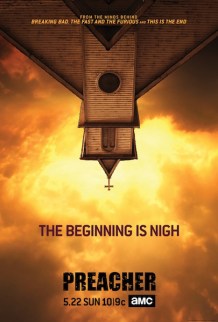 Sam Catlin of Breaking Bad and Seth Rogen & Evan Goldberg of… all those films Seth Rogen & Evan Goldberg have made (you know
  This month, I have mostly been missing anything I watch with my other half. It’s prime tennis season — eight weeks that starts with Geneva and flows through the French Open, Stuttgart, Nottingham, Birmingham, Queen’s, Eastbourne, and ends with the crowning jewel of all tennisdom, Wimbledon; all with near wall-to-wall coverage thanks to Eurosport, ITV4, and the BBC. It largely takes over the time we normally spend watching stuff together, so no room yet for the final seasons of Wallander or The Musketeers (not that we’ve watched season two yet, actually — oops), nor the just-finished fourth season of The Most Underrated Show On Television™, The Americans. Apparently it ended with “the Best Episode of TV So Far This Year”, according to one review’s headline (which obviously I can’t read because spoilers). Maybe in July.
 In the US Deadpool was, famously, rated R — which (for those not up on their international film certificates) ostensibly means you have to be over 17 to see it. In the UK it was rated 15, which is much more appropriate, because if Deadpool had a mind it would be that of a 15-year-old boy. Of course, plenty of grown men also have the mind of a 15-year-old boy, and that’s why it’s the highest-grossing R-rated movie (worldwide) ever. And I guess I must still have the mind of someone half my age too, because I loved it.
 It depends what you’re looking for. I think Deadpool’s makers set out to make a superhero film that was genre-aware and prepared to take the piss out of that, but I don’t think they were aiming to deconstruct superhero narratives. It might make Deadpool a less ‘intelligent’ movie than Kick-Ass, but it doesn’t stop it being entertaining.
 The film handles this really well: it’s not a non-stop commentary, but it’s also not isolated off in little clumps, like, “this had to be here but it’s kinda awkward to have him always talking to the audience”. It’s often used for irreverence, and I like a bit of irreverence. There are clearly some rules and/or considered choices with this fourth-wall breaking, though. In his commentary on the deleted scenes, Miller says that Reynolds kept wanting to pull the boom mic down from out of frame and use it to batter one of the villains, or something along those lines, but Miller thought this would be breaking the film’s rules. That’s a pretty fine line to tread — knowing he’s in a film, but not, like, using the fact he’s in a film… I guess it’s more of a “what feels right” set of choices than a little rulebook.
 One of the film’s best bits comes courtesy of that X-connection: stroppy teenage goth mutant Negasonic Teenage Warhead (excellent newcomer Brianna Hildebrand), and her immensely comic-faithful costume. Ironically, it’s not at all faithful to how NTW is portrayed in the comics (and you can find dozens of think-pieces about how the film changed her character and how that’s more than OK, if you’re so inclined), but it is generally like X-Men comic costumes, certainly ones that cropped up in the early ’00s. (I swear there was a Frank Quitely New X-Men cover showing a bald female in a costume really like NTW’s yellow-and-black X-Men uniform, but I can’t find it now. Maybe I imagined it.) Comic-faithful costumes are very much the MO of Marvel movies nowadays, but because the X-Men film franchise sprung from the “how do we make superheroes acceptable in movies?” period of the genre, the X-movies have never really done that before (though they do sort of, in passing, at the end of Apocalypse — I’m beginning to think we’re one day going to look back at that as a transition movie, assuming the next one goes super comic-book-y). I mean, this doesn’t really signify anything about Deadpool, I’ve just gone off on a geeky tangent.
 Speaking of which, I do feel like I should be mature enough to have grown out of loving Deadpool… buuuut tough. It’s fantastic fun. Though, it’ll be interesting to see how it holds up to re-watches. I’ve read reviews which point out it doesn’t have the substance underneath the jokes that Kick-Ass does (did I mention that already? I didn’t steal that point from someone else, nope, noooo sir), so while Matthew Vaughn’s film is completely enjoyable on multiple go-rounds, any enjoyment to be found in Deadpool will ultimately fade once the novelty has gone. I mean, that’s possible — literally, only time will tell — but there’s not necessarily anything wrong with a “first time is definitely the best” movie, if that first time is good enough. Heck,

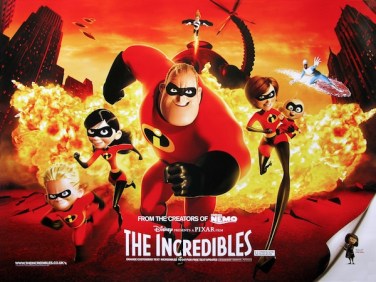
 Score:



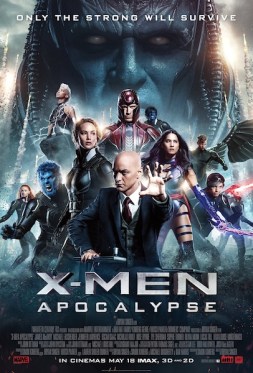 Despite fathering the modern superhero movie genre, the X-Men series always seems to punch under its weight at the box office (a point the recent
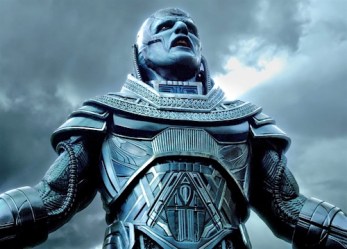
  That’s only the half of it, though. This is an X-Men movie, which not only means there’s an ensemble cast, but that it’s dedicated to constantly adding new members to it. This time around, we’re re-introduced to the ‘original’ team as teenagers: Scott Summers (Tye Sheridan) is the viewer’s “way in” to Xavier’s school after he suddenly starts shooting laser beams from his eyes; there he meets Jean Grey (Sophie Turner), a powerful telepath the other students are scared of because sometimes her dreams shake the school at night; Mystique rescues blue-skinned German teleporter Nightcrawler (Kodi Smit-McPhee) from a cage fight in Berlin, where he was up against Angel (Ben Hardy), who becomes one of Apocalypse’s Four Horsemen, alongside weather controlling street kid Storm (Alexandra Shipp) and Psylocke (Olivia Munn), who can create blades of energy with her hands. And there’s also Jubilee (Lana Condor), who has bugger all to do. Jubilee was a major character in the animated series, and the filmmakers seem obsessed with getting her into the movies (she had cameos in the first trilogy) without ever actually giving her anything to do.
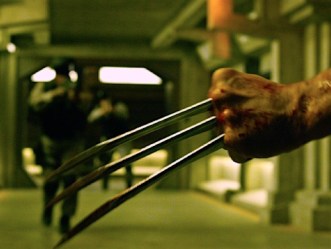 It doesn’t help that they feel the need to shoehorn a Wolverine cameo in there, an underwhelming action sequence that becomes a massive aside from the main storyline. It feels like setup for something more next time, but Hugh Jackman has stated
 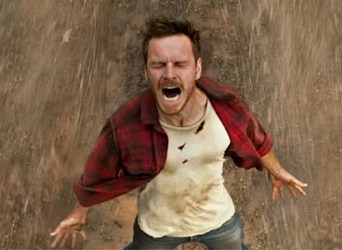 Another element lost in the mix is the real-world resonance contained in the best X-films. There’s a lot of to be said for the spectacle that’s present in all the movies, but Days of Future Past (for the most recent example) anchored it in the human conflicts between the heroes, and in their relation to the rest of the world. Apocalypse nods in that direction, with Mystique invoking Magneto’s metaphorical family to get him to stop destroying the world, but it’s not as well integrated, not as effective as previous outings. Said destruction is on a massive scale, but it’s too massive — the film doesn’t sell it; it’s just another city being destroyed somehow, emotionless computer-generated effects that are overfamiliar in these megablockbusters now (and not helped when you’ve seen similar sights two or three times right before the film in trailers for the likes of
  In fact, the film as a whole feels a draft or two away from being truly ready. Some of the dialogue clunks hard, especially when characters speak in exposition to one another. The plot needs streamlining and focusing, especially early on, and some events need appropriate weight added to them. Other things just need smoothing out — that trip to the mall happens Just Because, with no real sense of why the characters are doing it (other than some handwaving dialogue about needing to get out of the school for a change), and, as I said, in the final cut only leads to one single joke. Yet for all that, some things do work beautifully: Storm’s hero-worship of Mystique comes up almost in passing early in the film, establishing/emphasising Mystique’s place in the mutant world now; but then it becomes a key point in the climax without the need for any explanatory dialogue, as Storm wordlessly realises that her hero is fighting on the other side. It is, in a way, the best bit of the movie.
 Despite being a negative nelly for much of this review (like so many others, which has given it a lowly
 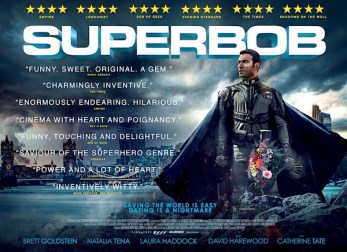 Comedies about superheroes tend to come in the form of big-bucks mainstream-aimed effects-y pieces (
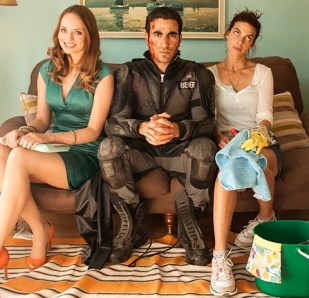 though, because the conceit is all but dropped fairly early on, and the film begins to develop in nice directions. It starts out as pure comedy, and while it doesn’t lose that aspect, it does develop a strand of endearingly genuine sweetness. That helps to see it through the predictable rom-com beats that follow, leaving you (or this viewer, at least) not minding that it’s predictable where the story’s going to go because, thanks to the characters, that’s where you want it to go.
 We’re now on to the 13th film in the Marvel Cinematic Universe, and while you don’t need to have seen all 12 preceding movies to follow the events of Civil War, you do need at least four — and, to get everything, a further four or five beyond that. (Don’t worry about the four TV series — it’s increasingly clear that they’re only notionally connected to the movies.) So the Marvel model for a “shared universe” is not discrete stories that take place in the same world, but a series of ever-more-connected narratives. It’s working for them, though, as the continually stellar box office totals prove.
 As complicated as the plot sounds once you start trying to succinctly summarise it, Civil War is easy to follow as it unfurls. In fact, it’s to its credit that it can’t be readily summarised in any more detail than “Cap and Iron Man disagree; fight” without really getting into it. Screenwriters Christopher Markus and Stephen McFeely have followed up the political thriller of Winter Soldier with another global thriller storyline, again bringing different genre textures to the superheroics that are nonetheless present and correct. The film’s style mixes in just the right amount of realism — no one’s pretending this isn’t a comic book movie, with some elements of comic book logic and a casual acceptance of people having world-changing powers; but if such people did exist, this is the kind of way they would be handled by the authorities.
 Well, maybe. But the debate is partially stalled by the fact this is a Captain America movie rather than an Avengers one. Yeah, you can side with Tony Stark & co, but you know Cap’s going to come out to the good, one way or another. As it pans out, it’s not a total victory (Team Cap are all now fugitives, presumably until
  On that visceral level, there are a couple of stunning action sequences. The car/foot chase between Cap, Bucky and Black Panther is fantastic, casually throwing in cool moments like the way Bucky steals a motorbike. The climactic two-on-one fight is also a sight, throwing in strong choreography and seamless effects work to create a battle that has a real ebb and flow, a back and forth over who has the upper hand. And the centrepiece of it all, of course, is the two teams facing off at the airport. For fans of superheroes, this is pretty much the ultimate expression of the genre yet brought to live-action moviemaking. For my money, the antics of Ant-Man — and Giant-Man — are by and large (pun very much intended) the best bit of it, but maybe I’m just
  “hey, remember that foreign prince who was Black Panther? He lives in a foreign country… where he’s Black Panther!” Other than that, it’s kinda important to answer the question of “hey, what happened to Bucky?” next time Cap turns up. So why isn’t the scene just in the film? Well, it is in the film — just after a few of the credits — so what does it matter, right?
 In the end, Civil War leaves plenty open for future Marvel movies. Well, of course it does — half the time MCU movies are feature-length trailers for the next MCU movie. Where Civil War is really clever, however, is that it does that stage-setting while also feeling conclusory. As the third part in the Captain America trilogy, it actually makes a pretty satisfying end to that narrative. As the third part in the “trilogy in five parts” that is The Avengers trilogy, well, it’s clearly not the end, but it’s a fairly discrete segment.
 With Warner Bros’ universe-launching superhero epic now in its second weekend (unless you live in Myanmar or Poland, anyway), you’ve probably more than had your fill of spoilerphobic reviews. So allow me to provide a spoiler-filled one. (There are a fair few of those around too, of course, but not all reviews can be beautiful or unique snowflakes.)
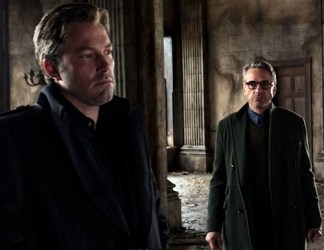
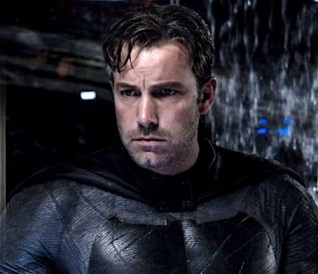 to good people turning bad; the Joker-graffitied Robin suit… This isn’t fan-pleasing/teasing background detail, it speaks to Bruce’s mindset. He’s become the kind of person who believes lines like, “if there’s a 1% chance he’s our enemy, we must take it as an absolute certainty.” He’s a bit of a right-wing nut, basically. If you want to find a character or emotional throughline to the movie, it’s Bruce learning to be a better hero again.
 But if we are criticising the screenplay, let’s turn our attention to the story and its structure, which leaves something to be desired. This isn’t just the writers’ fault, of course, because myriad things affect a film once the screenplay is signed off. In the case of story structure, editing seems a likely culprit — not the actual cutting together of individual shots to craft a sequence or scene, which is as good here as in any action blockbuster, but in terms of storytelling. Frankly, that’s a bit of a mess. Or a lot of a mess, maybe. Whole scenes serve literally no purpose or are clearly in the wrong place — the bit where Perry wanders up to Clark Kent’s desk and wonders if he’s clicked his heels and disappeared back to Kansas, for example. What purpose does it serve? None. But where it might have a role is where it clearly belongs: a couple of minutes later, right before the scene where Superman is in Kansas, chatting to his mom. Why is it not right before that scene? It’s like someone accidentally dragged it out of place on their computer editing timeline and never noticed. Sure, this is a minor point in the grand scope of the film, but it belies a sloppiness to the entire storytelling.
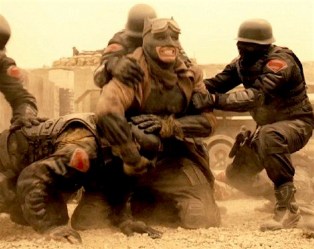 The only purpose it might serve is teasing the future — what is the giant Omega symbol? What are those flying devil-creatures? DC fans know that’s all related to alien supervillain Darkseid, and late in the film Lex Luthor makes a veiled reference to imply that some such alien badass is on the way. Yep, it’s Marvel-style foreshadowing, where every film is just a stepping stone to the next. Except BvS does it even more heavy-handedly than Marvel. As I said, the dream/vision is utterly unnecessary; Lex’s line is nonsensical (how does he know?); and the way other members of the Justice League are teased… You know, I don’t even want to discuss it. It’s a bad Marvel post-credit scene shoehorned into the middle of the movie. It feels like someone accidentally cut a teaser trailer into the actual print of the film. It’s not even so bad it’s good, it’s just tacky. And, I have to say, though I’m not the biggest fan of
  to look for clues you missed, not rethink to see if that even fits with everything we’ve seen. That’s because even if you do latch on to the almost-throwaway sliver of dialogue that indicates Lex put all of this together, the way it’s presented in this cut makes it come a little out of nowhere. However, I believe it’s a plausible explanation of events (within the realms of the version of the genre these films are in), and would tie the whole thing together neatly, were it just a little clearer.
 “Give audience an idea what future film(s) will be about while saying absolutely nothing concrete about what future film(s) will be about.” But in that mess (the mess I mentioned at the start of that last really long sentence, remember? OK,) there is stuff going on; there are ideas the filmmakers want to put across, possibly with the intention that they’ll actually be thought about.
 As I was saying: not a perfect movie, but one with a lot of material to provoke thought about both the inherent concepts of superheroes and, external to that, the genre itself, especially the way it’s presented in cinema. I’m not going to slag off the Marvel movies, because they are fun, but the entirety of the big-screen MCU
 100Films.co.uk