The Crowd (1928)

2007 #110
King Vidor | 98 mins | TV
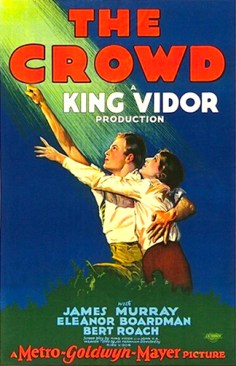
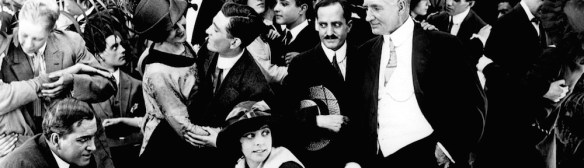
The CrowdLate silent-era drama — though you’d be forgiven for thinking it was a comedy until halfway, when the light antics of a young couple in ’20s New York give way to some increasingly dark drama (interesting trivia: seven endings were shot for distributors to choose from, some happy and some sad; all chose sad ones. However, the copy we saw (taped from an ’80s TV showing) had a happy ending).

The first half is gentle but amusing; the sudden shift catches the viewer off-guard, undoubtedly making what follows more effective. The main character is in many ways pretty useless and at least some of the problems that befall him are his own fault, yet his comedic treatment in the first half makes you care for him throughout the second.

If you can accept the shifting styles of an age before genre was rigidly defined, The Crowd is a worthwhile experience.

4 out of 5

Manhatta (1921)

2007 #109a
Paul Strand & Charles Sheeler | 10 mins | download

Another ’20s city film, showing off (as you might guess from the title) parts of New York. The focus appears to be industrial — skyscrapers under construction, finished architecture, tug boats, trains near the docks; the people of the city only crop up at the start and close, and then only in faceless crowds. It’s interspersed with poetic intertitles, which make for an odd contrast.

Once again, I feel that, unless you want to go getting a bit pretentious (and, to be fair, at least some of these films were made for just that), the main interest here is in an historical perspective: it provides another snapshot of a time and place long gone.

2 out of 5

The full short is available on Wikipedia.

Skyscraper Symphony (1929)

2007 #108b
Robert Florey | 9 mins | download

Another ‘city symphony’ film, this time a short one of skyscrapers in New York.

It’s probably hard to ‘appreciate’ this without getting a little pretentious; certainly, it’s much more aimed at creating the feeling of a city, or a visual representation of it, or something like that, than it is with, say, showing pretty views of New York’s buildings. That said, in between the meaningful mucking about, there are some fairly impressive sights to be seen.

2 out of 5

Available on YouTube.

À propos de Nice (1930)

2007 #108a
Jean Vigo | 23 mins | download | U

Short film about the French city of Nice, mixing documentary-style footage of people with shots of the architecture, as well as clearly staged scenes (a man getting sunburnt, for example).

There’s a certain playful edge to it all, not just with content such as a garish parade and crazy dancing, but with amusing tricks (again, the sunburning), camera tomfoolery (for example, moving it to follow the loops of arches at speed; or using slow motion and sped-up shots), and picking out shots of pedestrians apparently for their annoyance at being filmed.

It’s an interesting amalgamation, then: part art, part documentary, part sketch show.

3 out of 5

Berlin: Symphony of a Great City (1927)

aka Berlin: Die Sinfonie der Grosstadt / Berlin: Symphony of a Metropolis

2007 #108
Walther Ruttmann | 65 mins | download

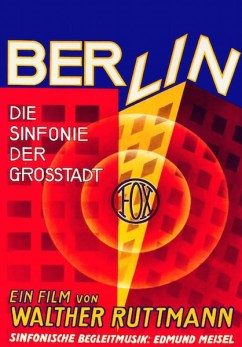
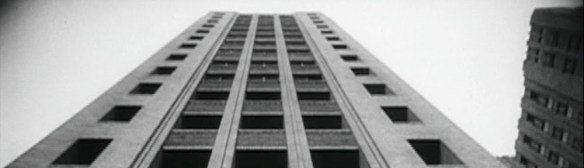
Berlin: Symphony of a Great CityGerman silent movie depicting a day in the ‘life’ of Berlin, part of the ‘city symphony’ genre that was popular around the 1920s. This makes it one of those films that is in some way Important, but sadly it’s still a bit, well, boring.

Essentially it’s a documentary showing many facets of city life and industry, though with no kind of narration and often edited in an artistic fashion (fast cutting and crazy angles to represent the chaos of a busy junction, for example). It has its moments (the opening train journey being the highlight for me), and I’m sure some would find the footage of ’20s life fascinating, but it’s the sort of thing that’s just too dull for my tastes.

For something similar which I enjoyed a bit more, try the Russian Man With a Movie Camera.

2 out of 5

Traffic in Souls (1913)

2007 #106
George Loane Tucker | 88 mins | VHS

Traffic in SoulsSilent movie (Universal’s first feature-length release) about white slavery in America. You don’t expect that from a 1913 film, eh?
Of course, the issue is handled in a suitable way for the period: why the women are kidnapped is never alluded to (in reality it was for prostitution) and all the Bad Men are brought to justice.

It’s not all bad: in a surprising move for the time, the main villain is an apparently-respectable society gentleman who publicly campaigns against white slavery; by a similar token, the kidnappers are made up of women as well as men.

The first half zips along an intricate multi-stranded narrative covering several groups of unrelated characters, but as they come together it begins to slow: what seems to be the climax takes half the film to play out its immediately-obvious events. It sadly ruins something that was initially rather promising.

2 out of 5

Fantômas: Juve Versus Fantômas (1913)

aka Juve contre Fantômas

2007 #105
Louis Feuillade | 62 mins | DVD | PG

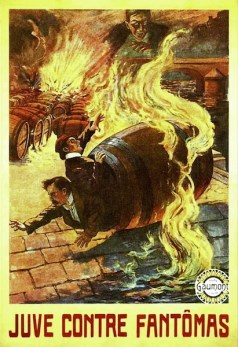
Juve Versus FantomasSecond instalment of the early French film serial, adapted from a long-running series of pulp novels.


Fantômas is a criminal adept at disguise and avoiding capture by police inspector Juve. It’s full of crazy schemes and action set pieces, which means it’s actually a great deal of fun, relatively fast-paced and densely plotted, exciting and deliberately amusing (though, as with anything this old, there are things to point and laugh at if you’re so inclined). It also looks stunning for its age, with a stable and crisp picture, which incidentally makes great use of colour tinting (for example, turning from blue to yellow when someone switches on a light).

It’s not for everyone, but if you’re interested in early cinema this is one of the most entertaining examples I’ve seen. As you may have guessed, we were shown this as part of my degree; off the back of it I’ve ordered the DVD of the full serial.

4 out of 5

I never got round to watching the rest of Fantômas, though I’ve been meaning to ever since… (story of my life.)

2007 | Weeks 41-42

Ah, University! Work has now fully returned to interrupt all the lazing around and film-viewing I so enjoyed before; of course, studying a film module does mean there’s a guaranteed one or two new films every week, and probably quite unusual ones too. “Hurrah,” cries the statistics! “Ooh,” cries… erm… anyone who likes more unusual choices…

I do feel a tad arty this week, actually. Of the six films listed below, two are French, one German, one Japanese, two are shorts, and five are between 77 and 94 years old. That’s two weeks at the start of a University film module for you!

We begin with the two oldest of all those, both made 94 years ago. That’s no guarantee of anything, mind… well, except no spoken dialogue.

#105 Fantômas: Juve Versus Fantômas

#106 Traffic in Souls

#107 Neon Genesis Evangelion: The End of Evangelion

#108 Berlin: Symphony of a Great City

#108a À propos de Nice

#108b Skyscraper Symphony

#109 The Paleface

Nosferatu (1922)

aka Nosferatu, eine Symphonie des Grauens / Nosferatu: A Symphony of Horror

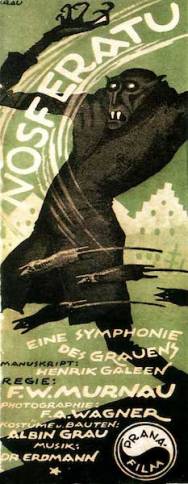
Nosferatu2007 #18
F.W. Murnau | 81 mins | DVD | PG

One of the earliest and most-referenced horror films, and the first screen adaptation of Bram Stoker’s Dracula (faithfully, albeit unofficially).

With such a weight bearing down upon it I found it quite hard to watch it objectively, and so was mainly left with the sense that I didn’t enjoy it as much as Sunrise and that I’d rather like to see a fully restored version. Perhaps Masters of Cinema shall treat us to one soon.*

Whatever one’s thoughts on it, it really is a must see for anyone into sci-fi/fantasy, horror, or (again) the history of film.

3 out of 5

* In the years since this review was written, they have. ^

Sunrise: A Song of Two Humans (1927)

2007 #16
F.W. Murnau | 91 mins | DVD | U

Sunrise: A Song of Two HumansMurnau’s first film in America, throughout the decades hailed as one of the greatest film ever made.

Maybe it is, in some respects — for a film made 80 years ago it certainly stands up very well today. It’s helped by being a fable, giving it added resonance for any time period, though probably hindered by being silent (virtually — as one of the first films with a synchronised soundtrack there are some effects).

Certainly recommended to anyone interested in the history of film.

4 out of 5