
As well as all the unreviewed feature films in my ridiculously-large backlog (see the Archive 5 series for more on that), there are also a load of short films from the past few years that I haven’t reviewed.
Today, I’m taking a step towards putting that right, by bundling together all the silent shorts I watched between 2020 and today. In original chronological order, they are…
Sherlock Holmes Baffled
(1900)
Arthur Marvin | 1 min | digital (SD) | 4:3 | USA / silent

This is noteworthy for being the first film to star Arthur Conan Doyle’s immensely popular sleuth, but it’s an “in name only” appearance by the Great Detective. In fact, he’s not named on screen, so maybe “in costume only” (a dressing gown and pipe) would be more accurate. The actual film is nothing to write home about, either: it’s a 30-second skit, built around showing off then-cutting-edge filmmaking tricks, i.e. using editing to allow a burglar to disappear and reappear out of thin air. No wonder Holmes is baffled.
It’s only really of interest as a curio to fans of early cinema or Sherlock Holmes on screen, even if the latter is only invoked as a hook to attract viewers. Although, I feel like the fact the first Sherlock Holmes film was basically a spoof is somehow significant…

The One-Man Band
(1900)
aka L’Homme orchestre
Georges Méliès | 2 mins | digital (SD) | 4:3 | France / silent

Using the magic of cinema to take the title literally, in this short director Georges Méliès clones himself seven times over to create a musical septet (plus conductor).
Even having the idea to do this kind of visual stunt for the first time is obviously impressive — there’s no doubt that Méliès was an extraordinary innovator — but pulling it off with such technical competency… that could be tricky today, never mind in 1900, when you couldn’t check your footage lined up, nor just do another take if it didn’t, never mind the array of computer tricks (split screen, time ramping, reframing, etc) that could be deployed to make it work nowadays. Here, Méliès was doing multiple exposures on the same strip of film; the original negative — imagine if you messed up on the seventh go-round!
And even with all that, it’s not just an exercise in technique; not just a technical demonstration for those interested in the possibilities of motion pictures. You can set all that aside and still find an entertaining and amusing short — with a couple of extra gags thrown in at the end for good measure. Genius.

The Infernal Cauldron
(1903)
aka Le chaudron infernal
Georges Méliès | 2 mins | digital (SD) | 4:3 | France / silent

A few years later, and Méliès’s work is looking more extravagant — there are sets! Costumes! Props! Colour! Hand-coloured, of course, and the result is glorious. The colours are not only incredibly stable (you’d expect some flicker or judder on static elements from frame to frame, but nope), but they really add to the atmosphere. The sickly green demons and burning red & orange flames really leap off the screen, making the unreality of it that bit more tangible. This would be so much less effective in pure black-and-white. It’s less like a flickering clearly-fake old film, more like a nightmare. You can kinda see how people at the time might’ve believed stuff like this was real. I mean, how else do you explain those ghosts, hmm? (Okay, obviously they’re a double-exposure effect; but it holds up well. Certainly better than the cardboard-cut-out props.)
Intriguingly, there’s a 3D version of the film — a real, authentic one! To quote wholesale from Wikipedia: “In order to combat piracy, Méliès … began producing two negatives of each film he made: one for domestic markets, and one for foreign release. To produce the two separate negatives, Méliès built a special camera that used two lenses and two reels of film simultaneously. In the 2000s, researchers at the French film company Lobster Films noticed that Méliès’s two-lens system was in effect an unintentional, but fully functional, stereo film camera, and therefore that 3D versions of Méliès films could be made simply by combining the domestic and foreign prints of the film. Serge Bromberg, the founder of Lobster Films, presented 3D versions of The Infernal Cauldron and another 1903 Méliès film, The Oracle of Delphi, in January 2010 at the Cinémathèque Française. According to film critic Kristin Thompson, ‘the effect of 3D was delightful … the films as synchronized by Lobster looked exactly as if Méliès had designed them for 3D.'” They were screened again in 2011 and, at least as far as Wikipedia can explain, that was the end of it. To which I say: argh! I really want to see them! A 3D Blu-ray release would be lovely; but, as these screenings happened over a decade ago, I can’t say I’m holding out much hope…
Life of an American Fireman
(1903)
Edwin S. Porter | 6 mins | digital (SD) | 4:3 | USA / silent

Although fundamentally a remake (or ripoff, depending how you look at it) of the earlier British film Fire!, Life of an American Fireman has found a place in film history (it even merited coverage in Mark Cousins’s The Story of Film: An Odyssey) for two reasons: firstly, for pioneering the technique of cross-cutting, a major and significant development in film editing; secondly, for not actually having done that at all.
“Huh?”, you may well exclaim. Well, although for a long time the short was admired for its innovation, research by the Library of Congress eventually revealed that the film was re-edited sometime after its release (possibly in the 1930s or ’40s), and the original version actually played the action out twice, without the all-important cutting back and forth. Viewed in that original version, I’d argue to a modern audience it’s more confusing having the same sequence twice back to back — nowadays we expect intercutting of action, so it’s initially disorientating when the film cuts to outside the house and starts the same sequence of events over again. Perhaps more importantly, watching it twice over feels redundant: the second version adds no new information; and, being outside the house, thus distanced from the threat of encroaching fire, it’s less dramatic than the inside sequence. And that’s not to mention that the timeline doesn’t add up: the fireman is in and out of the window much more quickly during the inside version than the outside version.
Despite all that, this does remain one of the earliest American narrative films, bringing together various innovations that had occurred in the early years of film — primarily, constructing a continuous narrative across multiple shots and scenes. It just wasn’t the first film to do, well, anything.

The Consequences of Feminism
(1906)
aka Les Résultats du féminisme
Alice Guy | 7 mins | digital (SD) | 4:3 | France / silent

Imagine a crazy world where men did housework and looked after the children, while women lazed around drinking, smoking, and cajoling innocent young men into the bedroom. What larks! But such horrors might come to pass if we let those pesky women have their way.
Such once-implausible things are depicted in Alice Guy’s 1906 short. Consequently, this is the kind of film that might be described as “of it’s era” — although, said era probably extended another six or seven decades. I can’t cite any specific examples, but I feel like “wouldn’t it be hilarious if men behaved like women?” sketches were still being done in the ’60s and ’70s, if not even more recently. So, it’s less that it’s dated, more that it shows Guy was ahead of her time. I mean, the film dates from before women even had the vote, yet she has the chutzpah to imagine men taking on women’s roles and women enjoying leisure time. Scandalous!
Considering the short was made by a pioneering female filmmaker, we can but assume it’s all satirical; that its very point is “the consequences of feminism” would not, in fact, be the ridiculous role-reversal presented here. But, in that context, the ending is quite interesting: the men force the women out of the bar and raise a toast. Are we supposed to read that as the natural order being restored? More likely, it’s meant to signify these men achieving equality with women; that Guy’s point is, “if men were in women’s situation, they’d want to change it, too.”
The Dancing Pig
(1907)
aka Le cochon danseur
4 mins | digital (HD) | 4:3 | France / silent
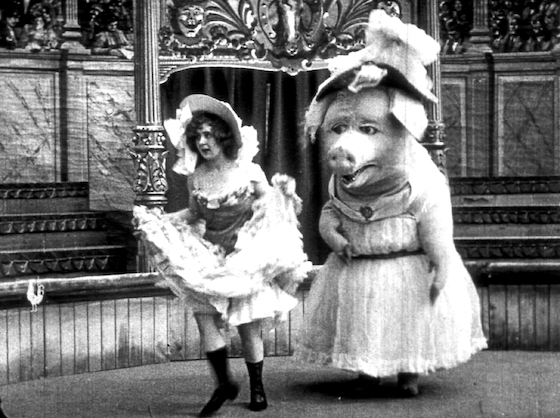
Apparently this had fallen into obscurity for a century or so, when it was revived as an internet meme because of “its creepy atmosphere”. Certainly, stills from the final scene (a closeup of the pig’s head, with vicious teeth and an oscillating tongue) look weird and freaky; and I guess if you slapped an ominous horror-movie-esque score across the whole short then it would become freakish in its entirety. But it was originally a vaudeville act, and with the jaunty score that usually accompanies it, it remains just that: a couple of minutes of daftness.
As such, I can hardly recommend it. It’s a curio of a past era, and while there’s undoubtedly value in preserving such things for historical interest, that’s still all it is.
Frankenstein
(1910)
J. Searle Dawley | 13 mins | digital (HD) | 4:3 | USA / silent

The first screen adaptation of Mary Shelley’s novel is such a thorough retelling in just 12 minutes, it almost makes you wonder what takes other versions so long. But what it gains in brevity, it loses somewhat in filmmaking craft: every scene is shown only in a theatrical static wide shot. It’s not entirely without interest, though: one setting places a full-height mirror screen right to enlarge the set by showing us what’s behind the camera to the left, and it’s surprisingly effective, especially when it’s used for a bit of fun cinematic trickery.
The film’s big set piece is the creation of the Monster; not from stitched-together body parts, as is usually the case, but some kind of ‘magic potion’ that makes it emerge from a cauldron, growing and forming before our eyes. The effect was achieved by burning a puppet and then reversing the film, but, rather than presenting an unbroken take, instead the film cuts back and forth to Frankenstein observing and, frankly, skips over what I imagine were the most effective bits. For example, we see the vague outline of a human figure emerge, then cut to Frankenstein, then cut back to see it fully-formed. Would it not have been better to see the Monster’s features ‘melt’ into being amongst the flames? Oh well.
Frankenstein was thought lost for decades, until a single print was found in the ’70s. Imperfect it may be, but it remains a significant milestone in the history of horror cinema.
What! No Spinach?
(1926)
Harry Sweet | 19 mins | Blu-ray | 1.33 | USA / silent

Included as a special feature on the Masters of Cinema Blu-ray of Buster Keaton’s Seven Chances, this little-seen* comedy short, directed by and starring Harry Sweet, “riffs on a number of elements from Seven Chances”, to quote MoC’s blurb. I’d say it’s less a riff on Seven Chances, more a brazen rip-off. It has moments of amusing physical comedy, but it lacks Keaton’s originality or heart. At least it’s brief, although that doesn’t mean it feels whole: rather than ending, per se, Sweet seems to run out of ideas and the film just stops.
Also, it has nothing to do with spinach.
* I couldn’t find a single photo or image from this short online. That there now are some on certain movie databases is because I uploaded screen grabs I took for this review (even editing some into a ‘poster’ for the sake of TMDB/Letterboxd). ^






















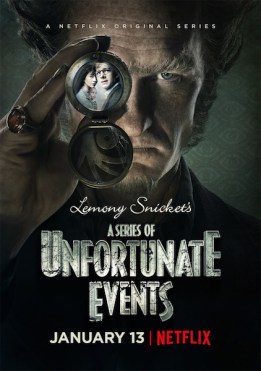 I’ve never read A Series of Unfortunate Events, the 13-book cycle of faux-gothic novels by Lemony Snicket that recount the terrible lives of the Baudelaire orphans as they are stalked by the scheming Count Olaf. I am, however, a verified fan / defender of the 2004 movie adaptation (I even
  As Olaf, Neil Patrick Harris has the difficult task of being both comically inept and genuinely menacing, as well as appearing in any number of disguises (well, four). Opinion seems divided on whether he manages this better than Jim Carrey in the film, but, well, that’s opinions for you. Personally, I thought he was very good. The extra screen time here (what was done in 108 minutes of film is granted 299 minutes of TV) means he has to work at a different level and pace to Carrey, and I think there are multiple moments where he nails it. Similarly, some may think the child actors are guilty of vigorously flat delivery of their lines, but I think this is just another aspect of the Wes Anderson-esque style — as the viewer (and, possibly, the cast) become more accustomed to the material, so the quality of the performances (and/or the perception thereof) improves.
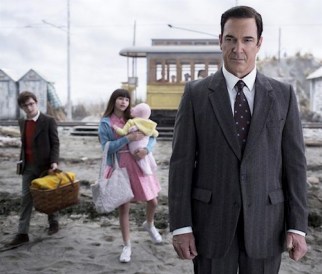 I think most would’ve thought A Series of Unfortunate Events was dead on screen after the film, but this series (and the reaction to it) suggests Netflix have been vindicated for deciding to revive the property. Let’s hope they have the common sense to do the right thing and commission the two more seasons needed to complete this sorry tale. In the meantime, I’m very favourably disposed to read all the books…
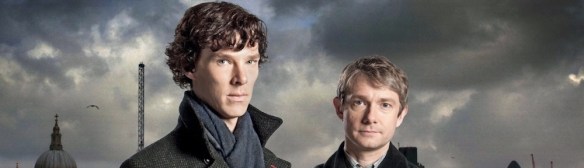
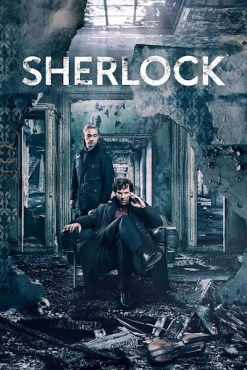 Sherlock comes to an end (for now) with another variable and divisive series. That’s actually the way it’s been received ever since the start (for all the people who think it only lost its way in the third run, there were plenty who slated various parts of it during the first and second series too), so I don’t think we should be so surprised. For my part, I enjoyed it on the whole.
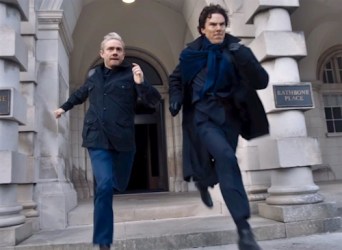 Sherlock’s commitment to being a fast-paced, audience-challenging adventure drama that strives to be constantly engaging and entertaining is definitely commendable, and a welcome contrast to much of the slow, dour TV drama we tend to produce over here — even if the end result is sometimes messy or unpopular. With events in-show leaving our heroes reset to a more familiar Holmesian situation, here’s hoping the big-name cast can be tempted back for a few more adventures in a couple of years.
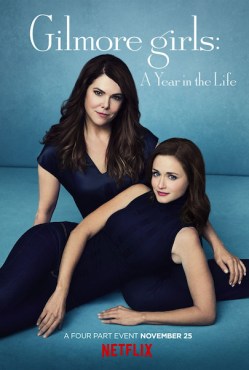 Nine years on and Gilmore Girls graduates from being considered a twee comedy-drama on disparaged network The WB to a major cultural event, thanks to it being produced for the arbiter of all modern televisual culture, Netflix. Instead of 22 42-minute episodes of network TV we get four feature-length instalments, though it’s still very much a series: the pros and cons are shared across the board.
 Bizarrest of all is the problematic ending. Thematically, A Year in the Life begins to look like it might be about moving on, new horizons, that kind of thing — indeed, I kind of expected it to end with Lorelei moving out of Stars Hollow. But the climax — the infamous final four words… well, you could see the development as a signal of a fresh start (very literally, new life), but it doesn’t play that way. Given Rory’s personal story (her career and relationships falling apart) and situation (single, living at home), it’s less a new path forward and more a depressingly regressive loop. If you’re interested in a fuller dissection of these issues, allow me to recommend
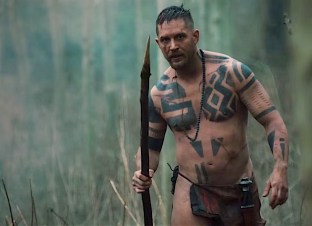 This month, I have mostly been missing Taboo, the BBC’s dark new period drama starring Tom Hardy and written by Steven Knight. I’m sure I’ll get round to it soon, but then I’ve been saying that about Peaky Blinders (you know, the BBC’s dark period drama written by Steven Knight and sometimes starring Tom Hardy) for years and still haven’t even started it. Its scheduling on BBC One on Saturday nights feels thoroughly at odds with how it looks (surely midweek BBC Two?), but putting a proper drama on our highest-profile channel on its highest-profile night seems to have been a popular move, so what do I know?
 100Films.co.uk