
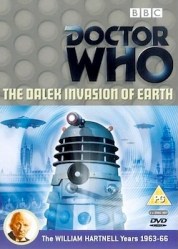
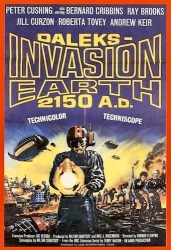
The Dalek Invasion of Earth
and
Daleks’ Invasion Earth 2150 A.D.
Doctor Who: The Dalek Invasion of Earth
1964 | Richard Martin | 149 mins | DVD | 4:3 | UK / English | PG
Daleks’ Invasion Earth 2150 A.D.
1966 | Gordon Flemyng | 84 mins | Blu-ray | 2.35:1 | UK / English | U
 In a week’s time, on the 23rd of November 2013, Doctor Who will celebrate its golden anniversary — 50 years to the day since the premiere broadcast of its first episode, An Unearthly Child. (As part of the celebrations, BBC Four are showing that initial four-parter at 10:30pm on Thursday 21st. I heartily recommend it.) The programme’s success was cemented several weeks later, however, with the appearance of the Daleks — a race of xenophobic mutants hidden in metal machines from the planet Skaro. A wave of Dalekmania followed, leading to a boom in merchandising and, naturally, a sequel serial for the TV series, one year later.
It also led to a film adaptation, which I discussed last week. When that was a box office success, a sequel was greenlit. As with the first film, rather than construct an original tale starring the Daleks, the filmmakers turned to the TV series and adapted the aforementioned TV sequel. The story is set hundreds of years in the future (perhaps 10 years after 2164 in the TV series; 2150 in the film), when the Daleks have somehow left their homeworld and their city (which previously they’d needed to survive) and found their way to Earth. But this isn’t a Hollywood-style alien invasion battle: the Daleks have already occupied the planet, and Britain in particular (of course). The Doctor and his friends stumble into this situation and resolve to stop the evil invaders.
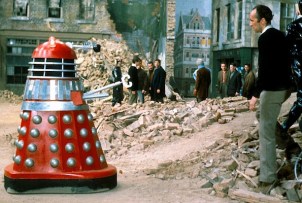
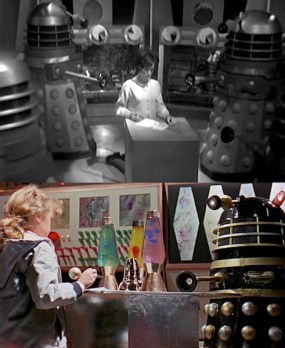
There’s little doubting that The Dalek Invasion of Earth is a minor epic. Where The Daleks struggled a bit to fill its seven-episode order, in six instalments writer Terry Nation takes us from an occupied, bomb-blasted London, to an attack on the Dalek spaceship, to a mine in Bedfordshire that’s digging to the centre of the Earth. Although made on Doctor Who’s typically tiny budget, the TV serial shines. 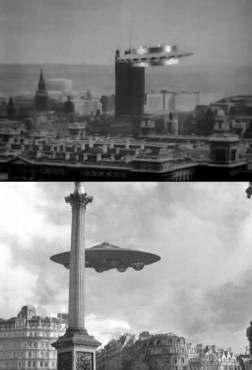 There are some fantastic sets, bolstered by peerless location filming of a deserted London (simply achieved by shooting very early in the morning), and the usual array of quality performances from the series’ regulars and guest cast. It’s only let down by the special effects. The Daleks are as great as ever, and a weird monster that turns up for a few minutes is passable (if you’re being kind), but shots of the Dalek saucer flying over London look like a pair of foil pie cases on some string in front of a photo. Even by the standards of the era it’s bad. The DVD release includes the option to watch the story with new (in 2003) CG effects in place of these sequences, and for once I’d actually recommend that.
The story once again trades on the Daleks’ clear Nazi undertones. Here they’ve occupied a bomb-blasted country where a small band of rebel fighters hold out against them, attempting small-scale attacks while trying to work out a bigger plan. It can only be deliberate that these parts — hidden workshops, missions in enemy uniform, even the fighter’s casual clothes — all trade on familiar imagery from World War 2 resistance movies. Here, at least, collaborators are men rendered brain-dead by Dalek machinery, controlled via radio waves directly into their heads, rather than those who have chosen to betray their people.
That said, this is not a cheery view of the world. We can see that right from the opening shot: a derelict stretch of urban river bank, overgrown and decrepit, and the caption “World’s End”. 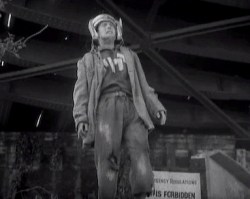 A man stumbles towards the steps, he screams in agony, battling with the strange machinery on his head. And then he hurls himself into the river, where he floats face down — dead. Beginning a kids’ programme with suicide? You wouldn’t do that today! We later learn that he’s a Roboman, controlled by the Daleks, essentially dead already… but it’s a bit late by then. Later, we meet unscrupulous country folk: a black marketeer who won’t give over food to the enslaved mine workers without payment, and won’t escort Ian out of the camp without payment either; and two women, employed by the Daleks to mend the workers’ clothes, who betray Barbara to get more food. There are heroes here, certainly — men and women who fight the Daleks, and some who give their lives for the cause — but not everyone’s doing the honourable thing.
The film is a bit less bleak in its outlook for humanity. The black marketeer remains, more treacherous than ever: he actively betrays the Doctor to the Daleks, though is killed for his troubles; the two women are there, too; but there’s no suicidal Roboman, and indeed the climax suggests the Robomen are able to return to being human just by taking their helmets off. 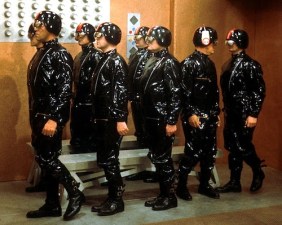 So that’s nice for them. There’s also some significant additions of humour, like when Tom is pretending to be a Roboman to stow away on the Dalek saucer and ends up in a mime act as he attempts to mimic a group of the real thing while they have lunch. Bless Bernard Cribbins. There aren’t too many of these almost-farcical bits, but the few there are lighten the general tone.
Overall, however, Daleks’ Invasion Earth 2150 A.D. (aka Daleks – Invasion Earth: 2150 A.D., and many other such punctuation-based variations, thanks to inconsistent spelling on posters and trailers) is, much like the the previous film, a strikingly faithful adaptation… at first. The running time is again a clue: while the TV serial takes two-and-a-half hours on its story (albeit with some subtractions for six sets of titles and five recaps), the movie rattles through it in 84 minutes. That’s with a new bookend sequence designed to establish the new character of PC Tom Campbell (Bernard Cribbins), leaving the film 75 minutes in which to condense Nation’s epic. Nonetheless, it’s scene-for-scene faithful, just picking the pace up with key actions and lines of dialogue rather than the comparatively-luxurious speed of the original.
As it goes on, though, things begin to diverge quite rapidly. Significant characters have been cut for time, while legacy changes from the first film also alter the plot — 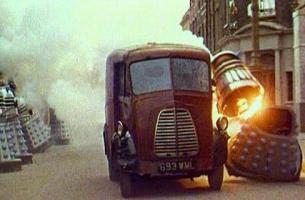 no burgeoning romance for Susan, here a small girl rather than TV’s young woman. Both stories split our leads into three groups following the assault on the Dalek saucer, but while the film retains the outline of these subplots, it rearranges which characters take which route. It’s a slightly bizarre turn of events, to be honest, and doesn’t always pay off: whereas the TV series manages to plausibly pace the various characters’ journeys from London to Bedfordshire, in the film the Doctor and his chum walk there in the same time it takes the Dalek saucer to fly it. Either that saucer’s underpowered or they’re impressive hikers.
Even with all these changes, the general shape of the story remains the same; yet the film feels less epic than the TV serial. It’s not just the length, but the sense of time passing: on TV the Doctor and co seem to be stuck on Earth for several days, while in the film it’s practically an afternoon’s work. And though the movie’s special effects are better (immeasurably so, in fact, because the model work in the film is fantastic), and there’s some great stunts too, the bigger-budget big-screen outing lacks the TV version’s London location filming. This makes a startling difference to the relative effectiveness of the story. On TV, you really feel like the Daleks have conquered Earth; in the film, it feels a little like they’ve conquered some expansive studio sets and impressive matte paintings. 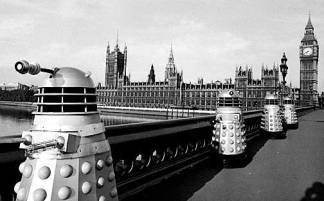 (Incidentally, perhaps the most striking thing about the serial’s location sequences are that they don’t include the iconic shot of the Daleks rolling across Westminster Bridge. That bit is in there, but it was filmed from an entirely different angle; I guess the famous image was just a unit photograph.)
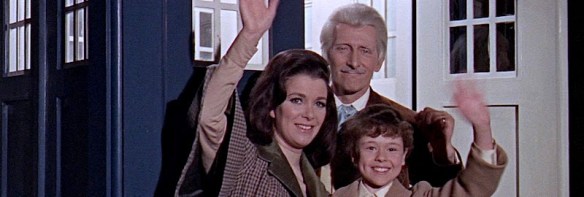
There are other bits that work less well on film. Dortmun’s sacrifice on TV makes sense, a bold character moment; in the film, he seems to do it for the hell of it. On TV, the Doctor commits himself to stopping the Daleks (in one of the series’ clunkiest bits of dialogue, to be honest), whereas in the film he just stumbles into things — which, funnily, is more like the Doctor of the time. Ian and Barbara have been replaced by the aforementioned PC Tom and the Doctor’s niece, Louise, because Dr. Who and the Daleks actors Roy Castle and Jennie Linden were unavailable. Not that it matters much — Bernard Cribbins is just as adept in the comedy role, and Jill Curzon’s Louise is just Barbara by any other name. Then there’s the music, which is often jauntily comedic rather than action-packed; and the ever-so-’60s main theme, as with the first film replacing the TV series’ iconic, groundbreaking, electronic howl with something altogether more forgettable. What the film most benefits from losing, however, is a couple of hilariously of-the-time lines from the Doctor — particularly one when he tells Susan she needs “a jolly good smacked bottom”!
That aside, perhaps the film’s biggest loss is in the age of Susan. Nothing against Roberta “One-Take” Tovey, who is fortunately much less irritating than your average child actor, 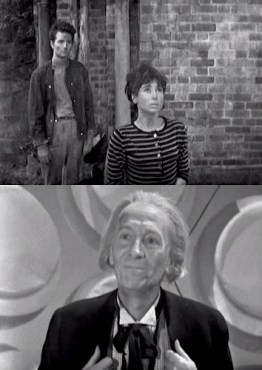 but the TV serial has a real advantage in this department. The original companion, this was Susan’s final story — the first companion departure in the series’ history. It handles it marvellously: rather than the final-minutes cut-and-run so many companions suffer, Susan’s growing sense of departure is built throughout the story… and then it’s the Doctor who realises it’s time for her to go, not her, and he leaves her behind. The speech he gives is one of the finest in the series’ history, beautifully and poignantly delivered by William Hartnell, and with a nicely under-played reaction from Carole Ann Ford. Doctor Who has had countless companion exits now, but this one still takes some beating.
Each version of The Dalek Invasion of Earth does something better than the other, but on balance the TV series is the clear victor. That said, the film is probably more entertaining than its big-screen predecessor; but that’s just the story itself, I guess, which I think is a more effective use of the villains. You could argue it ties into the fairly-modern idea of the first encounter being an establisher and the sequel a bigger, bolder, deeper, more exciting, experience. Both versions are certainly that.
Despite the enduring popularity of the titular villains, Daleks’ Invasion Earth 2150 A.D. wasn’t as much of a box office success as its predecessor. Combined with an overrunning schedule that led to a higher budget, its profitability was clearly lower. Production company AARU had the option to make a third film (presumably to be based on the third Dalek story, 1965’s The Chase), but the money-men passed. 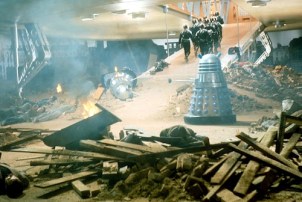 Most Doctor Who fans won’t lament that (especially as The Chase isn’t the most well-loved of Dalek adventures either), but, even though the TV series remains the superior product, I think the Dalek movies have their own merits and charm. I’m not suggesting we should be finding a way to write them into Doctor Who canon, but as an alternative to the norm, they’re a good bit of fun.
Tied in with Doctor Who’s 50th anniversary celebrations, Channel 5 are screening the Dalek movies next weekend. Dr. Who and the Daleks can be seen on the anniversary itself, Saturday 23rd November, at 10:05am. Daleks’ Invasion Earth 2150 A.D. is on Sunday 24th at 10am.

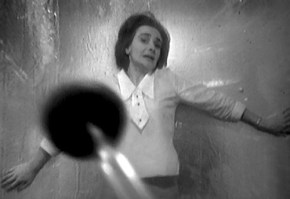 but that’s not what secured the chance to prove the series’ longevity. That would come a few weeks after the premiere, in the weeks before and after Christmas 1963, when producer Verity Lambert went against her boss’ specific orders and allowed “bug-eyed monsters” into the programme — in the shape of the Daleks.
 its inspiration comes both from the Nazis, not yet 20 years passed, and the threat of nuclear annihilation, at a time when the Cold War was at its peak. The film adaptation is so unremittingly faithful (little details have changed, but not the main sweep) that these themes remain, all be it subsumed by the COLOUR and ADVENTURE of the big-screen rendition.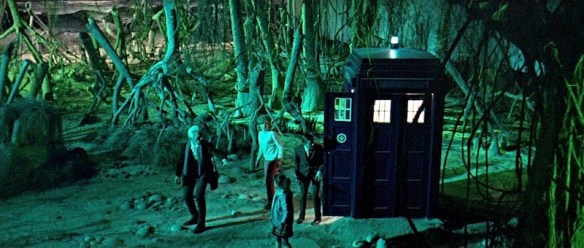
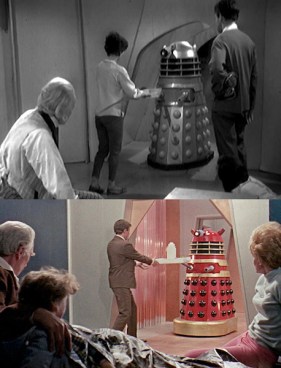 If the film’s rendering of the story and consequent themes is near-identical to its TV counterpart, plenty of other elements aren’t. The most obvious, in terms of adaptation, is that its 90 minutes shorter — roughly half the length. That’s not even the whole story, though: the film is newbie friendly, meaning it spends the first seven minutes introducing the Doctor and his friends. When we take out credits too, it spends 75 minutes on its actual adaption — or a little over 10 minutes for each of the original 25-minute episodes. And yet, I don’t think anything significant is cut. Even the three-episode trek across the planet that makes up so much of the serial’s back half is adapted in full, the only change being one character lives instead of dies (a change as weak as it sounds, in my view).
 The most obvious change — the one that gets the fans’ goat, and why so many dislike the film to this day — comes in those opening seven minutes. On TV, the Doctor (as he is known) is a mysterious alien time traveller, his mid-teen granddaughter Susan is also a bit odd, and Ian and Barbara are a pair of caring teachers who he kidnaps to maintain his own safety. In the film, the title character is Dr. Who — that’s the human Mr. Who with a doctorate — who has a pair of granddaughters, pre-teen Susan and twenty-ish Barbara, while Ian is the latter’s clumsy fancyman. They visit the time machine that Dr. Who has knocked up in his backyard, where clumsy old Ian sends them hurtling off to an alien world. In many respects this is once again the difference between TV and film: the former is an intriguing setup that takes time to explain and will play out over a long time (decades, as it’s turned out — the Doctor is still a mysterious figure, even if we know a helluva lot more about him now than we did at the start of The Daleks), while the latter gives us a quick sketch of some people for 80 minutes of entertainment. Plus, making Ian a bumbler adds some quick comedy, ‘essential’ for a kids’ film.
 (not to mention Peter Capaldi to come, a recast Hartnell in
 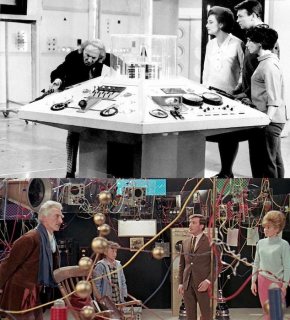 The console room in the TARDIS is another iconic piece of design, the six-sided central console and roundel-decorated walls having endured in one form or another throughout the show’s life (even if some of it’s become increasingly obscured in the iterations since
  Then there’s the way they glide, the screechy voice, the sink-plunger instead of some kind of hand or claw… It’s a triumph, and it works just as well in gaudy colours on film as it does in simple black and white.
 Whenever the series brings up past Doctors (and that’s surprisingly often, considering the “come on in, it’s brand new!” tone in 2005), Cushing isn’t among them. While he may once have been a prominent face associated with the show to non-fans, the ‘war’ has been ‘won’ — he’s become a footnote.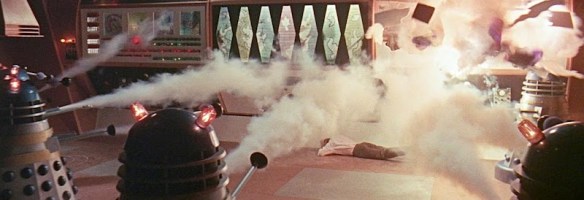
 This came in for quite a bit of stick on release — how dare they re-make a British classic, etc etc. It didn’t help matters that one of the stars, Edward Norton, was apparently forced to appear against his will as part of his contract with the studio.
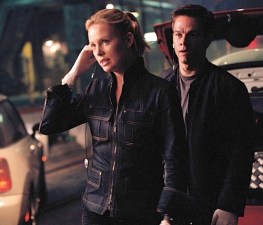 and while Edward Norton’s performance is hardly remarkable, it doesn’t smack too much of being phoned in.
 Screenwriting partnership Jane Goldman and Matthew Vaughn vacate their usual milieu (see
 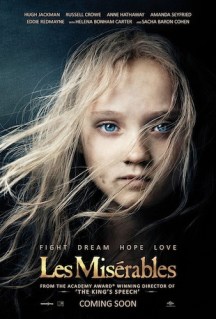 27 years after its West End debut, the long-running smash-hit musical finally makes the leap to the big screen. Such a beloved work paired with a recently Oscar-winning director and an all-star cast was pretty much a dead cert for big-name awards nominations, and so it was to be; but critical reaction was more mixed: I’ve seen people who love the film unreservedly, and others who despise it with a passion.
 Despite its running time, Les Mis is quite brisk for much of that plot (which, sorry if you’ve never seen it, I have described a fair old chunk of). There’s no interval in the film, but on stage it doesn’t come until well into the Paris section of the tale. Such a break must help the pacing, because while I remember enjoying it all on stage (where, I might add, it’s even longer), on screen I felt the middle portion began to drag. So yes, an epic running time for an epic, but it actually moves quickly through the parts that make it an epic before slowing for a bit of a forced romance and that kind of palaver.
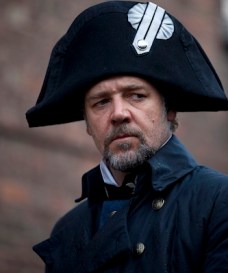 Much talk around Les Mis focused on the performances, with three in particular attracting discussion. As honourable wronged-man Valjean, Jackman is the star of the show, and brings his musical theatre background to bear on a clearly-sung but emotive performance. He was unlucky to be in the same awards year as Daniel Day-Lewis’ all-conquering turn in
 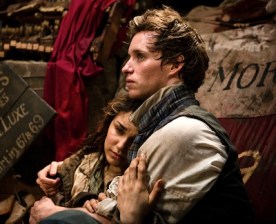 The rest of the cast is an assortment from the can-sing (Eddie Redmayne, Amanda Seyfried) to the comedic-so-it-doesn’t-matter (Sacha Baron Cohen, Helena Bonham Carter). The best voice of the lot belongs to Samantha Barks as Eponine. No surprise, really, as she was poached from the West End… where she’d found herself via one of Andrew Lloyd Webber’s BBC talent shows, so I imagine he feels thoroughly vindicated now (as if he didn’t before).
 Hooper does an above-average job on the whole, but the lack of awards nods shouldn’t be so surprising.
 #63 Bicycle Thieves, aka Ladri di biciclette (1948)
 The flip side is that, for me, the summer movie season is about to begin! That should help with the aforementioned final tally. Thanks to studios’ (wannabe-)piracy-beating speed when it comes to getting films onto disc these days,
  In researching this list I was surprised to discover a few films I didn’t know were adaptations. That might be a good list for another time, though that list, and this one, could be almost entirely filled by a single franchise: Die Hard. While the first film is based on
  As evocative as the title of
  Just as prone to retitling as Dick is Stephen King. Oh sure, there’s Carrie and The Shining and, y’know,
  Aww, a nice
  “But there is
 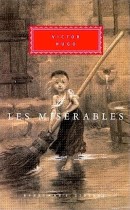 Despite having one of the most glaringly French titles ever committed to paper or celluloid,
 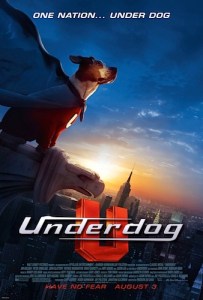 In this big screen live-action version of some old US cartoon, a dog gets superpowers and, naturally, becomes a superhero. That’s pretty much it.
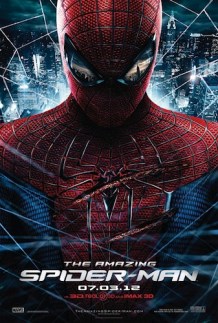 Andrew Garfield dons the webbed onesie for an unwarranted reboot of the only-one-decade-old Spider-Man film franchise, retelling his origins… but with a twist! Cos, y’know, the last version was only out about 10 minutes ago.
 some of the action sequences are alright. Mercifully, the much-trailed first-person segments are cut down to a minimum; kind of a “we made this so we ought to use it, but we’ve realised everyone was going to hate it”.
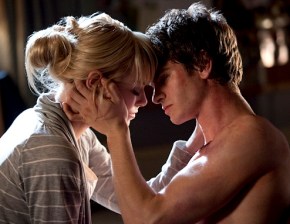 Not that it pays off — instead it just feels like the action scenes were bunged together because, hey, some of the fans want that stuff, right?
 The first Monty Python theatrical release (four more would follow; five if you count last year’s
  For my money, it becomes a bit tiring watching sketches for so long, even with the attempts made to link them together — it doesn’t form a narrative, so much as a series of casual crossovers that would make re-arrangement in an edit impossible. In and of themselves, however, many of the skits hit their mark.
 Reportedly the Pythons didn’t consider the film a success, hampered by interfering higher-ups and a ludicrously low budget (
 Shortly after I watched Tinker Tailor, it was announced that they (“they” in this instance being Working Title, I think) are planning a new film adaptation of Daphne du Maurier’s perennially popular novel Rebecca. This news was greeted (at least on the websites where I read it) with cries in the comments along the lines of, “you can’t remake Hitchcock!” Such is the power of
 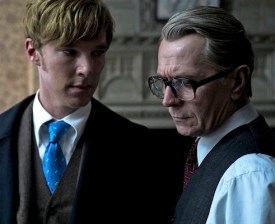 Yet, for all that, the film is excellent. It may not match the TV series in places, in my subjective opinion, but in its own right it shines. Gary Oldman does the impossible and offers a Smiley that is neither an imitation of Guinness’ nor a deliberate counterpoint, but stands apart as an equally proficient rendering of the character. The rest of the cast are equally up to task, with the exception of Kathy Burke, who stands out like a sore thumb in my opinion.
 Another noteworthy advantage of the film is that it’s gorgeously shot. The TV series actually has its own appeal in this area, with a realism that is quite pleasing. The film occasionally goes grander (look at the depiction of meeting rooms in The Circus for a major example — while the TV series goes for any old room in Whitehall, the film offers stonking soundproof ‘pods’), but it works in its own way.
 100Films.co.uk