2013 #72
J.J. Abrams | 132 mins | Blu-ray | 2.40:1 | USA / English & Klingon | 12 / PG-13
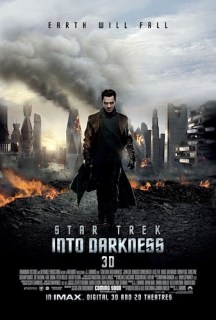 In an ethnically diverse and equal future, white American Kirk and white Vulcan-American Spock are commanded by white American Pike and white American Marcus to lead their crew to capture a Starfleet-targeting terrorist: John Harrison, a white Englishman who may be more than meets the eye…
Oh, but there are a couple of black characters. Like Uhura, who is sent to chat in their own language to one of the few other black characters… the Klingons. I don’t meant to assert the film is racist, but c’mon. This is presumably the same idea of “equal” that, in a recent survey, found men perceive a group with 17% women as being 50/50 male/female; and if 33% of the group is female, men think the women are outnumbering the men. Not really relevant to this at all, I suppose… although this future is also supposed to be gender equal, and only two of the primary crew are women… and one of them strips off to her bra for no reason…
If in that field Star Trek Into Darkness isn’t innovative, groundbreaking, or even different, then there are plenty of other aspects in which it is just as staid. For instance, like many a postmillennial sequel before it, Into Darkness is bigger and, most certainly, darker than its predecessor. Hey, at least there’s a clue in the stupid colon-less title! For goodness knows what reason, not having a colon in the title was of vital importance to the film’s writers/director/producers/tea-ladies; but surely they could’ve come up with something that made sense?!
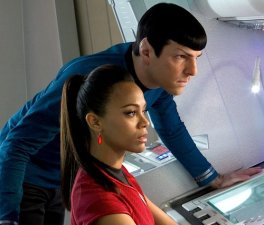 There’s still humour, mind; something which marked the first film out for a kind of geek controversy, as some felt it went too far. Because the original Star Trek TV series was dark and super-serious? An increased role for Simon Pegg’s Scotty provides most of the laughs, as everyone else is busy going Into Darkness. Unfortunately, despite the sporadic likability of several cast members, they don’t seem to have much to give. An inversion of a famous scene from a previous Trek movie ought to be tremendously moving, but doesn’t even stir.
The best performance comes from Benedict Cumberbatch as the villainous… John Harrison. Should I keep up that pretence? Paramount decided to blow it in the home video blurb, and really it’s only a twist to fans who know the character’s past. For some, therefore, the reveal of who John Harrison really is — and how he behaves from that point on — make or break the film. For me, less familiar with the original version of the character, it doesn’t really matter either way.
Anyway, Cumberbatch. Even though he’s clearly the best actor here, the script only gives him workable material some of the time. ‘Famously’ he auditioned by filming himself on a friend’s iPhone, 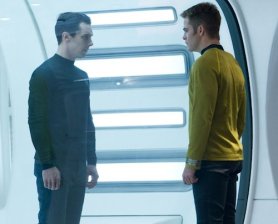 and I think the same process may have been used for some finished scenes. Which is a sarky way of saying that sometimes he phones it in. Take his first proper face-to-face with Kirk, when he’s in the Enterprise’s brig: he’s on Posh British Villain autopilot. There’s no menace, no tension; just words in our accent. It’s Cumberbatch’s Sherlock robbed of any of the charm, wit or intelligence.
It’s not the only scene to misfire, and I’m not just talking dialogue. The action sequence where Kirk and Kh— Harrison are fired from the Enterprise toward an attacking ship is somehow devoid of either tension or excitement. The sequence’s premise seems like it should offer both, so clearly that was bungled by the writing and/or directing. The same goes for the film’s climax, a punch-up on a garbage truck that both feels contrived and is distinctly low-key compared to the rest of the film — and not in good change-of-pace kind of way. At least Kh— Harrison’s first attack on Starfleet’s San Fran HQ is a pretty fine action sequence, though it gets a little videogame-boss-battle-like when Kirk fights the villain’s helicopter-like-thing.
Elsewhere, there’s a messy middle section which leaves behind an unclear structure; a lack of suitable development for some subplots (the infamous “magic blood” could have worked, but is poorly, obviously seeded… and even then feels like it comes out of nowhere later on); the score is unmemorable…
 There are good bits — in fact, I’d say that’s a pretty apt description: good bits in amongst mediocrity. There’s an arty dialogue-free bit starring Noel Clarke that’s kind of good… and kind of self consciously “look, we done told a story with no speaking!” Shot on a mix of 35mm and IMAX, the film occasionally looks very nice. I imagine some sequences were visually stunning in IMAX, though Paramount haven’t done us the courtesy of preserving the ratio shifts on Blu-ray (unless you buy some German version, apparently). I felt there was considerably less lens flare this time out too; if it was still there in hefty doses then the film was obviously doing something right because I didn’t notice it.
More so than the cinematography, it’s the production design and special effects that make the film look so good. The opening alien world, the so-called red planet (but not Mars), looks stunningly alien. The sets and/or locations used for the bowels of the Enterprise are grand and gleaming, retaining the first film’s Apple-esque future stylings. The CGI is not only flawless but at times either seamless or striking, as necessary. That said, there were no effects sequences that ‘blew my mind’. Which is fine in its own way, but less so in a film aiming for spectacle (the special features go on and on about Abrams wanting to tell a good story and every decision being driven by what the story needs, but I only half believe it).
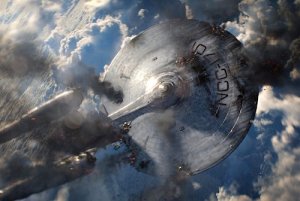 You probably remember that, just a few months after its release, a convention of Trekkies voted Into Darkness the worst Star Trek film ever made. That’s a bit much — for all its flaws, it’s still better than most of the Next Gen ones. But I don’t really see what led some to proclaim it the best blockbuster of Summer 2013. Or perhaps there’s nothing more to see, and they just let a reheated plot, adequate action sequences, and so-so technical aspects wash over them.
This review is part of the 100 Films Advent Calendar 2013. Read more here.

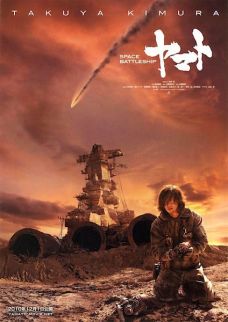 A live-action adaptation of the popular, influential and long-lasting anime franchise, known in the US as Star Blazers (here’s a very good history of the series and its significance courtesy of Manga UK). Set in a future where Earth has been ravaged by alien assault, a nearly-defeated humanity learns of a device that might turn the tide of the war, but it’s located on the other side of the galaxy. The World War II battleship Yamato is retrofitted with spacefaring tech and its crew set off on a last-ditch mission to save mankind.
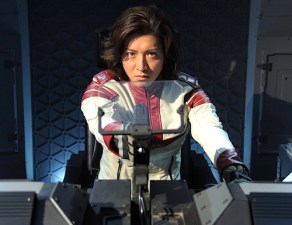 But this isn’t a mega-budget production (Manga UK’s review refers to the “colossal ¥2.2 billion budget”, but that converts as only $24 million), so such criticism is misplaced. And it doesn’t even look that bad. Besides, if you only watch films for flashy CG spectacle, you shouldn’t be trying to venture outside Hollywood’s summer tentpoles anyway.
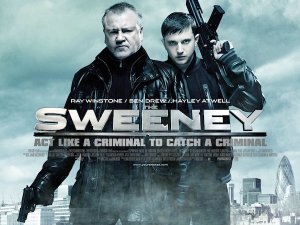 Despite a mediocre pedigree and TV-scale budget, this re-imagining of the iconic ’70s cop show is a solid thriller.
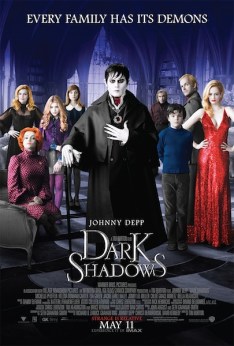 Director Tim Burton’s most recent live-action movie is an adaptation of a 1960s soap opera… albeit one featuring vampires, witches, ghosts and sundry other supernatural goings-on. You wouldn’t get that on
  Early on, it works. The first 20 to 30 minutes offer a serviceable prologue and an engaging introduction to most of the characters. It’s funny, it’s occasionally spooky, there’s a good deal of promise for a marginally-more-serious
  It’s a tonal grab bag: at times it seems to be a knowing spoof of daytime soaps, at others pushing for drama almost with a straight face; it’s sometimes deliberately and successfully comedic, at others straining too hard for a desperate laugh; it has a strain of bizarre sexuality that may be aiming at comic but is frequently just uncomfortable. This scrappiness leads to the most cardinal sin of any entertainment: it ends up a bit boring; and, in its out-of-the-blue big-battle climax, crushingly derivative.
 The writer-director of
 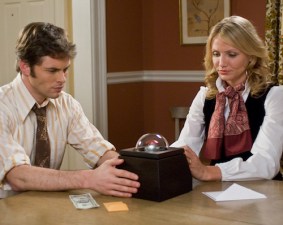 What a nice tribute to his supportive parents and their devotion to one another, eh? At the start, perhaps, but by the end of the film you may be wondering what the writer-director’s subconscious wants to do to his ma and pa…
 What could function well as an indie-level thriller is further undermined by abundant, therefore costly, CGI. Whether that’s Langella’s facial disfigurement (what could’ve been make-up is actually a complex array of tracking dots, green face-paint, motion-control cameras, and so on; all used merely to place him in simple dialogue scenes), or wide shots of ’70s Virginia, with a computer-adjusted skyline, computer-animated cars, and computer-painted snow. It’s not that the effects work is poor (though don’t look too closely at those cars), but that it screams “this must be special effects!” when you don’t want such distractions.
 The Box should have been a film we all discussed for years to come, its “what would you do”-ness providing an
  If someone you loved was locked up for decades for a crime you were sure they didn’t commit, how far would you go to get them out? That’s the premise of this methodical thriller from writer-director Paul Haggis (of
 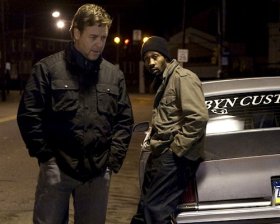 with a protagonist who either already has a “particular set of skills” or implausibly learns them (maybe over a longer period of time) before putting in motion their crazy scheme.
 Running him a close second is the all-action final half hour or so, when Crowe (spoilers! but not really!) finally stages the actual escape. It’s a long time coming, but we’re paid off with a pretty fantastic long-form action sequence. There’s genuine tension about whether they’ll pull it off or not, and along the way we’re treated to a few nice flourishes in his plan. There’s a fair degree of silliness still, though, so at least that’s in-keeping with the rest of the movie.
 Finally, there’s an attempt to keep uncertain the truth about Banks’ culpability. Haggis never wanted that question to be answered — Crowe believes she’s innocent, even when she confesses to his face, and that’s what matters. I don’t think Haggis is a filmmaker who can resist answers, however, and for all his assertions that her innocence/guilt is left ambiguous, by the end I think you can be pretty darned certain which it is… which kinda makes all the previous attempts to leave it open feel hollow, especially the ones that side with the untrue.
 Ambiguous endings used to be anathema to film audiences. They wanted things tied up in a pretty little bow, thank you very much; all the conflicts resolved and all their questions answered. Then the likes of
  In the Blu-ray’s special features, Boyle comments that “it’s more classical than you might expect.” He’s talking specifically about the cinematography (and he’s right, but more on that later), but he could equally be talking about the entire movie. Though it has a storyline that blurs the line between what’s actually happening and what’s happening inside a character’s head (or is that characters’ heads?), the overall tone and style — particularly of the climax — is actually quite Hollywood. It’s Hollywood jazzed up with storytelling trickery, a quirky score, dashes of extreme gore and surprising nudity (that it’s not an 18 is somewhat surprising); but underneath all that it’s not a million miles away from your run-of-the-mill thriller.
 there’s no switching to black and white for dreams, for instance; nothing to definitively tell you which state you’re in. And this is a good thing, because when you need to know you can tell, and the rest of the time… well, the film’s playing with you. That’s the point. What is real and what is a scenario McAvoy’s being talked through? Are these memories what happened or the product of an addled mind?
 Dod Mantle’s cinematography is also strikingly handsome. As noted, the film’s buzz had me expecting something akin to late-career Tony Scott, all jumpy and weirdly saturated and fragmented. Instead, as Boyle said, it’s actually very classical, but with a great eye. There are a number of shots which would look fabulous framed and hung on the wall, not least of the street outside Dawson’s flat at night, a restaurant next to intersecting train lines, and aerial photography of red-lit nighttime motorway junctions, looking like some kind of Rorschach test-esque psychiatrist’s tool.
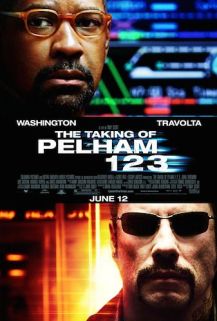 Based on a novel by Morton Freedgood (writing as John Godey), previously adapted into
 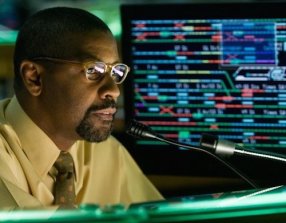 None of that here, where the captives are either even more unnoticeable, or heroic off-duty military types. So far so standard.
 Applied here to such a meat-and-potatoes tale, it feels like they’re trying to jazz it up because it can’t sustain itself otherwise.
 When
When  Personally, I find it a valid thing to attempt. Rather than take the Superman mythology as read, here Nolan and co — including screenwriter David Goyer and director Zack Snyder — have tried to imagine what would really happen if an alien baby with incredible powers arrived in our world. So Clark Kent hides his abilities, goes on a trek around the world to ‘find himself’, and when he’s uncovered there’s mass media and military interest. Which is pretty accurate, I think. If some guy started stopping oil rigs collapsing single-handed, or flying around the place, the military’s hardly going to sit back and go, “oh OK then”.
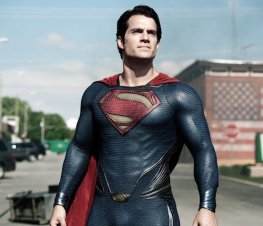 The filmmakers have certainly bought into their own conceit, to a frankly laughable extent. The Blu-ray contains a featurette called All-Out Action, which the menu describes as follows: “The action in Man of Steel soars to new heights with a level of realism never before seen in a super hero film.” Hahahaha! Realism my arse. Once the action kicks in it’s positively comic book. Men are hurled around like rag dolls; Metropolis is destroyed in a huge flying punch-up, which just feels like a less effective re-hash of
 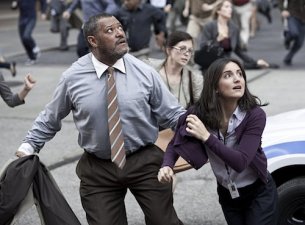 As to the destruction of the city, I think the criticism is right. The city clearly isn’t evacuated before buildings start falling — it’s being evacuated, but no one even knew to start running before the Massive Machine Of Destruction (I forget what it was actually for) turns up and starts destroying things. People run into the streets as buildings fall on them. As a viewer, how can you miss that hundreds, possibly thousands, of innocents are dying? The cinematography makes it look like 9/11 — incredibly like 9/11, in fact. That was 12 years ago by the time of the film’s release, but is it OK to trade on such iconography in a blockbuster entertainment? Should we just ignore the notion that so many ‘extras’ are dying because, hey, it’s just a superhero movie? But aren’t we meant to be taking this as Real World, chaps?
 There’s a lot else that Man of Steel plays with in the Superman legend besides the violence and cinematography. Some people will surely miss the bumbling Clark Kent, the burgeoning relationship with Lois Lane, and so on. These elements are eventually brought in, sometimes in a modified way, which makes it feel like they’ve been put in place — Superman Begins style — to be used in a sequel. Except we know
 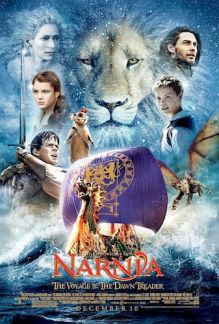 I’ve never actually read the Narnia novels, but I did have them read to me when I was very young and, for some reason, I remember Voyage of the Dawn Treader being my favourite. Sadly, this doesn’t quite translate to the big screen.
 but as a grown adult it is painful. The level of subtlety here is so low a participant in
  100Films.co.uk