2014 #13
Alfonso Cuarón | 91 mins | Blu-ray | 2.40:1 | USA & UK / English | 12 / PG-13
 2014 Academy Awards
10 nominations — 7 wins
2014 Academy Awards
10 nominations — 7 wins
Winner: Best Director, Best Cinematography, Best Film Editing, Best Original Score, Best Sound Editing, Best Sound Mixing, Best Visual Effects.
Nominated: Best Picture, Best Actress, Best Production Design.
 On its theatrical release, a commonly-cited recommendation was to see Gravity in 3D on the biggest screen possible. Obviously, I didn’t bother. Some say it isn’t as effective on a small screen in 2D. Maybe it isn’t as effective, but it’s still a damn fine film.
A near-future thriller (albeit one set in space), the destruction of a satellite sees a cloud of debris hurtling round the Earth, in the process destroying the space shuttle of Sandra Bullock, George Clooney, and other less-fortunate crewmembers. Using Clooney’s experimental space-jetpack, the survivors set off across the void for the nearest space station, racing against their oxygen supply to find a way home…
As many have noted, Gravity is a little light on plot. That’s a dealbreaker for some, it would seem, which I think rather misses the point. This is a survival story, predicated on two things: one, the desperate attempts of our heroine to triumph against increasingly-poor odds; and two, the spectacle of weightlessness and space. Not every movie needs a complex storyline to keep it going; not every film needs to only be about its plot. As co-writer and director, Alfonso Cuarón drives the film admirably on the aforementioned survival attempts and some swiftly-sketched character development.
The spectacle may have worked best on the big screen in 3D, but Cuarón’s talent as a director means it translates at home, too. That most of the film was created in computers means his penchant for long takes is indulged, but the impact of those is paramount: rather than fast-cut action sequences (even if the speed of cutting has been pushed to extremes in recent years,  quick editing has always been a way of creating excitement in that arena), the never-ending shots serve to make you feel closer to events, right alongside Bullock, almost wishing it would stop. Plus there’s skill in being able to show us what we need to see from a single vantage point, without the easy option of being able to cut to a different angle to clarify a detail.
Left to carry much of the film solo, Bullock’s performance is strong enough, but this isn’t a deeply-drawn character. There’s something to her, and the situation she’s been put in is trial enough without the need for backstory, but is it really a performance that cries out for awards recognition? Not as much as the rest of the film.
Speaking of which, controversy has occasionally dogged Gravity — on two fronts. Firstly, that BAFTA awarded it Best British Film. Cue varying degrees of outrage and incredulity that an American-funded film about American astronauts could be considered British. The flipside to this is that Cuarón has made Britain his adopted home; and while the Big Studio may ultimately be American, the production company and producers are British. It was shot in Britain by a British crew, and the groundbreaking CGI — which even James Cameron, he of great determination and resultant innovation, said couldn’t be done — was created in Britain by British artists.  The most high-profile jobs — the actors, the studio — may be American, but everything else is pretty darn British. Rather than cry “that’s ridiculous! Give it to a proper British film!”, we should be keen to point out that, actually, this surprise global mega-hit wasn’t made in America, but in Britain, by all the talented filmmakers we have here. Rule Britannia, etc etc!
Secondly, there’s the genre issue. Most have labelled the film “science fiction”, primarily because it’s set in space. The hardcore SF brigade take umbrage with that, however: technically it’s set almost-now, with present-day technology. This is a story that Could Happen Today, not a distant dream of what Might Happen Tomorrow. Really, it’s a bit of a mixed bag: technically it is set in the future — that’s proven by little things like flight numbers and the existence of a finished space station that, in real life, is still being built — and makes use of technology that doesn’t actually exist (the space-jetpack I mentioned earlier), plus it depicts a massive-scale disaster that, obviously, hasn’t happened. But that’s no worse than many an earthbound thriller, which routinely use just-beyond-possible tech (look at all of Bond’s gadgets, even (at times) in the newly-grounded Craig films) and depict huge events that haven’t actually occurred (Presidential assassinations, nuclear detonations, etc). So, really, Gravity is no more sci-fi than those, except for it being set in space… which immediately categorises it as SF to your average viewer.
 While I sympathise with the idea that it’s not A Science Fiction Movie, but instead A Thriller (That Happens To Be Set In Space), you can’t really deny its SF-ness. OK, if we’re classing this as SF then so too should be films like The Sum of All Fears, or most of the James Bond canon; but really that’s just an argument over technicalities — one I’ve indulged for far too long.
The point is, however you classify it, Gravity is an exciting, spectacular, technically-impressive movie; one that overcomes the alleged need for a huge screen and 3D to work even in the corner of your living room.
Gravity debuts on Sky Movies Premiere today at 4:30pm and 8pm.
It placed 1st on my list of The Ten Best Films I Saw For the First Time in 2014, which can be read in full here.

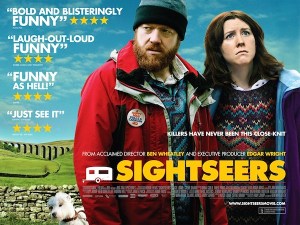 “He’s not a person Tina, he’s a Daily Mail reader.”
 I found
  The rest of the cast are a mix of old and new — clearly, some managed to wriggle out of a second go-round. Talulah Riley, Tamsin Egerton and
 The follow-up to 2009’s
  indeed, a band of outré ninjas are introduced almost as soon as our heroes, and they set off on an OTT plotline simultaneously. As the film wears on, it disappears further and further into fantasy; and not “version of our world” fantasy, but “kids’ Saturday morning cartoon” fantasy. The plot suggests the violence etc should be slightly toned down and the whole affair should have a PG, or even a U. Much like the first film, then.
 Elsewhere in that making-of, the guys from Hasbro talk about how they wanted to ensure the characters were distinct, not just Generic Soldiers. Failed that, then. It’s fortunate that most of the Joes are massacred because the only stand-outs are The Rock (because he’s The Rock), Channing Tatum (because he was in the first one), and Adrianne Palicki (because she’s the only girl). Even once D.J. Cotrona’s Flint (and I had to IMDb both of those names) is one of just three Joes left, his only distinguishing features are that he’s Not The Rock and Not The Girl. He is, to use a phrase borrowed from the Hasbro guys, a Generic Soldier. “Oops.”
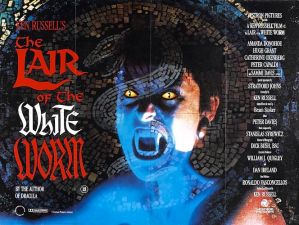 The Lair of the White Worm looks cheap, has a ridiculous story, overacted characters and overcooked dialogue, and by all rights should be a disaster. And maybe it is… but I don’t think so. In the right frame of mind, at any rate, it’s a whale of a time.

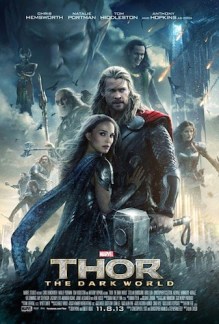
 Good will towards the participants counts for a lot, though. Tom Hiddleston’s Loki steals pretty much any scene he’s in, but Chris Hemsworth’s Thor is not an unlikeable hero, building further on the responsibility-and-honour story arc of the first film. Idris Elba also benefits from an expanded role, but others are less lucky: one of the Warriors Three is ditched as soon as we’re reacquainted with him; more criminally, Christopher Eccleston’s villain has nought to do but stomp around spouting exposition in a made-up language. Anyone could play that role, you don’t need an actor of Eccleston’s ability. Maybe something got cut (though it’s not in the Blu-ray’s deleted scenes), because I don’t see why else he’d’ve taken the part. Well, possibly the payday.
 Despite the title, there’s much fun to be had with The Dark World. It can’t deliver on all of its aims — the equally-promised expansion of Thor and Jane’s relationship is equally sidelined — but there’s enough entertainment value to make it a worthwhile proposition. Perhaps the longer lead-in that the third film seems to be getting (there’s no announced slot for it among Marvel’s numerous future release dates, meaning it’s unlikely to arrive before 2017) will allow them to round everything out a little better.
 Residents of a condemned high-rise witness a gang-related murder, but don’t intervene and deny all to the police. Months later, a sniper begins to pick them off. Can they band together and survive?
 Quirky director Jeunet uses quirky cinematography and quirky special effects to tell the quirky story of a quirky girl, who had a quirky upbringing by quirky parents, and now lives a quirky life with quirky friends. A quirky coincidence leads her into the quirky hobby of cheering up strangers in quirky ways, during which she meets more quirky people who do quirky things, and she quirkily falls for the quirkiest.
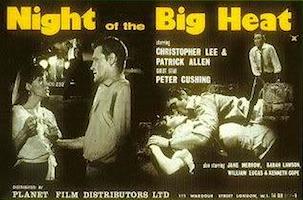 These days largely sold as a horror movie (the old Collector’s Edition DVD is branded as part of a “Masters of Horror” series), probably thanks to its cast (Christopher Lee and Peter Cushing), director (Terence Fisher, of many a Hammer Horror, including five with Cushing and Lee), and rating (an X originally, a 15 now), Night of the Big Heat is not really anything of the sort. Well, maybe a little; but you’re more likely to get scared by a contemporaneous episode of
  the pair were brought in to redraft because the original screenplay’s dialogue was “unsayable”. Anyone familiar with their ’80s work on Doctor Who, and their associated reputation, will find that highly ironic.) However, when the sci-fi stuff does roll in it’s a bit of a damp squib, leaving the scenes relating to the affair, whether it will be discovered, and what various characters do about their various feelings, as some of the more unique and interesting elements.
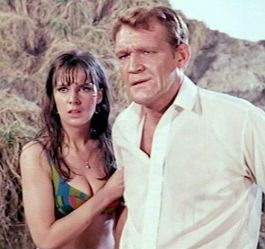 which considering it was shot in February and March is a real achievement. During night shoots the cast had to suck ice to stop their breath being visible, while running around in wet clothing to look like they were drenched in sweat. Poor sods. Said night scenes are a mess of genuine and atmospheric nighttime shooting, alongside the kind of day-for-night filming where everything’s extremely dark except for the sky, and also the kind of day-for-night filming where it’s day and… um… shh!
 Originally produced for the 2010 FrightFest film festival, horror director Jake West’s feature-length documentary with the unwieldy title explores the ‘video nasty’ scare that gripped early-VHS-era Britain. Starting with a primer on the birth of home video, and what it was like to watch movies in those days (because, ladies and gents, we’ve now reached a point where even fans of that (second-)most adults-only of genres, the gory horror flick, are young enough to not recall a time before DVD), West uses archive news clips and a wide array of new talking head interviews to take the story from the UK’s first video recorders in 1978, through a newspaper-led panic, up to the infamous Video Recordings Act of 1984, which irrevocably (thus far, anyway) changed the face of home entertainment releasing in the UK.
 Focusing on the scare rather than the films embroiled in it makes this less a “horror documentary” and more a social history/pop culture one, though the liberal use of extreme clips from the movies in question shuts out anyone without a hardened stomach. (If you did want more on the films themselves, the DVD set that contains the documentary — Video Nasties: The Definitive Guide — includes 7½ hours of special features discussing all 72 ‘official’ video nasties alongside their trailers.) There’s room for little asides amongst the main narrative, though. One of the highlights is the story of an interviewee who was invited on to Sky News in the wake of the James Bulger murder and asked if the film many were holding responsible,
  There was some counterargument, however, which leads us to the film’s best interviewee, and surely a new hero to many: Martin Baker. Baker was one of a few (certainly the first, and for a time the only) critical/intellectual-type voices to speak out in defence of the films that were outraging so many. He’s to be commended not only for his valiant defence of, essentially, free speech at a time when his views were immensely unpopular; but also because he remains one of the most lucid and fascinating commenters in the documentary. He makes the clearest points about the need to not forget both what happened and how it was allowed to happen, lest it occur again.
 that force ISPs to attempt to censor what we can and can’t see on the internet, and just yesterday rushed through anti-privacy legislation without proper debate. Sad to say, many of the valuable lessons of the ‘video nasties’ brouhaha — lessons made explicit with superb clarity in Jake West’s excellent documentary — have not been heeded.
 100Films.co.uk