
Edgar Wright | 109 mins | Blu-ray | 2.35:1 | UK, USA & Japan / English | 15 / R
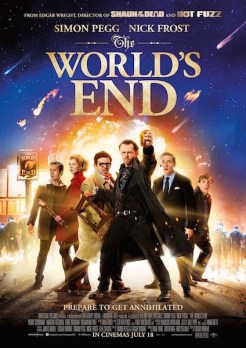 Shaun of the Dead is the favourite of critics and fanboys, and Hot Fuzz seems to have attained widespread popularity, but The World’s End may be the most mature and, in its own way, subtly subversive of the ‘Three Flavours Cornetto’ trilogy. Does that make it the best? Well…
The story sees man-child Simon Pegg gathering his old gang of Sixth Form friends — all now grown-up with proper jobs and lives — to attempt their hometown’s twelve-stop pub crawl, which they failed as teens. Despite lingering tensions within the group, all starts well enough — until they begin to notice there’s something oddly familiar about their old town… almost as if it hasn’t changed at all for a couple of decades… Cue sci-fi hi-jinks with special effects and action galore, mixed with some deft character-derived humour — the Cornetto trilogy’s usual M.O., in other words.
That’s not a criticism. This is a thematic trilogy, and as such you expect certain elements to be there. No one wants a beat-for-beat rehash, because what’s the point, but there are certain stylistic and tonal elements you want to be present. The World’s End largely achieves that, though not enough for some — those after nought but genre spoofery and non-stop humour may be disappointed.
This is a more mature work than its two predecessors. While they were clever genre mash-up/pastiches, this goes lighter on that crowd-pleasing bumf. There are still generous segments of that in the film, but the genre being manipulated is less clearly defined than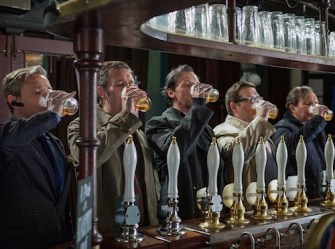 “zombie movie” or “Hollywood action movie”, and occasionally co-writers Pegg and Wright have substituted character development and thematic points for send-up. It may not play to the genre-loving fan-audience that the trio’s previous work has accumulated (demonstrably so, based on many a viewer review), but it does make for a more grown-up film.
I noted that the film is definitely a part of the Cornetto trilogy, but there’s an element of growing up and moving on about it. Shaun of the Dead was made when Pegg and Wright were in their early 30s, but now they’re in their early 40s — a very different time, with different personal concerns. Some people may wish to remain young forever (as per Pegg’s character in the film), but others mature, and it seems Pegg and Wright have more grown-up aims in mind with their filmmaking. In that sense The World’s End may be transitional, from the genre-focussed spoofery of their ‘youth’ to a more considered, perhaps even realistic (at least as far as character and theme are concerned), style of storytelling. Of course, it’s quite meta that the film they’ve made to grow up and move on from the Cornetto trilogy is all about growing up and moving on.
It’s a shame some viewers can’t get on board with this more mature approach. While the consensus appears to be “very good, but definitely the weakest of the trilogy”, there are (normally sane) people who seem to genuinely despise it (what was that I was saying about immaturity again…), and at least a couple who cite it as their favourite of the lot. It’s been a long time since I last watched Shaun or Fuzz so I’m not going to offer my definitive opinion on their relative merits, but I can see that this could be my favourite.
 It will definitely reward multiple viewings: it’s littered with signs, omens and portents (in fairness, a good few can be grasped on an attentive first go). There’s a featurette on the BD (but not the DVD) which helps point out any major ones you may’ve missed; though I have to say, even at seven minutes long, and even with it pointing out some that felt too obvious to be worth mentioning, I swear it left some stuff out. That could be a deliberate decision of course, to leave some things for people to just spot.
Clearly too mature for some viewers (and I don’t mean in the sense of swearing and violence), Wright and Pegg’s trilogy-capper is a thoughtful character movie about growing up and moving on… paired with the usual Cornetto trilogy genre-riffing hi-jinks. The result may just be the trilogy’s pinnacle.

This review is part of the 100 Films Advent Calendar 2014. Read more here.
 Comic book creator Frank Miller brings what he learnt co-directing
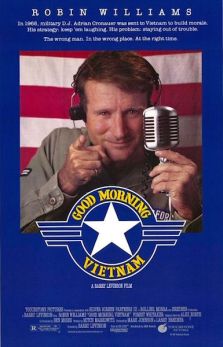 Inspired by the true story of a US Army DJ in Vietnam during the war, the resulting film is a showcase for star Robin Williams — reportedly, his antics aren’t even close to what really happened.
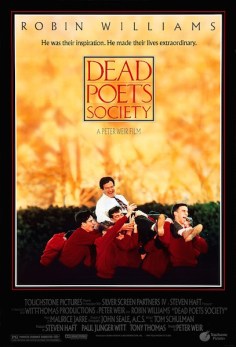 At an oppressive private school (is there another kind?), a gaggle of disenchanted students are invigorated by teacher Robin Williams; until his methods, and the independent thought they inspire, attract the ire of parents and faculty.
 Westerns don’t come more renowned than this Ford-Wayne collaboration about the years-long hunt for a girl kidnapped by Native Americans.
 Tom Hanks is Walt Disney and Emma Thompson is author P.L. Travers in “The Making of Mary Poppins: The Movie”. Disney has been desperate to turn Travers’ fictional nanny into a movie for years after he made a promise to his daughter; Travers has resisted, but now needs the money. She’s brought to LA to consult on the script, and proceeds to make life miserable for screenwriter Don DaGradi (Bradley Whitford) and songsmiths Robert and Richard Sherman (B.J. Novak and Jason Schwartzman). At the same time, we see the story of a family in Australia from the eyes of a little girl Ginty (Annie Rose Buckley), as they struggle with the whims of her father (Colin Farrell), a bank manager who’s a little too fond of the bottle. Guess what the connection is!
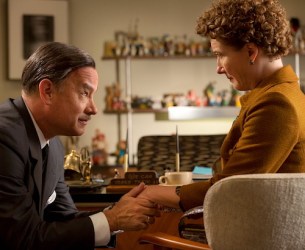 Similarly, Hanks’ part seems to be little more than a cameo at first, but he steadily appears often enough to make it a supporting role. Reportedly he has perfectly captured many of Disney’s real traits and idiosyncrasies, and who are we to doubt the word of people who knew the man? His performance is not just a shallow, simple impersonation, but there’s not that much meat to Disney’s character arc either.
 Some will find the story lacking in dirt, particularly when it comes to the portrayal of Disney. But it’s not whitewashed either, and do you really think the Disney Corporation would have allowed a movie to go ahead that depicts their founding father in a negative light? For that, I don’t think it’s as twee as it could have been — there’s definite conflict over what’s being done with Poppins, and, even with the film having turned out to be a solid-gold classic, we often find ourselves sympathising with Travers.
 Of late there seems to have been a glut of sci-fi films with highly generic, near-meaningless titles —
 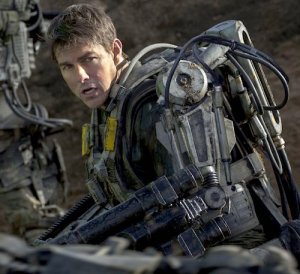 suitably exciting, surprisingly funny, and actually quite clever. It’s also boldly standalone. OK, so it’s an adaptation, but the book is hardly a
  Reflect too heavily and some bits may begin to crumble more but, for me, not too severely.
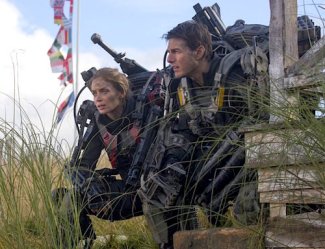 Edge of Tomorrow isn’t an unqualified success, but more than enough of it works to make for a well-above-average modern blockbuster. Excellent action sequences, plenty of amusing asides, and a couple of solid sci-fi concepts to chew on combine to render it quality entertainment. Bonus points for being a true original in a sea of remakes, sequels and spin-offs.
 1988: due to international pressure, Chile’s dictator, General Pinochet, has acquiesced to a vote on whether he should continue ruling the country. Despite the violent takeover he orchestrated, and subsequent murders and ‘disappearances’, the country has prospered under his rule, and many — especially influential affluent people — are keen for him to stay. The anti-Pinochet “no” campaign are allowed a daily slot on state-controlled television in the run up to the election, and they hire advertising exec René Saavedra (Gael García Bernal) to mastermind the campaign. Cue internal conflict — the politicos want dour films highlighting Pinochet’s evil; René wants to use the language of advertising to sell the promise of a happy future — before the campaign itself finally gets underway, and the “no” campaigners become targets of the ruling regime’s evil tactics…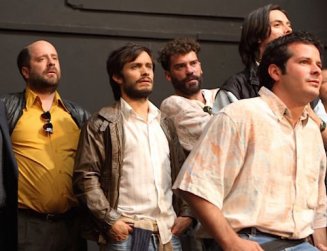
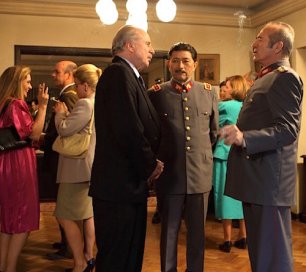 But seriously, there’s not really a comparison between the brutal military regime that ruled Chile — which nonetheless many were happy with because it had brought modernisation and prosperousness for some — and the voluntary union between the rest of the UK and Scotland. I’m sure some of “the 45”, as they now call themselves, would identify with those battling for freedom in this film, but I think that might be taking it a bit far.
 Box office gross is one of the methods most often used to summarise a film’s success and standing, and yet it’s one of the most useless markers of quality — and quotes like the above, from Terrence Rafferty in his article “Holy Terror” for Criterion’s Blu-ray release of Night of the Hunter (and available online
  In another piece in Criterion’s booklet, “Downriver and Heavenward with James Agee” (online
  And yet, as Rafferty explains, “the most radical aspect of The Night of the Hunter… is its sense of humor. More conventional horror movies overdo the solemnity of evil. The monster in The Night of the Hunter is so bad he’s funny. Laughton and Mitchum treat evil with the indignity it deserves.” I wouldn’t say that humour is one of the film’s defining characteristics, to be honest, but it does undercut its villain. He’s not some unstoppable supernatural creature, but a man who can trip over while chasing you up the stairs, and so on. In some respects it’s this very ordinariness that makes him so scary: however much they creep you out during the film itself, you know there’s no such thing as vampires or werewolves or ghosts. There are Powells in the world, though; an everyday evil that you might not see coming, but can still get you. Brr.
 In
In  Despite the fact that
  Then we have the much-maligned backstory about just what Peter Parker’s parents did all those years ago, before they abandoned him with Uncle Ben and Aunt May. There are pros and cons to this: it’s all new, which at least makes it interesting and unpredictable because it has no forebear in comics or films; but it’s also a pretty stock set of circumstances. Worse still, it robs Spidey of a major defining trait: Peter Parker is bitten by a spider by accident — it could’ve been anyone. In this version, it could only have been him. Boo. Sony clearly want an arc plot they can run across a trilogy (or more), so presumably this thread will rumble on… though whisperings that they’re considering some kind of soft-reboot may see it cut short. I wouldn’t complain.
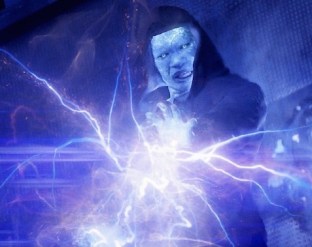 but it’s more textured, at least. Then there’s Electro, who (as mentioned) may have a familiar story, but is nonetheless perfectly pitched by Foxx. His powers lead to some excellent sequences, including but not limited to the aforementioned Times Square duel. He also contributes to the music, in a way, as Electro’s whispered/sung thoughts ‘bleed out’ into the score. It’s creepy, especially as it’s so subtle in the mix — I wondered what the hell was going on at first. I thought it was a fantastic score all round, in fact, bringing in a modern music element that fits the notion of Spidey as a young character perfectly.
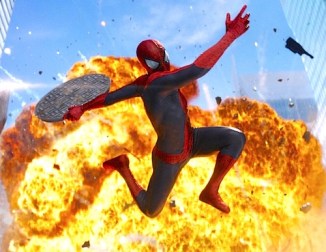 It lacks the confidence, heart and flair that mark out Spider-Man 2, and the bold originality and clarity of purpose that define
  100Films.co.uk