
Vincent Ward | 114 mins | streaming (HD) | 2.35:1 | USA & New Zealand / English | 15 / PG-13
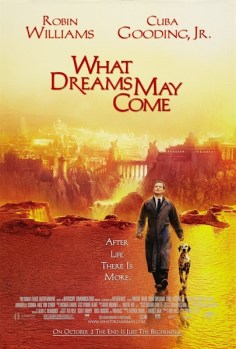 When What Dreams May Come first came out, the reviews seemed to conclude that it was rubbish, but at least visually splendid. Back in 1998, that put me off — “it’s not meant to be very good” was the takeaway thought there. As the years have gone on, for some reason those reviews (or possibly just one I extrapolated into a consensus, who knows?) stuck with me; and as my temperament as a film fan grew, that it was visually extraordinary (even if nothing else) began to seem reason enough to watch it. It lingered in the back of my mind, never quite becoming a “must see”, especially as the opportunity rarely (if ever) presented itself. So that’s more or less how I come to it now, 17 years since its release and those reviews — a long-awaited scratch of a long-lingering itch. (Perhaps this gives some insight into why/how it takes me so long to get round to watching recommendations/things I’m quite keen to see/etc.)
Adapted from a novel by Richard “I Am Legend” Matheson, the story concerns Dr Chris Nielsen (Robin Williams) and his wife Annie (Annabella Sciorra). Their perfectly lovely life is shattered when their two kids are killed in a car crash. Despite Annie suffering a mental breakdown, they hang in there… until Chris is killed in another car crash a few years later. He ascends to a kind of Heaven, a wondrous place controlled by his imagination — this is where those visuals come in. However, Chris learns that Annie has committed suicide, and so been condemned to Hell. He vows to do what has never been done, and travel to Hell to rescue her.
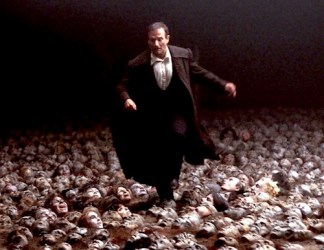 Hell, incidentally, also looks incredible, as do the various locales visited by Chris and his companions (played by Cuba Gooding Jr and Max von Sydow) on their way there. Director Vincent Ward and his team have created a rich, engrossing visual space here. It’s not just the Oscar-winning visual effects either, which create Chris’ initial realisation of Heaven as a kind of living painting, but also the locations, their decorations, and some fantastic sets. The design work is brilliant, and the vast majority of it still holds up today. Even the CGI doesn’t look glaringly like 17-year-old graphics, and in many cases what I presume is a mix of live action, models and some CGI is far more effective than the all-CG look it would likely have if made today.
However, the story is… problematic. Its logic comes and goes (the afterlife’s rules have to be obeyed or are able to be broken depending on the situation, for instance), it goes on too long, with too many asides, and there are needless twists, reveals, and reversals that are neither surprising (thanks to their ultimate predictability) nor illuminating (thanks to their unnecessariness). There were too many flashbacks and asides to real life, and I’d have liked it more if it stuck to the afterlife stuff — cut the flashbacks, limit the story to the afterlife quest, and stop mirroring it in the couple’s earlier real-life troubles. That would make the movie shorter, more streamlined, less wishy-washily sentimental, more focused, and therefore better.
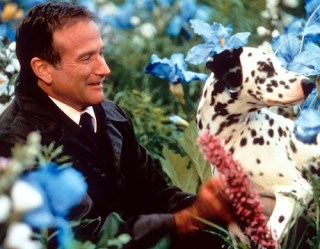 Nonetheless, some will identify with the sentimental “love transcends death”-type message more than others, and there’s a chance those who like (or don’t mind) their films to be at the soppier end of the spectrum will genuinely love it. For the rest of us — for anyone who likes visual splendour in their movies, anyway — it does indeed merit a look for the imagery alone.


 Score:



 Screened in UK cinemas simultaneously with its TV premiere (and coming to the big screen in various other countries over the next week or so, too), the latest episode of the BBC’s modern-day Sherlock Holmes series is actually a standalone adventure set in the character’s original Victorian time period.
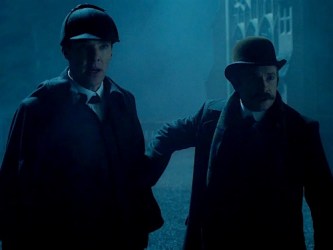 The case they find themselves embroiled in is a little more period than usual, however, with lashings of Gothic and some of the trappings of a Christmas ghost story. The episode is co-written by series creators Mark Gatiss and Steven Moffat, and anyone familiar with Gatiss’ wider work can clearly see his influence here. Moffat brings his trademark fast-paced intricately-tricksy plotting, for which individual viewers’ mileage varies greatly: some find it genius, some find it tedious. Is it clever, or does it just think it’s clever? Is it impossible to follow, or were you just not paying enough attention? As to the first question, I think it’s a bit of both; as to the second, I think the episode ultimately answers everything, but you might need to realise a few things for yourself.
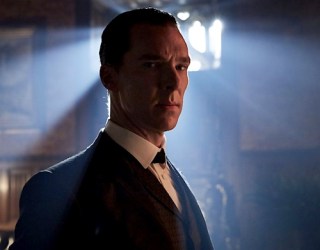 Until the last half-hour or so, anyway, when the modern version suddenly comes crashing in. At first it seems like a clever interlude; a little reminder of the true time period for this version of the characters, and a tease for season four. But it quickly transpires that, no, this episode isn’t actually a wholly standalone aside from the main series — Gatiss and Moffat have found a way to integrate it into continuity. For me, this is where the special begins to come apart at the seams; not because I inherently object to this integration, but because from that point on the episode begins to jump back and forth between the present, the imagined past, and various other dream-state asides. It’s almost entirely justified by the beautifully-shot Reichenbach Falls sequence, but a spot of cinematographic prettiness doesn’t really excuse the way the story goes a little haywire. The least successful part of all, for me, is that it calls into question the solution for the case we’ve just been presented with… but then doesn’t get round to offering another, meaning you kind of feel like the case hasn’t been solved, even though it presumably has been, with the first solution. I think.
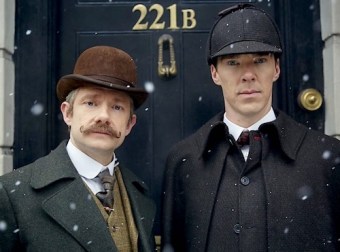 As someone who enjoys Sherlock Holmes in his proper era but is also a fan of this modern day version (I would say “a big fan”, but I’m not one of those people), I’d rather they’d played this a little more straightforward. Not a lot — it’s still under the umbrella of Sherlock after all, and the era-transposed stylistic flourishes in the first hour-ish worked very nicely in my opinion — but the mixed-up mishmash of the final act dilutes the effectiveness of the entire experience. There’s fun and thrills to be had along the way, but in another form it could perhaps have been a Sherlockian classic in its own right.


 John Singleton became the first African-American Best Director Oscar nominee, as well as the youngest, for this debut. 23 years on, his story of the lives and troubles of young black men in L.A. remains sadly pertinent.
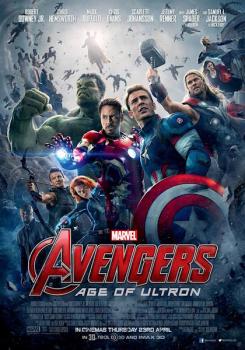 It feels kind of pointless reviewing Avengers: Age of Ultron, the written-and-directed-by Joss Whedon (and, infamously, reshaped-in-the-edit-by committee) follow-up to 2012’s “third most successful film of all time” mega-hit
 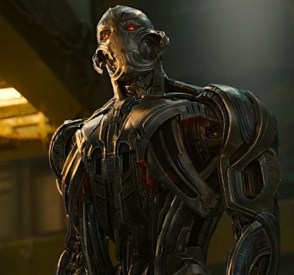 Even though the first half of that is still three years away, we’re still very much on the road to it. Heck, we have been practically since the MCU began, thanks to those frickin’ stones (if you don’t know already, don’t expect me to explain it to you), but now it’s overt as well as laid in fan-friendly easter eggs. The titular threat may rise and be put down within the confines of Age of Ultron’s near-two-and-a-half-hour running time, but no such kindness is afforded to the myriad subplots.
 (not just obvious stuff like the Hulk, but digital set extensions, fake location work, even modifying Stark’s normal Audi on a normal road because it was a future model that wasn’t physically built when filming) that stuff they genuinely did for real looks computer generated too. All that time, all that effort, all that epic logistical nightmare stuff like shutting down a capital city’s major roads for several days… and everyone’s going to assume some tech guys did it in an office, because that’s what it looks like. If you’re going to go to so much trouble to do it for real, make sure it still looks real by the time you get to the final cut. I’ll give you one specific example: Black Widow weaving through traffic on a motorbike in Seoul. I thought it was one of the film’s less-polished effects shots. Nope — done for real, and at great difficulty because it’s tough to pull off a fast-moving bike speeding through fast-moving cars. What a waste of effort!
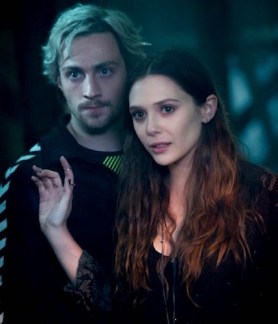 The really daft thing is, Whedon specifically added Scarlet Witch and Quicksilver… wait, are Marvel allowed to call them that? I forget. Anyway, Whedon added the Maximoff twins because, as he said himself, “their powers are very visually interesting. One of the problems I had on the first one was everybody basically had punchy powers.” I know Hawkeye’s power is more shoot-y than punchy, and we all know
  At the end of the day, what does it matter? Age of Ultron isn’t so remarkably good — nor did it go down so remarkably poorly — that it deserves a reevaluation someday. It just is what it is: an overstuffed superhero epic, which has too much to do to be able to compete with its comparatively-simple contributing films on quality grounds, but is entertaining enough as fast-food cinema. Blockbusterdom certainly has worse experiences to offer.
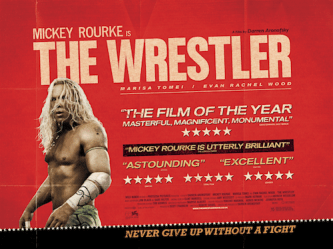 Mickey Rourke’s Oscar-robbed performance is the primary draw of this drama about a washed-up pro wrestler struggling to make ends meet. As ill health threatens his ability to continue performing on the miserable, brutal ex-pro circuit, he ties to connect with his estranged daughter (Evan Rachel Wood) and woo a kindly stripper with personal issues of her own (Marisa Tomei, in another Oscar-worthy turn).
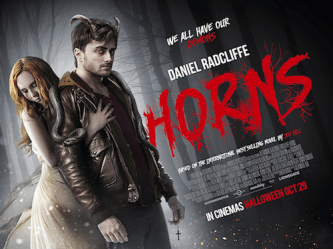 Did Daniel Radcliffe murder his girlfriend? Sprouting devilish horns doesn’t help his case…
 Once-great detective Sherlock Holmes (Ian McKellen) has retired to the countryside with his housekeeper (Laura Linney), her son Roger (Milo Parker), and his bees, but an unsolved case from late in his career troubles his dementia-addled mind. As he tries to remember the events, we also learn the significance of a trip he recently made to Japan, and the benefits of his growing friendship with Roger.
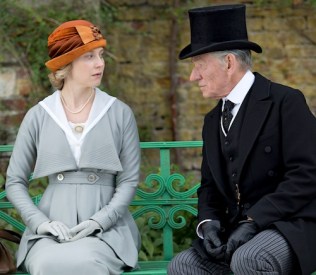 Alongside him, the lad, Milo Parker, is very good, managing to holding his own against the knight of the realm. Also excellent is Hattie Morahan, playing the object of the case in Holmes’ flashbacks. She’s probably best known for playing embattled fellow parent Jane in
 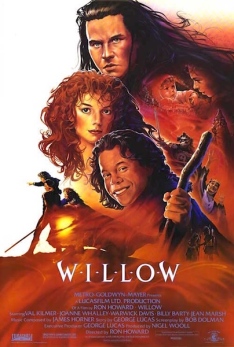 Warwick Davis is the farmer who must return an abandoned baby, unaware it’s heir to a throne evil queen Jean Marsh doesn’t wish to relinquish. Intermittently aided by Val Kilmer’s Han Solo-ish vagabond, they must elude the queen’s forces, led by her daughter, Joanne Whalley.
 100Films.co.uk