100 Films’ 100 Favourites #58
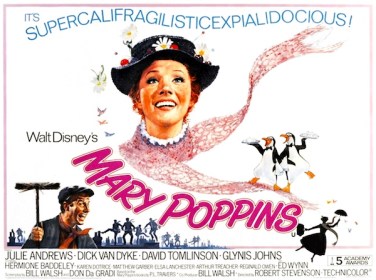
It’s supercalifragilisticexpialidocious!

Country: USA
Language: English
Runtime: 139 minutes
BBFC: U
MPAA: G (1972)
Original Release: 27th August 1964 (USA)
UK Release: 23rd December 1964
First Seen: by osmosis in childhood.
Stars
Julie Andrews (The Sound of Music, Torn Curtain)
Dick Van Dyke (Bye Bye Birdie, Chitty Chitty Bang Bang)
David Tomlinson (The Love Bug, Bedknobs and Broomsticks)
Karen Dotrice (The Gnome-Mobile, The Thirty-Nine Steps)
Director
Robert Stevenson (Jane Eyre, Bedknobs and Broomsticks)
Screenwriter
Bill Walsh (The Love Bug, Bedknobs and Broomsticks)
Don DaGradi (Blackbeard’s Ghost, Bedknobs and Broomsticks)
Based on
the Mary Poppins books by P.L. Travers.
Music and Lyrics
Richard M. Sherman (The Jungle Book, Chitty Chitty Bang Bang)
Robert B. Sherman (Bedknobs and Broomsticks, The Many Adventures of Winnie the Pooh)
The Story
Not impressed by the nannies selected by their domineering father, Jane and Michael Banks write a letter describing their ideal applicant. Conversely, Mr Banks is not impressed with their requirements, and tears up the letter and throws it in the fire… from whence it reaches Mary Poppins, who floats down to bring fun and discipline to all of the Banks household.
Our Hero
The magical nanny who comes from the sky, Mary Poppins can be (whisper it) actually a little bit annoying at times. Julie Andrews, on the other hand, is practically perfect in every way.
Our Villains
Ultimately, bankers. Some things never change.
Best Supporting Character
Ostensibly this is the story of children Jane and Michael Banks and their need for a SuperNanny to help them with their oh-so-terrible father — and, as a child, that’s where your focus lies. Really (and I guess you need to grow up at least a bit to see this), it’s about how said SuperNanny saves their father, Mr Banks, helping to transform him from a miserable corporate drone into a joyful family man. David Tomlinson negotiates this arc fantastically.
Memorable Quote
“You know, you can say it backwards, which is ‘docious-ali-expi-istic-fragil-cali-rupus’… but that’s going a bit too far, don’t you think?” — Mary Poppins
Quote Most Likely To Be Used in Everyday Conversation
“Just a spoonful of sugar helps the medicine go down.” — Mary Poppins
Memorable Scene
Chimneysweeps dancing on the rooftops! (Fun fact: I always thought Step In Time was called Stepping Time. I mean, the dance does contain a lot of, sort of, steps…)
Best Song as a Child
Iiiiiiit’s Supercalifragilisticexpialidocious, even though the sound of it is something quite atrocious. If you say it loud enough, you’ll always sound precocious. (Sacrilege maybe, but the version from the 2004 stage musical is even better.)
Best Song as an Adult
When I was little, the whole part of the film around the bank, Feed the Birds, etc, was The Boring Bit between the fun and the return of the fun. Now, I still think most of Feed the Birds is a little insipid, but the instrumental reprise as Mr Banks walks slowly back to the bank, his world and everything he knows torn asunder, his humiliation imminent… It’s heartbreaking, and the music is most of the reason why.
Technical Wizardry
The sequence where Mary, the children, and Bert jump into one of the latter’s street paintings — all of it animated, with the exception of the leads — is a sterling extended example of combining live-action with cel animation.
Truly Special Effect
As a lad, I could never work out how exactly they’d managed to create Mary’s bottomless bag. I haven’t watched the film for a while and imagine it’s painfully obvious now… I also used to think the little bird that lands on her hand was a miraculous effect and didn’t understand why some people slagged it off, but then I watched that bit on YouTube a couple of years ago and finally saw what everyone else saw. Oh, the sadness of ageing…
Letting the Side Down
The fact that real cockneys don’t sound like Dick Van Dyke. No, I don’t mean it the other way round — the fact that the real-life denizens of East London sound nothing like Bert is the problem here, not Bert’s accent. That is how I think cockneys should sound, and it always will be.
Making of
See: Saving Mr. Banks. Knowing biopics it’s probably not 100% accurate, but it is a good film.
Next time…
Despite several attempts, a sequel never happened. The director and/or writers worked together on multiple films at Disney over the next few years — most famously, an early-’70s blatant attempt to recreate the Poppins magic, Bedknobs and Broomsticks. Mary Poppins herself returned in 2004 in a Cameron Mackintosh-produced West End musical, based on the film but re-incorporating more from the books. Talk of it being adapted into a film seem to have come to nowt. Instead, a (very) belated sequel with Emily Blunt in the title role is due in 2018.
Awards
5 Oscars (Actress (Julie Andrews), Song (Chim Chim Cher-ee), Substantially Original Score, Editing, Visual Effects)
8 Oscar nominations (Picture, Director, Adapted Screenplay, Color Cinematography, Color Art Direction-Set Decoration, Color Costume Design, Sound, Scoring of Music Adaptation or Treatment)
1 BAFTA (Most Promising Newcomer to Leading Film Roles (Julie Andrews))
What the Critics Said
“Of course, it is sentimental. And, as Mary Poppins says, “Practically perfect people never permit sentiment to muddle their feelings.” But being not practically perfect, I find it irresistible. Plenty of other adults will feel the same way. And, needless to say, so will the kids.” — Bosley Crowther, The New York Times
What the Public Say
“It is the single glowing moment of sheer unmixed genius in the long stretch of lightweight successes and dreary failures that made up nearly three whole decades of Disney’s output in the ’60s, ’70s, and ’80s; a fantasy of the most delicate touch and charming disposition, sweet and precious while being neither sickening nor cloying.” — Tim Brayton, Antagony & Ecstasy
Verdict
I feel like Mary Poppins is the kind of movie that it would’ve been easy to overlook in putting together this list of favourites — a childhood favourite, that’s maybe so obvious you kind of forget about it as A Movie — which is one of the reasons I made sure to get it on here. Another is how well it works for both children and adults. As the former, the magical adventures and toe-tapping songs are pure joy, a wonder-filled experience that doesn’t date. As the latter, those elements are still entertaining, but the depth of some of the film’s messages (especially pertaining to the adults) really comes through. It’s a film for all ages, and one for the ages too.
#59 will be… 

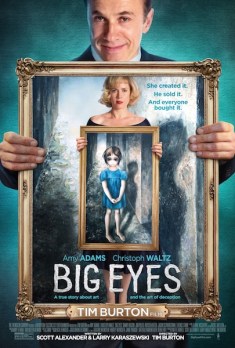 After a smidgen of early awards buzz that pegged it as a dark-horse major contender (which obviously never materialised into anything), everyone seemed to stop talking about Big Eyes, Tim Burton’s latest, and the first thing he’s made in over a decade that doesn’t instantly strike you as an obvious Burton-esque choice.
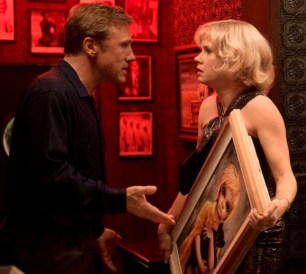 There’s thematic meat that could’ve filled the sandwich between those establishing and climactic, er, pieces of bread(?) — the tastes of critics versus the general public, and the disparity that exists there and what it means; or the inbuilt sexism of the era (though maybe everyone thought Mad Men had that covered) — but I’m not sure Burton was interested in such matters, at least not as much as he is in the kooky tale of some unusual characters and the odd turns of events that shape their lives.

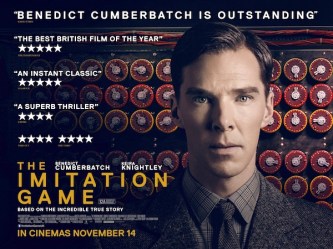 Alan Turing was a war hero: he led a team of cryptologists who managed to break the Germans’ Enigma encryption, thereby giving the Allies access to tonnes of vital information that (historians estimate) helped shorten the war by up to four years. This information was beyond top secret — so much so that they created a new designation for it, “ultra secret” — so when the war was over, Turing & co’s contribution went unrecognised for decades. Alan Turing was also a homosexual in an era when that was illegal. When he was caught, he was sentenced to chemical castration, which caused (or at least contributed) to him taking his own life. Fine way to treat a war hero, but that’s what you get with discriminatory attitudes.
 The screenplay by newcomer Graham Moore topped the Black List in 2011, so it’s probably of little surprise that it went on to win an Oscar, but I think it’s fair to say its quality, while good, isn’t that good. The use of three concurrently-told timelines seems to be too much for Moore and/or director Morten Tyldum to handle at times, occasionally flitting to a different era with little purpose beyond “it’s about time we told more of that storyline”. That’s not to say a wholly chronological telling would’ve been more effective — though perhaps it would’ve placated critical viewers who expected (and retrospectively demand) a cryptography-based wartime thriller — but the period juggling clouds the point as often as it illuminates it.
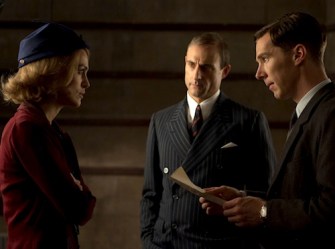 Also up for the golden man was Knightley, who does give one of her better turns as Turing’s sort-of-sidekick. The pair have a fairly complex relationship — both halves are key to conveying that, and they both do. At least as remarkable as either is young Alex Lawther, who arguably gets the film’s stand-out acting moment in his final scene, where a tumult of emotion is contained beneath a stiff-upper-lip surface in a tight close-up. On the strength of this, an actor to watch out for. The rest of the cast don’t get the same depth of material, but Charles Dance and Mark Strong provide exceptional value, as always, and Rory Kinnear does his best to bring some nuance and interest to a part he’s overqualified for.
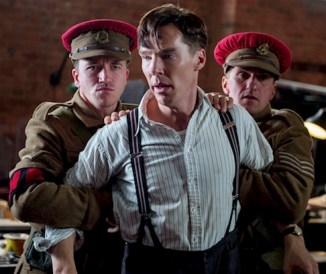 Perhaps that just stems from a frustration at some of the film’s other issues. It clearly has a flexible relationship with historical accuracy — well, what biopic doesn’t? Without wanting to spoil plot developments, some viewers feel the film suggesting Turing knew of the spy at Bletchley Park is insulting to his memory, because in real-life he didn’t even know the individual. Alternatively, is it not a way to integrate that part of the Enigma story into a film that otherwise wouldn’t have a satisfactory way to touch on it? Everyone’s mileage will vary on whether that should’ve been done or not.
 Without meaning to sound too judgemental (though when has that ever stopped me?), those factors making me think this is the kind of film “normal people” will probably love a lot more than “film fans” — which probably explains why it’s in the IMDb Top 250 but all the most-liked reviews on Letterboxd have exceptionally low scores. Personally, I’m going to side with the populous: not everything has to be a groundbreaking feat of Cinema to be a story worth telling and told well, and if it is indeed some kind of “historical revisionism” to say that there’s nothing wrong with being gay and the way Turing was treated post-war was horrendous, well, I’m OK with that revisionism.
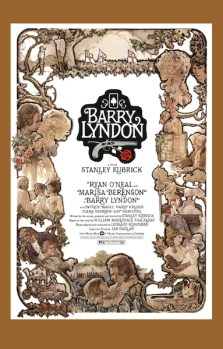 Stanley Kubrick made a good many exceptionally well-regarded films — indeed, with possibly the exception of his first semi-amateur feature,
 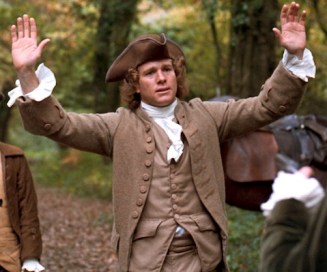 who often tells us less-than-favourable things about the lead character. Apparently this is an example of an unreliable narrator, and I suppose some of the things we’re told aren’t directly evidenced on screen, but I’m afraid I’m going to have to leave that seam to be mined by other writers, because (on a first viewing at least) I didn’t see where or to what effect the narrator was lying to the viewer.
 but a fictional biopic, that ranges across Europe and across time to… what effect? It’s a Kubrick film, so the ultimate goal of the tale, the message(s) it may be trying to impart, are debatable. You could see a story of the pitfalls of hubris. You could see an exploration of how a certain class lived in this time period. You could just see a man who led an adventurous life.
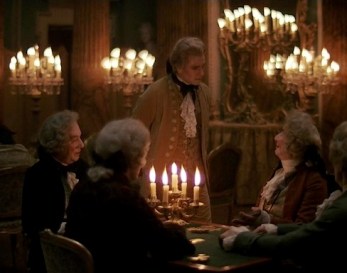 just that it remains the best among greats. (That said, having looked up images online for this review, it seems slightly less striking to me now. That may be the quality of the screengrabs; it may be that the painterly quality is so remarkable at first appearance (before becoming more familiar when the whole movie has that quality) that its memorableness is heightened.)
 The director of
  Score:



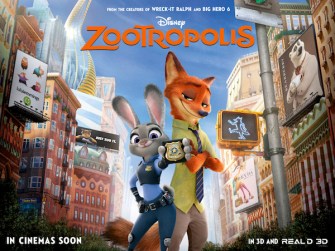 Disney’s 55th Animated Classic is their second highest-grossing ever, the 25th film to take over $1 billion at the worldwide box office, which makes it a hit of
  I think Zootropolis may be the first time they’ve attempted a neo-noir crime thriller, though. And I bet no one ever thought they’d see a Disney film with a sequence set at a nudist resort. Or in a drugs lab, for that matter. Or one with a substantial parody of
  However, that’s not to say kids can’t get enjoyment out of it: there are plenty of colourful characters and locations, relatable situations, cross generational humour, and a moral lesson young’uns will understand. There’s the DMV sequence, for instance, which is grounded in an adult experience but so funny it must cross over. Considering all the praise I’ve heard for that one scene, it’s also a feat it lives up to the hype. It’s gorgeously animated throughout, bolstered by a world that has been magnificently realised, with all the different themed districts of the city. (After all the Disney movies that have had contrived TV series spin-offs, this is a film that actually feels like it deserves one. The setup is obvious — a police procedural — and the world the film suggests is big enough to warrant it. Heck, it practically demands it — there’s so much more of this world, you want to see it explored.) Michael Giacchino’s score is different too: memorable and fun, in part thanks to using a cornucopia of unusual instruments to provide a ‘world music’ sound that’s in-keeping with the movie.
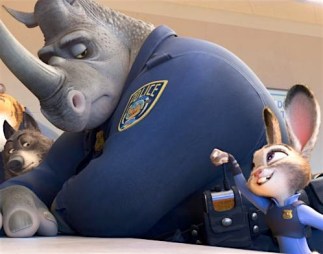 too, but that doesn’t mean the journey getting there is any less fun.



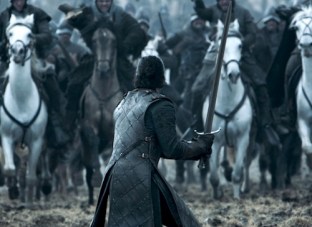 GoT produced two of its greatest-ever episodes to conclude this season. Actually, that’s arguably an understatement: based on IMDb votes, if nothing else, Thrones produced two of the best episodes of TV ever made. But what do IMDb voters know? Well, more than some people give them credit for. Obviously everyone has different tastes, but for the genres Thrones operates in — and, in some instances, even transcending those — these are incredible hours of TV. Episode 9, Battle of the Bastards, is surely one of the most thoroughly-realised medieval-style battles ever depicted on screen: the scale is epic, the strategy is clear, the feeling of what it’s like to be in the thick of that environment is palpable. How it turns out may have been predictable, but something being predictable is not the same as it being bad — not everything needs to be a twist.
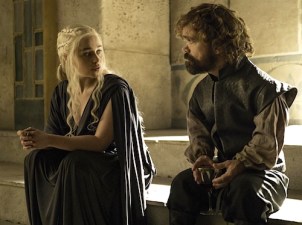 As for the forthcoming seventh season, it’s pretty clear we’re now entering the show’s endgame — though we’re going to have to wait even longer for it, with the next season set to have a later-than-normal premiere and the final end not coming until the season after that. It’s going to be an excruciating wait, but if they can maintain the form displayed throughout season six, it’ll be worth it.
 This is done and dusted Stateside now, but goodness knows when Channel 5 will choose to ‘officially’ air it over here, so I’m just getting on with it. I used to despise most of PoI’s arc plots and often wished it would stick to being just a pretty cool vigilante procedural; but at this point, it’s so invested in the epic Super-AI vs. Super-AI sci-fi storyline that any attempts at case-of-the-week episodes feel like a waste of time — especially when this truncated season is fast approaching the show’s final end. I really hope it comes to a proper conclusion, because there’s too much going on here to let it end forever on a cliffhanger. (Obviously that answer’s now out there, but naturally I’m avoiding spoilers.)
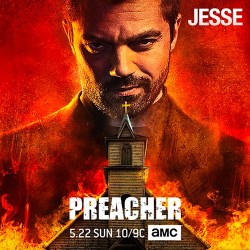 I’m a bit behind on this at the minute (the latest episode was the eighth), but, as of the halfway point, it’s definitely settled into its own skin — or maybe it was always settled there, but it’s taken time for viewers (or this viewer) to get past the expectations brought as a reader of the comic books. It’s still far from being a literally faithful adaptation, carving out its own path from some of the comic’s building blocks, which makes it an odd and hard-to-judge work if you have read any of the original. Still, it’s an entertaining series, and people involved keep talking about this season being something of a prequel to what we saw in the comic, so maybe the already-commissioned season two will feel more recognisable.
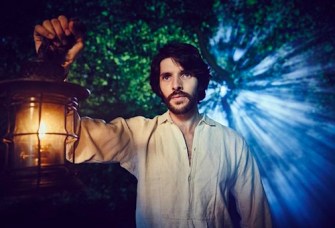 This month, I have mostly been missing stuff I don’t even know I’m missing. By which I mean, I haven’t been paying enough attention to the TV schedules to know what I’ve missed. The BBC’s supernatural drama The Living and the Dead sounds kind of interesting; I know Mr Robot is back, not that I ever got round to season one; plus The Musketeers continues (though I hear it’s gone off the rails this season); and I keep hearing vaguely good things about Netflix’s new series, Stranger Things, like that it’s a cross between Steven Spielberg and Stephen King, or The Goonies mixed with The X Files… which just reminds me that I need to get round to seeing The Goonies someday.
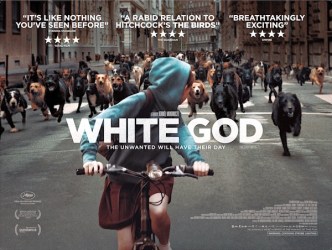 Thirteen-year-old Lili (Zsófia Psotta) and her dog Hagen are forced to temporarily live with her father, Dániel (Sándor Zsótér), because her mother is going on holiday with her new partner. Dániel doesn’t like Hagen anyway, but when the dog’s behaviour causes problems for him, he sets Hagen loose on the streets. Already angry with her father and his attitude, a devastated Lili sets out to find her beloved dog, who is busy discovering the darker side of mankind and our treatment of animals.
 For all the toughness of the journey, where it leads is triumphant; not entirely so, I must add, but enough. The film’s third act can pithily be described as Rise of the Planet of the Dogs: having seen the abuses of humans, an impounded Hagen leads a canine uprising that seeks to… well, they don’t speak (they’re dogs, remember, and this isn’t Disney), so who knows what their precise aims are? “Revenge” would be too cruel, but they definitely seeking some retribution. The film’s sadness doesn’t disappear (hence why not entirely triumphant), but some wrongs are righted.
 Some will find the middle of the film a slog, I suspect, both emotionally and with its occasionally lagging pace. However, the bookends seek to justify it. There’s catharsis in the finale, as described, but even better is the film’s opening. It has to be seen to be properly understood, but it’s operatically scored, shot, and edited, and involves hundreds (literally) of trained dogs en masse. It’s spectacular, unforgettable moviemaking; perhaps even one of the best openings to a film ever. And I don’t say that just as a “dog person”.

 100Films.co.uk