Starwoids (2001)

2008 #17
Dennis Przywara | 79 mins | DVD | PG

StarwoidsAnother fan documentary (following yesterday’s review of Done the Impossible), Starwoids tells the tale of two groups of Star Wars fans who queued for six weeks to be the first to see The Phantom Menace. Alongside this, the film takes a couple of diversions into general Star Wars fandom.

The main story here is the more interesting element. You might think an hour of people standing in line is pretty dull, but, surprisingly, enough happens to hold the attention. The two groups make a structurally pleasing contrast: one is just a group of fans, who have a great time playing games and hanging out in line. Their biggest worries are the police moving them off the pavement, and where to go to the toilet. The other group was organised by fansite CountingDown.com, and turns from a bunch of people having fun into a 24-hour television studio and media event on a sidewalk, provoking arguments, governments and revolutions. Przywara uses no narration for the majority of the film, so these contrasts are left for the viewer and participants to draw out on their own. Generally it works, though leaps in time and the skipping of certain events occasionally make it hard to follow what’s going on, especially at the more argumentative camp.

The asides into broader fandom work fairly well. They break up the occasional monotony of people queuing, but are neither entirely related to the release of Episode I nor delve far into painting a picture of Star Wars fandom as whole. This dilutes the focus of the film a little: it’s neither a comprehensive overview of fans nor entirely centred on the anticipation of one film. It would be a lesser film if they were missing, however, as Star Wars: The Musical, the life of a toy collector, and the woman whose car is painted like an X-Wing are among the highlights. A trip to find filming locations in Death Valley is a misguided inclusion though, as the lack of comparative clips or stills from the film itself renders it fairly pointless.

Eventually the hundreds of queuing fans get to see Episode I. First reaction: they love it. Przywara returns four days later, and then a year later — amusingly, no one is asked for a retrospective opinion on the (generally reviled) film. Personally, I’d much rather watch Starwoids again: while the fans’ aggressive nature makes it a somewhat more depressing experience than Done the Impossible, the insight into what it’s like to be completely obsessed (and to queue for a month and a half) are both interesting and entertaining.

4 out of 5

Done the Impossible: The Fans’ Tale of Firefly and Serenity (2006)

2008 #16
Jeremy Neish, Brian Wiser, Jared Nelson, Tony Hadlock and Jason Heppler | 79 mins | DVD

Done the ImpossibleOne of the more recent entries in the “fan documentary” sub-genre (which also includes the likes of Starwoids and Ringers: Lord of the Fans), Done the Impossible investigates the cult sparked by the prematurely-cancelled TV series Firefly and its continuation movie, Serenity — a movie that only exists thanks to the fans’ dedication.

The activism, and success, of Firefly’s fans (known as Browncoats) makes for a key difference from other fan docs: these aren’t just people who queue for obscene amounts of time to see something they like; these are people who helped turn a cancelled TV show into a DVD hit, and then a successful movie too. As such, as well as touching on the basics of fandom (forums, conventions, fanfic, and so on), this documentary is the tale of the rise and fall of the TV show and the making of the movie, but from the perspective of the fans rather than the filmmakers. That said, a noteworthy number of those involved in the film are interviewed, discussing their love for both the show and its fans, and often confessing to be fans themselves. These include six of the lead cast (one of whom hosts the documentary, and another narrates the DVD’s extras), writers and directors, and creator/writer/director (and God to fans) Joss Whedon.

As a film, Done the Impossible has a nicely loose structure, on the whole following the thread of the production story through to around the time of Serenity’s premiere, but taking time for diversions into personal recollections and general areas of Browncoatism. Actually having a story to tell gives the film an advantage over other fan docs (Ringers rather lacked one, for example) — even though there are diversions, there’s always a narrative to keep things moving forward. It certainly stops things from seeming too slow or repetitive.

Whatever you may think of them, Firefly and Serenity broke the rules, and in the process helped pave the way for other cancelled properties being revived by fan support. With its emphasis on personal recollections alongside the minutiae of fandom, Done the Impossible is undoubtedly of primary interest to fellow Browncoats, and perhaps anthropologists. But there should be broader interest in the story of a dedicated and unfailingly hopeful mass of people who came together, refused to give up, and, against all the odds, actually won.

4 out of 5

A Room with a View (1985)

2008 #14
James Ivory | 112 mins | download | PG

A Room with a ViewI can’t help but wonder if, back in 1985, there was any audience confusion between A Room with a View and A View to a Kill. One can imagine legions of Bond fans accidentally finding themselves with a witty heritage drama, and legions of old dears accidentally finding themselves with a man twice their age trying to be an action hero. (In actuality the films were released about a year apart — that being just one reason this is a particularly silly notion.)

Putting aside such nonexistent confusion, what of that witty heritage drama? Once again, thanks to the adaptations module of my degree, I’m stuck watching a film straight after reading the novel it’s based on. So far these viewings have supported my long-held theory that reading any novel before watching the film version (especially immediately before) is a Very Bad Idea. However good A Room with a View may be — and it certainly has its share of positives — it still pales slightly in direct comparison to the novel.

The film’s faithfulness is admirable at least, combining events effectively at times and at others leaving well alone. Unfortunately this “copying out” style of adaptation means that the dialogue is exactly as written but sometimes loses important elements through its abbreviation. In the novel, characters frequently mean something entirely different to what they say, but you wouldn’t guess so in the film. Similarly, a lot of the novel’s wittiness is lost — unsurprising, as much is carried in Forster’s narration, which here is largely left unadapted. “Largely”, because chapter names occasionally intrude as intertitles or subtitles. These usually merely skip what would be a few lines of expositional dialogue, but occasionally they’re entirely pointless, and frequently are rendered meaningless by what would otherwise be minor tweaks to the plot. As I suggested at the start, however, a lot of these flaws are only blatant when placed in stark contrast with the novel.

Others aren’t. Julian Sands is disappointingly flat as love interest George Emerson, and he frequently drags Helena Bonham Carter down with him (and not in the “written by Andrew Davies” sense). In my opinion, Bonham Carter is the weak line in an otherwise flawless cast, neither acting nor looking much like my image of Lucy (Sands might not give much of a performance, but at least he looks the part, and Emerson is meant to be quite awkward). This could well be just my personal vision clashing with that of the filmmakers, of course, but there you have it. Those two aside, the rest of the cast are excellent: Maggie Smith and Judi Dench are note-perfect, especially in the handful of scenes they share (it’s a real shame Dench’s character disappears before the halfway mark); Daniel Day-Lewis is the right mix of comical, annoying and unfortunate truth as Cecil; and Simon Callow, Denholm Elliott and a young Rupert Graves are also perfect fits for their roles.

Finally, no Room with a review (ho ho) can be complete without praising how gorgeous Italy looks here. The camera lingers on the art and architecture more like a documentary than a fiction film, taking the viewer on a sightseeing tour just as much as the characters. There are essays to be written (indeed, they have been) on why such spectacle is a bad thing, but if you don’t want to be so pretentious then it’s wonderful to look at. Which, in many ways, sums up the entire film.

4 out of 5

Ratatouille (2007)

2008 #13
Brad Bird | 106 mins | DVD | U / G

RatatouilleMy 2007 catch-up continues with Pixar’s highly-praised and award-winning latest, which currently sits as that animation studio’s highest entry in the IMDb Top 250 (their only films not to feature are A Bug’s Life, Monsters, Inc. and Cars). It seems a bit unfair to begin this review on such a downbeat note, but I personally don’t find such a position deserved. As is all too frequently the case, Ratatouille has become another victim of hype.
It’s been pretty impossible to avoid the praise that’s been heaped upon Ratatouille, be it unanimously positive reviews in papers, magazines and online, or overheard conversations in public, or the numerous high-profile awards it’s garnered (most recently, the best animation Oscar, plus a nomination for original screenplay). I was left expecting to be blown away by the best Pixar film made thus far. Sadly, this was not to be. It’s not as funny as Finding Nemo, or Toy Story, or Toy Story 2, or probably The Incredibles. Nor is it as cute as many of them. Or quite as heartwarming, to be honest. And the characters aren’t really as lovable.

OK, this is getting too depressing. The thing is, Ratatouille is a good film, but it is also a flawed one. It’s not nearly funny enough for a kid’s movie — laughs are almost non-existent in the first half and hard to come by in the second — and it’s too long, needing a good chunk taken out of that duller first half. It’s a bit confused as to who the villain is, meaning there’s a lack of real menace from either of the candidates. Despite a professed aim to make rats lovable, they’re not really. Even the potential love story is lacklustre because they wind up together far too quickly.

There I go again with the negatives. I think it’s far too easy to spot the faults in Ratatouille because everyone else has done such a thorough job on the positives, so I’m stuck analysing why I was so disappointed. There’s no denying how gorgeous it looks though — I can’t think of another CG film that even comes close. The level of detail is stunning, not just in set design (which includes whole intricately designed locations just for seconds-long sequences) but also in terms of what’s going on in the background. Check out Remy’s first conversation with his dad at the rats’ new home in Paris, for example: a simple shot-reverse-shot dialogue scene with two characters, but there’s continuously other rats talking, moving past, and so on in the background — all out of focus, not trying to be showy, like natural background detail in a live action film. No other CG film with such attention to ‘pointless’ detail comes to mind. But it also allows itself to be what it is — for want of a better word, a cartoon. Linguini waves his arms about like rope when he’s out of control, the chase sequences are madness, the design of the humans, cars, and almost everything else are suitably stylised. And it all comes with a soft warm glow that is, frankly, beautiful.

Despite my criticisms, Ratatouille is nonetheless a four-star film as far as I’m concerned. I also think that, with its shortage of laughs and cute characters, and with the main areas of appreciation in facets such as cinematography, it’s more a movie for adult animation fans than children. It’s not Pixar’s best, but true to form it’s head and shoulders above most other CG animated fare. Approach it with lower expectations than most reviews would give you and perhaps you’ll enjoy it even more than I did.

4 out of 5

Jane Eyre (1944)

2008 #12
Robert Stevenson | 96 mins | download | PG

Jane EyreI was meant to read Jane Eyre in the first year of my degree, but, given a week to attempt what seemed a positively enormous tome (I partly blame the edition) and a coinciding essay deadline, I didn’t even attempt it. Instead I settled for a friend summarising it for me — I tuned out halfway through the very long retelling due to boredom, though whether that was the fault of the novel or its summariser I still don’t know. I finally got through Jane Eyre the year before last — not the novel, though, but the BBC’s apparently-definitive adaptation (has it been that long already!), following numerous extremely positive reviews at the time. That was good — because or in spite of the novel, I do not know.
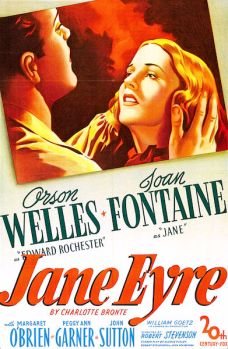
And so I come to this version, made in the wake of Rebecca (ironically, a novel clearly inspired in part by Jane Eyre) and also starring Joan Fontaine, alongside Orson Welles as the brooding love interest, Rochester. Well, he’s supposed to be brooding, but as played by Welles he comes across as merely gruff, apparently with a slightly unusual fake tan. Despite a suitably dramatic entrance, Welles’ stilted and occasionally overplayed performance, as well as a lack of chemistry with the equally weak Fontaine, does nothing to liven up what is already a rather uninspired production. The first 20 minutes are, at best, a Dickens rip-off, though without the appropriate comeuppance for the villains; in this version, it’s less Dickens and more obscene Christian morality play, complete with flat performances and (obviously) an over-reliance on God.

This section moves slowly… and then so does the rest of the film. Considering I’m primarily comparing this hour-and-a-half version to a four-hour miniseries, that’s quite a feat. The plot’s twists and revelations are all sadly underplayed, removing much of their dramatic effect; the same can be said of the abrupt ending. Perhaps there was an assumption that the audience would already be familiar with them, but true or not their weakening helps ruin this interpretation. And that’s all without mentioning the atrocious French accent of Adele, Rochester’s young ward, which often sounds as much like a bad Welsh accent as a French one.

All round, then, a very poor effort. A handful of redeeming features (the odd nice bit of cinematography, brief flashes of some decent performances) keep it from quite sinking to the lowest mark.

2 out of 5

Rebecca (1940)

2008 #10
Alfred Hitchcock | 125 mins | download | PG

This review could be seen to contain some spoilers.

RebeccaI must confess that I don’t think I’ve come to Rebecca under the best circumstances for judging it as a film in its own right. As with last week’s Great Expectations, Rebecca is on my current University module, which means I arrive at it having just read both Daphne du Maurier’s original novel and, the afternoon before viewing, a detailed and very interesting account of the film’s genesis and production from Hitchcock and Selznick: The Rich and Strange Collaboration of Alfred Hitchcock and David O. Selznick in Hollywood (nothing like a snappy title, eh?) by Leonard J. Leff. Such reading conspires to lead me into direct comparisons with the novel (which, as with most adaptations, are ultimately unfavourable due to things having to be cut), as well as a preoccupation with what was going on during production.

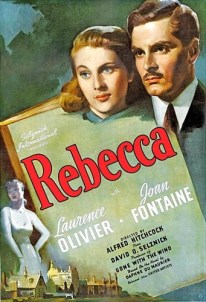
But, trying to put such distracting things aside, Rebecca has a great many good points. The cast, for one thing, are perfect. There were serious doubts about Joan Fontaine as the lead, but she is spot-on as the shy, almost childish, Mrs de Winter. Laurence Olivier is equally effective as Maxim, and Judith Anderson’s Mrs Danvers is suitably scary, if significantly younger than I imagined. The production’s technical aspects are also highly admirable: while the early Monte Carlo scenes may be nothing especially exciting, the plot whizzes past and we soon find ourselves at the infamous Manderley, all large halls, fog-filled grounds, dramatic lighting and big camera moves. Especially of note is Maxim’s confession — a long chunk of dialogue in the novel, it would have been all too easy to just use a flashback, but Hitchcock instead employs a camera move across the empty room to suggest the narrated action.

Further comparisons with the novel are inevitable, of course. The film skips nothing of importance, condensing events effectively so that the plot moves at a decent pace. Some events, such as the fancy dress ball and following ship wreck, are even made more dramatic by combining them. Some choices are thoroughly bizarre though: the novel is well known for its first person narrative, something the film attempts to retain by featuring Mrs de Winter in every scene… until the end when, in a deviation from the novel, she remains at Manderley while we follow Maxim and co. to London for some final twists. This does lead to a dramatic reunion upon Maxim’s return to Manderley, but I’m not convinced such a brief moment was worth the modifications.

As expected, viewing in such close proximity to the novel also forces comparisons that aren’t especially warranted — for example, the film loses much of the characterisation of Mrs de Winter by unsurprisingly finding no way to adapt her frequent flights of fancy and imagination. But then, one can always read the novel for those things (and I’d recommend it — get past the famous but dull opening and it often rattles along), and so, judged purely on its own merits, there is a considerable amount to recommend in Rebecca.

5 out of 5

The Hound of the Baskervilles (1939)

2008 #9
Sidney Lanfield | 77 mins | DVD | PG

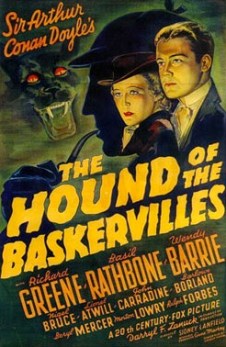
The Hound of the BaskervillesArguably the definitive screen interpretation of Sherlock Holmes and Dr Watson, played by Basil Rathbone and Nigel Bruce, appear for the very first time here, in what would become the first in a series of 14 pictures starring the pair. (Incidentally, this will be the first in an irregular set of reviews of that series. I have the rather lovely Optimum box set, you see, and so shall slowly work my way through it. Though as I’ve already owned it for several years and only just started watching it (as with so many DVDs), I have no idea how long it will be before I finish.)
I’ll start by laying my cards on the table: The Hound of the Baskervilles is a vastly overrated Holmes tale, and one that has been unduly adapted at least 15 other times (that from a quick search of IMDb). As far as I can tell its popularity is primarily due to the circumstances around its original publication (it was the first Holmes story in nearly a decade, following his death in The Final Problem). Holmes is absent for much of the story, which plods along fairly uneventfully (or, at least, inconsequentially) until a slightly dubious climax involving a centuries-old portrait. Naturally, all of these flaws carry over into any faithful adaptation, and this certainly is one.

One of the novel’s strong points is its occasional Gothic styling, and this is something the film version does very well. Dartmoor looks fantastic, like something Tim Burton would have created were he working in the ’30s. It’s clearly a set, but it’s dramatic and moody and completely effective. After the dull and poorly-designed interior scenes in London, it’s fantastic when the film finally moves down into Devon and things… well, don’t exactly get going, but at least there’s something to look at! As with the novel the plot meanders by, diverted by an escaped convict and an entirely pointless (in this version at least) seance, until that painting-based resolution. All is not lost, however, as a particularly vicious-seeming attack by the hound livens things up considerably.

Rathbone is underused as Holmes, which is a shame as he immediately makes the part his own. Bruce isn’t as bungling and comedic as he would later become, though the signs are already beginning to show. And the infamous final line — “Oh Watson, the needle!” — is actually a huge anticlimax if you haven’t seen it before, an entirely pointless, meaningless and misplaced addition.

I feel like I’ve come down a little harshly on Hound of the Baskervilles, mainly thanks to a general unfavourable opinion of the source material. There are many better Holmes stories, often ignored thanks to the fame of this particular one. The following 13 films may be even less faithful adaptations than this, but I’m looking forward to their fun and frivolity, which will hopefully top Baskervilles. The moor really is fantastic though.

3 out of 5

Great Expectations (1998)

2008 #8
Alfonso Cuarón | 111 mins | download | 15 / R

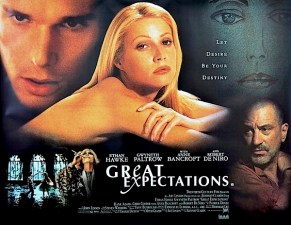
Great ExpectationsAfter re-enjoying the classic David Lean version of Great Expectations (which I reviewed in 2007) last week as part of my adaptations module, it’s now the turn of this American-set re-imagining. Despite a generally-held negative opinion toward this version, I found it to be more of a mixed bag.

Its main problem is that it can’t escape its roots. Not a fault in an adaptation, you might think, but in the case of one so radical as this it is a flaw: you’re left comparing and contrasting it with Dickens’ novel and Lean’s film, rather than appreciating it as a film or narrative in its own right. It comes across more as an academic exercise in turning a British Victorian novel into a modern American movie than a believable tale that works in isolation. Indeed, many of the changes appear to be designed purely to help distance it: the changed character names, the focus on the love story, and so on. Yet it directly recreates many scenes from the novel, and it obviously retains its title, despite there being no reference to that in the film itself.

Another product of this re-imagining is an unremitting sexualisation of everything. When Pip — sorry, Finn’s — hand is placed on Ms Havisham — sorry, Ms Dismoor’s — chest his first guess is that it’s her “boob” rather than her heart; when 10-year-old Estella kisses Pip — Finn, even — it now comes with added tongues; Finn — Pip — Finn! — draws now, and what he draws are nudes of Estella; and then they have sex too; and there are undoubtedly other examples that have since slipped my mind. This was pre Y Tu Mamá También, of course, where perhaps Cuaron exorcised this sexual preoccupations — they’re certainly not so evident in Children of Men or (unsurprisingly) his Harry Potter. His penchant for long takes, as seen constantly to great effect throughout Children of Men, also put in the odd pleasing appearance here.

By the end, it’s tricky to know what to make of this Great Expectations. It’s nicely faithful for a modern version, and yet that forbids it from striking out as its own work — it’s a fairly basic romantic film, bookended with some bizarre American Gothic trappings. I think it must stand as neither a success nor a failure, but as an interesting curio in the canon of Dickens adaptations.

3 out of 5

That picture was the only one I could find in high enough quality to make a banner image. Honest.

The BAFTAs 2008

British film’s big night has been and gone. I won’t offer a comprehensive list of winners, or even many thoughts on them — such things are easily found elsewhere — but I will instead offer my thoughts on one of the few ceremonies this year to be presented in full (well, relatively speaking), and the only film awards ceremony that receives a terrestrial television airing in the UK.

The first thought that comes to mind is, “oh dear”. Anyone would think the writers’ strike was affecting the UK too, if this was the evidence they had to go on. Jonathan Ross’s jokes were few and far between, and rarely gained much reaction from his audience. To be fair to Ross, Stephen Fry had a good deal of excellent material when he used to host the BAFTAs and he was often met with silence too… but not as often, and it tended to be the silence of “that went over the heads of the yanks in the audience” rather than of “it wasn’t that funny…”

I like Ross as a presenter, generally speaking — I enjoy his Friday night show, and while I rarely catch his radio show (I’m rather lax about listening to anything on the radio) I enjoy that even more; and I liked Film 2000-whatever, because I often find I agree with his views and have some broadly similar tastes. But he’s no BAFTA host. He’s just not funny enough… oddly, because his work at the Comedy Awards is usually hilariously good.

The opening, with a troop of 300-style Spartans, was by far the most interesting bit. It all seemed quite incongruous for an awards show, but through this it suggested a show with some flair and excitement. Sadly it just remained incongruous, with nothing else even vaguely close amongst the endless troop of fairly famous people reading poorly from an autocue. Even that Spartan-packed opening was flawed, missing out on the apparently obvious joke of having someone enter and yell, “THIS. IS. BAFTA!”, which would’ve been a far stronger opening than… whatever Jonathan Ross said. I can’t remember now…

It’s a shame we couldn’t make a better fist of it for a year when more eyes than ever were on the BAFTAs, thanks to the faltering performance of US awards shows under the strike. A new host would help. Eddie Izzard, maybe — he got laughs. So did Ricky Gervais, not that he’d do it. But when even Hugh Laurie can’t bridge the cultural divide of British and American humour, you have to wonder if the host is doomed to failure from the start. At least the awards themselves threw up some surprises, with enough nods to the American films (and a consequent shunning of British talent) to keep them interested — I do wonder if the BAFTAs pander to trying to gain an American audience too much, but one could probably debate that for hours.

There’s one thing we do better though: fewer awards, and we don’t even screen them all. It makes for a much less tiring experience.

Atonement (2007)

2008 #7
Joe Wright | 118 mins | DVD | 15 / R

Atonement“The Most Nominated Film of the Year” proudly proclaims a sticker on the cover of Atonement’s newly released DVD. Well, not quite: according to IMDb, Atonement stands at 68 nominations while No Country For Old Men has made it to a whopping 108! Nonetheless, it’s received a near ridiculous amount of acclaim on its way to awards season, and now, having missed it at the cinema, I can finally offer my opinion, just before it does its best to sweep the board at tomorrow’s BAFTAs.

There are certainly a lot of things in Atonement that definitely warrant their nominations, and in many cases the award itself would not be badly placed either. James McAvoy gives a strong lead performance (he is, of course, up for Best Actor at the BAFTAs) and even more astounding is 13-year-old Saoirse Ronan as Briony, wise beyond her years as the over-imaginative girl who causes so much misery. In many ways she’s the lead character, but as she shares the role with two other, older actresses, it’s no surprise she’s up for Best Supporting Actress — she probably stands more of a chance there anyway. She’s certainly one to watch, and can next be seen in Peter Jackson’s adaptation of The Lovely Bones, again as a leading character who’ll probably be designated supporting status because she’s so young. Keira Knightley’s performance, which has earned her a Best Actress nod, is certainly good, but if she wins it’ll be the strength of the film as a whole that carries her through against such tough competition. I should also mention the ever-excellent Benedict Cumberbatch, in a role too small to receive much recognition, yet central to the plot and well played.

Elsewhere at the BAFTAs, Atonement’s up for a slew of awards I’m not especially qualified to comment on in depth: production design, costume design, make-up & hair, sound, editing… Suffice to say the film looks luscious all round. The cinematography is certainly beautiful, capturing the lazy summer days of 1935 equally as well as the tumultuous wartime vistas. Arguably the stand-out sequence in this respect is the much heralded five-minute shot of the beach at Dunkirk. It’s perhaps over-hyped by this point but is still an impressive achievement, if not in the camerawork itself then in the staging of so many consecutive set pieces without a cut.

With all this considered, Joe Wright is a strong contender for Best Director, and also Christopher Hampton for Best Adapted Screenplay. The story jumps back and forth in time, occasionally to slight confusion but always clear enough to follow. The languid first half never drags, and the second half never feels weak despite the essential mystery already being solved. I won’t give away too much here, but the ending is also effectively pulled off, and the final twists feel more natural than tricksy. I haven’t read the novel so can’t compare it to that, but by all accounts it’s a very faithful adaptation. The only thing that really bothered me was that the dates didn’t seem to add up — apparently, World War Two had begun three-and-a-half years after the summer of 1935 (more like four-and-a-bit). A couple of other dates are unclear too, but that strikes me as the main one.

To digress to general BAFTA speculation for a bit (as if I haven’t already), for the directing win, Wright has to face (amongst others) last year’s winner, Paul Greengrass, though as (to my mind) United 93 was a stronger film than The Bourne Ultimatum, I don’t see him winning it again. In both of those awards it’s up against strong Oscar favourites No Country For Old Men and There Will Be Blood — when we’ve got our own film to praise, I’m not sure they’ll be able to stave off Atonement too much. The same goes for Best Film. But then there’s always Best British Film. In theory, if Atonement was good enough to take Best Film then it would take this too, but that’s often not the way — in effect, it’s a chance to reward two different movies. I can’t see Eastern Promises winning, but This is England, Control and The Bourne Ultimatum are all reasonable alternatives. If Atonement wins British Film I won’t be expecting it to go on to get Best Film as well. Of course, you can never be sure.

I appreciate this review has (quite deliberately) focused on Atonement’s BAFTA chances as much as its own merits, but hopefully that has still illuminated my thoughts on the film. It’s a very strong effort from all involved, with an unusually structured but no less engaging plot, beautiful cinematography, nice direction and admirable performances. All round, it’s just about enough to warrant 2008’s second

5 out of 5