2013 #97
George A. Romero | 95 mins | Blu-ray | 1.78:1 | USA / English | 18 / R
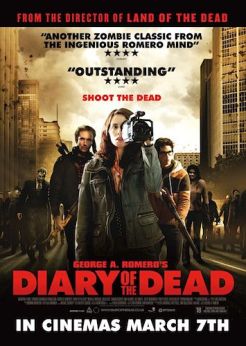 While making a horror movie in the woods, a group of friends hear news of the dead coming back to life. As they try to reach home, their aspiring documentary-maker director keeps his camera rolling, recording their encounters with the living dead…
After his first living dead movie, it took writer-director George A. Romero a full ten years to have a concept for a follow-up. Then it was seven years before he produced another, and then he skipped a decade entirely before he produced a fourth twenty years on. But it was only two years after that before he returned to the subgenre he’d spawned almost 40 years earlier.
The quick turnaround was thanks to Romero being inspired by the rise of ‘citizen journalism’ — that’s people who document events with mobile phone cameras and the like, telling their own alternative version of the news on blogs, YouTube, Twitter, and the rest. It gave him an idea for another of his zombie movies, which he rushed to make before anyone else could do it first. Too late, George: although he managed to get Diary of the Dead into festivals in 2007, its wider cinematic release came after Cloverfield, the high-profile big-budget version of Romero’s concept that’s rather kickstarted a whole found-footage subgenre. And anyway, both of them owe a clear debt to a film released eight years earlier, The Blair Witch Project.
I liked Cloverfield, and Blair Witch. I don’t object to found-footage as a genre when it’s done well. Diary of the Dead is… well, it’s a funny one. It marks Romero’s return to independent feature making, after producing Land of the Dead for a major studio, but he perhaps went a little too independent: with a clear low-budget ethic and a cast of unknown actors, criticism from some quarters that this is little better than a Syfy TV movie are not without basis. And the technological aspect is already beginning to feel dated after just six years (people use MySpace!), 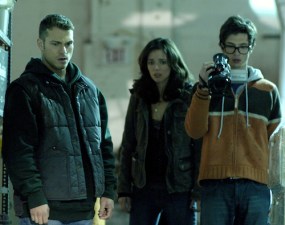 so goodness knows how it’ll look after even ten. Thing is, despite all that, Diary still has one ace up its sleeve: it’s written and directed by George A. Romero.
What does that mean, then? Well, it means clear social commentary, as usual. Some people say that’s not as subtle as it used to be — again, as usual. Romero’s targets this time are the news: how the mainstream media lies to us, and how we’ve turned to alternative sources. But he’s also aware of the limitations of those alternatives: the lack of real-world contact, interacting with each other through cameras, phones and computers; processing the world not by going to see it but by watching it in little boxes on a screen.
In taking on this world, Romero has produced a movie that fits right in amongst it. Diary feels like it was made by some just-out-of-film-school kid rather than a 67-year-old moviemaking veteran. Romero is clearly a stylistic chameleon (as I noted on Land of the Dead), but that’s the surface sheen: the digital HD visuals, the syndicated-TV-level ability of the cast, the cut-price CGI… It’s also, sadly, sometimes the writing: the dialogue isn’t all it could be, and the characters are sketchy and archetypal — though, in fairness, that’s not unheard of from a Romero supporting cast. But, as ever, Romero adds his own spin by attempting to engage with social themes; not only those I’ve mentioned, but several more: “do we deserve to survive this?” is the closing note — again, taking on one of Romero’s pet subjects, the violence of humanity, against ourselves and others. Earlier in the film the military turn up, very briefly, but they are the opposite of all they should be. It’s not just that Romero hasn’t changed his views in 30 years or more, it’s that the world hasn’t changed either.
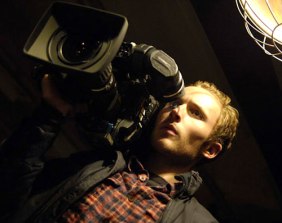 That said, the thematic concerns feel less resonant than in Romero’s previous work. The found-footage has led him to frame this as a film-within-a-film — the first title card reads The Death of Death, followed by one noting it’s “a film by Jason Creed”, the aforementioned aspiring director — complete with montages of news footage and, at times, a voice over narration. This rather rams the point home at times, over-explaining features that previously Romero would have allowed us to spot for ourselves. In some respects you can’t blame him being more obvious in this day and age — it needs to be on the nose to get through to some people — but it’s less satisfying, the blunt information coming across as a statement rather than asking us for our own interpretation, which I feel can lead to a more insightful analysis.
This is coupled with arguably a greater focus on action and gore than ever before. The first three films limit the majority of their violence to a final-act brawl — think Night’s trip to the gas pump/zombie break-in, the bikers in Dawn, the zombie break-in (again) in Day, the zombie, er, break-in in Land — but here we’re given a smattering throughout, with no all-or-nothing finale. That’s not a bad thing, but it makes it feel more pervasive — even more so than Land, which was an action-adventure movie through and through. Is Romero playing to his crowd, here? The ones who have always looked to his films foremost for their zombie-killin’ special effects; the ones who think Zack Snyder’s Dawn remake is superior to most/all of Romero’s films? (Seriously, those people exist.)
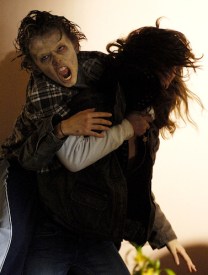
 Such folks, and even genuine Romero fans, seem to have two major problems with Diary (aside from arguments about the acting, the storyline, or even the entire concept). First, the gore: where Land added CGI to the traditional mix, Diary’s almost exclusively courtesy of computer wizardry. That’s the age we live in: computer effects are so commonplace that they’re now the cheap and easy thing to achieve, rather than men with buckets of red food colouring and entrails from the local butcher. For me, it’s a mixed bag. I don’t think this is the worst CGI I’ve ever seen (unlike some commentators), but I do think it lacks the distinctive Romero feel — there’s none of his trademark eating of intestines, for instance, or the tearing a human in half that’s become a key visual in every film since Dawn. Perhaps that’s because of the realism angle? No one would film that; they’d turn away. Of course, when zombies get shot/beaten/etc, that’s different; that we can watch.
In fact, Romero kind of has his cake and eats it. There’s CG gore aplenty, and new and inventive ways to kill the zombies, but he still criticises that “violence for the sake of it” attitude, particularly in the film’s closing moments. He also takes pot-shots at fast-moving zombies and the treatment of women in horror films, but those are deserved, especially as they generate a laugh here. Nonetheless, said inventiveness is somewhat entertaining. There’s a particular good bit with an Amish man (the film’s best character) and a scythe, and another with a kid and a bow & arrow. I guess gorehounds will never be satiated by CGI, instead always moaning it looks cheap, but here at least it’s fine — doubly so for a film of such low budget.
 The other problem bemoaned by fans is that this is a reboot, of sorts. Romero’s previous zombie films feature no recurring characters and don’t sit properly within the same timeline, but they nonetheless feature an evolution of the zombie epidemic: it spreads from a one-night issue in Night to a dragging problem in Dawn, to an all-consuming one by Day, in which we see the zombies gaining in intelligence, to the point where they consciously form an invading force in Land. But Diary scraps all that, going back to the start of the epidemic. It doesn’t remake Night — in fact, it handles a few things notably differently (in Night the radio and TV report factual and helpful information; in Diary, they obscure the fact the outbreak is even happening) — but it does disregard the development Romero had taken the undead through.
This may, then, be the time to mention that Romero doesn’t consider his films to be sequels, because each one starts with a new set of characters and tells a self-contained story. He has a point: consider any of the first four films in isolation and you’ll realise you don’t need to have seen the preceding movie(s) to follow them, they just don’t take the traditional move of starting from the birth of the zombie problem. This is perhaps most evident in Land: the sci-fi-esque dystopian world, born of ours but notably different, is the setting for dozens of movies; we’re used to jumping into that without three films’ worth of exposition on how we got from here to there. So if you choose to consider each film as a standalone, self-contained entity, Diary going back to the start doesn’t seem quite so odd. It’s even necessary for the film’s theme: the premise requires it to be set in a present-day we recognise that’s then transformed by the zombie epidemic, rather than a sci-fi future set post-Land.
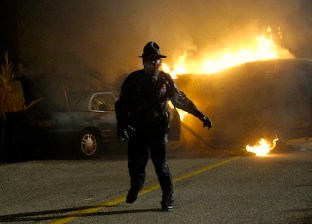 But, nonetheless, the epidemic did develop and evolve across Romero’s previous films, and that’s been lost here. Maybe there’s nowhere further to go with it? I’m not convinced of that. Perhaps Romero will have another idea and get to tell that story someday in the future, leaving Diary (and Survival) as an aside to his once-a-decade continuing series.
I disagree with those who think Diary is without interest or merit — clearly, as I’ve gone on this long about it. Romero brings a class to the concept that a lesser director wouldn’t, but it’s also a concept a lesser director could have realised much of in a similar fashion. It’s unquestionably the weakest of Romero’s first five ‘Dead’ films, then, but that still leaves it notably better than many, many other contributions to the genre.
Part of Week of the Living Dead for Halloween 2013.

 Tom Hanks is Walt Disney and Emma Thompson is author P.L. Travers in “The Making of Mary Poppins: The Movie”. Disney has been desperate to turn Travers’ fictional nanny into a movie for years after he made a promise to his daughter; Travers has resisted, but now needs the money. She’s brought to LA to consult on the script, and proceeds to make life miserable for screenwriter Don DaGradi (Bradley Whitford) and songsmiths Robert and Richard Sherman (B.J. Novak and Jason Schwartzman). At the same time, we see the story of a family in Australia from the eyes of a little girl Ginty (Annie Rose Buckley), as they struggle with the whims of her father (Colin Farrell), a bank manager who’s a little too fond of the bottle. Guess what the connection is!
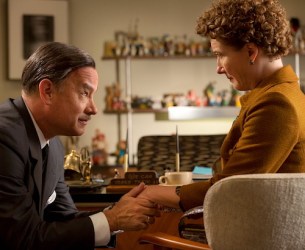 Similarly, Hanks’ part seems to be little more than a cameo at first, but he steadily appears often enough to make it a supporting role. Reportedly he has perfectly captured many of Disney’s real traits and idiosyncrasies, and who are we to doubt the word of people who knew the man? His performance is not just a shallow, simple impersonation, but there’s not that much meat to Disney’s character arc either.
 Some will find the story lacking in dirt, particularly when it comes to the portrayal of Disney. But it’s not whitewashed either, and do you really think the Disney Corporation would have allowed a movie to go ahead that depicts their founding father in a negative light? For that, I don’t think it’s as twee as it could have been — there’s definite conflict over what’s being done with Poppins, and, even with the film having turned out to be a solid-gold classic, we often find ourselves sympathising with Travers.
 Originally produced for the 2010 FrightFest film festival, horror director Jake West’s feature-length documentary with the unwieldy title explores the ‘video nasty’ scare that gripped early-VHS-era Britain. Starting with a primer on the birth of home video, and what it was like to watch movies in those days (because, ladies and gents, we’ve now reached a point where even fans of that (second-)most adults-only of genres, the gory horror flick, are young enough to not recall a time before DVD), West uses archive news clips and a wide array of new talking head interviews to take the story from the UK’s first video recorders in 1978, through a newspaper-led panic, up to the infamous Video Recordings Act of 1984, which irrevocably (thus far, anyway) changed the face of home entertainment releasing in the UK.
 Focusing on the scare rather than the films embroiled in it makes this less a “horror documentary” and more a social history/pop culture one, though the liberal use of extreme clips from the movies in question shuts out anyone without a hardened stomach. (If you did want more on the films themselves, the DVD set that contains the documentary — Video Nasties: The Definitive Guide — includes 7½ hours of special features discussing all 72 ‘official’ video nasties alongside their trailers.) There’s room for little asides amongst the main narrative, though. One of the highlights is the story of an interviewee who was invited on to Sky News in the wake of the James Bulger murder and asked if the film many were holding responsible,
  There was some counterargument, however, which leads us to the film’s best interviewee, and surely a new hero to many: Martin Baker. Baker was one of a few (certainly the first, and for a time the only) critical/intellectual-type voices to speak out in defence of the films that were outraging so many. He’s to be commended not only for his valiant defence of, essentially, free speech at a time when his views were immensely unpopular; but also because he remains one of the most lucid and fascinating commenters in the documentary. He makes the clearest points about the need to not forget both what happened and how it was allowed to happen, lest it occur again.
 that force ISPs to attempt to censor what we can and can’t see on the internet, and just yesterday rushed through anti-privacy legislation without proper debate. Sad to say, many of the valuable lessons of the ‘video nasties’ brouhaha — lessons made explicit with superb clarity in Jake West’s excellent documentary — have not been heeded.
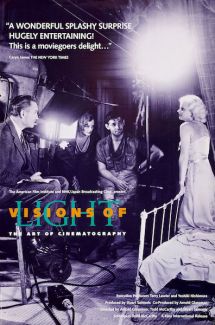 Cinematographers discuss cinematography in this AFI-produced documentary. Initially a whistlestop history of film photography, it segues into analysis of movies the interviewed DPs had shot. Unfortunately, casual film fans may judge it monotopical, while hardened cineastes may find it a haphazard, Hollywood-centric overview.
 After leaving his New York base to investigate some
 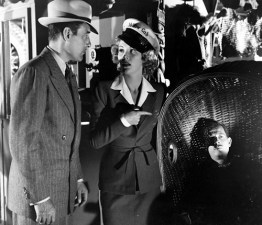 Stand-out sequences include a bit where the police detectives move through a crowd of suspects, all relaxing near the pool on a location shoot, while outlining each one’s possible motivations, essentially to their face. It’s a simple sequence, not exactly high on drama or humour, but there’s a pleasant structural touch to it. Or the finale: the Falcon is, as ever, drawn into the case by a mysterious woman… but by the end he has four of them grouped around him!
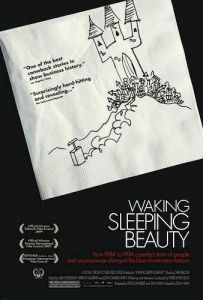 However, Waking Sleeping Beauty is told from the inside: director Don Hahn started out as an assistant director at Disney animation in the ’80s, graduating to producer by the time of Beauty and the Beast. With him he brings behind-the-scenes home movies and access to a stunning array of interviewees. Almost everyone who was anyone at Disney during that time is interviewed, either through archive footage or new audio commentary. It was a tough time, and while Hahn’s portrait is probably not quite warts-and-all, it comes damn close; for example, we get to see some of the caricatures the animators drew in disgust at their new boss, Jeffrey Katzenberg.
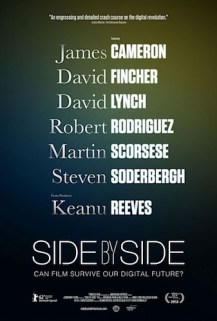 Side by Side is a documentary on camera technology. No, wait, come back! It’s much more interesting than that sounds.
 The significance of the debate is emphasised by the interviewees. Nearly every high-profile name who has at any time factored in the film vs. digital debate pops up, however briefly (renowned film advocate Christopher Nolan gets just a couple of comments; I think Peter Jackson is the only notable omission). Indeed, you can tell how significant the interviewees are just by looking at the poster — what more do you need to know? There are also others — producers, cinematographers, and so on — whose names you might not be familiar with, whose work you might not even know, but have insightful contributions to make. Presenter Keanu Reeves is not just a celebrity voiceover but also the primary (sole?) interviewer, and believe it or not he does a sterling job.
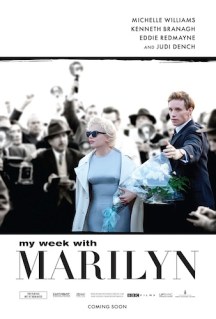 1956: global superstar Marilyn Monroe (Michelle Williams) comes to England to star opposite Laurence Olivier (Kenneth Branagh) in his latest directorial effort,
 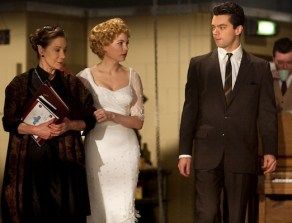 The supporting cast is a veritable who’s who of recognisable British faces, stars of screens both big and small. Barely a speaking part goes by without an actor you’re certain to recognise. I’d list them but, honestly, there are far, far too many. Despite Marilyn coming with a hefty entourage, Williams is the only American in the cast, meaning American accents are lumbered (to varying degrees of success) upon Zoe Wanamaker, Toby Jones, Dougray Scott, and Dominic Cooper. Hey, of course Dominic Cooper’s in it — is it even legal to make a mid-budget British movie without him now?
 If you don’t know that name then you must be a young whippersnapper, because otherwise Ray Harryhausen needs no introduction.
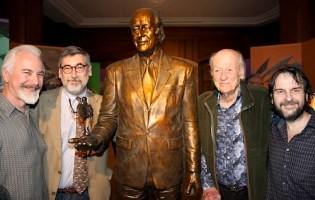 Sometimes they’re a bit jerky, maybe, and the inevitable issues of scale show they’re models fighting or interacting with actors on set… but for all that they’re still not significantly less realistic than so many modern computer-based techniques, and they carry a charm and obvious level of skill that said renderings usually lack.
 One thing I always wonder about ‘specialist’ documentaries is, do they have crossover appeal? Will someone with no interest in Harryhausen, or even in Cinema, get something out of this? Probably not, I guess. But that’s not a bad thing per se, because this is an informative overview of a man’s influential body of work that deserves all the appreciation it can muster. Even if, like me, you’re not that familiar with said work, this is a film that will show you why you should be.
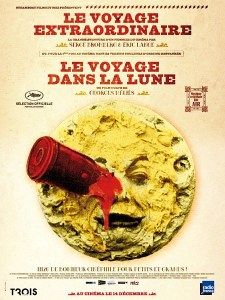 Documentary about the life and work of Georges Méliès, with particular attention to
 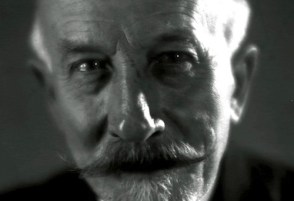 The Extraordinary Voyage accompanies A Trip to the Moon on DVD (or, if you fancy spending a small fortune, Blu-ray), but arguments that it goes beyond a mere ‘special feature’ are worth hearing. It’s a worthy biography/tribute to a cinematic force whose influence is still felt today, coupled with the extraordinary story of how his supremacy is being preserved.
 100Films.co.uk