Done the Impossible: The Fans’ Tale of Firefly and Serenity (2006)

2008 #16
Jeremy Neish, Brian Wiser, Jared Nelson, Tony Hadlock and Jason Heppler | 79 mins | DVD

Done the ImpossibleOne of the more recent entries in the “fan documentary” sub-genre (which also includes the likes of Starwoids and Ringers: Lord of the Fans), Done the Impossible investigates the cult sparked by the prematurely-cancelled TV series Firefly and its continuation movie, Serenity — a movie that only exists thanks to the fans’ dedication.

The activism, and success, of Firefly’s fans (known as Browncoats) makes for a key difference from other fan docs: these aren’t just people who queue for obscene amounts of time to see something they like; these are people who helped turn a cancelled TV show into a DVD hit, and then a successful movie too. As such, as well as touching on the basics of fandom (forums, conventions, fanfic, and so on), this documentary is the tale of the rise and fall of the TV show and the making of the movie, but from the perspective of the fans rather than the filmmakers. That said, a noteworthy number of those involved in the film are interviewed, discussing their love for both the show and its fans, and often confessing to be fans themselves. These include six of the lead cast (one of whom hosts the documentary, and another narrates the DVD’s extras), writers and directors, and creator/writer/director (and God to fans) Joss Whedon.

As a film, Done the Impossible has a nicely loose structure, on the whole following the thread of the production story through to around the time of Serenity’s premiere, but taking time for diversions into personal recollections and general areas of Browncoatism. Actually having a story to tell gives the film an advantage over other fan docs (Ringers rather lacked one, for example) — even though there are diversions, there’s always a narrative to keep things moving forward. It certainly stops things from seeming too slow or repetitive.

Whatever you may think of them, Firefly and Serenity broke the rules, and in the process helped pave the way for other cancelled properties being revived by fan support. With its emphasis on personal recollections alongside the minutiae of fandom, Done the Impossible is undoubtedly of primary interest to fellow Browncoats, and perhaps anthropologists. But there should be broader interest in the story of a dedicated and unfailingly hopeful mass of people who came together, refused to give up, and, against all the odds, actually won.

4 out of 5

The Mirror Crack’d (1980)

2008 #5
Guy Hamilton | 105 mins | TV | PG

The Mirror Crack'dA star-studded cast and the director of Battle of Britain, Goldfinger and three other Bond films can’t raise this adaptation of an Agatha Christie Miss Marple mystery far above the level of an ’80s TV movie.

There are some good lines, and it’s a Christie so obviously the fundamental story is good, but the direction is flat and lacks suspense, half the cast phone in their performances, and Angela Lansbury, lumbered with a sprained ankle and premature aging, seems to be in a dry run for Murder, She Wrote. The lack of involvement by the main character is something I always find problematic with Marple stories, even when the actress involved has the necessary twinkle. Edward Fox is her match as the detective who actually does most of the detecting for once (but is still robbed of the final revelation, of course).

The best bit, which I’ll just take a moment to highlight, is the opening. It’s a black & white murder mystery, the scene of the final revelation… and the print burns up just before the killer is revealed. The film cuts to a village hall, where the film was being screened and the projector’s just died. Miss Marple proceeds to explain what will happen to everyone, based on what she’s deduced from the film so far. A man at the back who’s seen it confirms she’s right. Much better than my summary makes it sound, this is by far the film’s highlight, one of the few whole scenes that rises above the pervading flaws.

Despite a few commendable elements, this is a good tale that’s not told as well as it could be.

2 out of 5

Easy Riders, Raging Bulls (2003)

2008 #3
Kenneth Bowser | 113 mins | DVD | 15

Easy Riders, Raging BullsDocumentary, based on the best-selling acclaimed book by Peter Biskind, about the decade in Hollywood between the death and effective re-birth of the studio system.
It’s a broad story, with many threads, which means this film has a tendency to sprawl all over the place as it attempts to take an overview of it in chronological order. Consequently it’s short on great insight, but does provide an overview of what went on in this period — that is, the story of how Hollywood made the transition from the old studio system to the era of the blockbuster (a method which still more or less exists), via a brief period where directors truly had auteur-level control.

There are numerous interesting interviewees to help the story along, all of them people who were actually there, who lived through it and helped create it. This makes for a refreshing change, as most documentaries of this ilk seem to be full of film historians and journalists. Of course, there are many big names notable by their absence, so when the film makes its rambling way onto the likes of Scorsese and Spielberg that familiar sense of historic detachment does begin to creep in.

All told, it gives a good overview of the shape of what happened in this period, and how Hollywood became what we know today. Anyone after deeper explorations (of the period, the people, or the films themselves) will want to look elsewhere. I suspect the book may be a good place to start.

3 out of 5

The Cat’s Meow (2001)

2007 #92
Peter Bogdanovich | 109 mins | DVD | 12 / PG-13

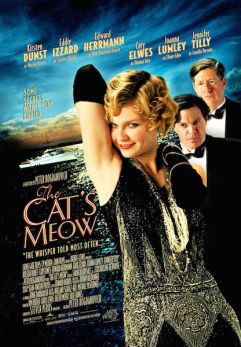
The Cat's MeowPossibly-true ‘murder mystery’ set in 1920s Hollywood.
As with the similar Gosford Park, the point lies less in plot and more in characterisation — there are some good performances, especially from Eddie Izzard, Joanna Lumley and Edward Herrmann, though Kirsten Dunst seems a bit flat in comparison. The era’s style suits her though, and the whole period is beautifully evoked; for my money the prettiest scenes are the black & white bookends.

Sadly the similarity to Gosford Park is the film’s main shortcoming: once realised, it’s clear that The Cat’s Meow doesn’t have the same subtle complexity in its story or performances. In its own right, though, there’s much to like.

3 out of 5

A Cock and Bull Story (2005)

aka Tristram Shandy: A Cock & Bull Story

2007 #5
Michael Winterbottom | 90 mins | DVD | 15 / R

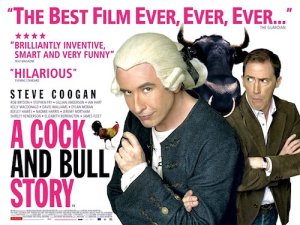
A Cock and Bull Story
I forget which British paper described this as “the best film ever, ever, ever”. It may’ve been The Guardian.* They’re not right, of course, but it has its moments — most of them courtesy of the excellent Rob Brydon, who far outshines Steve Coogan. It’s worth watching for the former alone.

3 out of 5

* It was.

Boogie Nights (1997)

Boogie Nights2007 #4
Paul Thomas Anderson | 150 mins | DVD | 18 / R

I loved Magnolia. I thought Punch-Drunk Love was dire. And this is how I come to Boogie Nights.

I didn’t fall for it in the same way I did for Magnolia, but it is nonetheless a very good film that shows a step on the path to that more complex and more rewarding picture. One I may get a better feel for when I see it again some day.

4 out of 5