2024 | Week 3

I’ve already covered Barbie, so here are the other films I watched during Week 3…

  • Chicken Run: Dawn of the Nugget (2023)
  • The Best of the Martial Arts Films (1990)


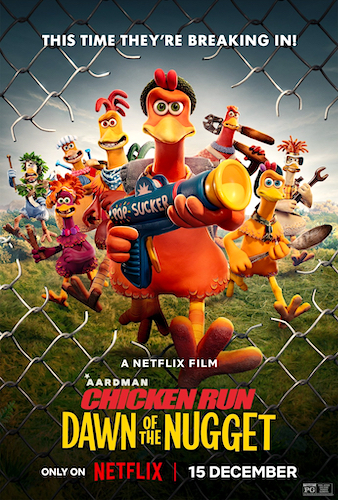
    Chicken Run:
    Dawn of the Nugget

    (2023)

    Sam Fell | 98 mins | digital (HD) | 2.00:1 | UK, USA & France / English | PG / PG

    Chicken Run: Dawn of the Nugget

    I wasn’t a massive fan of the original Chicken Run (it’s not bad, but it pales in comparison to some of Aardman’s other works, not least any of the main Wallace & Gromit films), so I approached this belated sequel more with trepidation than excitement. You could interpret a near-quarter-century wait as indicative of holding off until someone had a genuinely good idea; or you could see it as a shameless effort to generate a hit by tickling childhood nostalgia through a return to a cult-ish favourite. Behind-the-scenes stories of unnecessary cast changes (the primary offender: apparently 55-year-old Julia Sawalha is now too aged (for a voice role as a hen?) so they recast her with 51-year-old Thandiwe Newton) did nothing to bring confidence.

    Anyway, setting all that aside, the end result is… adequate. I’d probably have said the same of the first one, so maybe that’s no surprise. But even that felt like it had some moments that stood out, whereas this is just unrelentingly fine. The plot concerns the chickens having to break in to a farm — yes, it’s taken 25 years to have the genius idea of “what if we just reversed the story?” The immediate point of reference for break-in-type movies nowadays is the Mission: Impossible franchise, which features a noteworthy heist a least once per film. And so Dawn of the Nugget references M:I, and the gag goes thus: “It’s an impossible mission.” “Uh, shouldn’t it be the other way around?” That level of underscored bluntness is about the level all the humour operates at: unsubtle, unsophisticated, unvaried, and uninspired.

    The arguable exception in terms of quality is the animation itself. That it’s done well almost goes without saying — Aardman remain one of the masters of stop-motion (Laika having challenged them in recent years) — but, on the other hand, there’s nothing to wow you. It’s more than competent, slick and expressive and so on, but there’s no imagery you’ll take away; no shot or sequence that would make you reach for adjectives like “beautiful” or “stunning”.

    Aardman’s next major effort (it’s a bit unclear if it’s a feature or a short, as it’s going direct to the BBC in the UK) is a return to Wallace & Gromit, planned for later this year (no doubt a Christmastime treat, as usual). As I said, I prefer that duo, so I’m always excited to see them back on the screen. I just hope that belated sequel (almost 20 years since their feature film and 16 since their last short) doesn’t feel this… unnecessary.

    3 out of 5

    Chicken Run: Dawn of the Nugget is the 5th film in my 100 Films in a Year Challenge 2024.


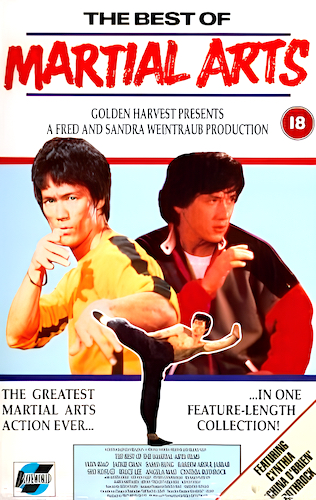
    The Best of the Martial Arts Films

    (1990)

    aka The Deadliest Art

    Sandra Weintraub | 91 mins | Blu-ray | 16:9 | USA & Hong Kong / English | 18

    The Best of Martial Arts UK VHS cover

    Originally released on VHS (back when martial arts films weren’t necessarily easy to come by for consumers, so I’m told), this hour-and-a-half selection of fight scenes is now available remastered / reconstructed in HD, with all the film clips also in their original aspect ratios, included on Eureka’s When Taekwondo Strikes Blu-ray. Hurrah!

    It is, primarily, a showcase for fight scenes. Whole uninterrupted sequences are shared, which is at least the right way to do it if that’s what you’re doing; unlike modern TV clip-show compilations, which seem to feel the need to cut the scenes to shreds and intersperse them with inane talking heads. There are a few interviews included here too, but rather than early-career comedians who’ll discuss anything for a paycheque, the interviewees include stars Sammo Hung, Jackie Chan, Cynthia Rothrock, and, er, Keith Cooke; plus Robert Clouse, director of Enter the Dragon.

    “Best Of” is more a titling convention than a fact, considering the film was co-funded by Golden Harvest and so only has access to their back catalogue, thus skipping entirely the output of the legendary Shaw Brothers studio. But then, what else would you expect them to call it — Some Pretty Good Bits of the Martial Arts Films We Had the Rights to Include? Of course, however you look it, 90 minutes of fight scenes is a pretty hollow experience — there’s no narrative; even the interviews offer mostly behind-the-scenes anecdotes rather than, say, a “history of the genre” approach. But if that’s all you expect, you get your money’s worth, because there are some stunners in here.

    Mind you, as well as being mostly limited to one studio, it’s also limited by time: having been made in 1990, there’s no Jet Li, no Donnie Yen; Van Damme is mentioned as a “rising star”… You could do the whole film over again — several times — if you were able to encompass a wider spread of studios and stars. But nowadays there’s no need: we can just head to YouTube for our out-of-context fight scene fulfilment… so long as you know what you’re looking for, anyway. That will always be the value of a curated experience.

    3 out of 5

    The Best of the Martial Arts Films is the 6th film in my 100 Films in a Year Challenge 2024.


  • Archive 5, Vol.8

    I have a(n insanely huge) backlog of 533 unreviewed feature films from my 2018 to 2023 viewing (not to mention the 77 shorts, but they’re a problem for another day). This is where I give those films their day, five at a time, selected by a random number generator.

    Today, it’s killers galore with Korean zombies, comical hitmen, rampaging security robots, and plain ol’ murderers. Plus, dying of boredom in Saturday detention.

    This week’s Archive 5 are…

  • One Cut of the Dead (2017)
  • The Breakfast Club (1985)
  • Chopping Mall (1986)
  • Dead Man’s Folly (1986)
  • Wild Target (2010)


    One Cut of the Dead

    (2017)

    aka Kamera o tomeru na!

    Shinichiro Ueda | 96 mins | Blu-ray | 16:9 | Japan / Japanese | 15

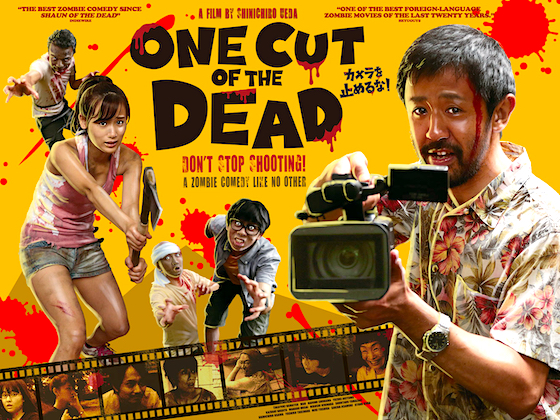
    One Cut of the Dead

    You know, it’s not just my reviews that are tardy: I bought this because it was hyped up, both as “good” and as “see it knowing as little as possible”, and it went on my “must watch soon” pile… where it sat for 14 months. And that’s far from the most egregious example of “ooh, I must get round to that” equally a long, long delay.

    Now, it’s taken me another 46 months to write this review. Eesh. On the bright side, perhaps I shouldn’t be so worried about spoilers anymore. I mean, if you’ve not seen it by now, whose fault is that? And it definitely is the kind of film where the less you know the better, because it’s going to pull the rug out from under you. Of course, even knowing that means you’re on the lookout for what’s going to happen; and the film gives you a helping hand, because right from the off there are nods to the conceit. Still, I’ll try to be fairly vague.

    It’s a film of three parts. The first is, with hindsight, an establisher; setup and groundwork for what comes next. Alternatively, some genre fans will take that as the purpose of the movie, and what follows as extraneous. Then there’s a long, slow middle section. Again, no direct spoilers, but we know where this part of the narrative ends up, so it feels like it’s over-expounding stuff (we don’t need as much backstory as we get) and consequently goes on a bit. Halfway through, I began to wonder what all the fuss was about. I worried that I’d left it too long to see it and let the hype get the better of me.

    But, ultimately, it’s all setup for the final half-hour, and it pays off in hilarity. The middle could still do with a trim, but it’s worth sticking with for the payoff.

    4 out of 5

    One Cut of the Dead was #54 in my 100 Films in a Year Challenge 2020.


    The Breakfast Club

    (1985)

    John Hughes | 97 mins | Blu-ray | 1.85:1 | USA / English | 15 / R

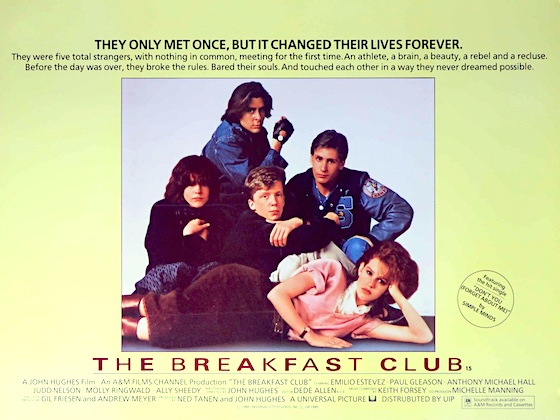
    The Breakfast Club

    Is The Breakfast Club the definitive ’80s high school movie? It’s got to be on the shortlist, right? Personally, I preferred Heathers, or, if you want to stay within the John Hughes universe, Ferris Bueller, but that doesn’t mean this is without its qualities.

    If you’re unfamiliar, it’s about a gaggle of misfits in Saturday detention. Over the course of the day, the unlikely group form a bond — well, there’s a surprise. One thing I did like about that: even after they’ve become ‘friends’, the slightest thing can still set off their animosity to one another. They’ve not really changed and it’s a fragile allegiance. The stuff about how they’d never talk to each other in real life after this rings true. So, I don’t want to come down too heavily in the region of the idea that the film might be clichéd. I’ve read other modern reviews criticise it for that, and you have to wonder: when you’re writing about a popular movie 35 years after it came out, was the film clichéd or did it create the clichés? That said, my favourite observation in this sphere was: “if this is cliché, then life is too.” Oh boy is that a sentiment I agree with about so many fictions that are deemed “cliché”.

    That said, I guess we’re beyond the film’s era of influence now. I mean, if you made something like this today, it would probably be an arthouse-aimed indie production (in fairness, the original is also an indie), probably produced for a similar (or lower) budget than it was almost 40 years ago; and it would be adored and analysed by 30- and 40-something-year-old cineastes while actual teenagers were at the multiplex watching MCU XXIV. (You can tell I wrote these notes four years ago, because I would not now suggest the latest MCU release as a default popular success.)

    On the other hand, I know we all look down on remakes, but if you’re going to remake any popular film, this is the kind of thing that would withstand it. It’s so much about its era that if you took the basic concept and remixed it for the 2020s, there are a several interesting avenues to be explored. I’m sure cliques still exist in American high schools (based on media depictions, they never seem to go away), so you’d still get the contrasting personalities; and you could shift the sexual dynamics, the way different groups view each other, and sort out the ending (the way certain characters are ‘fixed’ is very of its time, and not in a good way); and put a modern spin on it all, of course, with some race and LGBT points. You know, make it “woke”, as dickheads say. That would be a pretty different film, but that’s entirely the point: if you’re going to remake something, make it different, make it new. (To be clear, I’m not criticising the original film for not including those elements — it’s a product of its time and it’s not choosing to be about those things, which is entirely valid.)

    I appreciate I’ve talked more about what the film could be today than what it is. Oops. But, look, this is the kind of film where I can’t remember any of the characters’ names — if I wanted to talk in specifics, I’d have to refer to them by their actors (or do a bit of googling, of course). That’s another way of saying I did like it, but it’s not a film that’s stuck with me in the way it has for its many fans.

    4 out of 5

    The Breakfast Club was #56 in my 100 Films in a Year Challenge 2020. It was viewed as an additional film in my Blindspot 2020 project, after I failed to watch it for Blindspot 2019.


    Chopping Mall

    (1986)

    Jim Wynorski | 76 mins | digital (HD) | 16:9 | USA / English | 18 / R

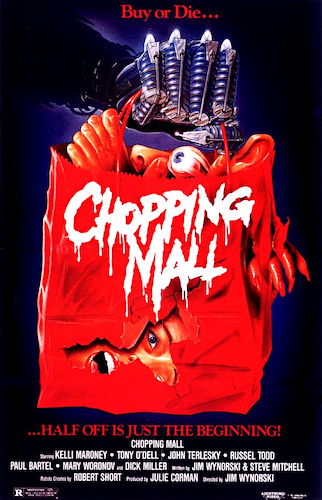
    Chopping Mall

    Blood, boobs, and berserk ’bots are the order of the day in this campy sci-fi actioner.

    That’s right: “sci-fi actioner”. I don’t know where I’d heard about this, or if I’d just made inferences from the title and poster, but I’d assumed it was a regular slasher whose USP was simply “it’s set in a shopping mall”. But nope, it’s actually about security robots who go barmy and start killing a bunch of young people who’d locked themselves in a mall overnight. According to IMDb, it was originally released as Killbots — a more to-the-point title — but it performed poorly, and the producers’ reasoning was the title had made audiences think it was a Transformers-like kids movie (if anyone did take their kids to see it, boy, were they in for a surprise!) So, after cutting over quarter-of-an-hour, they re-released it with the more-clearly-exploitation-y title and… well, I don’t know if it as a major success or anything, but I guess it performed better and that’s the version that has endured.

    I don’t know what was in those deleted 15 minutes, but presumably nothing of great import. Indeed, the short running time is a blessing: it gets on with things at the start, and doesn’t try to drag them out later. It knows what we’ve come to a movie like this for, and it delivers that with admirable efficiency. What’s left is so barmy and schlocky that it’s kinda fun, even if most of it doesn’t make a lick of sense. Even allowing for the implausible setup (lightning sends robot security guards berserk), there’s little to no logic in what follows (the robots have turned murderous? Fine, but why are they such shit shots? And why, when they have an easy shot, do they suddenly stop shooting? And so on).

    Chopping Mall is no lost gem, although it may make you nostalgic for an era when they actually made stuff like this. Would the world be a better place if people were still churning out low-budget schedule-fillers full of gratuitous-but-clearly-fake violence and unnecessary-but-welcome nudity? I don’t know, but I doubt it could be any worse. At least it might’ve desensitised younger generations enough that we wouldn’t have to suffer endless rounds of “sex scenes are bad, actually” discourse on Twitter…

    3 out of 5

    Chopping Mall was the 13th new film I watched in 2023.


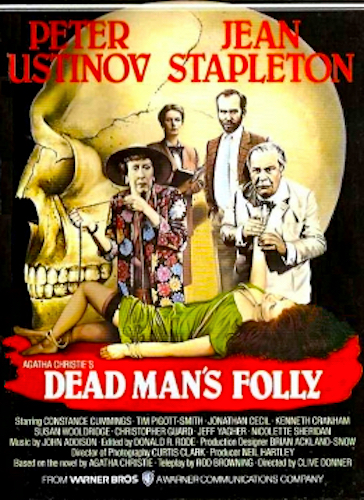
    Dead Man’s Folly

    (1986)

    Clive Donner | 94 mins | digital (SD) | 4:3 | USA / English | PG

    Dead Man's Folly

    This second of three TV movies starring Peter Ustinov as Poirot marks the fourth of his six appearance as the character overall, and it might be the low point of the generally-underwhelming bunch. Ustinov was no doubt a quality performer, and I know his version of Poirot has its fans, but, for me, he remains a lesser interpreter of the Belgian sleuth.

    This particular film does nothing to outweigh his shortcomings. I don’t know if it’s the fault of the original story, this adaptation, or just me, but I didn’t feel there was enough provided for the the viewer to join in with the whodunnit guessing game, which I think is half the fun of a murder mystery. Events just unfurled until, eventually, Poirot explained it all. Add to that a portrayal of Poirot’s sometime-sidekick Hastings by Jonathan Cecil that verges on the lascivious, and production elements (costuming, hairdos, music) that are painfully ’80s, and the recipe is all-round distasteful.

    2 out of 5

    Dead Man’s Folly was #154 in my 100 Films in a Year Challenge 2021.


    Wild Target

    (2010)

    Jonathan Lynn | 98 mins | digital (HD) | 2.35:1 | UK & France / English & French | 12 / PG-13

    Wild Target

    In this remake of French comedy-thriller Cible émouvante, Bill Nighy plays an ageing hitman who falls for his latest target, pretty young thief Emily Blunt. Romance blossoms, in what must be one of the most implausible storylines ever committed to film. That’s partly because of the 33-year age gap between 26-year-old Blunt and 59-year-old Nighy (who, frankly, seems even older — the age gap may be roughly father/daughter, but she feels more like his granddaughter), but also because the movie does little to overcome this blatant shortcoming. If it wants us to buy it, it needs to sell it, but instead it half-arses it. When you learn that Helena Bonham-Carter was originally cast in Blunt’s role (but had to pull out due to commitments to Alice in Wonderland), it all begins to make sense: you can imagine a relationship between her and Nighy working on screen, and presumably they didn’t bother to retool the screenplay in between actor changes.

    All of which says, the film just about survives because there’s enough else going on. The hitman and thief wind up on the run from the people who want her dead, with a young apprentice (Rupert Grint) in tow, and the ensuing farcical hijinks are all daft fun, with the great cast (which also includes Martin Freeman, Eileen Atkins, and Rupert Everett, among others) clearly having a good time. Sometimes that’s off-putting, but here it’s infectious.

    4 out of 5

    Wild Target was #59 in my 100 Films in a Year Challenge 2021.

  • Archive 5, Vol.6

    Hey, wouldja look what it is! After getting off to a fairly strong start back at the beginning of 2022, I allowed my Archive 5 strand to fall by the wayside while I made a concerted attempt to stay up-to-date reviewing my new viewing (with mixed success). But now it’s back, hopefully on a more permanent basis. And I guess going forward it should include what’s left of 2022, because otherwise I’m stuck trying to catch up on those reviews before I can even begin 2023. But not just yet, because I selected today’s five films back when Vol.6 should originally have been posted (last February, gasp!)

    For those who’ve forgotten, I have a backlog of 421 unreviewed feature films from my 2018 to 2021 viewing (448 if we add in 2022 too). This column is where I give those films their day, five at a time, selected by a random number generator.

    Today, some films sizzle with heat or tension, while others fizzle into disappointment. This week’s Archive 5 are…

  • Paris When It Sizzles (1964)
  • 7500 (2019)
  • The Rhythm Section (2020)
  • Carefree (1938)
  • The Lie (2018)


    Paris When It Sizzles

    (1964)

    Richard Quine | 110 mins | digital (HD) | 16:9 | USA / English | U

    Paris When It Sizzles

    William Holden and Audrey Hepburn are clearly having a whale of a time in this marvellously cine-literate romp about a struggling screenwriter (Holden) and the secretary (Hepburn) hired to type up the script he hasn’t actually started. With the deadline just two days away, the pair rush to put a script together, which plays out as a film-within-a-film, also starring Holden and Hepburn, and allowing them even more fun as they get to overact extraordinarily. The “inside baseball” feel of the thing is furthered by a handful of surprise cameos.

    Perhaps it’s me just misjudging the era, but the whole thing feels somewhat ahead of its time. In the way its such an insider’s riff on the movie industry, it feels like something you wouldn’t expect to have emerged until maybe the ’90s (The Player being an obvious point of reference). How well that worked for audiences at the time, I don’t know — maybe it did come across as too esoteric — but, viewed today by anyone with an idea of the history and inner workings of the Hollywood machine — it’s a lot of madcap fun.

    5 out of 5

    Paris When It Sizzles was #129 in my 100 Films in a Year Challenge 2020. It placed 20th on my list of The Best Films I Saw in 2020.


    7500

    (2019)

    Patrick Vollrath | 93 mins | digital (UHD) | 2.39:1 | Germany, Austria & USA / English, German & Turkish | 15 / R

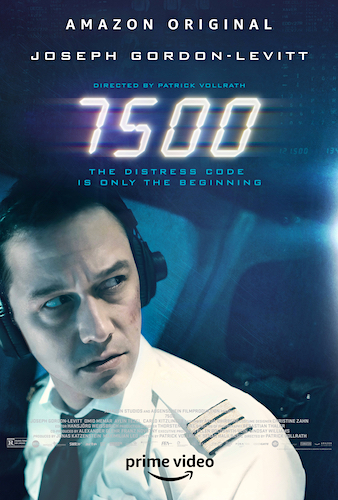
    7500

    After a title sequence that uses security camera footage to follow some shifty-looking blokes around Berlin airport, the film fades up in a passenger airplane cockpit as the crew arrive and begin their regular pre-flight routines. It’s a location we won’t leave for the next 80 minutes, as the unremarkable flight to Paris takes a turn when the aforementioned shifty-looking blokes attempt to invade the cockpit mid-flight, leaving it up to copilot Joseph Gordon-Levitt to try to rescue the situation.

    A tense thriller set entirely in one confined location and told in (near-as-dammit-)real-time? This film could have been made just for me. Suffice to say, I was suitably pleased. This kind of style and pace clearly won’t be to everyone’s taste (I mean, the first 15 or so minutes are almost entirely about watching the pilots just doing their everyday job), but there’s something about the format that does it for me. I think it’s something to do with the inescapability of real-time — that what’s happening and what will happen is going to last as long as it lasts, no shortcuts — that serves to underscore the tension of a thriller storyline. That said, in this case the final act does lose some of the momentum and tension, as much as it tries to maintain it, meaning it feels like it limps to the end, with the really suspenseful stuff having expired a little after the hour mark. It’s not that this final act is bad, just that it feels like a comedown from what’s gone before.

    Still, Gordon-Levitt is great throughout, carrying a large chunk of the film singlehanded, and there’s ultimately a more nuanced treatment of the terrorists than you might expect. I saw someone criticise it for trying to humanise one of them, as if that was problematic. Sure, terrorists are bad guys, but they’re still human beings underneath, and they’ve been plenty demonised enough in plenty of less thoughtful media — I’m not sure it should be considered controversial or a step too far to suggest that one of them (out of four) might be a misguided teenager rather than Evil Personified. On the flip side, I read another review that trashed the film for “featuring brown terrorists again”. I imagine those two reviewers would have a lot to disagree about…

    4 out of 5

    7500 was #144 in my 100 Films in a Year Challenge 2020.


    The Rhythm Section

    (2020)

    Reed Morano | 110 mins | digital (HD) | 2.39:1 | UK & USA / English & French | 15 / R

    The Rhythm Section

    I don’t know about you, but sometimes I watch movies with a bad rep in case I see something in them that everyone else* missed — because that does happen. In that vein, The Rhythm Section isn’t some overlooked masterpiece, but I don’t really get why everyone hated it so much.

    Blake Lively uglies up and forces an English accent to star as Stephanie Patrick, a drug-addicted prozzie who used to be a pretty Oxford student until her family died in a plane crash three years earlier, which a journalist now tells her was a terrorist attack that MI6 have covered up. Events lead her to a disgraced agent (Jude Law) who agrees to train her to hunt down the people responsible.

    Hardly the most plausible storyline ever, but it’s no more ludicrous than many a thriller. So, as a genre piece, well, it’s certainly not the greatest action-thriller ever made, but it’s decent overall with a couple of neat twists on the usual formula. The primary one is that our heroine isn’t actually very good at being an action hero and keeps fucking up. Normally these films are about highly competent super agents (Jason Bourne, John Wick, etc), or newbies who take to it like a duck to water. Stephanie’s borderline incompetence is not only a mite more realistic, it makes a refreshing change, and at times is even successfully used to heighten the tension.

    Unfortunately, other aspects were stale on arrival. For no reason, it begins halfway through and then does the “8 Months Earlier” thing. This is a personal bugbear of mine, because it’s a trick that’s been used to death at this point, routinely trotted out to no real purpose. Usually it’s used as a cheap way to deliver some action upfront because otherwise there won’t be any until somewhere in Act Two, which is just an insult to the audience’s attention span. In other cases, the film just got unlucky. I imagine when they conceived of a single-shot car chase it seemed like an original idea — as it probably did to all the other filmmakers who attempted the same thing around the same time; not least Netflix’s Extraction, which did it bigger and therefore better. Oh well.

    Ultimately, I suppose The Rhythm Section is fundamentally derivative, with only fleeting moments of originality. But I still thing everyone else was overly negative — it’s not bad, just not strikingly fresh. I think if you enjoy Bourne-esque action-thrillers, you should enjoy this.

    3 out of 5

    * It’s never everyone else, but you know what I mean. ^

    The Rhythm Section was #138 in my 100 Films in a Year Challenge 2020.


    Carefree

    (1938)

    Mark Sandrich | 83 mins | digital (SD) | 4:3 | USA / English | U

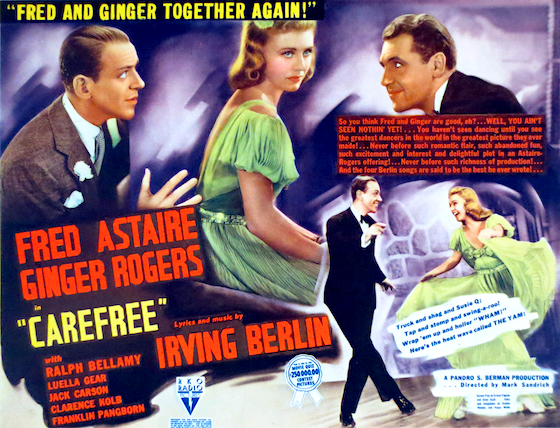
    Carefree

    Fred Astaire is a psychiatrist prone to misogynistic views and unethical practices who mimes playing the harmonica and performs dance routines with golf balls, and Ginger Rogers does a song & dance about yams (because Astaire thought it was so silly, he refused to sing it. He was right). Yeah, I think it’s fair to say this isn’t the couple’s finest hour. The public agreed: this was the first Astaire-Rogers film to lose money on its initial release.

    That said, it’s not without the occasional charm. Rogers still shines — the sequence where she goes around playing naughty pranks with a cheeky grin while under the influence of anaesthetic is a delight — and there’s a slow-motion dream-sequence dance that is rather lovely. But these are fleeting pleasures amongst the distasteful storyline (see: my description of Astaire’s character) and less refined moments (there’s a song about yams).

    2 out of 5

    Carefree was #97 in my 100 Films in a Year Challenge 2021.


    The Lie

    (2018)

    Veena Sud | 95 mins | digital (UHD) | 2.39:1 | USA / English | 15 / R

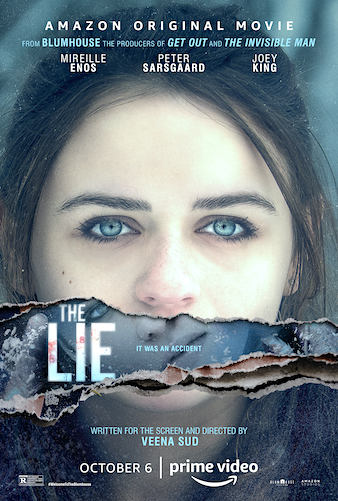
    The Lie

    Although it debuted to most of the world as one in a series of eight Blumhouse original movies that premiered together on Amazon Prime in 2020, The Lie is listed as a 2018 film because that’s when it premiered at TIFF under a different title (Between Earth and Sky). The fact it went from being a standalone production to one of a series released en masse provides a clue as to how well it went down.

    The film has a solid premise that starts out well enough: a father (Peter Sarsgaard) and daughter (Joey King) are driving to a ballet retreat when they spot her best friend waiting by the side of the road, so they offer her a lift. Later, they stop in the middle of nowhere so the friend can go to the bathroom, but she falls off a bridge into an icy river. Or possibly the daughter pushed her. Either way, presumably she couldn’t survive the fall, and her body has washed away. Fearing how all that would look, they set about covering it up… which is where things go awry, both for the characters and us viewers. The longer the story goes on, the further it departs from actions and consequences that feel plausible. It’s not ludicrously far-fetched, it just doesn’t feel right; like people wouldn’t make those decisions, or those decisions wouldn’t have those consequences. The lead cast give it their best shot, but they’re battling against material that’s below their skills.

    Then there’s an inevitable last-minute twist that just hurls the whole thing off a bridge. Kate Erbland for IndieWire wrote that it “should rank among the all-time great fake-outs,” and she’s sort of right: it could have been a reveal for the ages, but rather than eliciting a pleasant “OMG I don’t believe it!”, it plays as “ugh, I don’t believe it.”

    2 out of 5

    The Lie was #245 in my 100 Films in a Year Challenge 2020.


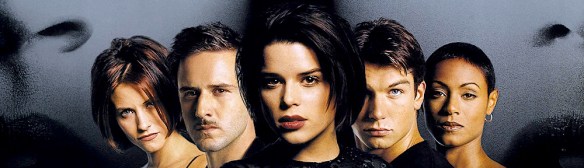
  • The 100 Films Guide to Scream

    I don’t always do anything to mark Halloween on this blog… but when I do, this is the kind of thing I do: complete coverage of the Scream movies (so far).

    That means all-new “100 Films Guide To”s for the original film, its two sequels, and the 2011 legacy sequel, plus my brand-new review of this year’s, er, new legacy sequel. You know, the film that should’ve been called 5cream, but wasn’t.


    Scream (2022)

    Matt Bettinelli-Olpin & Tyler Gillett | 114 mins | Blu-ray (UHD) | 2.39:1 | USA / English | 18 / R

    Scream (2022)

    Nowadays, reviving horror franchises with reboots or continuations that just use the same title as the original film are all the rage — witness The Thing, Halloween, and Candyman; you might also include Evil Dead, Blair Witch, The Predator, and Texas Chainsaw Massacre. (And it’s not just limited to horror movies: Shaft is a sequel to Shaft, which was a sequel to Shaft.) And where there’s a trend in horror movies, the Scream series must follow, to both emulate and roast the genre’s new status quo. Fortunately, there’s more than merely “we could call a new Scream film ‘Scream’” to the movie’s satirical targets.

    Set about ten years after the last film, the fifth Scream (I get that the recycled title is a meta-gag too, but I still think it’s a shame they missed the chance to go with 5cream, or Screams / Scream5) introduces us to a new cast of characters. That’s what every Scream film has had to do (that’s the thing with slashers — most of your cast gets killed off each time), but here we’re in ‘requel’ mode. For those who don’t know, ‘requel’ is a portmanteau of “reboot” and “sequel”, i.e. a film that’s both a reboot (in the sense it’s a new story you can jump onboard with) and a sequel (in that it’s still in continuity with the previous films). “Legacy sequel” is a similar thing — a belated sequel, in continuity, with the original cast, now older — but Scream already targeted that kind of follow-up last time out. What being a ‘requel’ means for this film is we meet all the new characters before the legacy ones are gradually introduced the plot.

    A plot summary is barely necessary: someone in a Ghostface mask is murdering people. Who is it? What’s their motive? That’s the plot of all the Scream films — of course it is, that’s how horror franchises work. The devil is in the details, but that can make the details spoilers. There are some neat reveals, and twists on the franchise’s formula, that I’m not going to spoil here because that would ruin the fun. If you’re a fan of the series, the less you know going in, the better. For example, there’s one reveal — which doesn’t come until we’re already in the final act — that was, apparently, blown in the trailer, even after the filmmakers worked hard to keep it secret until the right moment in the film itself. (That’s according to the audio commentary — I haven’t watched the trailer to see if it blatantly blew it or if fans just worked it out from the footage shown.)

    Ghostface Mk.V

    Scream being Scream, it gets to both have its cake and eat it by pointing out the laughable clichés and ridiculous tropes of other horror films, then doing them anyway. Some people dislike this approach — “pointing out that what you’re doing is a cliché doesn’t stop it from being a cliché” — but, personally, I think it’s part of the charm of these films. They don’t do the thing and then have someone go “that was so cliché!”, they tell you “wouldn’t it be clichéd if this happened?” and then it does. Too subtle a difference for some, I guess, but it works for me. One thing the previous films have a habit of doing — and it continues in this one — is laying out the entire plot for you, even telling you who the villain is, but you don’t notice because you’re busy playing whodunnit and stringing the mystery together. Of course, they also lay out red herrings, so it’s always easier to spot the “they gave it all away” moments with hindsight.

    Whether or not you’re on board with that “point out what it’s going to do then do it” approach will probably dictate how much enjoyment you can get out of a film like Scream. The best bits are the ones that are self-aware, either because characters are expressly discussing the plot or because the filmmakers are playing with our expectations. In the case of the latter, this film has a really neat sequence in which you know for certain the killer is going to jump out at some point, but the character on screen is, as ever, oblivious to this fact, so merrily goes around opening doors, thus blocking our lines of sight, or wandering past open doorways, which are then held in shot for just a moment too long… It’s a gag that builds in hilarity the longer it goes on, and directors Bettinelli-Olpin & Gillett milk it magnificently.

    As for the former, this film has an especially neat exchange about “fan fiction”. Without Wes Craven in the director’s chair and/or Kevin Williamson at the typewriter, this film could definitely be dismissed as just “fan fiction” — that’s the gag, really. But, in terms of quality, there’s “fan fiction” and there’s “fans who have become professionals picking up the baton and continuing a franchise perfectly”. If this film is either, I’d argue it’s the latter. Which is a slightly convoluted way of saying Scream (5) nails the tone, style, and — perhaps most importantly — meta humour that makes a Scream film a Scream film.

    4 out of 5

    Scream is the 69th film in my 100 Films in a Year Challenge 2022.

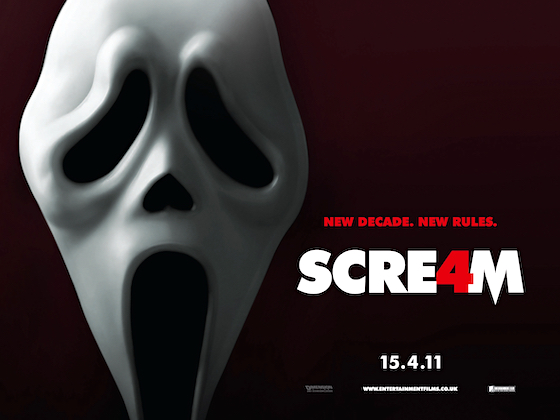
    Scre4m (2011)

    The 100 Films Guide to…

    Scre4m

    New Decade. New Rules.

    Also Known As: Scream 4. Not in the film itself, though. Nor on any of its marketing. But most places on the internet? Apparently. Quite why certain online movie databases are so resistant to listing the film by its proper title, I don’t know.

    Country: USA
    Language: English
    Runtime: 111 minutes
    BBFC: 15
    MPAA: R

    Original Release: 13th April 2011 (Belgium, Egypt & France)
    US & UK Release: 15th April 2011
    Budget: $40 million
    Worldwide Gross: $95.99 million

    Stars
    Neve Campbell (Scream (1996), Scream (2022))
    Courtney Cox (Scream 2, Scream (2022))
    David Arquette (Scream 3, Scream (2022))
    Emma Roberts (Wild Child, We’re the Millers)
    Hayden Panettiere (I Love You, Beth Cooper, Scream 6)

    Director
    Wes Craven (Wes Craven’s New Nightmare, Scream)

    Screenwriter
    Kevin Williamson (Scream, I Know What You Did Last Summer)

    The Story
    Ten years since the last Ghostface killings, and the tragic events have faded into festivity for the teens of Woodsboro, who now celebrate the anniversary of the first killings. But this year is a special one, because Sidney Prescott is back in town, and someone has donned the mask to go on a new killing spree…

    Our Heroes
    Sidney Prescott, perennial survivor of multiple Ghostface killers, must face one again as she returns to her hometown for the first time in years to promote her new book. Dewey — now Sheriff — and Gale — now his wife — are back, too, along with an array of fresh faces ready for the slaughter.

    Our Villain
    After a decade away, Ghostface is back! Except, as always, it’s a new killer (or killers) behind the famous mask. They’re still stalking Sidney, her friends and her family, but who is it and what’s their motive this time?

    Best Supporting Character
    Each new Scream film has introduced fresh faces (the films have a habit of killing off most of the supporting cast each time round, funnily enough, so you kinda have to), but the “whole new generation” angle of Scre4m makes it feel like there are even more this time round. While many are clear mirrors of characters from the first film (deliberately so), perhaps the one that manages to stand out the most in her own right is Hayden Panettiere’s Kirby, sassy best friend to Sidney’s cousin Jill. Yeah, she’s he new version of Rose McGowan’s Tatum, but, unlike some of the other characters, she doesn’t just feel like a 2011-painted carbon copy of the original. Plus, (major spoiler alert!) there’s a reason that, despite this film leaving her for dead, she’s set to reappear in Scream 6.

    Memorable Quote
    The Voice: “It’s time for your last-chance question. Name the remake of the groundbreaking horror movie in which the vill—”
    Kirby: “Halloween, Texas Chainsaw, Dawn of the Dead, The Hills Have Eyes, Amityville Horror, Last House on the Left, Friday the 13th, A Nightmare on Elm Street, My Bloody Valentine, When a Stranger Calls, Prom Night, Black Christmas, House of Wax, The Fog, Piranha. It’s one of those, right?”

    Memorable Scene
    The film begins with two teen girls at home choosing a movie to watch, when a mysterious caller with a gravelly voice threatens their lives. What happens next would be a spoiler… but, from the very start, Scre4m sets out its stall as a movie that, in true franchise tradition, is going to play with the rules and expectations of movies.

    Previously on…
    After a hugely successful and acclaimed first film, Scream did what so many popular movies have done in the past few decades: got turned into a trilogy. Really, it’s only fitting that it got in early on the 2010s trend of “reviving a once-popular but thought-finished film series”.

    Next time…
    And now it’s getting in on the “just keep making more films forever” trend that once used to be more-or-less limited to James Bond and shitty horror sequels but nowadays is the defining feature of the entirety of Hollywood. First there was a new film simply titled Scream (the fact it’s not called 5cream or Scream5 is a sin), and next is… a second/sixth film that no one seems quite sure what the final title will be. I guess we’ll find out when it’s released next March.

    Awards
    2 Scream Awards nominations (Horror Actress (Neve Campbell), Best Cameo (Anna Paquin & Kristen Bell))

    Elsewhere on 100 Films…
    I originally reviewed Scre4m after I first watched it back in 2012, when I felt the film was “kind of old school. It fits better in the era of the original trilogy and/or earlier horror films than with the development of the genre in the intervening decade.” I went on to suggest it “plays best to those who saw the first three at the right age, i.e. mid-to-late teens or so. I shouldn’t think it would engage a new audience all that much, especially ones versed in the gorier Saw and Final Destination franchises. But for those of us with fond memories (to one degree or another) of the first three films, it’s kind of a nice little revisit.”

    Verdict

    The original Scream trilogy was the defining horror franchise of the ’90s, so reviving it over a decade after its last instalment seemed like the usual Hollywood BS of revisiting any recognisable IP. But with the original last, screenwriter, and director all returning, the film actually did what Scream has always done: be part scary movie, and part commentary on the horror genre landscape. And this time it throws in some social commentary for good measure, with some slightly-ahead-of-its-time satire of social media celebrities. It’s only become more pertinent with the stratospheric rise of YouTubers in the additional decade since the film came out.

    One criticism I’ve seen levelled at Scre4m a few times is that it takes on remakes when it isn’t a remake itself. Well, that wouldn’t work, would it? For the characters to know they’re in a ‘remake’, they’d have to know there was an original — which by default would mean it’s not a remake but a continuation. In fact, the film does address this: it points out that we’re back in the original town, with killers who are following the pattern of the original movie (in-universe, that’s Stab, which seems to be a pretty faithful telling of the ‘real-life’ events shown in Scream). Most of the new characters are analogous to ones from the first film, too. So, Scre4m is, in fact, a remake… while also not being one, obviously.

    All in all, the eleven years between Scream 3 and Scre4m gave the filmmakers enough fresh material to chew on to make the film a more-than-worthwhile addition to the franchise. For my money, the fresh perspectives make it easily the series’ best film since the first.

    Scream 3 (2000)

    The 100 Films Guide to…

    Scream 3

    The most terrifying scream
    is always the last.

    Country: USA
    Language: English
    Runtime: 117 minutes
    BBFC: 18
    MPAA: R

    Original Release: 4th February 2000 (USA & Canada)
    UK Release: 28th April 2000
    Budget: $40 million
    Worldwide Gross: $161.8 million

    Stars
    Neve Campbell (Three to Tango, The Company)
    David Arquette (Ravenous, Ready to Rumble)
    Courtney Cox Arquette (Commandments, Zoom)
    Liev Schreiber (Sphere, X-Men Origins: Wolverine)

    Director
    Wes Craven (The Last House on the Left, My Soul to Take)

    Screenwriter
    Ehren Kruger (Arlington Road, The Ring)

    The Story
    As production gets underway on Stab 3 — the latest in the series of horror movies based on the Woodsboro killings — someone wearing a Ghostface costume starts killing the cast. But really, they want to know one thing: the whereabouts of perpetual murder-target Sidney Prescott…

    Our Heroes
    With Sidney in hiding at a remote location known only to a handful of people, the initial investigation into the new killings falls to the other survivors of the previous films: Dewey, now working as a consultant-cum-security on Stab 3, and his former love interest, intrepid reporter Gale Weathers.

    Our Villain
    The Ghostface killer is back, now terrorising Hollywood — but who’s behind the mask this time? As with the first two films, this technically counts as a whodunnit, though well done if you guess anywhere near the correct conclusion — it’s hardly Christie-level…

    Best Supporting Character
    Mark Kincaid (Patrick Dempsey) is the Hollywood homicide detective investigating the murders. As someone who grew up around the movie biz, he’s as au fait with the rules of cinema as most of the characters have had to become — but does that mean he fits right in, or has all the knowledge necessary to be the new Ghostface?

    Memorable Quote
    “Is this simply another sequel? Well, if it is, same rules apply. But here’s the critical thing: if you find yourself dealing with an unexpected backstory and a preponderance of exposition, then the sequel rules do not apply. Because you are not dealing with a sequel, you are dealing with the concluding chapter of a trilogy.” — Randy

    Memorable Scene
    Looking for someone, Sidney wanders into the abandoned Stab 3 soundstage — to be confronted by a perfect full-size replica of her childhood home. As she wanders inside, remembering the terrifying events that occurred there, she begins to suspect the killer is also lurking. Cue a clever re-staging of one of the first film’s most memorable scenes, as the new killer chases Sidney around her old home.

    Making of
    Neve Campbell was busy shooting a TV series and another film during the production of Scream 3, meaning her availability was limited to just 20 days on set. That’s why Dewey, Gale, and the new supporting cast get so much more screentime now, with Sidney mostly by herself. But whoever was in charge of scheduling around Campbell’s availability actually did a pretty good job maximising her presence, spreading her appearances throughout the film, with a few key interactions with the rest of the cast. If you didn’t know the behind-the-scenes story, you might not even realise what they had to do.

    Previously on…
    The first Scream garnered much acclaim for its amusing deconstruction of slasher movies. Naturally, Scream 2 applied the same modus operandi to sequels.

    Next time…
    Scream 3 was supposedly the end of the series… but if there’s one thing popular horror movie franchises do, it’s keep coming back. So, a little over a decade later, the series was revived with Scre4m in 2011. Then it was turned into an unrelated TV series that ran for two seasons in 2015 and 2016. Then that was rebooted as Scream: Resurrection in 2019. Then the original movie continuity was returned to earlier this year, in the confusingly-titled Scream. That’s getting a sequel next year. Goodness knows what they’re gonna call it.

    Awards
    2 MTV Movie Award nominations (Female Performance (Neve Campbell), Comedic Performance (Parker Posey))
    1 Fangoria Chainsaw Award (Supporting Actress (Parker Posey))

    Verdict

    The Scream movies were always noteworthy for the metatextual way in which they addressed and engaged with the tropes and clichés of slasher movies, but actually setting this one in Hollywood on the set of a slasher movie based on the events of the previous movies is perhaps taking the whole self-awareness thing one step too far. It pushes its luck even further with some cameos that are kinda fun, but also kinda too silly (Jay and Silent Bob?! So the Scream movies are canonically set in the View Askewniverse…) Plus, the attempt to retcon in a series-overarching motive for the killer, in aid of making it a true trilogy rather than just “another Scream movie”, is as forced and unsatisfying as it sounds.

    All of which said, the film still has effective moments and individual sequences, and a smattering of entertaining gags that are still on the money. Even if it remains the least of the Scream films, but it’s far from the disaster it’s often been painted as.

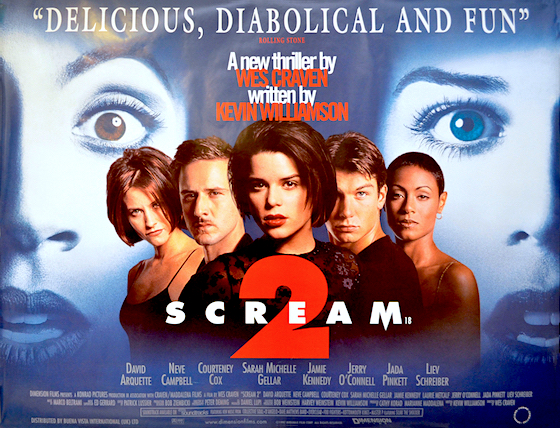
    Scream 2 (1997)

    The 100 Films Guide to…

    Scream 2

    Someone has taken their love of
    sequels one step too far.

    Country: USA
    Language: English
    Runtime: 120 minutes
    BBFC: 18
    MPAA: R

    Original Release: 12th December 1997 (USA & Canada)
    UK Release: 1st May 1998
    Budget: $24 million
    Worldwide Gross: $172.4 million

    Stars
    Neve Campbell (54, Skyscraper)
    Courtney Cox (Masters of the Universe, Bedtime Stories)
    David Arquette (Wild Bill, Eight Legged Freaks)
    Jamie Kennedy (Romeo + Juliet, Son of the Mask)

    Director
    Wes Craven (The Hills Have Eyes, Cursed)

    Screenwriter
    Kevin Williamson (Teaching Mrs. Tingle, Cursed)

    The Story
    Sidney is now at college, but when a movie is released based on the Woodsboro murders, a new killer dons the Ghostface mask and begins targeting her fellow students.

    Our Heroes
    The sequel natural reunites the survivors of the first film (spoilers!) — target Sidney Prescott, police officer Dewey Riley, reporter Gale Weathers, and film nerd Randy Meeks — while adding a host of new victims / suspects. It’s full of faces that were TV-famous at the time and/or have gone on to be better known since: Jada Pinkett Smith, Omar Epps, Liev Schreiber, Sarah Michelle Gellar, Joshua Jackson, Timothy Olyphant, Jerry O’Connell, Laurie Metcalf…

    Our Villain
    Ghostface — but unlike other slasher franchises with supernatural villains, this is just a mask, worn by different killer(s) in each film. Who is it this time? Well, that’d be a spoiler — the Scream movies are effectively murder mysteries. Not particularly good murder mysteries (they don’t function in that Christie-esque way of laying out suspects and clues so we can have a fair guess at whodunnit), but they’re technically murder mysteries nonetheless.

    Best Supporting Character
    Some of the new characters give their best shot at being memorable, but sorry, it’s Randy again (see this category in the first Scream). That said, there is a nice little cameo from the ever-excellent David Warner.

    Memorable Quote
    Randy: “The way I see it, someone’s out to make a sequel. You know, cash in on all the movie murder hoopla. So it’s our job to observe the rules of the sequel. Number one: the body count is always bigger. Number two: the death scenes are always much more elaborate. More blood, more gore. Carnage candy. Your core audience just expects it. And number three: if you want your sequel to become a franchise, never, ever—”

    Memorable Scene
    Sidney and her roommate Hallie are being escorted to safety in the back of a police car when Ghostface appears out of nowhere, hijacks the car, and crashes it into roadworks. With the car’s back doors locked, the girls’ only chance of escape is by climbing into the front seat and out the driver’s window — right past the unconscious serial killer…

    Previously on…
    The original Scream was such a hit that this sequel was in production just six months later, and eventually released less than a year after the first.

    Next time…
    As the horror franchise of the ’90s, naturally Scream has continued into the ’00s and beyond: Scream 3 wrapped up the trilogy in 2000, before the series was revisited with Scream 4 (actually titled Scre4m) in 2011, and then revived earlier this year in a film simply titled Scream. That’s getting a sequel next year, which obviously poses titling issues. There have also been a couple of TV incarnations, both entirely unrelated in story terms: Scream: The TV Series ran for two seasons in 2015 and 2016, and Scream: Resurrection (or season 3, if you prefer) in 2019.

    Awards
    1 MTV Movie Award (Female Performance (Neve Campbell) — she beat Kate Winslet in Titanic!)
    3 Fangoria Chainsaw Awards (Wide-Release Film, Supporting Actress (Courtney Cox), Screenplay)
    2 Fangoria Chainsaw Award nominations (Actress (Neve Campbell), Supporting Actor (Liev Schreiber))
    3 Saturn Award nominations (Horror Film, Actress (Neve Campbell), Supporting Actress (Courtney Cox))

    Verdict

    Where the first Scream was a forensic deconstruction of the slasher genre, the second is more of a vague gesture in the general direction of sequel tropes — less focused, less insightful, less funny. But, crucially, it’s still quite entertaining. There are abundant references for movie buffs to enjoy (primarily to other sequels and, er, other Friends cast members), while Wes Craven’s ever-skilful thrill sequences ensure the tension doesn’t slack too much. There are even a few jump scares for the more susceptible. It’s not a genre-(re)defining classic like the first movie, but it’s still a solid scary movie.

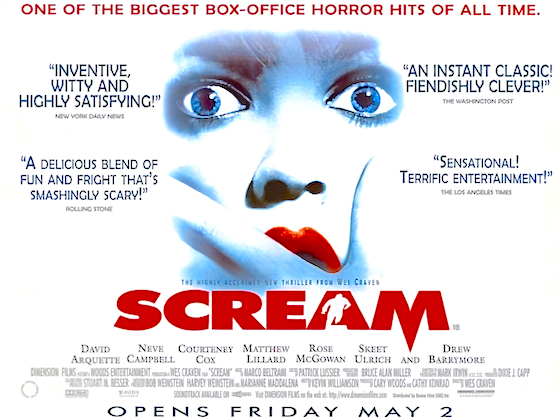
    Scream (1996)

    The 100 Films Guide to…

    Scream

    Someone has taken their love of
    scary movies one step too far.

    Country: USA
    Language: English
    Runtime: 111 minutes
    BBFC: 18
    MPAA: R

    Original Release: 20th December 1996 (USA)
    UK Release: 2nd May 1997
    Budget: $14 million
    Worldwide Gross: $173 million

    Stars
    Neve Campbell (The Craft, Wild Things)
    David Arquette (Buffy the Vampire Slayer, Never Been Kissed)
    Courtney Cox (Ace Ventura: Pet Detective, 3000 Miles to Graceland)
    Drew Barrymore (Firestarter, 50 First Dates)

    Director
    Wes Craven (A Nightmare on Elm Street, Red Eye)

    Screenwriter
    Kevin Williamson (I Know What You Did Last Summer, The Faculty)

    The Story
    In the quiet town of Woodsboro, a mysterious man in a mask starts murdering teenagers, first taunting them with horror movie trivia questions.

    Our Hero
    Sidney Prescott is an ordinary high school girl… apart from the fact her mother was murdered a year ago, and it was her eyewitness testimony that saw a man sentenced to death. Now, a serial killer seems to be targeting her — could the events be connected?

    Our Villain
    A slasher movie has to have a distinctive-looking, nicknamed serial killer at its centre, and here it’s Ghostface — although he’s actually only called that once in the film itself. His costume is a generic Halloween outfit bought from any old store, and is technically called Father Death. Why didn’t that name stick instead? Probably because it’s a bit shit.

    Best Supporting Character
    The film has severable memorable supporting turns, but perhaps the key one is nerd and video store employee Randy (Jamie Kennedy). He knows all the rules of horror films, and when it turns out his friends don’t, he helpfully gives them an explainer — which also works for any audience members who maybe aren’t so au fait with the genre either.

    Memorable Quote
    “No, please don’t kill me, Mr. Ghostface, I wanna be in the sequel!” — Tatum

    Memorable Scene
    The opening scene: everyday teenage girl Casey (played by Movie Star™ Drew Barrymore) is preparing to watch a movie when she gets a phone call. It seems like a wrong number, but the man keeps calling back. At first their chat is a bit flirty, but then it begins to get a bit weird, and soon… well, if you haven’t seen it, I wouldn’t want to spoil it for you.

    Making of
    The movie’s climax takes place at a house party the kids are having to take their mind off the killings, or something. But you wouldn’t guess it was the climax to start with, because it begins a little over halfway through the film — the ‘scene’ altogether lasts 42 minutes. It was shot across a gruelling 21 days of night shoots. After it was finally done, the crew had T-shirts made saying “I Survived Scene 118”.

    Next time…
    Two direct sequels followed in 1997 and 2000. More recently, the franchise has been subjected to the usual rounds of revivals: it took on parodying the ‘legacy sequel’ with a continuation in 2011, then did the same again with another one in 2022. A sequel to that is on the way next year. In between, there was a spin-off TV series that lasted three seasons. Season 1 and 2 were a reboot, unconnected to the movies; then it rebooted itself for season 3, still with no connection to the movies.

    Awards
    1 MTV Movie Award (Movie)
    1 MTV Movie Award nomination (Female Performance (Neve Campbell))
    4 Fangoria Chainsaw Awards (Wide-Release Film, Actress (Neve Campbell), Supporting Actress (Drew Barrymore), Screenplay)
    1 Fangoria Chainsaw Award nomination (Supporting Actor (Skeet Ulrich))
    3 Saturn Awards (Horror Film, Actress (Neve Campbell), Writer)
    3 Saturn nominations (Director, Supporting Actor (Skeet Ulrich), Supporting Actress (Drew Barrymore))

    Verdict

    By the mid-’90s the once-popular horror genre was languishing in a mire of endless sequels to the same old titles — but then Scream came along and gave it a much-needed kick up the rear end. Originally titled Scary Movie (in some ways, a more apt title), Scream is a horror movie that knows it’s a horror movie — a kind of self-awareness, often (arguably mistakenly) referred to as post-modernism, that was ever so popular in the ’90s. But it worked for a reason: it treated the audience with respect. It said, “you know the rules, so let’s not pretend.” And that facilitates two things: by acknowledging the rules, it can play with them to make you laugh; and it can break them to surprise you. Thus Scream is simultaneously a spoof of the slasher genre and a genuine entry in it. It’s potentially a tricky tightrope to walk (several major directors were rejected because they thought the film was just a comedy), but Wes Craven nails the tone so perfectly that he makes it look easy. So what might have been a last-hurrah commentary on what had already been instead turned out to be the beginning of a new wave; one which has helped fuel the genre for over 25 years since.

    2022 | Weeks 27–28

    Hello! Yes, it’s me — I am still here. I’ve just been finding my time filled up with other stuff: working on the 2022 iterations of both WOFFF and FilmBath Festival (in addition to the ol’ day job); dogsitting for the in-laws; throwing up from eating bad garlic…

    Anyway, here are some reviews of films I watched all the way back in July. (Oh dear, I am behind. Well, let’s see if I can catch up…)

  • Johnny Gunman (1957)
  • A Better Tomorrow (1986), aka Ying hung boon sik
  • Mifune: The Last Samurai (2015)
  • The Lost Daughter (2021)


    Johnny Gunman

    (1957)

    Art Ford | 67 mins | digital (HD) | 4:3 | USA / English

    Johnny Gunman

    The history of cinema is littered with fascinating asides and dead ends, and this is one of them: an independent film from before independent films were really a thing; from the time when the studio system was beginning to falter, but the film school auteurs hadn’t yet arrived (Spielberg, Scorsese, Coppola, et al were still in their teens when this was made).

    As with the films that would later break similar new ground after the digital video revolution in the ’90s, there are cracks — it’s amateurish and undeniably low-budget in places — but also artistry — every once in a while it’ll whip out an exceptionally well-lit scene or interesting visual. Story-wise, it’s an odd mix: there’s the noir-ish gangster plot line, which is derivative and clichéd; but it takes over the film from what you feel like it almost wants to be, which is a Before Sunrise-style slice of life. Maybe, in a freer world, that’s what the filmmakers would’ve produced; but when you’re one of the first people trying to break in from the outside, hitting the familiar beats of a genre is no bad idea.

    Some of the highlights of the film come at the start, with documentary-like shots of New York street life when our heroine visits the Greenwich Festival. It’s a brief little window into the real 1950s NYC, before the rote gangster plot comes to dominate. Indeed, being shot on location, and with an inexperienced cast, lends the whole production a certain veracity that you don’t always get from soundstage-bound studio pictures of the era. On the other hand, that’s also what gives it the rough edges that will make it unpalatable to some viewers.

    However you cut it, this is hardly a forgotten gem, but it’s an interesting detour of movie history that I’m glad I stumbled across.

    3 out of 5

    Johnny Gunman is the 45th film in my 100 Films in a Year Challenge 2022.


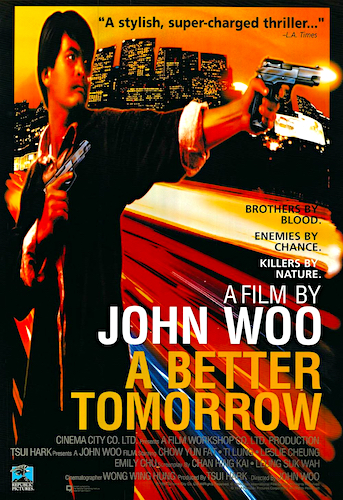
    A Better Tomorrow

    (1986)

    aka Ying hung boon sik

    John Woo | 96 mins | digital (HD) | 1.85:1 | Hong Kong / Cantonese, Mandarin & English | 18

    A Better Tomorrow

    A Better Tomorrow was the first in a run of modern-day gangster action movies that would make director John Woo’s name. Its original Chinese title translates as True Colours of a Hero, which is just as apt: it’s about a pair of mid-level crooks, one of whose brother is a cop, and the ways and whys in which they try and fail to escape the criminal life.

    Woo’s style was cutting edge back in the day, but that day is now pushing 40 years ago. Of course, his flamboyant style has never been to some people’s taste (witness the dismissive stance some still take towards M:i-2). Viewed now, this is cheesier and less stylistically polished than his later career-defining HK films like The Killer or Hard Boiled, but, on the couple of occasions it does explode into action, it’s suitably grandiose, and it has an engaging storyline and character dynamics.

    In regards to the latter, you can definitely see why Chow Yun-Fat was the breakout star. He’s actually got a supporting role, but his charisma shines off the screen, and there’s a plausibility to the way he handles the action. (Ironically, although it made Chow an action icon, he was cast because Woo didn’t think he looked like an action star.)

    Not Woo’s strongest film, then, but a definite sign of someone headed in the right direction — and, clearly, his later work paid off that promise.

    4 out of 5

    A Better Tomorrow is the 46th film in my 100 Films in a Year Challenge 2022. It was viewed as part of “What Do You Mean You Haven’t Seen…?” 2022.


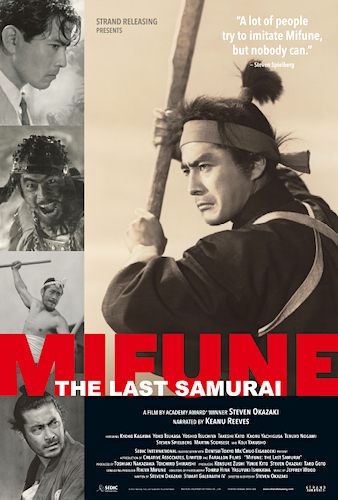
    Mifune: The Last Samurai

    (2015)

    Steven Okazaki | 77 mins | DVD | 16:9 | USA & Japan / English & Japanese | 12

    Mifune: The Last Samurai

    At just an hour and a quarter, this biography of the actor Toshiro Mifune feels more like a primer on his work and life (complete with newcomer-friendly contextual asides into the history of Japanese cinema, the career of Akira Kurosawa, etc) rather than the deep-dive exploration of the man and his legacy that some reviewers hoped for. I certainly learnt stuff, but such criticism has validity. For that reason, the less you know about Mifune (and Kurosawa), the more you’ll get out of the film. That said, it might pay to have already seen some of their films — it’s not that director Steven Okazaki doesn’t introduce and summarise them adequately; more that, if you’ve seen them, you know the full context.

    Nonetheless, a good range of interviewees ensure the documentary is not without insight, managing to explore both what made Mifune the man tick and what made him such a phenomenal screen presence. Plus, the fact that Okazaki is happy to explain contextual topics (like a history of chanbara films; or matters of social history, like what losing World War 2 was like for the Japanese people) is both education and useful, because I imagine most non-Japanese viewers don’t have much baseline knowledge about this stuff. The film is definitely a biography of Mifune (not, say, a history of 20th century Japan using the actor as a gateway), but there’s much to be gleaned here for the interested viewer.

    4 out of 5

    Mifune: The Last Samurai is the 47th film in my 100 Films in a Year Challenge 2022.


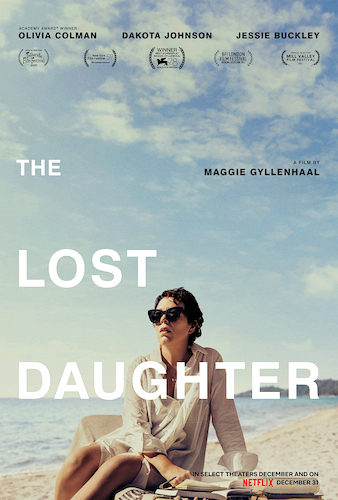
    The Lost Daughter

    (2021)

    Maggie Gyllenhaal | 122 mins | digital (HD) | 1.66:1 | USA, UK, Israel & Greece / English & Italian | 15 / R

    The Lost Daughter

    Maggie Gyllenhaal’s directorial debut, based on a novel by Elena Ferrante, stars Olivia Colman as Leda, a woman on holiday alone in Greece, where she encounters a young mother (Dakota Johnson) whose daughter briefly goes missing, reminding Leda of her own younger days, when she was played by Jessie Buckley and had a husband and two daughters herself.

    It’s perhaps initially difficult to pin down exactly what The Lost Daughter is driving at — I suspect it’s the kind of film in which some people would say nothing happens. But it’s really a kind of mystery, where the mystery is the lead character’s psychology: why is she like this? There’s also the more obvious mystery of what exactly happened in her past, but that isn’t solved so much as gradually doled out in flashbacks. Obviously that kind of story relies a lot on its performances, and Colman is as strong as ever. So much of the importance of the film, which lies in her character and emotion, is conveyed without dialogue. That’s not do down the able support from Buckley and Johnson, mind.

    Gyllenhaal’s direction is interesting and effective, using lots of fairly extreme close-ups to give a kind of tactile sensation to the film. On the other hand, I would say it feels a little longer than necessary (especially after the ‘reveal’ scene, where the final piece of the puzzle clicks), and I’m not convinced it knows how to end (or perhaps it’s my fault for not really ‘getting’ the finale).

    Overall, though, it’s an impressive debut from Gyllanhaal, and a great alternative perspective on motherhood.

    4 out of 5