Alice in Wonderland [3D] (2010)

2010 #38
Tim Burton | 108 mins | cinema | PG / PG
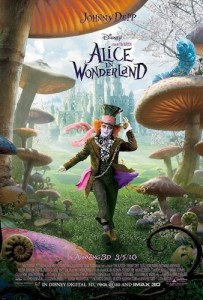
I believe Tim Burton coined the now-ubiquitous term “reimagine” when he remade — I mean, reimagined (sorry Tim!) — Planet of the Apes almost a decade ago. Now, he turns his re-imagination to a new version of The Mad Hatter — sorry, posters/ad campaign/DVD art confused me, I mean Alice in Wonderland — which receives its controversially speedy (remember all that fuss with Odeon?) DVD/BD release tomorrow.

This time, rather than starting from scratch, Burton has created a sort of “Alice 2”, crafting a new plot from the novels’ elements. It’s set 13 years after Alice’s first trip down the rabbit hole, which presumably occurred in the classic Disney animation (as opposed to her two trips in the original novels, or any of the other numerous screen versions there have been). Maybe this is for the best — with Alice committed to film so many times before, one might well argue there’s no need to see the exact same tale done again.

Consequently, this new Alice positions itself freshly in two ways: one, as “Burton’s version”, and two, by following in the footsteps of the specific side of the filmic fantasy genre started by Peter Jackson’s Lord of the Rings, which has since encompassed the likes of two Narnia adaptations, The Golden Compass, and probably several more that I’m forgetting. Although it uses the original’s most famous elements, the film’s narrative and structure is familiar from those recent films more than 19th Century literature, particularly a final epic (well, epic-ish) battle in which our unlikely heroine emerges as the long-prophesised One Who’ll Win It For The Good Guys.The One Who’ll Win It For The Good Guys It’s a moderately interesting cycle to attach it to, one it seems has been missed by its pigeon-holing as “a Tim Burton film” and “another Alice adaptation”.
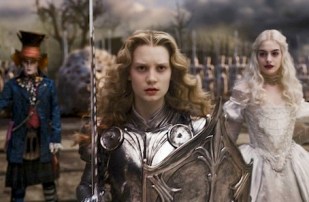
So, talking of Burton, Alice falls into the same ballpark as Charlie and the Chocolate Factory and the supposedly-forthcoming Addams Family remake: they’re the kind of films one expects Burton to be interested in making, and consequently there’s a sense of ticking-boxes about the results. Like Charlie, Alice offers no real surprises from either Burton or their shared star, Johnny Depp. Both do good work, certainly — the former is visually imaginative, the latter suitably barmy — but neither produce anything you don’t expect. True, one might not have been able to predict the exact elements they wheel out — particular Depp’s random use of a Scottish accent — but it nonetheless never feels unexpected.

Mia Wasikowska is something of a revelation as Alice. She’s a newcomer, so say reviews — the kind of newcomer who’s been in a dozen other things of various size — and presents an almost-knowingly naive Alice, which seems an entirely appropriate characterisation. She’ll next be seen as another titular character in a classic novel adaptation — the BBC’s new Jane Eyre (as if the one they did four years ago wasn’t good enough). (It was.) — which is neither here nor there when it comes to this film, really. I’m sure she’ll do fine.
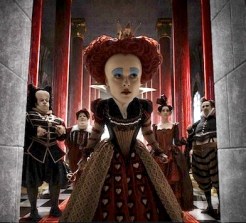
Speech impedimentedAmong the rest of the cast, Helena Bonham Carter does a speech-impedimented Red Queen that feels as familiar was Burton and Depp’s work; Anne Hathaway’s White Queen is amusingly floaty, her hands permanently raised in a faux-delicate gesture; Crispin Glover is under-characterised and marred by some dodgy CGI (quite what’s been done to him I don’t know, but his movement is frequently jerky), but otherwise a decent enough henchman. In the all-Brit voice/mo-cap cast, Matt Lucas is best as Tweedles Dum and Dee — sadly, there’s not enough of him… um, them… — while Alan Rickman is Alan Rickman as the Caterpillar; Stephen Fry has little important to do as a less-scary-than-usual Cheshire Cat; and others — like Michael Sheen, Paul Whitehouse and Timothy Spall — blend into the background with competent but unremarkable work.

The post-production 3D proves (as far as I’m concerned) that James Cameron is being falsely elitist and some reviewers are too easily led: it is very rarely less convincing than what we saw in Avatar. True, Burton doesn’t show it off quite as much as Cameron did — this is a normal film that’s been put into 3D (even the stuff-flying-at-the-camera shots feel like they would’ve remained in a 2D-only version), not one designed to make you go “woah, look at that world! In 3D! I’m, like, so immersed”, the driving factor behind 90% of Avatar’s visuals. I suspect Roger Ebert’s correct that Burton’s visuals would pop more in 2D, away from the sunglass effect of polarised specs, and the added depth adds little of significance to one’s enjoyment of the story or even the visuals… other than 3D sometimes looks nicer, what with all that depth. Well, maybe.

faux-delicateThe funny thing about Burton’s Alice is that — despite the ultimately needless 3D, the familiar fantasy-epic storyline grafted onto Carroll’s characters, and the apparent lack of inspiration from either the director or his cast — it’s still quite enjoyable. It’s not going to do much to engage your emotions or your brain, it won’t give you any hearty laughs or edge-of-your-seat thrills, and it may occasionally make you wish it would get a move on — all of which means that, by the end, it can feel a tad slight. Valid criticism abounds on the web, but… well, I enjoyed it. Maybe I’m just too forgiving.

4 out of 5

Alice in Wonderland is available on DVD and Blu-ray (2D only) now in the US and from Friday in the UK.
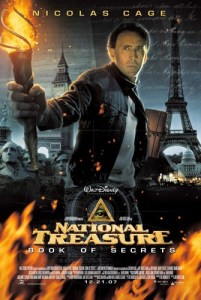
National Treasure: Book of Secrets (2007)

2010 #56
2007 | Jon Turteltaub | 119 mins | DVD | PG / PG

I enjoyed the first National Treasure. There, I said it. I’ve wound up seeing it several times, somehow, and each time appreciated it as a fun romp. It’s not a fashionable film to like by any means, and it’s certainly derivative of all kinds of other things, not least The Da Vinci Code, but it’s an entertaining and consummate minor blockbuster.

National Treasure 2 (that’s this one, in case you didn’t know) essentially offers more of the same. That’s often levelled as a criticism, but in this instance it’s absolutely fine: Book of Secrets isn’t a rehash — there’s a new mystery with new puzzles — but is another adventure in the same vein, with clue-hunting and the occasional action sequence. Things are different, but it’s rather swings and roundabouts. For example, Ed Harris isn’t as fun a villain as Sean Bean, but he’s also suitably different, while on the other hand the London car chase bests any action sequence in the first film.

There’s also the usual sequel escalation: never mind just getting the Declaration of Independence, here Gates & co not only break into the Queen’s office in Buckingham Palace, they also kidnap the President of the United States (briefly. Sort of.) Yes, it’s wildly improbable, not only in the clue-laden treasure hunt but also the feats this three-person team pull off. But that’s half the fun. It doesn’t claim to be real — OK, it uses historical facts, but they’re to embellish its tale, in the same way many higher-class films have — it’s just an entertaining ride, with some exciting action, intriguing clues, and the odd bit of humour.
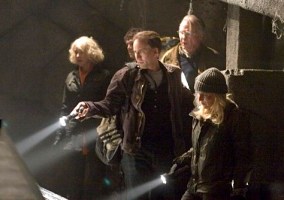
The cast are fine. The unforgiving will find Justin Bartha’s Riley irritating, but by making him a tad down on his luck and a little devoted to Gates he may endear himself to others. Aside from Ed Harris, Helen Mirren is the biggest addition, though both make little more than a cameo when there are so many other characters and plot points flying around. The main attraction of her role is pondering her accent — is it meant to be American? I wasn’t sure. Perhaps she was doing a very good job of being A Brit Who’s Lived In America For A Long Time, but that’s a mite too subtle for all the noise and bluster in a fast-paced conspiracy adventure-thriller.

There are plot holes and logic gaps and it rather leads you by the hand through it all, but none of these undermine what it’s really all about. Either that or I was in a particularly forgiving mood — even the thoroughly daft bit with the traffic camera didn’t bother me too much. It’s not the highest class of blockbuster, it won’t be remembered as fondly as Indiana Jones, or even the Pirates series, but there are worse ways to spend a couple of hours, particularly if all you want is a bit of well-made light entertainment.
If you enjoyed the original, I see little reason why you wouldn’t enjoy the sequel; conversely, if you didn’t like the first one… I’m sure you can finish that sentence. It’s the kind of film that would probably sit quite well on, say, a Bank Holiday afternoon. Which is a stroke of luck.

4 out of 5

The UK TV premiere of National Treasure: Book of Secrets is on BBC One tomorrow, Bank Holiday Monday, at 4:35pm.

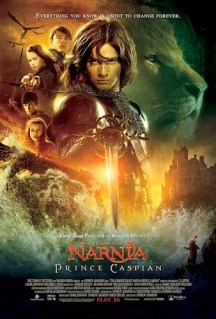
The Chronicles of Narnia: Prince Caspian (2008)

2010 #47
Andrew Adamson | 150 mins | Blu-ray | PG / PG

The Chronicles of Narnia: Prince CaspianThe Pevensie children return to Narnia, but hundreds of years later, in Disney’s last adaptation from C.S. Lewis’ series (don’t worry, Fox have taken it over). For those keeping track, this is both the second book and second film, but fourth chronicle chronologically. Which is fine for now, but I wonder what they’ll do come those earlier-set ones…
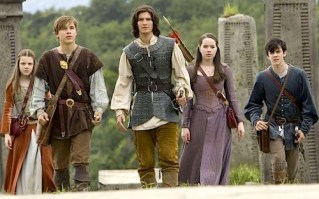
This time out, the world of Narnia has a harder edge. We’re still in PG territory — just — but everything’s turned a bit nasty, with a race of humans having wiped out the fantastical Narnians. Or (naturally) so they thought. Throw in some moderate political intrigue and you’ve got a more grown-up feel, if only slightly. It also makes for a slightly more cohesive tale — there are no odd elements leaking through from our world, like lampposts or Father Christmas, though one can well argue this removes something of Narnia’s unique magic.

It’s perhaps overlong, with numerous places trims could be made without denting the overall story. A half hour could surely have been saved without too much exertion. The first hour in particular is a tad slow, though the sometimes-wordy plot, based around some light court intrigue, adds depth beyond what might otherwise be a series of humans-on-magical-creatures punch-ups. I can’t comment on faithfulness here because it’s an awfully long time since I read the books. Besides, that running time is distorted by a whopping 12 minutes of end credits. I vaguely recall that, a few years ago, the second Matrix filmHeroes held the record for the longest closing credits at 10 minutes. I don’t really know what’s common these days but 12 minutes is nonetheless 8% of the film.
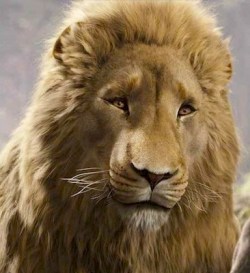
Once the human squabbling is passed — or by-passed, depending on your point of view — the human-Narnian war/one big battle really kicks off. Indeed, action sequences are frequent and fantastic throughout. The raid on the castle is tense, exciting and ultimately devastating — the troops left behind to certain slaughter is an incredibly dark moment in a PG-rated kids’ film. Later, a climactic sword fight is well staged, making excellent use of point-of-view shots, something I don’t recall seeing in a sword fight before.

The epic final battle comes as close to rivalling Helm’s Deep as anything I can think of, albeit — in typical Narnia style — in broad daylight on a big field. It has a real story to it, with specific moves being made by each side in the name of an overall strategy, rather than just A Lot Of Good Guys charging at A Lot Of Bad Guys and hacking away ’til one side wins, the apparent battle tactic in most other such large encounters on film.

The child actors aren’t going to set the world alight but are perfectly decent. I’m still not fully sold on Liam Neeson as Aslan, though I suppose the contrast of boom and gentility may be the point. Eddie Izzard is sadly underused as the excellent Reepicheep, who comes across as Narnia’s answer to Shrek 2’s Puss in Boots. Everyone else is fine — if nothing stands out, there is at least humour and an appropriate level of villainy provided.

Perhaps shortages such as this make the film a rather empty experience, as some have claimed. Not even titular new boy Caspian is treated to a huge amount of characterisation, and what little there is elsewhere depends wholly on knowledge of the first film. In fact, while the primary story largely stands alone, a proper understanding of it relies on the viewer remembering the previous instalment — at no point does anyone bother to explicitly explain that these kids we’ve just followed into Narnia are siblings, never mind that they were there before for decades as Kings and Queens. Maybe this is respecting your audience’s intelligence,Aslan or maybe it’s just counting on their memory a bit too much. With only limited characterisation and basic political complications, Prince Caspian really boils down to a series of fights and battles. Nicely done fights and battles, I’d argue, but still, no one’s coming away from this particularly enriched.

I was quite disappointed with the first Narnia in the end. It was entertaining and at times fun, but the primary-coloured bloodless climax in particular made it feel like Lord of the Rings Lite. I know I’m not alone in this — with the teaser poster for the next film, The Voyage of the Dawn Treader, coming out last week, I noticed a number of sites commenting that they’d not bothered with the second film after disliking the first; box office numbers were down too (though it’s still the 108th highest grossing film ever). Loyalty to a series I enjoyed as a child ensures my return (albeit two years after the theatrical release) but it’s a shame others chose to pass it by, because Prince Caspian is a step-up from The Lion, the Witch and the Wardrobe in pure entertainment stakes. Hopefully this tone continues into Dawn Treader and, fingers crossed, the four chronicles beyond.

4 out of 5

Hannah Montana/Miley Cyrus: Best of Both Worlds Concert [3D] (2008)

2009 #78
Bruce Hendricks | 72 mins | TV | U / G

Hannah Montana and Miley Cyrus: Best of Both Worlds Concert UK posterRubbish. In almost every way possible.

I could expand on that in numerous ways, but what would be the point? The only real exception is the 3D — being a very recent production, that was flawless.

Take solace in the fact that one day — hopefully, one day soon — Cyrus, Montana, this ‘movie’, and all the rest, will be completely forgotten.

1 out of 5

This was shown as part of Channel 4’s 3D Week. That’s why.

Hannah Montana/Miley Cyrus: Best of Both Worlds Concert featured on my list of The Five Worst Films I Saw in 2009, which can be read in full here.

The Many Adventures of Winnie the Pooh (1977)

2008 #92
John Lounsbery & Wolfgang Reitherman | 71 mins | DVD | U / G

The Many Adventures of Winnie the PoohHaving finished 2007 with Piglet’s Big Movie, it feels somewhat appropriate to round off 2008 (almost) with Disney’s first Winnie-the-Pooh feature.

The Many Adventures… is actually compiled from three shorts made in 1966, 1968 and 1974, with some new linking material. I don’t know if these shorts were produced with any great expense, but there’s occasional evidence of what looks like cheap animation. It’s not that it’s not smooth or fluid, but rather the attentive viewer will often spot sketch marks around some lines, or flashes of other bits not properly erased. Perhaps it was deliberate, considering the sketchy style of the backgrounds, designed to evoke the original illustrations, but I sometimes found it distracting.

This is one relatively minor flaw in an otherwise brilliant adaptation, however. The film faithfully adapts several of the original stories, acknowledging its sources by frequently showing the action as illustrations within a copy of the book. This fourth-wall-breaking move may irritate some, but personally I loved seeing Pooh and co have to leap from page to page, or tipping the book sideways to free Tigger from a tree. Such moves seem tonally in keeping with A.A. Milne’s original stories and, even though some tales are abridged and some good ones left out, that spirit is always retained.

The characterisation is also spot on, producing an array of cute and loveable creations, none more so than Pooh himself. The gopher is an unnecessary addition, though the running joke about him not being in the book is very nicely done. And one can’t fail to mention the excellent songs, now as linked to the world of Pooh as anything from the original books — especially Tigger’s little tune, surely familiar to anyone who was a child in the last 30 years.

If some later Disney ventures have lost sight of the correct spirit for Pooh’s adventures, at least this original is a great adaptation. Bouncy, trouncy, flouncy, and, above all, fun fun fun fun fun.

5 out of 5

Enchanted (2007)

2008 #80
Kevin Lima | 103 mins | DVD | PG / PG

EnchantedYou’ve probably heard about Enchanted: it’s the one that starts out as a traditionally animated Disney film, before The Normal Girl Who Will Marry A Prince is thrown into a Magic Portal by The Evil Stepmother and finds herself in present-day New York. It’s one of those concepts so good it just makes you think, “why haven’t they thought of that before?”

Thankfully, they pull it off. It’s very funny, riffing on many recognisable elements from Disney’s considerable library of classics, and manages to produce a number of catchy songs of its own. Amy Adams is brilliant in the lead role, managing to be infectiously sweet rather than sickeningly sugary, while Susan Sarandon has a whale of a time in her boundlessly camp (though disappointingly small) role. The rest of the cast are good too, especially a wonderfully vacant James Marsden as The Prince.

The plot is ultimately predictable, but no more than you’d expect considering the target audience — certainly, kids will likely go through all the requisite emotions, and it would probably be more disappointing if they did try anything truly shocking. Still, it’s crammed with more than enough fun invention and new ideas to make up for any unsurprising plot beats.

Quite simply, Enchanted is a fantastic concept, beautifully executed. A veritable success.

4 out of 5

WALL-E (2008)

2008 #48
Andrew Stanton | 98 mins | cinema | U / G

“Pixar films” seem to have become a bit of a genre unto themselves — yes, they fit into “animation” (always dubious as a genre), “family” (almost as bad), “comedy”, and occasionally a few others, but, much as the Bond films have their own rules and expectations outside the “action” and “spy thriller” conventions, the work of Pixar always achieves special and particular attention. WALL-E subverts some of these expectations (it’s not a buddy comedy, mainly) and has received huge amounts of praise — “consequently”, some might add. It is indeed a very good film, but you’ll surely have heard all that elsewhere; instead, I’m going to draw attention to a couple of things that bothered me.
Most of these issues can be attributed to the fact that WALL-E is a film of two halves. They’re not exactly poorly linked, as elements from each feed into the other, but they are notably different. The first presents a realistically-rendered future Earth, deserted by humans (who are nonetheless represented on hologram screens by live-action actors) and now only inhabited by insects and a trash-collecting robot called WALL-E. Silent but for R2D2-like bleeps, WALL-E quickly endears himself to the audience through his actions. He’s cute, funny and likable, and the early scenes cement him in the audience’s sympathies, which is certainly handy for later. When EVE — a futuristic, iPod-alike ‘female’ robot — turns up, the film becomes a sweet love story, as WALL-E tries to instill the human-like emotions he’s developed into the cold new robot. A very funny and surprisingly touching love story, this is the film’s better half.

The second travels out into space, taking us to meet cartoon humans on a cartoony spaceship. It jars painfully with the realism that pervades the Earth-bound scenes, and the continued use of real actors in holograms highlights the cartoonish style of the future humans. There’s nothing wrong with a cartoon style, I hasten to add — certainly, it works better in films like The Incredibles and Ratatouille than the attempts at realism do in the Toy Story films — but it’s the contrast that’s uncomfortable. The story itself also takes a weak turn here: it becomes a light kiddy-adventure runaround, which is fun and still has flashes of humour and heart, but is nowhere near as daring or as effective as the first half. This is where the sympathies engaged earlier become important, because it’s the audience’s affection for WALL-E that provides most of the genuine quality in this half.

If I were to broadly characterise the two halves, I’d say the first is everything you’d hoped for after the advance hype, while the second is something you could have feared. It’s not bad — it’s still a superior light kiddy-adventure runaround, with exciting-enough sequences and a largely interesting (if unoriginal and preachy) plot — but it’s not as groundbreaking or engaging as the first half. Worst of all is when the cartoon humans land on the realistic Earth, however — it brings to mind films like Who Framed Roger Rabbit, where cartoon characters are placed in the real world. In this instance, that’s not a positive comparison.

WALL-E is a good film. The bits that work do so perfectly, keeping the overall quality high, and the weaker sections are ultimately only poor by comparison. If the whole film were like the second half I’d probably merrily accept it as a cartoon runaround but, coming after that beautiful beginning, it only served to gradually erode the fifth star from my rating. It’s a shame, in that respect. On the other hand, this is still one of Pixar’s very best films — I’d certainly rate it above the even-more-over-praised Ratatouille, and probably slot it close behind The Incredibles or Toy Story 2 at the top of the scale. Being pipped by films of that level — and then only just — is nothing to be ashamed of.

4 out of 5

Presto (2008)

2008 #47b
Doug Sweetland | 5 mins | cinema | U / G

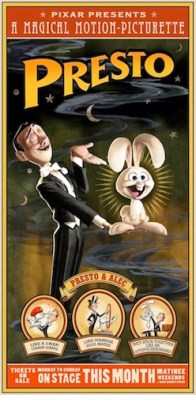
PrestoThe last Pixar film I bothered to head to the cinema for was 1999’s Toy Story 2, back in the days before “it’s made by Pixar” was reason enough to see a film (remember those times? They seem so long ago…) Their only other releases had been the first Toy Story (my enjoyment of which being the motivation to see the sequel) and the unappealing A Bug’s Life. Since then I haven’t had enough desire to expend the effort — or the money — to catch any of their films on the big screen. I explain this because, I’m reliably informed, all Pixar films are preceded by a short while in cinemas… but, because I’ve only seen most of them on DVD, I forgot this, so was initially surprised to see a caged rabbit when I was expecting an adorable little robot.

This rabbit, it turns out, is called Alec, and he’s a bit of a bastard. I think we’re supposed to root for him, and I’m sure kids (and many adults too) will, but while his owner (the titular magician) isn’t especially nice to our starring bunny (the plot is concerned with Alec trying to get a carrot that Presto won’t give him, yet), Presto doesn’t treat Alec quite as badly as Alec treats Presto. On the other hand, the overload of OTT physical violence is all in the name of humour, so that’s OK. It’s not as satirically extreme as The SimpsonsItchy & Scratchy though, which will ironically lead some to declare it promotes violence as comical. But then such ludicrousness is political correctness for you — in fact, Presto‘s brand of violence is very funny indeed. Completely dialogue free, it quickly becomes a breakneck feast of visual, mostly slapstick, humour. It may be violent, but it’s also highly witty, marvelously inventive, and wholly entertaining… even if the hero is morally dubious. But then, Roadrunner was a total wanker and he always won.

You can’t judge shorts on the same level as features, because they’re a different form — that’s why I don’t include them in the main numbering on this blog, and why I once felt the need to go on about that. So while awarding Presto a full five stars doesn’t mean it’s likely to be vying with The Dark Knight or… well, The Dark Knight… for my Film of the Year, it is thoroughly deserved. It’s a perfectly entertaining piece of short comedy, and it’s great that Pixar continues to facilitate wide exposure for such work.

5 out of 5

Ratatouille (2007)

2008 #13
Brad Bird | 106 mins | DVD | U / G

RatatouilleMy 2007 catch-up continues with Pixar’s highly-praised and award-winning latest, which currently sits as that animation studio’s highest entry in the IMDb Top 250 (their only films not to feature are A Bug’s Life, Monsters, Inc. and Cars). It seems a bit unfair to begin this review on such a downbeat note, but I personally don’t find such a position deserved. As is all too frequently the case, Ratatouille has become another victim of hype.

It’s been pretty impossible to avoid the praise that’s been heaped upon Ratatouille, be it unanimously positive reviews in papers, magazines and online, or overheard conversations in public, or the numerous high-profile awards it’s garnered (most recently, the best animation Oscar, plus a nomination for original screenplay). I was left expecting to be blown away by the best Pixar film made thus far. Sadly, this was not to be. It’s not as funny as Finding Nemo, or Toy Story, or Toy Story 2, or probably The Incredibles. Nor is it as cute as many of them. Or quite as heartwarming, to be honest. And the characters aren’t really as lovable.

OK, this is getting too depressing. The thing is, Ratatouille is a good film, but it is also a flawed one. It’s not nearly funny enough for a kid’s movie — laughs are almost non-existent in the first half and hard to come by in the second — and it’s too long, needing a good chunk taken out of that duller first half. It’s a bit confused as to who the villain is, meaning there’s a lack of real menace from either of the candidates. Despite a professed aim to make rats lovable, they’re not really. Even the potential love story is lacklustre because they wind up together far too quickly.

There I go again with the negatives. I think it’s far too easy to spot the faults in Ratatouille because everyone else has done such a thorough job on the positives, so I’m stuck analysing why I was so disappointed. There’s no denying how gorgeous it looks though — I can’t think of another CG film that even comes close. The level of detail is stunning, not just in set design (which includes whole intricately designed locations just for seconds-long sequences) but also in terms of what’s going on in the background. Check out Remy’s first conversation with his dad at the rats’ new home in Paris, for example: a simple shot-reverse-shot dialogue scene with two characters, but there’s continuously other rats talking, moving past, and so on in the background — all out of focus, not trying to be showy, like natural background detail in a live action film. No other CG film with such attention to ‘pointless’ detail comes to mind. But it also allows itself to be what it is — for want of a better word, a cartoon. Linguini waves his arms about like rope when he’s out of control, the chase sequences are madness, the design of the humans, cars, and almost everything else are suitably stylised. And it all comes with a soft warm glow that is, frankly, beautiful.

Despite my criticisms, Ratatouille is nonetheless a four-star film as far as I’m concerned. I also think that, with its shortage of laughs and cute characters, and with the main areas of appreciation in facets such as cinematography, it’s more a movie for adult animation fans than children. It’s not Pixar’s best, but true to form it’s head and shoulders above most other CG animated fare. Approach it with lower expectations than most reviews would give you and perhaps you’ll enjoy it even more than I did.

4 out of 5

Piglet’s Big Movie (2003)

2007 #129
Francis Glebas | 72 mins | TV | U / G

Piglet's Big MovieI used to enjoy the Disney Winnie the Pooh series when I was younger. I also used to love the original books by A.A. Milne. In fact, I still enjoy the books — they’re witty, knowingly written, and often sweet. Sadly, Disney’s interpretation seems to have faired less well.

In this case it’s largely down to the first half, where the mostly original storyline and weak & randomly inserted songs simply aren’t up to scratch. However, things improve massively with a couple of fairly straight adaptations of Milne’s original tales.

Mildly amusing at times and with a positive (if predictable) message about friendship and self-worth, this would undoubtedly entertain young children — which, to be fair, is its intended audience. While it initially seems to fall far short for older audiences, it turns out to be not all bad.

3 out of 5