
Tom Hooper | 158 mins | Blu-ray | 1.85:1 | UK & USA / English | 12 / PG-13
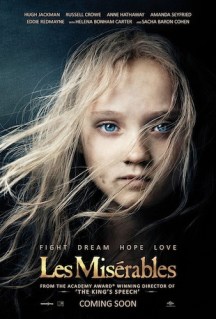 27 years after its West End debut, the long-running smash-hit musical finally makes the leap to the big screen. Such a beloved work paired with a recently Oscar-winning director and an all-star cast was pretty much a dead cert for big-name awards nominations, and so it was to be; but critical reaction was more mixed: I’ve seen people who love the film unreservedly, and others who despise it with a passion.
Let’s begin with the obvious: Les Mis* is a two-hour-forty-minute musical — some people are never going to be on board with that. “Why are they siiingiiiiing?!”, etc. Such complaints must be ignored. After that, more valid complaints do arise: the quality of said singing; the necessity of such length; whether said Oscar winning director is overrated and should he have won the Oscar in the first place; and so forth.
Les Mis is an epic tale: it spans decades, albeit in three distinct chunks. It begins when Jean Valjean (Hugh Jackman), freed from years of hard labour as punishment for stealing a loaf of bread, breaks his parole and disappears. Years later, we find him a wealthy man, manager of his own company and the mayor or something to boot. But his former prison guard, Javert (Russell Crowe), finds him too — oh no! Indebted to a young woman he wronged (Anne Hathaway), Valjean takes her child for a better life in Paris, where, more years later, they end up embroiled in one of the capital’s failed revolutions.
 Despite its running time, Les Mis is quite brisk for much of that plot (which, sorry if you’ve never seen it, I have described a fair old chunk of). There’s no interval in the film, but on stage it doesn’t come until well into the Paris section of the tale. Such a break must help the pacing, because while I remember enjoying it all on stage (where, I might add, it’s even longer), on screen I felt the middle portion began to drag. So yes, an epic running time for an epic, but it actually moves quickly through the parts that make it an epic before slowing for a bit of a forced romance and that kind of palaver.
I noted that it’s longer on stage, which is because here some songs have been trimmed. That’s partly for time, partly for re-staging (is it “hot as hell” in a spray-drenched dock pulling in wrecked galleons? No, apparently not), and partly to squeeze in a new song so it could get an Oscar nod. That’s Suddenly, which did get its awards nom but of course lost to Skyfall. It doesn’t fit too badly into the film, as it turns out, but in and of itself is a bit insipid. How much other trims bother you will depend on whether you’re a fan or not, of course. Some of the very best numbers are left to play in full, while tonally-awkward reprises (a comedy song after the climactic massacre) are cut back to literally a couple of lines.
 Much talk around Les Mis focused on the performances, with three in particular attracting discussion. As honourable wronged-man Valjean, Jackman is the star of the show, and brings his musical theatre background to bear on a clearly-sung but emotive performance. He was unlucky to be in the same awards year as Daniel Day-Lewis’ all-conquering turn in Lincoln, because otherwise those gongs might well have been his. Opposite him in the film’s central rivalry is driven letter-of-the-law lawman Javert, divisively sung by Crowe. I think the best criticism I read was that his vocal style seems at odds with the rest of the cast — whereas they’re musical theatre, he’s got a gruffer, perhaps rockier, tone. I didn’t think he was all that bad, a few moments aside, which I suppose is the advantage of hearing so much negativity in advance.
And then there’s Anne Hathaway, as much of a sure thing during awards season as Day-Lewis. To be honest, I think Jackman comes out of the film better. I can never quite escape Hathaway’s earnestness; a sense of, “look, I’m singing! And isn’t this role important and meaningful!” Her delivery of I Dreamed a Dream, so over-used in the film’s trailers, is pretty flawless, realised (if I remember rightly, which I might not) in a single shot, a soul-crushing close-up on her face. Otherwise, while she’s good really, I felt she’d stolen some of the attention that should be on Jackman.
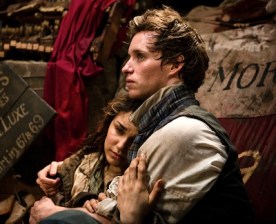 The rest of the cast is an assortment from the can-sing (Eddie Redmayne, Amanda Seyfried) to the comedic-so-it-doesn’t-matter (Sacha Baron Cohen, Helena Bonham Carter). The best voice of the lot belongs to Samantha Barks as Eponine. No surprise, really, as she was poached from the West End… where she’d found herself via one of Andrew Lloyd Webber’s BBC talent shows, so I imagine he feels thoroughly vindicated now (as if he didn’t before).
Famously, they’re all singing live. As a viewer, this is more appreciable as a technical accomplishment than something that makes any difference to what we see on screen. It brings some extra emotion (read: odd breathing points and half-achieved notes) at times, and a knowledge of authenticity always has a way of adding authenticity, but otherwise…
There was much surprise when Tom Hooper wasn’t rewarded with a Best Director nomination at the Oscars — much of it originating from within the Les Mis camp, I felt, whereas no one else was particularly fussed. Hooper has improved a bit as a director (finally, close-ups are framed properly!) but, to be honest, I don’t particularly rate him on the whole. For every good decision (going for a grimy real-world style rather than something typically musical-y) there’s an awkward one (the decision to represent Paris almost entirely with one slightly-stagey set). For every well-staged song (realising Lovely Ladies as a montage to show Fantine’s fall over time) there’s one that’s lacking (we don’t see any empty chairs at empty tables until the song’s half over).  Hooper does an above-average job on the whole, but the lack of awards nods shouldn’t be so surprising.
After so long on the stage, a film adaptation can feel redundant or insufferably inferior. Despite the negative reaction from some quarters, I think it’s fair to say the team behind Les Mis have managed to render something that is neither of those, even if I had a nagging feeling it could’ve been even better still.

* Why Americans insist on using a ‘zee’ there I don’t know — do they think it says “miss”? How do they say the word “miss”? “Misssss”? Anyway: ^
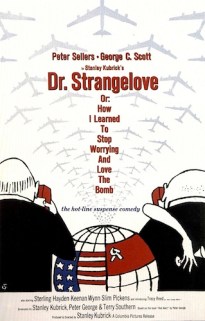 There are few things as weird (or, at least, weird in quite the same way) as watching an acclaimed and beloved classic film and… just not getting it. Here’s a paragon of moviemaking; a film that is not only exalted but, crucially, has remained in people’s affections against the forces of age; a thing that has truly stood the test of time… and yet… meh.
 In the end, I felt like I just didn’t get it. Not that I was watching something bad and I couldn’t fathom why so many people loved it, but that I just didn’t understand what it was I was meant to be seeing. Which is perhaps the same thing. I mean, I can see Kubrick was making an anti-war point at least as much as he was trying to make people laugh, but what do turgid sequences of people reading out numbers and flicking switches contribute to either of those aims? Perhaps the joke is meant to be in how long it goes on for? Like
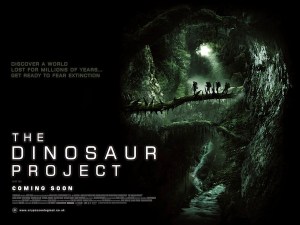 Found footage movies, eh? You either love them or hate them. Well, plenty of people hate them. I don’t mind them — it’s fast becoming an unoriginal idea (“existing genre + found footage = exciting new idea” is a sum that stopped working a couple of years ago), but if it’s done well, of course it still works.
 Essentially, then, it’s a cut-price
 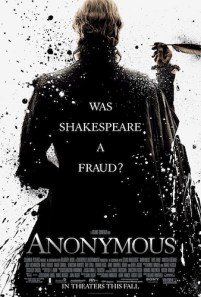 The director of
  which is what you should expect from the director of all those films I listed above but quite blatantly doesn’t sit right. And it’s over two hours long too, so it keeps going… and going…
 Some films benefit from knowing as little as possible going in; some are at their best when you know nothing at all. But that’s pretty much impossible — unless you go purely on someone’s “you’ll like this, trust me” recommendation about a film you’ve never even heard of, you’ll be aware of something. Normally this comes from a review or blurb, and you just have to trust that the reviewer or copywriter was kind enough to keep it spoiler-free.
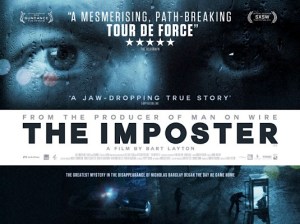
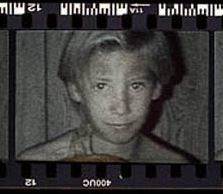 So here’s what the film lets you in on in the opening moments: in 1993, 13-year-old Nicholas Barclay went missing in Texas. In 1997, a boy claiming to be him surfaced… in Spain. He had Nicholas’ tattoos, but he had a French accent and the wrong colour eyes. And yet the first relative to see him, Nicholas’ older sister, gave a positive ID, and upon returning to America he was accepted into the family. Why did they take in such an obvious fraud?
 but, nonetheless, it makes the documentary itself feel untrustworthy, just like its participants. Is that an intended effect? Arguably the film’s main theme is lies — the lies we tell ourselves, the truths we want to believe; confirmation bias, perhaps, though that term is never mentioned — but the documentary itself never lies to us… I don’t think. It just feels like it might be.
 as the poster prominently tells us, this is “from the producer of
  Remember
 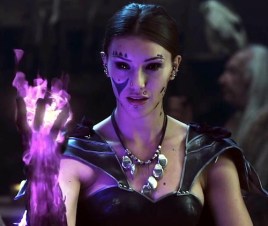 Director Gerry Lively helmed the preceding D&D movie and some stuff you’ve never heard of, as well as serving as DoP on such auspicious-sounding films as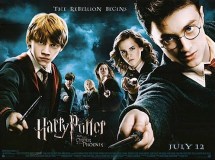


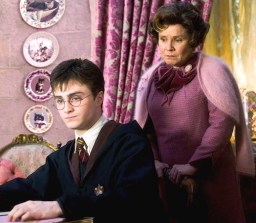 Their main weapon is Dolores Umbridge, perhaps the series’ most despicable villain, because she is so horrendously plausible. She seems to be all sweetness and light, but it masks a dangerous streak that sees her eliminate any fun from the school and, in one of the most sadistic sequences in either the novels or the films, she has Harry write lines with a magic quill that cuts each one into the skin of his left hand. The Potter series actually has its share of nuanced villains, but Umbridge is thoroughly unlikeable. Though she’s defeated and carted off at the end of Phoenix, she resurfaces in
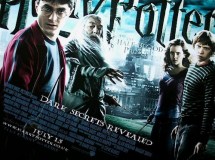
 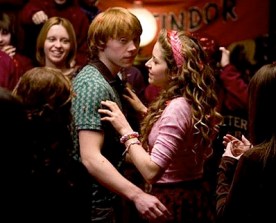 But not so. Yates approached his follow-up with a stated aim of introducing more comedy, believing the three leads to be talented in that area but not having had a chance to show it in his dour first film. So here we get a whole subplot given over to Ron’s attempts to join the Quidditch team, as well as much focus on the trio’s romantic entanglements — teenage love always being a good topic for humour. The film is not without its dark side, but peppered liberally throughout are those comedic subplots and scenes that are liable to see the viewer laugh perhaps more than in any other Potter film. It’s easy to miss this element — the main plot is, as always, getting darker and more serious — but once it’s been highlighted (as the makers do in the film’s special features) I think it becomes very noticeable.
 grading the film in perfectly-calibrated conditions so they can really push it to extremes, not considering how most end-users will view it; and, much like fast-cut action scenes, an over-familiarity with the material that means the director/editor/grader can see what’s going on because they’ve watched it dozens (or hundreds) of times, which doesn’t work for a first-time viewer in the middle of the film. As you may be able to guess, I’m not a fan.
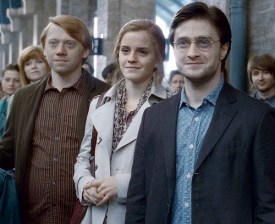 not a sudden smash-cut to a few decades on where we see how some characters’ lives have developed. I know some people complain about
 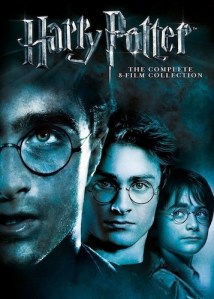 It’s hard to offer a final summary of the Harry Potter series. Some people see them as mediocre and overblown; for others, they are their life. Personally, I think they develop from sometimes-uncertain roots in the early films, to a flourishing series of epic fantasy movies. There are often niggles of one kind or another, be it acting (I forgot to discuss Emma Watson’s eyebrows!), or cartoonish designs, or too-faithful adaptation, or abbreviated adaptation, or what have you — but none of these are ever-present. More importantly, every film offers something to enjoy, and the growing maturity — of not only the cast, but also the filmmaking — means their impact only increases when viewed as an entire eight-film saga.
 The first Monty Python theatrical release (four more would follow; five if you count last year’s
  For my money, it becomes a bit tiring watching sketches for so long, even with the attempts made to link them together — it doesn’t form a narrative, so much as a series of casual crossovers that would make re-arrangement in an edit impossible. In and of themselves, however, many of the skits hit their mark.
 Reportedly the Pythons didn’t consider the film a success, hampered by interfering higher-ups and a ludicrously low budget (
 After
After 
 100Films.co.uk