
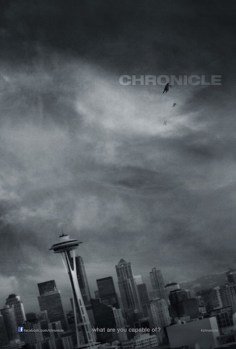
 The birth of the “found footage” sub-genre and the resurgence of the superhero movie began around the same time, the former with The Blair Witch Project in 1999 and the latter with X-Men in 2000. They both arguably came of age towards the end of the noughties, with the box office success of Paranormal Activity in 2009 and the start of the Marvel Cinematic Universe in 2008’s Iron Man. It was inevitable, really, that someone would eventually combine these coincidentally-linked post-millennial cinematic obsessions, and that someone was director Josh Trank, who became one of (if not the) youngest directors to open a movie in the #1 spot at the US box office with this, his debut feature.
The obvious route for a found-footage superhero movie is surely in the Kick-Ass/Super mould: a wannabe dressing up in a funny costume and setting out to fight crime, in the real world. Trank and screenwriter Max Landis have grander ambitions, however, setting their sights on characters who develop Superman-esque powers. It means the movie isn’t as low-budget and independently-produced as you might have expected (although clearly not high-budget, it’s full of special effects, and was released by 20th Century Fox), but it does retain a more subversive element — for one, that great responsibility doesn’t necessarily follow great power.
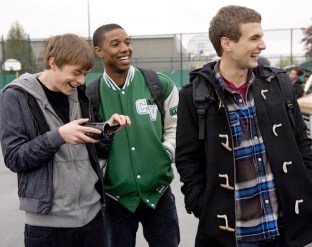 The story sees high school senior Andrew (Dane DeHaan) decide to start filming everything in his life, thanks to his borderline-abusive alcoholic father (Michael Kelly) and terminally ill mother (Bo Petersen). The same day (what a coincidence!), his cousin and only friend, Matt (Alex Russell), takes him to a party where, along with most-popular-kid-in-school Steve (Michael B. Jordan), they discover a hole in the woods with mysteries inside… Days later, all three begin to develop telekinetic powers, which they learn they can levy in various incredible ways — those ways being super, but largely without the heroic…
Which, in case you misread me, is not to say the boys become supervillains. Rather, they do what a lot of teenage lads would do: throw balls at each other with their mind; eat Pringles without having to pick up the can; use a leaf blower on a girl’s skirt; and so on. Using the found-footage style naturally, the friends experiment with their abilities, gradually increasing them, and bonding in the process. The story isn’t short of action or incident (some might disagree), but is equally character-focused, presenting individuals who are more rounded and believable people than your average superhero characters.
 This is even more pronounced in the extended version (“extended director’s cut” in the US), which includes over five minutes of extra bits that, in my opinion, make it a superior edit. Some are minor in impact, true, but there are a couple of short sequences with Andrew and Steve that deepen their relationship further, which enriches events at the end of act two. There’s also a moment that subtly prefigures the climax, and an extra bit in said finale that seems nigh-on essential to me. Considering the film still runs (just under) 90 minutes even with these additions, it’s difficult to see why they were cut in the first place. “Pace” is usually the rational for that, but if this is indeed a Director’s Cut then clearly Trank didn’t think they were an issue; equally, I can’t see why Fox would have objected. Still, they’re here to enjoy on Blu-ray…. though not on DVD… and I guess they’re not in TV screenings… Tsk.
Some accuse the film of being clichéd and predictable, which I don’t hold much truck with. It’s not twist-filled, but I felt the characters and their interactions grew naturally — if you can see where it’s going, it’s because it’s well-constructed, not because it’s how every movie does it. The time invested in growing our relationship with all three lead characters pays off increasingly as the movie rolls on, too, so that the climax is about more than just spectacle.
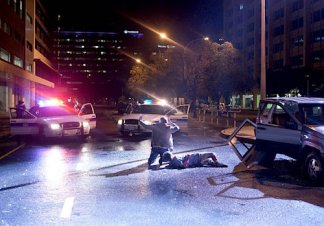 That said, spectacle it has. You wouldn’t expect that from a $12 million found-footage movie, but an epic duel through the streets of Seattle is one of the strongest climaxes to any superhero movie I can remember. It’s kind of like Man of Steel’s, only released a year earlier and executed a thousand times better (the lack of mass destruction and associated innocent-bystander massacre is a bonus). The finale is undoubtedly the high point of the film’s visual extravagance, but numerous other sections are striking too, not least thanks to Andrew’s mastery of controlling the camera with his mind, letting it float gently around as he films himself and others.
The qualities of the climax could be seen as a microcosm for the entire film, actually: a stylistic gimmick that works so well you forget many people consider it a gimmick; a scale grander than you might expect from both that gimmick and the movie’s budget; a largely-innovative treatment of a much-trod genre; and, similarly, characters who are multi-dimensional and better-realsied than your average, thanks both to Landis’ writing and a team of top-notch performances, particularly from DeHaan and Jordan — there’s a reason they’ve both gone on to bigger things.
 In the hands of many a desperate-to-get-noticed filmmaker, a found-footage superhero movie would likely have been a straight-to-DVD affair that could at best be described as “mediocre”. In Chronicle, however, Trank and co have crafted one of the best movies produced in either sub-genre. Most of the people involved — as well as the film they’ve all come from — can be classed as “one to watch”.

The network TV premiere of Chronicle is on Channel 4 tonight at 10pm.
It placed 6th on my list of The Ten Best Films I Saw For the First Time in 2014, which can be read in full here.
* Right: Chronicle was released in UK cinemas as a 12A, but with a couple of cuts for violence. On DVD/Blu-ray, it’s an uncut 15. Meanwhile, in the US, the theatrical version is PG-13, while the extended cut is technically Unrated. However, most of the additions are character scenes, so it’s surely still a PG-13. ^
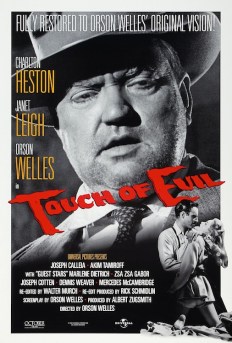 A bomb is stuck to the underside of a car. As the vehicle pulls away, the camera drifts up into the sky, and proceeds to follow the automobile through the streets of a small Mexican border town, until it crosses the border into the US… and explodes. It’s probably the most famous long take in film history, and probably the thing Touch of Evil is most widely known for; that, and it being one of the most commonly-cited points at which the classic film noir era comes to an end.
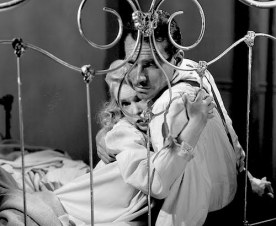 It’s like a terrible fever dream, with events and characters that sometimes seem disconnected, but nonetheless interweave through a dense plot. In this sense Welles puts us quite effectively in the shoes of Vargas and his wife — out of our depth, out of our comfort zone, out of control, struggling to keep up and keep afloat. It might be unpleasant if it wasn’t so engrossing.
 Quinlan at all… there is not the least spark of genius in him; if there does seem to be one, I’ve made a mistake.” You can get pretentious about it all you want, and bring to bear political views that the film doesn’t support (after all, within the film Quinlan is punished for his crimes and the “mediocre” (Truffaut’s word) moral hero triumphs), but sometimes a spade is a spade; sometimes a villain is a villain; sometimes your disgusting moral perspective isn’t being covertly supported by a film that seems to condemn it.
 Notably and obviously absent from that list is Touch of Evil. It was taken away from Welles during the editing process, and though he submitted an infamous 58-page memo of suggestions after seeing a later rough cut, only some were followed in the version ultimately released. Time has brought change, however, and there are now multiple versions of Touch of Evil for the viewer to choose from; but whereas history often resolves one version of a film to be the definitive article, it’s hard to know which that is in this case. Indeed, it’s so contentious that Masters of Cinema went so far as to include five versions on their 2011 Blu-ray (it would’ve been six, but Universal couldn’t/wouldn’t supply the final one in HD.) The version I chose to watch, dubbed the “Reconstructed Version”, tries to recreate Welles’ vision, using footage from the theatrical cut and a preview version discovered in the ’70s to follow his notes. Despite the best intentions of its creators, this can only ever be an attempt at restoring what Welles wanted. Equally, although it was the version originally released, the theatrical cut ignores many of the director’s wishes — so as neither version was finished by Welles, surely the one created by people trying to enact his wishes is preferable to the one assembled by people who only took his ideas on advisement?
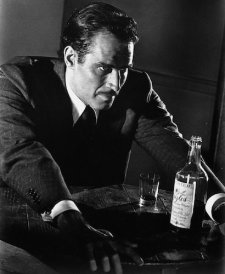 To quote from Master of Cinema’s booklet, “the familiar Wellesian framing appears in 1.37:1: indeed, the “world” of the film setting emerges with little or no empty space at the top and bottom of the frame, almost certainly beyond mere coincidence.” There are things to recommend the widescreen experience (“a more tightly-wound, claustrophobic atmosphere”), and undoubtedly the debate will continue… and such is the wonders of the modern film fan that, rather than having to make do with someone else’s decision on what to put out, all the alternatives are at our fingertips.
 The follow-up to 2009’s
  indeed, a band of outré ninjas are introduced almost as soon as our heroes, and they set off on an OTT plotline simultaneously. As the film wears on, it disappears further and further into fantasy; and not “version of our world” fantasy, but “kids’ Saturday morning cartoon” fantasy. The plot suggests the violence etc should be slightly toned down and the whole affair should have a PG, or even a U. Much like the first film, then.
 Elsewhere in that making-of, the guys from Hasbro talk about how they wanted to ensure the characters were distinct, not just Generic Soldiers. Failed that, then. It’s fortunate that most of the Joes are massacred because the only stand-outs are The Rock (because he’s The Rock), Channing Tatum (because he was in the first one), and Adrianne Palicki (because she’s the only girl). Even once D.J. Cotrona’s Flint (and I had to IMDb both of those names) is one of just three Joes left, his only distinguishing features are that he’s Not The Rock and Not The Girl. He is, to use a phrase borrowed from the Hasbro guys, a Generic Soldier. “Oops.”
 Ever since I read
  naturalistic to the point of being almost documentarian, with half-caught snatches of dialogue and sequences that seem trimmed to (almost) the relevant moments from much longer filming — still begs that you pay attention, but it seems this cut gives you more of a hand: it gets to the killing quicker (“63 vs 82 minutes”), a meeting with gangsters is “longer, more coherent and explicit”, and so on.
 The Killing of a Chinese Bookie is not a neat little thriller in any respect. As Tom Charity puts it (in the BFI booklet again), “if the scenario sounds generic, the film is something else”. It reminded me of Martin Scorsese’s
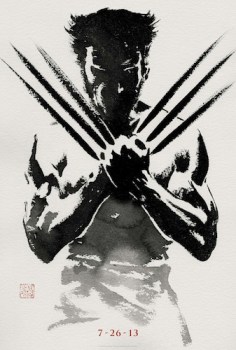 Rather than a sequel to the poorly-received
 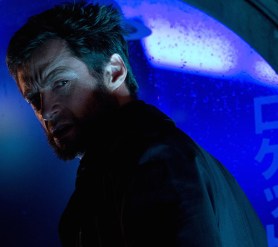 and the end result is a moderately unique movie. OK, it doesn’t ooze originality, but nor does it feel quite like your run-of-the-mill powered-people-punch-each-other comic book yarn.
 Talking of women, you can’t overlook Logan’s lost love, Famke Janssen’s Jean Grey. Considering the build-up pitched The Wolverine as a standalone film, with perhaps the occasional nod to the wider X-universe, including rumours of a Jean cameo, the final film is surprisingly tied-in to previous events: there’s actually loads of Jean (how? Well…), and Wolverine’s personal journey is very much grounded in the events of The Last Stand. I’m sure you could watch this without having seen or remembered a previous X-movie, because the bulk of the plot is indeed standalone, but the emotional journey is invested in what came before.
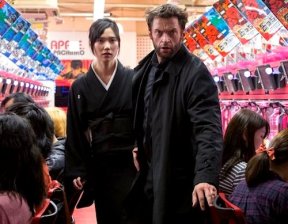 Without seeing all the behind-the-scenes goings-on it’s difficult to know whose fault this was, but it’s equally difficult to imagine the screenplay that Darren Aronofsky (far from your regular blockbuster director) described as “a terrific script” could have concluded this way; and knowing that his replacement, James Mangold, fiddled with the script before shooting commenced… well, draw your own conclusions.
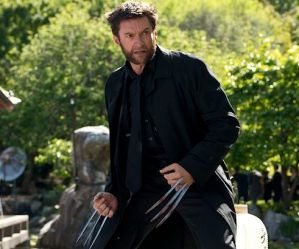 The Wolverine isn’t quite the movie it could have been; nor, I think, quite the one the makers hoped they were producing. Jackman has intimated since that it’s studio interference that pushes for silly-big action sequences and the like, but that fan feedback might slowly be winning them around to the things viewers actually care about. Whether that’s true or not, I guess we’ll see in the next instalment…
 Few would deny that Peter Jackson’s extended versions of
 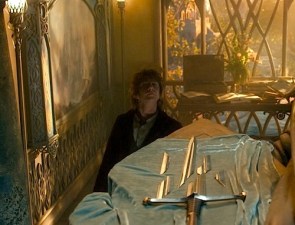 There’s not as much extra time with the dwarves as I expected, though, with most of the character time still going to Bilbo.
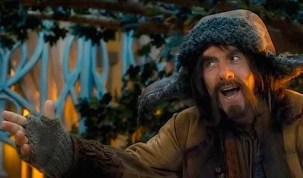 having to work alone on a green screen for many of his scenes with the smaller characters), but newcomers Martin Freeman, Richard Armitage and James Nesbitt shine too. This is Freeman’s film to be the centre of attention, but Armitage and Nesbitt will have much more to do in the follow-ups, and the groundwork is nicely laid here.
 Having heard only bad things, I expected a soul-crushing dud of
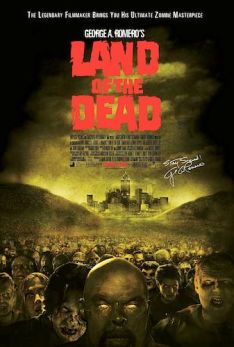 While the first three ‘Dead’ films (or “the original trilogy”, to put it in
 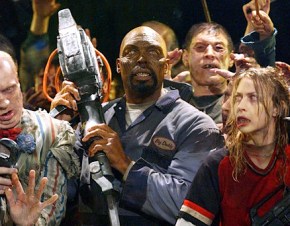 and then a desire for revenge, when he sees the glittering lights of the city in the distance. Lead he does, corralling the other zombies into a slow march towards their target.
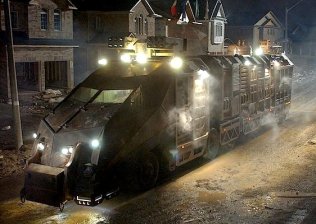
 In the world of the humans, meanwhile, we also have an oppressed majority: the slum dwellers. Attempts at revolution there are soundly ignored, with the rich quietly taking the opposition out as ‘trash’ whenever able (which, I guess, is whenever they want). The people are controlled by drink, drugs, gambling, prostitution, and any other cheap entertainment you can imagine, all secretly managed from on-high to keep the general populace docile. And those entertainments are getting increasingly extreme, too: the zombie-on-zombie cage fights previously used cat or dog meat as motivation, but now they throw in Asia Argento. Again, Romero is holding a mirror up to present-day America, where the illusion of a ‘free society’ with easy social mobility is supported by the mega-rich in order to keep the poor down. It takes the zombie invasion for anything to change, which may be a case of Romero “following the story” rather than reflecting a political reality — who’s going to invade the US?
 Those commenters that do acknowledge these facets claim Romero’s just not as subtle as he used to be, which is also poppycock: Dawn’s criticism of consumerism is as blatant as anything listed here — perhaps even more so, because you can just watch Land as a near-future science-fiction humans-vs-humans-vs-zombies action flick, whereas I think Dawn’s ‘subtext’ is unmissable.
 If you want to see people getting ripped apart by zombies with their guts spilling out everywhere, in traditional Romero style, then… seriously, what’s wrong with you people?! But, erm, you should be satiated.
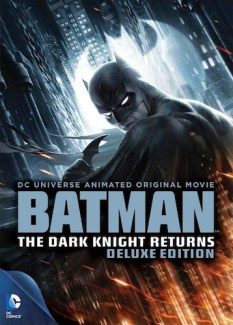 Warner Premiere’s $7 million animated adaptation of one of the seminal graphic novels is here rejigged from its original
 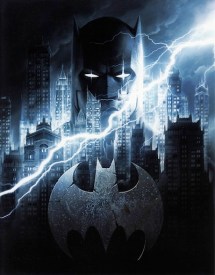 one of which is basically a climax before the halfway mark. Considering Miller’s original structure, that arguably leaves the film with a good three or four climaxes scattered throughout.
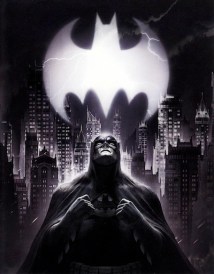 and a feature-length documentary all about the original graphic novel,
 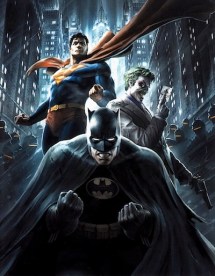 While I’ll continue to champion viewing the two halves of The Dark Knight Returns as separate movies, this single-film version is far from a travesty. If you’ve already got the separate releases, it definitely isn’t worth picking this up just for the film; so a purchase depends on how much value you place on the commentary and Masterpiece documentary (oh, and four art cards found in the box, which I’ve used to illustrate this review). If you don’t own the existing releases then whichever way works out as most cost-effective (bearing in mind which extras can be found where, of course) is the way to go.
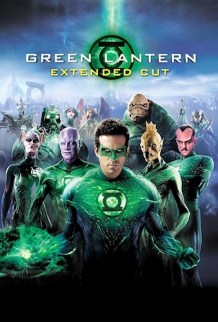 “Hype” has to be one of the biggest factors in how we view films these days. Technically it’s defined as “extravagant or intensive publicity”, I suppose thereby meaning something to “positive expectation”, but I think it also works the other way: if you’ve heard nothing but awful things about a film, its weakness has been ‘hyped’. It’s this latter point that applies to Green Lantern, which has an almost insurmountable degree of negative expectation attached. To summarise the headline points, it’s got a woeful rating of
 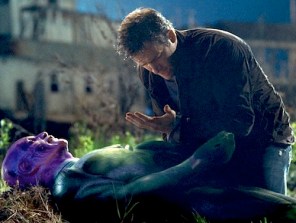 But I digress. Cocky jocky Hal is whisked off to the other side of the galaxy to learn how to be a Hero and use his ‘magic’ ring, which can conjure stuff up, then returns to Earth to save it from some menace(s). As superhero origin stories go, at least it’s got a couple of differences.
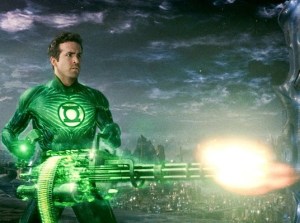 There are positives. The action sequences are good, which is a definite plus in this kind of film. The inventiveness with what the ring can do is fun. There’s a lack of relation to the sketchily-drawn characters that stands in the way of us truly engaging with them, and there’s a certain brevity and lack of scale that undersells the alleged threat to Earth (it’s a giant evil space-cloud that can barely cover a few city blocks, let alone the entire planet) — but, that aside, they’re entertaining enough. That said, much as the film pulls its punches with characterisation and threat, so it does with awe and spectacle. The Lanterns’ planet Oa doesn’t have the same impact as Asgard in
 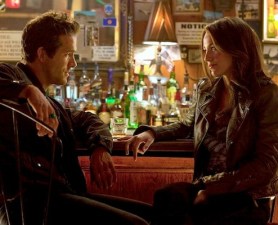 Indeed, I’d say the Extended Cut doesn’t go far enough, with some of the disc’s deleted scenes meriting inclusion. However, the main one occurs on Oa, meaning an effects-heavy scene that hasn’t had CG work done or all the voices recorded, so couldn’t just be dropped back into the finished film as-is. I imagine that’s why it wasn’t. That said, even if they’d done such work, those scenes are minor points, not game-changers.
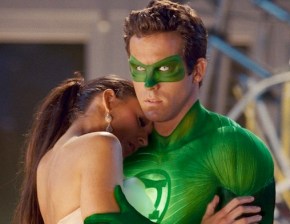 Still, I think there’s a better film lurking in Green Lantern, and it’s a shame it didn’t get the screenwriter(s) or director(s) required to bring it out. It’s even more of a shame that worse films than this have received a kinder critical consensus or huge box office. That leaves some suit feeling vindicated and churning out the same rubbish again, whereas with a bit more effort Green Lantern 2 could’ve been worthwhile.
 100Films.co.uk