
James Ivory | 112 mins | download | PG
 I can’t help but wonder if, back in 1985, there was any audience confusion between A Room with a View and A View to a Kill. One can imagine legions of Bond fans accidentally finding themselves with a witty heritage drama, and legions of old dears accidentally finding themselves with a man twice their age trying to be an action hero. (In actuality the films were released about a year apart — that being just one reason this is a particularly silly notion.)
Putting aside such nonexistent confusion, what of that witty heritage drama? Once again, thanks to the adaptations module of my degree, I’m stuck watching a film straight after reading the novel it’s based on. So far these viewings have supported my long-held theory that reading any novel before watching the film version (especially immediately before) is a Very Bad Idea. However good A Room with a View may be — and it certainly has its share of positives — it still pales slightly in direct comparison to the novel.
The film’s faithfulness is admirable at least, combining events effectively at times and at others leaving well alone. Unfortunately this “copying out” style of adaptation means that the dialogue is exactly as written but sometimes loses important elements through its abbreviation. In the novel, characters frequently mean something entirely different to what they say, but you wouldn’t guess so in the film. Similarly, a lot of the novel’s wittiness is lost — unsurprising, as much is carried in Forster’s narration, which here is largely left unadapted. “Largely”, because chapter names occasionally intrude as intertitles or subtitles. These usually merely skip what would be a few lines of expositional dialogue, but occasionally they’re entirely pointless, and frequently are rendered meaningless by what would otherwise be minor tweaks to the plot. As I suggested at the start, however, a lot of these flaws are only blatant when placed in stark contrast with the novel.
Others aren’t. Julian Sands is disappointingly flat as love interest George Emerson, and he frequently drags Helena Bonham Carter down with him (and not in the “written by Andrew Davies” sense). In my opinion, Bonham Carter is the weak line in an otherwise flawless cast, neither acting nor looking much like my image of Lucy (Sands might not give much of a performance, but at least he looks the part, and Emerson is meant to be quite awkward). This could well be just my personal vision clashing with that of the filmmakers, of course, but there you have it. Those two aside, the rest of the cast are excellent: Maggie Smith and Judi Dench are note-perfect, especially in the handful of scenes they share (it’s a real shame Dench’s character disappears before the halfway mark); Daniel Day-Lewis is the right mix of comical, annoying and unfortunate truth as Cecil; and Simon Callow, Denholm Elliott and a young Rupert Graves are also perfect fits for their roles.
Finally, no Room with a review (ho ho) can be complete without praising how gorgeous Italy looks here. The camera lingers on the art and architecture more like a documentary than a fiction film, taking the viewer on a sightseeing tour just as much as the characters. There are essays to be written (indeed, they have been) on why such spectacle is a bad thing, but if you don’t want to be so pretentious then it’s wonderful to look at. Which, in many ways, sums up the entire film.

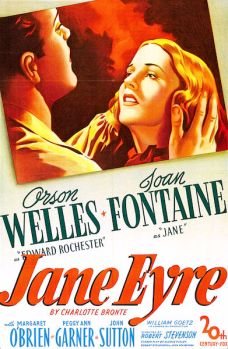 I was meant to read Jane Eyre in the first year of my degree, but, given a week to attempt what seemed a positively enormous tome (I partly blame the edition) and a coinciding essay deadline, I didn’t even attempt it. Instead I settled for a friend summarising it for me — I tuned out halfway through the very long retelling due to boredom, though whether that was the fault of the novel or its summariser I still don’t know. I finally got through Jane Eyre the year before last — not the novel, though, but the BBC’s apparently-definitive adaptation (has it been that long already!), following numerous extremely positive reviews at the time. That was good — because or in spite of the novel, I do not know.
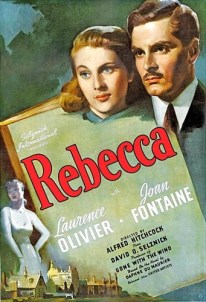 I must confess that I don’t think I’ve come to Rebecca under the best circumstances for judging it as a film in its own right. As with last week’s
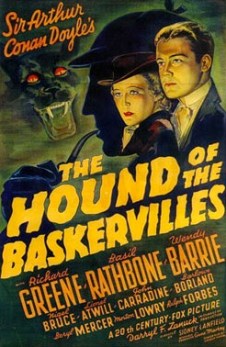 Arguably the definitive screen interpretation of Sherlock Holmes and Dr Watson, played by Basil Rathbone and Nigel Bruce, appear for the very first time here, in what would become the first in a series of 14 pictures starring the pair. (Incidentally, this will be the first in an irregular set of reviews of that series. I have the rather lovely Optimum box set, you see, and so shall slowly work my way through it. Though as I’ve already owned it for several years and only just started watching it (as with so many DVDs), I have no idea how long it will be before I finish.)
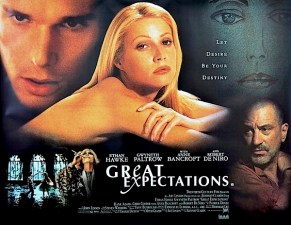 After re-enjoying the classic David Lean version of Great Expectations (which I
 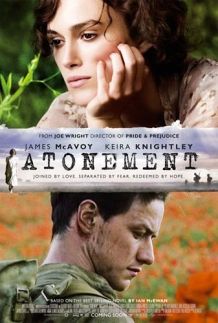 “The Most Nominated Film of the Year” proudly proclaims a sticker on the cover of Atonement’s newly released DVD. Well, not quite: according to
  A star-studded cast and the director of
  Documentary, based on the best-selling acclaimed book by Peter Biskind, about the decade in Hollywood between the death and effective re-birth of the studio system.
 I used to enjoy the
 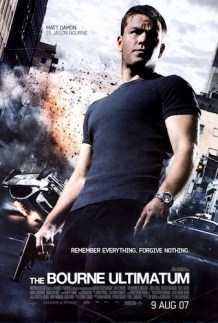 This final instalment in the action-thriller trilogy was recently announced as Empire magazine’s film of the year, following wide praise on release that dubbed it the best action movie in a long time. Unfortunately, I fear it may’ve become a victim of its own hype.
 100Films.co.uk