2018 #187
David Lynch | 124 mins | Blu-ray | 2.35:1 | USA & UK / English | PG / PG
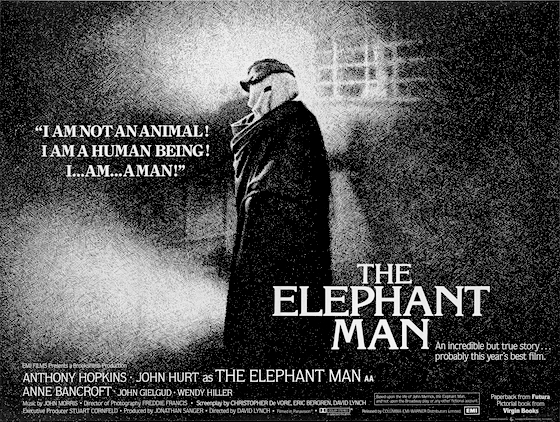
This biopic of Joseph Merrick — better known as ‘the Elephant Man’, a Victorian circus sideshow ‘freak’ who became a star of London society during his stay at the London Hospital — is noteworthy not only for its documentation of a key figure in Victorian life, who perhaps transformed people’s views of what it meant to be human, but also because it’s a film directed by David Lynch.
The Elephant Man is sometimes placed alongside Dune and The Straight Story as anomalies in Lynch’s filmography, which is more often characterised for its horror-inducing oddness and sometimes-incomprehensible plotting. Of course, upon proper examination, all three of these movies exhibit Lynchian touches, perhaps none more so than The Elephant Man. It’s there in the avant-garde opening; the dream sequence; the sound design, for which he’s co-credited; the focus on industrial machinery. The film can certainly be read as a Victorian melodrama, but in execution it’s far from a Merchant Ivory movie.
It’s also a very human and humane film, perhaps more so than you might expect from Lynch. But then again, look to The Straight Story, which in my review I described as “understatedly human and kind of heartwarming”; or Fire Walk with Me, which is about exposing the tragic injustices inflicted upon Laura Palmer. He may not come at it from the most obvious angles, but I think Lynch is consistently a compassionate filmmaker. Indeed, some critics even accused the film of “excessive sentiment”, probably due to being partly based on the memoirs of Merrick’s friend and physician, Frederick Treves. I disagree because, even if it is pretty sentimental, I think it hits the sweet spot — the point is that we should care.
A significant boost to our emotional connection is the absolutely superb performances from Anthony Hopkins as Treves and John Hurt as Merrick. The latter earnt a BAFTA win and an Oscar nomination (losing to Robert De Niro in Raging Bull) in what became a truly iconic performance, but it’s a wonder Hopkins wasn’t similarly recognised. One of the themes the film tackles is the dichotomy of Treves being Merrick’s friend but also, to an extent, exploiting him to further his career, and finding the truth in that balance is down to Hopkins. They also both contribute enormously to the graceful beauty found throughout the film, not least in close-ups where a single tear can convey so much complex emotion, or the understated but moving final scene.
So too the gorgeous black-and-white photography by Freddie Francis. As Tom Huddleston writes in his essay accompanying the film’s StudioCanal Blu-ray releases, “imagine the film in colour, how fleshy and grotesque the makeup would have appeared, how gaudy and nauseating the carnival sequences.” It doesn’t bear thinking about. Instead, the monochrome visuals mix “gothic horror with documentary realism, lush drawing-room drama with mist-shrouded flights of fantasy”, to create a film that feels realist and historical, but also timeless and fantastical.
The Elephant Man is on BBC One tonight at 10:30pm (11pm in Scotland).
2020 #88
Sam Hargrave | 116 mins | streaming (UHD) | 2.35:1 | USA / English, Hindi & Bengali | 18 / R
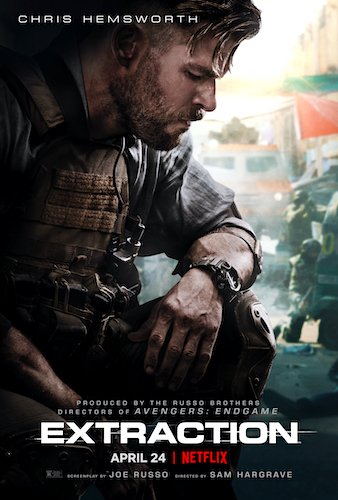
Chris “Thor” Hemsworth stars in this action-thriller masterminded by the Russo brothers (directors of Avengers: Infinity War and Endgame) and directed by Sam Hargrave, who has dozens of stunt coordinating credits to his name, including threeHungerGames, Atomic Blonde, and work on six Marvel Studios movies. But don’t take all those MCU connections to heart — this is not a Marvel-style PG-13 action-comedy. Oh no.
We first meet mercenary Tyler Rake (Hemsworth) engaged in a gunfight on a bridge. He’s covered in wounds, spitting up blood, looks like he’s about to die. Cut to two days earlier! No, really, it’s one of those openings. They just won’t bloody die. Never mind “skip titles” or “watch credits”, Netflix needs to add a “skip pointless in media res prologue” button. It would improve almost any film/TV episode where it was featured.
Anyway, two days earlier we’re introduced to Ovi (Rudhraksh Jaiswal). Just an ordinary, well-to-do schoolboy in India… except his dad’s an imprisoned drug kingpin, and when Ovi slips out to a club one evening he’s kidnapped by goons from the competition, run by the thoroughly ruthless Amir Asif (Priyanshu Painyuli). With daddy behind bars, it falls to Saju (Randeep Hooda) to get the kid back, for which he hires some organisation, I guess — the film is incredibly light on specifics here. Basically, it involves Nik (Golshifteh Farahani) sending in Mr Rake and a support team to extract the kid. Naturally the mission goes sideways, leaving it up to Rake alone to get Ovi and himself out of a city crawling with henchman and corrupt cops who are all out to get them.
Of course, Rake has issues in his backstory, and rescuing the kid becomes more than just a job, etc, etc. The “Man on Fire Lite” plot is as predictable as this sentence ending with a simile. When David Harbour turns up halfway through as an old mate of Rake’s who lives in the city and agrees to help him out, I’ll be surprised if you can’t guess what inevitably happens a couple of scenes later. Though it is amusingly bold of the film to try to make us believe David “dad bod” Harbour could hold his own in a fight against Chris “literally a Norse God” Hemsworth.
That minor brawl aside, the action sequences are great, more than making up for the lightweight plot mechanics. Letting stunt coordinators move into full-on directing has been the saviour of the action movie genre in recent years, working wonders for the JohnWickseries in particular, but also several other movies that have followed suit. Hargrave is the latest to suggest he might have a bright career ahead of him on the basis of his ability to stage electrifyingly choreographed combat scenes. The action is fast and hard-hitting; not unnecessarily horror-movie gory like it was in fellow Netflix actioner 6 Underground, but certainly not PG-13 material either. Clearly Netflix don’t force the makers of their expensive movies to hit that PG-13, presumably tied to not having to worry about box office takings. One advantage of going direct to streaming.
The highlight of the film is undoubtedly an already-much-discussed 11½-minute single-take action sequence. We’ve seen plenty of these trick shots in the past few years (Atomic Blonde and, obviously, 1917 particularly come to mind), but Extraction offers another belter. It starts as a full-blown car chase, which transitions into a game of cat-and-mouse around a warren-like apartment block, then tumbles into a mano-a-mano knife duel on a busy street, before ending in a second car chase. Obviously there are myriad hidden cuts in there, but that’s almost beside the point: it’s not physically doing it in one long shot that’s impressive, it’s the design and choreography and planning and execution to make it feel like one. It pays off handsomely.
You wonder if Netflix might look to turn Extraction into a franchise — in many non-English-speaking countries it’s been titled Tyler Rake, which might suggest that’s what they’re thinking. But then, they could’ve retitled it that in English if they wanted, so maybe not. It’s not the most sophisticated thriller ever made, and it doesn’t reach the giddy heights of John Wick in the action department, but it’s nonetheless entertaining at what it sets out to achieve. If they do decide to make more, I’ll definitely be there.
Also Known As: Chapeau melon et bottes de cuir (France — Bowler Hat and Leather Boots) Mit Schirm, Charme und Melone (Germany — With Umbrella, Charm and Bowler Hat)
Country: USA Language: English Runtime: 89 minutes BBFC: 12 MPAA: PG-13
Original Release: 13th August 1998 (Israel) UK Release: 14th August 1998 Budget: $60 million Worldwide Gross: $48.6 million
Based on The Avengers, a ’60s British TV series created by Sydney Newman.
The Story
After the UK’s weather control project is destroyed, apparently by one of its own scientists, Ministry agent John Steed is assigned to investigate. Teaming up with that scientist, Mrs Emma Peel, they uncover a plot to hold the world’s governments to ransom…
Our Heroes
Extraordinary crimes against the people and the state must be avenged by agents extraordinary: John Steed: traditional, stylish, reserved, lethal. Emma Peel: doctor, atomic scientist, poet, meteorologist, physicist, marksman.
Our Villain
A former agent of the Ministry, Sir August de Wynter is now head of BROLLY, the British Royal Organization for Lasting Liquid Years, who have developed the technology to control the weather and now seek to put it to nefarious ends.
Best Supporting Character
Machine-gun firing granny Alice. Eileen Atkins was offered the role of the Ministry’s deputy leader, Father, but thought the part of Alice sounded more fun, so they re-wrote to enlarge it for her.
Memorable Quote
“Now is the winter of your discontent!” — Sir August de Wynter
Memorable Scene
Instructed to meet Steed at his gentleman’s club, Mrs Peel waltzes into the place, despite the objections of the receptionist. She marches through the building, shocking the patrons, until she finds Steed in the steam room — naked but for the newspaper he’s reading. “Please, don’t get up.” “I was about to throw in the towel.”
Memorable Music
Michael Kamen was originally hired to score the film, but eventually quit after being constantly given revised cuts of the movie to work with. His replacement, Joel McNeely, had to turn something round in short notice, and I’ve seen his score described as clearly rushed, dull and uninspired. But at least the TV series’ classic theme is in there, and fairly well used — once right at the start (although there’s an ever-so-’90s X-Files-y number over the main credits), and then again perfectly as a farewell over the final scene. Rumour has it Kamen’s score was darker and more atmospheric, with a greater and more interesting use of the original theme. Given the general disregard for the movie, I don’t imagine it’ll ever be unearthed for us to find out for ourselves.
Letting the Side Down
The teddy-bear meeting, where the participants are kept anonymous by wearing giant teddy-bear costumes. It’s an attempt at emulating the whimsy of the TV series, but an empty one — as the series’ regular writer Brian Clemens once commented, if the plot’s about controlling the weather then the meeting should’ve been weather-themed somehow.
Some people would say there’s a lot more wrong with the film than just that one scene, but there’s more to it than that…
Making of
When Warner Bros execs saw the first cut of the movie, it was not what they were expecting. I don’t know what they were expecting, but I guess not something so tongue-in-cheek, whimsical, and camp. Apparently the first test screening in Phoenix, Arizona, was to a “largely Spanish-speaking, working class” audience — hardly the film’s target market, and unsurprisingly they hated it. The studio forced cuts and reshoots, taking the movie from 115 minutes to a sprightly 89, sacrificing plot coherence for the sake of speed. And so a true disaster was born.
Previously on…
This is a reboot rather than continuation of the original TV series — it shows how Steed and Mrs Peel met for the first time. I don’t know if the TV series actually covered that (I really should watch it all one of these days), but I don’t imagine it went like this.
Next time… The Avengers ultimately became a massively successful multi-film franchise under the auspices of Marvel Studios. Oh, no, wait, that’s some other thing. No, after suffering atrocious reviews (it’s sometimes cited as one of the worst movies of all time), the ’98 Avengers slinked off into relative obscurity (it’s probably better remembered here than in the US thanks to the TV series connection, but Marvel’s super-friends are gradually replacing it in the consciousness, sadly). Still, the world of the TV series lives on in occasional comic books and audio dramas.
Awards
1 Razzie (Worst Remake or Sequel (tied with Godzilla and Psycho))
8 Razzie nominations (Worst Picture, Actor (Ralph Fiennes), Actress (Uma Thurman), Screen Couple (Fiennes & Thurman), Supporting Actor (Sean Connery), Director, Screenplay, Original Song (Storm by Grace Jones))
Verdict
I was one of the half-dozen people who actually saw The Avengers at the cinema in 1998. I don’t remember disliking it, but then I was all of 12 so what would I have known? Its poor reputation has only grown in the intervening decades, so I wasn’t expecting to think much of it as a more critically sophisticated adult. But, much to my surprise, I kind of loved it.
I guess in ’98 people were expecting some kind of serious-minded thriller, probably in the Bond mould — this was just after GoldenEye and Tomorrow Never Dies had relaunched that series to much acclaim and box office success, of course, and The Avengers was another hallmark of ’60s British spy-fi. But The Avengers and Bond were never the same tonally, and the film embraces the mannered, quirky tone of the TV series, then turns it up to eleven. Personally I think it’s a tonne of fun, with arch performances, ripe dialogue, and a deliciously camp air.
If it wasn’t for WB’s post-production fiddling, which has left the plot feeling a bit janky and spasmodic, I reckon this would be a cult classic by now. They really ought to have a bad reputation for that kind of fiddling at this point — Batman Forever, Suicide Squad, and Justice League come to mind. But never mind the Snyder cut, I want them to #ReleaseTheChechikCut. Sadly, it’ll never happen.
If everything had gone according to plan, this weekend Americans would’ve been flocking to cinemas to see Daniel Craig’s final performance as Bond, James Bond, secret agent 007, in No Time to Die (us Brits would’ve all been to see it last weekend, of course). As that’s not to be, here’s something both entirely similar and entirely different: my reviews of Sean Connery’s final performance in the role — both of them.
This concludes my coverage of Connery’s time as Bond, the previous instalment of which I posted in, er, 2013. (And you thought No Time to Die had a long delay.) That covered his first stint as James Bond — the five films he starred in from 1962 to 1967. Now, here are his two remaining performances:
Neither of these films is Connery’s finest hour as Bond — they’re his worst hours, in fact — but, I must say, they were both better than I had remembered.
Based on
An original James Bond story by Kevin McClory, Jack Whittingham and Ian Fleming, which Fleming later novelised as Thunderball.
The Story
Ageing secret agent James Bond is sent to a health spa to get back into shape, but therein stumbles upon part a plot to hijack nuclear warheads and hold the world to ransom. With the theft successful, it falls to Bond to retrieve the weapons before it’s too late.
Our Hero
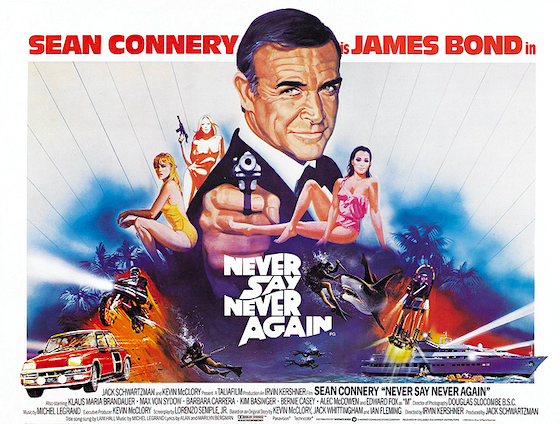
Bond, James Bond, British secret agent 007. He’s played by Sean Connery — already the first and third actor to play James Bond on the big screen (in a serious movie), here he becomes the fifth too. Unlike the official Bond films, which carried on regardless as Roger Moore began to look more like an OAP than a capable secret agent, Never Say Never Again acknowledges that Bond is getting on a bit. That’s because Connery was 53 at the time, and this is from back in the days when 53 was old, especially for an action star — not like today.
Our Villains
Billionaire businessman Maximilian Largo is actually the highest-ranking agent of SPECTRE, a global criminal organisation masterminded by Ernst Stavro Blofeld. With Blofeld merely pulling the strings behind the scenes, it’s Largo and his lackeys that Bond must defeat to save the world.
Best Supporting Character
Rowan Atkinson’s cameo-sized role as inexperienced local bureaucrat Nigel Small-Fawcett is actually quite amusing, and therefore probably the best thing about the film.
Memorable Quote
Largo: “Do you lose as gracefully as you win?”
Bond: “I don’t know, I’ve never lost.”
Memorable Scene
At a charity event hosted by Largo, Bond comes face-to-face with his adversary for the first time, where he’s challenged to play Domination, a 3D computer game. It couldn’t be more ’80s if it tried.
Memorable Music
James Bond films have a very distinct musical style… but not when they’re unofficial productions they don’t. Without access to familiar themes, Never Say Never Again finds itself having to reach for something different… and fails: the title song is bland and the jazzy score is forgettable.
Letting the Side Down
Where to begin? Well, let’s pick on perhaps my least favourite bit of the whole endeavour: henchwoman Fatima Blush; and, more specifically, how the film ends up handling her. First, there’s a truly terrible sex scene between her and Bond, but it only gets worse later: the self-espoused feminist becomes monomaniacally concerned that Bond should think she’s the greatest shag he ever had, which distracts her to the point that he gets the opportunity to kill her… which he does with an explosive bullet that just leaves her smoking high heels behind. No, seriously. And for this performance Barbara Carrera received a Golden Globe nomination! If you told me she’d been nominated for an award and asked me to guess which, I’d’ve been certain it was a Razzie.
Making of
“So how did an unofficial James Bond film come about anyway?,” I hear you ask. Well, the story starts in the early ’60s, after the Bond novels had become popular but before the film series began. Creator Ian Fleming worked with independent producer Kevin McClory and screenwriter Jack Whittingham on a script for a potential Bond film titled Longitude 78 West, but this was abandoned due to costs. Fleming then adapted the screenplay into a Bond novel, Thunderball, but without credit for either McClory or Whittingham. McClory sued for breach of copyright, and the matter was settled by Fleming giving McClory all rights to the screenplay. By this time the official Bond film series was underway, and Eon Productions made a deal for McClory to coproduce their adaptation of Thunderball, an agreement which forbade him from making any further films of the novel for another decade. That lands us in the mid-’70s, when Bond was still very popular. As McClory began attempting to get a new adaptation off the ground, Eon put legal obstacles in his path, accusing his new script of breaking copyright restrictions by going beyond the confines of Thunderball. Eventually McClory and other producers managed to clear these hurdles and, after rewrites to make Connery happy (which were undertaken by British TV writers Dick Clement and Ian La Frenais, who went uncredited due to Writers Guild of America restrictions, despite much of the final script being their work), the remake finally went before the cameras — with a new title, suggested by Connery’s wife, referring to his vow that he would “never” play Bond again.
Previously on…
James Bond had starred in 13 official movies by the time this came along. It’s kind of ironic that Never Say Never Again’s unofficial status means it can’t acknowledge any of that, while also tacitly acknowledging it with Connery’s very presence in the lead role. Though if it had been able to acknowledge it, the fact this film is a straight-up remake of Thunderball might’ve led to some awkwardness.
Next time…
Early in 1984, producer Kevin McClory announced a sequel, S.P.E.C.T.R.E. It never happened. He spent most of the rest of his life trying to pursue further James Bond projects: he tried to remake the same story again in 1989 as Atomic Warfare starring Pierce Brosnan, and again in the early ’90s as Warhead 2000 AD starring Timothy Dalton. In 1997 he sold the rights to Sony, who already held the rights to Casino Royale and hoped to use that to launch its own Bond series. MGM sued and the matter was settled out of court, with Sony giving up all claims on Bond. (Perhaps this explains why Sony have been so keen on acquiring/retaining the series’ distribution rights in recent decades.) And so we’re left with just one James Bond series, which has mostly gone from strength to strength.
Awards
1 Golden Globes nomination (Supporting Actress (Barbara Carrera))
2 Saturn Award nominations (Fantasy Film, Special Effects)
Verdict
Between this and the state of the official Moore-starring films at the time, it must’ve sucked to be a Bond fan in the early- to mid-’80s. Maybe some thought Connery returning to the role he’d defined would be a boon, but it didn’t turn out that way: in just about every respect, Never Say Never Again plays like a weak imitation of a Bond film… which I suppose is exactly what it is, really.
As an unofficial production, it’s missing a bunch of the identifying features of the Bond films: the gun barrel, the title sequence, the musical stylings, and, most conspicuously, the famous theme. There’s more to Bond than these tropes, of course, and a really good Bond movie can survive without them, but their absence contributes to the feel of this being a low-rent wannabe, when it needs all the help it can get. The stuff it can include isn’t great either. The one-liners and innuendos are particularly bad. The action is rather dated (although the chase between a souped-up Q-bike and the henchwoman’s tacky little ‘80s car is more exciting than the notoriously underpowered car chase in Spectre, which says more about Spectre than Never Say Never Again). Then there’s the sex scene I mentioned above.
One critic retrospectively described the film as “successful only as a portrait of an over-the-hill superhero,” which is true… up to a point. I mean, most of the stuff about Bond being past his best seems designed to explain Connery’s grey hair and lined face — Bond is still irresistible to literally every woman he meets, and has no problem at all doing any of the action stuff. Connery’s performance isn’t bad either, although it didn’t quite feel like Bond to me. I’m not sure why. It’s not that he seems bored or like he’s only going through the motions (a sensation that definitely comes across in some of his original performances as the character), but he no longer seems to have quite the panache you expect from 007.
And yet, for all that, it’s not as irredeemably terrible as I’d remembered. For all the glaring faults, it actually ticks along with a decent level of entertainment value. So is it, in fact, unfairly maligned? It’s nowhere near the best of Bond, but it doesn’t descend into outright silliness like some of the official ones do (well, apart from those smoking shoes), and it even has a couple of pretty good bits. It would definitely be a lesser Bond — if it counted, which it doesn’t — but, as a couple of hours of off-brand Bondian fun, it could actually be a lot worse.
Based on Diamonds Are Forever, the fourth James Bond novel by Ian Fleming.
The Story
After finally assassinating his nemesis, Blofeld, Bond is assigned to investigate a diamond smuggling operation in Holland, but following the trail leads him to the glitz of Las Vegas — and a familiar foe.
Our Hero
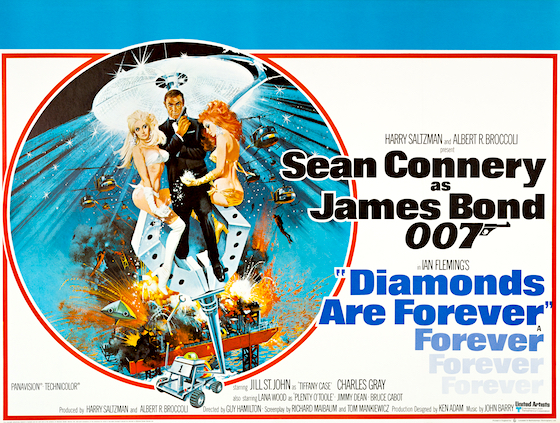
Bond, James Bond, agent 007 of the British secret service. He may be looking a little older than when we last saw him, but he’s still capable of wooing all the ladies and scaling the outside of skyscrapers.
Our Villains
We so much focus on the Dr Nos and Auric Goldfingers of the early Bond films — plus the ever-changing roster of villains he’d face in later movies — that it’s easy to forget Blofeld has a presence in almost every Bond movie before Diamonds Are Forever (indeed, Dr. No (which only mentions SPECTRE) and Goldfinger (which has no ties whatsoever) are the only exceptions), so it’s no real surprise that he’s not just confined to the pre-titles here. It certainly wouldn’t have been to audiences in 1971, either: he’s prominent in the trailer, and Charles Gray is rather highly billed for someone who’s only in the opening minutes. That said, Lana Wood is fourth billed and she only has about three scenes, so… Until he’s properly revealed, however, we have overtly homosexual assassins Mr Wint and Mr Kidd to tide us over. Considering they’re shown as creepy and murderous, it’s hardly an enlightened portrayal of homosexuality; but then it is from 1971, so what do you expect?
Best Supporting Character
Tiffany Case is Bond’s way in to the diamond smuggling operation. She’s a self-assured and capable woman… for about the first half of the film, before she sharply descends into a stereotypical Bond Girl bimbo. Oh well, they tried.
Memorable Quote
“That’s quite a nice little nothing you’re almost wearing. I approve.” — James Bond
Memorable Scene
Bond travels to Amsterdam under the identity of a diamond smuggler they’ve captured, but when he escapes and to Amsterdam too, Bond must intercept the chap before his cover’s blown — which he does in a small lift, leading to a brutal close-quarters brawl that’s almost as good as the famous train carriage one in From Russia with Love.
Write the Theme Tune…
One of the most famous of the Bond title tracks, its music was written by the film’s — and, by this point, the series’ incumbent — composer, John Barry. It was his fifth Bond theme song (seventh if you include Mr. Kiss Kiss, Bang Bang and We Have All the Time in the World). The lyrics were by Don Black, returning for his second theme after Thunderball.
Sing the Theme Tune…
This is also the second Bond theme for singer Shirley Bassey, after (of course) Goldfinger. Apparently co-producer Harry Saltzman hated the song, objecting to the innuendo in the lyrics, and it was only saved by his fellow producer, Cubby Broccoli. That said, Saltzman may have had a point: in a later interview, Barry revealed that he instructed Bassey to imagine she was singing about… a penis. “They are all I need to please me / They can stimulate and tease me … Hold one up and then caress it / Touch it, stroke it and undress it…” Whew, crikey!
Making of
By this point in the Bond series (this is the seventh film, remember) a lot more original thought was going into which direction to take things than just “adapt a Fleming novel”. For one thing, they were worried Bond’s British style was becoming passé, so they decided to set the movie in glamorous Las Vegas — which, let’s be frank, has dated far, far more than the classier style of the earlier films. Anyway, they went even further than that: with Lazenby having deserted them, a new leading man was required, and so they cast… an American! *gasp* Unthinkable today. The man in question was John Gavin, best known for playing Sam Loomis in Psycho. He’d also played France’s answer to Bond, agent OSS 117, in a film just a couple of years earlier, which is either good training or a weird conflict, depending how you look at it. Not that it mattered anyway, because United Artists insisted they get Sean Connery back, and they did — albeit for a then-extraordinary $1.2 million salary. To Connery’s credit, he gave every cent of it to a Scottish education charity he’d established.
Previously on…
Connery played Bond in five movies between 1962 and 1967, eventually becoming bored of the role and quitting. They replaced him with an unknown Australian model, who promptly got too big for his boots and ran off after just one movie. It just so happens that the films’ storylines lend credence to the theory that James Bond is a codename that goes along with the 007 designation — normally I hate that theory, but the way it explains the events of OHMSS and Diamonds Are Forever is quite neat. (Basically: Connery-Bond retires and is replaced by Lazenby-Bond (hence the “this never happened to the other fella” line), but when Lazenby-Bond’s wife is killed he quits and Connery-Bond comes out of retirement to avenge her for him (hence him tracking down Blofeld at the start of DAF, but not seeming all that emotional about it).)
Next time…
Connery said he’d never play Bond again… which became the inspiration for the title the next time he did. But that really was his last hurrah in the role. As for the official Bond movies, they finally did the inevitable and cast Roger Moore. The rest is history.
Awards
1 Oscar nomination (Sound)
Verdict
Well throw me out a window and call me Plenty if Diamonds Are Forever isn’t actually a really enjoyable Bond movie. Okay, it’s probably still the worst (official) Connery movie, thanks to a few daft bits (the elephant playing the slot machine; Blofeld in drag; etc), and because it simply doesn’t have as many standout sequences or memorable lines as his other five. But, on its own merits, it’s good fun. The first 45 minutes or so are played admirably straight and serious; the car chase around Vegas is rather good; and while those bits of silliness do creep in, they’re only fleeting (albeit a precursor to where the whole series would go in the Moore years). I’d previously remembered Diamonds as a real nadir; a blight on the name of the series. Now, while I wouldn’t rank it among my most favourites, I found a lot to like.
Regular readers may be aware that for a while now I’ve been struggling with what to do about my increasingly ludicrous review backlog. It continues to grow and grow — it’s now reached a whopping 215 unreviewed films! (And to think I started that page because I was 10 reviews behind…) Realistically, there’s no way I’m ever going to catch that up just by posting normal reviews, especially given the rate I get them out nowadays. But since this blog began I’ve reviewed every new film I watched — I don’t want to break that streak.
So, I’ve come up with something of a solution — and kept it broadly within the theming of the blog, to boot.
The 100-Week Roundup will cover films I still haven’t reviewed 100 weeks after watching them. Most of the time that’ll be in the form of quick thoughts, perhaps even copy-and-pasting the notes I made while viewing, rather than ‘proper’ reviews. Today’s are a bit more review-like, but relatively light on worthwhile analytical content, which I think is another reason films might end up here. Also, the posts won’t be slavishly precise in their 100-week-ness. Instead, I’ll ensure there are at least a couple of films covered in each roundup (it wouldn’t be a “roundup” otherwise). Mainly, the point is to give me a cutoff to get a review done — if I want to avoid a film being swept up into a roundup, I’ve got 100 weeks to review it. (Lest we forget, 100 weeks is almost two years. A more-than-generous allowance.)
I think it’s going to start slow (this first edition covers everything I haven’t reviewed from April 2018, which totals just two films), but in years to come I wouldn’t be surprised if these roundups become more frequent and/or busier. But, for now, those two from almost two years ago…
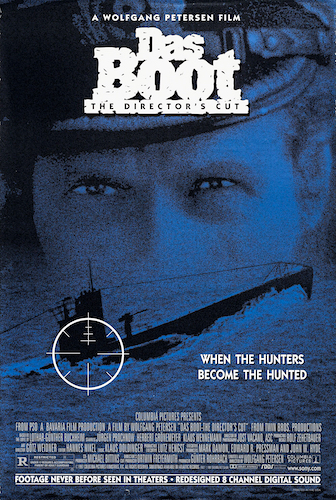
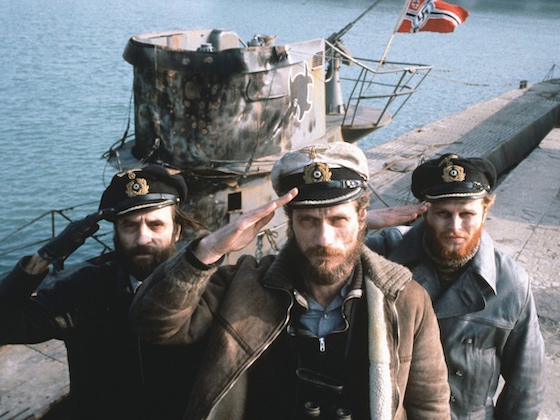
Das Boot The Director’s Cut (1981/1997)
2018 #69
Wolfgang Petersen | 208 mins | Blu-ray | 1.85:1 | Germany & USA / German & English | 15 / R
Writer-director Wolfgang Petersen’s story of a German submarine in World War 2 may have an intimate and confined setting, but in every other sense it is an epic — not least in length: The Director’s Cut version runs almost three-and-a-half hours. However, the pace is excellently managed. The length is mainly used for tension — quietly waiting to see if the enemy will get them this time. It’s also spent getting to know some of the crew, and the style of life aboard the sub. It means the film paints an all-round picture of both life and combat in that situation. The only time I felt it dragged was in an extended sequence towards the end. I guess the long, slow shots of nothing happening are meant to evoke time passing and an increasing sense of hopelessness, but I didn’t feel that, I just felt bored. Still, while I can conceive of cutting maybe 10 or 20 minutes and the film being just as effective, being a full hour shorter — as the theatrical cut is — must’ve lost a lot of great stuff.
It’s incredibly shot by DP Jost Vacano. The sets are tiny, which feels realistic and claustrophobic, but nonetheless they pull off long takes with complex camera moves. Remarkable. Even more striking is the sound design. It has one of the most powerful and convincing surround sound mixes I’ve experienced, really placing you in the boat as it creaks and drips all around you. The music by composer Klaus Doldinger is also often effective. It does sound kinda dated at times — ’80s electronica — but mostly I liked it.
Versions Das Boot exists in quite a few different cuts, although The Director’s Cut is the only one currently available on Blu-ray in the UK. If you’re interested in all the different versions, it’s quite a minefield — there are two different TV miniseries versions (a three-part BBC one and a six-part German one), in addition to what’s been released as “The Original Uncut Version”, as well as both of the movie edits. There’s a lengthy comparison of The Director’s Cut and the German TV version here, which lists 75 minutes of major differences and a further 8 minutes of just tightening up. Plus, the TV version also has Lt. Werner’s thoughts in voiceover, which are entirely missing from The Director’s Cut. That means this version “has a lack of information and atmosphere”, according to the author of the comparison.
As to the creation of The Director’s Cut, the Blu-ray contains a whole featurette about it called The Perfect Boat. In it, Petersen explains that he thought the TV version was too long, but that there was a good version to be had between it and the theatrical cut. It was first mooted as early as 1990, but it was when DVD began to emerge that things got moving — Columbia (the studio, not the country) was aware of the format’s potential even from its earliest days, and so it was with an eye on that market that they agreed to fund the new cut. Not only was it all re-edited, but as for that soundtrack I was so praiseful of, the audio was basically entirely re-recorded to make it more effective as a modern movie. The only thing they kept was the original dialogue… which had all been dubbed anyway, because the on-set sound was unusable.
In the end, the new cut was such a thorough re-envisioning that it took three times as long as anticipated, and led to a glitzy premiere and theatrical re-release. Petersen thinks the main difference between the theatrical and director’s cuts is the latter is more rich and has more gravitas because we spend more time with the individual characters.
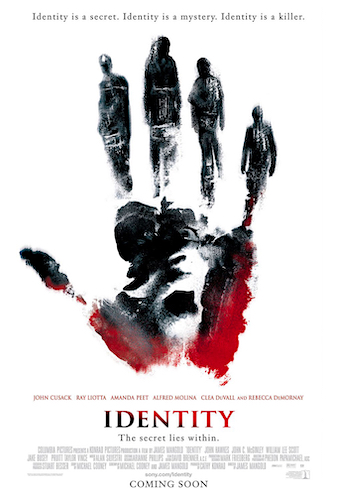
2018 #78
James Mangold | 90 mins | streaming (HD) | 16:9 | USA / English | 15 / R
I bought Identity probably 15 or so years ago in one of those 3-for-£20 or 5-for-£30 sales that used to be all the rage at the height of DVD’s popularity, and no doubt contributed massively both to the format’s success and even regular folk having “DVD collections” (as opposed to just owning a handful of favourite films). As with dozens (ok, I’ll be honest: hundreds) of other titles that I purchased in a more-or-less similar fashion, it’s sat on a shelf gathering dust for all this time, its significance as a piece of art diminishing to the point I all but forgot I owned it.
But I did finally watch it, not spurred by anything other than the whim of thinking, “yeah, I ought to finally watch that,” which just happens for me with random old DVDs now and then. But, like so many other older films that I own on DVD, I found it was available to stream in HD, so I watched it that way instead. The number of DVDs I’ve ended up doing that with, or could if I wanted… all that wasted money… it doesn’t bear thinking about.
Anyway, the film itself. On a dark and stormy night, a series of chance encounters strand ten disparate strangers at an isolated motel, where they realise they’re being murdered one by one. So far, so slasher movie. And, indeed, that’s more or less how it progresses. But there’s a twist or two in the final act that attempts to make it more than that. Without spoiling anything, I felt like it was an interesting concept for a thriller, but at the same time that it didn’t really work. There’s an aspect to the twist that is a cliché so damnable it’s rarely actually used (unlike most other clichés, which pop up all the time), and so the film attempts a last-minute explanation of why it’s better than that, but, I dunno, I feel like a cliché is a cliché.
So maybe Identity is best considered as just a straight B-movie-ish slasher, and just overlook the final act’s attempts at being more interesting as just trying to be different. In fact, more interesting to me was the fact it was mostly shot on an enormous soundstage set, which is kinda cool given the scope of the location.
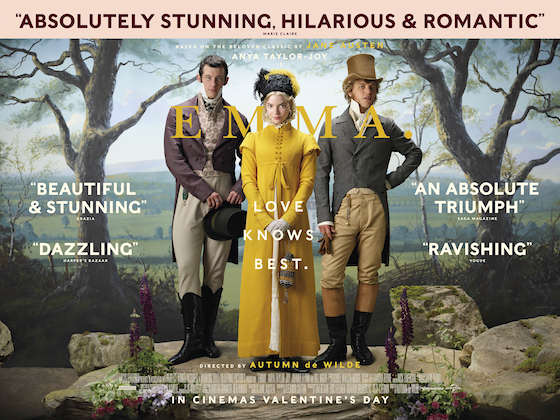
2020 #20
Autumn de Wilde | 125 mins | cinema | 1.85:1 | UK & USA / English | U / PG
According to IMDb, Jane Austen’s Emma has only been adapted for the big screen twice before — and one of those was Clueless. There have been multiple TV movie and miniseries takes on the novel, though, but as the most recent was over a decade ago I guess someone felt it was about time to trot it out again (after all, every major Dickens and Austen must be adapted for the screen at least once a decade or so, right?)
Following in the footsteps of the likes of Gwyneth Paltrow, Kate Beckinsale, and Romola Garai — and, I guess, Alicia Silverstone — in the title role is Anya Taylor-Joy. With her wide eyes, blonde ringleted hair, and silent, still demeanour, Emma is the very vision of loveliness. But, like so many stereotypical outer appearances, her sweet visage masks a manipulative schemer, obsessed with her own matchmaking ability; and, in private, her opinions of others are often not so kind. She is, in short, a bit of a bitch. Taylor-Joy is perfect in the role, doing an awful lot with subtle changes of expression in reaction shots — her Emma may often be silent and still, but she still conveys so much. Some have labelled Taylor-Joy a “scream queen” after her breakthrough roles in the likes of The Witch and Split, but she’s got a lot more range than that label implies.
Around her is a cast mixed of well-known faces and up-and-comers. For the latter, the standout is Josh O’Connor, who you may recognise from The Durrells, or The Crown, or God’s Own Country, or one of several other roles — he’s been an up-and-comer for a while and is about due a full-on breakthrough, which I guess all of these things combined have or will provide. Anyway, here he’s an obsequious vicar whose manner changes entirely once his true intentions and character are exposed, and O’Connor tackles both sides with the right amount of humour and churlishness. Johnny Flynn brings a rugged edge to Mr Knightley, Emma’s neighbour and lifelong friend, who disapproves of her meddling ways even as he clearly approves of her. Mia Goth brings a convincing wide-eyed innocence to Harriet Smith, a young girl of unknown parentage who Emma takes under her wing with the real motive of once again showing off her matchmaking skills, which is quite at odds with her previous roles in the likes of Nymphomaniac and The Survivalist.
As to the better-known cast members, Bill Nighy is reliably drily hilarious as Emma’s father, while Miranda Hart injects a lot of her familiar persona into the babbling Mrs Bates, before hitting you with an almost gut-punch of emotion (there were gasps at my screening, dear reader — gasps). Fans of the book / other adaptations will surely know which moment provokes such a response, so there’s the quality of Austen’s original storytelling at work there, and also that of the filmmakers and the rest of the cast — the reactions of the other characters; the way they hastily try to cover up the faux pas; and the exposure of Emma’s true character contrasting with the overall sugariness of the way this world has been presented.
This is director Autumn de Wilde’s most striking contribution to the story. The colour palette evokes confectionary; the manner of framing and camera moves is sometimes Wes Anderson-esque. If this Austen adaptation lacks the pure satirical bite of, say, Love & Friendship, it counterbalances with a contrast between the prettiness of the design work and the true thoughts, feelings, and schemes of the protagonist.
Of course, at the end of the day, Emma is a romance, and all’s well that ends well, earned via a flurry of apologies and plotting that lands everyone just where they always ought to have been. I suppose such narrative tidiness is anathema to some, just as are the delightful visuals, the witty dialogue, or the fundamental triviality of a bunch of rich people fussing over each other’s love lives. Well, that’s Jane Austen, people. And, like the elaborate confectionary it so resembles, Emma may not be nutritional, but it is delicious.
Emma. is released in the US today, and is in UK cinemas already.
2019 #136
Armando Iannucci | 119 mins | cinema | 2.35:1 | UK & USA / English | PG / PG
A fresh perspective on Charles Dickens’s favourite of his own novels, from co-writer/director Armando Iannucci, best known for sitcom The Thick of It, its spinoff movie In the Loop, and The Death of Stalin.
Those are all political satires, of course, whereas David Copperfield is more of a shaggy dog story; though its attracted some degree of ‘political’ commentary thanks to its colourblind casting. So let’s get that out of the way first. Not every character here is played by a white actor. Is every character in Dickens’s novel white? I dunno, probably. Is it unrealistic to have people of colour in a story set in Victorian England? Well, considering England was at the heart of a worldwide empire with global trade links and had been through the slave trade, I would guess not everyone in the country was white by that point. I’m no expert on this, but I’ve certainly seen comments by experts that would agree with that.
Now, all of that said, David Copperfield’s attitude to casting is the most genuinely colourblind I’ve ever seen — it’s not concerned that related characters have ‘plausible’ similar skin tones, even. It seems Iannucci has just cast whichever actor he felt was right for the role. I guess that’s going to prove an insurmountable barrier to some people; too great an ask to accept the ‘reality’ of the story. Whereas a giant hand crashing through a ceiling to pluck little David from comfort, well, that’s just dandy. Anyway, I’m already getting bored with this debate and I’ve barely written about it. If it bothers you, I don’t think it should, but hey, you do you. For the rest of us, we can just get on with enjoying everything else the film has to offer.
And that’s quite a bit. Dickens’s novel is a thick tome (768 pages, as per the film tie-in edition), and here it’s been condensed briskly into just under two hours, so there’s a lot more going on than the colour of people’s skin. It’s a semi-autobiographical tale, and Iannucci emphasises that side of it by framing it as David telling his own story at a staged reading. Such a framing device also allows for some flights of whimsy in the film’s treatment of certain things, especially scene transitions, but to say too much of those would destroy some delightful surprises. Trust that Iannucci is doing more than just showing off or messing around, however, instead establishing a style that allows for a neat twist or two later on.
I don’t know how thoroughly the film adapts those 768 pages, but it feels like it’s trying to cram in as much as possible. It rattles by at a whipcrack pace, which is both one of its greatest assets, because it moves like the clappers, and its biggest drawbacks, because it winds up feeling a bit too long. Every time you think it’s getting to the end, there’s another bit. (Maybe this is less of a problem if you’re familiar with the whole story, which I was not.) This is a minor complaint, though, because while those 119 minutes may be a few more than seems strictly necessary, what’s within them is frequently riotously funny. I saw the film with an almost-full house, and it was clear everyone was having a whale of a time.
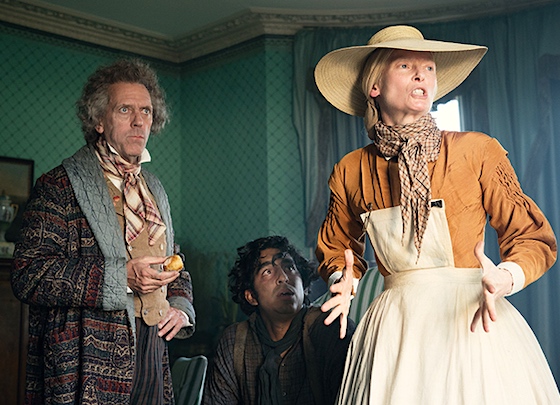
The same appears to be true of the cast. I suppose Dev Patel is best known for heavier stuff, like Slumdog Millionaire (though that was 12 years ago now (jeez)) and Lion, but here reminds us he’s adept at lighter material too (which shouldn’t surprise anyone who’s seen the Marigold Hotelfilms). Elsewise, the extensive and sublime supporting cast vie for attention in an array of standout performances. For my money the winner (if we must pick one) is Hugh Laurie as the flighty but unfailingly kind Mr Dick. Plus it’s quite nice (or you could say “nostalgic”) to see him back in bumbling toff mode after years of things like House and The Night Manager.
Not that the others don’t get their moments to shine — when you’ve got the likes of Tilda Swinton, Peter Capaldi, and Ben Whishaw involved, you’d expect nothing less. I could go on listing recognisable names, for there are plenty here, but you can always just read the cast list for yourself. One of the most noteworthy is Morfydd Clark in a dual role, one of which likes to mainly talk through her dog. I suspect this may be another stop on her path to stardom — she was recently seen in the BBC’s Dracula and a small-but-memorable role in His Dark Materials, and has been cast as Galadriel in Amazon’s Lord of the Rings series.
So there’s a lot of talent on screen, but it takes that degree of skill to negotiate the tone Iannucci has set: a narrative full with comedy, but that doesn’t lose sight of an underlying heart. Indeed, the degree of humour is a welcome counterpoint to the machinations of the plot, which contain an array of miseries when looked at objectively — death, loss of home, betrayal, and so on. This is again perhaps where that framing device comes into play, setting the story as a man finding the (sometimes dark) humour in the list of tragedies that have befallen him, as well as his friends and family. David’s predilection for storytelling is an important throughline, and the film’s affection for the emotional power of the act of writing is sure to make it a favourite for many authors (and wannabes).
The Personal History of David Copperfield is in UK cinemas now. It’s released in the US on May 8th.
2019 #132
Bill Condon | 110 mins | streaming (HD) | 2.35:1 | USA / English | 12 / PG-13
I may’ve been pretty quiet for most of October, but it’s Halloween today and that means it’s time to uphold a tradition I’ve had since 2015 — but for the final time! Well, all good things must come to an end. Fortunately, so too must Twilight.
As usual with films this deep into an ongoing story, I won’t bother making much of an effort to set it up for newcomers. Film series like this are more like miniseries, just with feature-length episodes that are released theatrically and years apart. You wouldn’t just watch Episode 5 of a five-part TV series, would you? That goes double here, as the title indicates: it’s also the second half of the final book.
Ah, the title… As regular readers may’ve picked up by now, I’m a stickler for title accuracy (heck, it’s literally my job at the minute). The ‘correct’ title is what’s on the film’s title card… which you’d think is pretty straightforward, but every now and then something challenges that methodology. The Twilight films have consistently been a problem with that. Always promoted as “The Twilight Saga: [Film Title]”, the main title card in the films themselves use just the individual title bit. But Breaking Dawn has decided to be even more irritating, because Part 1 was called Part 1, but Part 2 is called Part Two. No, seriously. Look, I know this kind of thing matters not a joy to most viewers, but I feel like it’s indicative of the amount of effort and attention that was actually spent on these movies. (Despite all that, I’ve gone with Part 2 for the title of this review to match my Part 1 review, because I appreciate consistency, at least.)
Numerical formatting inconsistencies aside, the opening titles are really nice. I mean, they’re not so amazing that you should go seeking them out especially, but they look good. And for once, it’s not all downhill from there!
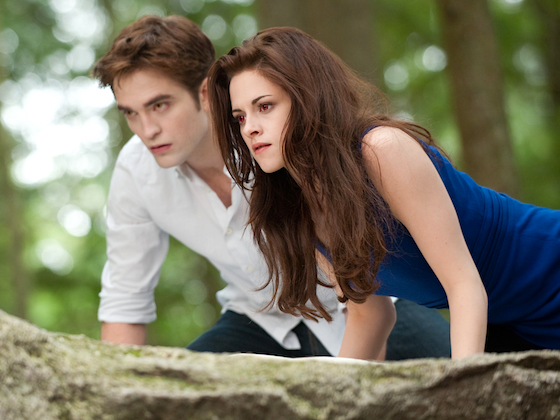
But only because the climax is probably the highlight of the whole saga — unless you’re primarily here for the romance stuff, which was mostly tied up in previous movies. It does make you wonder somewhat who this final part is for, actually. The central couple got married in the last film — that’s the end goal of all conservatively-minded relationship stories. You get married, then you live happily ever after, so naturally there’s no story beyond that point. (Heavy eye roll.) But Twilight isn’t quite an ordinary conservative romance, what with one of the pair being a vampire, so there’s some mythology stuff left to tackle. Well, no spoilers (yet), but Breaking Dawn isn’t ultimately very conclusive in that regard. Maybe author Stephenie Meyer was deliberately leaving room for a further book.
As a commercially-minded theory, that seems a reasonable presumption. But the narrative of Breaking Dawn suggests Meyer was more than ready to move on. Out of almost nowhere, everyone starts developing superpowers (element manipulation, forcefield projection, the ability to deliver electric shocks, etc), which they must then learn how to use. Sound familiar? I can only assume Meyer got bored of writing shitty novels about vampires and werewolves so decided to make this one a shitty version of the X-Men instead.
Further evidence of restlessness comes from the amount of plot we’re treated to. In almost all my Twilight reviews I’ve specifically noted how slow the films are, or that nothing happens; but this time so much happens they have to condense events with montage and voiceover. New characters are introduced at a rate of knots, simply to fill out an ‘army’ for the final battle. Any writer worth their salt would’ve known this was coming and spent time introducing these people earlier — it’s not as if there hasn’t been room for it in the sparsely-plotted earlier instalments. Simply, this saga is exceptionally poorly paced.
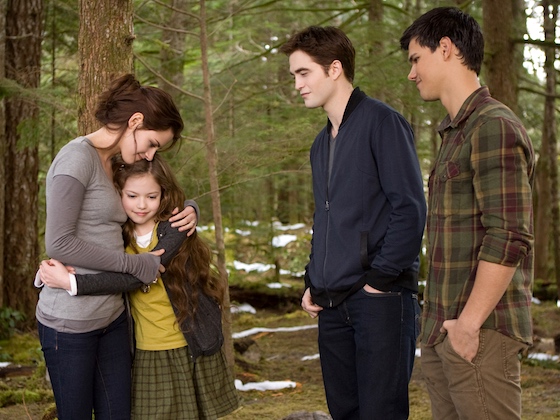
It’s certainly not the film’s only technical flaw. Apparently it cost $136 million, so why does it look like it was made for £3.50? Inadequate CGI has always been a feature of these films, so what possessed them to think they could pull off a CGI baby/toddler?! The result is fucking creepy; the very definition of the uncanny valley. Sometimes I think the people who made these movies shouldn’t be allowed to work again. The dialogue, the editing, the obvious green screen, the cheapo effects… it’s not just that it’s a crummy story with dubious morals, it’s that the films are so shittily made.
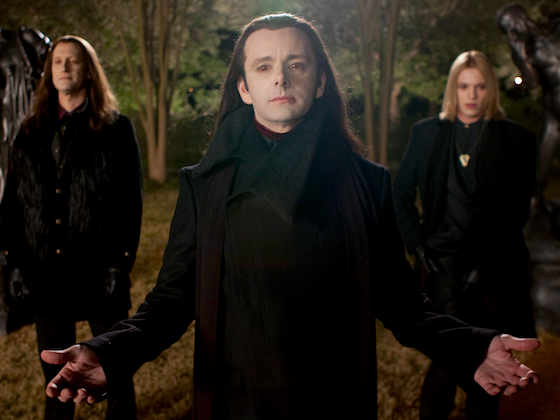
But, as I said earlier, there’s almost some redemption. First, Michael Sheen rocks up as the head of the Volturi, who are the top vampire coven or something (I don’t really remember, it was explained three films ago). I think he’s thoroughly aware it’s all rubbish (I believe I read he only did it because his daughter was a fan), so he gives a delicious performance. It’s not over the top — he’s not just phoning it in for the payday — but it also seems aware that it’s all daft, so why not have some fun? He’s the Big Bad, so his presence enlivens the climax, which also benefits from a good old “two armies face off across the battlefield with rousing music” approach.
And then they fight… and, wow, they should’ve called this The Twilight Saga: Breaking Off People’s Heads. It’s possibly the best of the series simply because of how fucking brutal it is. If you watched the previous films thinking, “I wish most of these characters would just die horrible deaths”, this is the sequel for you. And it’s still rated PG-13! They pull a woman’s head and arms off, and toss the head into a fire, and then they toss a toddler into the fire too… and it’s still rated PG-13! But half a glimpse of a woman’s nipple and you get an R. You’re fucked up, America.
Post-fight, the film has one final good bit. I’m just going to spoil it, because if you’ve got this far I figure you don’t care. It’s revealed that the entire battle — which, note, killed off a slew of major supporting characters — was all a premonition. “It was all a dream” is frowned upon as a rule, but here it’s actually quite a neat twist. I didn’t see it coming, anyway. I guess I didn’t think anyone involved with Twilight was capable of such structural ingenuity. How I wish it was in a better film, more deserving of its effectiveness.
Oh, but it’s not all sunshine and roses. It means the fight never happens, which means the bad guy isn’t actually defeated, he just decides not to bother (because he’d lose). But is he happy about it? Duh, no. So he… just goes home… still in a position of power, still not happy with our heroes… Is that a victory? Or has the villain gone away to cook up a new plan? As I said, it feels open for a further story. A pair of characters who wanted the good guys to win for their own nefarious reasons basically tell the heroes, “you’re all fools, the Volturi might’ve left but they’ll never forgive what happened”… and all the good guys just laugh, because they’ve won, because they’re the good guys. But they haven’t won, have they? They didn’t defeat him. They didn’t convince him. It won’t take much for him to come up with a new, better plan. Fuck it, I was glad this was over, but now I want to see The Twilight Saga Episode 6: The Volturi Slaughter All Those Cocky Bastards.
But there isn’t a sixth instalment. This is it. I have completed The Twilight Saga, just over a decade since it first came to the big screen. Back then it was a relatively significant part of pop culture, with a rabid fanbase clamouring for the movies to be recognised, and turning them into major, much-discussed hits. But they were always critically reviled, both in print and on screen, and now it feels like their relevance is waning, presumably as old fans grow up and new ones fail to materialise. Or maybe they still do good numbers in book sales / TV airings / Netflix streams, but we just don’t talk about them widely because they’re not new anymore. Who knows. The only reason I care is because I’m wondering if I’ve spent ten hours of my life watching something I knew would be poor, spurred merely by its cultural significance, only to find that significance has quickly evaporated.














 100Films.co.uk