Ultimate Avengers (2006)

2008 #82
Curt Geda & Steven E. Gordon | 68 mins | DVD | PG / PG-13
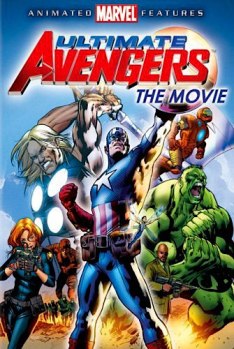
Ultimate AvengersWith the big-screen live-action Avengers movie on its way in just two-and-a-half years — once we’ve had a variety of tie-ins to lead into it, of course — now seemed as good a time as any to check out this direct-to-DVD animated version (and its sequel).

I won’t say too much about the plot because, if the rumours are true, the live action film may follow it fairly closely — indeed, the first 15 minutes of Ultimate Avengers presents a roll call of elements already introduced in this summer’s Iron Man and The Incredible Hulk: the Avengers Initiative, a super solider serum, a black Nick Fury, Captain America frozen in ice (OK, so that was only in a deleted scene…) But to follow this story wouldn’t necessarily be a bad thing… as long as there were some tweaks.

The primary problem is balance. Ultimate Avengers spends the entire first half assembling the team, the story crawling along at a snail’s pace; consequently, there’s nothing like enough time to do the remaining plot justice, leaving much of it to feel rushed. However, the tale itself retains an appropriately comic-book feel — no surprise considering it’s adapted from a specific storyline — while still containing just about enough information to keep newcomers covered. Were it properly paced, and bolstered by the main characters being introduced in their own films, there’s no real reason this wouldn’t suffice in live action.

On the other hand, in its current incarnation it’s very much Captain America’s story — possibly a problem for the 2011 version, as it will follow Cap’s debut feature by just two months. If his solo outing isn’t a success — particularly if whoever plays him is no good — it would likely sink an Avengers movie that was as focused on him as this. Not encumbered with such problems here it works fine, though it’s disappointing how little we see of other major players — Tony Stark/Iron Man barely features and there’s even less of Thor. That said, Bruce Banner/Hulk gets a key subplot which could be even better if fully developed.

Dodging further predictive comparisons for a moment, the animation quality is variable. Some is very good — mainly the opening World War II-set action sequence — but most is no better than you’d expect from a kid’s TV cartoon (unless they’ve got even worse recently). It does the job adequately, but there’s little exemplary. If there’s a theme emerging it’s this: promise is shown, but not fully realised. That’s not the fault of the medium of course, but rather the brief running time and unbalanced structure.

When the live-action Avengers reaches our screens, I suspect this animated outing will be of greater interest — an intriguing point of comparison between a direct-to-DVD fan-aimed version and a Summer Blockbuster mass audience version of (possibly) the same story. Of course, by that point, Ultimate Avengers will be half a decade old and no longer such a contemporary — or memorable — example.

3 out of 5

Ultimate Avengers II will be reviewed tomorrow, Tuesday 21st April 2015. Live-action sequel Avengers: Age of Ultron is in UK cinemas from Thursday 23rd.
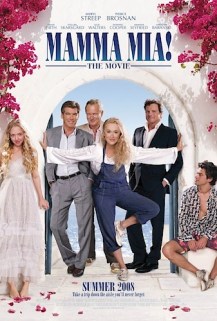
Mamma Mia! (2008)

2008 #81
Phyllida Lloyd | 104 mins | DVD | PG / PG-13

Mamma Mia!If you listen to the critics, no one liked Mamma Mia. If you listen to the public, everyone loved it. It’s the highest grossing British film of all time at the UK box office — at last count, just over £400,000 away from being the highest ever* — and was still playing on the big screen at hundreds of locations the weekend before its DVD release.

Mamma Mia! is the first feature from director Lloyd, who also directed the original stage production — and sometimes both facts show. She doesn’t always quite know what to do with the camera, the choreography is often aimed at a theoretical audience rather than the camera position (a pet peeve of mine), some shots are over-simplistic, others over-done, and there’s a bit of “point and shoot” too, missing opportunities that would be obvious to more experienced film directors. It’s never atrociously directed — at the very least, the scenery looks stunning, and is put to much good use — but it does the job and little more.

The songs themselves don’t need discussion (everyone knows what they think of Abba) but it’s worth mentioning how they’re choreographed and how they come about in story terms. Some have been brilliantly staged (Mamma Mia itself, but especially Does Your Mother Know), though others are flat and awkward (The Winner Takes It All doesn’t win anything as far as I’m concerned). Equally, some emerge naturally from the story (Chiquitita, Money Money Money), while others feel shoehorned in (again, The Winner Takes It All). For others still they seem to have just given up forcing them into the plot, leaving them to be performed by a musical act: Super Trouper, which at least is vaguely appropriate to the juncture it appears; and Waterloo, which is tacked on during the end credits, though at least is amusingly done.

The majority of the cast were clearly chosen for acting skills rather than singing ability, not that it’s done the film many favours. Pierce Brosnan was unfairly singled out by critics for poor vocals, but he’s no worse than several others. On the other hand, Julie Walters is as much of a riot as you’d expect, right from her first line, and earns the lion’s share of the laughs. For any bored male viewers, there’s always Amanda Seyfried, with her often bouncy pair of friends — played by newcomers Rachel McDowall and Ashley Lilley (why, what did you think I meant?) Every cast member is clearly having a ball, so much so that some forget to do more than read lines aloud; but it’s occasionally infectious, the frequency of infection being directly proportional to how susceptible the viewer is to this genre of music and this genre of film.

It may go without saying, but the more you like Abba the more you’ll like Mamma Mia. Conversely, the more you hate them the more you’ll hate it. (Extra stars can be added or subtracted at the end depending on which side of the fence you fall.) It’s therefore easy to see why audiences — especially British audiences — have lapped it up, while the critics have been fairly damning. On the other hand, the often clichéd first-draft-level script and occasionally ungainly first-readthrough-level performances don’t help things any. Luckily it very rarely takes itself too seriously, and consequently is often hilariously funny. Though it attempts both, it clearly works best when being a camp and cheesy comedy rather than a serious romance/family drama. One especially weak note, in my opinion, is the subplot awarded to Colin Firth’s character, who turns gay almost out of nowhere. It’s not a bad idea for a subplot, especially in a film based on Abba music (not that I’m applying any stereotypes here), but it’s poorly executed.

Mamma Mia! never aimed to please the critics, or even your regular movie-goer. Instead it sets its sights firmly on Women Of A Certain Age who can remember Abba from first time round, and students who perhaps listen to them in a more ironic way nowadays. In that sense, it’s clearly an unmitigated success. As camp as a row of tents, disliked by critics, loved by audiences: Mamma Mia! is everything you’d expect from Abba.

3 out of 5

* In the interests of fully-correct information, I feel I should point out that Mamma Mia! has now [December 28th, 2008] overtaken Titanic at the UK box office. (BBC News) ^

Sherlock Holmes and the Secret Weapon (1943)

2008 #75
Roy William Neill | 66 mins | DVD | PG

The name’s Holmes, Sherlock Holmes, as Universal’s loose adaptations of Britain’s Greatest Detective deliver a low-key proto-Bond, 22 years before Goldfinger applied the same tricks to Britain’s Greatest Spy.

“How so?”, you might ask. Well, Holmes has been employed as a spy for His Majesty’s Government; it begins with an ‘end of the previous adventure’ almost-action sequence that would undoubtedly take place before the opening credits now; there’s a war-winning weapon at stake; a bit of globetrotting (albeit just from Switzerland to London); some double-crossing and side-switching; even a surprisingly nasty torture sequence; a nice race-against-time final act; and an equally-matched villain, with a secret lair, who has devised a clever death for our hero. So the lair is just a house with soundproofing and unbreakable glass, but that’s not a bad effort — I don’t think there are many volcanoes to hollow out in the London area. It may be Bond on a World War Two London scale, but the feeling is there.

I discussed the controversy (for a modern audience, at least) of this updated setting in my last Holmes review, and it’s even more abundant here — seeing Baker Street as a victim of the Blitz, and 221B surrounded by sandbags, is very odd indeed — but at least it employs several elements from a variety of Conan Doyle’s plots, and it’s not unreasonable to assume that, given his skills of deduction and disguise, Holmes would’ve been employed as a spy had he been ‘alive’ during the war. In fact, Holmes actually does some detecting this time, whereas in Voice of Terror he seemed to meander around a bit, and employs several disguises, even if some of them are about as much cop as one of those glasses-nose-and-moustache masks. Of course, it would help the mystery if its solution wasn’t revealed before Tobel (the inventor of the titular war-winning weapon) was even kidnapped, but you can’t have everything.

What lets the film down more is Lionel Atwill as a weak Moriarty, supposedly the film’s grand villain. It’s not all his fault — for one example of poor writing, Holmes deduces the final code after an accidental clue from Watson, while Moriarty gets it by clumsily spilling water over a copy, hardly displaying great powers of deduction — but he doesn’t compare to the scheming, cunning Moriarty we saw played by George Zucco in The Adventures of Sherlock Holmes. On the plus side, the ease with each Moriarty outwitted Holmes in that earlier outing made our hero look a bit ridiculous, whereas here Holmes gets to outwit his nemesis a couple of times, including a particularly nice denouement.

As with Voice of Terror, I enjoyed a lot of Secret Weapon in spite of its distinct un-Holmes-ness — it’s another pacey, exciting World War Two spy thriller. It’s better than its immediate predecessor on the whole, though a spot of miscasting nearly persuaded me to remove another star.

4 out of 5

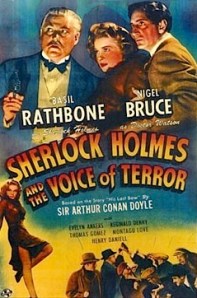
Sherlock Holmes and the Voice of Terror (1942)

2008 #74
John Rawlins | 63 mins | DVD | U

Despite the success of their two Sherlock Holmes films (The Hound of the Baskervilles and The Adventures of Sherlock Holmes, both 1939), Fox decided the character was outdated and resolved not to make any more. Universal clearly disagreed, and the popular pairing of Basil Rathbone and Nigel Bruce reprised their roles three years later for this, the first of twelve Holmes films the studio would make with the duo in just five years.

There’s more change afoot than just the logo at the start, however, as Holmes and Watson are dragged from their typical Victorian setting to London in the midst of World War Two. For a modern audience, who definitively associate Holmes with the Victorian era, this move seems virtually incomprehensible and sacrilegious; but Conan Doyle’s original Holmes stories take him as far as the start of World War One, so bringing the character another 28 years forward is little worse than, say, relocating the 1980 novel The Bourne Identity to 2002. Nonetheless, the filmmakers were aware of the problem even at the time, choosing to open the film with a title card that asserts Holmes to be “immortal… ageless, invincible and unchanging” in the hope that audiences would accept a then-present-day setting.

Whether the setting bothers you or not, the story itself might. The basic concept is a nice idea for a war-set spy-thriller, but not really for a Sherlock Holmes mystery. There are plenty of audience-pleasing applications of his ‘impossible’ deduction skills, such as the moment when Holmes concludes someone dislikes him based on the depth of footprints left in a carpet (never mind that the character huffily ignored Holmes when he came in), but the main plot involves a minimal use of these abilities. It’s also loaded with implausible elements — why would the Nazis waste bombs on empty fields (to disguise one plane going a different route) when they could have used them on genuine targets? Why are recordings shipped to Germany and broadcast back, rather than just broadcast from England? Worst of all, what’s going on with Rathbone’s haircut? The final twist is either genius or ludicrous, I’m not sure which; and the misguided reference to Holmes’ deerstalker (he’s promised not to wear it — why?) is, well, misguided.

It’s not all bad. As mentioned, the basic storyline is a good one, providing decent entertainment once it gets going; Holmes gets plenty of amusing lines, which manage to provide more genuine laughs than Watson’s incompetence; and there’s some lovely shadow-drenched photography — though the film’s even more drenched in patriotism, to the point of propaganda at times.

The consensus seems to be against me, but by the end I was quite enjoying Voice of Terror. It may be a Sherlock Holmes film in name only, but taken instead as a cheap spy thriller it makes for passable entertainment.

3 out of 5

Casino Royale (2006)

2008 #72a
Martin Campbell | 139 mins | DVD | 12 / PG-13

Casino RoyaleI’ve seen Casino Royale four times in the two years since its release (twice on opening weekend, in fact), which is an unusually high number of viewings for me. Normally I’ll see a film once and, even if I really like it, might not bother again for years; even films I’d name among my most-favourites fall into this category.
The reason I share this upsettingly trivial bit of information about my film watching habits is because, after two years and four viewings, I don’t really have much to say about Casino Royale. It’s a damn fine Bond film, returning to Fleming and resetting the character without losing anything truly essential about the franchise. The action sequences are great because they’re not only exciting but also drive the plot forward and reveal character — when Bond runs through the wall at the building site is a prime example of this.

In Daniel Craig and Eva Green the franchise has probably the best two leads it’s ever had, in terms of acting ability, and they put it to good use. There are many more pitch-perfect things about this film — not least making a poker game engrossing — and, yes, a few flaws, though for me they’re so minor as to not matter; but I don’t feel the need to expound on them a great deal because the film really speaks for itself. And, looking at the UK box office and DVD/Blu-ray sales, I’m not sure there’s anyone who hasn’t seen it.

In summary, Casino Royale is possibly the best Bond film of all time — though when you have a series that has encompassed so many disparate styles (directly compare From Russia With Love to Moonraker and one might even struggle to believe they’re from the same series), it makes for an incredibly hard selection to pick a sole winner from. Still, this one’s up there with the very best, not just of Bond but of action-spy-thrillers in general.

Now, I just wonder what happened next…

5 out of 5

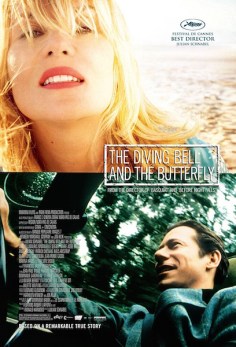
The Diving Bell and the Butterfly (2007)

2008 #69
Julian Schnabel | 112 mins | download | 12A / PG-13

The Diving Bell and the ButterflyLe Scaphandre et le Papillon, as it’s titled in its original French, has until now been on my (unwritten) ‘List of Films to Avoid’, alongside the likes of Ichi the Killer, Hostel, Caligula, and Salo. Strange company for an Oscar-nominated drama I know, but whereas those others have visceral horror that I have no real desire to deal with, the situation of Diving Bell’s central character, Jean-Dominique Bauby, which is exacerbated by it being a true story, seemed too horrendous to bear. In a similar way to how one might struggle to think about death if one doesn’t believe in an afterlife, the idea of being paralysed but for one eye is an almost unimaginably tortuous fate. Nonetheless, in the wake of a huge amount of praise — and in the name of finding a film starring Mathieu Amalric for My Quantum of Solace Film Season — I resolved myself and hoped for the best.
The most striking thing about the film is that, for about the first 40 minutes, it takes place almost entirely within the head of Jean-Do, as Bauby is affectionately known. From the opening shot we literally see through his his eyes, blurry and limited as that is, and hear his thoughts, which brings us a lot closer to him than any character in the film can be as we soon realise he can’t speak. During this first third the film only ventures outside Jean-Do’s immediate vision for memories or imaginings — although the viewer might perceive them as breaks from the prison of his mind due to the change in imagery, we’re actually still stuck inside his head, just as he is. One begins to wonder if the whole film will be told this way, or, if it does break free, how Schnabel and writer Ronald Harwood are going to find a cinematically plausible way to achieve this after so long. (Pleasingly, when do they it doesn’t feel like a contrivance.)

Jean-Do’s situation is obviously far from everyday, so this device makes for a highly effective — and, indeed, affective — form of identification. As we can see all he sees and hear all he hears, and as he can’t feel anything, we’re being given access to his entire sensory experience and, through his voice over, we even have access to his thoughts. (I say “his entire sensory experience” — it’s never mentioned whether he can taste or smell; but as his paralysed mouth means he’s unable to eat I presume the former isn’t much of a consideration at least.) This style also creates some exceptionally uncomfortable moments, such as when Jean-Do’s right eye has to be sewn up so as it doesn’t dry out, even though it still works at the time. As we see from his vision, we see the eyelid being half-closed and the needle pushing through as if it were our own. Again, it brings the viewer a lot closer to his experience than watching the act objectively from a third-person perspective would.

It’s not just the effect on Jean-Do that we’re privy to, however. As the story progresses we encounter his family: an estranged wife, three children, a mistress, and a house-bound father. The pain these relatives feel is both varied and palpable, as is the added pain for Jean-Do. He can’t play with his kids, or even really communicate with them, and his mistress is too afraid to visit — in one scene, his disability means they have to communicate uncomfortably through his wife. Arguably most affecting of all is his father. Played by Max von Sydow, the couple of scenes featuring him are beautifully understated in both direction and performance, but it’s their attempt at a phone conversation, using only the awkward blinking system developed by Jean-Do’s speech therapist, that is absolutely heartbreaking.

Incidentally, the scenes where Jean-Do uses this method — which, put simply, involves him choosing one letter at a time — are quite odd to watch for an English viewer. Obviously the word is being spelt in French, but the subtitles unsurprisingly spell the word in English. It’s the only sensible way to convey the point, but it makes for an especially odd disjunct between original dialogue and the subtitle translation. It’s not so much a flaw as something that distracted me at times, but I can’t come up with a better solution.

As Jean-Do, Amalric is required to give a rather unusual performance — not just because he’s stuck with only the use of one eye, but because for much of the film Jean-Do is omnipresent while Amalric is nowhere to be seen. This in-his-head style means that the direction, cinematography, editing and sound design are as much part of the character as the work Amalric does. He rarely actually narrates anything — it’s sort of a half voiceover, with snippets of thoughts and the like. That said, it’s to the credit of his work with this slight material, and to those on the technical side, that when he does actually appear on screen it doesn’t seem unusual or disconnected.

I’m not sure where I got the notion that The Diving Bell and the Butterfly would be truly excruciating to watch, but, as anyone who has seen the film will surely be aware, it isn’t. Schnabel and Harwood employ a variety of techniques to make you understand the real-life horror of Jean-Do’s situation, but these don’t tip the film into sensationalism or terror. In fact, despite the measures taken to enable the viewer to identify with Jean-Do and make his a very personal drama, I found it was primarily interesting on a documentary level — understanding the hard, slow, awkward processes of recovery (as much as he can) and coping (to a degree); how it might feel to be in that situation, or stuck in similar aspects of human experience, such as in the visit from a former Beirut hostage.

In fact, if the film had a message it would surely be, “live every day as if it’s your last”. That might sound a bit corny — something which I certainly wouldn’t accuse the film of being — but it’s never been presented so starkly. Never mind dying, thereby having no chance to realise what you didn’t do — Jean-Do is a prisoner, tortured with all the things he never did or didn’t do enough, and the knowledge that he will never be able to do them again.

4 out of 5

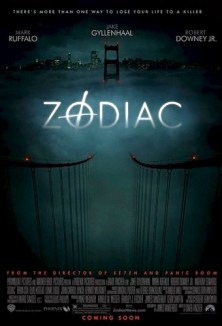
Zodiac (2007)

2008 #64
David Fincher | 151 mins | DVD | 15 / R

Context time: I’m a David Fincher fan. Se7en and Fight Club number among my favourite films of all time; I’ve always found The Game to be an immensely enjoyable thriller; much the same can be said of Panic Room, especially the famous slow motion sequence, which is one of my favourite action scenes ever; and I love The Hire series of short films, which Fincher produced but (sadly) never directed. I’ve never seen Alien³ (or Aliens, or any other entry in that series bar Ridley Scott’s first for that matter), but considering its troubled production history one might say it barely counts. All this considered, why’s it taken me so long to see Zodiac? Well, laziness, to be honest, but I’m here now. And unlike another recently-viewed highly-anticipated film (namely, Southland Tales), this was more than worth the wait.

As other reviews have pointed out, Zodiac is really a film about obsession, and it makes for as engrossing a tale as the case was for those investigating it. In following the story the film chooses to eschew normal structural niceties for fact-following, yet structure is never a problem. Yes, it jumps from character to character, and if you step back and analyse it that’s odd, but while watching it doesn’t matter one jot — this is more like real life than some shallow crime thriller dependent on a twist ending. That level of realism is key throughout, be it the period detail or the exemplary performances — both are excellent and accurate without being showy. Much like Fincher’s direction, in fact, which is appropriately more restrained than usual, though he can still display a suitable level of flair when warranted.

Some have called it slow, even dull, but I was totally engrossed throughout and never overwhelmed by the number of facts being thrown around — and I was watching it in the middle of the night when I should have been asleep. At 5AM, when it finally ended, I was even wishing there was more. (It seems a shame that the recently-released (in the UK) director’s cut adds barely five minutes.) It does exactly what it aims to: it’s not about the killer’s mind and it’s not a whodunnit; it’s about procedure, obsession, and how one deals with an unsolved mystery. The fact it isn’t definitively solved — and yet, for all the characters, there’s a way out or a solution that satisfies them — is possibly the most telling part of the whole film.

After the disappointment of the long-awaited Southland Tales, it’s especially pleasing that the long-awaited Zodiac is such a triumph. It’s easily up there with Fight Club and Se7en, and perhaps even surpasses them both. My most unreserved full marks since Dark City.

5 out of 5

Zodiac placed 2nd on my list of The Ten Best Films I Saw For the First Time in 2008, which can be read in full here.

My more thorough review of the Zodiac: Director’s Cut can now be read here.

The Wizard of Oz (1939)

2008 #60
Victor Fleming | 98 mins | DVD | U / G

The Wizard of OzThe Wizard of Oz is one of those films whose reputation unavoidably precedes it. Considering it’s nearly 70 years old now, that’s a reputation long in the making.
The biggest problem with this is that, coming to it for the first time as an adult, one knows just about everything that’s going to happen. There are still some gaps to fill for the uninitiated — it takes a surprisingly long time to get to Oz, and a surprisingly quick time from there to the Wizard — but it mostly feels oddly disconcerting: it’s such a well-known tale, even to those of us who hadn’t seen it, that having it played out in full, complete with bits one didn’t know about, is strange. That’s not really anything to do with the film, of course, just my personal impression.

My other observations amount to little more than “the second half is surprisingly light on musical numbers” and “the transition from sepia to full colour is still highly effective and glorious to watch” — as the (very interesting) restoration featurette on the DVD details, it literally looks better now than it ever has before. Beyond that, I had the sense that the film would exert a greater sense of wonder over the very young. That’s appropriate enough, but it means that, coming to it a tad later in life, it’s not a film I’m ever likely to really love.

4 out of 5

Gentlemen Prefer Blondes (1953)

2008 #56
Howard Hawks | 87 mins | DVD | U

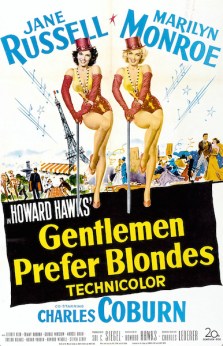
Gentlemen Prefer BlondesIt’s easy to see how Gentlemen Prefer Blondes helped launch Marilyn Monroe as a sex-symbol superstar — her ditzy, breathy blonde, who may just be cleverer than she looks, is clearly the star of the film.
For starters, she gets the lion’s share of the best bits. Diamonds Are a Girl’s Best Friend has justifiably become a classic song and there’s a solid routine attached, but the rest of the musical numbers are disappointingly weak. Jane Russell does get her fair share of good lines, but the most memorable comedic moment is Monroe’s: climbing out of a window, she gets stuck halfway and has to enlist the help of a little boy — and a big coat — to pretend she’s standing outside in the cold. That last one makes more sense in context…

Frankly, it’s all a bit sillier than I expected, more in line with the likes of Texas Across the River and the Road to… series than my memories of Some Like It Hot. That’s not necessarily a bad thing (I enjoyed both those examples), but it didn’t gel with my expectations of a film that’s got a greater reputation than they do.

I suspect said reputation is founded on Monroe’s career-making performance. I don’t have anything against her, but I’m not especially a fan either; yet despite my indifference she’s easily the best reason to watch this. Famously, when told she wasn’t the star of the film Monroe replied, “well whatever I am, I’m still the blonde.” The clue’s in the title, people.

3 out of 5

Gentlemen Prefer Blondes is on More4 today, Monday 6th April 2015, at 12:45pm.

Stardust (2007)

2008 #55
Matthew Vaughn | 122 mins | DVD | PG / PG-13

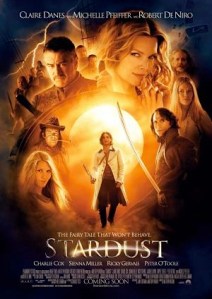
StardustPerhaps the simplest way to describe Stardust — to a film aficionado, at any rate — is as “the British Princess Bride”. That may do it a disservice however, as this tale of a boy entering a magical realm to find a fallen star is sufficiently its own beast to stand apart from such (admittedly lofty) comparisons, and be much more than a simple rehash with different accents.

Stardust succeeds in numerous ways. The plot is a good mix of fantasy archetypes, fairytale morality, a slight-but-knowing modern filter (thanks primarily to top-and-tail narration from Ian McKellen), humour and action. It rattles along, occasionally running the risk of becoming episodic, but thankfully avoiding it by linking and returning to various episodes. For a British film the effects work is perhaps surprisingly good, with impressive sequences that neither suggest restraint or budget limitations, nor smack of ambitious overreaching by the filmmakers (unlike, for example, the recent Tin Man miniseries).

This sort of fantasy adventure film is a somewhat unexpected choice for co-writer/director Vaughn, who previously produced Lock Stock, Snatch and Mean Machine, and directed Layer Cake, but his direction is neither over-grounded in reality (as you might expect from his background), nor over-done to the point of distraction (as if he were compensating). Instead, he demonstrates an entirely appropriate flair and skill, which promises much for future work.

If you watch a lot of British TV the cast seems star-studded, though even if not there’s the likes of Robert De Niro and Michelle Pfeiffer in major roles. Both are clearly having a whale of a time — as is everyone else, to be fair. De Niro’s role is especially surprising and fun, though to say any more would ruin it. It stands out as one of the best and most memorable elements in a film loaded with them. Charlie Cox is a likeable lead, while Claire Danes’ fallen star is pleasing subversive — you’d expect her to be sweetness and light (literally), but she is in fact amusingly stroppy — and Mark Strong is a perfectly villainous villain. They’re just three further standouts from an almost uniformly excellent ensemble. “Almost” because, sadly, the film’s weakest links are also among the cast. Ricky Gervais plays himself, as ever, almost shattering the well-constructed universe in the process; and Sienna Miller is too bitchy — and, to be frank, too wooden — for us to believe our hero could ever really want her.

But these are minor, easily ignored flaws in what is otherwise a fantastically entertaining fantasy. In fact, in recalling it for this review, it’s just magicked itself an extra star. How very appropriate.

5 out of 5

Stardust placed 4th on my list of The Ten Best Films I Saw For the First Time in 2008, which can be read in full here.