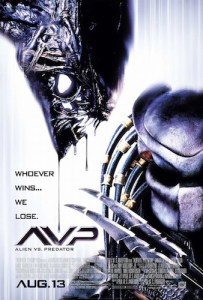
AVP: Alien vs. Predator – Extended Version (2004)

2009 #18
Paul W.S. Anderson | 98 mins | DVD | 15 / PG-13
This review contains minor spoilers.

AVPOnce upon a time — around the late ’90s, when he was only known for Event Horizon (and that video game thing no one wanted to mention) — director Paul W.S. Anderson was seriously and vocally attached to a film adaptation of Doctor Who. At the time it was such a good idea, a bright new hope for Who’s revival, with a Hollywood-level — yet, pleasingly, British — director at the helm. When it didn’t come together it was quite disappointing. In retrospect, I think we can breathe a collective sigh of relief.

Anderson’s films always come in for a critical drubbing and AvP was no exception. Sadly, it was well deserved. The main problems are a weak script, including an abundance of prologues in place of genuine character development, and poor performances, not helped by what sounds like a regular use of bad ADR. Characters make leaps of logic that would be reasonable if they’d seen the preceding six films, but make no sense whatsoever given what they know in context. The story begins moderately well, even pushing to the slow build in the franchises’ best entries (though without as much tension), until just 13 minutes in, when there’s a pointless scene on a Predator ship. Of course we know they’re coming — they’re in the title — but it’s a reveal too soon and ruins any mood Anderson’s managed to create. Constant updates on their progress exacerbate the problem.

There are actually some very inventive ideas scattered throughout — like the captured, frozen Alien Queen — but, in storytelling terms, their reveals are poorly handled, occuring too early and too far from the protagonists. However much time Anderson wants to spend getting his humans into position (a lot, just like the other six filmmakers before him), he clearly doesn’t trust the audience to go along with it without some hints of the creatures (unlike the best of the filmmakers before him). It’s not his only directorial misstep. He makes the fatal mistake of letting his monsters out into the light too much, though the choppy editing almost obscures them again. While effects can now withstand this level of scrutiny, the effect of the creatures can’t — they belong half-hidden in shadow, especially the Alien.

Elsewhere, every facehugger is treated to a graphic slow-mo shot. Once might’ve been cool, but it quickly becomes overkill — especially when the first instance features three, immediately rendering every solo example that follows unremarkable. And then there’s the ending nabbed from Predator 2. And the final beat that, though the groundwork is laid earlier in the film, still doesn’t really make sense (considering how fast chestbursters came out of the humans, or how long the Predator had been dead by the time it popped). When the director doesn’t know how to handle the titular monsters correctly, you know you’re in trouble.

That said, Anderson certainly delivers on the title’s Aliens-fighting-Predators promise. Most of the film’s limited imagination is lavished on these battles, but as with most monster-on-monster bouts we have no stake in either side, leaving them mostly heartless and only engaging on the level of “cool!” The human characters are left by the wayside at these moments, disappearing out of the way — and taking what little plot there is with them — for a few minutes. When they do appear there are some attempts at character development (yes, beyond those prologues) which are well-intentioned but painful. All things considered, Anderson has taken two horror franchises with an action-adventure tinge and turned them into an action-adventure film with a horror tinge.

This ‘extended version’ is a whopping 79 seconds longer than the theatrical cut, adding a whaling station prologue. This exacerbates the issue of revealing the monsters too early, but it does go some way to justifying the otherwise random glimpses of the Predator ship. Nonetheless, to be truly effective we shouldn’t know more about what the aliens are up to than the human characters do and it’s all a mistake. (An unrated version of the film is also available in some territories. It runs eight minutes longer, but the additions seem to just be the deleted scenes included on other releases.)

Flash forward however many years since that mooted Who movie, and Anderson’s career has mostly reverted to video game adaptations and trashing as many franchises as he can. AvP is surely the culmination of his efforts: here he manages to amalgamate a popular and acclaimed film franchise, its almost-as-beloved stablemate, and an equally popular and acclaimed comics & video game series, and then decimate all three in one 85-minute (without credits) swoop. Well done Mr Anderson, your efficiency knows no bounds.

2 out of 5

Tomorrow, AVPR – Aliens vs Predator: Requiem.

High Society (1956)

2009 #54
Charles Walters | 107 mins | DVD | U

High SocietyCole Porter-scored musical remake of The Philadelphia Story, which is probably most famous for featuring Who Wants to Be a Millionaire? and being star Grace Kelly’s final film before becoming a princess.

Despite rarely singing, Kelly is by far the film’s standout element — it’s easy to believe three different men would be vying for her affection, but she also gets the chance to show the greatest range of any cast member. Admittedly it’s shades of comedy rather than a full awards-worthy display of ability, but she carries the film beautifully. It’s no wonder her husband-to-be, Prince Rainier of Monaco, objected to her appearing in movies when she played roles such as this: a divorcee who at one point allegedly sleeps with another man on the eve of her wedding to a third is surely no role for a princess. (Turns out she didn’t sleep with him, mind.)

Bing Crosby and Frank Sinatra are more-or-less themselves as the male leads, though the sole song they perform together, Well, Did You Evah!, is one of the film’s best — despite being a late addition from a previous Cole Porter musical after it was realised Crosby and Sinatra didn’t have a number together. Louis Armstrong also plays himself, literally, and brightens up the screen whenever he appears. His band’s duet with Crosby, Now You Has Jazz, is another of the film’s highlights.

Despite being adapted from an acclaimed play and film, the plot feels like a relatively slight contrivance to link together a couple of songs — alternately of the Romantic and Comedic variety — and some farcical humour with a romance-based thread. That the right people end up together is no surprise — so little surprise, in fact, that the story doesn’t even bother with such trivial things as making the final entanglements come together believably.

No matter. It’s the journey to the inevitable conclusion, through a few comical scenes and a few decent tunes, that makes High Society a perfectly pleasant dose of entertainment.

4 out of 5

High Society is on TCM UK today, Saturday 4th April 2015, at 4:15pm, and on Sunday at 9:35am.

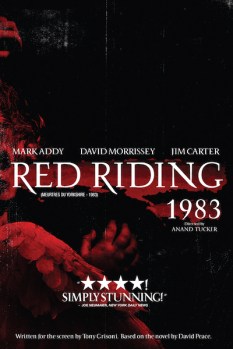
Red Riding: 1983 (2009)

aka Red Riding: In the Year of Our Lord 1983

2009 #52
Anand Tucker | 100 mins | TV (HD) | 15

Red Riding: 1983The Red Riding Trilogy draws to a close with its finest instalment, a superior work in just about every respect.

From the off, 1983 returns to the story of the previous films, showing events from different perspectives. It’s dominated by a new story — the search for a child kidnapper in the titular year — but even this harks back to the past, the actual kidnapping closely resembling the one that kick-started 1974. Indeed, it’s 1974 that’s primarily drawn upon, confirming 1980 as little more than an aside in the scope of the trilogy.

1983 doesn’t just reiterate, however, but builds on previously-seen events and characters, both overtly — showing the police investigation into Clare Kemplay, which was the story of 1974 — and more subtly — Hunter’s apparent sidekick being present at secret meetings of the Evil Policemen in 1974. Despite clear links to the past, 1983 may also work well enough on its own. It’s undeniable that there’s more depth when viewed in light of the first two films, but most (perhaps all) of it would be comprehensible simply from what’s presented here.

Tucker’s film bests its predecessors in almost every assessable value. The story and characters have more genuine surprises and suspense than ever, while the performances are at the very least the equal of what’s gone before. Unlike the other two films, where the corrupt cops were little more than cartoon villains despite claims to the contrary, 1983 makes their brutality really felt; here, for the first time in the trilogy, their disregard for the law and their vicious methods made me feel sickened and angry, just as they should.

But best of all is the stunning sepia-tinged cinematography, which uses the popular RED cameras to amazing effect. The instances of beauty are too numerous to mention, from obvious moments such as the final scenes of white feathers drifting in slow motion through shards of sunlight as part of a heroic closing image (even if one finds it tonally incongruous, which some surely will, it looks gorgeous), to low-key scenes like Jobson lost in contemplation, the sepia-toned foreground standing out from the blues of the background. The omnipresence of lens flare, an idea that was so annoying when liberally sprinkled across Star Trek, seems to work perfectly here. Perhaps it’s due to consistency: every light source seems to cast streaks across the frame, not just the occasional flourish. The trilogy isn’t yet available on Blu-ray, but for some of the images in this film alone it really should be.

Sadly, 1983 still isn’t perfect. Many plot threads are tied off, or we can infer our own explanations for the missing bits, but significant others are left hanging, not least what happened to the numerous corrupt police officers. We don’t necessarily need to see them come to justice — though that might be nice, obviously — or even a summary of the rest of their life, but some nod of a conclusion to their stories would be appreciated. Elsewhere, BJ’s narration is slightly twee, which is a shame because his story is both compelling and one of very few that is actually told across all three films, even though he’s barely noticed at first, rather than just starring in one and cameoing in the others.

I enjoyed 1983 immensely, much more so than either of the preceding films, so it’s only minor flaws like these that hold it back from full marks.

4 out of 5

Red Riding: 1980 (2009)

aka Red Riding: In the Year of Our Lord 1980

2009 #51
James Marsh | 93 mins | TV (HD) | 15

This review contains major spoilers.

Red Riding: 1980The second instalment of the Red Riding Trilogy sets out its stall with a stunning opening montage, covering six years of the Yorkshire Ripper case in as many minutes through news footage and faux news footage. In one fell swoop this establishes its own storyline, fills in some of what’s happened since 1974, and sets itself apart from its predecessor: this one’s based on fact. Well, a bit.

Unfortunately, a factual grounding hasn’t helped the story one jot. Where the first idled, this meanders, flitting between the Yorkshire Ripper, the investigation into the Karachi Club shooting (which closed 1974), and the private life of lead character Peter Hunter. It’s the cover up surrounding the middle of these that’s the most interesting, but that’s also the bit with the least time devoted to it. Most is spent on Hunter’s investigation into the investigation of the Ripper case, though by the end it becomes apparent this exists to cover the ‘real’ story — which is, of course, the Karachi Club cover up. Consequently neither are covered with the appropriate depth: the Ripper investigation is never a serious thread, the team we follow uncovering nothing significant and the Ripper himself captured by chance, off-screen, by a previously-unseen regular constable; and the incidents at the Karachi Club, and their lasting impact, are just about clarified but given no serious weight before a last-minute explanation.

If that sounds complicated, it isn’t. As in 1974, it’s all too straightforward: the people you suspect did it actually did, as it turns out, and there’s no serious attempt to conceal that. In fairness, it just about manages one surprise, right at the end, and the moment after this — where Hunter’s murderer shows remorse with one brief, subtle facial expression — is by far the best bit of the film. Worse than the lack of suspense, 1980 seems to forget its own plot all too often. Hunter is employed by the Home Office, for example, and told to report directly to them and them alone. But then we never see those characters again, not even when he’s later dismissed by lower-ranked officers — why not return to the men he was, supposedly, actually employed by? Other plot points are pushed aside too soon, forgotten about or just abandoned.

Characters and locations resurface from the first film — an unsurprising continuity, but pleasingly almost all appear in a context that’s actually relevant to the plot, rather than a mere catch-up on a previously-known person. Some of them have great import now, their role in the trilogy apparently fulfilled, while others remain little more than cameos with no bearing on the story, suggesting an even bigger part still to play. This works quite well, creating a real world where characters come and go rather than one that is obsessively — and unrealistically — interconnected.

The same can be said of the cinematography. Marsh frequently finds a beautiful or unusual shot, enlivening proceedings considerably. The 35mm glossiness doesn’t evoke the feel of a grimy past quite so thoroughly as Jarrold’s hazy 16mm, but as this is now the ’80s perhaps that’s the point. Nonetheless, the setting conveyed is still a drab, dreary — and constantly damp — North.

Underscored by a plot that doesn’t really come together, and largely bears little relation to the other two films, 1980 is the weakest entry in the trilogy.

3 out of 5

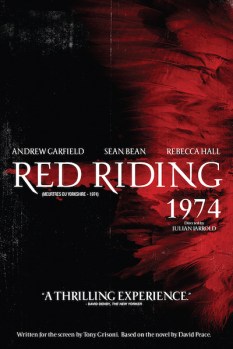
Red Riding: 1974 (2009)

aka Red Riding: In the Year of Our Lord 1974

2009 #50
Julian Jarrold | 102 mins | TV (HD*) | 18

Red Riding: 1974The Red Riding Trilogy covers nine years of police corruption and child kidnap/murder in Yorkshire, amongst one or two other things, and begins here with a very film noir tale, courtesy of author David Peace and screenwriter Tony Grisoni, slathered in neo-noir stylings, courtesy of director Julian Jarrold.

Jarrold is most recently responsible for Kinky Boots, Becoming Jane and Brideshead Revisited, all of which stand in a sharp juxtaposition to the style and content of Red Riding. But turning from his lovely English-as-they-come costume dramas to something altogether nastier should come as no great surprise, for Jarrold is merely returning to his TV roots: in the mid ’90s he directed episodes of Cracker, Silent Witness and Touching Evil.

He certainly seems to know his territory, but perhaps he knows it too well — though this is also the fault of Grisoni and, perhaps, Peace — as the plot that he unfolds is not only familiar but told as if he’s all too aware we know what’s coming. The feeling one gets is of a British James Ellroy, albeit a low-rent, less complex version. (The same is true of 1980, though for me 1983 manages to escape such comparisons.) The story idles along, not exactly slow so much as in no hurry, full of near-clichéd plot points and an unrelentingly standard structure. These things aren’t necessarily a problem, but when you’ve got as big and bold a reality claim as the Red Riding Trilogy they feel out of place.

Another recent point of comparison would be David Fincher’s Zodiac — young newspaperman on the hunt for a serial killer in an inspired-by-fact ’70s setting — though this does 1974 no favours. It may be grittier than Fincher’s film, but it lacks the polish, the originality, and manages to feel slower, despite being a whole 50 minutes shorter. However much arty photography, disjointed storytelling, relatively dense accents and ‘gritty reality’ is plastered over the barebones of the tale, the familiarity of it — to both viewers and the makers, who don’t even seem to be trying — means there’s not an ounce of suspense or surprise to be had.

The cast is made up of established names, familiar faces and rising stars, many of them unfortunately stuck in familiar roles or otherwise left stranded by the unrewarding material. If they’re not quite stereotypes it’s because they’re too bland, lacking enough discernible character traits to reach such lofty heights. Occasionally this is because, with two films to come, some minor parts here have a major role later, but this can’t be said of them all. As the lead, Andrew Garfield’s journalist is as much of a stock character as the plot he finds himself in: a young reporter type, idealistic among journalists who no longer care (if they ever did), hunting to expose The Truth. Again, it could work, but is belied by the insistence — in both promotion and filmmaking style — that Red Riding is something more than Another Murder Mystery. Only Rebecca Hall, as a mother whose young daughter went missing years earlier, is granted the material to give an outstanding performance — which she does, easily justifying her recent BAFTA Rising Star nomination.

Besides Hall, the best thing about 1974 is its dull, desaturated photographing of grimy, desolate locations, where any colour that isn’t beige desperately wants to be. It suits the story and era perfectly, and the choice of 16mm seems to add a level of haziness that is equally appropriate. It’s perhaps indicative of everything this is aiming for that the most beautiful imagery is of an incinerated gypsy camp. Rendered almost black and white by the soot and desaturisation, ash floats through the air like snowflakes as Garfield stumbles through it, the whole picture a vision of Hell. It’s a kind of perverse beauty, true, but that’s also entirely in keeping with Red Riding.

1974 is a stock noir tale, dressed up with fancy filmmaking techniques and claims of realism to look like something more truthful, more real, more Important. And it makes me a little bit angry because of it. Maybe the violence is more realistically depicted than your average genre entry, maybe the police corruption is a little more plausible — then again, maybe it isn’t — but the real story here is so familiar they haven’t even bothered to hide the plot beats and twists properly, no doubt assuming a “gritty” veneer plastered over the top would do the job for them. It doesn’t. Maybe 1974’s grimy setting, brutal violence and unbeatable police corruption are all true to life, but the familiar and predictable plot leaves the realism feeling like no more than a pretence.

I was enjoying 1974 a lot more by the time the unexpectedly satisfying conclusion came around, but the sense that it had tried to pull the wool over my eyes throughout — and not in the good way a thriller should — just leaves a bitter taste.

3 out of 5

* Though I watched Red Riding: 1974 on 4HD, it’s my understanding that it was upscaled. ^

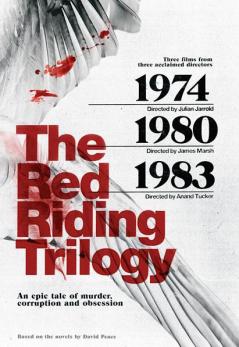
The Red Riding Trilogy

Red Riding Trilogy UKYou’d think Red Riding was a TV miniseries, wouldn’t you? After all, it was on Channel 4 on the same day for three consecutive weeks (recently repeated over three consecutive nights).
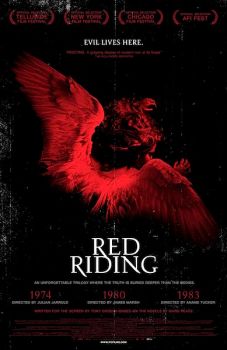
But the promotion — on iTunes, for example, or of Silva Screen’s soundtrack releases — is very keen to make reference not to “Red Riding” — as in, the title of a TV series — but “The Red Riding Trilogy” — as in, a series of films. Indeed, they are frequently referred to as “the films” (and similar variations thereof) in promotion and press, have received screenings at various film festivals and cinema releases in much of the rest of the world, including the US, and several other production and style points could also be rallied to confirm them as a film trilogy rather than miniseries.

As that’s how the makers would most like them to be regarded, then, it seems only fair to treat them as such. And so:


“The feeling one gets is of a British James Ellroy, albeit a low-rent, less complex version. The story idles along, not exactly slow so much as in no hurry, full of near-clichéd plot points and an unrelentingly standard structure. These things aren’t necessarily a problem, but when you’ve got as big and bold a reality claim as the Red Riding Trilogy they feel out of place.” More…

3 out of 5


“Where the first idled this meanders, flitting between the Yorkshire Ripper, the investigation into the Karachi Club shooting, and the private life of lead character Peter Hunter. Most time is spent on Hunter’s investigation into the investigation of the Ripper case, though by the end it becomes apparent this exists to cover the ‘real’ story — which is, of course, the Karachi Club cover up. Consequently neither are covered with the appropriate depth.” More…

3 out of 5


“Tucker’s film bests its predecessors in almost every assessable value. The story and characters have more genuine surprises and suspense than ever, while the performances are at the very least the equal of what’s gone before. Unlike the other two films, where the corrupt cops were little more than cartoon villains despite claims to the contrary, 1983 makes their brutality really felt.” More…

4 out of 5


Red Riding Trilogy USMy final thoughts about Red Riding — other than “that was disappointing” — are stuck on the reality (or not) of the police corruption it portrays. It’s difficult to know whether anyone who believes our police were never so nasty as this is naive, or whether anyone who believes they were quite this bad is paranoid. The truth no doubt lies somewhere in between.
Despite my disappointment with the majority of the Red Riding Trilogy, I intend to return to it some day: considering my enjoyment of the third instalment and the adjusted expectations that come from being disappointed first time round, the potential inherent in the trilogy means it certainly merits revisiting.

The Right Stuff (1983)

2009 #49
Philip Kaufman | 181 mins | TV | 15 / PG

The Right StuffThe Right Stuff ostensibly dramatises the story of the ‘Mercury 7’, America’s first group of astronauts, but in fact equally concerns itself with the tale of test pilot Chuck Yeager. But I’ll get to him.

I’ve recently steeped myself in dramas and documentaries relating to the US space program, from For All Mankind’s contemporary footage to In the Shadow of the Moon’s retrospective interviews, from Moonshot’s earnest docudrama account of Apollo 11 to From the Earth to the Moon’s thorough chronicling of events. But all of these have one thing in common: they cover the Apollo missions alone. Mercury came first, America’s initial attempts to put men into space before Apollo’s grand mission to the Moon.

In this context it’s nice to actually get some coverage of these earlier, vital missions, though such an in-depth knowledge of what was to follow has its problems for The Right Stuff’s narrative, just as knowing the facts always does for a historical movie. Equally, it gives the emotional resonance a helping hand — knowing Gus Grissom’s tragic fate lends the poor treatment he received following his unfortunate splashdown an extra poignancy; or when Alan Shepard asserts he’s going to the Moon you know he’ll make it (eventually).

Exposure to other such works makes quality comparisons inevitable too, though the only one of serious relevance here is From the Earth to the Moon. It’s an unfair one, of course: despite The Right Stuff’s epic running time, it’s nothing to the twelve hours afforded to an HBO miniseries. Conversely, where the miniseries is effectively twelve one-hour plays, shifting focus every episode, director Philip Kaufman’s film does follow a more linear — albeit wide-reaching — progression. While Yeager may disappear for long stretches, for example, his story is revisited and continued; while Gordon Cooper isn’t introduced until after we’ve had plenty of Yeager, the film closes on his first spaceflight. Flitting from character to character could make the film feel fragmented — and the brevity in dealing with many of the supporting characters, especially the wives, does suggest this — but the missions move ever on and take the narrative with them.

The other effect of having seen so much about the space program of late is that the trips to space lose some of their wonder. The handful of spaceflights actually depicted here are often praised, both for their special effects and their pure effect on the viewer, but having seen many others recently does tarnish the sense of wonder somewhat. The effects work is faultless however, as is the integration of footage of the real missions, and the unique qualities of John Glenn’s flight make it stand out regardless of how many other real spaceflights one’s seen recreated on screen.

A handful of these sequences aside, Kaufman leaves the technical aspect of proceedings alone. The various test flights and rocket launches we do see are undoubtedly important set pieces, but they’re not a thorough catalogue of events. Attention is only lavished on the scientific and engineering challenges when it has some direct impact on the characters, and just as often Kaufman is concerned with the family — specifically, the wife — behind the astronaut. These touches of family drama are well played, most affectingly with Glenn and his shy, stuttering wife, but each astronaut’s tale comes and goes, not even one relationship going through an arc that lasts more than two or three scenes. Even when powerfully portrayed, these are portraits not stories.

There are some injections of humour and symbolism too, but again in keeping with the piecemeal style. A pair of NASA recruitment officers, played by Jeff Goldblum and Harry Shearer, provide some comic relief early on for quite a sustained stretch, but then more or less disappear — excepting a recurring motif of Goldblum telling a room of Important Men news they already know. Similarly, the film opens with a fantastic image of Death, a black-clad preacher arriving to inform a wife and child of their husband/father’s fiery death. He crops up again, demonstrating his presence as symbol and not character, but is too often forgotten about. Plaudits are due for not overusing him, naturally, but a few more appearances wouldn’t have gone amiss.

And so what of Yeager? Why so much of a test pilot who was denied the chance to apply to be an astronaut, even if he’d wanted to? It’s hard to disagree with the assessment of screenwriter William Goldman, who left the project over disagreements with the director: it seems Kaufman, for whatever reason, is set in a belief that Yeager had ‘the right stuff’ pumping through his veins, while those chosen to be astronauts were just ordinary guys who got lucky; that Yeager was a pilot proper, brave and skilled, while the Mercury 7 were little more than living computers to perform a handful of tasks atop a huge rocket. If this is Kaufman’s belief it isn’t overbearing, but you can see where Goldman’s coming from. After all, if this is purely the story of the Mercury 7 and their trips into space, why is Yeager there at all, never mind so prominently?

By eschewing a straight trotting out of facts and incidents, even a dramatised one, for a selection of events and experiences, Kaufman made a film that is perhaps less about the real-life story and more thematic — that theme being, primarily, heroism. If he winds up uncertain whether or not the Mercury 7 were heroes, perhaps that’s the point: these were just ordinary men, thrust into an extraordinary situation. Except Yeager, of course, who is never anything less than the flawless embodiment of the titular virtue.

4 out of 5

The Right Stuff is on ITV4 tonight at 10:35pm.

The Knack …and How to Get It (1965)

2009 #34
Richard Lester | 85 mins | download | 15

The Knack …and How to Get ItI’ve never actually seen a Richard Lester film before, and so spectacularly failed to put two-and-two together about who the director was and what else he’d done before I watched this. If I had, recent (at the time of viewing) reviews of the BFI’s release of Lester’s later The Bed Sitting Room (such as John Hodson’s or Clydefro Jones’) might’ve prepared me for what was to come.
As it was, all I had to go on was the DVD art (as used by iTunes — this was another 99p Film of the Week), the bright and breezy title, and that it stars Frank Spencer. From that you’d be forgiven (I hope) for thinking The Knack was a colourful Swinging Sixties sex-com romp. Upon watching it, however, it’s immediately clear it’s nothing of the sort: it begins with a dream/nightmare sequence, complete with horror-esque music, before settling into a style and rhythm more reminiscent of Breathless than Confessions of a Window Cleaner.

At least, it does for a bit. In fact, it does a lot of things for a bit: Carry On-level double entendres, intense thriller-like scenes, slapstick sequences, an occasional New Wave-esque light jazz score… If it were an American schoolchild The Knack would surely be diagnosed with ADD, flitting around from one style to another with no immediately obvious rhyme nor reason, except perhaps a desire to try out interesting things and see where they lead. This will undoubtedly put some people off — on another day, I might be included among them — but instead I found it quite intriguing.

Stuck in the middle of what could have been a slew of directorial flourishes, the cast are allowed to surprise with some layered performances. Michael Crawford more or less does an early version of Frank Spencer (in fairness, that’s perfect for the role), leaving him overshadowed by Ray Brooks as lothario Tolen and Donal Donnelly as the slightly kooky Tom. Both subvert their initial impressions: Donnelly’s oddness hides a perceptive intelligence, while Brooks’ suave lover hides a subtly unnerving, menacing, dominating sexual predator. Some of the time, anyway.

There’s no doubt that I’m severely under-qualified to pass any kind of serious judgement on The Knack (some would say any film, but there you go). I’ve not even mentioned Rita Tushingham (apparently something of a ’60s icon), or Ray McBride (who or what is he, and what is his relevance?), or that it won the Palme d’Or at Cannes in 1965 (I do know what that is at least). A proper, informed judgement is therefore best left to those with a greater familiarity with Lester’s films (or at least his early work, before he went on to the likes of The Four Musketeers and Superman III). But to those equally as uninitiated as I, The Knack can be recommended as an unusual but surprising piece of work, full of things to pique one’s interest.

4 out of 5

A Few Good Men (1992)

2009 #38
Rob Reiner | 138 mins | download | 15 / R

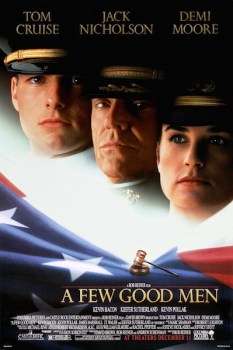
A Few Good MenSometimes you have to wonder where it all went wrong. I can only imagine how good things looked for Rob Reiner at the start of the ’90s, when he’d had an almost-interrupted near-decade-long run of acclaimed movies in the director’s chair: This is Spinal Tap, Stand By Me, The Princess Bride, When Harry Met Sally, Misery, and finally this. ‘Finally’ being the operative word however, as it all seems to have gone down hill from there, to the extent that I actually felt the need to look him up on IMDb to check if he was still working/alive. (He’s both, having recently directed The Bucket List, a bit of a hit if I recall correctly.) Reiner is a recognisable name, and if he’d stopped making films after A Few Good Men perhaps he’d find himself bandied about on lists of Great Directors (at least in certain circles/magazines), but the fact I had to check what he’s been up to (and had forgotten how many acclaimed films he’d made in the first place) shows what a 15-year run of nothingy films can do for your reputation. Even the career of Spinal Tap themselves seems to be in better condition.

All that said, A Few Good Men isn’t really Reiner’s show. It’s not that he does a bad job — far from it — but courtroom dramas primarily depend on two things, even more so than most films: the quality of the writing and the quality of the performances. When you have scene after scene in which a handful of people battle with words alone, often in one-on-one confrontations, then those two elements are virtually all you’ve got. Of course camerawork, editing, music and the rest still have their part to play, but without the underpinning of good writing and good performances the technical attributes are merely fighting to cover for significant shortcomings. Fortunately, A Few Good Men has those underpinnings.

In this case the screenplay is by Aaron Sorkin, adapting from his own play, who would go on to create and write a great deal of The West Wing (which, incidentally, was inspired by leftover ideas from a later Sorkin/Reiner collaboration, The American President). The seeds of that show’s influential style are in evidence here, although the sheer pace and famous ‘Walk and Talk’ scenes aren’t yet part of the formula. As in The West Wing, Sorkin’s writing is both intelligent and witty, a hallmark of high-quality writing that’s able to rise above the shackles of “it’s not real drama unless it’s all grimly serious”. His characters and their personal story arcs may be straight from the stock pile — Tom Cruise is the hot-shot young lawyer who’s actually trying to live up to his daddy (and comes through in the end); Demi Moore is the goody-two-shoes woman trying to make it in a man’s world (who learns to work with her colleagues); and so on — but the plotting of the central case remains undiminished, and Sorkin thankfully avoids such obvious subplots as a romance between Cruise and Moore’s initially-mismatched-but-ultimately-mutually-respectful good guys. Nonetheless, the occasional lapses into extreme, often patriotic, sentiment that would later mar the odd episode of The West Wing are also on show here, most notably at the climax, though they fail to do any serious damage.

It’s in the all-important court scenes that Sorkin’s writing really shines. Dialogue flies back and forth like bullets, full of protocol and technical jargon — like in The West Wing — that we either understand or, when we don’t, get enough of the gist to follow the key plot points — like in The West Wing. The biggie is the final confrontation between Lt. Kaffee and Col. Jessep, an interview that’s the courtroom equivalent of a high noon showdown. It’s true that Tom Cruise plays Tom Cruise and Jack Nicholson plays Jack Nicholson, just as they almost always do, but it makes for a grand act-off. It’s fair to say that Nicholson comes out the victor, gifted with material that guides him from cocksure commanding officer to angry thug in just a few minutes, but it’s the bravado of Cruise’s questioning — undercut with uncertainty and genuine surprise when he pulls it off — that pushes Jessep there.

There are plenty of other good performances — typically competent work from Kevin Pollak doing the best friend thing and Kevin Bacon doing the friend-turned-rival thing, while Kiefer Sutherland’s ‘head bully’ role is memorable and Demi Moore holds her own better than the rest of her career might suggest — but this is undoubtedly a showcase for Nicholson and Cruise, and through them Sorkin’s writing. Not to mention that there are some nice directorial flourishes from Reiner. I wonder what happened to him?

4 out of 5

A Few Good Men is showing on Five tonight at 10pm.

Flags of Our Fathers (2006)

2009 #39
Clint Eastwood | 126 mins | DVD | 15 / R

Flags of Our FathersIt’s been two years since I reviewed the second in Clint Eastwood’s 2006 double bill of World War II films; thanks to the machinations of my DVD rental site, it’s taken this long to see the first. In a somewhat innovative move, the pair examine both sides of the battle for Iwo Jima: Letters from Iwo Jima from the (losing) Japanese perspective, while Flags of Our Fathers shows the (victorious, obviously) American view. I found Letters to be a fair effort, if undeserving of some of the praise and nominations it garnered, but the consensus seems to have it that this first half isn’t as good.

Perhaps that’s because Flags is a different kind of war film. While it seems to have been promoted as the story of the battle for Iwo Jima, it’s more about the experience of three men, both on the island and upon their return to America — hailed as heroes and paraded around the country trying to raise money for the war effort, purely because they happened to be in a photograph raising a flag. While there are still plenty of battle sequences and the occasional bit of “who will survive?” suspense — not to mention an examination of such issues as honour, duty, responsibility and so forth — Eastwood is clearly aiming for something different here. Indeed, while those themes may be standard war movie fare, by placing them in slightly different contexts Eastwood finds new (or at least uncommon) perspectives on them. Perhaps this explains why Letters came off better: by comparison it’s a much more typical war movie, therefore more what was expected.

Many of Flags’ weak spots also arise from this approach however. It adopts a time-jumping structure, flitting between the battle itself and what happened after. It’s debatable how well that works: at times it’s fine, at others it needlessly complicates matters. The final stretch also gets a bit meta/hyper/intertextual, following the author of the book on which the film is based as he conducts research for the book… then rams it home when the three lead actors also appear as his brothers. (To be fair, the latter is in a single shot where their faces are almost hidden.) In the end, Flags offers neither of the usual clear-cut war movie endings (“we won!” or “we lost nobly!”), closing with no easy answers or conclusions to the issues it raises. This at least sticks to its realism, but won’t be to all tastes (with reservations, I liked it).

One side effect of such a different approach is that Eastwood’s two Iwo Jima films make good companion pieces. In no serious way do they present Part One and Part Two of a story, but instead two vastly different perspectives on the same events. The points of crossover between the two are neatly used, occurring naturally rather than forcing “you’ll understand this later”-style mysteries upon the viewer, but mainly they explore the way two very different cultures reacted to the same battle.

They do directly share something however, and that’s a debt to Saving Private Ryan in their depiction of combat. A beach-storming sequence naturally invites direct comparisons, with Flags unquestionably coming off worse due to a lack of focus. It’s still an effective sequence and it’s not a clone of Ryan, but the comparison is hard to avoid and Ryan’s opening is famous for a reason.

Despite the verisimilitude the Ryan-esque visual style now has, Eastwood nonetheless shies away from some of the reality. It seems he can’t bear to explain or show what happened to Iggy, for example, though in fairness the viewer should be glad he didn’t. (If you want, some of the details can be found on Wikipedia, but be warned that his fate was truly distressing.) Knowing the truth, one can only imagine the trauma and guilt felt by ‘Doc’ Bradley in the wake of the incident.

On a lesser level, one also imagines it must be difficult as a filmmaker deciding whether to include such details or not — on one hand, I’m glad we weren’t confronted with them on screen (certainly, to show a body would have been too much), but, while the details are horrific, knowing them adds an extra layer of emotion that is absent when kept a mystery. An externally-gained awareness of the reality of Iwo Jima adds a weight that is arguably missing from the film, but which improved it for me.

Flags of Our Fathers is an unusual war movie, probably not what many were expecting when told Eastwood was doing a War Film about the battle of Iwo Jima. But by being different it has a lot to say about the experience of war — both on an individual level and in a broader sense — that is rarely (if ever) expressed on film in quite this way.

4 out of 5

My thoughts on the second half of this pair can be read here.