
Sidney Lumet | 125 mins | TV | 1.85:1 | Italy & USA / English | 18 / R
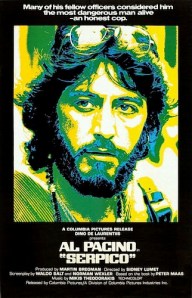 Before Murder on the Orient Express or Dog Day Afternoon, Sidney Lumet directed this true story about a New York cop battling corruption.
Noting it’s a true story, it certainly has a biographical feel. That came as a bit of a surprise, to me at least — I was expecting a thriller about a good cop exposing the corrupt ones, but instead got Frank Serpico’s life story from the time he left training on. It’s not as if it just deals with his professional career — say, showing how his early days formed his moral compass, or something — there’s lots of screen time devoted to his personal relationships too, which may or may not have been relevant to his work. More than a corrupt cop thriller, it’s a biopic about someone involved in that world.
This focus on reality begs one question: just how much is it based in the truth? It makes an uncommonly high claim to reality by including all this near-extraneous detail, but typically “true life” stories, especially those made quickly after the real events, fictionalise things for one reason or another. It wouldn’t matter if it didn’t effect the quality of the film, but I think it does: it feels a bit sloppy at times; kind of disjointed. The timeline jumps forward almost at random; things occasionally seem to go by half explained; there’s no clear throughline… This all plays into the feeling of it being like real life, where nothing — certainly not a police investigation — is as simple or straightforward as it’s usually made out to be for the movies. Which has its pros and its cons.
 As the titular copper, it’s a typically strong performance from Al Pacino. Not his best work — I don’t think the part really gives him enough to deliver that — but he’s more often than not the most engaging element of the film. This was his fifth film; considering The Godfather was just his third, and he followed this up with Part II and Dog Day Afternoon, it’s easy to see why he’s long been regarded as a Great Actor.
I feel like Serpico used to come up fairly often as a minor classic; the kind of film not a lot of people have seen these days but many more should have; but I don’t feel like I hear it mentioned any more. Obviously this is just a perception and maybe it’s a load of rubbish, but I’m afraid I side a little more with the latter-day less-mentioned side of things.
I would say it feels rather worthy, at least in part for the things I’ve mentioned about its claims to truth. It’s an interesting, sometimes compelling film, but I wouldn’t say I enjoyed or liked it. “Enjoy” is an awkward word — you wouldn’t typically say you “enjoy” Schindler’s List, but you do (you could say) enjoy its greatness. I didn’t enjoy Serpico in the way you would typically say you enjoyed something; nor did I enjoy it in a Schindler’s List way; nor did I really admire it, again for the reasons levelled above. But it has elements of interest nonetheless.

 Lewis Gilbert is the director of
 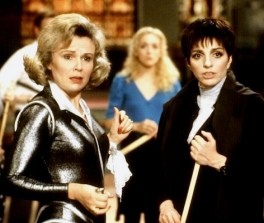 The standout from the cast is probably Julie Walters, in a relatively early big-screen role. Considering how well-known she is now she seems quite lowly billed and little-featured, but bearing in mind this is a US production from the early ’90s, it’s less surprising. She’s very good (isn’t she always?) as the group’s newest member, a posh English lady who sticks her oar in and is a bit too blunt with her comments. I seem to remember her generating most of the laughs in this comedy-drama, although that’s not to disparage anyone else’s work.
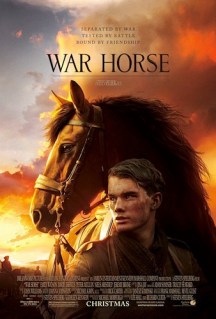 After decades telling tales from the Second World War, Spielberg moves back a conflict. That said, the BD’s special features make sure to point out this “is not his First World War movie” — it’s just a good tale about a boy and his horse.
 It can’t be denied that there’s factual inaccuracy here (the climax takes place at the Somme in the lead up to Armistice Day in 1918, but that battle was actually fought in 1916), or the occasional heavy dose of sentimentality (it’s directed by Spielberg and co-penned by Richard Curtis — what did you expect?), but I think it carries through these with a scale and heart that is, primarily, entertaining. It is based on a children’s novel and I think aims to be a family film (it should by rights be a PG; my twitter rant on that subject is
  Aiding the sense of the epic is Janusz Kaminski’s cinematography, which is regularly stunning and definitely one of the film’s standout achievements. The beauty of some shots is immediately obvious — he lenses the countryside idyll of Dartmoor in a sweeping fashion, bathed in summer sunlight — but there are striking compositions to be found throughout, be they in close-ups, cavalry charges, horse auctions, battlefield hospitals… There’s often a lovely texture to things too, from the likes of drifting snow or chaff, or the way light streaks across a room. The final scene, fully tinted orange, calls to mind the likes of
 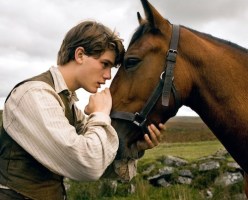 one that isn’t afraid to depict some of the nastier realities of the world, but in a way that makes them relatable for a younger audience. I think that’s important; but this isn’t a Worthy Film for that, it’s just something it does well. I think it also nails sensations of adventure and, yes, sentimentality.
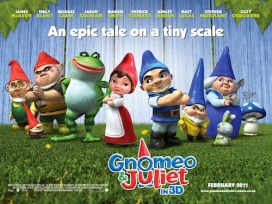 Gnomeo & Juliet is the latest British attempt to crack the lucrative CGI animated kids’ movie market, after the lack of success (or, alternatively, failure) from the likes of
 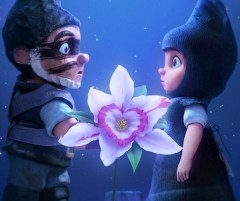 My only other note is that it ends with a truly awful cover of Crocodile Rock by Nelly Furtado. A storyboarded “all’s well that ends well” ending (included on the BD, and the DVD for all I know) looks much better.
 Following the surprise success of
  Hitler (aka Bruno Ganz) and a cool exit; a really good car chase; and a couple of solid punch-ups, including a particularly good one at the climax.
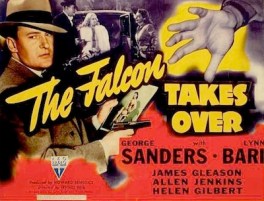 Quite outside of the Falcon film series, this third entry is notable for being the first screen adaptation of a Raymond Chandler novel. Ditching Chandler’s then-unknown Philip Marlowe in favour of the Falcon in the lead role, this is a version of the character’s second mystery, Farewell, My Lovely — which would be
  As usual, it doesn’t have the same je ne sais quoi that makes the Saint films particularly entertaining (yeah, you know I mean wit); and I can well believe it has “
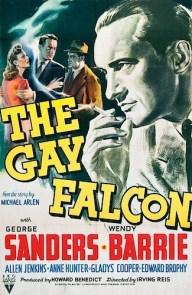 Worried about the cost of renewing the licence to popular hero the Saint, RKO instead acquired Michael Arlen’s the Falcon and essentially modelled him as a replacement, much to the chagrin of Saint creator Leslie Charteris. And who can blame him? They even cast the star of the Saint, George Sanders. Cheeky.
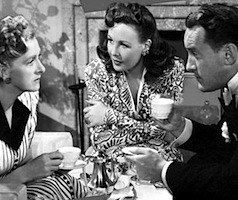 The story (the only one in the series adapted from a work by Arlen) is a solid mystery about jewellery thieves, which doesn’t seem to have quite the scale of the Saint films. Those were often contained to one city, but they felt somehow grander, like the schemes being foiled were of broad significance; here, it’s basically work for the police. To put it another way, if there was always the sensation that the Saint was an anterior James Bond, you could say the Falcon is more like Sherlock Holmes.
 The Gay Falcon makes for solid enough entertainment, mixing thrills with humour to decent effect. But despite attempts to emulate it, not least with the same leading man and woman, it’s no the Saint — they’ve not injected Gay Laurence with quite the same way with words and the supporting cast lacks a Teal or ‘Pearly’ Gates type to really make it click. Whether future entries stray further from Arlen’s original and more into Saint territory, or not, remains to be seen.
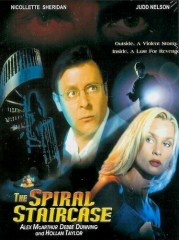


 A couple of years ago I discovered the ’40s Gothic noir thriller
  There are about three suspects in the entire tale. One is so clearly being set up from the off that you know it can’t be him; one barely even registers as a suspect; and it’s not the third one. But the film doesn’t pull off a twist because the attempt (by dragging that middle character back into it) comes so out of the blue as to make no sense. They don’t even bother to try to explain it properly! It’s about the only time the film holds back on painful over-exposition, and it’s about the only time it needs it. Either way, it’s not the same as the original film’s, and it’s not as good.
 The original story is clearly suited to a Gothic historical setting (the ’40s film didn’t keep the novel’s time period, but it chose one similar enough), but that doesn’t mean a modern-set rendition isn’t without potential. Or maybe it is — it’s hard to be certain from a movie that certainly doesn’t realise what potential there may be. Yet for all its countless weaknesses, I can’t quite bring myself to entirely despise it. Can I really give this wholly derivative remake 2 stars? It may be some kind of Stockholm Syndrome — after 90 minutes with it, I can’t help but find some point in it all; some thing to like.
 There are a few Oscar nominees from the ’00s that inspire little desire in me to bother seeing them (I’m certain that’s completely true of every era, but I’ve seen most of the ’00s nominees so I tend to focus on them more often), meaning it’s taking me a very long time to get round to them (maybe I never will). Master and Commander isn’t really one of those — it’s no
 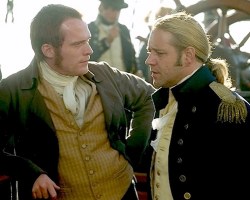 he’s not a naval man and doesn’t always understand their traditions. He’s not a crass audience-cipher in the way such parts often can be, but it does make him identifiable.
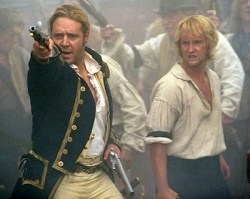 (that makes for a strangely bizarre array of company logos at the start). Despite the fact it’s based on a series of 20 (completed) books, and various people involved have mentioned the possibility down the years, a sequel is so unlikely it seems silly calling it just “unlikely”. And that’s a shame, because this is an entertaining action-drama with likeable characters and an engrossing atmosphere. A little to my surprise, I loved it.
 100Films.co.uk