
Andrew Dominik | 160 mins | Blu-ray | 2.40:1 | USA, Canada & UK / English | 15 / R
 September 1881: after admiring their leader for years through cheap magazine stories, 19-year-old Robert Ford manages to hook up with the James Gang. Little does he suspect that, just seven months later, he will be responsible for the murder of his idol, Jesse James. (That’s not a spoiler, it’s in the title.)
Ultimately released in 2007, The Assassination of Jesse James by the Coward Robert Ford found itself going head-to-head in the awards season with No Country for Old Men and There Will Be Blood. The accepted narrative of that time is about the two-horse-race between the latter two, though Jesse James fits with them in some kind of thematic and stylistic triumvirate: they’re all products of what I’d call “American mainstream art house” cinema; all classifiable as Westerns, though none in a strictly traditional sense; all more concerned with their characters and their lives than the machinations of the plot. In the end, No Country garnered most of the awards, There Will Be Blood seems to have settled in as a critical darling, but, for my money, this purest Western of the three is by far the best.
I’m not going to waste much time making direct comparisons between the three films. I suspect there’s an article in that, if someone hasn’t written it already, but it’s not one I have much interest in penning: I don’t think I’ve made much secret of my distaste for the Coen and Anderson efforts in this little threesome, both being films I never really engaged with and certainly didn’t enjoy (in fairness, I should give Blood a second shot, but even the idea of sitting through No Country again makes me shudder). The Assassination of Jesse James, however, is a film I both engaged with and enjoyed greatly.
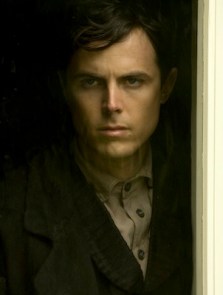 Let’s be clear, though: this is not a film for everyone. This is not an action movie set in the Wild West, which might be what’s expected from a Hollywood studio movie starring Brad Pitt. Apparently director Andrew Dominik intended to make a film with a Terence Malick vibe, so I read after viewing, which chimed with me because “Malick-esque” was one of my foremost thoughts during viewing. This is a slowly-paced two-hours-and-forty-minutes, with more shots of crops blowing gently in the breeze or riders approaching gradually over distant hills as there are flashes of violence. Despite what the studio wanted, this is not a fast-paced action Western, it’s a considered, sometimes meditative, exploration of character and theme.
The character explored is not particularly Jesse James, but Robert Ford. As the latter, Casey Affleck was largely put forward for Supporting Actor awards, which does him a disservice — the film is largely told from Ford’s perspective, and though there are asides where it follows James or other members of the gang, it begins with Ford’s arrival and ends with his departure from this world. Affleck is superb in a quiet but nuanced performance, which I would say ranges wildly without ever appearing to change. At times he is cocky and self-sure, at others cowardly and defensive, often creepy and occasionally likeable, sometimes both worldly and naïve, a perpetual wannabe who even when he achieves something is still poorly viewed. You might think the title is stating its position on him, but it really isn’t — it’s a position to be considered, a point of contrast to the man’s motives and actions; a statement that is in fact a question.
Conversely, Pitt’s Jesse James is closer to a supporting role. We see him primarily through the eyes of others; he is distant, unknowable, his moods and actions unpredictable thanks to years of law-dodging that’s led to a paranoia about his own men — not all of it misplaced.  Jesse’s mood swings are more obvious than Ford’s, but Pitt makes them no less unlikely. At times charming and a clear leader, at others he is a genuinely tense, frightening presence, without ever needing to resort to the grandstanding horror-movie grotesques offered by (Oscar winners) Daniel Day-Lewis and Javier Bardem in There Will Be Blood and No Country respectively.
Though there are other memorable and striking performances — particularly from Sam Rockwell, Paul Schneider, and a pre-fame Jeremy Renner; plus a precise, perfectly-pitched, occasional voiceover narration from Hugh Ross (who doesn’t have many credits to his name but surely deserves some more now) — the third lead is Roger Deakins and his stunning cinematography. There are many clichés to use for good-looking films, and the vast majority of the time they are trotted out as what they are and not really meant. Jesse James, however, is one most could be applied to with total accuracy. For example, there are very few — if any — films where you could genuinely take any frame and hang it as a perfect photograph; but if there is one where you could, this is it.
Deakins has reportedly said that “the arrival of the train in darkness is one of the high watermarks of his career”, and he’s right to think that. It’s a glorious sequence, made up of several shots where every one is perfectly composed and lit to create a remarkable ambience and beauty, as well as telling the story, which in this instance involves as much creation of suspense as eliciting pure artistic appreciation. Deakins did take home a few awards for his work here, but not the Oscar. I can’t remember which film did win and, frankly, I don’t care, because whichever it was this outclasses it by miles.
 This must also be thanks in part to director Andrew Dominik. Every last shot feels precisely chosen and paced. Of course, every shot in every film has been chosen and placed where it is, but the amount of thought that’s gone into that might vary. Jesse James somehow carries extra weight in this department, with no frame in its not-inconsiderable running time wasted on an unnecessary angle or take that’s allowed to run even a second too long. Somewhat famously, there was a lot of wrangling over the film’s final cut (delaying its release by a year or more), with the aforementioned debate between something faster and something even slower: a four-hour version screened at the Venice Film Festival, to a strong reception. Sadly, the intervening years haven’t seen that cut, or any of its parts, resurface (to my knowledge). That’s an hour and twenty minutes of material and I’d love to know what’s in them.
One thing in there, I’d wager, would be the performances of Mary-Louise Parker and Zooey Deschanel. Both their characters have a tiny presence in the finished product, and while that may be fine for the overall story (some would criticise how much female characters are sidelined, but that’s another debate), casting two moderately major actresses creates a disjunct with the size of their roles. I was going to say this is one of the film’s few flaws, but it’s debatable if it even qualifies as that: if they’d cast less recognisable faces, their lack of presence would pass by unnoticed.
The other thread I mentioned, seven paragraphs ago, was “theme”. The film has a lot of concurrent aspects one might consider — “loyalty” being a major one, for instance — but I think the biggest is “celebrity”. Not in the modern sense, though I’m sure there are analogies for those that wish. To pick up on what I was saying before: Ford is the main character, and the main thing he wants, even if he doesn’t realise it, is fame. He joins the James Gang because he’s enamoured with the adventurous tales he’s read; 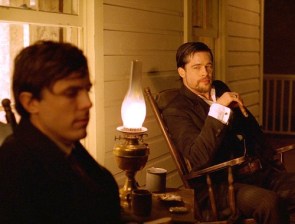 because he’s obsessed with the notoriety of Jesse. Later, once the titular deed is done, he becomes an actor (not without talent, as the narration informs us) and re-performs the act that made him famous hundreds of times. It’s his legacy, however, to not be as well-remembered as his victim; to not be as well-liked, even; not even close. There’s something there about the pursuit of fame for its own sake, if nothing else.
It’s difficult to call any film “perfect”. Certainly, there would be plenty of viewers who would consider The Assassination of Jesse James to be an overlong bore. Each to their own, and I do have sympathy with such perspectives because there are acclaimed films that I’ve certainly found to be both overlong and boring. Not this one, though. From the constant beauty of Deakins’ cinematography, to the accomplished performances, to the insightful and considered story (not to mention that it’s been cited as the most historically accurate version of events yet filmed), there are endless delights here. As time wears on and awards victors fade, it deserves to elbow its way back into the debate for the best film of the ’00s.

The UK TV premiere of The Assassination of Jesse James by the Coward Robert Ford is on ITV4 tonight at 10pm. It’s screening again tomorrow at 11pm.
It placed 3rd on my list of The Ten Best Films I Saw For the First Time in 2013, which can be read in full here.
 Directed by the inestimable Billy Wilder, winner of the Grand Prix (forerunner to the Palme d’Or) at the first Cannes, winner of the Best Picture Oscar in 1946, and also Best Actor, Director, and Screenplay, it’s a wonder that The Lost Weekend isn’t better known. I don’t think I’d even heard of it until Masters of Cinema announced their Blu-ray release
 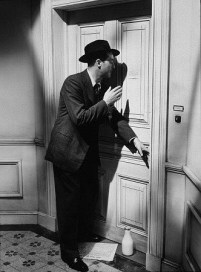 all of them thwarted at the last possible moment, when victory seems assured. The film isn’t preachy, but if it does teach us a lesson then this is how it does it.
 Milland is astounding. The film rides on him and he really carries it. It’s easy to play a comic drunk, but Milland doesn’t sink to that. Indeed he doesn’t do one type of drunk at all, swaying back and forth across various levels of inebriation as required. I often find films of this era contain performances we assess as great, but if you put them in a film today no one would buy it; they’d find it stagey and fake. Milland’s transcends that — it fits the era, but I wouldn’t be surprised to find it would play just as potently today. I think it’s fair to say that Milland is not widely known today, but with every film of his I become more convinced that history has been unkind.
 There’s also able support from Howard Da Silva as barman Nat and Doris Dowling as Gloria (is she a whore of some kind? Just an escort? A bar-crawler? Did I miss something?), whose slang is oddly infectious. No offence to Jane Wyman, but her lovelorn-but-strong girlfriend character only seems to really come alive in the closing minutes, when she considers abandoning Birnam to his fate.
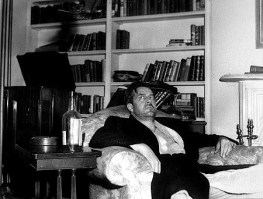 but from what I do know of other conditions of addiction and mental health, this feels as if it’s still thoroughly relevant.
 After
After  The fourth Harry Potter film is the pivot around which the series revolves, in oh so many ways. Most obviously, it’s book 4 of 7 — the halfway point. It’s also where the books switch from short ‘children’s novel’ lengths to the huge tomes they eventually became. More importantly, it’s the instalment on which the overarching plot of the entire series hangs. Although each previous entry in the Potter canon contributed something to the mythology (even if sometimes its significance wouldn’t become apparent until much later), they’re still viewable as discrete adventures. So too is Goblet of Fire, for the most part — the exception being its final act, which kicks off the story that will consume the rest of the series.
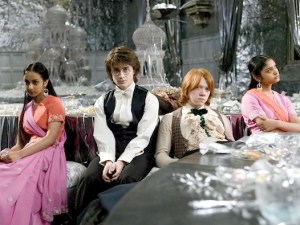 It makes sense: at this point the series was moving beyond your stock franchise length of “trilogy” and into less frequently charted waters, amid speculation that the leads would be recast. With Goblet of Fire being the last point you could reasonably pull that off, I imagine it paid to emphasise that these were the same kids — that we see a cast age in more-or-less real time throughout their childhood, including many small supporting roles as well as the leads, is one of the Potter films’ more unique highlights.
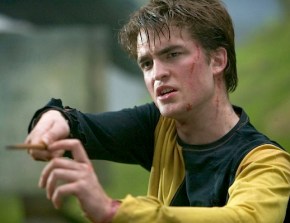 I can’t remember if Diggory’s meant to be a nice guy or an irritating jock, but here he’s played by Robert Pattinson, proving it’s not only his involvement with
 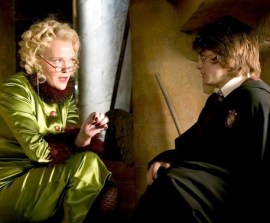 but her Quick-Quotes Quill — which, essentially, just makes stuff up — is present and correct. The next tale,
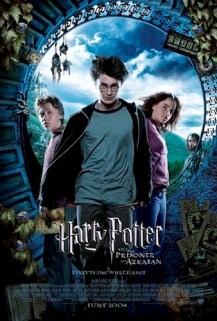 Prisoner of Azkaban marks a significant turning point for the Harry Potter film series. Viewed now, it’s easy to see it as just Episode 3 of 8; a saga still getting underway. At the time, coming off the back of two incredibly successful films, it felt like a grand shake-up of an established formula.
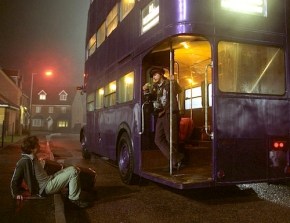 Cuarón and screenwriter Steve Kloves (who would pen every Potter film bar
 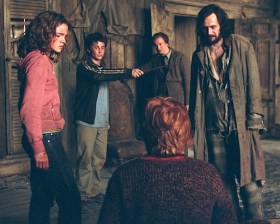 The film series doesn’t treat either of them particularly well compared to the books, but then supporting characters and subplots are the first things to go (quite rightly).
 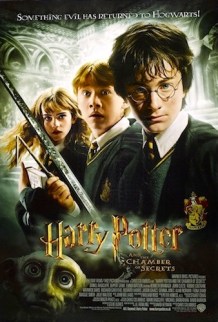 This extended cut takes the already-lengthy second instalment in the Harry Potter franchise and pushes it to nearly three hours (though if you lop off the extensive end credits it’s more like two-and-three-quarters). As with the extended version of
 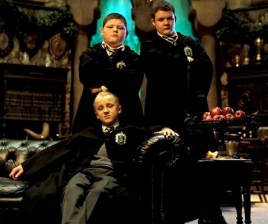 The longest extension comes near the start, when Harry misspeaks while using Floo powder and ends up in the nasty part of Diagon Alley. In the theatrical version he just walks out of the creepy shop, but here he has to hide as Malfoys Senior and Junior enter to sell some items. Though it has the advantage of showing us how Lucius treats his son when out of sight of more respectable wizards, and possibly seeds something for later films (what is the one item Malfoy isn’t prepared to sell?), it dilutes the introduction of Jason Isaacs’ villain, which in the theatrical version came slightly later in the bookshop, where he bumps into Harry, Hermione and the Weasleys as they’re leaving Lockhart’s signing. It’s a more effective, more dramatic introduction to someone who will become a major character as the series progresses.
 There are, arguably, three notable additions to the cast this time out. The first is Lucius Malfoy who, as discussed, will come into his own later. Then there’s Gilderoy Lockhart, a preening wizard celebrity played with relish by Kenneth Branagh. He’s often very amusing and there’s not enough of him. And then there’s Dobby. Apparently Dobby is a beloved character; apparently kids really like him. I’ve always found him intensely irritating, and was surprised how much Rowling made me warm to him in
 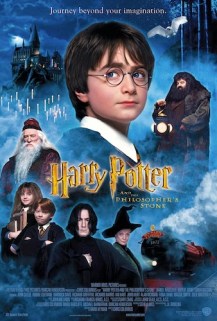 Originally created for the film’s US TV premiere in May 2004, then later released on the film’s Ultimate Edition in 2009 (and not making it to the UK in HD until the Wizard’s Collection last September), this Extended Version of the first Harry Potter film adds six-and-a-half minutes of new bits and bobs to the already lengthy adaptation.
 (See all of that with pictures
  that wasn’t common practice back at the turn of the millennium (unless your name was Ridley Scott), so the filmmakers can’t be blamed for not doing it. As it stands, I think they mostly struck a fair balance between fidelity and the fact it’s an adaptation. Similarly, Columbus’ direction is rarely exemplary, but it’s competent with some memorable moments.
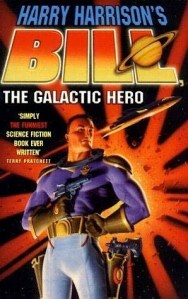 (described by no less than Terry Pratchett as “the funniest science fiction book ever written”), and he’s trying to fund it through
  What’s on offer varies from project to project, of course. In
 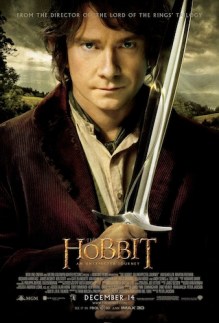 So here we are: nine years after his last tour of duty in Middle-earth, and after a Guillermo del Toro-shaped attempt at not having to serve again, Peter Jackson returns to the world of hobbits, dwarves, elves, orcs, and the rest, to tell the tale some have been clamouring for him to make since
 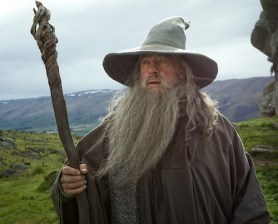 And, I have to say, as someone who hasn’t read the novel since primary school, I couldn’t spot the joins. I could take some guesses, but not many, and considering how long the film is I’m sure there must be quite a lot added.
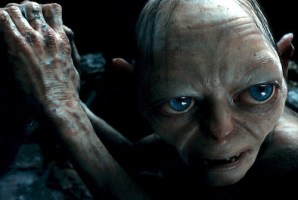 but I could have, and knowing you can do something makes all the difference. There’s also the little timer on the Blu-ray player, which means I can know that it took forty minutes to get out of Bag End rather than just thinking it feels like it. Does that somehow make it more palatable? Would I have been as bothered as others by the film’s length and pacing had I seen it in a cinema initially? It’s tough — nay, impossible — to say, because while there are those other subliminal factors, I also felt like I flat out enjoyed the film for itself, not just for my potential ability to escape it. But it is long and it is episodic, so maybe the association of watching individualistic episodes of TV back to back feeds into the acceptance of that? It’s a circular argument, so we’ll leave it there.
 Howard Shore returns to deliver another fantastic score. After he composed the iconic Fellowship theme for, um, Fellowship, I thought he could never muster anything else as monumental. And, in fairness, that theme is still the defining aspect of the series’ score (its absence here is at times felt, by me at least); but he produced another excellent motif for
 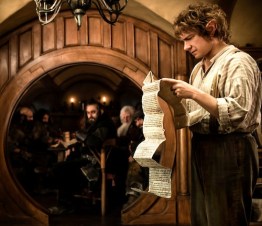 Without the breadth and world-changing story of The Lord of the Rings, The Hobbit was always going to be a somewhat smaller experience. By emphasising the backstory of the dwarves’ stolen homeland and the hints of war-to-come that will ultimately lead in to Rings’ story, Jackson has made it considerably more epic — for good or ill. For me, the whole experience clicked. I don’t think it’s as good as Lord of the Rings, but it is the next best thing.
 100Films.co.uk