
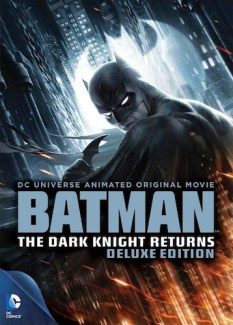
 Warner Premiere’s $7 million animated adaptation of one of the seminal graphic novels is here rejigged from its original two–part release into a single two-and-a-half-hour experience. To persuade those who didn’t make the purchases first time around — and to lure back those who did — the Deluxe Edition Blu-ray also includes a new cast & crew audio commentary and a 79-minute documentary about Frank Miller’s original novel, as well as all the old special features. I don’t normally review editions on here, but in this case it’s relevant.
But before all that, what of the new cut itself? Personally, I felt it worked better as two movies.
Thing is, Miller’s original wasn’t just released as four issues, it’s very much a four-parter: sure, there’s an overarching plot, but each issue/chapter works as a finite unit. In making the transition to the screen, director Jay Oliva and screenwriter Bob Goodman did a great job of adapting two issues at a time to create two complete-feeling films: Part 1 tells the tale of Batman vs the mutants, building to a cliffhanger; Part 2 deals with the fallout of said cliffhanger.
As one long film, it fades to black halfway through and then resumes again. Whole new plot threads suddenly appear that, were this conceived as a single 2½-hour movie, should have been introduced earlier in the running time. The pace goes skwiffy, because it was designed to flow naturally as two distinct movies — action sequences butt up against each other in the middle of the film, 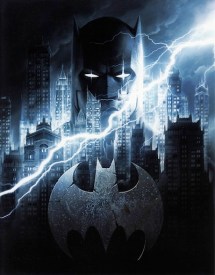 one of which is basically a climax before the halfway mark. Considering Miller’s original structure, that arguably leaves the film with a good three or four climaxes scattered throughout.
I suppose you could count these as nothing more than niggles. Given the choice, I think this adaptation functions better in its original, intended, two-part version; but the single-film version is not fundamentally different to double-billing its constituent parts. (If you want more detailed thoughts on the film itself, you can find my original review of Part 1 here and Part 2 here.)
Though there are aesthetic reasons for choosing to watch The Dark Knight Returns as two separate features, there are several unavoidable reasons why picking up the Deluxe Edition is preferable. For starters, it’s potentially a heckuva lot cheaper. I don’t know how much Parts 1&2 are available for now, but the Deluxe Edition is only slightly more expensive than just one of those halves was when new. That said, from a UK perspective, importing it will cost in the region of £18, whereas Part 1 has already made its way into 2-for-£10 offers, and I’m sure Part 2 can’t be far behind.
Cost aside, the disc — or, rather, discs (two Blu-rays and a feature-only DVD) — themselves present a couple of incentives. Exactly two, in fact, because that’s the number of new special features. Oh, but they’re hefty ones: a feature-length audio commentary by director Jay Oliva, screenwriter Bob Goodman, and voice director Andrea Romano (for some reason the latter doesn’t merit a credit on either the box or the disc’s menu, but she is there); 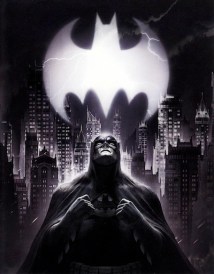 and a feature-length documentary all about the original graphic novel, Masterpiece: Frank Miller’s The Dark Knight Returns. (I’ll review the latter separately at some point. If you like we can debate the line that distinguishes films from TV programmes/DVD special features/etc, but Masterpiece is almost 80 minutes long and begins with the full Warner Bros and DC Comics logos, just like A Proper Film, so I’m goin’ there.)
For the completist, all the original special features are also ported over. That’s five featurettes totalling almost two hours, delving into: the character of Carrie Kelly (aka Robin), the Joker, the film’s depiction of Superman vs Batman, the story of Batman’s creator Bob Kane, and a lengthy exploration of the adaptation and animation process with director Oliva, in a kind of Maximum Movie Mode style (though for 43½ minutes rather than the entire film — though that’s not to be sniffed at, is it?) There’s also five additional animation episodes from the archives (four from the classic Batman: The Animated Series and one from the more recent Batman: The Brave and the Bold). The only stuff that’s gone walkabouts are the Sneak Peek promos, though as they’re all for now-released titles that’s hardly a major loss (though as they constitute mini-featurettes rather than pure trailers, some completists may feel a mild tang of disappointment). All-in, you’re looking at 7½ hours of special features to complement your 2½-hour film, something even the most hardened whinge-happy fanboy would struggle to complain about.
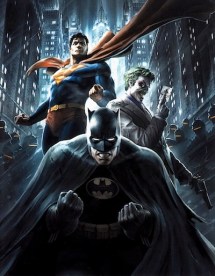 While I’ll continue to champion viewing the two halves of The Dark Knight Returns as separate movies, this single-film version is far from a travesty. If you’ve already got the separate releases, it definitely isn’t worth picking this up just for the film; so a purchase depends on how much value you place on the commentary and Masterpiece documentary (oh, and four art cards found in the box, which I’ve used to illustrate this review). If you don’t own the existing releases then whichever way works out as most cost-effective (bearing in mind which extras can be found where, of course) is the way to go.

Batman: The Dark Knight Returns – Deluxe Edition is currently available in the US on DVD and Blu-ray as a Best Buy exclusive, but goes on wide release from next Tuesday, 8th October.
* Technically the BBFC haven’t classified this single-film version, but the two halves each received a 15. ^
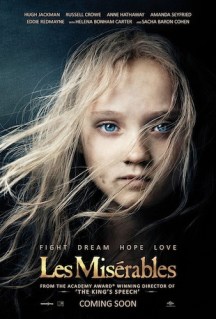 27 years after its West End debut, the long-running smash-hit musical finally makes the leap to the big screen. Such a beloved work paired with a recently Oscar-winning director and an all-star cast was pretty much a dead cert for big-name awards nominations, and so it was to be; but critical reaction was more mixed: I’ve seen people who love the film unreservedly, and others who despise it with a passion.
 Despite its running time, Les Mis is quite brisk for much of that plot (which, sorry if you’ve never seen it, I have described a fair old chunk of). There’s no interval in the film, but on stage it doesn’t come until well into the Paris section of the tale. Such a break must help the pacing, because while I remember enjoying it all on stage (where, I might add, it’s even longer), on screen I felt the middle portion began to drag. So yes, an epic running time for an epic, but it actually moves quickly through the parts that make it an epic before slowing for a bit of a forced romance and that kind of palaver.
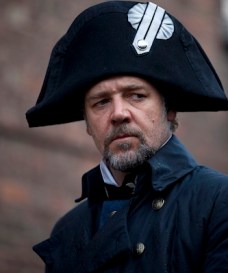 Much talk around Les Mis focused on the performances, with three in particular attracting discussion. As honourable wronged-man Valjean, Jackman is the star of the show, and brings his musical theatre background to bear on a clearly-sung but emotive performance. He was unlucky to be in the same awards year as Daniel Day-Lewis’ all-conquering turn in
 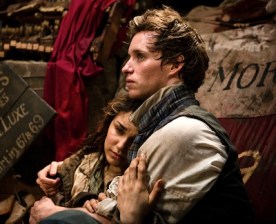 The rest of the cast is an assortment from the can-sing (Eddie Redmayne, Amanda Seyfried) to the comedic-so-it-doesn’t-matter (Sacha Baron Cohen, Helena Bonham Carter). The best voice of the lot belongs to Samantha Barks as Eponine. No surprise, really, as she was poached from the West End… where she’d found herself via one of Andrew Lloyd Webber’s BBC talent shows, so I imagine he feels thoroughly vindicated now (as if he didn’t before).
 Hooper does an above-average job on the whole, but the lack of awards nods shouldn’t be so surprising.
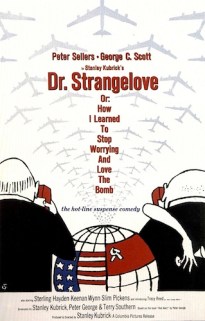 There are few things as weird (or, at least, weird in quite the same way) as watching an acclaimed and beloved classic film and… just not getting it. Here’s a paragon of moviemaking; a film that is not only exalted but, crucially, has remained in people’s affections against the forces of age; a thing that has truly stood the test of time… and yet… meh.
 In the end, I felt like I just didn’t get it. Not that I was watching something bad and I couldn’t fathom why so many people loved it, but that I just didn’t understand what it was I was meant to be seeing. Which is perhaps the same thing. I mean, I can see Kubrick was making an anti-war point at least as much as he was trying to make people laugh, but what do turgid sequences of people reading out numbers and flicking switches contribute to either of those aims? Perhaps the joke is meant to be in how long it goes on for? Like
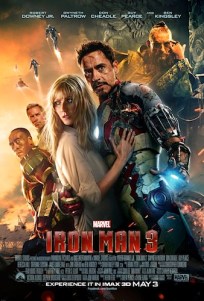 Some have described Iron Man 3 (or, as the onscreen title would have it, Iron Man Three) as “the best Iron Man yet”, even better than the exalted
  and ends it as… a wisecracking show-off partying womanising superhero. Film 2 and even The Avengers don’t take him a great deal further, arguably, but here he’s pushed. He still behaves recklessly, because that’s what he’s used to doing, but then the consequences of that recklessness — when he has something he cares about — are brought home. Literally.
 as to why S.H.I.E.L.D. and the super-friends aren’t sticking their noses in, so instead we have a problem on a grand scale, yes, but one for Stark/Iron Man to tackle on his lonesome.
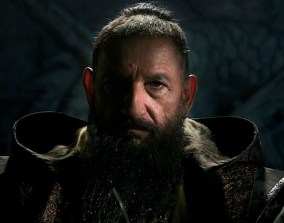 Ah, the Mandarin. He’s Iron Man’s big bad; the guy fans have been asking about since before the first film. I don’t know much about him, but I believe in the comics he’s some kind of magician — doesn’t sit well with the film series’ more sci-fi leanings, even after we’ve seen Iron Man meet the likes of Thor. Here, the Mandarin is reconfigured as a terrorist; a very powerful one, spreading his message by taking over US airwaves… and blowing things up as well, naturally. But there’s a twist to him, which I won’t discuss here; beyond to say that, even though I saw it coming (helped, I admit, by everyone saying “there’s a twist to the Mandarin!”), I thought it was quite brilliantly done. Ben Kingsley is magnificent.
 In the grand scheme of things, I still think that’s a minor complaint. Indeed, any issues I have with the film are minor complaints, including the slightly elongated first act and the Iron Man-less second one. I think it works for the style the film is aiming at — more of a military-ish spy-ish thriller than a bombastic beat-em-up superhero flick — and that works for me. And, not a complaint, but a minor point: the Actor’s Agent of the Week award goes to whoever represents Stephanie Szostak. I’ve never heard of her and her character’s only really in one sequence, but she’s billed right below the big-name lead cast and above henchman and
  I don’t think there’s much left to do with the character right now. Plus, ending the film with the latest twist on the first movie’s renowned closing declaration is a nice way to round off a series… at least until the inevitable recasting one day.
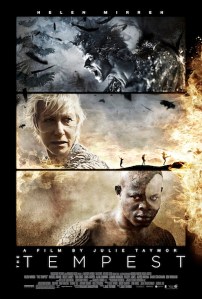 Film and theatre director Julie Taymor (infamous now for Spider-Man: Turn Off the Dark) here brings us a radical-seeming interpretation of Shakespeare’s final play. The main character’s changed gender! There’s CGI being tossed about everywhere! It’s got Russell Brand in it! If that sounds superficial, it is. Taymor’s film is still set in the Elizabethan period, in Elizabethan dress (broadly speaking), with a cast of mostly classical actors, enacted on an island that is admittedly a stunning setting but is nonetheless where the original play is set. If it’s a “modern retelling of William Shakespeare” (per the blurb), it perhaps missed what Baz Luhrmann
 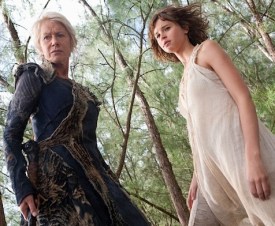 It goes on in the middle, a mess of scenes of characters traipsing about the island for no apparent reason. (This reminded me of
 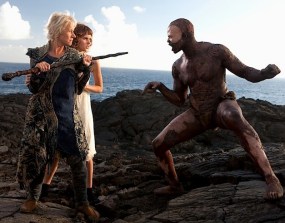 Another key role sees Djimon Hounsou as the slave Caliban, immediately suggesting a colonialist reading that isn’t exactly a huge reach anyway. And Russell Brand makes Shakespeare sound like Russell Brand talking, which at some points I’m not convinced he isn’t (I’ve no idea if Taymor allowed him to stray from the text or not). Love interest is provided by Reeve Carney. I’ve never heard of him, but he’s young and quite pretty and has a music video on the Blu-ray, so I guess he’s from that kind of arena. He speaks with an English accent, but so does everyone else (bar Caliban and the boatswain), so he may still be sourced from the other side of the pond’s teenybopper scene.
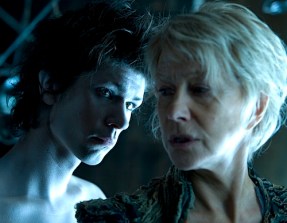 Ariel as a truly spiritual spirit, half invisible and jetting off into the sky on a regular basis. I found his realisation a mixed bag: it’s nice to take advantage of the medium to render the spirit in a way that’s impossible on stage, but sometimes it goes a bit far and looks a bit cheap. They’ve also tried to make him androgynous, but done it a bit weirdly: he’s always naked, occasionally making it clear he has no penis, sometimes has small breasts, but always has a moderately deep, clearly manly voice. Show it to a class of teenagers studying the play and you may illicit some confused feelings… That aside, the make-up effects are brilliant. Caliban’s patchwork skin is the best piece of work, but Ariel’s rendering as a giant crow is a fearsome sight as well. For all I know the latter may count as costume design, which is what earnt the film an Oscar nomination. But, hey, the clothes are nice too.
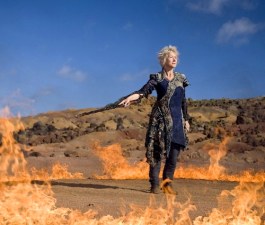 It would be nice to say the magic and fantasy could convert new fans to Shakespeare, much as Leo DiCaprio and swishy editing did for teens nearly two decades ago, but there’s nothing beyond that trailer-friendly neat-looking stuff to convince them it was worth their time. Meanwhile, Shakespeare traditionalists may find it all a bit much. If that leaves it stranded on an ill-located isle of terrible beauty, then at least it’s an apt fate.
 #63 Bicycle Thieves, aka Ladri di biciclette (1948)
 The flip side is that, for me, the summer movie season is about to begin! That should help with the aforementioned final tally. Thanks to studios’ (wannabe-)piracy-beating speed when it comes to getting films onto disc these days,
  In researching this list I was surprised to discover a few films I didn’t know were adaptations. That might be a good list for another time, though that list, and this one, could be almost entirely filled by a single franchise: Die Hard. While the first film is based on
 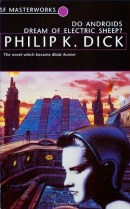 As evocative as the title of
 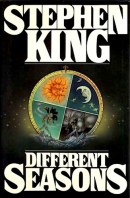 Just as prone to retitling as Dick is Stephen King. Oh sure, there’s Carrie and The Shining and, y’know,
 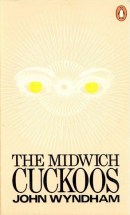 Aww, a nice
 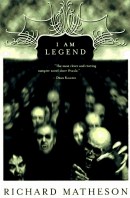 “But there is
  Despite having one of the most glaringly French titles ever committed to paper or celluloid,
 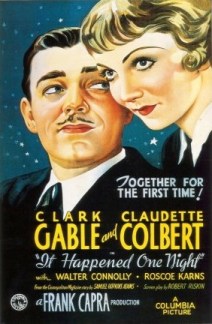 It Happened One Night was the first film to win the Oscar “grand slam” (Best Picture, Actor, Actress, Director, Screenplay), and is still one of the few to have won everything it was nominated for (alongside
 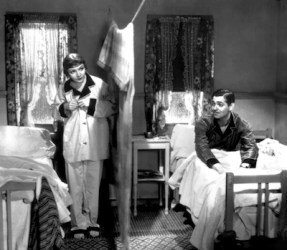 The Walls of Jericho running motif is also nicely executed, leading to perhaps the sauciest final scene not to feature a single shot of human beings that I can think of.
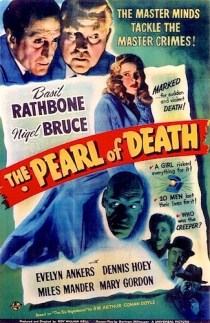 The Pearl of Death is one of the better-regarded films of the Basil Rathbone Sherlock Holmes canon, but somehow it didn’t quite click for me. That doesn’t meant there isn’t a lot to enjoy, however.
 Elsewhere, Nigel Bruce gets to indulge in a slapsticky scene that, as ever, people who dislike this interpretation of Watson would be happy to do without. Also worth noting is the female lead, British actress Evelyn Ankers: she was a regular fixture of Universal’s horror features, terrorised in no less than
 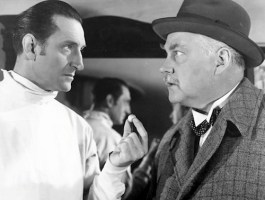 Neill somehow managed to pick one of the least dramatic. Neither of these reveal fudges are ruinous, of course, and are outweighed by the handling of sequences like Holmes setting off the museum’s alarm, the ensuing robbery, the villains stalking round a potential victim’s house, and so on. Still, I was surprised to find them so wanting.
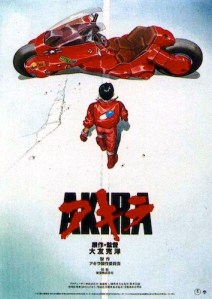 For many Westerners of a certain generation, Akira was their first (conscious) exposure to anime. Not so me: a step or two down,
 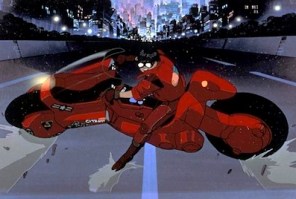 The visuals remain something to be savoured; they’re probably the film’s strongest point, in my opinion. Akira was an expensive production and it pays off on screen. It’s not just the bike chases that I appreciated either, while an extra decade of experience made the ending a bit less freakish! The other strong point is the audio. The BD’s booklet goes on about “hypersonic” sound. I’ve no idea if that worked on my system, but it sounded fantastic regardless.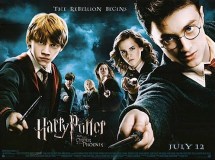


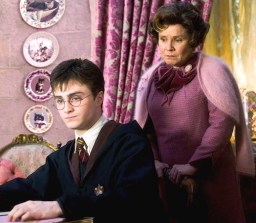 Their main weapon is Dolores Umbridge, perhaps the series’ most despicable villain, because she is so horrendously plausible. She seems to be all sweetness and light, but it masks a dangerous streak that sees her eliminate any fun from the school and, in one of the most sadistic sequences in either the novels or the films, she has Harry write lines with a magic quill that cuts each one into the skin of his left hand. The Potter series actually has its share of nuanced villains, but Umbridge is thoroughly unlikeable. Though she’s defeated and carted off at the end of Phoenix, she resurfaces in
 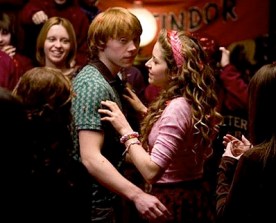 But not so. Yates approached his follow-up with a stated aim of introducing more comedy, believing the three leads to be talented in that area but not having had a chance to show it in his dour first film. So here we get a whole subplot given over to Ron’s attempts to join the Quidditch team, as well as much focus on the trio’s romantic entanglements — teenage love always being a good topic for humour. The film is not without its dark side, but peppered liberally throughout are those comedic subplots and scenes that are liable to see the viewer laugh perhaps more than in any other Potter film. It’s easy to miss this element — the main plot is, as always, getting darker and more serious — but once it’s been highlighted (as the makers do in the film’s special features) I think it becomes very noticeable.
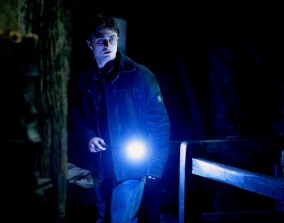 grading the film in perfectly-calibrated conditions so they can really push it to extremes, not considering how most end-users will view it; and, much like fast-cut action scenes, an over-familiarity with the material that means the director/editor/grader can see what’s going on because they’ve watched it dozens (or hundreds) of times, which doesn’t work for a first-time viewer in the middle of the film. As you may be able to guess, I’m not a fan.
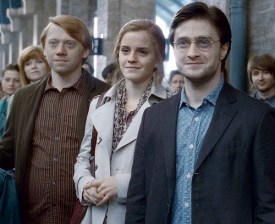 not a sudden smash-cut to a few decades on where we see how some characters’ lives have developed. I know some people complain about
 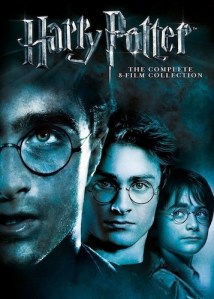 It’s hard to offer a final summary of the Harry Potter series. Some people see them as mediocre and overblown; for others, they are their life. Personally, I think they develop from sometimes-uncertain roots in the early films, to a flourishing series of epic fantasy movies. There are often niggles of one kind or another, be it acting (I forgot to discuss Emma Watson’s eyebrows!), or cartoonish designs, or too-faithful adaptation, or abbreviated adaptation, or what have you — but none of these are ever-present. More importantly, every film offers something to enjoy, and the growing maturity — of not only the cast, but also the filmmaking — means their impact only increases when viewed as an entire eight-film saga.
 100Films.co.uk