
Tim Burton | 109 mins | streaming (HD) | 16:9 | USA & Australia / English | 12 / PG-13
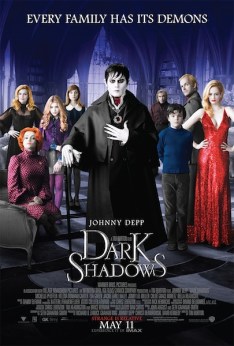 Director Tim Burton’s most recent live-action movie is an adaptation of a 1960s soap opera… albeit one featuring vampires, witches, ghosts and sundry other supernatural goings-on. You wouldn’t get that on EastEnders (more’s the pity).
In the mid 18th Century, the Collins family leaves Liverpool for the New World, setting up a successful fishing empire and their own town, Collinsport. The son Barnabas (Johnny Depp) has a fling with the maid, Angelique (Eva Green), before laying his affections on Josette (Bella Heathcote). Little does he know, Angelique is a witch, who kills Josette, turns Barnabas into a vampire, and goads the townsfolk into burying him alive. As you do.
Fastforward 200 years to 1972, where young Victoria Winters (also Heathcote) arrives in Collinsport to become governess for the still-surviving Collins family’s youngest. The fishing business is failing, the mansion crumbling, and the family (Michelle Pfeiffer, Jonny Lee Miller, Chloë Grace Moretz, Gully McGrath, plus live-in psychologist Helena Bonham Carter and handyman Jackie Earle Haley) are a collection of odd-sorts. Then Barnabas’ coffin is dug up, resurrecting him, and… Oh, look, I’m basically telling you the whole movie now. It’s quite hard to provide a summary of the introduction to the plot, because there’s actually rather a lot going on.
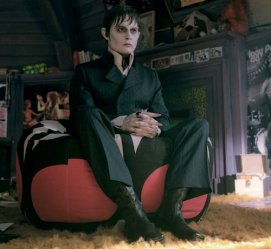 Early on, it works. The first 20 to 30 minutes offer a serviceable prologue and an engaging introduction to most of the characters. It’s funny, it’s occasionally spooky, there’s a good deal of promise for a marginally-more-serious Addams Family-cum-Edward Scissorhands fantasy (I did say “marginally”). All in all, it’s a skilful and cohesive opening, if nonetheless a little Burton-by-numbers. Sadly, the film doesn’t seem to know where to go with it after that.
The story is hard to summarise because it feels like someone tried to cut a year’s worth of a soap into a movie. There are more characters than the film knows what to do with, meaning we get major developments that come literally out of nowhere, plots that are explained rather than seen, others that are introduced only to be wrapped up, and the nagging sense that a lot of material has been deleted.
Standing out from that crowd are Eva Green, who chews the scenery with aplomb, and Bella Heathcote, who grabs her chance to shine among an otherwise starry but phoning-it-in cast. Depp trots out the latest variation on his white-facepainted-weirdo Burton staple; Pfeiffer seems to wish she was back in Stardust or Hairspray; Moretz almost undermines her rising-star status (and is a little too jailbait-y to boot); Jonny Lee Miller battles his American accent almost as much as his character’s lack of purpose; and Helena Bonham Carter is in it as well, obviously.
 It’s a tonal grab bag: at times it seems to be a knowing spoof of daytime soaps, at others pushing for drama almost with a straight face; it’s sometimes deliberately and successfully comedic, at others straining too hard for a desperate laugh; it has a strain of bizarre sexuality that may be aiming at comic but is frequently just uncomfortable. This scrappiness leads to the most cardinal sin of any entertainment: it ends up a bit boring; and, in its out-of-the-blue big-battle climax, crushingly derivative.
Burton has spent almost a decade picking projects that are glaringly obvious choices for him. Perhaps it’s a reaction to Planet of the Apes’ failure; perhaps he’s just as predictable as the “Burton-esque” labelling these projects would likely have received under a different director. Whatever, it seems to have led to an artistically-criminal level of laziness — and I say laziness rather than ineptitude because, for all the project’s predictability, some almost-inspired moments do shine through. Just not often enough.

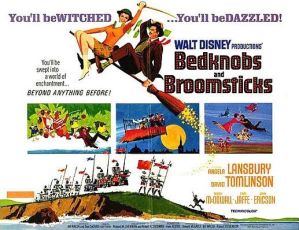 Disney attempted to replicate the success of
 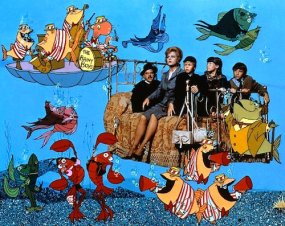 and one that’s mostly animated with our live-action heroes integrated; plus a climax where the good guys defeat one of the world’s great evils, with Poppins’ bankers here switched for the almost-as-bad Nazis. The magical special effects in that final sequence won an Oscar — and well deserved it was too. They look great, definitely holding up today, and it’s actually hard to be sure how they were all achieved.
 It would seem there’s a market in Sweden for series of feature-length crime dramas that begin with a first episode released in cinemas before continuing in regular direct-to-DVD/TV instalments. It’s what happened with the Krister Henriksson
  The specifics of the plot see young university lecturer Puck (Tuva Novotny) invited to spend midsummer on the island home of her supervisor, who’s really asking on behalf of attractive history lecturer Eje (Linus Wahlgren), who Puck has been to a café with three times. A whole gaggle of old chums of Rutger and Eje are also there, including a couple of uninvited guests who arrive out of the blue — and before you know it, Puck finds one of them dead. Eje calls in his chum, detective Christer Wijk (Ola Rapace), and, after the island is cut off from the mainland in a more permanent fashion, the three set about getting to the bottom of things. Cue suspicious actions spied through trees, suspicious conversations partially overheard, suspicious evasion of perfectly reasonable questions, and all the usual suspiciousness you’d expect from a Christie narrative — only subtitled.
 Novotny makes for a likeable lead, though the attempted love triangle between her, Wahlgren and Rapace feels like a non-starter. The biggest surprise is Rapace: previously seen as troubled young copper Stefan Lindman in Wallander and, most famously, as shaven-headed silent assassin Patrice in
 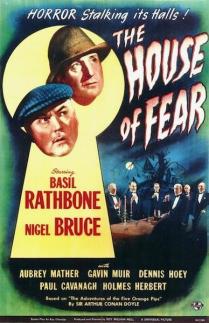 Adapted very loosely from the early Conan Doyle story The Five Orange Pips, this outing for Basil Rathbone’s Sherlock Holmes and Nigel Bruce’s Dr Watson sees them summoned to Scotland to investigate the suspicious deaths of the members of a club, where each killing is preceded by an ominous postal warning.
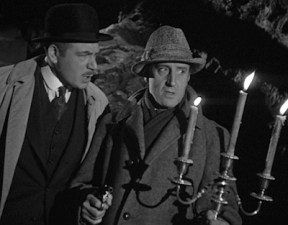 While the club having seven members does mean there’s a fair few suspects, it also means it takes a long time to get through them all being bumped off! It doesn’t sink so low as to be deemed repetitive, but does border it.
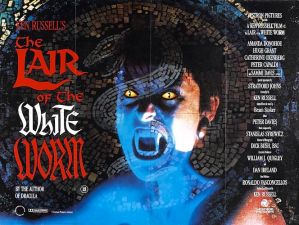 The Lair of the White Worm looks cheap, has a ridiculous story, overacted characters and overcooked dialogue, and by all rights should be a disaster. And maybe it is… but I don’t think so. In the right frame of mind, at any rate, it’s a whale of a time.
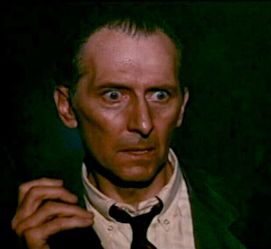
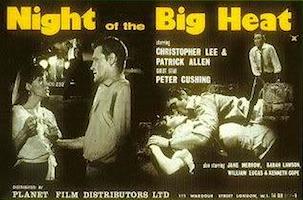 These days largely sold as a horror movie (the old Collector’s Edition DVD is branded as part of a “Masters of Horror” series), probably thanks to its cast (Christopher Lee and Peter Cushing), director (Terence Fisher, of many a Hammer Horror, including five with Cushing and Lee), and rating (an X originally, a 15 now), Night of the Big Heat is not really anything of the sort. Well, maybe a little; but you’re more likely to get scared by a contemporaneous episode of
  the pair were brought in to redraft because the original screenplay’s dialogue was “unsayable”. Anyone familiar with their ’80s work on Doctor Who, and their associated reputation, will find that highly ironic.) However, when the sci-fi stuff does roll in it’s a bit of a damp squib, leaving the scenes relating to the affair, whether it will be discovered, and what various characters do about their various feelings, as some of the more unique and interesting elements.
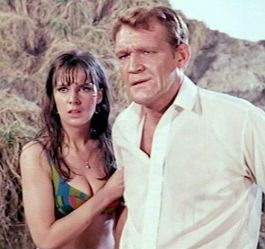 which considering it was shot in February and March is a real achievement. During night shoots the cast had to suck ice to stop their breath being visible, while running around in wet clothing to look like they were drenched in sweat. Poor sods. Said night scenes are a mess of genuine and atmospheric nighttime shooting, alongside the kind of day-for-night filming where everything’s extremely dark except for the sky, and also the kind of day-for-night filming where it’s day and… um… shh!
 Remembered largely thanks to the involvement of Orson Welles (he has a supporting role, produced it, co-wrote it, and reportedly directed a fair bit too, though he denied that), Journey into Fear is an adequate if unsuspenseful World War 2 espionage thriller, redeemed by a strikingly-shot climax. The latter — a rain-drenched shoot-out between opponents edging their way around the outside of a hotel’s upper storey — was surely conducted by Welles; so too several striking compositions earlier in the movie.
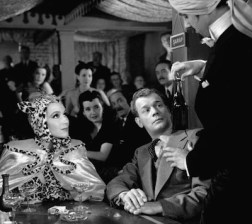 all added by Welles after the studio had their way, which seems to be the one US viewers know. The version without those seems to be the only one shown on UK TV, however.)
 Krister Henriksson returns as the Swedish detective for a third and final series of mysteries, starting with this final theatrically-released episode, based on the final Wallander novel. Yes, there is a sense of finality here — albeit one not reached just yet.
 It’s here that Henriksson gets to show off his acting chops the most. At a dinner party with his family, Wallander largely sits quietly with a drink rather than interact with others, occasionally staring aimlessly into the distance, or only remotely engaging with what the others are doing. He witters about a painting of a goat. Later, he has a disproportionately angry response when his friend brings news that he’s been suspended. He dotes on his granddaughter, but one day loses her and her buggy when he pops into a shop — but finds her quickly enough that no one will be any the wiser. Little signs like this are scattered around, clueing us in to where Wallander will presumably end up: retired from the force, and possibly retired from his life. Whether Mankell brought the issues to a head in his novel or not, I don’t know, but here I can only imagine it will build throughout the series.
 The one thing that really cuts through Kurt’s newfound confusedness is when he gets a nose for a case. Quietly, by himself, he sets about digging in to what’s going on, unearthing evidence that’s been missed by others, piecing it together to complete a picture of long-kept secrets and new crimes committed in the name of keeping them. It resolves into a complex conspiracy, one that touches the lives of altogether innocent people. Is there justice at the end of it? Of a sort, but how satisfying that justice is… well…
 Nicolas Cage fulfils his long-held wish of playing a comic book hero in this peculiar effort from the writer-director of
  Adapted from a Marvel comic, though you can’t really call this a superhero movie: undercover cop Frank Castle’s family are murdered, so he goes after the crime organisation responsible. This is action-thriller territory, not guys in tights fighting.
 100Films.co.uk