
Bryan Singer | 132 mins | Blu-ray | 2.40:1 | USA & UK / English | 12 / PG-13
 I think I’ve previously discussed my life-long love of the X-Men franchise, so I shan’t go into detail again, but suffice to say Days of Future Past has been one of my most-anticipated movies ever since the title (which is that of a classic and influential story from the comics) was announced. Thank goodness, then, that the final result doesn’t disappoint.
After two Wolverine-focused spin-offs and a ’60s-set prequel, Days of Future Past returns us to the world of the original X-Men movie cast — Sirs Patrick Stewart and Ian McKellen and all the rest. Only now it’s a future dystopia, where mutants are killed or imprisoned by giant robots called Sentinels. A gang of former X-Men led by Kitty Pryde (Ellen Page) think they’ve worked out a way to send someone back in time to before the incident that incited this terrible future, so that they can stop it. The man chosen is — of course — Wolverine (Hugh Jackman). Transported back into his 1970s body, Wolverine must find the younger Professor Xavier (James McAvoy), reunite him with an imprisoned younger Magneto (Michael Fassbender), and stop younger Mystique (Jennifer Lawrence) from assassinating the inventor of the Sentinels, Bolivar Trask (Peter Dinklage). Throw in almost every other mutant who’s ever appeared in the extensive ensemble casts of the four previous X-Men movies, and you’ve got yourself an epic — reportedly the second-most-expensive film ever made by 20th Century Fox (after Avatar).
There’s an awful lot going on in Days of Future Past, which, if you want to dig into it, makes for quite a rich film. There’s the obvious need to balance major storylines taking place in both the past and the future, though the latter has been sacrificed to focus on the former — quite literally, in the sense that a subplot centred around Anna Paquin’s Rogue was famously deleted (leaving Paquin with high billing for a three-second cameo). There’s also the inevitable complexity of time travel stories — how do changes in the past impact on the future, etc.  Beyond that, there’s the characters: the younger versions are having to deal with the fall-out from First Class, which tore apart friendships and families; meanwhile, Wolverine is having to deal with a new level of responsibility and maturity — he is, almost literally, having to do for Charles what the professor did for him back in the first X-Men movie.
You wouldn’t think of an X-Men feature being an actors’ movie, and at the end of the day it’s not really, but there’s enough material for a quality actor like McAvoy to sink his teeth into. When we meet him Charles is a disillusioned drug addict, entirely different to the man we know from First Class and his future as Patrick Stewart. He’s forced to face his demons in every way possible: stopping his drugs, accepting his mutant superpowers, facing up to the man who did this to him, and the woman he raised as a sister but who turned on him… None of this is necessary to serve the blockbuster spectacle that the film also excels in, but it makes for deeper viewing than your average 2010s tentpole.
If McAvoy is the star, many of the rest of the cast do alright. As mentioned, Jackman has a bit on his plate as a one-time loner trying to become a teacher. Jennifer Lawrence is best served, the depth of her role no doubt bolstered by her Oscar-winning success elsewhere in the acting world. Although the original story also features Mystique as the antagonist, she’s far less conflicted: it’s a straight-up assassination attempt. The dilemmas that leave her torn between Xavier and Magneto are entirely an invention of the film franchise, but they make for a much more interesting story — it’s genuinely unpredictable what she’ll do and who she’ll side with.
 Not everyone gets to shine in a cast this big, although pretty much everyone gets a moment. The future-set cast have the least to do, people like Halle Berry turning up to do little more than show their face, though Stewart and McKellen get a moment or two worthy of their talents. After he was the focus of the last film, Fassbender is slightly shortchanged here; but after McAvoy gave him essential support in First Class, Fassbender plays the same service here, informing Charles’ journey. Of the new additions, Evan Peters as Quicksilver (that’s the one who’ll also be played by Aaron Taylor-Johnson in Avengers: Age of Ultron) gets both laughs and the film’s stand-out action sequence, as he races around a room, literally faster than a speeding bullet, to save our heroes. Dinklage, on the other hand, is underused. As with Stewart and McKellen, the fact he’s an excellent actor brings extra layers to the little he does have to do, but if you want to see what he can really do you’ll need to get your Game of Thrones box sets back out.
For those that like their blockbusters explosive and adrenaline-pumping rather than character-driven, Days of Future Past doesn’t drop the ball. It kicks off with a mutant vs. Sentinel sequence that innovates with an X-Woman who can create portals. I’m sure this looked grand in 3D, with all that depth disappearing through the other side of the aforementioned gateways. The side effect for us 2D viewers is that Singer is a skilled filmmaker: he does the sensible thing and holds his shots longer, reigning in the fast cutting style of most modern action sequences. That’s essential in 3D, for viewers’ brains to get their bearings, but is a nice change of pace in 2D too.
 Later, there’s the aforementioned ‘slow-mo’ sequence, and the grand climax, which offers more “fly something big around” antics a la First Class’ submarine, only considerably grander. Yet for all the spectacle, the final moments once again come down to character: what is Magneto prepared to do? What is Mystique prepared to do? Will anyone listen to Charles? And so on. Even the much-vaunted Marvel Studios movies tend to base their climaxes in slabs of ‘epic’ CGI crashing into each other; Days of Future Past does that for a bit, then brings the characters back into focus for the real final beats.
By all rights, Days of Future Past should be a mess. There’s too many characters, too many storylines, too many time periods, too much inconsistency in the continuity of the previous films to allow for a time travel-focused story. Actually, in the case of the latter, it’s used to straighten things out a bit: events we saw in The Last Stand are barely acknowledged and, by the end, are completely eradicated. As for the rest, well, turns out everyone involved actually knew what they were doing, in spite of the fears of some fanboys. Those who number certain characters among their favourites may feel ill-served by some cameo-level appearances, but for less wedded viewers, all the roles are well balanced.
Despite the all-franchise team-up, this is First Class 2 as much as it’s X-Men 5, and that’s only right — although it leaves the door open for more adventures featuring the future X-Men, their stories are probably all told. It’s already been confirmed that the next film, X-Men: Apocalypse, will be First Class 3, taking the younger cast into the ’80s and centred on Mystique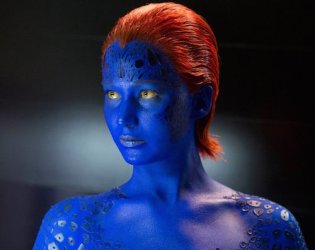 (Jennifer Lawrence being the third pillar of the past triumvirate, as they’ve already focused on Xavier and Magneto). While Days of Future Past does wrap up the majority of its threads (the open-ended ones are answered by previous films, if you want them to be), there’s plenty there to play with in the next film (and, perhaps, ones beyond that) if they want to… which they do.
But that’s for the future. For now, debate can rage over which is the best X-Men film. Personally, I’m just glad that we’re in a situation where there are three or four X-Men movies that are contenders for the crown of, not only the best in the series, but to be among the best comic book movies ever made. And as that’s the genre du jour, it’s an important title to hold. Whether Days of Future Past’s all-eras team-up can best X2 or First Class, I don’t know, but it stands alongside them.

X-Men: Days of Future Past placed 9th on my list of The Ten Best Films I Saw For the First Time in 2014, which can be read in full here.
This review is part of the 100 Films Advent Calendar 2014. Read more here.
 Comic book creator Frank Miller brings what he learnt co-directing
 Westerns don’t come more renowned than this Ford-Wayne collaboration about the years-long hunt for a girl kidnapped by Native Americans.
 Of late there seems to have been a glut of sci-fi films with highly generic, near-meaningless titles —
 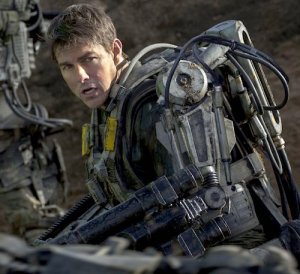 suitably exciting, surprisingly funny, and actually quite clever. It’s also boldly standalone. OK, so it’s an adaptation, but the book is hardly a
  Reflect too heavily and some bits may begin to crumble more but, for me, not too severely.
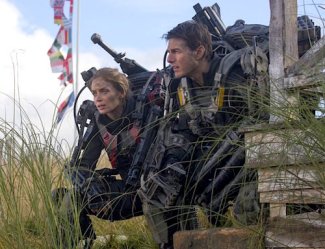 Edge of Tomorrow isn’t an unqualified success, but more than enough of it works to make for a well-above-average modern blockbuster. Excellent action sequences, plenty of amusing asides, and a couple of solid sci-fi concepts to chew on combine to render it quality entertainment. Bonus points for being a true original in a sea of remakes, sequels and spin-offs.
 1988: due to international pressure, Chile’s dictator, General Pinochet, has acquiesced to a vote on whether he should continue ruling the country. Despite the violent takeover he orchestrated, and subsequent murders and ‘disappearances’, the country has prospered under his rule, and many — especially influential affluent people — are keen for him to stay. The anti-Pinochet “no” campaign are allowed a daily slot on state-controlled television in the run up to the election, and they hire advertising exec René Saavedra (Gael García Bernal) to mastermind the campaign. Cue internal conflict — the politicos want dour films highlighting Pinochet’s evil; René wants to use the language of advertising to sell the promise of a happy future — before the campaign itself finally gets underway, and the “no” campaigners become targets of the ruling regime’s evil tactics…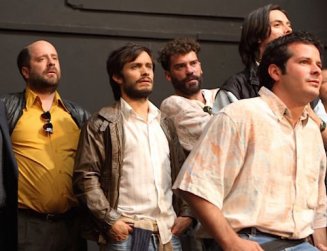
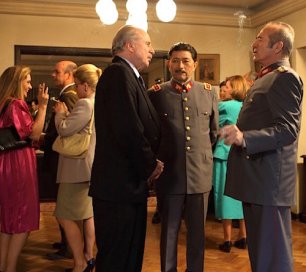 But seriously, there’s not really a comparison between the brutal military regime that ruled Chile — which nonetheless many were happy with because it had brought modernisation and prosperousness for some — and the voluntary union between the rest of the UK and Scotland. I’m sure some of “the 45”, as they now call themselves, would identify with those battling for freedom in this film, but I think that might be taking it a bit far.
 Box office gross is one of the methods most often used to summarise a film’s success and standing, and yet it’s one of the most useless markers of quality — and quotes like the above, from Terrence Rafferty in his article “Holy Terror” for Criterion’s Blu-ray release of Night of the Hunter (and available online
  In another piece in Criterion’s booklet, “Downriver and Heavenward with James Agee” (online
  And yet, as Rafferty explains, “the most radical aspect of The Night of the Hunter… is its sense of humor. More conventional horror movies overdo the solemnity of evil. The monster in The Night of the Hunter is so bad he’s funny. Laughton and Mitchum treat evil with the indignity it deserves.” I wouldn’t say that humour is one of the film’s defining characteristics, to be honest, but it does undercut its villain. He’s not some unstoppable supernatural creature, but a man who can trip over while chasing you up the stairs, and so on. In some respects it’s this very ordinariness that makes him so scary: however much they creep you out during the film itself, you know there’s no such thing as vampires or werewolves or ghosts. There are Powells in the world, though; an everyday evil that you might not see coming, but can still get you. Brr.
 In
In  Despite the fact that
  Then we have the much-maligned backstory about just what Peter Parker’s parents did all those years ago, before they abandoned him with Uncle Ben and Aunt May. There are pros and cons to this: it’s all new, which at least makes it interesting and unpredictable because it has no forebear in comics or films; but it’s also a pretty stock set of circumstances. Worse still, it robs Spidey of a major defining trait: Peter Parker is bitten by a spider by accident — it could’ve been anyone. In this version, it could only have been him. Boo. Sony clearly want an arc plot they can run across a trilogy (or more), so presumably this thread will rumble on… though whisperings that they’re considering some kind of soft-reboot may see it cut short. I wouldn’t complain.
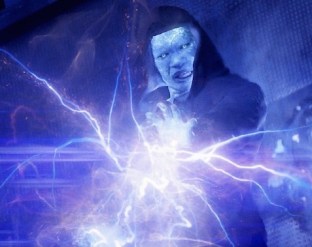 but it’s more textured, at least. Then there’s Electro, who (as mentioned) may have a familiar story, but is nonetheless perfectly pitched by Foxx. His powers lead to some excellent sequences, including but not limited to the aforementioned Times Square duel. He also contributes to the music, in a way, as Electro’s whispered/sung thoughts ‘bleed out’ into the score. It’s creepy, especially as it’s so subtle in the mix — I wondered what the hell was going on at first. I thought it was a fantastic score all round, in fact, bringing in a modern music element that fits the notion of Spidey as a young character perfectly.
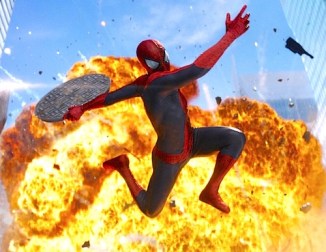 It lacks the confidence, heart and flair that mark out Spider-Man 2, and the bold originality and clarity of purpose that define
 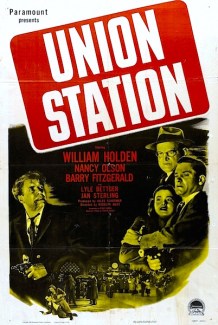 Often noted merely for being filmed in Los Angeles’ busy train station, there are some spirited defences of Union Station to be
  Based on a radio serial that spawned film serials, a famous TV series, and, eventually, comic books, The Green Hornet is a ‘superhero’ saga with a difference. For one thing, technically he’s just a vigilante — no superpowers here — and for another, as noted, it didn’t originate as a comic book. But that’s the milieu the character slots into these days, and so this attempted revival plays in that ballpark.
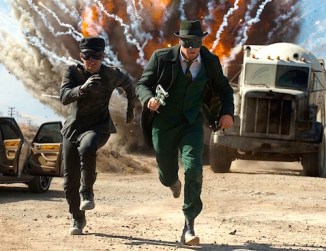 Well, screw them — The Green Hornet is brilliant. If you’re after the po-faced angsty worthiness of
 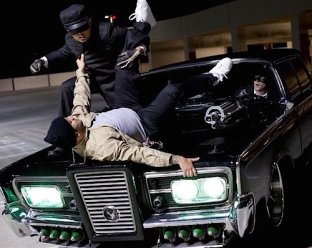 Then there’s Gondry’s direction, which is often as idiosyncratic as you’d expect. He’s at his peak during the action sequences, which explode in an array of effects and slow-motion to create multiple memorably unique fights and chases. Highlights are the first time Kato unveils his martial arts prowess, and the crazy car-driven climax. Chou and the tricked-out car, Black Beauty, are undoubtedly the stars of these bits — indeed, the film has an overall good line in making Kato the brains behind the operation. I imagine this is subverting the depiction of the Asian sidekick from previous versions, considering when they were made, but as I’ve never seen any I can’t comment fairly.
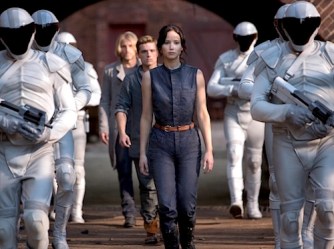
 Jennifer Lawrence (who, depending on your mileage, is either “the most charming young movie star in, like, forever” or “actually kind of a little bit irritating”) returns as the totally-plausibly-named Katniss Everdeen in this super-successful follow-up to the super-successful
 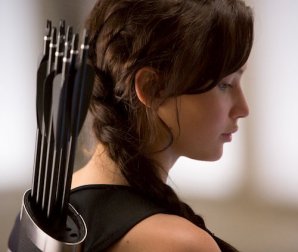 Tonally, however, it’s more similar to
 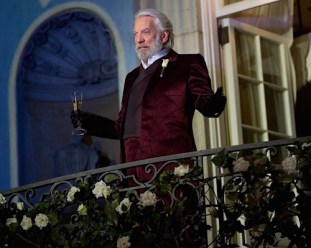 Of course, to an extent the tone of this ending comes from it being an adaptation: the filmmakers haven’t looked at the history of movie cliffhangers and chosen which to emulate, but instead brought someone else’s ending to the screen. Adapting doesn’t mean you have to take the original work faithfully, mind — you could go the
  which seems richer, more detailed, despite no genuine increase in resolution. I guess it’s true what they say: if you start with a higher quality source, it filters all the way down. The “bigger screen” effect probably wouldn’t work for a film entirely shot on IMAX — it’d just fill your TV from the start — but, after an hour-or-so of black bars, it really feels like the screen has grown.
 100Films.co.uk