Batman: The Killing Joke (2016)

2016 #129
Sam Liu | 77 mins | Blu-ray | 1.78:1 | USA / English | 15 / R
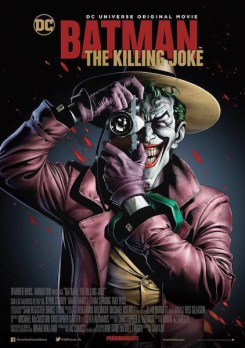
Batman: The Killing JokeAlan Moore and Brian Bolland’s 1988 graphic novel The Killing Joke is one of the seminal works of superhero comic books’ move into seriousness in the ’80s, sitting just behind the likes of Watchmen, The Dark Knight Returns, and Batman: Year One in terms of significance. It’s also seen by many as the definitive story about Batman’s nemesis, the Joker, and has influenced the live-action interpretations of both Jack Nicholson & Tim Burton and Heath Ledger & Christopher Nolan. It is not without controversy, however, thanks in large part to its treatment of Barbara Gordon / Batgirl; and Moore has since semi-disowned it, saying it has no intrinsic value because it has nothing to say about real human beings, only commenting on the comic-book-y relationship between Batman and the Joker.

Now, it finally makes its way to our screens in animated form. What took so long? Well, it’s dark, and to do it justice the makers needed the potential to make it R-rated. Given permission to do so by Warner, they’ve done just that. So here we have a very faithful adaptation of the graphic novel… but it’s a bit short, so there’s a 28-minute prologue stuck on the front. Designed to ameliorate some of the issues people have with the original book, it’s actually only made things worse, containing brand-new controversial elements all of its own. Oh dear.

In this new segment, Batgirl (Tara Strong) and Batman (Kevin Conroy) find themselves on the trail of Paris Franz (say it aloud… or don’t), a young upstart who wants to take control of his uncle’s organised crime operation. Once that business is dealt with, we get to the familiar meat of the story, where the Joker (Mark Hamill) decides to prove a point — in a violent and twisted fashion, naturally.
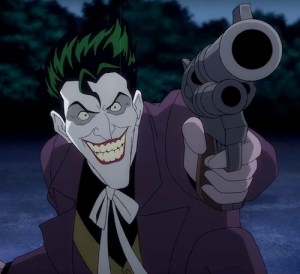
To really discuss where this adaptation of The Killing Joke goes awry, I’m going to have to stop being coy about spoiling a 28-year-old comic book that had lasting ramifications for Barbara Gordon’s place in the DC universe. Also, spoilers for this new film, too. You have been warned.

So, for those not in the know or who would like a recap, the Joker’s plan is to prove we’re all just one bad day away from going insane like him. The target of his experiment is Commissioner Gordon (Ray Wise), and he begins by shooting his daughter Barbara in the spine, paralysing her, then taking photos of her naked to torment the Commissioner with later. (The actual photo-taking isn’t depicted in the comic or this film, but the images are hinted at later on.) This is problematic for a number of reasons, not least Barbara’s lack of presence in the story as anything more than a pawn to torture her father.

The film’s solution is to begin with a standalone Batgirl adventure. Not an inherently bad idea — it could make her a more rounded character; someone we care about for herself, not just a minor victim in some other game. However, screenwriter Brian Azzarello (and, presumably, director Sam Liu and executive producer Bruce Timm) have tried to do this by making her horny for Batman, and have that infatuation actually consummated in an al fresco rooftop sex scene (not graphically shown, but the film is unequivocal about what happened). To say the least, this doesn’t seem like the best way to go about making her an independent, rounded human being — it comes off like fan service. No, worse: fan fiction. A scene earlier on where she explains her Bat-infatuation to her gay best friend is presumably meant to suggest a genuine motivation for the eventual sexy times, but it all comes across as a great big excuse.
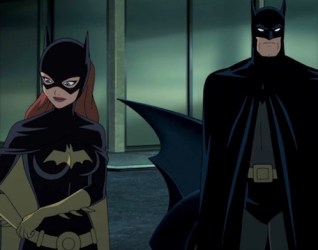
To top it off, it in no way informs the adaptation of The Killing Joke that follows. It makes nods towards some of the thematic concerns of the main story, but, structurally, it’s not part of the same film at all — there’s a fade to black & fade back in that really signals the end of one production and the start of a new one; the end of an opening short film and the start of the feature presentation. Only the ‘feature’ is far too short (44 minutes before credits), so that ‘short’ is clearly there to bulk up the running time.

The titular adaptation that follows is arguably faithful to a fault. If you’re seeking to make it feature-length, would it not have been better to expand the story out and examine some of its points more fully, even if the points you illuminated were about plot logic rather than themes — the original comic is very short and arguably a little rushed in places, so I think there’s definite room for expansion. In fact, while it might make sense to expand the role of Barbara Gordon for reasons of taste and social mores that have (not wrongly) since been projected onto the comic, from a purely narrative point of view the character who needs expanding is Commissioner Gordon. In the comics he’s a regular cast member, so it can afford to take as read his status as an “ordinary man” — or perhaps even a paragon of virtue, which brings its own problems to the story. But while he is a familiar figure in the Batman mythology, and so by extension to anyone who’s likely to watch this film, it’s also a standalone movie, not part of a series, and so it would be beneficial to establish his character somewhat before the Joker’s plan for him gets underway.
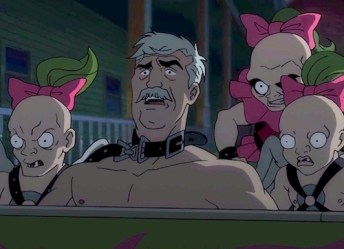
Heck, the film’s own special features even feature a psychologist talking about how it’s Jim Gordon’s story! While the Joker and Batman are the same characters at the beginning and the end, it’s Gordon who goes through a terrible ordeal and then has a choice to make. Yet in spite of that he’s treated as the fourth lead, at best, with the Joker and Batman taking precedence in the main adaptation and Barbara gaining masses of focus thanks to her half-hour preamble. It’s probably the twin desires to put the graphic novel on screen as-is and to in some way justify Barbara Gordon’s role in it that have led to this point. A less literal adaptation — one prepared to expand and elucidate the story, rather than just tack on an extra part at the start — could have found room to deepen both the Gordons.

Still, I suppose the literal faithfulness of the story adaptation will please purists. And reuniting the key voice acting cast from Batman: The Animated Series, arguably the all-time definitive screen interpretations of Batman and the Joker, is always fan-pleasing. Hamill, in particular, is fantastic, even when having to deliver Alan Moore’s typically verbose dialogue. However, one of the reasons the graphic novel is so beloved is Brian Bolland’s detailed, realistic, dynamic artwork. His draftsmanship transcends the actual narrative of Moore’s writing so that, however distasteful the tale being told, it looks incredible. Naturally, this animated adaptation loses that entirely, employing the standard “Saturday morning cartoon +” aesthetic of these DC direct-to-video movies. There are sound budgetary reasons for that, but it means the focus falls even more squarely on the narrative rather than the images. (It’s somewhat ironic, then, that (as ever) Alan Moore doesn’t receive an onscreen credit while Bolland does.) There are a handful of effective visuals here (the Joker’s gleeful face as he turns on the amusement park, its lights twinkling in his eyes), but they’re the exception to work which is adequate — good for what it is, even — but unremarkable.
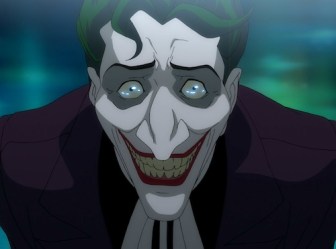
For such a long-awaited adaptation, it’s difficult to conclude The Killing Joke is anything other than a disappointment. It didn’t have to be that way: I thought Warner made a good hash of adapting Year One, and an even better one of The Dark Knight Returns. While this adaptation does allow some of the book’s inherent quality to carry through, The Killing Joke was always going to be more problematic due to its content, and the filmmakers’ clumsy attempts to fix that have only made it worse. Shame.

3 out of 5

Batman: The Killing Joke is out on DVD and Blu-ray in the UK today.

Minority Report (2002)

100 Films’ 100 Favourites #61

Everybody runs

Country: USA
Language: English
Runtime: 145 minutes
BBFC: 12
MPAA: PG-13

Original Release: 20th June 2002 (Australia)
US Release: 21st June 2002
UK Release: 4th July 2002
First Seen: cinema, July 2002

Stars
Tom Cruise (Born on the Fourth of July, Mission: Impossible)
Samantha Morton (Morvern Callar, Synecdoche, New York)
Colin Farrell (Tigerland, In Bruges)
Max von Sydow (The Virgin Spring, Shutter Island)

Director
Steven Spielberg (Close Encounters of the Third Kind, War of the Worlds)

Screenwriters
Scott Frank (Out of Sight, The Wolverine)
Jon Cohen

Based on
The Minority Report, a short story by Philip K. Dick.

The Story
Washington, D.C., 2054: a special police department, PreCrime, arrests murderers before they even commit a crime, using information gained from three ‘precogs’ who have visions of the future. When the precogs report PreCrime’s captain, John Anderton, will kill a man he doesn’t even know, he goes on the run to prove his innocence.

Our Hero
PreCrime Captain John Anderton believes in the infallibility of the system, no doubt motivated by the disappearance of his son years earlier, which has also left him a divorced drug addict. He’s played by Tom Cruise, so of course he’s charming and heroic nonetheless.

Our Villains
The PreCrime unit is under consideration for nationwide adoption, so is being audited by sceptical Department of Justice agent Danny Witwer when Anderton is accused. While Witwer might seem antagonistic, you know there’s some other Big Bad behind the whole thing…

Best Supporting Character
Agatha, the lead precog, who sometimes has a different vision to the other two, which produces the so-called ‘minority report’ that may prove Anderton’s innocence — so he breaks her out. Unsurprisingly, an individual who spends her life hooked up to a machine in some kind of dream-state while having visions of different futures isn’t necessarily suited to the real world.

Memorable Quote
Fletcher: “John, don’t run.”
Anderton: “You don’t have to chase me.”
Fletcher: “You don’t have to run.”
Anderton: “Everybody runs, Fletch.”

Memorable Scene
So he can’t be identified by the future’s ubiquitous iris scanners, Anderton has undergone an eye transplant with a dodgy backstreet surgeon. He’s told he can’t take the bandages off for 12 hours or he’ll go blind. While he’s still convalescing, police searching for him arrive at his location. With thermal imaging confirming how many people are in the building, they unleash spider robots to scour each floor and scan everyone’s eyes. Hearing their approach, Anderton attempts to hide in an ice bath, but the thermal scan notices his disappearance. The officers close in on his location, as do the spiders… but he can’t take his bandages off… but the officers will recognise him…

Technical Wizardry
Cinematographer Janusz Kamiński gave the film a very distinctive visual style, described by one critic as looking “as if it were shot on chrome, caught on the fleeing bumper of a late ’70s car”. Aiming for a film noir feel, the shoot was deliberately overlit, then the film was bleach-bypassed in post-production, a process that desaturates the colours but gives the blacks and shadows a high contrast. Kamiński used the same technique on Saving Private Ryan. Here, coupled with the chrome-and-glass production design, it succinctly evokes a dystopian future.

Making of
Spielberg wanted the film’s near-future world to be based in reality rather than the usual extravagant imaginings of science fiction. To create this plausible future, he convened a three-day ‘think tank’ of fifteen experts, including architects, computer scientists, biomedical researchers, and futurists. Their ideas didn’t change key points of the film’s story, but did influence the creation of the world. Production designer Alex McDowell maintained a “2054 bible”, an 80-page guide listing all of the architectural, socio-economic, political, and technological aspects of the future decided by the think tank. The film’s Wikipedia article has a whole section about technologies seen in the film that have since come about or that are in active development.

Next time…
A sequel TV series aired last year (with none of the original cast (well, except for one)). It didn’t go down very well with either critics or viewers, and swiftly had its episode order reduced before being completely cancelled.

Awards
1 Oscar nomination (Sound Editing)
1 BAFTA nomination (Visual Effects)
1 World Stunt Award (Best High Work)
4 Saturn Awards (Science Fiction Film, Supporting Actress (Samantha Morton), Director, Writing)
7 Saturn nominations (Actor (Tom Cruise), Supporting Actor (Max von Sydow), Music, Costumes, Make-Up, Special Effects, DVD Special Edition Release)
Nominated for the Hugo for Best Dramatic Presentation Long Form

What the Critics Said
“Steven Spielberg’s Minority Report doesn’t look or feel like anything he’s done before, yet no one but Spielberg could have made it. Ferociously intense, furiously kinetic, it’s expressionist film noir science fiction that, like all good sci-fi, peers into the future to shed light on the present. The director couldn’t have known, when he and writers Scott Frank and Jon Cohen set about adapting Philip K. Dick’s short story, how uncannily their tale of 2054 Washington, D.C., would resonate in [2002’s] political climate, where our jails fill up with suspects who’ve been arrested for crimes they haven’t yet committed.” — David Ansen, Newsweek

Score: 90%

What the Public Say
“This film is an excellent example of why Steven Spielberg is one of the great master directors of American cinema. It’s a perfect balancing act, a movie that sacrifices neither ideas nor action, nor emotion, nor mystery, in the service of its story. […] How can we categorize this movie? It is a sci-fi neo-noir that prefers to tell its story on Earth and with humans, much like Blade Runner (1982) and Gattaca (1997). It’s a twisty mystery, a classic whodunit of double-crosses, murder, and troubled pasts. It’s also an innocent-man-on-the-lamb chase movie, not unlike The Fugitive (1993). And it all fits together; it works, it feels like, yes, this is the way this story should be told.” — David, The Warden’s Walk

Verdict

Spielberg once described Minority Report’s story as “fifty percent character and fifty percent very complicated storytelling with layers and layers of murder mystery and plot,” which I think is indicative of why it’s such a successful experience: it mixes exciting, propulsive plot and action sequences with thematic concerns that use science-fiction ideas to explore real-world issues, both tangible (the prevalence of state control and policing) and metaphysical (free will vs determinism). It makes for a rounded, thrilling movie.

#62 will be your mission… should you choose to accept it.

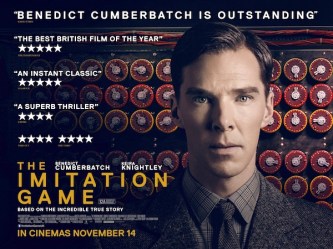
The Imitation Game (2014)

2016 #125
Morten Tyldum | 114 mins | streaming (HD) | 2.35:1 | UK & USA / English | 12 / PG-13

Oscar statue
2015 Academy Awards
8 nominations — 1 win

Winner: Best Adapted Screenplay.
Nominated: Best Picture, Best Actor, Best Supporting Actress, Best Director, Best Editing, Best Original Score, Best Production Design.


The Imitation GameAlan Turing was a war hero: he led a team of cryptologists who managed to break the Germans’ Enigma encryption, thereby giving the Allies access to tonnes of vital information that (historians estimate) helped shorten the war by up to four years. This information was beyond top secret — so much so that they created a new designation for it, “ultra secret” — so when the war was over, Turing & co’s contribution went unrecognised for decades. Alan Turing was also a homosexual in an era when that was illegal. When he was caught, he was sentenced to chemical castration, which caused (or at least contributed) to him taking his own life. Fine way to treat a war hero, but that’s what you get with discriminatory attitudes.

Discrimination is surely one of the major themes of The Imitation Game, a film that it’s apparently easy to mistake for a drama about the deciphering of Enigma, but which is really a Turing biopic. It takes place across three eras: the 1920s, when Turing (played by Alex Lawther) was a bullied schoolboy; the war years, when Turing (played by Benedict Cumberbatch) faced discrimination across the board, including a commanding officer who thought he was a Soviet spy and teammates who flat out didn’t like him; and the 1950s, when Turing (played by Cumberbatch in gentle older-age make-up) is uncovered as gay and gets the persecution already discussed. As if that wasn’t enough, the best person he recruits for his team during the war is female (played by Keira Knightley), who of course is also pre-judged by some as capable of nothing more than being a dimwitted secretary.

The screenplay by newcomer Graham Moore topped the Black List in 2011, so it’s probably of little surprise that it went on to win an Oscar, but I think it’s fair to say its quality, while good, isn’t that good. The use of three concurrently-told timelines seems to be too much for Moore and/or director Morten Tyldum to handle at times, occasionally flitting to a different era with little purpose beyond “it’s about time we told more of that storyline”. That’s not to say a wholly chronological telling would’ve been more effective — though perhaps it would’ve placated critical viewers who expected (and retrospectively demand) a cryptography-based wartime thriller — but the period juggling clouds the point as often as it illuminates it.
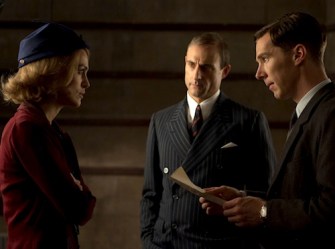
Regardless, it blusters through with a relatively brisk pace (for what is essentially a heritage drama), supported by several excellent performances. Oscar-nominated Cumberbatch is the obvious headline — he’s Alan Turing in the Alan Turing biopic so of course he is, but it’s a very strong performance. His Turing is surely somewhere on the autistic spectrum, which at best has speculative historical basis, but Cumberbatch embodies well that social awkwardness with hidden inner genius. It would’ve been easy for him to slip into familiar traits from that other antisocial clever-clogs he plays, Sherlock Holmes, but at worst there are only vague and infrequent nudges to our memory of that performance. Rather, I’d argue he fully subsumes himself into this role. Surely that Oscar would’ve been his were it not for Eddie Redmayne’s even more remarkable turn as Stephen Hawking. (Well, Oscar voters might’ve plumped for Michael Keaton instead, but they’d’ve been wrong.)

Also up for the golden man was Knightley, who does give one of her better turns as Turing’s sort-of-sidekick. The pair have a fairly complex relationship — both halves are key to conveying that, and they both do. At least as remarkable as either is young Alex Lawther, who arguably gets the film’s stand-out acting moment in his final scene, where a tumult of emotion is contained beneath a stiff-upper-lip surface in a tight close-up. On the strength of this, an actor to watch out for. The rest of the cast don’t get the same depth of material, but Charles Dance and Mark Strong provide exceptional value, as always, and Rory Kinnear does his best to bring some nuance and interest to a part he’s overqualified for.
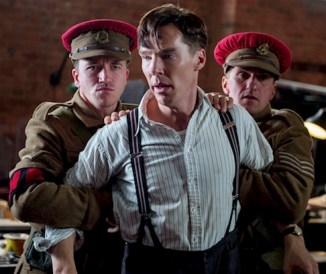
To return to the issue of the film’s reception, some people seem to be angry with or offended by the notion that the war was won as much — maybe even more — by men in rooms breaking codes than by soldiers on the ground doing the actual fighting. However, I can’t help but think that’s actually one of the points the film is making — that soldiers are the obvious ‘heroes’, because they’re there doing the shooting, but the people behind the scenes telling them where to go do that shooting are just as important to the overall victory. I mean, if you watched this film and still think the boots on the ground are the only thing that won the war, and by extension that intelligence isn’t all that important, then maybe you missed something.

Perhaps that just stems from a frustration at some of the film’s other issues. It clearly has a flexible relationship with historical accuracy — well, what biopic doesn’t? Without wanting to spoil plot developments, some viewers feel the film suggesting Turing knew of the spy at Bletchley Park is insulting to his memory, because in real-life he didn’t even know the individual. Alternatively, is it not a way to integrate that part of the Enigma story into a film that otherwise wouldn’t have a satisfactory way to touch on it? Everyone’s mileage will vary on whether that should’ve been done or not.

And let’s not even get into opinions on how the film dealt with Turing’s homosexuality, which swing wildly between “it was just a footnote, why didn’t it get more attention?!” and “why did they allow that to dominate a film about codebreaking?!”

There’s no denying that The Imitation Game contains an interesting story about an important aspect of the war, starring a fascinating and complex central character. How well it handles those aspects if more a matter for debate, as it doesn’t develop some elements as well as it perhaps should have, and the heritage stylings always turn some off. If you ignore or gloss over some of those faults and take the film at face value, it’s a 5-star effort with a well-told primary narrative and strong performances. If you do listen to the niggling faults and the “what could have been”s, it sinks back down a little.

Without meaning to sound too judgemental (though when has that ever stopped me?), those factors making me think this is the kind of film “normal people” will probably love a lot more than “film fans” — which probably explains why it’s in the IMDb Top 250 but all the most-liked reviews on Letterboxd have exceptionally low scores. Personally, I’m going to side with the populous: not everything has to be a groundbreaking feat of Cinema to be a story worth telling and told well, and if it is indeed some kind of “historical revisionism” to say that there’s nothing wrong with being gay and the way Turing was treated post-war was horrendous, well, I’m OK with that revisionism.
4 out of 5

The UK TV premiere of The Imitation Game is on Channel 4 at 9pm tomorrow.

Barry Lyndon (1975)

2016 #111
Stanley Kubrick | 185 mins | Blu-ray | 1.78:1 | UK, USA & Ireland / English, German & French | PG / PG

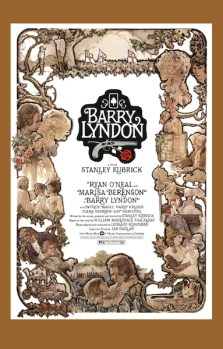
Barry LyndonStanley Kubrick made a good many exceptionally well-regarded films — indeed, with possibly the exception of his first semi-amateur feature, Fear and Desire, every one of his works can lay claim to being someone’s favourite. Nonetheless, although you wouldn’t guess it from its barebones also-ran type treatment on DVD and Blu-ray, three-hour period drama Barry Lyndon places among his top works in terms of consensus audience favourites, in that it’s on the IMDb Top 250. That said, it’s at #230, while the other six films on there are in the top 100, and he only made 13 features anyway — so it sits at the precise halfway point of his oeuvre, at least on IMDb.
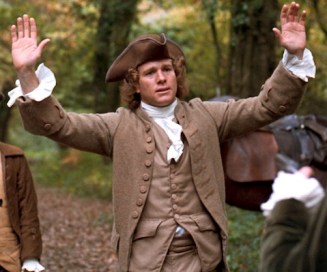
Adapted from a novel by William Makepeace Thackeray, commonly called The Luck of Barry Lyndon but whose full original title is going in a footnote because it’s so long,* Kubrick’s film narrates the life of the eponymous Irish rogue (Ryan O’Neal) as he falls in love, runs away from home, joins the army, becomes a spy, becomes a con artist, marries a wealthy heiress (Marisa Berenson), runs an estate, and is a man of dubious virtue and questionable likeability throughout the whole affair.

Apparently the novel is considered to be the first English-language ‘novel without a hero’, aka antihero, and Lyndon certainly fits that bill. He serves his own interests throughout the tale, which is rarely seen as a desirable characteristic but can certainly be an understandable one, though at times you may despair at how his stubborn dedication to certain causes actually works against his interests. On the other hand, he has a great propensity for blagging his way through a war, and the ensuing complications, so I guess he learns from his mistakes… some of them, at any rate. It would be tough to say that Barry is a character you empathise with, but that doesn’t stop him from being a fascinating one to follow for a couple of hours. Some of this dislike may stem from the film’s voiceover narrator, who often tells us less-than-favourable things about the lead character. Apparently this is an example of an unreliable narrator, and I suppose some of the things we’re told aren’t directly evidenced on screen, but I’m afraid I’m going to have to leave that seam to be mined by other writers, because (on a first viewing at least) I didn’t see where or to what effect the narrator was lying to the viewer.

As played by O’Neal, Barry’s accent places him as coming from the same part of Westeros as Littlefinger. Although I wouldn’t say he did a bad job, there seems little doubt he was miscast. The story of how he came to be in the film is more interesting than his performance, really: Warner Bros would only finance the film if Kubrick cast a top-ten box office star, based on the annual Quigley Poll of Top Money-Making Stars. O’Neal was second on the 1974 poll, just behind Clint Eastwood and ahead of people like Steve McQueen, Robert Redford, Paul Newman, John Wayne, and Marlon Brando. Barbra Streisand was the only woman on the list, so you’d think Kubrick had nine options, but apparently they were all considered “too old or inappropriate for the role” with the exception of O’Neal and Redford. O’Neal was the bigger star thanks to also securing a Best Actor Oscar nomination in the past, but Kubrick was smart enough to offer it to Redford first, but he turned it down so O’Neal it was. Ironically, 1973 was the only year O’Neal appeared in that top ten, while Redford placed first in 1974, 1975, and 1976.

Whether it was the intention or not, O’Neal often gets by thanks to the style of the narrative, in which a series of variously-plausible events keep happening to Barry as much as he is proactive in making them occur. This is not a simple, narrow-focused, cause-and-effect kind of story, but a fictional biopic, that ranges across Europe and across time to… what effect? It’s a Kubrick film, so the ultimate goal of the tale, the message(s) it may be trying to impart, are debatable. You could see a story of the pitfalls of hubris. You could see an exploration of how a certain class lived in this time period. You could just see a man who led an adventurous life.
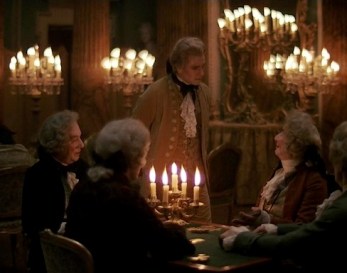
Whatever the merits of the tale, its telling is a frequent wonder. Its length and pace are surely barriers to entry for some — this is not a thrill-a-minute rollercoaster ride; it’s more analogous to a BBC miniseries, perhaps, albeit one where you’re watching all three episodes at once. Well, binge viewing is the TV watching style du jour, so that shouldn’t be a problem for anyone nowadays. Much has been made of the film’s candle-lit photography, using special lenses adapted from NASA, and rightly so; though perhaps it’s beginning to look less remarkable as we move into an era where digital cameras can produce exceptional range and quality. That’s not to say the potential commonality of such lighting decisions dulls the excellence of John Alcott’s photography, but, without knowledge of the production challenges, a modern viewer might not be so readily wowed.

Maybe I’m one of them, because for me the best shots are to be found elsewhere. The film is littered with recreations of art from the era — not obvious “ooh, I know that painting” recreations, but photographic imitations of the painters’ style, subjects, and composition. The opening shot, for instance, really looks like a painting. It’s incredible. I’d even go so far as to say it’s the best shot in the film; which is not to say the ensuing three hours are a visual disappointment, just that it remains the best among greats. (That said, having looked up images online for this review, it seems slightly less striking to me now. That may be the quality of the screengrabs; it may be that the painterly quality is so remarkable at first appearance (before becoming more familiar when the whole movie has that quality) that its memorableness is heightened.)

With its measured pace, obfuscated meaning, and sporadically likeable characters, Barry Lyndon is not the most readily accessible movie ever made. Well, it’s Kubrick, isn’t it? There’s so much to commend it though, especially if you consider visual style a reason to watch a movie (not everyone is satiated by that, but, for a visually-driven medium, I think it’s a perfectly acceptable element to be particularly engaged by). It’s an imperfect film (for Ryan O’Neal if nothing else), but perhaps a brilliant one. Certainly I’d put it in the high-middle of my Kubrick viewing so far — and as his only films that I’ve seen are all on the IMDb Top 250, that’s an upgrade from me, at least.

5 out of 5

The restored 40th anniversary re-release of Barry Lyndon is in UK cinemas from today.

Barry Lyndon was viewed as part of my What Do You Mean You Haven’t Seen…? 2016 project, which you can read more about here.

* The Memoirs of Barry Lyndon, Esq. Of The Kingdom Of Ireland Containing An Account of His Extraordinary Adventures; Misfortunes; His Sufferings In The Service Of His Late Prussian Majesty; His Visits To Many Courts of Europe; His Marriage and Splendid Establishments in England And Ireland; And The Many Cruel Persecutions, Conspiracies And Slanders Of Which He Has Been A Victim. ^

Noah (2014)

2016 #36
Darren Aronofsky | 132 mins | streaming (HD) | 1.85:1 | USA / English | 12 / PG-13

The director of The Fountain tackles the Biblical tale of the flood as if it were also a science-fiction/fantasy adventure — familiarity with the story leads us to assume it’s set in the past, but watch without baggage and the setting looks like a post-apocalyptic future.

I imagine it was terribly controversial with hardened believers, but for the open-minded its rock-angels and action sequences are merely diverting asides to considerations of personal belief — both its dangers and its benefits.

By turns plodding and suitably rousing, it’s far from perfect; but as an alternative kind of blockbuster entertainment, it’s an interesting one.

4 out of 5

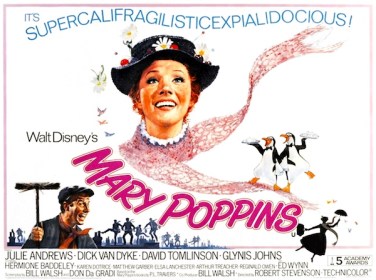
Mary Poppins (1964)

100 Films’ 100 Favourites #58

It’s supercalifragilisticexpialidocious!

Country: USA
Language: English
Runtime: 139 minutes
BBFC: U
MPAA: G (1972)

Original Release: 27th August 1964 (USA)
UK Release: 23rd December 1964
First Seen: by osmosis in childhood.

Stars
Julie Andrews (The Sound of Music, Torn Curtain)
Dick Van Dyke (Bye Bye Birdie, Chitty Chitty Bang Bang)
David Tomlinson (The Love Bug, Bedknobs and Broomsticks)
Karen Dotrice (The Gnome-Mobile, The Thirty-Nine Steps)

Director
Robert Stevenson (Jane Eyre, Bedknobs and Broomsticks)

Screenwriter
Bill Walsh (The Love Bug, Bedknobs and Broomsticks)
Don DaGradi (Blackbeard’s Ghost, Bedknobs and Broomsticks)

Based on
the Mary Poppins books by P.L. Travers.

Music and Lyrics
Richard M. Sherman (The Jungle Book, Chitty Chitty Bang Bang)
Robert B. Sherman (Bedknobs and Broomsticks, The Many Adventures of Winnie the Pooh)

The Story
Not impressed by the nannies selected by their domineering father, Jane and Michael Banks write a letter describing their ideal applicant. Conversely, Mr Banks is not impressed with their requirements, and tears up the letter and throws it in the fire… from whence it reaches Mary Poppins, who floats down to bring fun and discipline to all of the Banks household.

Our Hero
The magical nanny who comes from the sky, Mary Poppins can be (whisper it) actually a little bit annoying at times. Julie Andrews, on the other hand, is practically perfect in every way.

Our Villains
Ultimately, bankers. Some things never change.

Best Supporting Character
Ostensibly this is the story of children Jane and Michael Banks and their need for a SuperNanny to help them with their oh-so-terrible father — and, as a child, that’s where your focus lies. Really (and I guess you need to grow up at least a bit to see this), it’s about how said SuperNanny saves their father, Mr Banks, helping to transform him from a miserable corporate drone into a joyful family man. David Tomlinson negotiates this arc fantastically.

Memorable Quote
“You know, you can say it backwards, which is ‘docious-ali-expi-istic-fragil-cali-rupus’… but that’s going a bit too far, don’t you think?” — Mary Poppins

Quote Most Likely To Be Used in Everyday Conversation
“Just a spoonful of sugar helps the medicine go down.” — Mary Poppins

Memorable Scene
Chimneysweeps dancing on the rooftops! (Fun fact: I always thought Step In Time was called Stepping Time. I mean, the dance does contain a lot of, sort of, steps…)

Best Song as a Child
Iiiiiiit’s Supercalifragilisticexpialidocious, even though the sound of it is something quite atrocious. If you say it loud enough, you’ll always sound precocious. (Sacrilege maybe, but the version from the 2004 stage musical is even better.)

Best Song as an Adult
When I was little, the whole part of the film around the bank, Feed the Birds, etc, was The Boring Bit between the fun and the return of the fun. Now, I still think most of Feed the Birds is a little insipid, but the instrumental reprise as Mr Banks walks slowly back to the bank, his world and everything he knows torn asunder, his humiliation imminent… It’s heartbreaking, and the music is most of the reason why.

Technical Wizardry
The sequence where Mary, the children, and Bert jump into one of the latter’s street paintings — all of it animated, with the exception of the leads — is a sterling extended example of combining live-action with cel animation.

Truly Special Effect
As a lad, I could never work out how exactly they’d managed to create Mary’s bottomless bag. I haven’t watched the film for a while and imagine it’s painfully obvious now… I also used to think the little bird that lands on her hand was a miraculous effect and didn’t understand why some people slagged it off, but then I watched that bit on YouTube a couple of years ago and finally saw what everyone else saw. Oh, the sadness of ageing…

Letting the Side Down
The fact that real cockneys don’t sound like Dick Van Dyke. No, I don’t mean it the other way round — the fact that the real-life denizens of East London sound nothing like Bert is the problem here, not Bert’s accent. That is how I think cockneys should sound, and it always will be.

Making of
See: Saving Mr. Banks. Knowing biopics it’s probably not 100% accurate, but it is a good film.

Next time…
Despite several attempts, a sequel never happened. The director and/or writers worked together on multiple films at Disney over the next few years — most famously, an early-’70s blatant attempt to recreate the Poppins magic, Bedknobs and Broomsticks. Mary Poppins herself returned in 2004 in a Cameron Mackintosh-produced West End musical, based on the film but re-incorporating more from the books. Talk of it being adapted into a film seem to have come to nowt. Instead, a (very) belated sequel with Emily Blunt in the title role is due in 2018.

Awards
5 Oscars (Actress (Julie Andrews), Song (Chim Chim Cher-ee), Substantially Original Score, Editing, Visual Effects)
8 Oscar nominations (Picture, Director, Adapted Screenplay, Color Cinematography, Color Art Direction-Set Decoration, Color Costume Design, Sound, Scoring of Music Adaptation or Treatment)
1 BAFTA (Most Promising Newcomer to Leading Film Roles (Julie Andrews))

What the Critics Said
“Of course, it is sentimental. And, as Mary Poppins says, “Practically perfect people never permit sentiment to muddle their feelings.” But being not practically perfect, I find it irresistible. Plenty of other adults will feel the same way. And, needless to say, so will the kids.” — Bosley Crowther, The New York Times

Score: 100%

What the Public Say
“It is the single glowing moment of sheer unmixed genius in the long stretch of lightweight successes and dreary failures that made up nearly three whole decades of Disney’s output in the ’60s, ’70s, and ’80s; a fantasy of the most delicate touch and charming disposition, sweet and precious while being neither sickening nor cloying.” — Tim Brayton, Antagony & Ecstasy

Verdict

I feel like Mary Poppins is the kind of movie that it would’ve been easy to overlook in putting together this list of favourites — a childhood favourite, that’s maybe so obvious you kind of forget about it as A Movie — which is one of the reasons I made sure to get it on here. Another is how well it works for both children and adults. As the former, the magical adventures and toe-tapping songs are pure joy, a wonder-filled experience that doesn’t date. As the latter, those elements are still entertaining, but the depth of some of the film’s messages (especially pertaining to the adults) really comes through. It’s a film for all ages, and one for the ages too.

#59 will be…

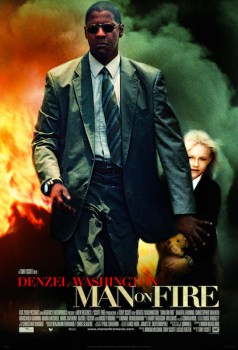
Man on Fire (2004)

100 Films’ 100 Favourites #57

A promise to protect.
A vow to avenge.

Country: USA & UK
Language: English & Spanish
Runtime: 146 minutes
BBFC: 18
MPAA: R

Original Release: 23rd April 2004 (USA)
UK Release: 8th October 2004
First Seen: in-flight, c.2004

Stars
Denzel Washington (Philadelphia, Training Day)
Dakota Fanning (War of the Worlds, The Runaways)
Radha Mitchell (Pitch Black, Melinda and Melinda)
Christopher Walken (The Deer Hunter, Hairspray)
Marc Anthony (Bringing Out the Dead, El cant ante)

Director
Tony Scott (Top Gun, Enemy of the State)

Screenwriter
Brian Helgeland (L.A. Confidential, Legend)

Based on
Man on Fire, a novel by A.J. Quinnell.

The Story
As a wave of kidnappings from rich families sweeps Mexico City, burnt-out former soldier Creasy is hired as the bodyguard of little Pita Ramos. She begins to bring him out of his reclusive shell, so when he fails to prevent her abduction, he vows to make the people responsible pay — very, very violently.

Our Hero
Washed-up alcoholic former Marine and ex-CIA operative John Creasy is a broken man, only taking bodyguard work in Mexico City because he needs the cash. He still has a particular set of skills at hand when needed, though.

Our Villains
An array of ruthless kidnappers and corrupt cops, though some of the villains may be closer to home…

Best Supporting Character
Dakota Fanning has relatively limited screen time as little Pita, at least after the first act, but it’s enough for the viewer to warm to her as much as Creasy does, getting us on side for the violence to come.

Memorable Quote #1
“Creasy’s art is death. He’s about to paint his masterpiece.” — Rayburn

Memorable Quote #2
“Forgiveness is between them and God. It’s my job to arrange the meeting.” — Creasy

Memorable Scene
After corrupt detective Fuentes is kidnapped by Creasy, he wakes up tied to the bonnet of a car wearing just his boxers. Creasy demonstrates how he built a small bomb, before informing Fuentes where that bomb is currently located. To be blunt: it’s in Fuentes’ ass. That certainly gives the interrogation a different flavour.

Technical Wizardry
The film’s visual style — jumpy cutting, heavy saturation, etc — is apparently designed to reflect Creasy’s fractured mental state. The most memorable part, at least for me, were the subtitles, which use various fonts, placements, and reveals to make them feel part of the whole package, rather than a bunged-at-the-bottom last-minute addition.

Making of
The film was really shot in Mexico City, under the real threat of kidnapping and/or other violence. Radha Mitchell was escorted by three bodyguards after her driver was carjacked at gunpoint; Denzel Washington was also surrounded by bodyguards at all times; several crew members were robbed at gunpoint, and, according to the police, the crew were also targeted for kidnapping

Previously on…
A.J. Quinnell’s novel was previously adapted in 1987 starring Scott Glenn, Joe Pesci, and Jonathan Pryce.

Awards
2 Golden Trailer Awards nominations (Best Action (for trailer C), Best Drama (for trailer B))
3 nominations for Dakota Fanning as supporting or young actress (Broadcast Film Critics Association Awards, Golden Schmoes Awards, Young Artist Awards)

What the Critics Said
“On paper, we have a well-worn initial-mistrust-gives-over-to-mutual-affection arc, but Washington’s despair-tinged reserve and Fanning’s astonishing naturalness give the relationship warmth and resonance. Fanning exudes more than enough charm and decency to make Creasy’s renewal of faith completely believable. […] As the action goes increasingly over the top, so does Scott’s visual pyrotechnics. Probably setting a new world record for the number of different film stocks in one movie, Scott and hot-to-trot cinematographer Paul Cameron (Collateral) whip-pan and crash-zoom to new levels of excess, heightening both the teeming life of Mexico City and the anxiety around Pita’s kidnapping. Best of all are the subtitles: rather than simply translating dialogue, they assault the viewer, conveying drama and emotion through aggressive graphic design. You’ve never seen any done like this before.” — Ian Freer, Empire

Score: 39%
(I had no idea this was so critically reviled! I thought it was quite well liked, in fact.)

What the Public Say
“it is relentless in assaulting your senses and your sensibilities, and that can often be unpleasant, at best. While this is obviously the intended effect in many cases, [it] has the effect of making it unlikeable to watch, if not for the actions of its star character, then just for the fact that it seems intent on making the audience feel every ounce of anguish in the torturer and his victim. It’s definitely intended, but it doesn’t exactly result in me feeling empathy for either character, one way or another. It must be said, however, that Tony Scott is not afraid to have his character do horrible things to people. He’s not concerned about what the audience thinks about Creasy so much as they just consider why he is.” — CJ Stewart, The Viewer’s Commentary

Verdict

On the one hand, Man on Fire represents the start of Tony Scott’s stylistic excess that would see him through the rest of his career — the jumpy editing, oddly saturated images, etc. (It’s also present to an extent in Spy Game, though.) It would get a bit much at times (Domino), but Man on Fire uses it effectively. On the other hand, the film works just as well as a character-driven revenge drama. Rather than rush to the shooting-and-killing, Scott and screenwriter Brian Helgeland take their time to build the relationship between Creasy and Pita, so that when we do reach the vengeance portion of the story, you’re as invested as the characters are. Of course, from there it is (as a film from the year before would put it) a roaring rampage of revenge.

#58 will be… practically perfect in every way.

The Past Month on TV #6

The other half’s love of tennis preempted a fair bit of TV watching this past month — but with an incredible Game of Thrones finale, and some stuff we’ve had time for since Wimbledon ended, there’s still plenty to talk about.

Game of Thrones (Season 6 Episodes 9-10)
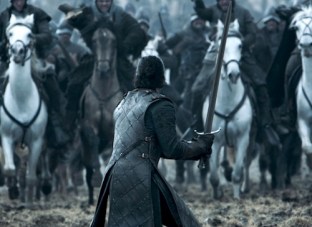
Game of Thrones - Battle of the BastardsGoT produced two of its greatest-ever episodes to conclude this season. Actually, that’s arguably an understatement: based on IMDb votes, if nothing else, Thrones produced two of the best episodes of TV ever made. But what do IMDb voters know? Well, more than some people give them credit for. Obviously everyone has different tastes, but for the genres Thrones operates in — and, in some instances, even transcending those — these are incredible hours of TV. Episode 9, Battle of the Bastards, is surely one of the most thoroughly-realised medieval-style battles ever depicted on screen: the scale is epic, the strategy is clear, the feeling of what it’s like to be in the thick of that environment is palpable. How it turns out may have been predictable, but something being predictable is not the same as it being bad — not everything needs to be a twist.
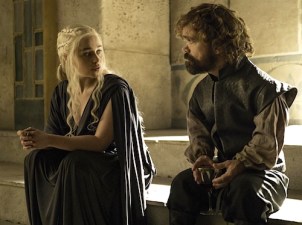
Then that finale, The Winds of Winter, was full of long-awaited decisions and reveals, and stunning for different reasons. Perhaps the biggest star across both episodes was director Miguel Sapochnik (who also helmed last year’s remarkable Hardhome) and the variety of directorial inventiveness he displayed — not only bringing all that realism to the aforementioned battle, but the classically-scored opening sequence/montage of the finale is incredible moviemaking. Presumably the only reason he’s not one of the directors for season seven is because he’s been tapped for bigger things.

Game of Thrones - The Winds of WinterAs for the forthcoming seventh season, it’s pretty clear we’re now entering the show’s endgame — though we’re going to have to wait even longer for it, with the next season set to have a later-than-normal premiere and the final end not coming until the season after that. It’s going to be an excruciating wait, but if they can maintain the form displayed throughout season six, it’ll be worth it.

Person of Interest (Season 5 Episodes 1-4)
Person of Interest season 5This is done and dusted Stateside now, but goodness knows when Channel 5 will choose to ‘officially’ air it over here, so I’m just getting on with it. I used to despise most of PoI’s arc plots and often wished it would stick to being just a pretty cool vigilante procedural; but at this point, it’s so invested in the epic Super-AI vs. Super-AI sci-fi storyline that any attempts at case-of-the-week episodes feel like a waste of time — especially when this truncated season is fast approaching the show’s final end. I really hope it comes to a proper conclusion, because there’s too much going on here to let it end forever on a cliffhanger. (Obviously that answer’s now out there, but naturally I’m avoiding spoilers.)
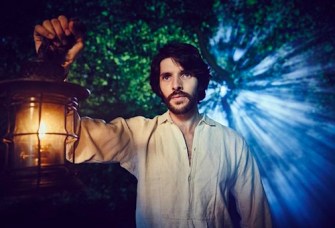
Preacher (Season 1 Episodes 4-5)
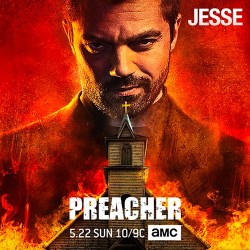
PreacherI’m a bit behind on this at the minute (the latest episode was the eighth), but, as of the halfway point, it’s definitely settled into its own skin — or maybe it was always settled there, but it’s taken time for viewers (or this viewer) to get past the expectations brought as a reader of the comic books. It’s still far from being a literally faithful adaptation, carving out its own path from some of the comic’s building blocks, which makes it an odd and hard-to-judge work if you have read any of the original. Still, it’s an entertaining series, and people involved keep talking about this season being something of a prequel to what we saw in the comic, so maybe the already-commissioned season two will feel more recognisable.
Also watched…
  • Cowboy Bebop Episodes 17-18 — as regular readers will know, I’m unconscionably bad at getting round to watching things, and here is a case in point: I started this anime series way back in 2013 and have been slowly making my way through it ever since. It’s really good, though.
  • Gilmore Girls Season 7 Episodes 15-20 — nearly done! I guess they heard the fan complaints by this point, because things definitely pick up towards the end.
  • Poldark Series 1 Episodes 5-8 — for a Sunday night BBC One drama, this is surprisingly, consistently glum — the heroes never seem to win. Still, looking forward to series two!

    Things to Catch Up On
    The Living and the DeadThis month, I have mostly been missing stuff I don’t even know I’m missing. By which I mean, I haven’t been paying enough attention to the TV schedules to know what I’ve missed. The BBC’s supernatural drama The Living and the Dead sounds kind of interesting; I know Mr Robot is back, not that I ever got round to season one; plus The Musketeers continues (though I hear it’s gone off the rails this season); and I keep hearing vaguely good things about Netflix’s new series, Stranger Things, like that it’s a cross between Steven Spielberg and Stephen King, or The Goonies mixed with The X Files… which just reminds me that I need to get round to seeing The Goonies someday.
    Next month… it’s about time to get started on season four of The Most Underrated Show On Television™, The Americans. So. Excited.

  • The Lord of the Rings (2001-2003)

    100 Films’ 100 Favourites #53—55
    Peter Jackson | 685 mins | New Zealand & USA / English & Sindarin | 12 / PG-13

    For obvious reasons, Peter Jackson’s adaptation of The Lord of the Rings is usually listed as the three separate films it was released as. But in the same way J.R.R. Tolkien considered it one long novel that had to be split up for the sake of publication, so too the movies work well — best, one could even argue — as a single 11½-hour experience.

    Having inducted the trilogy’s individual instalments into my 100 Favourites series over the past week (and a bit), I’ve covered most aspects of this epic moviemaking endeavour pretty thoroughly already, so here are links to each of my previous entries:


    The Lord of the Rings: The Return of the King (2003)

    100 Films’ 100 Favourites #55

    The Journey Ends.

    Country: New Zealand & USA
    Language: English & Sindarin
    Runtime: 253 minutes (extended edition)* | 201 minutes (theatrical version)
    BBFC: 12A
    MPAA: PG-13
    * 263 minutes with the interminable fan club credits.

    Original Release: 17th December 2003 (UK, USA & others)
    First Seen: cinema, December 2003

    Stars
    Liv Tyler (Armageddon, The Incredible Hulk)
    Miranda Otto (Love Serenade, War of the Worlds)
    Cate Blanchett (Elizabeth, Blue Jasmine)
    John Noble (The Monkey’s Mask, Risen)
    Ian Holm (Alien, Hamlet)

    Director
    Peter Jackson (The Frighteners, The Hobbit: An Unexpected Journey)

    Screenwriters
    Fran Walsh (Heavenly Creatures, King Kong)
    Philippa Boyens (The Lovely Bones, The Hobbit: The Battle of the Five Armies)
    Peter Jackson (Braindead, The Hobbit: The Desolation of Smaug)

    Based on
    The Lord of the Rings, a trilogy of novels by J.R.R. Tolkien.

    The Story
    The Ring’s evil influence over Frodo intensifies as he and Sam allow Gollum to lead them on a difficult path into Mordor. Meanwhile, Aragorn and Gandalf try to unite the world of men against Sauron’s forces, hoping to at least buy Frodo and Sam the time they need…

    Our Heroes
    It’s an ensemble cast so there are heroes aplenty, but this is the film where Sam really comes to the fore. Although wronged by Frodo, whose Ring-induced confusion allows him to be convinced by the machinations of Gollum, Sam repeatedly comes through to rescue his friend. “I can’t carry it for you… but I can carry you!”

    Our Villains
    With Saruman out of the picture, the focus falls back on the Big Bad big eye, Sauron. In the extended cut we’re also treated to his rather disgusting Mouth. Special mention also for the Witch-King of Angmar, who reckons he can be killed by no man. Of course, despite Tolkien’s reputation, not every character is a man…

    Best Supporting Character
    Women get short shrift in Tolkien’s world on the whole, but Miranda Otto’s Éowyn gets a relatively strong role through Two Towers and Return of the King, here riding into battle (in disguise) and (spoiler alert!) avenging the murder of her uncle, the king.

    Memorable Quote
    “My friends, you bow to no one.” — Aragorn, to the Hobbits.

    Quote Most Likely To Be Used in Everyday Conversation
    “Fool of a Took!” — Gandalf

    Memorable Scene
    With the Ring destroyed and Sauron defeated, the film takes the necessary time to walk us through the ultimate fates of the surviving characters. For the conclusion of an eleven-hour story, The Return of the King has a proportionally appropriate number of endings. Stop bloody whinging.

    Memorable Music
    Howard Shore completes his fantastic score. This time, memorable moments include The Realm of Gondor (in Ascension), heard best as Gandalf rides into and up the city of Minas Tirith; and The Edge of Night, sung by Pippin (Billy Boyd) as Faramir leads a futile charge on Osgiliath (another strong contender for Memorable Scene, that).

    Technical Wizardry
    The Fellowship of the Ring was one of the films that pioneered digital grading, a process which pretty quickly became standard (and now is fundamentally unavoidable, what with digital photography being the primary movie production format). Return of the King demonstrates the full power of the form, however: After the final battle, Pippin finds Merry on the battlefield. In the theatrical cut, the scene takes place during the day; in the extended cut, new and rearranged scenes means it takes place at night. It’s the same footage, graded differently, and it works seamlessly in either cut.

    Truly Special Effect
    Creating the trilogy’s many epic battle sequences required the ability to computer generate hundreds of thousands of soldiers fighting, a gargantuan task and a problem that hadn’t had to be solved in filmmaking before. This is what led to the creation of MASSIVE — short for Multiple Agent Simulation System In Virtual Environment — a computer program which creates thousands of characters who are capable of acting as individuals, responding to their surroundings through the use of pre-programmed actions and animations. The kit has been used in many sci-fi/fantasy films since, including Avatar.

    Letting the Side Down
    I’ve never really bought all the stuff with the ghost army, and apparently Peter Jackson agrees. Although he hated it because it was so unbelievable, he kept it in so as not to disappoint fans of the novel.

    Making of
    Although most of the trilogy was filmed as part of one massive shoot before the first film was even released, pick-ups and additional filming were later done for both parts two and three. Ultimately, the final day of filming for the trilogy (to get one additional shot for the extended edition of Return of the King) actually occurred not only after the final film had already been released, but after it had swept the board at the 2004 Academy Awards, too. Apparently it amused Peter Jackson to be shooting footage for a movie that had already won the Best Picture Oscar.

    Previously on…
    The story began in The Fellowship of the Ring and continued in The Two Towers, of course.

    Next time…
    Jackson and co returned to Middle-earth to adapt prequel tale The Hobbit in three parts, which has a framing device that places it… before Fellowship. So this remains the chronological end of the line.

    Awards
    11 Oscars (Picture, Director, Adapted Screenplay, Editing, Art Direction-Set Decoration, Costume Design, Makeup, Score, Song, Sound Mixing, Visual Effects)
    5 BAFTAs (Film, Adapted Screenplay, Cinematography, Visual Effects, Audience Award)
    8 BAFTA nominations (Supporting Actor, Director, Music, Editing, Production Design, Costume Design, Sound, Make Up/Hair)
    9 Saturn Awards (Fantasy Film, Actor (Elijah Wood), Supporting Actor (Sean Astin), Director, Writing, Music, Make Up, Special Effects, DVD Special Edition Release (for the extended cut))
    5 Saturn nominations (Actor (Viggo Mortensen), Supporting Actor (both Ian McKellen and Andy Serkis), Supporting Actress (Miranda Otto), Costumes)
    7 Teen Choice Award nominations (including Choice Movie Liar and Choice Movie Sleazebag (both for Gollum))
    Won the Hugo for Best Dramatic Presentation Long Form

    What the Critics Said
    “the invisible wizard Peter Jackson makes use of every scene to show us the meaning of magnificence. Never has a filmmaker aimed higher, or achieved more. The third and last installment of the screen epic based on J.R.R. Tolkien’s literary classic redefines — steeply upward — the very notion of a major motion picture. […] To write about this culminating chapter of The Lord of the Rings is to risk gushing in a public place. Still, I’ve never seen a movie like it, or been so struck by a filmmaker’s generosity and the prodigality of what he has done. Yes, the running time is long, and yes, those many endings in a slow, dreamy coda left me feeling spent — better spent than I can ever remember.” — Joe Morgenstern, The Wall Street Journal

    Score: 95%

    What the Public Say
    “When I talk about any of the Middle Earth films, I’m referring to the extended edition because, despite Jackson’s dissembling, they’re the movies he always intended to release and are uniformly better than the theatrical cuts. Nowhere is this more true than with The Return of the King which, despite winning Best Picture, was made infinitely better by its extended cut, which does clock in at a whopping four and a half hours. It’s a wonderful end to one of the most epic tales in all of fiction (and if I hear anything about the “five million endings” I’ll reach through your screen and slap you unless you can tell me how you would have ended an 11 hour film better).” — David Yaeger, Killing Time

    Verdict

    Return of the King is widely regarded as the best Lord of the Rings film, which is an opinion I can’t agree with. At its simplest: there’s nothing I’d change about Fellowship to improve it, whereas RotK could stand to lose the Army of the Dead and (were it not for the fact it comes from Tolkien) no one would mind. Still, that element aside, this is a fantastic conclusion to Tolkien/Jackson’s epic saga, bringing numerous plots and characters to their conclusion, and rounding out one of the most impressive feats of filmmaking we will likely ever see. There are very few things I could imagine watching for 12 hours straight (without it feeling like a chore, anyway), but The Lord of the Rings is certainly foremost among them.

    #56 will be… ロストイントランスレーション。