The Twilight Saga: Eclipse (2010)

2017 #142
David Slade | 119 mins | streaming (HD) | 2.35:1 | USA / English | 12 / PG-13
The Twilight Saga: Eclipse

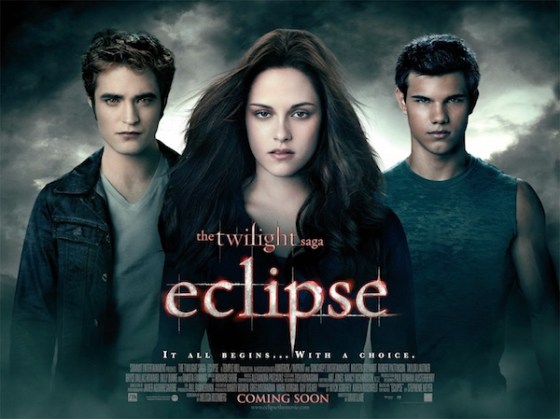
For the third Halloween in a row, I’ve subjected myself to true cinematic horror: a Twilight film. I suppose this one’s theoretically the turning point of the franchise: it’s the middle movie in the film series, while in the books it’s the penultimate instalment — surely in every regard placed to set up the final conflict. Well, you wouldn’t know it, because this is another Twilight film where very little happens.

The plot, such as it is, sees Bella (Kristen Stewart) trying to juggle her romantic relationship with vampire Edward (Robert Pattinson) and her just-about-platonic friendship with werewolf Jacob (Taylor Lautner), which is tricky because the pair don’t get on owing to an ancient feud between their species. Just your regular high school problems, then. Meanwhile, a series of mysterious murders in Seattle have caught the attention of Edward’s de facto vamp family, because they reckon it’s probably not your bog standard serial killer, but rather something in their neck of the woods. (Their neck of the woods. Geddit? Neck of the woods. Nothing? Okay then.) What do they plan to do about it? Watch it… on the news… and… er… wait and see… if it comes near them… maybe?

So, that, but for two hours.

I know how to settle this... a stare off!

So yes, nothing happens — and yet, somehow, nothing happens less boringly than last time. I mean, it’s not great, but it’s not as bad. It actually has some passably good scenes and conflicts, for example. That said, it spends the whole movie getting to basically where the last one ended. The dialogue’s still shit as well. Especially the supposedly passionate stuff, which is like some 11-year-old-who’s-watched-too-many-movies’ idea of what would be romantic. Most of the scenes go on far longer than needed. Plots go round in circles (as I said, nothing happens). And there’s nothing as brilliantly awful as Face Punch, though Edward and Jacob do get one passingly amusing one-liner each. And I have absolutely no idea whatsoever why it’s called Eclipse. I suppose Twilight and New Moon didn’t mean a great deal either, but I still think they meant more than Eclipse.

This may sound a strange thing to say, but this one’s very much a romance movie. The first two must’ve been as well, because that’s what Twilight is, so I’m not sure why I felt it more this time. I suppose the first one had a lot on its plate establishing all the supernatural stuff, and New Moon had a lot of palaver building out the world further, mixing in werewolves and the vampire high council (or whatever). Eclipse does have the Seattle stuff, but that just pops up now and then in between Bella umming and ahhing over her relationships.

Team Abs

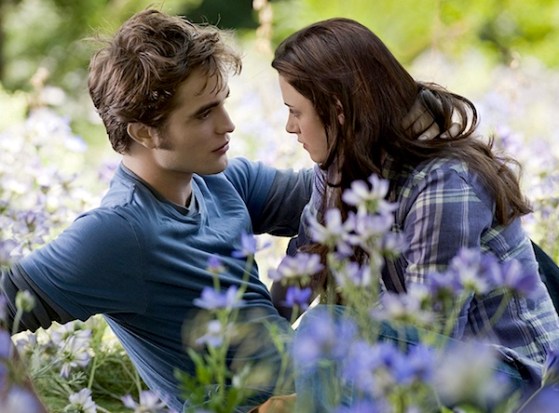
As to that, the story tries so. hard. to make you believe it’s possible Bella could change her mind and switch affections from Edward to Jacob — but did anyone ever really believe that was an actual possibility? The story just isn’t built that way. Before I watched the films, I could never understand why anyone would be Team Jacob. It seemed so obvious she’d end up with Edward, why waste your energy? But now, even still thinking it’s inevitable, if I had to pick a team it’d definitely be Team Jacob. The reason is Taylor Lautner. No, not because of his phwoarsome abs. I remember everyone being very surprised when Lautner joined BBC Three sitcom Cuckoo, but actually watching these films you can see he has at least some ability with comic timing. His character is also more down-to-earth and levelheaded than his vampiric rival. Put together, these traits make Jacob much more likeable than bloody Edward.

The rest of the cast are as much nonentities as ever. It’s no wonder it’s taken Kristen Stewart years to re-establish the positive career path she was on before Twilight. Original Victoria actress Rachelle Lefevre was fired because her schedule for another film overlapped, and her replacement is Bryce Dallas Howard. Although Victoria has been an antagonist throughout the series, and her storyline ostensibly comes to a head in this instalment, she’s barely present. Quite why they cast a relatively well-known actress in such a minor role, or why she agreed to do it, is a mystery. At least it doesn’t seem to have harmed her career.
Team Sparkles

Others have been less fortunate. I mean, Robert Pattinson still works, but in what lately? I thought the same about director David Slade, whose work here is perfectly serviceable while at no point being memorable. Previously he’d helmed well-received horror/thrillers Hard Candy and 30 Days of Night, a promising start to his career. However, since taking the Twilight dollar (he’d previously slagged off the series, comments he tried to pass off as a joke when he signed on for Eclipse) he’s shifted to TV, starting off poorly with a raft of pilot episodes like This American Housewife (not picked up), Awake (ditched after a half season), Crossbones (cancelled after nine episodes), and Powers (only available on PlayStation). But more recently he’s been an executive producer and director on Hannibal and American Gods, and has a Black Mirror coming up. I guess the era of prestige TV is working out for him.

Anyway, back to Eclipse. For a movie in which so little happens, I found it surprisingly unobjectionable. It’s not good, but I’d say it’s the least-bad Twilight so far. Of course, it wouldn’t make any sense to watch it without sitting through the previous two first, so my assessment is even more damning with faint praise than it sounds.

2 out of 5

See you this time next year for Breaking Dawn Part 1… and maybe Part 2, just to get this thing over with.

The Exorcist (1973)

2017 #150
William Friedkin | 122 mins | Blu-ray | 16:9 | USA / English & Arabic* | 18 / R

The Exorcist

Did you know The Exorcist was based on a true story? I didn’t, until I watched some of the special features on the Blu-ray release. “Based on” is a bit of a stretch, to be honest. “Inspired by” would be more accurate. But you get the sense from author and screenwriter William Peter Blatty that he believes all this stuff so much that he thinks “based on” would be fine.

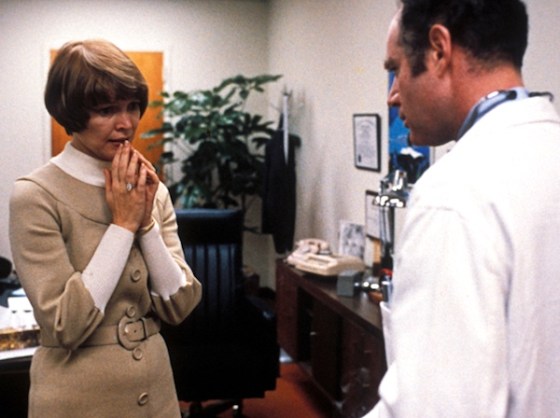
The Exorcist does start out very plausibly. It’s about Regan MacNeil (Linda Blair), a sweet 12-year-old kid living with her mother Chris (Ellen Burstyn) in Washington, D.C. But one day Regan begins to act oddly: delivering insults and soiling herself at a party; yelling obscenities; slapping her beloved mother; somehow causing her bed to shake uncontrollably… Doctors run tests, but they reveal nothing. The only suggestion they’ve left to give is that Regan may believe she’s possessed by an evil spirit, and that she might be tricked into believing she’s cured if the church will perform a little-known procedure called an exorcism.

Worried mother

Everyone’s so busy talking about The Scary Stuff when it comes to The Exorcist, no one ever tells you how low-key and grounded a lot of it is. Okay, the talking in voices and spinning heads and vomiting green gunk and bloody crucifix masturbation are pretty memorable, so fair enough. Before that, though, it’s more of a character drama, about a single mother struggling to handle what appears to be her daughter’s out-of-control mental health problems. Meanwhile, a priest, Father Karras (Jason Miller), struggles with a crisis of faith brought on in part by his ailing mother. Naturally these two threads align when Chris calls on Karras to investigate Regan’s condition.

Another thing I’ve never heard about The Exorcist is how good Miller is. This is his film debut, before which he was a stage actor, but he delivers a very naturalistic performance as a man of the cloth who also has his head screwed on — his training in psychology keeps him suitably skeptical of what’s going on with Regan. Events conspire to challenge his point of view, of course. Karras has the clearest arc of anyone in the film, giving Miller the most scope to develop his role. I’d venture he’s the film’s most interesting character.

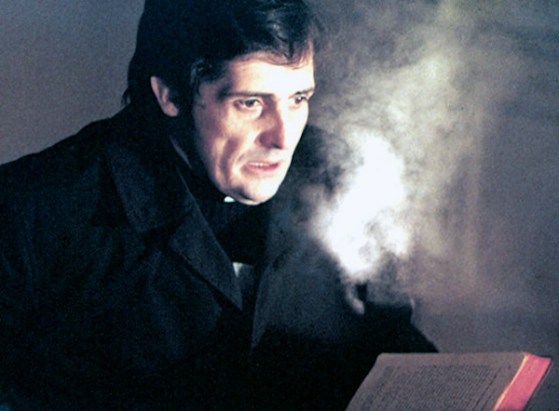
Father Karras

That’s not to dismiss Burstyn, who’s also excellent as the very together mom who begins to crack under the increasing strain of her daughter’s worsening, inexplicable condition. As said daughter, Blair’s performance is certainly memorable, though the potency of Regan is aided by special effects and voice work from another actress. Although second billed, Max von Sydow only pops in at the beginning and end in the titular role of Father Merrin. It’s no wonder someone later thought Merrin’s past was ripe for a prequel, because there’s a backstory there that’s only hinted at.

And no one ever says how little Tubular Bells is in it, either.

The thing people do say about The Exorcist is how scary it is. Tales of audiences fainting and running out during its initial theatrical run are the stuff of movie legend. Today its releases are branded as “the scariest film ever made”, with the justification of several polls that have named it thus. I can well believe that, in the early ’70s, it was indeed the most shocking film most people had ever seen, certainly from a major studio. The extreme bad language, the gruesome special effects, the morally depraved acts, and all of it happening to a child…

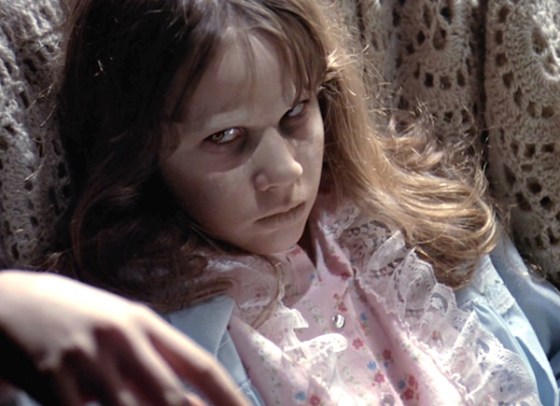
Regan... or is it?

It was surely an element of sensibilities being offended (especially in America), as much as it was actual horror, that provoked such radical reactions from audiences back in the day. Nowadays we’re a bit more deadened to those things — the last 40+ years have served up plenty of elaborate gore, and potty-mouthed pre-teen girls are more likely to be found in comedies (Hit-Girl is even younger than Regan when she utters the C word in Kick-Ass, for example). I also thought it frequently undermined its own intensity by cutting away from the scary scenes to more mundane stuff. Maybe the goal was to never give those scenes an ‘out’ — we always seem to leave them when supernatural stuff is still going on — but for me it killed the momentum that was building.

That’s not to say the horrific and shocking stuff is no longer powerful. What really works in its favour is how long the film spends being grounded and plausible — most of the first hour is a ’70s social drama about a child with a mental health problem. That level of realism helps the later horror scenes be all the more effective. They quite quickly transcend the realms of the plausible (unless you’re some kind of religious fanatic, I guess), but the grounded setup lends weight to them nonetheless. The climax in particular — the actual exorcism — might just be silly without the realistic world it’s been placed in. Instead, it’s a suitably tense climax.

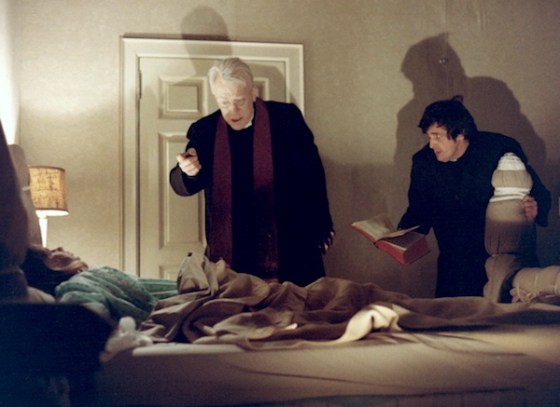
The exorcism

Obviously it was the extreme stuff that caught people’s attention and earnt The Exorcist a reputation that it still trades off to this day. However, I’d say it’s best regarded, not as a fright-fest, but as a film about characters: the mother who’ll do anything for her child; the priest battling with a crisis of faith. It’s a drama about real people in extreme circumstances, it’s just that these extreme circumstances happen to be horror movie fodder. In this respect it’s such a film of the ‘70s, which I mean in the best possible way.

5 out of 5

The Exorcist was viewed as part of my Blindspot 2017 project, which you can read more about here.

* IMDb lists half a dozen other languages, but Arabic’s the only one I remember being significant enough to earn subtitles. ^

Twilight Zone: The Movie (1983)

2017 #129
Joe Dante, John Landis, George Miller & Steven Spielberg | 97 mins | streaming (HD) | 16:9 | USA / English | 12 / PG

Twilight Zone: The Movie

I can’t remember when I first heard of Twilight Zone: The Movie — certainly not until sometime this millennium — but I do remember being surprised I hadn’t heard of it before. Why wasn’t it more often talked about? After all, here’s a film based on a classic TV series, directed by some of the hottest genre filmmakers of the time: John Landis just after An American Werewolf in London; Joe Dante just before Gremlins; George Miller fresh from Mad Max 2; and, most of all, Steven Spielberg, coming off a run that encompassed Jaws, Close Encounters, Raiders of the Lost Ark, and E.T. I mean, Jesus, even if the movie wasn’t great then surely it should be well-known! It was only later still that I learnt about the infamous helicopter crash. Couple that with a mediocre critical reception and relatively poor box office results, and suddenly it’s no wonder no one ever talked about the film. My viewing of it was primarily motivated by attempting to complete the filmographies of Spielberg and Miller, but I’m glad I did because, on the whole, I rather enjoyed it.

As the original Twilight Zone was an anthology series, so is the movie — hence having four directors. Although the original plan was to have some characters crop up in each segment, thereby linking them all together, that idea didn’t come off. The end result, then, is really just five sci-fi/fantasy/horror short films stuck together — composer Jerry Goldsmith is the only key crew member to work across more than two segments. The advantage of that as a viewer is, if you don’t like one story, there’ll be another along before you know it. Because of that, I’ll take each part in turn.

The Trump Zone

The film begins with a prologue, directed by John Landis, featuring Albert Brooks and Dan Aykroyd as a driver and a hitchhiker chatting about classic TV and scary stories. Although obviously the shortest segment, it’s good fun and sets a kind of comic tone — not one the rest of the film follows, to be fair, but it’s kind of effective in that it has a knowing wink to the audience: “we all know The Twilight Zone is a TV show. Now, here are four stories from it.”

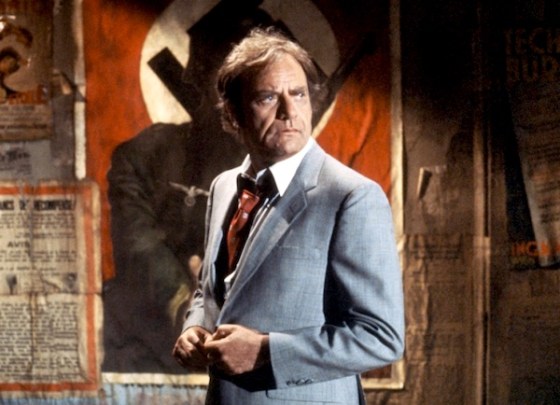
Landis also directs the first full segment, Time Out, the only one of the four not adapted from an original TV episode. Basically, it’s about a Trump supporter. You might not have noticed that if watching before last year, for obvious reasons, but viewed now it’s kind of hard to miss. What’s depressing it that the point of the film is this guy’s views are outdated in 1983, and yet you have Trumpers spouting the same shit in 2017, three-and-a-half decades later. That aside, as a short moral parable it’s effective. It doesn’t have the ending that was scripted (thanks to the aforementioned tragedy), but I think the conclusion it does have is actually more appropriate. It feels kind of wrong to take that view, because the only reason it was changed was that terrible accident. Obviously it wasn’t worth it just for this segment to have a better ending, but there it is.

Scary kid? Check.

Segment two, Kick the Can, is Spielberg’s, and anyone familiar with his oeuvre — and the criticism of it — will see that right away: it’s shot in nostalgic golden hues and contains positive, sentimental moral lessons. In fact, it’s so cloyingly sweet, it’s like a parody of Spielberg’s worst excesses. It was originally intended to be the last film in the movie, and you can see why: it would’ve formed a positive, upbeat finale to the picture. I’m not sure why they moved it — possibly because they felt it was the least-good. That’s what a fair few critics believe, anyway.

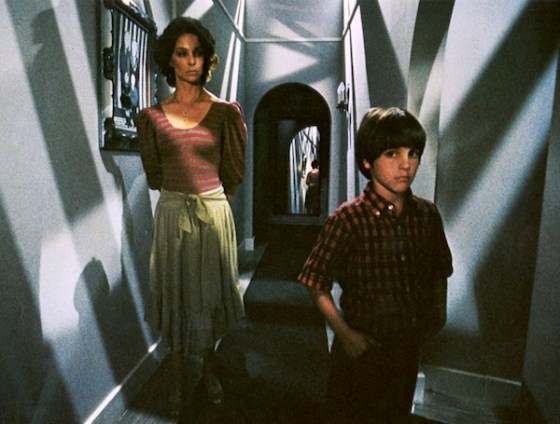
Personally, segment three was my least favourite. This is Joe Dante’s short, titled It’s a Good Life, and is about a woman who accidentally knocks a boy off his bike, gives him a lift home, and finds a pretty strange situation therein. I found it to be kind of aimless; weird for the sake of weird. It’s prettily designed and shot, with bold cartoon colours, but if I watched the film again I’d give serious thought to just skipping it.

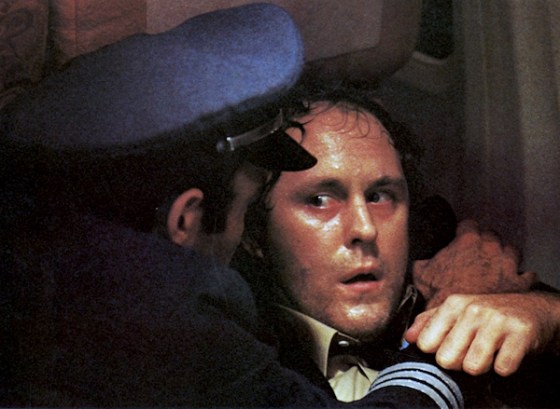
The final segment remakes arguably the most famous Twilight Zone episode: Nightmare at 20,000 Feet. It’s about a paranoid airplane passenger on a turbulent flight, who thinks he sees a monster on the wing. Naturally, no one believes him. I’ve not seen the original version so can’t compare, but director George Miller and star John Lithgow do a fantastic job of realising Richard Matheson’s story, loading it with tension and uncertainty — is it actually all in the passenger’s head? And if it isn’t, can they survive?

Fear of flying

On the whole, I liked Twilight Zone: The Movie more than I’d expected I would. Nonetheless, as a series of shorts, it’s destined to be a footnote in the career of all involved (even Landis has done a fair job of moving on from the controversy — as I said, I hadn’t even heard about it until relatively recently). The only truly great segment is Miller’s finale, but the others all have elements that make them worth a look.

4 out of 5

Musical Review Roundup

My blog is alive with the sound of music, courtesy of…

  • Sing Street (2016)
  • Jersey Boys (2014)
  • Sing (2016)
  • Into the Woods (2014)


    Sing Street
    (2016)

    2017 #13
    John Carney | 106 mins | streaming (HD) | 2.35:1 | Ireland, UK & USA / English | 12 / PG-13

    Sing Street

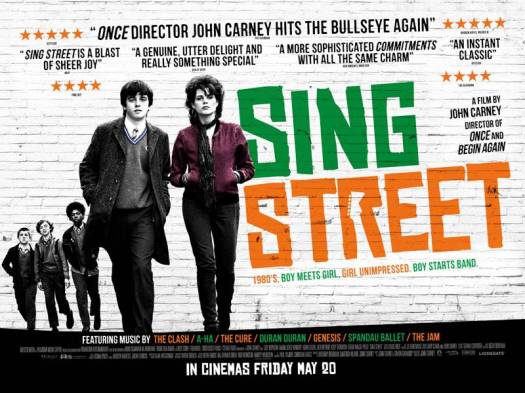
    A struggling busker — sorry, a failing record exec — no, sorry, a misfit teenage boy… sets out to impress a beautiful fellow busker — sorry, a promising singer-songwriter — no, sorry, a cool girl… by helping her record a record — sorry, by coercing her to record a record — no, sorry, by persuading her to star in the music video for the record he’s recorded. Except he hasn’t actually recorded that record yet. In fact, he doesn’t even have a band.

    Yes, the writer-director of Once and Begin Again has, in some respects, made the same film again. Yet somehow the formula keeps working. Here there’s extra charm by it being school kids dealing with first love and finding their place in the world. It’s something we all go through, so there’s a universality and nostalgia to it that perhaps isn’t present in the story of twenty/thirty-somethings who are still floundering around (especially Begin Again, which made them cool twenty/thirty-somethings living in cool New York).

    It’s fuelled by endearing performances, particularly from young leads Ferdia Walsh-Peelo and Lucy Boynton, and a soundtrack of era-aping toe-tappers — in an alternate (better) universe, The Riddle of the Model and Drive It Like You Stole It competed for the Best Original Song Oscar, and one of them won it too. And those are just the highlights — the rest of the soundtrack is fab as well. I imagine if you were a music-loving teenager in the ’80s, this movie is your childhood fantasy.

    5 out of 5

    Sing Street placed 7th on my list of The 17 Best Films I Saw For the First Time in 2017, which can be read in full here.

    Jersey Boys
    (2014)

    2017 #97
    Clint Eastwood | 134 mins | streaming (HD) | 2.35:1 | USA / English | 15 / R

    Jersey Boys

    A musical biopic about Frankie Valli and the Four Seasons doesn’t seem like a very Clint Eastwood film at first glance, but when it turns out to be kind of Goodfellas but with the music industry, it becomes at least a little more understandable.

    Based on the hit Broadway musical, it retains a staginess of structure — the four band members take turns narrating the story by speaking to camera — while also opening out the settings so it feels less “jukebox musical” and more “biopic with songs”. It takes some liberties with the chronology of events for dramatic effect, but that’s the movies for you.

    The shape of the story feels familiar and it feels leisurely in the time it takes to tell it, but the songs are good and most of it is perfectly likeable. It’s by no means a bad movie, just not one that’s likely to alight any passion.

    3 out of 5

    Sing
    (2016)

    2017 #107
    Garth Jennings | 108 mins | download (HD+3D) | 1.85:1 | USA / English | U / PG

    Sing

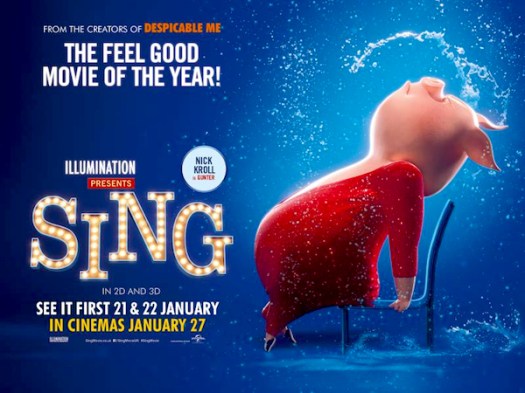
    The seventh feature from Illumination (aka the Minions people) comes across like a cut-price Zootopia: in a world where animals live side-by-side in cities like humans, a struggling theatre owner launches an X Factor-esque singing competition to revive his fortunes. Naturally there’s a motley cast of participants, all with celebrity voices, and hijinks ensue.

    Apparently the film features 65 pop songs, the rights to which cost 15% of the budget — if true, that’s over $11 million just in music rights. The big musical numbers (all covers, obviously) are fine, with the best bit ironically being the new Stevie Wonder song on the end credits, which is accompanied by Busby Berkeley-ing squid. Elsewhere, there are some moments of inventiveness, but it doesn’t feel as fully realised as Zootropolis. Perhaps that’s part and parcel of Illumination’s ethos: to make films that translate internationally, presumably by being quite homogeneous. And to make them cheaply (their budgets are typically half of a Pixar movie), which has its own pros and cons.

    Anyway, the end result is fine. Much like Jersey Boys, Sing is perfectly watchable without ever transcending into anything exceptional.

    3 out of 5

    Into the Woods
    (2014)

    2017 #118
    Rob Marshall | 125 mins | streaming (HD) | 2.39:1 | USA, UK & Canada / English | PG / PG

    Into the Woods

    Fairytales are combined and rejigged in Stephen Sondheim’s Broadway musical, here brought to the screen by the director of Chicago. The original is a work that definitely has its fans, but doesn’t seem to have crossed over in the way of, say, Phantom of the Opera or Les Mis — I confess, I’m not sure I’d even heard of it before the film was announced.

    The film adaptation readily suggests why that might be. For one, it’s light on hummable tunes. It’s almost sung through, with only a few bits seeming to stand out as discrete songs in their own right. For example, it takes the opening number a full 15 minutes to reach its culmination, having been diverted into a few asides. Said song culminates with most of the main characters going into the woods while singing about how they’re going into the woods, and yet the film doesn’t put its title card there. The placement of a title card is a dying art, I tell you.

    Performances are a mixed bag. Everyone can sing, at least (by no means guaranteed in a modern Hollywood musical adaptation), and the likes of Emily Blunt, James Corden, and Anna Kendrick are largely engaging, but then you’ve got Little Red Riding Hood and her incredibly irritating accent. Fortunately, she gets eaten. Unfortunately, she gets rescued. On the bright side there’s Chris Pine, his performance well judged to send up the romantic hero role. You may remember Meryl Streep got a few supporting actress nominations for this, which is ludicrous. It’s not that she’s bad, but she’s in no way of deserving of an Oscar.

    There are witty and clever bits, both of story and music, but in between these flashes it feels kind of nothingy. It’s also overlong — the plot wraps up at the halfway point, with the second half (presumably what comes after an interval on stage) feeling like a weak sequel to the decent first half. All in all, another one for the “fine, but could do better” pile.

    3 out of 5

  • 21 (2008)

    2017 #114
    Robert Luketic | 123 mins | streaming (HD) | 2.35:1 | USA / English | 12 / PG-13

    21

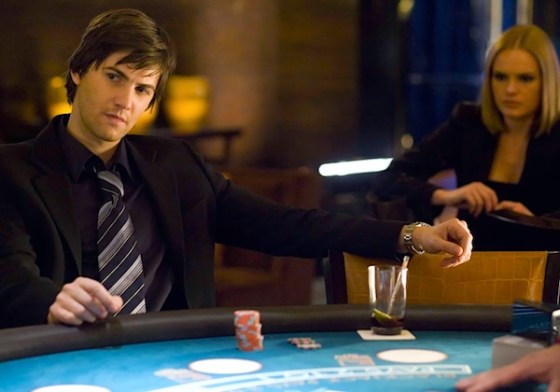
    21 is based on a true story. Actually, it’s based on a book that’s based on a true story. Bringing Down the House by Ben Mezrich was a non-fiction bestseller, telling the fun and exciting story of the MIT blackjack team, a bunch of college kids who learnt card counting and took Vegas for millions of dollars. It was such a popular book that all the attention made people look into it, and it turned out it was heavily fictionalised — Mezrich not only exaggerated events, he flat out invented whole chunks of the story. (At the same time, he also left out some good stuff.) In turn, the book has itself been heavily melodramatised for this movie adaptation. What we’re left with is probably about as close to the truth as Game of Thrones is a fair depiction of the Wars of the Roses: some of it happened, but not to those people, not in that way, not at that time, and certainly not all of it.

    As a film, it’s been mashed broadly into the heist movie template. Setting aside the veracity and treating it purely as an entertainment, this has pros and cons. Whenever it’s whizzing around in Vegas it’s kinda fun, with flashy camerawork and a slick feel for the excitement of being a successful high-roller. But when it puts that aside to get stuck into the characters’ thinly-drawn personal lives, it gets kinda dull. Part of the point of the book is how boring normal life began to seem to the team when compared to their Vegas lifestyle, but 21 tacks on more interpersonal subplots that just become finger-drumming.

    Counting cards

    Trying to make the chosen genre function isn’t helped by the fact that there’s no complicated heist here. The blackjack team are doing the same thing over and over — that’s basically how their system works as a moneymaker — and once the system’s been explained and we see it in action, the film only has a few ways to jazz that up. Between that and those subplots, at over two hours 21 is much longer than it needs to be, but doesn’t focus that time in the right areas: at least one major character undergoes a huge personality change across a single montage.

    21’s got enough pizzazz to make it enjoyable purely as a lightweight movie experience, but you do have to wonder: would the incredible real story, by dint of being true and not movieised to fit a genre template, actually have been more interesting?

    3 out of 5

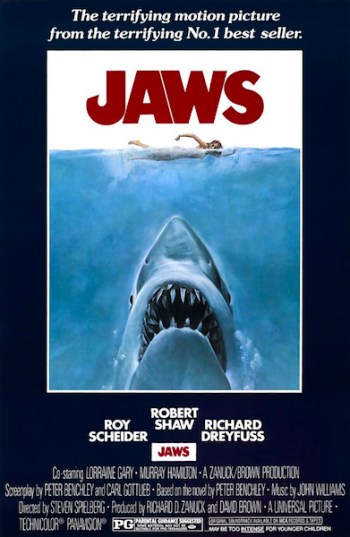
    Jaws (1975)

    The 100 Films Guide to…

    See it before you go swimming.

    Country: USA
    Language: English
    Runtime: 124 minutes
    BBFC: A (1975) | PG (1987) | 12A (2012)
    MPAA: PG

    Original Release: 20th June 1975 (USA)
    UK Release: 26th December 1975
    Budget: $7-12 million (sources vary)
    Worldwide Gross: $470.6 million

    Stars
    Roy Scheider (The French Connection, All That Jazz)
    Robert Shaw (From Russia with Love, The Sting)
    Richard Dreyfuss (Close Encounters of the Third Kind, Poseidon)
    Lorraine Gary (Jaws 2, 1941)

    Director
    Steven Spielberg (The Sugarland Express, E.T. the Extra-Terrestrial)

    Screenwriters
    Peter Benchley (The Deep, The Island)
    Carl Gottlieb (Jaws 2, The Jerk)

    Based on
    Jaws, a novel by Peter Benchley.


    The Story
    As the seaside resort of Amity Island prepares for the lucrative 4th of July weekend, a series of violent shark attacks threaten the lives of residents and holidaymakers alike.

    Our Heroes
    Police chief Martin Brody is the one lumped with having to work out how to stop a man-eating shark, battling both small-town politics as well as the underwater predator. Eventually he’s aided by Matt Hooper, a young shark expert, and Quint, a salty old shark hunter.

    Our Villain
    A 25ft great white shark, with a taste for human flesh.

    Best Supporting Character
    Amity’s Mayor just wants what’s best for his town and its people — which, in this case, is having the beaches open for July 4th, whether people might get eaten or not.

    Memorable Quote
    “You’re gonna need a bigger boat.” — Brody

    Memorable Scene
    A group of young people sit on the beach at night drinking. The eyes of a boy and girl meet. They race off towards the sea, stripping as they go. She gets into the water first, while he’s too drunk to get his clothes off. She messes around in the ocean while he passes out on the sand. Then, she notices something underneath the water — something that grabs her — and… well, it doesn’t end well.

    Memorable Music
    John Williams’ famous, simple main theme is the definitive musical interpretation of approaching terror. When Spielberg first heard it, he thought it was a joke. Later, he said it was half of what made the film so successful.

    Making of
    Three mechanical sharks were built for the film, but no one thought to test them in water before taking them on location. They kept malfunctioning, causing a constant headache throughout production — because of them and other issues of shooting at sea, the film’s 55-day schedule ended up taking 159 days, and the $3.5 million budget ballooned to as much as $12 million. On the bright side, Spielberg had to work out how to shoot material around the unavailability of the sharks, which led to him taking a Hitchcockian approach of showing the ‘monster’ as little as possible, which was ultimately a benefit to the film’s effectiveness.

    Next time…
    Jaws was the highest grossing film of all time, so naturally there were a series of cash-grab sequels. As far as I was aware they were universally condemned, so I’d never paid them any heed, but I recently read a review that made me think I should give them a go. It said Jaws 2 wasn’t actually all that bad, Jaws 3-D was trashy fun, and Jaws: The Revenge… well, in for a penny, in for a pound, I guess. Incidentally, the last one is the film of which star Michael Caine famously said, “I have never seen it, but by all accounts it is terrible. However, I have seen the house that it built, and it is terrific.”

    Awards
    3 Oscars (Editing, Sound, Original Dramatic Score)
    1 Oscar nomination (Picture)
    1 BAFTA (Music (also for The Towering Inferno))
    6 BAFTA nominations (Film, Director, Actor (Richard Dreyfuss), Screenplay, Editing, Sound)
    1 Grammy (Original Score Written for a Motion Picture or Television Special)

    Verdict

    It’s easy to start discussing Jaws in terms of it being the first summer blockbuster, or its troubled production, or the effect it had on audiences’ desire to go swimming. But divorced from all that, as a film in its own right, it’s a thrilling adventure movie — a man vs. a shark, when it comes down to it. It’s so packed with memorable shots and moments — be they horrific shark attacks, improvised one-liners, or precisely calibrated jump scares — that it’s no wonder it made Spielberg’s name. Personally, I feel the pace flags a bit once the three men get on a boat and go shark hunting, which slightly holds me back from completely loving it. Quibbles aside, it’s still a classic of suspense.

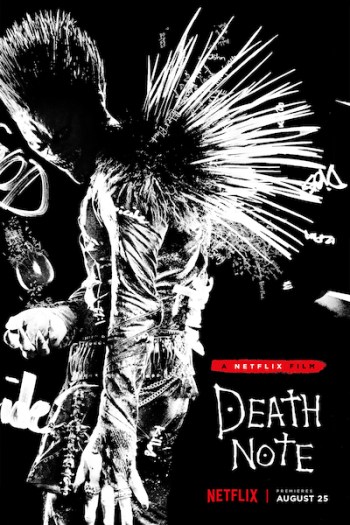
    Death Note (2017)

    2017 #115
    Adam Wingard | 100 mins | streaming (UHD) | 2.35:1 | USA / English | 18

    Death Note

    Something of a global phenomenon in the ’00s, Death Note started life as a manga, is perhaps best known for its anime adaptation, was adapted into a series of live-action films (I reviewed the first two last week), adapted again as a live-action TV series, and was even turned into a musical. Although it’s taken a while, finally the inevitable is here: an American remake. After passing through several studios, it’s wound up with Netflix, under the helmsmanship of Adam Wingard. Thus, I was hoping for the new film from the director of The Guest. Instead, I got the new film from the director of Blair Witch. And much like Blair Witch, this is a ham-fisted reimagining of a once-popular franchise.

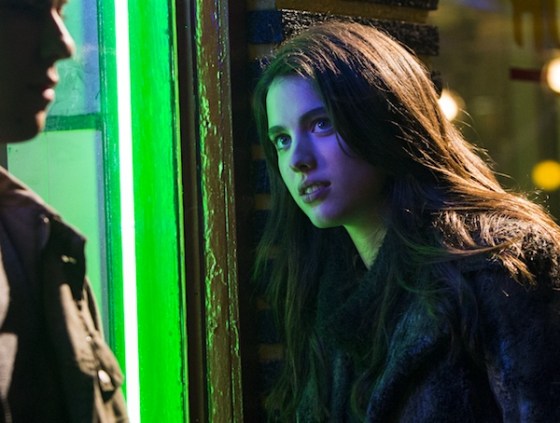
    This incarnation of the story concerns Light Turner (Nat Wolff), a Seattle high school student who one day discovers the mysterious Death Note, a notebook with the power to kill just by writing someone’s name in it. Goaded into using it by the demonic death-god Ryuk (voiced by Willem Dafoe), Light soon teams up with his crush Mia (Margaret Qualley) and they set about murdering criminals. Their actions become famous under the alias Kira, which they hope to use to establish a new world order. But hot on the case is a mysterious super detective known only as L (Lakeith Stanfield), who engages Kira in a battle of wits.

    As with so many things nowadays, the US version of Death Note has been dogged by accusations of whitewashing. As seems to be the case at least half the time, these accusations are largely unfounded. If this had kept the Japanese settings and character names but given them white faces, fair enough, but it hasn’t — it’s relocated to America, with American characters. It’s no different to all the other new-country remakes that have always happened (and also goes on the other way, with US movies remade in Bollywood and Asia, we just don’t hear about them very often here).

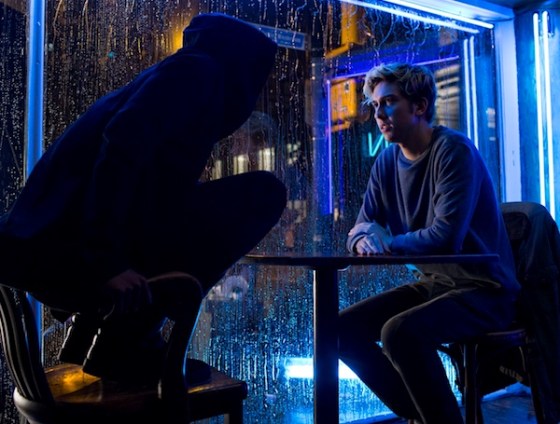
    Light vs L

    Unfortunately, Death Note: America has genuine problems to contend with. Despite that reimagining status, it’s still understandably shackled to the broad shape of the original work. Consequently, it glosses over some of the more interesting implications of the premise in its rush to make Kira famous and introduce L. Partly that’s what happens when you condense so much story into just 100 minutes, but it’s also because it’s beholden to bringing in L and starting his cat-and-mouse game with Light. When I reviewed the Japanese live-action movies, I didn’t think Light and L’s battle of wits was as clever as the films clearly thought they were, and it’s even worse here.
    There would seem to be more fertile and interesting ground for exploration in why Light and Mia are trying to establish a new world order — what exactly they think that means; what motivates them to do it; and how they intend to achieve it. On the whole, the film doesn’t seem to be making time to dig into the psyche of its characters — why they’re doing what they’re doing, how it changes them — instead just going through the motions of a thriller plot. It feels like it’s had 20 minutes of character stuff cut out that would grease the wheels of the plot. The worst offender is the climax: there’s no weight to the big finale because we’ve been given no time to care about these characters or their relationships with each other.

    Ello, L

    For all the faults of the way the other version I’ve seen executed Light and L’s chess-like interactions, at least they consistently involved Light using the Death Note and its rules to try to trick L. Here, after the eponymous book and its abilities have been established, it’s basically just used to control other people to make them forward the plot, only returning to its real purpose come the climax. This is another reason the focus on Light and L’s duelling doesn’t work here: at least the original thought they were both geniuses and behaved as thus; each of them was motivated by proving they were cleverer than the other, everything and everyone else be damned. Here, L is still some kind of savant, whereas Light seems a pretty normal teenager, motivated by… well…

    So, in the original, Light does his utmost to keep the Death Note secret from everyone to protect his identity as its user. Here, almost as soon as he’s got it he blabs about it to the girl he fancies. Why? Same reason most guys try to show off to girls: because he thinks it’ll impress her. It’s a change of motivation, but okay, why not? But he’s given very little indication that such a thing would impress her. What if she’d been appalled and gone running to the police? She doesn’t, of course, because this is a geek’s fantasy, so she a) loves it, and b) within minutes is shagging him. (Presumably. This may be an 18 for gore, but sexy times are implied by no more than a little light clothing removal. Perhaps they just sat around in their undies while murdering people with their magic book, I dunno.)

    Bloodthirsty crush

    Believe it or not, Death Note is not a total washout. Indeed, the best things about the film are easily identified. Firstly, there’s Willem Dafoe’s voice performance as Ryuk. If you need a manipulative death-god, he’s a perfect choice. Secondly, the visual realisation of said death-god, a mix of strong CG and keeping him in the shadows. It’s light years more effective than the ’00s movies. On the downside, Ryuk’s role amounts to little more than a glorified cameo: after an initial appearance to explain the rules, he just pops up briefly to remind us he’s still a bother.

    Thirdly, then, there’s the death sequences that occur on the first couple of occassions Light uses the Death Note. This film skips the “they just die of a heart attack” phase and goes straight for the “you can dictate how they die” jugular. In this version, that means a Final Destination-a-like chain of random events occur that make the deaths fairly amusing. Also, graphically violent — enough for that 18 in the eyes of the BBFC. These go AWOL again as the film has to get busy with its plot, which is a shame. Basically, someone should’ve tapped Wingard to make Final Destination 6.

    Fourthly, and finally, the score is very likeable. It’s full of the ’80s horror movie synths you’d expect from the director of The Guest, though it’s undercut somewhat by a few bizarre song choices, mostly during the climax.

    In the dark, no one can see your CGI

    Having read a few reactions to the film online, it strikes me that on one hand you’ve got fans criticising it for not being faithful enough, while on the other you’ve got critics picking on it for things that I’d argue are inherent in the source narrative (at least based on what I’ve seen before). That doesn’t excuse this adaptation entirely — they’ve changed so much that fixing logic issues could definitely have happened too — but it’s an amusing juxtaposition of reasons for displeasure: it’s a film scuppered both by being faithful and by not being faithful. Unfortunately that means that, whether you’re comparing it to a previous version or not, it fails to be a coherent experience.

    2 out of 5

    Death Note is available worldwide on Netflix now.

    Death Note: The Last Name (2006)

    aka Desu Nôto: the Last name

    2017 #112
    Shūsuke Kaneko | 135 mins | DVD | 16:9 | Japan / Japanese | 12

    Death Note: The Last Name

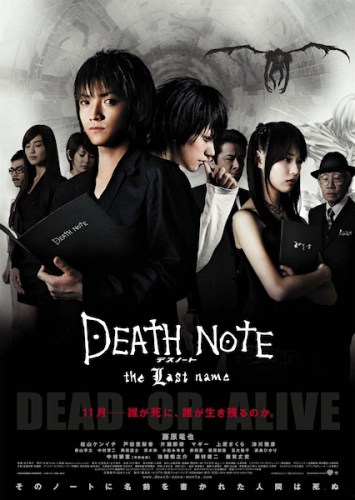
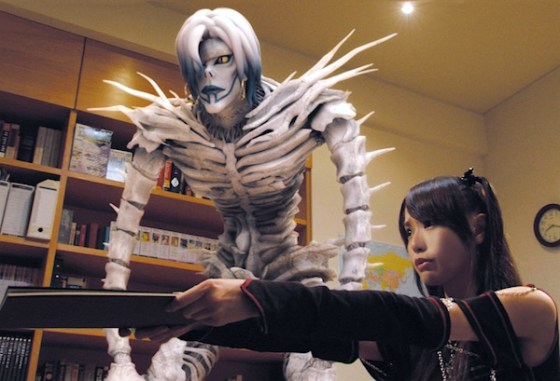
    Picking up immediately after the first movie, this sequel — part two of two — sees Light Yagami (Tatsuya Fujiwara), the owner of a supernatural notebook that allows him to kill anyone simply by writing their name, join the team of detectives searching for him. Although he had supposedly proven his innocence, Light is still the prime suspect of genius detective ‘L’ (Kenichi Matsuyama). Light aims to discover L’s real name and write it in his Death Note. He’s aided by the emergence of a second Death Note, wielded by TV host Misa Amane (Erika Toda), who has a crush on Light and agrees to help him. They’re observed and aided by their respective shinigami (death-gods), Ryuk (Shidô Nakamura) and Rem (Shinnosuke Ikehata) — but can supernatural beings be relied on in the end?

    Fundamentally, The Last Name resumes Light and L’s cat-and-mouse game in the same style as the first movie — in case you didn’t get it, near the start of the film their figurative chess game is represented by a literal chess game. This time there are the added complications of Light being on L’s team and the second Death Note being in play, which at least adds some variety. Light continues to manipulate the book’s rules to help prove his innocence and achieve his goals, which is perhaps where the films are at their most inventive — for example, you forget about the Death Note if you lose possession of it, but regain those memories if you touch it again, so what if you could find a way to give it up, prove your innocence conclusively, and get it back later? The endless games and counter-games begin to get a bit tiresome after a while (together the duology pushes four-and-a-half hours), but they do eventually make for quite a surprising climax.

    Figurative chess, literal chess

    Produced hot on the heels of its predecessor (see my previous review for how ridiculously tight the production schedule was), it’s no wonder that The Last Name feels very much of a piece with the last movie. The major downside of this is L’s alleged genius-level intellect, which was quite ridiculous last time but is now off the charts as he frequently makes entirely unfounded leaps of logic. All of his ‘deductions’ are correct, of course, because the story wants him to be a genius, but he has no reason to be. No other character ever calls him out on it. Even when events would seem to prove him wrong, other characters, who should know better and stop him, let him keep going. He has a starting hypothesis (“Light is Kira”) and, whenever something disproves it, he pulls a reason out of thin air to keep himself being correct. He guesses right every time, but for no good reason. He should’ve been kicked off the case for being loony several times over.

    Something else that’s more noticeable in The Last Name is how this series treats its female characters terribly. (Spoilers for the first film follow.) At the end of the first movie, it’s revealed that Light murdered his girlfriend in cold blood and feels absolutely no remorse, but he’s still positioned as the hero. In this film, every woman that turns up loves either him or his Kira alter ego. When they’re not working to help him, they prance around in schoolgirl outfits, or lounge about showing off their legs, or are chained up in revealing rags. They’re all a bit dippy, too, happy to do whatever Light/Kira says just because he’s deigned to interact with them. Conversely, almost all the menfolk are positioned as geniuses. It’s not outright distasteful, but you don’t have to think too hard to find it a bit eye-roll-worthy at the very least.

    Me Light you long time

    Although The Last Name seems to conclusively end its story, that hasn’t stopped the live-action incarnation of the franchise rolling on: a couple of years later there was a spin-off movie starring L (I have it on DVD and was going to review it this week, but, frankly, I couldn’t stomach anymore of the brat right now), and in 2016 it was revived with a miniseries that led into a fourth movie (no sign of a UK release for either of those, though).

    As I said at the end of my review of part one, it seems clear these Death Note films were hampered by their hurried production — greater thought at the writing stage could iron out some of the issues I’ve outlined. Conversely, as it’s adapted from an existing work, it’s equally possible the problems are inherent to the material and more time wouldn’t’ve made any difference. Maybe the imminent US version will have reworked it to positive effect…

    3 out of 5

    The US remake of Death Note is released on Netflix tomorrow.

    Death Note (2006)

    aka Desu Nôto

    2017 #110
    Shūsuke Kaneko | 121 mins | DVD | 16:9 | Japan / Japanese | 12

    Death Note

    Something of a worldwide phenomenon in the ’00s, Death Note started life as a manga and is perhaps best known for its anime adaptation, but it was also adapted into a series of live-action films, the first of which actually predates the anime.

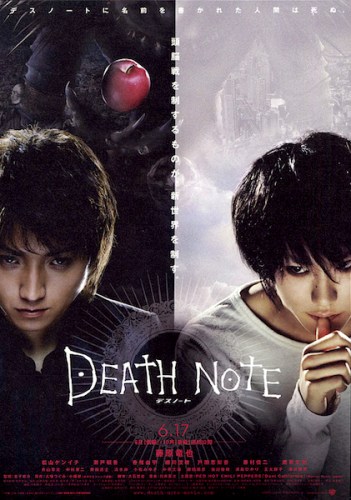
    In case the whole thing passed you by, it’s the story of student Light Yagami (Battle Royale’s Tatsuya Fujiwara) who discovers a supernatural notebook, the titular Death Note, that was dropped by death-god Ryuk (voiced by Shidou Nakamura). Whenever a name is written in the Death Note, that person drops dead. Light begins to use it to execute criminals who’ve escaped justice, a pattern of killings that is quickly noticed by the police and the media, who dub the mysterious murderer “Kira”. While much of the public agree with his actions, the police are stumped in their investigations. Also on the case is a reclusive genius detective known only as ‘L’ (Kenichi Matsuyama), who quickly suspects Light of being Kira, initiating a game of cat and mouse between the pair.

    It’s a good setup for a story, a premise that invites moral conundrums and “what would you do?” questions. I can see why it appealed to young people, too — what youth hasn’t wished certain annoying people would just drop dead? (Some places banned the manga because its popularity was leading to kids making their own Death Note books, writing in names of classmates and teachers. Obviously they didn’t actually work, but it was a “psychological health” thing.)

    A little Light reading

    There’s not much plot in that idea, mind: the Death Note is so all-powerful that there’s little drama in Light using it, especially as he isn’t morally conflicted himself — he’s sure he’s doing the right thing, despite people around him voicing their disagreement with Kira. The story therefore comes to focus on the battle between Light and L, a pair of self-proclaimed geniuses who work to constantly outwit each other. This is where the film begins to falter, because a lot of their supposed intelligence comes from leaps of logic designed to make them look clever.

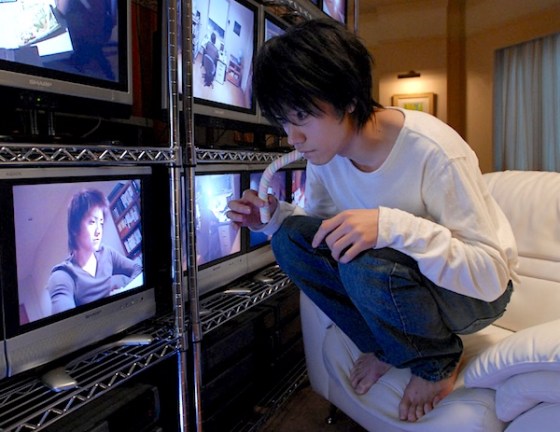
    It’ll also be a problem for any viewers who need a likeable protagonist: although Light starts out aiming to do good, he’s gradually led to be a right evil bastard; on the other side, L is an irritating brat, walking around barefoot, weirdly crouching on chairs, always stuffing his face with sugary treats, and speaking cryptically to the level-headed coppers forced to work with him. I’ve said before that I don’t think a film necessarily needs a likeable hero to work, but it does feel odd that there’s no one to root for here. Partly I don’t think the film’s sure whose side we should be on. It’s made to feel like it should be Light’s, but the film also knows he’s not got the strongest moral compass.

    One L of a detective

    This “duel of the geniuses” eventually comes to a head in a neatly-conceived climax, but one which doesn’t wrap everything up — the film ends on a very “end of part one” note. Although this film is simply called Death Note and the second was released here as Death Note 2, in Japan they were marketed as a “two-part event” and released just months apart. So I guess the cliffhanger ending is fair enough — it’s not an attempt at launching a franchise (an annoying trend when sequels aren’t produced), but is instead no different than The Matrix sequels, or Kill Bill, or so on.

    That said, the production schedule to make that happen is somewhat interesting, especially as it clearly had an influence over the film’s quality. The duology was produced at extraordinary speed. The concept of a two-film adaptation was greenlit in November 2005, Shūsuke Kaneko signed on as director in December, and they were shooting by the start of February 2006. Film 1 was shot in February and March, then came out in the middle of June, just three months later. Film 2 was still being written during Film 1’s post-production, before shooting in June and July, and was released at the start of November, just two months later. There were six assistant directors, including people who’d already graduated to helming their own films, just to handle the volume of work required to fit in the tight schedule — two major movies from script to screen in under 12 months. It’s no wonder the production looks a bit TV-ish at times, with somewhat dull cinematography and Ryuk realised through cheap and cheerful CGI. More vitally, the script or edit probably could’ve done with greater attention, to iron out some of those logic leaps and improve the pace in the middle.

    Demonic CGI

    The final work still manages to be an enjoyable thriller with a supernatural conceit — a film which definitely has its moments, especially as Light begins to work with the Death Note’s rules to creative effect — but it needed more polish, the legacy of its speedy production resulting in an array of niggles.

    3 out of 5

    The US remake of Death Note is released on Netflix this Friday.

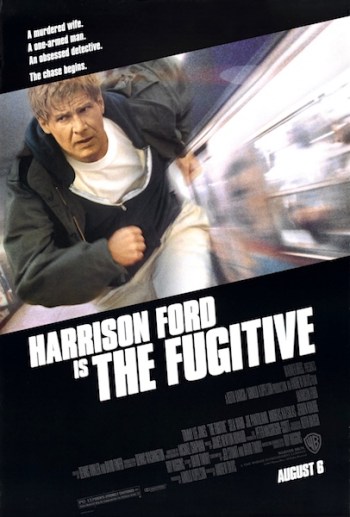
    The Fugitive (1993)

    The 100 Films Guide to…

    A murdered wife.
    A one-armed man.
    An obsessed detective.
    The chase begins.

    Country: USA
    Language: English
    Runtime: 130 minutes
    BBFC: 12 (cinema, 1993) | 15 (video, 1994)
    MPAA: PG-13

    Original Release: 6th August 1993 (USA)
    UK Release: 24th September 1993
    Budget: $44 million
    Worldwide Gross: $368.9 million

    Stars
    Harrison Ford (Witness, Air Force One)
    Tommy Lee Jones (JFK, No Country for Old Men)
    Sela Ward (54, Independence Day: Resurgence)
    Joe Pantoliano (Risky Business, The Matrix)

    Director
    Andrew Davis (Under Siege, Holes)

    Screenwriters
    Jeb Stuart (Die Hard, Fire Down Below)
    David Twohy (Waterworld, Pitch Black)

    Story by
    David Twohy (G.I. Jane, Riddick)

    Based on
    The Fugitive, a TV series created by Roy Huggins.


    The Story
    After Dr. Richard Kimble’s wife is murdered, he is framed for the crime. Managing to escape custody, Kimble sets out to prove his innocence, while being pursued by a team of marshals intent on recapturing the fugitive.

    Our Hero
    Dr. Richard Kimble, respected surgeon, convicted of killing his wife, a crime he didn’t commit. When an accident on his way to prison allows me to break free, he goes on the run to clear his name.

    Our Villain
    The mysterious one-armed man who did kill Mrs Kimble. Why did he do it? Why can’t he be found?

    Best Supporting Character
    U.S. Marshal Samuel Gerard is the big dog on Kimble’s trail after he escapes custody. He just aims to bring the doctor back in, but maybe his sense of justice will ultimately prevail…

    Memorable Quote
    Kimble: “I didn’t kill my wife!”
    Gerard: “I don’t care!”

    Memorable Scene
    Kimble runs through drainage tunnels, pursued by Gerard, when he suddenly reaches the outlet — a massive drop over a dam. Gerard approaches, gun raised, his man cornered, Kimble left with no escape route — except to jump…

    Truly Special Effect
    The famous bus/train crash was done for real with a real train and a real bus on a real track, because that was actually cheaper than doing it with miniatures! The scale of the setup meant it could only be done once, so it was shot with multiple cameras — several of which were destroyed and their footage rendered unusable. Conversely, a couple of others were caught up in the crash but continued rolling. Although it may’ve been driven by cost-saving, the fact it was done for real makes it all the more effective, one of cinema’s iconic stunts.

    Letting the Side Down
    Despite years in development that created literally dozens of drafts, filming began without a completed screenplay — and sometimes it shows. Just don’t try to think through the logic of the villains’ nefarious scheme, nor wonder why the supposedly super-smart marshals never twig that maybe Kimble is investigating his wife’s murder.

    Making of
    The sequence in the St Patrick’s Day parade was conceived by director Andrew Davis late in the day — so late that it wasn’t part of the shooting schedule and there wasn’t time to plan it. On the day, the cast and crew made an early start so they could complete all of the schedule material before heading over to the parade. Shooting with a Steadicam, the director, cast, and cameraman improvised the action and shot it more-or-less in real-time.

    Next time…
    Five years later, Tommy Lee Jones reprised his Oscar-winning supporting performance as the lead in U.S. Marshals. It wasn’t as successful. Personally, I didn’t realise it was a sequel for years and have never bothered to see it.

    Awards
    1 Oscar (Supporting Actor (Tommy Lee Jones))
    6 Oscar nominations (Picture, Cinematography, Sound, Editing, Sound Effects Editing, Score)
    1 BAFTA (Sound)
    3 BAFTA nominations (Supporting Actor (Tommy Lee Jones), Editing, Special Effects)
    2 MTV Movie Awards (On-Screen Duo (Harrison Ford & Tommy Lee Jones), Action Sequence (train wreck))
    2 MTV Movie Award nominations (Movie, Male Performance (Harrison Ford))

    Verdict

    It must be at least 20 years since I last watched The Fugitive (it turns 25 next year), and it’s an interesting experience to revisit it today. Once upon a time this was a blockbuster; nowadays it’d be a mid-budget thriller… and probably wouldn’t get made because Hollywood doesn’t do those anymore. It’s a pleasingly ’90s manhunt movie — they can’t just track his mobile phone or zoom in with a satellite or what have you — but, aside from the nostalgia kick, the quality is a bit wobbly at times. It has strong performances, a breakneck pace (at least early on), and some stunning sequences, but the behind-the-scenes story of many, many drafts and a rushed schedule occasionally leave their mark on the screen, mainly in that the film’s whodunnit mystery isn’t all that engrossing or surprising. Maybe I’m just being nitpicky — it’s still a quality thriller. (The Blu-ray is a real dog, though. Could definitely do with a remaster.)