2012 #56
Jon Favreau | 136 mins | Blu-ray | 2.40:1 | USA / English | 12 / PG-13
This review contains spoilers.
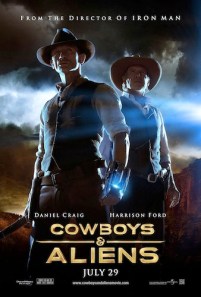 We all know the saying “too many cooks spoil the broth”, and it can’t help pop into one’s mind during the 85 seconds of company logos that kick off this genre mashup. Here the “cooks” are Paramount (serving non-US distribution only), Dreamworks, Universal and Imagine Entertainment — I can’t remember the last time I saw a Hollywood blockbuster begin with so many individual logo animations. It’s unsurprising that no one wanted to take a solo punt on a Western-with-a-twist after the failure of the last one anyone can remember, and after this (it barely reclaimed its production budget at the worldwide box office) it looks unlikely many will want to again.
Unlike that Will Smith vehicle, however, Cowboys & Aliens isn’t an appallingly bad film. It’s not a particularly great one, true, but its lack of success is due in part to someone agreeing to spend too much money on it — it made $175m and looks like a failure for Chrissake! Looked at objectively, that’s a pretty fine number, especially when its “Indiana Jones and James Bond fight aliens” selling point is tarnished by the recent films in both those franchises being poorly received.
But enough about money, what about the film itself. The story concerns Indiana Jones and James Bond fighting aliens. Sadly, not literally — it’s Harrison Ford and Daniel Craig as cowboys faced with an alien invasion. Sounds like pulpy fun, right? That’s what the title implies. Unfortunately, director Jon Favreau and the team of seven writers (that’s right, seven) decided it would be better to make it Serious. Ugh. Well, I say “ugh” — I’m not adverse to the idea of serious-minded renditions of initially-daft concepts; but not using the daft version of the concept as your final title might be a starting point.
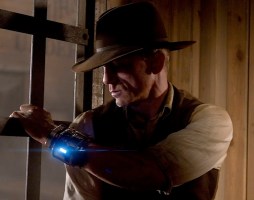 Thing is, what the film gives us doesn’t quite sit right, even if you’re expecting it to be non-pulpy. It’s still an action-adventure summer blockbuster, but with pretensions at times to be a Western drama. I think that’s the fundamental problem with the entire film, and probably why it feels slow, especially in the middle. A lot of that is character scenes, despite which the characters feel underdeveloped and under explored. One wonders if these particular writers, versed in the art of the blockbuster, don’t really know what they’re doing. Sometimes you can see what they were going for, for instance in how they set things up and pay them off (like the alien with a grudge against Craig), but somehow it doesn’t come off.
And the outcome is: maybe some of the pulpy thrills the name promised would’ve been better. It doesn’t need to be a comedy, it just needs to stop trying to be so grandiose and get on with the cowboys-fighting-aliens action. Which in this version, when it finally gets to it right at the end, is no fun because it’s too busy distracting us elsewhere — literally, the fight is a distraction for some of the other heroes to get on with the plot. Which I guess is why it feels so unsatisfying and you just want it to go away — we’ve nothing invested in that fight, other than it has to keep going on, and even that isn’t made clear (the aliens certainly aren’t desperate to get back inside their base, for instance).
 Also note that this climax lasts a full 25 minutes. It may not sound a lot for the big finish — it’s the whole third act after all — but it felt it (especially as the build-up begins 40 minutes out), with constantly shifting goal posts and Favreau’s attempts at making a skirmish feel like an epic battle. Other parts are just straight wasted opportunities, like the extended sequence in an upturned riverboat. For one thing, no effort is made to explain its presence. For another, it’s all so darkly shot that you can’t get a real sense of it. Could have made for some impressive sets — heck, maybe they were impressive sets — but it’s not well utilised. Makes it harder to work out just what’s going on at times too. Thank goodness it wasn’t in 3D!
Even without that gimmick, however, I really disliked some of the cinematography. Much of it is great, but then there are those dark bits, and even worse is some handheld psychedelically-graded stuff that just sticks out like a sore thumb. I can see what Favreau was going for, but it feels out of place, wrong, distractingly nasty rather than provocatively effective in a film that is mostly shot very classically, especially for a modern effects-packed blockbuster.
 I could go on. For example, Craig loses the love of his life to the aliens, then loses the new woman he seems to have quickly fallen for to them too… but it’s OK because he saw a hummingbird at the end, so he’s happy. Or there’s the fact that the town is called Absolution — I believe, anyway, because I think one of the three guys at the beginning mentions it and it’s the title of a featurette on the BD. Other than that, no mention is made in the film, despite it arguably being one of the key themes. We don’t need to be battered around the head with symbolism, but a bit more effort might’ve been nice.
Remember when I said the film wasn’t bad? Honestly, it… well, it wasn’t really. There are good bits. British composer Harry Gregson-Williams offers a likeable score, especially the main theme (which plays over the DVD & BD menu, if you want to hear it quickly). It’s nicely evocative of familiar Western music while giving it a modern style too, at times sweeping when we reach an appropriate bit. One of the best elements of the film, in many ways.
As you may have noticed, I watched the Blu-ray’s extended cut of the film, which in this instance offers somewhere in the region of 17 minutes of new material. (Normally that website is reliable, but this isn’t their best guide in my opinion.) That’s quite a chunk of time, which makes me wonder if some of the pacing issues — the slow middle, as I mentioned — may be down to this being extended. Still, despite their relatively large total length, the extensions mostly come in tiny bits. Some I guessed (all the stuff with them exploring the boat), some it’s hard to imagine the film without (an early scene with Craig and the town priest, or stuff about the doctor and the kid coming along on the hunt — the doc they could’ve got away with, but the kid? Did no one watching the theatrical version question why they took him along?) Conversely, some of the extensions seem borderline unnecessary — 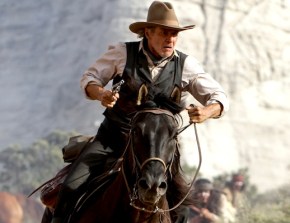 so maybe the theatrical version wouldn’t be much better pacing-wise after all. On balance this feels like an extended cut where someone decided to save a work-in-progress edit and later deem it an “extended cut”, then kept trimming to craft a more streamlined theatrical cut, as opposed to the filmmakers dropping missed elements back in post-release.
For an ending, I’m actually going to cheat a little and turn to another review. Naughty me. But Blu-ray.com’s coverage of the US disc has a good section that I may as well just quote in (almost) full as paraphrase as a source, and it goes on to a conclusion I simply agree with. So:
President of Universal Studios Ron Meyers’ brutally blunt assessment of [Cowboys & Aliens]? “Wasn’t good enough. Forget all the smart people involved in it, it wasn’t good enough. All those little creatures bouncing around were crappy. I think it was a mediocre movie. We misfired. We were wrong. We did it badly, and I think we’re all guilty of it. I have to take first responsibility because I’m part of it, but we all did a mediocre job and we paid the price for it. It happens. They’re talented people. Certainly you couldn’t have more talented people involved in Cowboys & Aliens, but it took, you know, ten smart and talented people to come up with a mediocre movie.”
Such honesty is rare indeed. As Blu-ray.com’s reviewer Kenneth Brown goes on to say,
you have to admire a studio exec willing to address criticism head on and take responsibility for projects that should have taken off but, for one reason or another, crashed and burned. So is Cowboys & Aliens really that bad? “Mediocre” is fair, “disappointing” even more so. It isn’t a bad flick — it’s actually kinda fun, if you’re willing to abandon high expectations and switch off your brain for two hours — it just isn’t nearly as good as it could have and should have been.
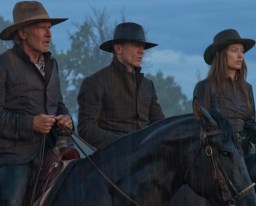 Sad, but true.
And I’m sure that, in its wake, Disney haven’t made a mistake by spending a reported $250m ($87m more than Cowboys & Aliens cost; $75m more than it earned) on Western-with-a-twist The Lone Ranger, have they?
…have they?
This review is part of the 100 Films Advent Calendar 2012. Read more here.

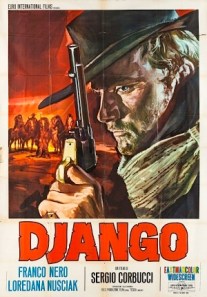 The ’60s were a pretty exciting time for cinema. In France, the Nouvelle Vague were tearing up the rulebook and pushing forward their own techniques; in Britain, the James Bond series was ditching kitchen sink drama in favour of reinventing the action movie, turning itself into a global phenomenon in the process; and in Italy (and Spain) they were pulling a similar trick on that most American of genres, the Western.
 Much of the film plays as an action movie. There’s a lot of atmospheric ponderousness at the start, but once things kick off they rarely let up. In just over 90 minutes the film rattles through a damsel-in-distress rescue; a blink-and-you’ll-miss-it shoot-out; a 40-on-1 massacre; a raid on a fort; a barroom brawl (one of the stand-outs, that — anyone who thinks handheld ShakeyCam fights are a modern invention should take a look); a tense, silent escape; a brutal punishment (or two); a valley ambush; and a graveyard stand-off. I think that’s all, but I may have missed some. It’s practically a definition of bang for your buck, which I’m sure goes a long way to explaining its popularity.
 but it’s like watching something on a not-quite-correctly-tuned analogue TV; like you’ve found the channel, but you’re one or two points off the optimum frequency. Or, to put it another way, it’s really snowy. As I said, I’m no expert in BD quality, but this looks like it needs a sympathetic dose of DNR. No one but fools want a waxy Predator-esque hack job, but the mess here is equally distracting. When the odd clear bit comes along, though, it looks gorgeous. There’s a UK version out on Monday, but obviously I have no idea if it’ll be any better.

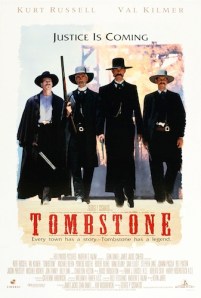 The story of the OK Corral is one I know by name only; I haven’t even seen the
  That may be down to historical accuracy. There’s a distinct feeling of veracity to proceedings, and as I understand it a concerted effort was made in that regard. The Movies perhaps shouldn’t worry about sticking too closely to fact (if you want an accurate lesson, read a textbook), but when they can manage to be both factually accurate and entertaining, it’s all the better. Cosmatos & co appear to balance this well.
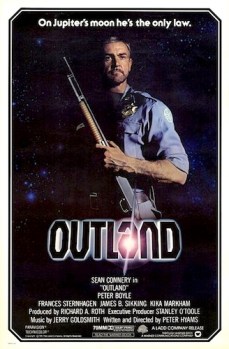 I first encountered Outland in a similar context to a lot of people, I think, based on reviews and whatnot I’ve read; that is, as “
 It works as well in space as it does anywhere else.
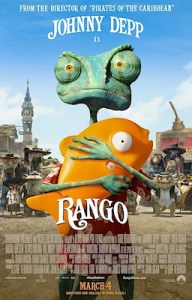 There seem to be an increasing number of live-action directors sticking their oar into animated films; and not just lending their ideas and name, as Tim Burton did with
 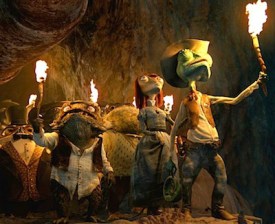 Indeed, perhaps the most striking thing about Rango is ILM’s hallmark, the extraordinary realism. Though some of the characters are rendered cartoonishly (just look at Rango’s face) and all are of course anthropomorphised, the textures and lighting are as true-to-life as any of their work in live-action movies. They consciously went for a photographic look, as if it had been shot with real cameras, including consultation with Oscar-winning cinematographer Roger Deakins, and it paid off because the whole thing looks incredible. I know I only just recommended it in the last paragraph, but the making-ofs are really great for an insight into why the film looks and feels so different to most current computer-animated films. The sequences of them recording performance reference are incredible — they essentially shot some scenes in full, with the entire cast, in costume, with full props, some sets, blocking, marks, camera angles, improvisation… (The only thing lacking on the Blu-ray is a
 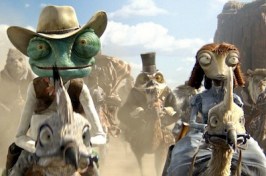 Back to the film itself. I know it’s less interesting, and it is far too slow at the start, but when it eventually gets underway it becomes very entertaining. Somewhere in the middle there’s a five-minute wagon/bat chase that’s a properly exciting action sequence, excellently realised. It was so good I watched it again immediately afterwards. It’s got a clever use of Wagner too, as well as some regular Hans Zimmer action scoring. Zimmer’s score throughout is top quality, referencing Morricone and all the other staples of Westerns.
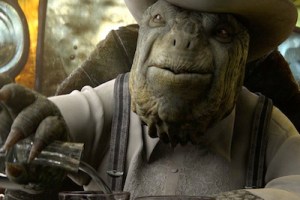 The plot, however, is clearly borrowed from
  With its detailed references to other films and real-world visual aesthetic, Rango may be more likely to find appreciation among grown-ups than the children who are the typical target for English-language feature animation. Then again, there’s that immature humour I mentioned. A ‘family’ film indeed. Either way, it’s an entertaining addition to — and alternative from — American animation’s usual offerings.
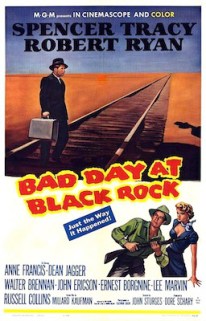 Bad Day at Black Rock comes with an air of the forgotten classic — or, at least, it did to me. I think that’s important to how I ultimately reacted to it. As is that wherever I first heard about it pitched it as a suspenseful mystery with a twist. I forget where that was now, but I remember consciously avoiding finding out the plot’s developments (more so than one naturally would anyway) before viewing.
 I missed the commentary. Indeed, in
  For a film so based in mystery and which has what I’d call a methodical pace (despite its short running time), there are surprisingly good action sequences to look out for: a car chase/battle along a thin path, a one-handed punch-up in a bar, and a climactic shoot-out that’s at its most tense once all the bullets have been fired. It’s not an action movie by any means, but these cinematic sequences stand out nonetheless.
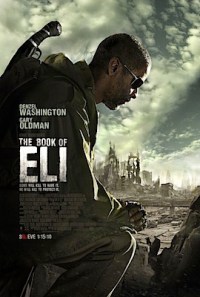 The directors of
 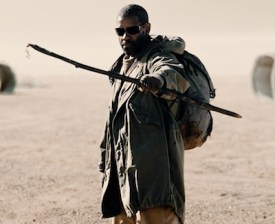 The music is by Atticus Ross, which was interesting because I’d thought it was reminiscent of
 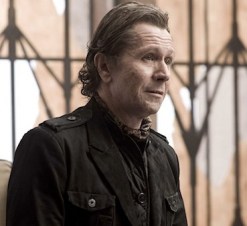 Late on the film pulls out surprise appearances from Michael Gambon and Frances de la Tour. Their roles aren’t even close to needing thesps of such calibre though — they appear fleetingly, the actors underused. Particularly Gambon, who really has nothing to do except fire a gun. I know it’s usually a joke to comment that a usually-better cast member must have needed the money, but that’s the only reason I can imagine he’s here.
 Newman concludes that “you can’t help feel you were invited to a party with fizzy pop and cream cake and got suckered into a sermon instead.” I couldn’t have put it better. Eli starts off with the potential for an arty 5; slips slightly to a solid 4 when the standard post-apocalyptic trope of a gang fighting for local power comes in to play; unsteadies that 4 with an increasingly atonal second half; and quite frankly borders a 1 with its sickening ending.
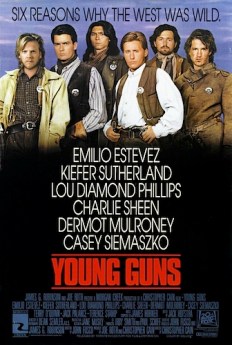 Way back in March, the ever-excellent Colin at
 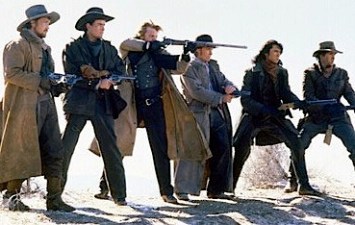 Though if someone was planning to use Young Guns to research the real-life facts of these events, more fool them in the first place. Wikipedia says (without citation) that “historian Dr. Paul Hutton has called Young Guns the most historically accurate of all prior Billy the Kid films”. We’ll leave it at that for now.
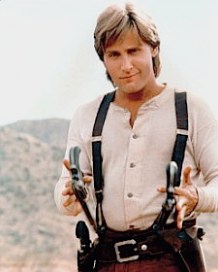 And that’s without mentioning the overuse of dated slow-motion that descends upon its eventual climax.
 Young Guns is not a particularly likeable film, managing to miss both its potential target audiences: it’s not serious-minded enough for Western enthusiasts, let down by the Brat Pack cast and (it seems) historical accuracy; but it’s surely not fun or modernised enough to appeal to a younger (or younger-minded) crowd. Though clearly it did well enough as it spawned a sequel two years later. I didn’t hate it, I just didn’t particularly like it.
 Having been remade to Oscar-nominating effect by American Cinematic Gods the Coen brothers, the first adaptation of Charles Portis’ Western novel True Grit was around plenty (on TV, Blu-ray, etc) back in… February, I guess. The story in all three versions (which might sound obvious, but is never guaranteed when it comes to adaptations) concerns a 14-year-old girl, Mattie Ross (here, Kim Darby), whose father is murdered by his hired hand, so she sets out for murderous revenge, recruiting Marshal Rooster Cogburn (John Wayne) to help because she’s heard he has the titular attribute.
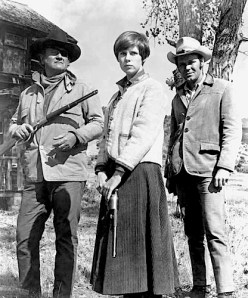 14-year-old but as a 14-year-old who’s wise beyond her years. Hailee Steinfeld’s performance in the remake has been much praised, but it has a lot to live up to from this.
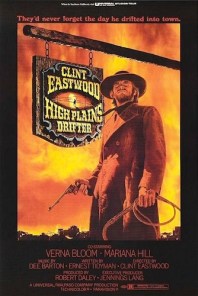 That this is the first Western directed by perennial Western star Clint Eastwood is enough to make it worthy of note. To be honest, I’m far from immersed enough in the history of Westerns to know if anything else makes it worthy of note either; but I did like it.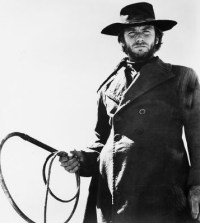
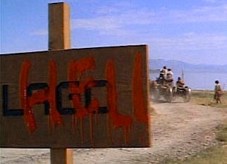 Eastwood’s first Western in the director’s chair is obviously influenced by those he’s worked with when on the other side of the camera, but by making sure the mix is a bit dark, somewhat ambiguous, but also gratifying in turns, he crafted a supernaturally-tinged revenge tale that packs a few satisfying punches.
 100Films.co.uk