2013 #56
Andrew Dominik | 160 mins | Blu-ray | 2.40:1 | USA, Canada & UK / English | 15 / R
 September 1881: after admiring their leader for years through cheap magazine stories, 19-year-old Robert Ford manages to hook up with the James Gang. Little does he suspect that, just seven months later, he will be responsible for the murder of his idol, Jesse James. (That’s not a spoiler, it’s in the title.)
Ultimately released in 2007, The Assassination of Jesse James by the Coward Robert Ford found itself going head-to-head in the awards season with No Country for Old Men and There Will Be Blood. The accepted narrative of that time is about the two-horse-race between the latter two, though Jesse James fits with them in some kind of thematic and stylistic triumvirate: they’re all products of what I’d call “American mainstream art house” cinema; all classifiable as Westerns, though none in a strictly traditional sense; all more concerned with their characters and their lives than the machinations of the plot. In the end, No Country garnered most of the awards, There Will Be Blood seems to have settled in as a critical darling, but, for my money, this purest Western of the three is by far the best.
I’m not going to waste much time making direct comparisons between the three films. I suspect there’s an article in that, if someone hasn’t written it already, but it’s not one I have much interest in penning: I don’t think I’ve made much secret of my distaste for the Coen and Anderson efforts in this little threesome, both being films I never really engaged with and certainly didn’t enjoy (in fairness, I should give Blood a second shot, but even the idea of sitting through No Country again makes me shudder). The Assassination of Jesse James, however, is a film I both engaged with and enjoyed greatly.
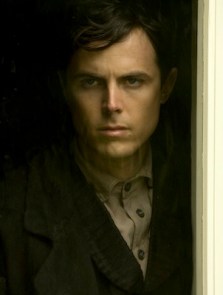 Let’s be clear, though: this is not a film for everyone. This is not an action movie set in the Wild West, which might be what’s expected from a Hollywood studio movie starring Brad Pitt. Apparently director Andrew Dominik intended to make a film with a Terence Malick vibe, so I read after viewing, which chimed with me because “Malick-esque” was one of my foremost thoughts during viewing. This is a slowly-paced two-hours-and-forty-minutes, with more shots of crops blowing gently in the breeze or riders approaching gradually over distant hills as there are flashes of violence. Despite what the studio wanted, this is not a fast-paced action Western, it’s a considered, sometimes meditative, exploration of character and theme.
The character explored is not particularly Jesse James, but Robert Ford. As the latter, Casey Affleck was largely put forward for Supporting Actor awards, which does him a disservice — the film is largely told from Ford’s perspective, and though there are asides where it follows James or other members of the gang, it begins with Ford’s arrival and ends with his departure from this world. Affleck is superb in a quiet but nuanced performance, which I would say ranges wildly without ever appearing to change. At times he is cocky and self-sure, at others cowardly and defensive, often creepy and occasionally likeable, sometimes both worldly and naïve, a perpetual wannabe who even when he achieves something is still poorly viewed. You might think the title is stating its position on him, but it really isn’t — it’s a position to be considered, a point of contrast to the man’s motives and actions; a statement that is in fact a question.
Conversely, Pitt’s Jesse James is closer to a supporting role. We see him primarily through the eyes of others; he is distant, unknowable, his moods and actions unpredictable thanks to years of law-dodging that’s led to a paranoia about his own men — not all of it misplaced.  Jesse’s mood swings are more obvious than Ford’s, but Pitt makes them no less unlikely. At times charming and a clear leader, at others he is a genuinely tense, frightening presence, without ever needing to resort to the grandstanding horror-movie grotesques offered by (Oscar winners) Daniel Day-Lewis and Javier Bardem in There Will Be Blood and No Country respectively.
Though there are other memorable and striking performances — particularly from Sam Rockwell, Paul Schneider, and a pre-fame Jeremy Renner; plus a precise, perfectly-pitched, occasional voiceover narration from Hugh Ross (who doesn’t have many credits to his name but surely deserves some more now) — the third lead is Roger Deakins and his stunning cinematography. There are many clichés to use for good-looking films, and the vast majority of the time they are trotted out as what they are and not really meant. Jesse James, however, is one most could be applied to with total accuracy. For example, there are very few — if any — films where you could genuinely take any frame and hang it as a perfect photograph; but if there is one where you could, this is it.
Deakins has reportedly said that “the arrival of the train in darkness is one of the high watermarks of his career”, and he’s right to think that. It’s a glorious sequence, made up of several shots where every one is perfectly composed and lit to create a remarkable ambience and beauty, as well as telling the story, which in this instance involves as much creation of suspense as eliciting pure artistic appreciation. Deakins did take home a few awards for his work here, but not the Oscar. I can’t remember which film did win and, frankly, I don’t care, because whichever it was this outclasses it by miles.
 This must also be thanks in part to director Andrew Dominik. Every last shot feels precisely chosen and paced. Of course, every shot in every film has been chosen and placed where it is, but the amount of thought that’s gone into that might vary. Jesse James somehow carries extra weight in this department, with no frame in its not-inconsiderable running time wasted on an unnecessary angle or take that’s allowed to run even a second too long. Somewhat famously, there was a lot of wrangling over the film’s final cut (delaying its release by a year or more), with the aforementioned debate between something faster and something even slower: a four-hour version screened at the Venice Film Festival, to a strong reception. Sadly, the intervening years haven’t seen that cut, or any of its parts, resurface (to my knowledge). That’s an hour and twenty minutes of material and I’d love to know what’s in them.
One thing in there, I’d wager, would be the performances of Mary-Louise Parker and Zooey Deschanel. Both their characters have a tiny presence in the finished product, and while that may be fine for the overall story (some would criticise how much female characters are sidelined, but that’s another debate), casting two moderately major actresses creates a disjunct with the size of their roles. I was going to say this is one of the film’s few flaws, but it’s debatable if it even qualifies as that: if they’d cast less recognisable faces, their lack of presence would pass by unnoticed.
The other thread I mentioned, seven paragraphs ago, was “theme”. The film has a lot of concurrent aspects one might consider — “loyalty” being a major one, for instance — but I think the biggest is “celebrity”. Not in the modern sense, though I’m sure there are analogies for those that wish. To pick up on what I was saying before: Ford is the main character, and the main thing he wants, even if he doesn’t realise it, is fame. He joins the James Gang because he’s enamoured with the adventurous tales he’s read; 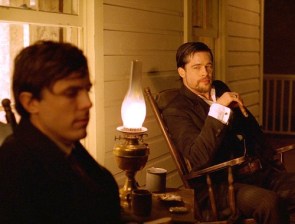 because he’s obsessed with the notoriety of Jesse. Later, once the titular deed is done, he becomes an actor (not without talent, as the narration informs us) and re-performs the act that made him famous hundreds of times. It’s his legacy, however, to not be as well-remembered as his victim; to not be as well-liked, even; not even close. There’s something there about the pursuit of fame for its own sake, if nothing else.
It’s difficult to call any film “perfect”. Certainly, there would be plenty of viewers who would consider The Assassination of Jesse James to be an overlong bore. Each to their own, and I do have sympathy with such perspectives because there are acclaimed films that I’ve certainly found to be both overlong and boring. Not this one, though. From the constant beauty of Deakins’ cinematography, to the accomplished performances, to the insightful and considered story (not to mention that it’s been cited as the most historically accurate version of events yet filmed), there are endless delights here. As time wears on and awards victors fade, it deserves to elbow its way back into the debate for the best film of the ’00s.
The UK TV premiere of The Assassination of Jesse James by the Coward Robert Ford is on ITV4 tonight at 10pm. It’s screening again tomorrow at 11pm.
It placed 3rd on my list of The Ten Best Films I Saw For the First Time in 2013, which can be read in full here.

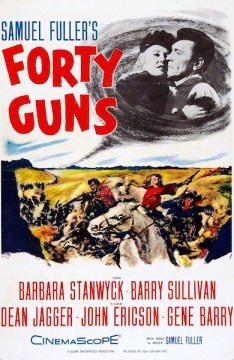 Western with Barbara Stanwyck as a powerful landowner, and commander of the titular posse, whose bullying brother, Brockie, is consequently allowed to run riot over the town. Enter lawman Griff (Barry Sullivan) and his two brothers, whose moves to bring Brockie in line kickstart a chain of ruinous events.
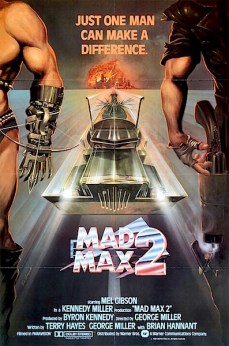 Roaming the outback of a gasoline-desperate post-apocalyptic Australia, “Mad” Max Rockatansky (Mel Gibson) comes across a commune-like oil refinery, whose inhabitants are under siege by a brutally violent gang. Max strikes a bargain: he’ll help them escape with their oil, in exchange for a tank full for himself.
 The most memorable part, however, is the climax. They escape the oil refinery, Max driving the tanker — fitted out with weaponry and defences — and the gang give chase. An almighty action sequence follows, a speeding battle through the outback. It feels wrong to just call it “an action sequence”, like that’s selling it short. You get the sense that this is why the movie exists; that co-writer/director George Miller’s goal with the entire rest of the film has been to get us to this point. It’s not just “the climax”, it’s “the third act”, and it’s stunning — the choreography of it, the editing, the stunts, as dozens of vehicles chase each other, people run around on top of them, jump between them… I don’t think it’s hyperbolic to say it must be one of the greatest action sequences ever committed to film. One of the reasons
 The second feature from
 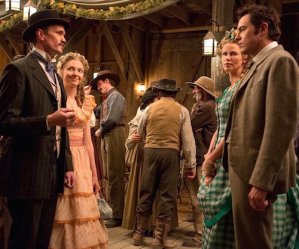 and two other men’s hats, briefly has a funny bit in the middle when he tries to acquire the second hat. The film also uses swearing as a comedic crutch too often. I’m not one of those people who’s only tolerant of swearing if they feel each and every use is absolutely justifiable, and I don’t object to it as just part of dialogue, but too often the film leans on someone saying “oh shit” (or whatever) as if that’s a serviceable punchline.
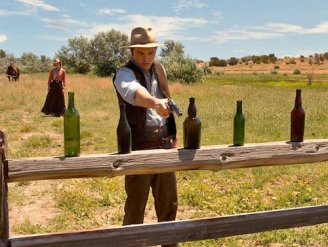 The movie’s best running gag is its titular one. At first it just seems like the concept is going to be limited to Albert sitting in a saloon and listing ways to die, which isn’t funny; but then it keeps cropping back up, sometimes unexpectedly, which really works. The whole fair thing — a running gag within a running gag — is particularly effective. If the film had traded more on this, less on farting and other bodily functions, it would’ve been much improved.
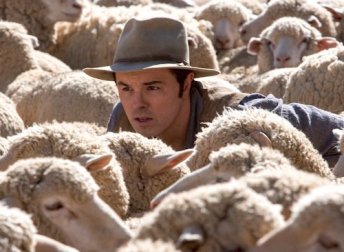 I dread to think what the
 Westerns don’t come more renowned than this Ford-Wayne collaboration about the years-long hunt for a girl kidnapped by Native Americans.
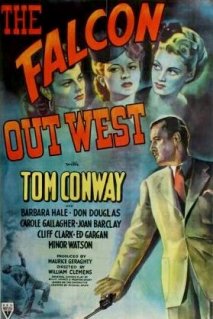 With each passing entry, the Falcon films become less reminiscent of their Saint forebears and more akin to the Poirots and Marples of this world: a gently comical murder mystery, with a finite location and a finite number of suspects, where the ‘game’ of solving the plot is the point.
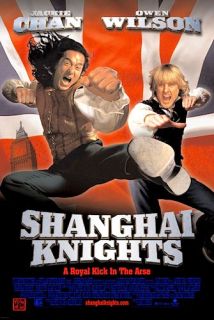 Jackie Chan and Owen Wilson are back as… um… whatever their characters were called, in this follow-up to
 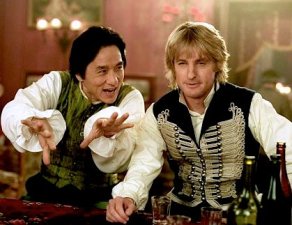 Knights as a whole feels like it moves better than its predecessor — it gets going quicker, without the need to establish these characters and force them together; there’s a greater reliance on those quality action sequences. The guest cast feels a bit bargain basement, though the villains — Aiden Gillen and the aforementioned Yen — are of a higher calibre. This means we’re treated to a pair of great climaxes, with Chan first having that punch-up with Yen, followed by a three-sword duel with Gillen (or possibly a stuntman).
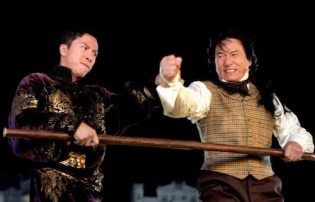 In the end, I’m not sure if I like it more or less than the first film. The Western setting was a smoother fit in many ways, but here there’s a less stodgy plot, a general reduction in the overlong comedy sequences, and even better action sequences. All things considered, I think Knights may actually have the edge.
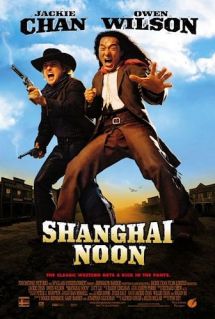 Hong Kong martial arts legend Jackie Chan and Hollywood funnyman also-ran Owen Wilson team up for a film that I don’t think anyone involved could reasonably deny is just “
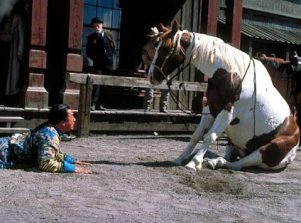 Things that could have (should have) been fixed way back at the writing stage leer out at the viewer. The plot is treated almost perfunctorily, as if it’s not interesting enough to bother explaining or expounding upon. It’s hardly highly original or complex, but it feels as if important beats or character motivations have just been skipped over. For instance, the character/story impact of the final fight would be so easy to build up a bit, but they haven’t and so it falls a bit limp. Not to mention the bit when two characters who are essentially on the same side have a duel when they have more pressing things to worry about — save the Princess first, fight amongst yourselves later! Then there’s all the time given to Wilson’s rivalry with the local sheriff/martial/whatever, which we’re told exists, isn’t really built from anything, and suddenly is half the focus of the climax.
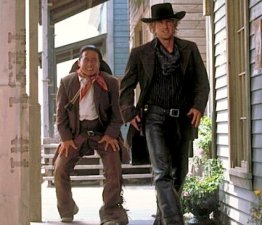 Shanghai Noon should be a lot of fun. It should be Jackie Chan and Owen Wilson engaging in a bit of comedy between skilfully choreographed, occasionally amusing, balletically staged fight sequences. But it isn’t. It’s laden with an underwritten plot, bulked up by clichés, stereotypes, overplayed character scenes, humour that doesn’t work, and a shortage of judicious editing. It is still kinda fun, but it could so easily have been more.
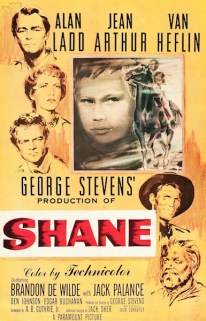 Though not part of my
  The thing with the wife, for instance, is mainly down to a few looks, or the way a line of dialogue is played. I was once taught that if a writer doesn’t put any subtext into a scene the actors will add it themselves — perhaps that’s even what happened here. I was wondering if it was going somewhere, if we were going to learn that Shane and wifey actually knew each other, or if they were going to have A Thing now (this being a ’50s American movie, “almost have a thing but then not quite” is probably nearer the mark). But, without meaning to spoil things, it doesn’t play out like that. At all.
 Quentin Tarantino made his name in the ’90s with a series of dialogue-heavy gangster thrillers that provoked a storm of imitators. Since the turn of the millennium, however, he’s contented himself with a series of extravagant hyper-cinephilic genre homage/parodies. After tackling Japanese action movies in
  It’s fair to say Django Unchained sprawls. But, unlike the chapterised character-flitting antics of Kill Bill and Inglourious Basterds, it has a straight throughline it follows from beginning to end, with only a few asides. In terms of length and scope, it’s perhaps not too much of a reach to evoke
  Or how about those action sequences? Months of work training real horses to do things never before seen pays off (and Tarantino proudly displays the “no animals were harmed” notice right at the top of the credits), while the blood-drenched Candyland shoot-out is arguably one of the best pure action scenes in years. Those are amongst myriad other sequences, from the small and transitory to the epic and vital.
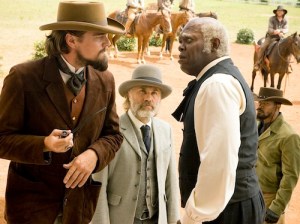 Still, best served — and, perhaps, more deserving of the Supporting Actor nod — are villainous duo Leonardo DiCaprio and Samuel L. Jackson. For starters, has Leo ever played a villain before? He’s on stonking form here as Southern gent Monsieur Candie (who can’t speak French), a sinisterly welcoming fellow with a dark side that’s on constant display. He’s all smiles and all lingering threat and menace. Indeed, scenes are often at their most tense when he’s at his nicest. I think there’s an argument for him to go down as one of the great screen villains — he even has the obligatory cool dispatch. “I couldn’t resist” indeed.
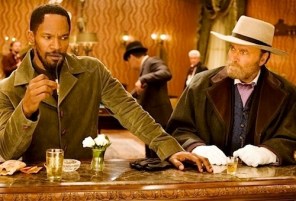 It does make you wonder if some of these people had bigger roles that got cut… or maybe there are just
 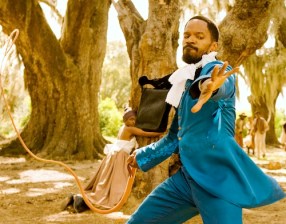 Tosh and piffle, I say. One of the best ways to skewer many an evil institution is to make them a laughing-stock, to take the piss out of them, and that’s exactly what Tarantino is doing. These aren’t likeable, funny people who are Klan members; they’re incompetent fools because they’re Klan members. The resulting scene is hilarious and deservedly one of the movie’s most memorable moments.
 100Films.co.uk