
Mel Gibson | 178 mins | Blu-ray | 2.35:1 | USA / English | 15 / R
 I figured I ran the risk of affecting the outcome of the Scottish independence referendum if I posted this review yesterday (because of course I have that kind of reach and influence), but after Mel Gibson’s historical(ly-dubious) epic wound up on my 2014 WDYMYHS list, it seemed too good an occasion to miss. So whether Scotland is about to become independent or not, here are my thoughts on a movie that hopefully didn’t actually influence anyone’s vote…
I say that because Braveheart, for thems that don’t know, is the Oscar-winning story of William Wallace (Mel Gibson), a Scot who led a rebellion against English rule and King Edward ‘Longshanks’ (Patrick McGoohan) at the end of the 13th Century. That much, at least, is true — I think. Y’see, Braveheart has been described as “the least accurate historical epic of all time”, its plot and subplots riddled with changes that go above and beyond the usual tweaks needed to make a coherent narrative out of a true-life tale. You don’t have to dig very hard on the internet to find those errors catalogued, so I’m going to set them aside: this is a movie, not a history lecture; and while I can completely understand the frustration its inaccuracies must provoke in those who’d rather see the truth on screen, it’s not as if rewriting the past is anything new for dramatists (to stick with Scottish examples, Macbeth — resplendent as it is with cold regicide and prophetic witchcraft — is based on history), and we can (should?) view it as an entertainment rather than an education.
 Judged as that, Gibson’s three-hour (near as damn it) movie is a pleasingly traditional epic. Many big films these days are just long, but the story here has scope too — it’s about a war, essentially. And war means battles, which are a particular highlight. The standout is surely the famed Battle of Stirling Bridge — you know, the one where the Scots moon the English. Funny and all, but just a small part of a larger sequence. Gibson has the confidence to show the build-up to the fighting, outline the tactics that will be used, and only then launch into the fray. It’s this measured approach that makes it so effective, rather than the crash-bang-wallop straight-to-the-slaughter style of more recent movies. Due to its notoriety I’d assumed the aforementioned clash was the film’s climax, but it’s actually the centrepiece, pretty precisely in the middle of the film. Fortunately there’s enough else going on (because this isn’t actually An Action Movie) that it doesn’t make things feel lopsided.
A big plus comes courtesy of the era the film was made in. It’s the mid-’90s, still a few years away from “let’s use CGI for everything!”, so it was all done ‘for real’. That means great sets and location builds, stunning scenery that’s beautifully photographed, and swathes of extras in the battles. There’s something much more viscerally exciting about watching a few hundred men run at each for real than watching a few hundred thousand polygons do it. The downside of the aforementioned era is some occasionally dated direction, in particular at least one sequence that goes overboard with the slow-mo, but almost everything becomes dated with time — it’s not as bad as, say, Robin Hood with a mullet from Prince of Thieves.
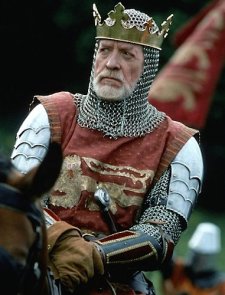 It also doesn’t suffer from that film’s accent issues. Mel Gibson isn’t an American-Scot (or an Australian one), instead delivering an accent that sounds passable to this Englishman. He believed he was too old for the part, which may well be true, but when the rest of it is so inaccurate what does that matter? He’s a solid leading man and a commanding-enough presence. The supporting cast are an array of recognisable Celtish faces — including at least one Irishman playing a Scot and a Scot playing an Irishman — and, because they’re from our fair isles, of course they’re all brilliant. Best of all, however, is Patrick McGoohan. He makes for a fantastic Evil King, given some juicy lines that are even juicier thanks to his delivery. He may not be moustache-twirling-ly memorable like an Alan Rickman creation, but any scene is enlivened by his presence.
Interestingly, Braveheart’s Best Picture Oscar win was the only time it took that gong — no other award or critics group saw fit to deem it 1995’s best movie. So what’s wrong with it? Well, that’s hard to pin down precisely. It’s a little politically simplistic, with the Bad Oppressive English and the Good Honest Scots, including inventing all sorts of stuff to sway the arguments in both those directions. Plenty of old-fashioned epics do exactly the same thing, but I guess by the ’90s we were demanding a little more nuance. The same can be said of the characters — there’s nothing wrong, but aside from Gibson’s grandstanding speeches and McGoohan’s first-class villainy, the only really memorable turn is from the morally-troublesome camply homosexual prince — and that’s a whole can of representational worms.
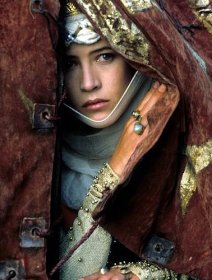 Then there’s that issue of historical accuracy. I know I said we should ignore it, but even if you accept fiction films shouldn’t be slavish history lessons (and not everyone does), how far can they ignore the facts? Often with such films the viewer assumes they’re true until someone says, “actually, I think you’ll find in reality…” Not so with Braveheart: you don’t have to know anything of Scottish history to guess that the face-to-face chats (and more, wink-wink-nudge-nudge) between Wallace and the future-Queen must be almost entirely poppycock (and, in fact, you can drop that “almost”).
How much that matters — indeed, how much any of those issues are a problem — will vary from one viewer to the next. For some, Braveheart goes beyond the pale. It does make for a rollickingly good story, though.

Braveheart was viewed as part of my What Do You Mean You Haven’t Seen…? 2014 project, which you can read more about here.
 Arguably the most famous clash of the First World War, the Battle of the Somme lasted four-and-a-half months from July to November 1916 and, with over a million men wounded or killed, is “
 The British press certainly believed they were seeing “the real thing at last” (the Manchester Guardian), feeling it showed “war, grim, red war; the real thing” (the Daily Sketch). The British public agreed, flocking to see the movie en masse: twenty million admissions were sold in the first six weeks of release. At the time, the battle still raged (the film debuted on 10th August 1916) — as Smithers notes, “to its original audience, the film was not history but a despatch from the front”. It is such an historical document now, but at the time it wasn’t even recent-history — it was produced as newsreel, a record of current events, designed to make people at home feel connected to the everyday lives of their family, friends and countrymen serving on the frontline.
 Equally striking is the scale of the operation. You know it was a monumental effort, but actually seeing so many men… You never see that scope in dramas because they don’t have the budget for all those extras, I guess, but here the crowds of soldiers just waiting around are remarkably large. And crikey, the heavy artillery! Even though you know these were real weapons, today they look more like some fantastical steampunk creation, so covered are they in rivets, and so damn huge.
 Speaking of the music, the Imperial War Museum DVD release offers up a choice of two scores: a newly-commissioned (in 2008) one by film composer Laura Rossi, and a recreation of the kind of music that would have accompanied the film in 1916. The film’s producer and distributor, William F. Jury, was also the editor of trade paper The Bioscope, and had columnist J Morton Hutcheson draw up a list of suitable pieces to be performed alongside screenings, which was published days before the film’s release. To quote Dr Toby Haggith (the Imperial War Museum’s film programmer), again in the DVD booklet
 Haggith summarises many of Hutcheson’s choices as “motivated wholly by the needs of propaganda… jaunty, martial and unashamedly heroic. Given the nature of the scenes recorded and the bloody history of this phase of the battle, the selection of such upbeat music seems deeply inappropriate.” However, other selections “reflect Hutcheson’s personal response to scenes that he found distressing on a universal level, and which led him to warn musicians that ‘they must realise the seriousness and awfulness of the scenes’… These contradictions suggest that Hutcheson had difficulty selecting music for the film because he was torn by the contrasting images and messages it conveyed. In this way the medley highlights the tension at the heart of the film.” Musician Stephen Horne, who leads the 1916 medley recreation, agrees that the film is torn “between a sense of propagandist duty and a desire to honour the reality that had not evaded the camera’s gaze.” It’s true that, however positive the final movie wants to be, it can’t completely escape reality. At one point it cuts abruptly from a jauntily-scored scene of men happily receiving post to “German dead on the field of battle”. A deliberate juxtaposition of happiness with the fate that awaits them with near inevitability? Seems a bit radical for a propaganda piece…
 But it can’t avoid drawing parallels: the film ends almost as it began, with artillery being moved up for the next assault and men marching to the front, waving merrily as they go. History repeats — probably not the lesson a propaganda film wants to impart, but one it can’t quite escape. And one that, even a hundred years later, we can’t quite learn.
 The writing and directing team from
  As for the veracity of the facts, I have no idea. Nothing seems implausible. And when condensing eight years of a manhunt into around two hours of screen time, of course some details will be lost, or truncated, or slightly modified to support the flow. I think those who allege the film is poppycock are accusing it of more than minor tweaks, but nonetheless, that’s inevitably part of the process. What’s perhaps most interesting is it hasn’t whitewashed the facts to make a film that feels like A Movie — this isn’t a relentless thriller-shaped eight-year chase, but a more methodical, occasionally messy, real-life-like quest for information.
 This carries through to the final half-hour (or so), which is a near-real-time rendition of the Navy SEAL mission to invade bin Laden’s compound in Pakistan. The unit assigned to the task turn up and get on with it — like the rest of the characters, they are no more than sketches. I read a review that asserted this is where the film’s focus should have been — on who these men were, what their home lives were like, on their training for the mission, and what effect it had on them after. All of which are valid points for a film, but that’s not what Zero Dark Thirty is trying to be.
 The one other criticism I do agree with is that we don’t see enough of the SEALs’ preparation. They built a full-scale replica of the compound and trained on it — was that not worth putting on screen? I know this is the story of Maya and her investigation, not the SEALs and their assault, but I think a bit of time could have been spent on that fascinating aspect of the raid. On the bright side, there’s a sequence where our characters collect their still-in-development super-top-secret stealth helicopters from Area 51. Yes, really. I guess that must be true, because without the reality-claim of the previous two hours it would come across as
 If you were looking for the archetype of an epic movie, Lawrence of Arabia would be a strong contender. It has a wide scope in just about every regard, from the desert locations that stretch as far as the eye can see, to the thousands of extras that fill them, to the glorious 70mm camerawork that captures it all, to the sweeping story that also contains a more personal throughline, to the 3½-hour running time.
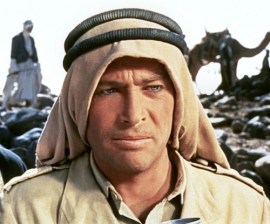 As such, the film hangs on the performance of O’Toole. We’re told Lawrence is an enigmatic figure and his depiction arguably supports that — we never fully get inside his head; we’re always observing him. And yet that’s no bad thing, because even as Lawrence’s confidence waxes and wains, as his allegiances shift and alter, we can feel what he wants to achieve, why he thinks he can. He attempts the impossible and succeeds, which is why he later attempts a bigger impossibility, and must leave the pieces to the more level-headed men, who didn’t have his genius but can therefore play the political game better than he.
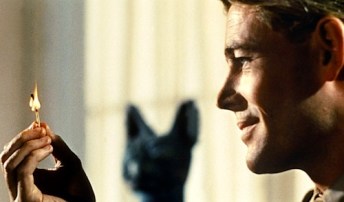 A similar legacy is left by those behind the scenes. Maurice Jarre’s score is the reference point for many a period desert epic — indeed, his music is so synonymous with such settings that it has arguably transcended its source to simply be what music for those locations and times is. It graces a film edited with class by Anne V. Coates, where scenes are allowed to play in luxuriantly long takes at times, while at others smash edits throw us from one location to another. This is undoubtedly supported by F.A. Young’s cinematography, where the wide frame can encompass so much action that there’s no need to cut amongst close-ups; and which can show the world in such majesty that you want it to hold for long, lingering takes. Even viewed on the small screen, the 70mm photography shines, especially on Blu-ray.
 As with any great film, Lawrence of Arabia is at least the sum of its parts. Replace any of the artists I’ve mentioned, or surely many more, and it would not be the film it is. In fact, when working on such a scale, this is more than a film — it’s an experience. And if that sounds pretentious, well, tough. If you haven’t experienced it yet, try not to leave it as long as I did.
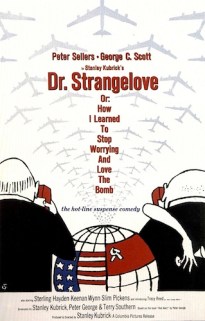 There are few things as weird (or, at least, weird in quite the same way) as watching an acclaimed and beloved classic film and… just not getting it. Here’s a paragon of moviemaking; a film that is not only exalted but, crucially, has remained in people’s affections against the forces of age; a thing that has truly stood the test of time… and yet… meh.
 In the end, I felt like I just didn’t get it. Not that I was watching something bad and I couldn’t fathom why so many people loved it, but that I just didn’t understand what it was I was meant to be seeing. Which is perhaps the same thing. I mean, I can see Kubrick was making an anti-war point at least as much as he was trying to make people laugh, but what do turgid sequences of people reading out numbers and flicking switches contribute to either of those aims? Perhaps the joke is meant to be in how long it goes on for? Like
 Samuel L. Jackson and Tommy Lee Jones star in this military courtroom thriller from the director of
  That’s not all that’s bungled. There’s numerous instances of awkward editing by Augie Hess; a screenplay from Stephen Gaghan that clearly wants to be
 Despite winning a bunch of Canadian film awards, this First World War drama seems to have been really poorly received by critics — the
 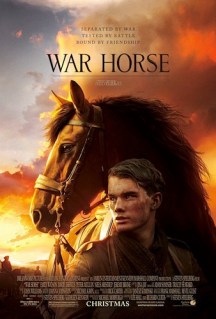 After decades telling tales from the Second World War, Spielberg moves back a conflict. That said, the BD’s special features make sure to point out this “is not his First World War movie” — it’s just a good tale about a boy and his horse.
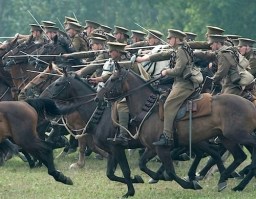 It can’t be denied that there’s factual inaccuracy here (the climax takes place at the Somme in the lead up to Armistice Day in 1918, but that battle was actually fought in 1916), or the occasional heavy dose of sentimentality (it’s directed by Spielberg and co-penned by Richard Curtis — what did you expect?), but I think it carries through these with a scale and heart that is, primarily, entertaining. It is based on a children’s novel and I think aims to be a family film (it should by rights be a PG; my twitter rant on that subject is
 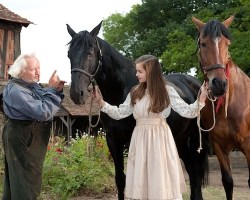 Aiding the sense of the epic is Janusz Kaminski’s cinematography, which is regularly stunning and definitely one of the film’s standout achievements. The beauty of some shots is immediately obvious — he lenses the countryside idyll of Dartmoor in a sweeping fashion, bathed in summer sunlight — but there are striking compositions to be found throughout, be they in close-ups, cavalry charges, horse auctions, battlefield hospitals… There’s often a lovely texture to things too, from the likes of drifting snow or chaff, or the way light streaks across a room. The final scene, fully tinted orange, calls to mind the likes of
 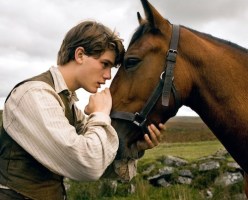 one that isn’t afraid to depict some of the nastier realities of the world, but in a way that makes them relatable for a younger audience. I think that’s important; but this isn’t a Worthy Film for that, it’s just something it does well. I think it also nails sensations of adventure and, yes, sentimentality.
 There are a few Oscar nominees from the ’00s that inspire little desire in me to bother seeing them (I’m certain that’s completely true of every era, but I’ve seen most of the ’00s nominees so I tend to focus on them more often), meaning it’s taking me a very long time to get round to them (maybe I never will). Master and Commander isn’t really one of those — it’s no
 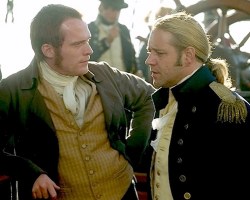 he’s not a naval man and doesn’t always understand their traditions. He’s not a crass audience-cipher in the way such parts often can be, but it does make him identifiable.
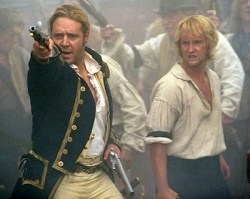 (that makes for a strangely bizarre array of company logos at the start). Despite the fact it’s based on a series of 20 (completed) books, and various people involved have mentioned the possibility down the years, a sequel is so unlikely it seems silly calling it just “unlikely”. And that’s a shame, because this is an entertaining action-drama with likeable characters and an engrossing atmosphere. A little to my surprise, I loved it.
 The final entry in Marvel’s multi-film campaign leading up to big team-up
  The connections don’t stop there. Some people complained that
  It also has the same problem that the first
 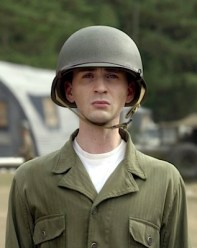 It’s hard to say what exactly is wrong here, but it’s mainly an abundance of CG backdrops, green/blue screen stuff that doesn’t scan. Heck, in one shot you can see a blue glow around the edge of a character’s hair! That’s bordering on the amateurish.
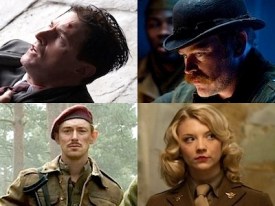 Still, do look out for
  Elsewhere, Tommy Lee Jones could play roles like this grumpy-but-good-at-heart-General in his sleep, but at least claims the film’s best line. Equally, Hugo Weaving could be in a similar state of unconsciousness and give a good villain, and while he does his best to chew the scenery, I thought he was fine but unmemorable in an underused role. As I said, the screenplay positions him as a “we need a villain for a climax”-level enemy when his character should be The Hero’s Nemesis, leaving a waste of both character and actor. Co-villain Toby Jones is similarly ill-treated, although at least he may return, semi-reincarnated as another villain (no explicit clues in the film, but he is one in the comics).
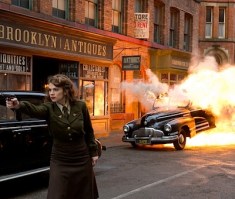 And I haven’t even mentioned the over-graded sepia hue, because it’s Set In The Past. Digital grading brought much potential to the film industry, but instead it’s pathetically and predictably overused. Whenever you compare a film itself to some B-roll footage in a behind-the-scenes documentary or somesuch, you suddenly noticed how not-like-real-life the film looks. In every thriller whites are actually blue, for instance. Here, I imagine if you compared it you’d find whites are actually bronze. I don’t imagine this kind of thing is going away now though.
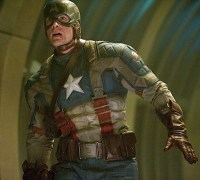 But hey-ho, here it is. Like I theorised at the end of Iron Man, maybe with this setup out of the way they can produce a better sequel… but considering the skinny-little-man-turned-muscly-superhero is one of the more interesting aspects of Cap, and they’ve done that now; and the World War 2 setting is another unique facet, which they’re leaving behind… sadly, I’m not holding out quite as much hope.
 100Films.co.uk