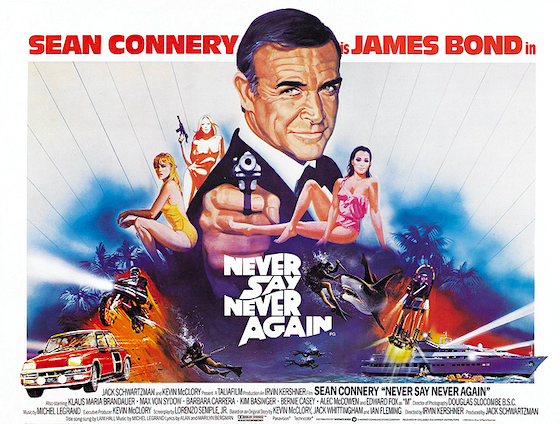
Never Say Never Again (1983)

The 100 Films Guide to…

Never Say Never Again

Sean Connery is James Bond 007

Country: UK, USA & West Germany
Language: English
Runtime: 134 minutes
BBFC: PG
MPAA: PG

Original Release: 7th October 1983 (USA)
UK Release: 15th December 1983
Budget: $36 million
Worldwide Gross: $138 million

Stars
Sean Connery (Thunderball, Highlander)
Klaus Maria Brandauer (Mephisto, Out of Africa)
Kim Basinger (Mother Lode, Batman)
Barbara Carrera (The Island of Dr. Moreau, Lone Wolf McQuade)
Max von Sydow (The Exorcist, Minority Report)

Director
Irvin Kershner (The Empire Strikes Back, RoboCop 2)

Screenwriter
Lorenzo Semple Jr. (Papillon, Flash Gordon)

Based on
An original James Bond story by Kevin McClory, Jack Whittingham and Ian Fleming, which Fleming later novelised as Thunderball.


The Story
Ageing secret agent James Bond is sent to a health spa to get back into shape, but therein stumbles upon part a plot to hijack nuclear warheads and hold the world to ransom. With the theft successful, it falls to Bond to retrieve the weapons before it’s too late.

Our Hero
Bond, James Bond, British secret agent 007. He’s played by Sean Connery — already the first and third actor to play James Bond on the big screen (in a serious movie), here he becomes the fifth too. Unlike the official Bond films, which carried on regardless as Roger Moore began to look more like an OAP than a capable secret agent, Never Say Never Again acknowledges that Bond is getting on a bit. That’s because Connery was 53 at the time, and this is from back in the days when 53 was old, especially for an action star — not like today.

Our Villains
Billionaire businessman Maximilian Largo is actually the highest-ranking agent of SPECTRE, a global criminal organisation masterminded by Ernst Stavro Blofeld. With Blofeld merely pulling the strings behind the scenes, it’s Largo and his lackeys that Bond must defeat to save the world.

Best Supporting Character
Rowan Atkinson’s cameo-sized role as inexperienced local bureaucrat Nigel Small-Fawcett is actually quite amusing, and therefore probably the best thing about the film.

Memorable Quote
Largo: “Do you lose as gracefully as you win?”
Bond: “I don’t know, I’ve never lost.”

Memorable Scene
At a charity event hosted by Largo, Bond comes face-to-face with his adversary for the first time, where he’s challenged to play Domination, a 3D computer game. It couldn’t be more ’80s if it tried.

Memorable Music
James Bond films have a very distinct musical style… but not when they’re unofficial productions they don’t. Without access to familiar themes, Never Say Never Again finds itself having to reach for something different… and fails: the title song is bland and the jazzy score is forgettable.

Letting the Side Down
Where to begin? Well, let’s pick on perhaps my least favourite bit of the whole endeavour: henchwoman Fatima Blush; and, more specifically, how the film ends up handling her. First, there’s a truly terrible sex scene between her and Bond, but it only gets worse later: the self-espoused feminist becomes monomaniacally concerned that Bond should think she’s the greatest shag he ever had, which distracts her to the point that he gets the opportunity to kill her… which he does with an explosive bullet that just leaves her smoking high heels behind. No, seriously. And for this performance Barbara Carrera received a Golden Globe nomination! If you told me she’d been nominated for an award and asked me to guess which, I’d’ve been certain it was a Razzie.

Making of
“So how did an unofficial James Bond film come about anyway?,” I hear you ask. Well, the story starts in the early ’60s, after the Bond novels had become popular but before the film series began. Creator Ian Fleming worked with independent producer Kevin McClory and screenwriter Jack Whittingham on a script for a potential Bond film titled Longitude 78 West, but this was abandoned due to costs. Fleming then adapted the screenplay into a Bond novel, Thunderball, but without credit for either McClory or Whittingham. McClory sued for breach of copyright, and the matter was settled by Fleming giving McClory all rights to the screenplay. By this time the official Bond film series was underway, and Eon Productions made a deal for McClory to coproduce their adaptation of Thunderball, an agreement which forbade him from making any further films of the novel for another decade. That lands us in the mid-’70s, when Bond was still very popular. As McClory began attempting to get a new adaptation off the ground, Eon put legal obstacles in his path, accusing his new script of breaking copyright restrictions by going beyond the confines of Thunderball. Eventually McClory and other producers managed to clear these hurdles and, after rewrites to make Connery happy (which were undertaken by British TV writers Dick Clement and Ian La Frenais, who went uncredited due to Writers Guild of America restrictions, despite much of the final script being their work), the remake finally went before the cameras — with a new title, suggested by Connery’s wife, referring to his vow that he would “never” play Bond again.

Previously on…
James Bond had starred in 13 official movies by the time this came along. It’s kind of ironic that Never Say Never Again’s unofficial status means it can’t acknowledge any of that, while also tacitly acknowledging it with Connery’s very presence in the lead role. Though if it had been able to acknowledge it, the fact this film is a straight-up remake of Thunderball might’ve led to some awkwardness.

Next time…
Early in 1984, producer Kevin McClory announced a sequel, S.P.E.C.T.R.E. It never happened. He spent most of the rest of his life trying to pursue further James Bond projects: he tried to remake the same story again in 1989 as Atomic Warfare starring Pierce Brosnan, and again in the early ’90s as Warhead 2000 AD starring Timothy Dalton. In 1997 he sold the rights to Sony, who already held the rights to Casino Royale and hoped to use that to launch its own Bond series. MGM sued and the matter was settled out of court, with Sony giving up all claims on Bond. (Perhaps this explains why Sony have been so keen on acquiring/retaining the series’ distribution rights in recent decades.) And so we’re left with just one James Bond series, which has mostly gone from strength to strength.

Awards
1 Golden Globes nomination (Supporting Actress (Barbara Carrera))
2 Saturn Award nominations (Fantasy Film, Special Effects)

Verdict

Between this and the state of the official Moore-starring films at the time, it must’ve sucked to be a Bond fan in the early- to mid-’80s. Maybe some thought Connery returning to the role he’d defined would be a boon, but it didn’t turn out that way: in just about every respect, Never Say Never Again plays like a weak imitation of a Bond film… which I suppose is exactly what it is, really.

As an unofficial production, it’s missing a bunch of the identifying features of the Bond films: the gun barrel, the title sequence, the musical stylings, and, most conspicuously, the famous theme. There’s more to Bond than these tropes, of course, and a really good Bond movie can survive without them, but their absence contributes to the feel of this being a low-rent wannabe, when it needs all the help it can get. The stuff it can include isn’t great either. The one-liners and innuendos are particularly bad. The action is rather dated (although the chase between a souped-up Q-bike and the henchwoman’s tacky little ‘80s car is more exciting than the notoriously underpowered car chase in Spectre, which says more about Spectre than Never Say Never Again). Then there’s the sex scene I mentioned above.

One critic retrospectively described the film as “successful only as a portrait of an over-the-hill superhero,” which is true… up to a point. I mean, most of the stuff about Bond being past his best seems designed to explain Connery’s grey hair and lined face — Bond is still irresistible to literally every woman he meets, and has no problem at all doing any of the action stuff. Connery’s performance isn’t bad either, although it didn’t quite feel like Bond to me. I’m not sure why. It’s not that he seems bored or like he’s only going through the motions (a sensation that definitely comes across in some of his original performances as the character), but he no longer seems to have quite the panache you expect from 007.

And yet, for all that, it’s not as irredeemably terrible as I’d remembered. For all the glaring faults, it actually ticks along with a decent level of entertainment value. So is it, in fact, unfairly maligned? It’s nowhere near the best of Bond, but it doesn’t descend into outright silliness like some of the official ones do (well, apart from those smoking shoes), and it even has a couple of pretty good bits. It would definitely be a lesser Bond — if it counted, which it doesn’t — but, as a couple of hours of off-brand Bondian fun, it could actually be a lot worse.

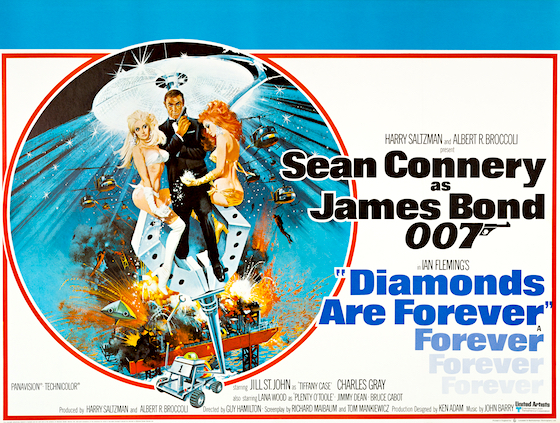
Diamonds Are Forever (1971)

The 100 Films Guide to…

Diamonds Are Forever

You’ve been waiting for him…
Asking for him…
Now he’s here.

Country: UK
Language: English
Runtime: 120 minutes
BBFC: A (cut, 1971) | PG (1987) | 12 (2012)
MPAA: PG

Original Release: 14th December 1971 (West Germany)
UK Release: 30th December 1971
Budget: $7.2 million
Worldwide Gross: $116 million

Stars
Sean Connery (Marnie, The Untouchables)
Jill St. John (The Lost World, Sitting Target)
Charles Gray (The Devil Rides Out, The Rocky Horror Picture Show)
Lana Wood (The Searchers, Grayeagle)

Director
Guy Hamilton (Battle of Britain, Evil Under the Sun)

Screenwriters
Richard Maibaum (Ransom!, Licence to Kill)
Tom Mankiewicz (The Sweet Ride, Ladyhawke)

Based on
Diamonds Are Forever, the fourth James Bond novel by Ian Fleming.


The Story
After finally assassinating his nemesis, Blofeld, Bond is assigned to investigate a diamond smuggling operation in Holland, but following the trail leads him to the glitz of Las Vegas — and a familiar foe.

Our Hero
Bond, James Bond, agent 007 of the British secret service. He may be looking a little older than when we last saw him, but he’s still capable of wooing all the ladies and scaling the outside of skyscrapers.

Our Villains
We so much focus on the Dr Nos and Auric Goldfingers of the early Bond films — plus the ever-changing roster of villains he’d face in later movies — that it’s easy to forget Blofeld has a presence in almost every Bond movie before Diamonds Are Forever (indeed, Dr. No (which only mentions SPECTRE) and Goldfinger (which has no ties whatsoever) are the only exceptions), so it’s no real surprise that he’s not just confined to the pre-titles here. It certainly wouldn’t have been to audiences in 1971, either: he’s prominent in the trailer, and Charles Gray is rather highly billed for someone who’s only in the opening minutes. That said, Lana Wood is fourth billed and she only has about three scenes, so… Until he’s properly revealed, however, we have overtly homosexual assassins Mr Wint and Mr Kidd to tide us over. Considering they’re shown as creepy and murderous, it’s hardly an enlightened portrayal of homosexuality; but then it is from 1971, so what do you expect?

Best Supporting Character
Tiffany Case is Bond’s way in to the diamond smuggling operation. She’s a self-assured and capable woman… for about the first half of the film, before she sharply descends into a stereotypical Bond Girl bimbo. Oh well, they tried.

Memorable Quote
“That’s quite a nice little nothing you’re almost wearing. I approve.” — James Bond

Memorable Scene
Bond travels to Amsterdam under the identity of a diamond smuggler they’ve captured, but when he escapes and to Amsterdam too, Bond must intercept the chap before his cover’s blown — which he does in a small lift, leading to a brutal close-quarters brawl that’s almost as good as the famous train carriage one in From Russia with Love.

Write the Theme Tune…
One of the most famous of the Bond title tracks, its music was written by the film’s — and, by this point, the series’ incumbent — composer, John Barry. It was his fifth Bond theme song (seventh if you include Mr. Kiss Kiss, Bang Bang and We Have All the Time in the World). The lyrics were by Don Black, returning for his second theme after Thunderball.

Sing the Theme Tune…
This is also the second Bond theme for singer Shirley Bassey, after (of course) Goldfinger. Apparently co-producer Harry Saltzman hated the song, objecting to the innuendo in the lyrics, and it was only saved by his fellow producer, Cubby Broccoli. That said, Saltzman may have had a point: in a later interview, Barry revealed that he instructed Bassey to imagine she was singing about… a penis. “They are all I need to please me / They can stimulate and tease me … Hold one up and then caress it / Touch it, stroke it and undress it…” Whew, crikey!

Making of
By this point in the Bond series (this is the seventh film, remember) a lot more original thought was going into which direction to take things than just “adapt a Fleming novel”. For one thing, they were worried Bond’s British style was becoming passé, so they decided to set the movie in glamorous Las Vegas — which, let’s be frank, has dated far, far more than the classier style of the earlier films. Anyway, they went even further than that: with Lazenby having deserted them, a new leading man was required, and so they cast… an American! *gasp* Unthinkable today. The man in question was John Gavin, best known for playing Sam Loomis in Psycho. He’d also played France’s answer to Bond, agent OSS 117, in a film just a couple of years earlier, which is either good training or a weird conflict, depending how you look at it. Not that it mattered anyway, because United Artists insisted they get Sean Connery back, and they did — albeit for a then-extraordinary $1.2 million salary. To Connery’s credit, he gave every cent of it to a Scottish education charity he’d established.

Previously on…
Connery played Bond in five movies between 1962 and 1967, eventually becoming bored of the role and quitting. They replaced him with an unknown Australian model, who promptly got too big for his boots and ran off after just one movie. It just so happens that the films’ storylines lend credence to the theory that James Bond is a codename that goes along with the 007 designation — normally I hate that theory, but the way it explains the events of OHMSS and Diamonds Are Forever is quite neat. (Basically: Connery-Bond retires and is replaced by Lazenby-Bond (hence the “this never happened to the other fella” line), but when Lazenby-Bond’s wife is killed he quits and Connery-Bond comes out of retirement to avenge her for him (hence him tracking down Blofeld at the start of DAF, but not seeming all that emotional about it).)

Next time…
Connery said he’d never play Bond again… which became the inspiration for the title the next time he did. But that really was his last hurrah in the role. As for the official Bond movies, they finally did the inevitable and cast Roger Moore. The rest is history.

Awards
1 Oscar nomination (Sound)

Verdict

Well throw me out a window and call me Plenty if Diamonds Are Forever isn’t actually a really enjoyable Bond movie. Okay, it’s probably still the worst (official) Connery movie, thanks to a few daft bits (the elephant playing the slot machine; Blofeld in drag; etc), and because it simply doesn’t have as many standout sequences or memorable lines as his other five. But, on its own merits, it’s good fun. The first 45 minutes or so are played admirably straight and serious; the car chase around Vegas is rather good; and while those bits of silliness do creep in, they’re only fleeting (albeit a precursor to where the whole series would go in the Moore years). I’d previously remembered Diamonds as a real nadir; a blight on the name of the series. Now, while I wouldn’t rank it among my most favourites, I found a lot to like.

(For the sake of comparison, I previously gave five stars to From Russia with Love, Goldfinger, You Only Live Twice, and On Her Majesty’s Secret Service, and four stars to Dr. No and Thunderball. This would be three-and-a-half, but I’ve never done half stars on this blog. If I did, perhaps one or two of those others would’ve been marked down by half-a-star too.)

Hustlers (2019)

2020 #39
Lorene Scafaria | 110 mins | streaming (HD) | 2.39:1 | USA / English | 15 / R

Hustlers

A struggling stripper (Constance Wu) is taken under the wing of an older pro (Jennifer Lopez) at a club frequented by super-rich Wall Street types. The going is good… until the 2008 financial crash happens, knocking out their clientele and, in turn, them. Of course, the Wall Street guys got away scot-free after that debacle, even as others floundered — including our stripper friends. That is, until J.Lo and co come up with a scheme to rip the bastards off.

Crime movies are sometimes criticised for glamourising the illegal acts of their characters. Sometimes that’s people misreading the film (in the case of many a Scorsese movie, for instance). Sometimes it’s true (the many rip-offs by people who misread Scorsese movies, for instance). Sometimes it’s unavoidable, because we’re going to be on the criminals’ side however you present it — and I think that’s the case here. Those fuckers had it coming, and these girls brought it to them. Not all heroes wear capes clothes.

Even more satisfyingly, it’s based on a true story. Director Lorene Scafaria leans into the story’s caper movie parallels just the right amount, giving the movie a great tone — funny without turning it into an outright comedy; heartfelt without getting schmaltzy; a crime drama without getting self-consciously Gritty. Her direction is fantastic, with exciting shot choices, editing tricks, sound design, and fitting needle drops. But among the razzmatazz she doesn’t lose sight of the point: it’s about these women and their relationships as much as it is about the scam they pulled.

Every day they're hustlin'

And so the film rests heavily on the shoulders of Wu and Lopez, but they’re both strong enough to carry it. Wu gets the bigger arc — from nervous newbie to confident co-conspirator to a frustrated “only adult in the room” position when others begin to push things too far. We also see her in framing flash forwards, where she’s in a different position again. Normally I hold little truck with this kind of framing device, because it’s often a lazy shortcut through the story or gives away too much of where thing are going. Here, though, it’s just tantalising enough to make you wonder where exactly she’s ended up, and therefore how exactly she got there. J.Lo’s performance has attracted plenty of praise (there was widespread disappointment when she didn’t get an Oscar nom), and she is wholly convincing as an outwardly glamorous and successful woman with a steely survivor’s core.

“Strippers rip off rich businessmen” sounds like the setup for an exploitation movie, and in other hands it probably would’ve been. But without a leering gaze, and with a true-story basis that remembers these women are human beings, there’s a dimension of reality that elevates proceedings — even as it’s still fun seeing the underdog pull a fast one on schmucks who deserved it.

4 out of 5

Hustlers is available on Amazon Prime Video in the UK from today.

Mission: Impossible – Fallout in 3D

Rewatchathon 2020 #14
Christopher McQuarrie | 147 mins | download | 2.39:1 + 1.90:1 | USA, China, France, Norway & UK / English & French | 12 / PG-13

Mission: Impossible - Fallout 3D

Despite Paramount’s best efforts to screw over 3D fans by not releasing it on Blu-ray anywhere in the world, there is a copy of Fallout in 3D out there if you know where to look (and you do have to hunt for it a bit, because it’s not on the best-known torrent sites).

Like so many modern blockbusters, Fallout was not shot in 3D but was converted during post-production, at the request of the filmmakers (including director Chris McQuarrie) to tap into the box office potential of that format in certain markets (I believe 3D remains very popular in Asia, primarily). Paramount agreed to that, but didn’t think there was enough market to bother releasing it on 3D Blu-ray (a view clearly not held by other studios, who continue to release 3D discs in some countries (although which countries varies by studio, strangely)). However, the 3D version was quietly released for streaming rentals in some places, which is the source of the copy I found.

Most streaming rental services don’t offer 3D, and those that do tend to be TV-based and stuck on older, lower quality standards. So the original source for this was probably 720p, which was then ripped, squashed (to what’s known as half side-by-side 3D), and recompressed. It’s wound up looking almost DVD-ish in resolution. But it’s better than literally nothing, which (given Paramount’s irritating refusal to release it on disc) is the only alternative. And it’s watchable, so long as your focus is on the 3D rather than the overall PQ. (The thing that really amazed me while watching this is that there are people who think such DVD-like levels of quality are perfectly acceptable on their 4K TVs, and they see no need to upgrade to Blu-ray / an HD Netflix subscription / etc. Those people really should’ve gone to Specsavers.)

It's even more vertiginous in three dimensions

As a 3D fan, it’s worth enduring the lower resolution, because the 3D itself is superb. It may be a post-conversion (and, at that, one the director not only didn’t supervise but has never even watched) but it’s really well done, in particular during the action sequences — which, in fairness, is most of the movie. The skydive; the Paris bike chase; the helicopter stuff; perhaps most of all the clifftop fight — they all gain something from the third dimension. In some it’s a sense of scale — Hunt and Walker suspended in space as they freefall; an almost similar sensation during their climactic fight on the cliff, which now feels so high up. Other times, it puts you right in the heart of the action — the low-angle shots and speeding camerawork during the car chases mean that surrounding traffic whooshes at and past you in 3D, like being on some sort of rollercoaster. There’s not much poking-out-of-the-screen action (though I rarely notice it in home 3D viewing even when others praise a film for it, so I won’t swear to there being none), but at appropriate times you can feel bullets or debris flying out of the screen at you. It’s a literally engrossing experience.

I’m thrilled I finally managed to find and watch it. Though that’s a mixed blessing, because while the 3D didn’t disappoint, the lack of disc release still does. If the 3D had been a bit rubbish, I could’ve written this viewing off to experience and been happy to never see the film in that format again. But as it’s great, I’m now even more disappointed by the lack of a 3D Blu-ray. I’m going to find it frustrating to go back to watching some of the action scenes in boring old 2D. Whenever I next watch Fallout it’ll be in 4K, and I’ll console myself with the fact that’s how it was actually shot, and I’m sure it’ll look great because it’s a very well-shot film… but the third dimension will be sorely missed.

5 out of 5

My full review of Mission: Impossible – Fallout is here.

The 100-Week Roundup

Regular readers may be aware that for a while now I’ve been struggling with what to do about my increasingly ludicrous review backlog. It continues to grow and grow — it’s now reached a whopping 215 unreviewed films! (And to think I started that page because I was 10 reviews behind…) Realistically, there’s no way I’m ever going to catch that up just by posting normal reviews, especially given the rate I get them out nowadays. But since this blog began I’ve reviewed every new film I watched — I don’t want to break that streak.

So, I’ve come up with something of a solution — and kept it broadly within the theming of the blog, to boot.

The 100-Week Roundup will cover films I still haven’t reviewed 100 weeks after watching them. Most of the time that’ll be in the form of quick thoughts, perhaps even copy-and-pasting the notes I made while viewing, rather than ‘proper’ reviews. Today’s are a bit more review-like, but relatively light on worthwhile analytical content, which I think is another reason films might end up here. Also, the posts won’t be slavishly precise in their 100-week-ness. Instead, I’ll ensure there are at least a couple of films covered in each roundup (it wouldn’t be a “roundup” otherwise). Mainly, the point is to give me a cutoff to get a review done — if I want to avoid a film being swept up into a roundup, I’ve got 100 weeks to review it. (Lest we forget, 100 weeks is almost two years. A more-than-generous allowance.)

I think it’s going to start slow (this first edition covers everything I haven’t reviewed from April 2018, which totals just two films), but in years to come I wouldn’t be surprised if these roundups become more frequent and/or busier. But, for now, those two from almost two years ago…


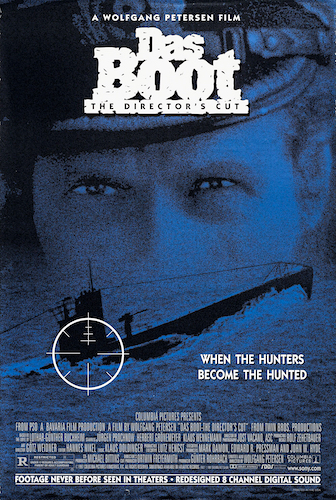
Das Boot
The Director’s Cut
(1981/1997)

2018 #69
Wolfgang Petersen | 208 mins | Blu-ray | 1.85:1 | Germany & USA / German & English | 15 / R

Das Boot: The Director's Cut

Writer-director Wolfgang Petersen’s story of a German submarine in World War 2 may have an intimate and confined setting, but in every other sense it is an epic — not least in length: The Director’s Cut version runs almost three-and-a-half hours. However, the pace is excellently managed. The length is mainly used for tension — quietly waiting to see if the enemy will get them this time. It’s also spent getting to know some of the crew, and the style of life aboard the sub. It means the film paints an all-round picture of both life and combat in that situation. The only time I felt it dragged was in an extended sequence towards the end. I guess the long, slow shots of nothing happening are meant to evoke time passing and an increasing sense of hopelessness, but I didn’t feel that, I just felt bored. Still, while I can conceive of cutting maybe 10 or 20 minutes and the film being just as effective, being a full hour shorter — as the theatrical cut is — must’ve lost a lot of great stuff.

It’s incredibly shot by DP Jost Vacano. The sets are tiny, which feels realistic and claustrophobic, but nonetheless they pull off long takes with complex camera moves. Remarkable. Even more striking is the sound design. It has one of the most powerful and convincing surround sound mixes I’ve experienced, really placing you in the boat as it creaks and drips all around you. The music by composer Klaus Doldinger is also often effective. It does sound kinda dated at times — ’80s electronica — but mostly I liked it.

Versions
Das Boot exists in quite a few different cuts, although The Director’s Cut is the only one currently available on Blu-ray in the UK. If you’re interested in all the different versions, it’s quite a minefield — there are two different TV miniseries versions (a three-part BBC one and a six-part German one), in addition to what’s been released as “The Original Uncut Version”, as well as both of the movie edits. There’s a lengthy comparison of The Director’s Cut and the German TV version here, which lists 75 minutes of major differences and a further 8 minutes of just tightening up. Plus, the TV version also has Lt. Werner’s thoughts in voiceover, which are entirely missing from The Director’s Cut. That means this version “has a lack of information and atmosphere”, according to the author of the comparison.

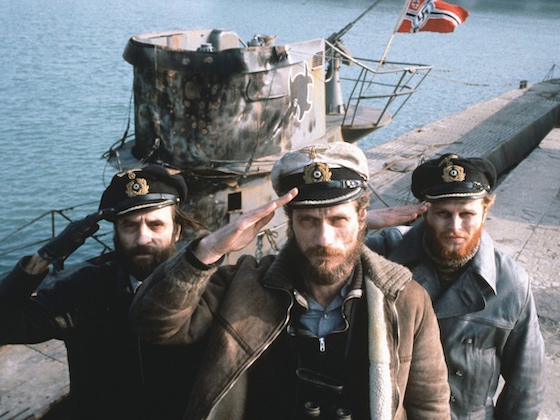
Das salute

As to the creation of The Director’s Cut, the Blu-ray contains a whole featurette about it called The Perfect Boat. In it, Petersen explains that he thought the TV version was too long, but that there was a good version to be had between it and the theatrical cut. It was first mooted as early as 1990, but it was when DVD began to emerge that things got moving — Columbia (the studio, not the country) was aware of the format’s potential even from its earliest days, and so it was with an eye on that market that they agreed to fund the new cut. Not only was it all re-edited, but as for that soundtrack I was so praiseful of, the audio was basically entirely re-recorded to make it more effective as a modern movie. The only thing they kept was the original dialogue… which had all been dubbed anyway, because the on-set sound was unusable.

In the end, the new cut was such a thorough re-envisioning that it took three times as long as anticipated, and led to a glitzy premiere and theatrical re-release. Petersen thinks the main difference between the theatrical and director’s cuts is the latter is more rich and has more gravitas because we spend more time with the individual characters.

5 out of 5

Das Boot: The Director’s Cut was viewed as part of my What Do You Mean You Haven’t Seen…? 2018 project.

It placed 22nd on my list of The 26 Best Films I Saw For the First Time in 2018.

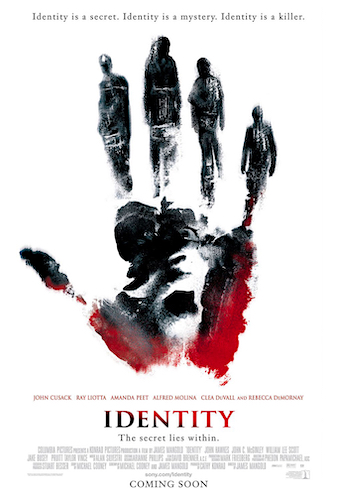
Identity
(2003)

2018 #78
James Mangold | 90 mins | streaming (HD) | 16:9 | USA / English | 15 / R

Identity

I bought Identity probably 15 or so years ago in one of those 3-for-£20 or 5-for-£30 sales that used to be all the rage at the height of DVD’s popularity, and no doubt contributed massively both to the format’s success and even regular folk having “DVD collections” (as opposed to just owning a handful of favourite films). As with dozens (ok, I’ll be honest: hundreds) of other titles that I purchased in a more-or-less similar fashion, it’s sat on a shelf gathering dust for all this time, its significance as a piece of art diminishing to the point I all but forgot I owned it.

But I did finally watch it, not spurred by anything other than the whim of thinking, “yeah, I ought to finally watch that,” which just happens for me with random old DVDs now and then. But, like so many other older films that I own on DVD, I found it was available to stream in HD, so I watched it that way instead. The number of DVDs I’ve ended up doing that with, or could if I wanted… all that wasted money… it doesn’t bear thinking about.

Whodunnit?

Anyway, the film itself. On a dark and stormy night, a series of chance encounters strand ten disparate strangers at an isolated motel, where they realise they’re being murdered one by one. So far, so slasher movie. And, indeed, that’s more or less how it progresses. But there’s a twist or two in the final act that attempts to make it more than that. Without spoiling anything, I felt like it was an interesting concept for a thriller, but at the same time that it didn’t really work. There’s an aspect to the twist that is a cliché so damnable it’s rarely actually used (unlike most other clichés, which pop up all the time), and so the film attempts a last-minute explanation of why it’s better than that, but, I dunno, I feel like a cliché is a cliché.

So maybe Identity is best considered as just a straight B-movie-ish slasher, and just overlook the final act’s attempts at being more interesting as just trying to be different. In fact, more interesting to me was the fact it was mostly shot on an enormous soundstage set, which is kinda cool given the scope of the location.

3 out of 5

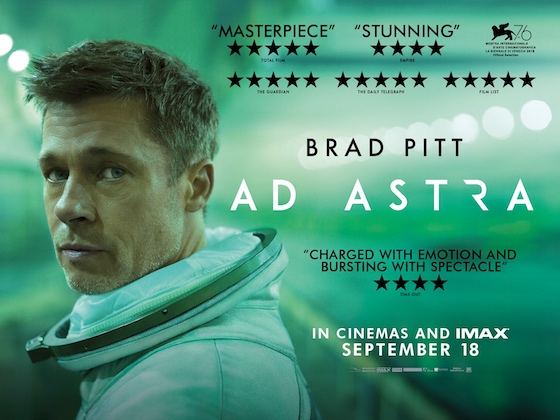
Ad Astra (2019)

2020 #10
James Gray | 123 mins | Blu-ray (UHD) | 2.39:1 | USA & China / English | 12 / PG-13

Ad Astra

This review contains spoilers (though most of them are in the trailer).

Rad Astra”, “Bad Astra”, “Sad Astra”, “Dad Astra”, “Mad Astra”, “Glad Astra”, “Brad Astra”, “Fad Astra”… the puns came thick and fast when Ad Astra hit cinemas back in September (and, as you may see in some of those links, ever since). I’d love to contribute to the game, but I’m four months late so I think all the puns have been had Astra.*

Resisting the urge to describe the film’s plot using some of those aforementioned puns (considering I already gave into that urge for the email notifications and social media posts promoting this review), I’ll instead do it in an equally pithy fashion: this is “Apocalypse Now in space”. Kinda. After unexplained energy waves from Neptune have disastrous consequences on Earth, astronaut Roy McBride (Brad Pitt) is informed that his believed-dead father may actually still be alive and be the one causing these waves, and NASA Starfleet his bosses want him to send a message into space in the hope his dad’s out there and it reaches him. But with Earth facilities damaged by the aforementioned energy waves, Roy must travel to Mars, via the Moon, to even send the message. Hence where Apocalypse Now comes into it: it’s about a man travelling ‘up river’ in search of a superior-gone-rogue.

Apocalypse Now is one of my favourite movies. Sci-fi is one of my favourite genres. “Apocalypse Now in space” sounds like a pitch aimed at me. Ad Astra doesn’t score a direct hit, but it gets pretty close. One thing is it’s not just an emulation of the previous film’s plot (which itself is, of course, rejigged from Joseph Conrad’s novel Heart of Darkness), but also adopts its meditative style. Roy is a man with emotional problems, struggling with the state of his relationship on Earth (with Liv Tyler) and with the comfort the isolation of space brings him. Is it comfort, or is it just escape? And is that healthy? These are the things the film has on its mind.

In space, no one can hear you ponder your own sense of isolation

While it does have something to say about them, I feel like it thinks it’s deeper than it actually is. The final act, in particular, gets a little muddled. Why did his father make the decisions he made? Thematically, what does Roy gain by learning the truth about his father? On a simplistic level, he sees what isolation taken to extremes does to you; but he and his father seem to have fundamentally different attitudes to disconnection anyway. I appreciate that the film dodged the easy blockbuster-y versions of things (it would’ve been a bit pat if his dad was either desperate to be rescued or outright insane and tried to stop the mission), but I’m not convinced what it did instead wholly hung together. Still, as third acts go, “not completely ruining the film” is better than some.

But it does seem like Ad Astra is at least a partially compromised movie. Co-writer/director James Gray has said that he had to make some changes to the ending to get a studio to finance it, and if you watch the trailers again after the film it’s clear that stuff was cut, including much of Liv Tyler’s character. How big an effect that had it’s impossible to say (unless someone inside the production speaks up), but it certainly implies some reworking in post-production. Another thing that makes me wonder this is the film’s use of religion. At times it seems fairly foregrounded — not in a heavy “this movie is about religion” way, but there are lots of references to it, people saying prayers for the dead, that kind of thing — but then the film doesn’t really seem to do anything with that. No one’s actions are different because they’ve found God, nor is caused to find God by the events of the movie, nor rejects God because of them, nor thinks they are God… Religion seems to be this underlying theme (it might be too kind to call it that, even) which ultimately disappears from the narrative just when it should, perhaps, be becoming more prominent.

On the flip side, perhaps it was meant to be this subtle. Ad Astra is certainly trying to say something about our place in the universe (are we alone? If we are, what does that mean? How does the vastness of space, the emptiness, the isolation, the distance from home, affect the mind?), and maybe that’s all implicitly tied to religion and our belief (or otherwise) in an all-powerful creator who made us in his image (and, by extension, no other ‘intelligent’ life). Or maybe the studio got cold feet about tackling religion and made Gray cut that, too.

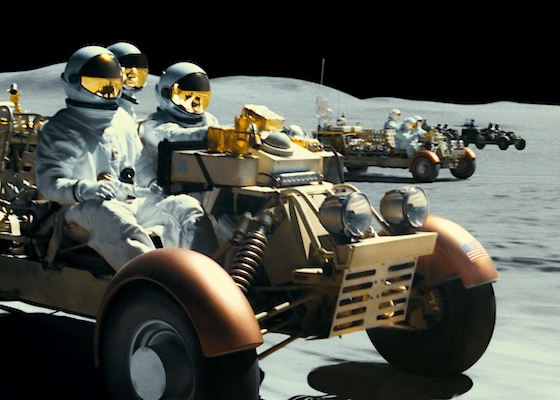
Moon pirates!

Nonetheless, there’s still a lot more good than bad in Ad Astra. Its depiction of the future is interesting; a plausible extension of the present, where space travel has been at least partially commercialised, the Moon more like a concrete shopping mall than a place of genuine wonder. That groundedness extends to the ‘action’ scenes. I mean, you wouldn’t expect a movie that I’ve described as “meditative” to feature “a chase/shoot-out with moon pirates” — that sounds like the pulpiest thing imaginable — but it’s here, and it’s achieved with what feels like a large degree of plausibility and realism. Personally, I like the way the film mixes together contemplativeness with such spikes of adrenaline — again, it’s quite like Apocalypse Now. There’s also the bold choice not to present sound in space. This isn’t the first film to make that choice, certainly, but it remains a noteworthy decision, and it has a more tangible impact than you might expect. Indeed, that seemingly-simple choice goes a long way towards that feeling of reality, though it is just one of several connected choices that ground the film’s vision of the future and make it plausible.

Ad Astra is certainly a journey into darkness — of space; of mind. Whether it gets to the heart of it, I’m not convinced. But it’s still a trip worth taking.

4 out of 5

Ad Astra is released on DVD, Blu-ray, and 4K Blu-ray in the UK this week.

* I’m so proud of that gag I’ve already used it on three different social media posts, and now I’ve worked it in here for posterity. ^

Judy & Punch (2019)

2019 #143
Mirrah Foulkes | 106 mins | cinema | 2.35:1 | Australia / English | 15

Judy & Punch

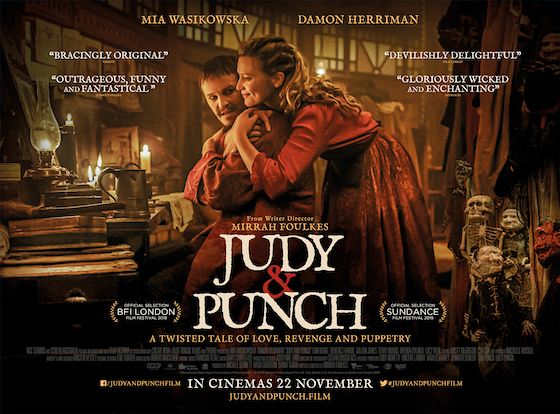
Australian actress turned writer/director Mirrah Foulkes makes her feature debut with this live-action version of the (in)famous Punch and Judy puppet show. I don’t know how well-known the show is outside the UK (I guess it reached Australia, at least), but here it’s a staple of seaside children’s entertainment — although given its propensity for violence and misogyny, it’s suitability has been the subject of a small degree of controversy over the last couple of decades, and its prevalence is on the wane.

There’s no set version of Punch and Judy — each puppeteer has their own spin on the events of the tale and which characters show up — but there are certain elements that are, I suppose, considered standards and widely associated with the show. Here, Foulkes takes all of those familiar tropes and remixes them into a freshly imagined origin story. The real Punch and Judy comes out of the 16th century Italian commedia dell’arte, a fact which has very loosely inspired Foulkes’s take.

The setting is somewhere in Europe (never specified, and there’s a wide-ranging mix of accents to be heard), sometime in the past (it seems quite medieval, but there are buildings and notions that date from later), in a town called Seaside… which is nowhere near the sea. Judy & Punch comes with a hefty dose of absurdity and whimsy that calls to mind the work of Terry Gilliam as a reference point, and with dialogue and music choices that range from cod-medieval to very modern-sounding (especially in some of the references thrown up, which I won’t spoil), it’s clear Foulkes is taking a playful attitude to the material. Well, fair enough — “a live-action version of Punch and Judy” does sound a bit ridiculous, and so the film takes an appropriately irreverent tack. It won’t work for some people, for various reasons, but I was easily on board with the concept.

Punch and Judy

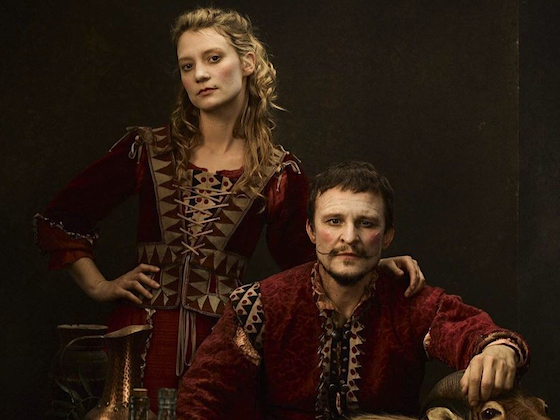
So, in this town we meet the self-proclaimed great puppeteer Mr Punch (Damon Herriman, most noticed for his small role as Charles Manson in Once Upon a Time in Hollywood) and his wife Judy (Mia Wasikowska), who is of course at least equally responsible for the brilliance of their show. Now, it will come as no surprise to those familiar with the original that Punch beats his wife. One day he takes it too far and he leaves her for dead. But this being a modern telling with feminist inclinations, that’s not the end of her role. No spoilers, but some viewers will consider where this ends up to be too preachy — literally, considering there’s a grand speech given at the climax. It’s a shame Foulkes pushes it to such a blunt point; not because I disagree with what she and her characters have to say, but because it ends up a little heavy-handed. The rest of the film makes its point well enough and is entertaining with it, so do we really need it to end with a polemic? Personally, I can let that slide because I was enjoyed the rest enough that it barely mattered by that point, but I know some other viewers found it a bit much.

And really, that could be said about the entire film. Like much of Gilliam’s work, it’s an acquired taste, with a distinct oddness and tonal mix that some will find distasteful. In my screening, one particular key moment drew what seemed to be a 50/50 mix of genuinely shocked gasps and stifled guffaws. I think that’s the kind of reaction it’s meant to provoke — a mix of shock and laughter — although I imagine anyone who genuinely found it gasp-inducing might not take to the fact that, actually, it is played for the laugh. But then there’s some quite genuine emotional fallout. Anyone who struggles with a variable tone, or with visual signifiers that don’t match said tone (the production design is muted and realist, not bright and whimsical), might not get along with the way the film dances merrily back and forth.

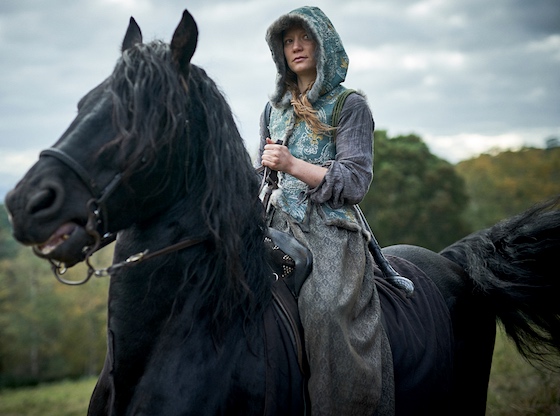
Horse and Judy

For me, it nailed what I was expecting in that regard. This is a film that kinda wants to tell the Punch and Judy story seriously, but knows it’s kinda silly to take Punch and Judy seriously, and so it manages a balance between a grounded grit and a comical daftness. There’s a lot of inventiveness in how it incorporates the familiar elements of the original, but, unfortunately, not quite enough to sustain it all the way — if it were a bit shorter (or pacier in the middle), or had just a few more bright ideas to see it through to the finale, I would’ve loved it. As it is, it’s a bold effort that I liked a lot. That is, indeed, the way to do it.

4 out of 5

Judy & Punch is in UK cinemas from today.

John Wick: Chapter 3 – Parabellum (2019)

2019 #127
Chad Stahelski | 131 mins | Blu-ray (UHD) | 2.39:1 | USA / English* | 15 / R

John Wick: Chapter 3 - Parabellum

The action-man with the second most quotable line about being back is, er, back — again — for the third chapter in the ongoing saga of what happens if you kill a man’s dog. Basically, lots of people die. Quite right too.

Chapter 3 begins exactly where Chapter 2 left off: John Wick (Keanu Reeves) has been made “excommunicado” from the organisation that controls the criminal underworld, the High Table, and he has just an hour’s grace before every assassin in the world will be out to claim his life. He’s just one man, with a $14 million bounty on his head, in a New York City where about 50% of the population seem to be highly trained killers — as Winston (Ian McShane) says, his odds are “about even”.

And so the first half-hour is basically nonstop action, first as Wick desperately tries to prepare for the all-out assault coming his way, and then as he faces it. The series’ reputation is built on its lengthy, stylish, inventive action sequences, and Chapter 3 does not disappoint, with some of its best material coming right out the gate. I feel like they could’ve expanded this first half-hour into an entire movie (i.e. John on the run, fighting endless assassins, until he finds some way out of his bind) and I’d’ve been happy with that — it would’ve mirrored the simplicity of the first one. But the previous film’s cliffhanger is not so simply resolved, because what John did to earn his excommunicado status cuts deep into the mythology of this world — oh so very deep — and the fallout of his actions, well, that’s the plot of the movie. And not just for John himself, because a High Table Adjudicator (Asia Kate Dillon) rocks up to decide the fate of any person or organisation who might’ve given John a helping hand when they really shouldn’t, including Winston, the Bowery King (Laurence Fishburne), and the Director (Anjelica Houston).

Adjudgement day

The first John Wick had a bit of fun introducing us to a rule-driven shadow-world of assassins. The first sequel put a lot of stock in extending that mythology. Now, the third chapter thrives on it. The first film’s plot was a straightforward revenge thriller with some extravagant flourishes; for the third, we’re (to borrow a phrase from Reeves’ other major action franchise) right down the rabbit hole. Just like the famed action sequences, if you’re onboard with it then there’s a ton of fun to be had; but if that kind of thing bores you, there’s little respite from it. Extravagant brutal action and gradually-unveiled ever-deepening mythology: these are John Wick’s twin raisons d’être.

Half the fun of how the films present their mythology lies in the way every character seems to be completely aware of all the rules. No one ever needs a symbolic coin or a judgement’s motivation explained to them; they inherently understand its significance or reasoning, the status and power that’s conferred. But we don’t know what any of it means, of course, because this is a fictional world that we’re being inducted into as and when parts of it become relevant to the narrative; and so we’re led along on a magical mystery tour of what these arcane rituals might mean and where they might lead us. As I said, it’s quite a particular kind of storytelling, and if it doesn’t engage you then that’s that, but if you do find it enjoyable then the John Wick films are spinning it into a fine art.

A hundred bad guys with swords? Who sent those goons to their lords? Why, John Wick!

Naturally, nowhere is the film’s sense of artistry more on display than in the fights. For all the mythology, director Chad Stahelski and the small team of screenwriters never forget what really made people love John Wick in the first place: the gonzo action. There’s a lot of competition in that arena (not just its own preceding instalments, but the past decade’s acclaimed imports like The Raid and its sequel, The Villainess, The Night Comes for Us, et al), but Chapter 3 is up to the challenge, boasting continual inventiveness among the slickly choreographed and expertly performed carnage. One innovation includes dogs getting involved in the action — appropriate for a series all about the love of pooches. The mutts in question are commanded by an old acquaintance of Wick’s, played by Halle Berry, who trained with the dogs so she could actually control them during takes. It’s that level of dedication that marks out the action here.

It all looks great as well, with the camerawork boasting precise movement and impressively long takes to celebrate the action and how well it’s been achieved. The actual phototography is fantastic too, the light looking gorgeous whether in the neon glow of New York or the sand-orange Moroccan desert (I watched it in UHD, where it’s a real showcase for why HDR is a bigger benefit than pure resolution; though that’s not to discredit the film’s crispness). It’s complemented further by the design work, in particular a glass-house set where several key scenes take place, which reportedly cost $4 million. On any technical merit you care to name, Chapter 3 is exceptional.

Unleash the dogs of bellum

That said, while there’s fun to be had throughout, by the end I felt like the story was the film’s real problem. Not the tone and style that I praised earlier (though it’s easily the most fantastical of the series so far, which might turn some off), but its significance: it ultimately feels like merely a dot-join between Chapter 2 and the already-announced Chapter 4. The film’s Latin subtitle, Parabellum, translates as “prepare for war”, and that’s apt: this film is a preparation for the next. But maybe I’m being unfair. Maybe, when this series is all said and done, we’ll see that Chapter 3’s contribution to the overarching narrative is equivalent to the other films. However, at first blush, it feels to me like this is either a kind of linking passage, or maybe Chapter 3 Part 1. I guess only time — specifically, the time until after we’ve seen the fourth chapter (currently slated for May 2021) — will tell.

In the meantime, let’s not get too distracted from storyline niggles in a film that’s really about style over substance, in a good way. Chapter 3 certainly knows what boxes it should tick, and it ticks every last one of them with considerable flair. (Can you tick a box with flair? I bet John Wick could. After all, we know how skilled he is with a pencil…)

4 out of 5

John Wick: Chapter 3 – Parabellum is released on DVD and Blu-ray in the UK today.

* The film’s primary language is undoubtedly English, but IMDb also lists seven more. Each only pops up briefly, in short lines or exchanges here and there, which is why I haven’t cluttered the top of this post by listing them. But for the record, they are: Mandarin, Latin, Russian, Japanese, Italian, Arabic, and Indonesian. ^

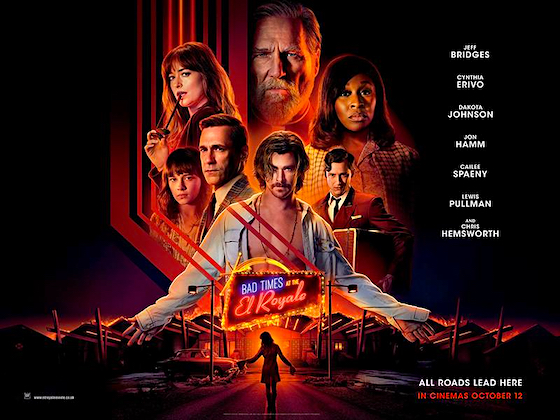
Bad Times at the El Royale (2018)

2019 #75
Drew Goddard | 142 mins | streaming (HD) | 2.39:1 | USA / English | 15 / R

Bad Times at the El Royale

If you thought Tarantino copycats died out after the mid-’90s boom in Reservoir Dogs / Pulp Fiction wannabes, well, you’re sweetly naive — those still crop up from time to time, a quarter of a century too late. But the better emulators have evolved along with their inspiration, as writer-director Drew Goddard demonstrates in Bad Times at the El Royale, a film which feels like an imitation of latter-day Tarantino flicks. At least Goddard has the good sense to dodge the carbon-copy style of those Reservoir Dogs mimics by shifting genre, taking some of what QT brought to war movies in Inglourious Basterds and Westerns in The Hateful Eight and applying it to a neo-noir mystery-thriller. He even preempts Tarantino’s own oeuvre by including a Charles Manson-esque cult leader, thereby prefiguring Manson’s role in QT’s own Once Upon a Time in Hollywood.

Also like Once Upon a Time, El Royale sets its scene in 1969; and, like The Hateful Eight, its setting is an isolated establishment. That’s the eponymous hotel, a destination straddling the California/Nevada state line, which in its heyday attracted celebrities and what we’d now call “influencers”, but has faded since it lost its gambling licence and the wealthy patrons dried up. Now, over the course of one day and night, a variety of customers arrive, strangers, each with secrets, all of which will out in the twists of fate that ensue. All of that plays out in chaptered sections, divided with title cards, that mix in flashbacks and juggle the timeline of the present section as necessary — all of which are familiar Tarantino flourishes, of course.

One thing it shouldn’t’ve copied from Tarantino is the running time: just like many of his recent works, it’s longer than it needs to be. That’s not because the material is bad per se, but because the pacing isn’t tight enough. It seemed to drag its heels for no reason (again, I felt the Tarantino comparison), whereas a tighter pace might’ve contributed some tension, which I rarely felt despite the scenario screaming out for it.

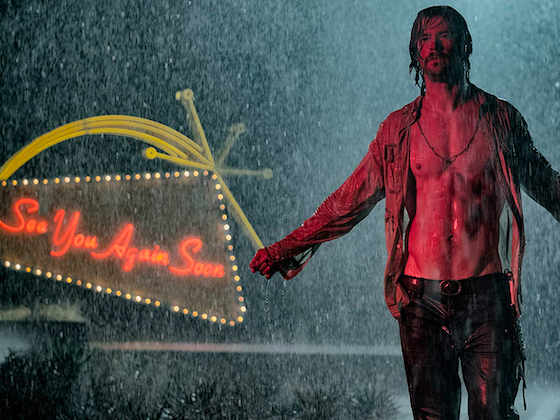
Heavy rain at the El Royale

Well, as the saying goes: if you’re going to steal, steal from the best. Heck, Tarantino has certainly borrowed plenty from his own wide-ranging influences. If you are going to imitate another filmmaker, this is the way to do it: by bringing your own characters and settings and plots and twists to the table. That might sound obvious, but so many of those wannabes are slavish in their borderline-plagiarism. Goddard doesn’t sink to that level overall, though there were some parts I felt were only a couple of steps above it. For example, the whole “the hotel is on the state line” bit seemed quirky for the sake of being quirky, imitating a bit that a filmmaker like Tarantino would use but without quite knowing how to use it (it plays a big role in the opening sequence, after which there’s one slight gag with it before it’s never mentioned again).

But such lapses were outweighed by the good. For one, there’s some very nice photography by Seamus McGarvey. It looks like it was shot on 35mm (I checked and it was, which proves Nolan & co are right when they say it does make a difference), which didn’t always translate too well to the 1080p stream I watched, but I suspect might look all the more stunning in 4K. Visual aside, much of what’s good stems from the characters, especially the strong performances by actors like Cynthia Erivo, Jeff Bridges, and Lewis Pullman. It was those, and in particular how each role comes together in the final act to define the whole character, that definitely elevated the quality of the film for me. And while those three are the highlights, there are also good turns from the likes of Jon Hamm, Dakota Johnson, Chris Hemsworth, and Cailee Spaeny. I’d say more, but so much of the meat of these characters comes from how they present themselves vs what the truth is revealed to be — the less you know, the more there is to uncover.

Rewatch you again soon

That said, I wonder if this is a film that will play better on a rewatch. There are several surprise plot developments I wouldn’t wish to spoil for a first-time viewer, for sure, and I do feel like that’s a worthy filmmaking tool (I don’t agree with that research that ‘proved’ audiences enjoy something more if they know the story beforehand — you don’t appreciate it more, you just appreciate different stuff, same as with a rewatch). But I feel like some of that plotting did distract focus from other bits of the film that were working well. Put another way, in my memory the niggles have damped down and I primarily recall the good stuff, so my enjoyment has gone up with hindsight. I’ll have to pick up the 4K disc at some point and give it another go.

For the time being, while I did like it overall, I judged it to be the kind of 4-star effort that could’ve easily become a 5-star top-ten-of-the-year film if it had just polished up everything that I felt didn’t work.

4 out of 5

Bad Times at the El Royale is available on Sky Cinema from today.

Sholay (1975)

2018 #200
Ramesh Sippy | 205 mins | DVD | 4:3 | India / Hindi | PG

Sholay

For many Western readers (and the stats say most of mine are, though India is in 3rd of all countries for 2019 so far), there’s every chance you’ll’ve only heard of Sholay (if you’ve heard of it at all) as “one of those Indian films that’s on the IMDb Top 250 nowadays”. But in Indian culture it’s a much bigger deal, a huge and longstanding success; like Star Wars or something is to us, I guess, only without the reams of sequels and spinoffs and merchandise and theme parks. Instead, it’s enjoyed remarkable success of its own: it topped the Indian box office for 19 years, was the first film in India to celebrate a Silver Jubilee at over 100 cinemas, and eventually set a record of 60 Golden Jubilees across India. From a British perspective, in 2002 it topped the BFI’s “top ten Indian films of all time” poll, and in 2004 it was voted the “Greatest Indian Movie” in a Sky poll of 1 million British Indians. I first heard about it years ago in that context, and my desire to see it was only exacerbated when it made it onto IMDb’s list. All of which is why I chose it to be my second-ever #200.

It’s a tricky film to sum up, because it offers a massive mash-up of tones and genres in a way we’re not accustomed to from Western cinema. There are whole sequences (not just fleeting moments) of broad slapstick humour, epic action, heartfelt romance, brutal violence, colourful musical numbers, intense tragedy, plus backstory that’s filled in via regular, lengthy flashbacks. It wouldn’t be a stretch to say its primary genre was Action, or Comedy, or Musical, or Western — it’s all of those things, by turn; sometimes at the same time. Apparently it’s a defining example of the “masala film”. Masala is, of course, a mix of spices in Indian cuisine, and the films that take that name blend genres together, typically (according to Wikipedia) action, comedy, romance, and melodrama, plus musical numbers.

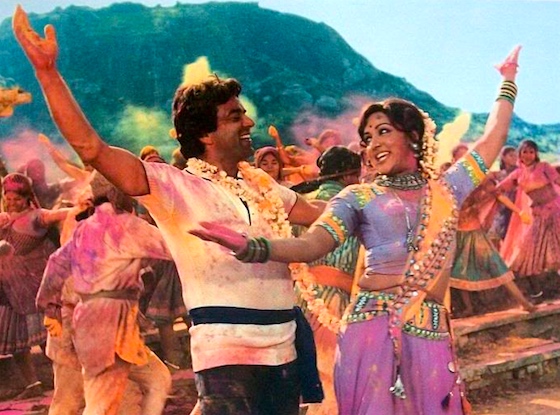
Who doesn't enjoy a colourful sing-song?

That sounds like a recipe for disaster, but what’s perhaps most remarkable about Sholay is that it pulls them off. Thanks to engaging characters and relationships, powerful and humorous performances, quality filmmaking (there’s some strikingly effective camerawork and editing in the big scenes), it all flows. You can see why it became such a success: there’s something for everyone. And you can see why it struggles to transcend the culture it originates from, because when Western movies ever even vaguely attempt this kind of range of tones, there are trolls aplenty waiting to rip them apart for the perceived fault of being tonally inconsistent.

The heroes are Veeru (Dharmendra) and Jai (Amitabh Bachchan), a pair of crooks with hearts of gold, who are recruited by a retired policeman who once arrested them, Baldev Singh (Sanjeev Kumar), to capture a wanted outlaw, Gabbar (Amjad Khan), who’s terrorising Singh’s village, and who he has a personal history with. The way that storyline plays out is highly reminiscent of Spaghetti Westerns and the samurai movies that inspired some of them — anyone who’s seen the likes of A Fistful of Dollars, Seven Samurai, or Once Upon a Time in the West (or any of the other films that have riffed on / ripped from them) is going to see a lot of reflections here. I don’t mean that to be a criticism — after all, Dollars was an unendorsed remake of Yojimbo, and Seven Samurai was remade as classic Hollywood Western The Magnificent Seven, so there’s strong pedigree among these movies for reworking each other to excellent effect.

I'm not sure that's safe...

Sholay certainly adds its own stuff to the mix. I mean, those other films I’ve mentioned don’t have musical numbers or slapstick comedy (not much of it, anyway). Lest you think this plays as a spoof, Singh eventually unveils a tragic backstory (and a neat twist to his character), and Gabbar is a properly despicable, nasty villain. Plus, like most of the best bad guys, he’s not just evil for evil’s sake — he’s motivated to subjugate this particular village for a reason — but he’s still a properly nasty piece of work, excessively and inventively cruel. Rather than a spoof, then, the different genres come into play via an array of plots and asides. At times it does feel like a selection of unconnected subplots to bulk out the running time (and, as you may’ve noticed, it does have a long running time), but most of them come together in the end. Your tolerance for those that don’t (a lengthy comedic aside in a prison, for example) is another matter.

Musical numbers are another thing that put some people off. There are only five though, and they don’t actually drive the plot that much — I was kind of forced to assess their impact, because for some reason my DVD copy didn’t bother to subtitle the songs, leading me to search out translations online so I could get the gist. Still, when they fill several minutes of screen time each, it is nice to at least have an idea what’s being said sung!

In the West, Sholay has been hard to find at times (personally, it was years ago that I managed to source an out-of-print DVD by a label you’ve never heard of from an Amazon Marketplace seller), but as of this week it’s available on Amazon Prime Video in the UK (either as part of a subscription or to rent and buy individually), and in HD to boot! Based on the running time it’s the shorter widescreen theatrical version; there’s also a longer, open matte 4:3 “director’s cut”, which is what I watched. There’s info on the differences between the two cuts here, but the mostly it’s a couple of bits of violence that were censored. The biggest change, though, is the ending. No spoilers, but I think the original version is better — it included one of my favourite parts of the entire film, in fact. The revised version was at the insistence of India’s censor board, and includes a heavy-handed moral lecture — it’s not just less good in itself, it also feels overtly censor-mandated. Oh well.

Vicious villainy

On the bright side, the 4:3 version isn’t great to watch compositionally. The makers wanted to produce an epic 70mm widescreen kinda movie, but didn’t have the tech to do it properly, so they shot it in full frame 4:3 on 35mm and then had it cropped and blown up in London. Watching in 4:3, it’s obvious that it was always intended to be cropped to widescreen: there’s loads of dead space above everyone’s heads, things like that. That said, every once in a while there’s a shot that seems to be perfectly framed. Maybe they look just as nice cropped, I don’t know. To further muddy the waters about different versions, five years ago Sholay was converted to 3D. Despite the film’s enduring popularity, it didn’t come close to making its money back (the conversion cost US$3.5 million, but the 3D release only grossed US$1.4 million). In the West the studio would seek to recoup more of that with home media, but apparently Blu-ray isn’t popular or successful in India, so the chance of getting a 3D BD is basically nonexistent. But, as I said, it’s on Amazon in HD now, so at least there’s that. (Hopefully it has subtitles for the songs…)

Whichever version you watch, Sholay is best described as “an experience”. Perhaps lots of Bollywood movies are like this (after all, with huge success comes huge influence, and I’m sure many have tried to emulate it), but I’m not familiar with them so this was all new to me. That epic running time makes it feel like an event to watch, and the winding plot and variety of tones it encompasses make it feel like a whole buffet of entertainment, as opposed to the just one meal that most films offer. I guess, like any food that is foreign to an individual, it comes as an acquired taste, but it’s one I enjoyed immensely. It would also be entirely accurate and fair to roll out a somewhat clichéd sentiment: if you only watch one Bollywood film, this is the one to watch.

5 out of 5

As mentioned, Sholay is available on Amazon Prime Video now.

It placed 25th on my list of The 26 Best Films I Saw For the First Time in 2018.