2011 #60
Matthew Vaughn | 132 mins | cinema/Blu-ray | 2.35:1 | USA / English | 12A / PG-13
Superhero films have been a significant regular part of the summer movie season for over a decade now, but this year really looks like it’s going to take the biscuit: The Avengers obliterated box office records Stateside last weekend, and has spent most of the week knocking down more worldwide; there’s a Batman sequel/finale to look forward to, which everyone has been expecting to do the same; and sandwiched somewhere between the two is a Spider-Man reboot that, provided it doesn’t get dwarfed by the other two and/or poor reviews, is likely to make a pretty penny. (If I recall correctly, the initial Raimi Spidey film was the first movie ever to make over $100m in its opening weekend; and now, 10 years later, The Avengers is the first to beat $200m — how neat.)
But that’s all still to come (I haven’t even seen The Avengers yet myself, and I won’t now until at least sometime next week, for various reasons. Grr.) Instead, here’s a review of my personal favourite from last year’s crop of comic book adaptations — indeed, I ranked it the second best film I saw all year.
 I made sure to see First Class soon after its cinema release back in June 2011 — an increasingly-rare cinema trip for me (previous one before this was Inception in July 2010), and even rarer to go so quickly, but it earnt it as probably my most anticipated movie of the summer. I’ve been a fan of the X-Men since the ’90s animated series was a defining part of my childhood; Matthew Vaughn has become one of my favourite filmmakers thanks to Stardust and Kick-Ass, both of which earnt 5 stars and spots on my end-of-year top 10s (and Layer Cake was 4-star-ly entertaining too); and the idea of doing a superhero film that was definitively set in a specific point in the past (namely the early ’60s), rather than the perpetual Now of every other entry in the sub-genre, is the kind of thing creative fans long for but risk-averse studios rarely greenlight. Plus the trailers looked brilliant.
So my long-held high anticipation (unlike many whingy comic-continuity-obsessed inexplicably-Vaughn-dubious internet fanboys, who needed the trailer to even consider thinking the film might be good) led me to the cinema quickly. Why so long to post a review, then? Because I’ve been waiting for Blu-ray to see it properly.*
As “Film fans”, rather than “movie consumers”, we’re supposed to believe 35mm cinema projection is the best way to view a film, rather than the cold hard digital realm that’s taking over, or the home cinema that is increasingly the viewing location of choice as people seek to avoid inflated ticket prices and noisy crowds, and gain a huge degree of convenience in the process. Well, sod that. I saw X-Men on 35mm. 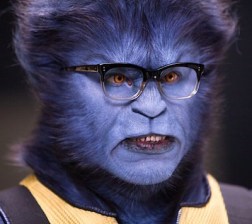 It was blurry, the sound was muffly. I saw a clip in a summer movies trailer just a few days later when I saw Pirates 4 in 3D (i.e. digitally projected), and had a genuine moment of, “oh, that’s how it’s meant to look”. So thank God for Blu-ray — never mind prices, crowds or watching when I want, the real advantage is seeing it as sharp as a pin and being able to hear everything the characters are saying. I can enjoy the cinema experience, but at the end of the day it’s about the film, and if the only way to see, hear and appreciate it properly is to watch it 5+ months later on a much smaller screen from a digital source, so be it. The fact that it’s usually cheaper to buy the Blu-ray to own forever than take two people to see it just once doesn’t hurt either.
But I digress massively. X-Men: First Class takes us back to the origins of the X-Men (at least, the movie-universe X-Men): it’s the 1960s, mutants aren’t widely known about yet, Charles Xavier is uncovering some interesting ideas at Oxford, and Erik Lehnsherr is travelling the world taking revenge for Nazi atrocities. But when some Evil People are plotting to do Something Nasty, the US government winds up bringing them together, and the road to establishing the X-Men begins…
I should give up on plot summaries again, I never write good ones. There’s so much more to First Class than that might suggest. Firstly, it’s very much a prequel to the other X-Men films, rather than a reboot. So no Cyclops and co in the original team-up, which really annoys some fanboys, but pfft, it doesn’t matter. It’s fair to say the characters who make up the eventual first X-Men team aren’t as iconic or memorable,  but that’s fine because here they’re just supporting characters. This is the story of two other young men, Xavier and Lehnsherr, aka Professor X and Magneto.
You need some pretty fine talent to replace two of our greatest actors — Ian McKellen and Patrick Stewart, of course — and in Michael Fassbender and James McAvoy you certainly have that. Fassbender carries much of the emotional weight of the film, and certainly received much of the praise from critics, but it’s thanks to McAvoy’s support that the film is lifted to a higher level. He provides calm, humour and fundamental decency to balance Fassbender’s rage and emotion. What’s fascinating about them as characters is that they are half-formed people. That is to say, while they are Wise Old Men by the time of X-Men, here they are still flawed and finding their way; witness Charles’ insensitivity toward Raven, for instance. That’s quite aside from all the little character-building touches. It all builds to the fantastic, heartbreaking climax on the beach. I’d also say it adds weight to the relationship between McKellen and Stewart in the original X films. Not significantly, perhaps, because those films are about other things, but I think you can feel their shared history more keenly.
The rest of the cast is suitably well equipped. There’s 2011 Best Actress Oscar nominee Jennifer Lawrence as Raven, aka Mystique. Little more than a henchman designed to bring sex appeal in the trilogy, here she’s given a significant degree of backstory that makes her an important piece of the overall series. Indeed, she comes across as woefully underused if you watch X-Men after this — 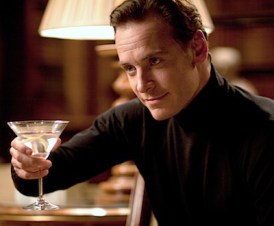 the flipside to the Xavier-Lehnsherr relationship working better, if you will. There’s also Kevin Bacon, playing his second superhero villain in as many years, who does sterling work as a former Nazi seeking world domination — remember the ’60s, when world domination was a valid aim for a villain? There’s more than a little Bond in the mix here.
Rounding out, we have the likes of Vaughn regular and perpetual “I’m only doing it for the money”-er Jason Flemyng, in an almost dialogue-free part that, while visually striking, doesn’t fare much better than his Kick-Ass ‘cameo’ in terms of screen time. There’s also a very flat (in every way apart from her frequently highlighted chest) turn from January Jones as a villainous sidekick, feeling every bit like the last-minute casting she was (after various other actresses walked away — considering the small size of both the role and costume, I can see why). Plus Rose Byrne, who’s always worth mentioning.
Much was made in some circles of a rushed production schedule leading to some of the film’s flaws. I think that’s only an issue because people know it could be one, because (on second viewing especially) I noted no such problems. The earlier parts are probably the film’s best — with Lehnsherr and Moira being all Bond-y, and Kevin Bacon’s Shaw being very much a Bond villain, making it feel more like a big ’60s spy thriller than a superhero movie in many ways — and when it tries to introduce an X-Men team made up of second-string leftover characters it loses its way slightly. But balance is everything with ensemble casts like this, and watching the film again gives a better perspective on its pace and its actual balance. First time through these things are distorted because you don’t know how far through the story you are, how long’s left, how long each scene will last, and so on; a second time, with an idea of where it’s going and so forth, you can better appreciate how it’s all actually weighed up, and I think First Class achieves a balance better than most have given it credit for.
Also worthy of a mention is Henry Jackman’s score. He gives us brilliant driving, menacing action themes, alongside some evocative ’60s stuff too, especially when they’re on the hunt for mutants for instance. I love a good blockbuster movie score, and this is definitely one of those.
Perhaps the thing that most impressed me about First Class, however, was its genuine sense of spectacle. The climax features master-of-magnetism Magneto hoisting a submarine out of the ocean with his powers. That’s not a spoiler, it’s in the trailers — so we’d all seen it going in. And we’re in an era of anything-goes CGI — nothing looks impressive any more because we know not only that it can be done, but how it was done too (greenscreen and pixels, essentially). But that’s not what happens, at least for me, especially on the big screen.

Between Vaughn’s direction, Jackman’s score, Fassbender and McAvoy’s performances, plus those of other supporting cast members, and sterling work by the visual effects team(s), the moment when that submarine floats dripping into the sky is hair-raising. It played to me as a moment of genuine cinematic spectacle; the kind of thing you used to get when big stunts had to be done for real somehow. It’s not a feeling I expected to get from a new film ever again.
I’ve mentioned a couple of times how it ties in to the earlier (set later) films in the series, and how some complained about it messing up X-Men comics lore. But this is an adaptation — it’s not beholden to what’s established in the comics. And it’s working around fitting into the world of the later films, so of course they’re not going to have Cyclops in a ’60s X-team, and so on.  It’s a complete non-issue for non-fans, and the same for any open-minded fans who realise they’re not trying to faithfully bring the X-Men canon to the big screen. Earlier films should already have shattered that illusion anyway.
As to the former, it largely fits well with the earlier films. There might be some questions about ages and events not lining up precisely (especially with the flashbacks in The Last Stand), but these are minor points that I think we can overlook for the overall quality of the film. Largely, a use of certain effects, call-forwards, cameos and little touches here and there really tie it in to the existing films. You don’t need to have seen them to get this — indeed, I imagine the ultimate way to experience it would be with no foreknowledge whatsoever of where Charles & Erik’s relationship is going — but for all those of us who have, it works very nicely.
Yet despite these links, and the 40(-ish)-year gap between the end of this story and the start of X-Men, if First Class never received a follow-up it would work perfectly as a standalone ’60s X-Men film. But I’m ever so glad we’re getting more, because I want to see this crew and this cast tell us more stories of the X-Men.
 After seeing First Class in the cinema I thought to myself that, while I would dearly love to give it a full five stars, in all good conscience I couldn’t; for whatever reason, it didn’t quite come together enough. Watching it again on Blu-ray, however, I’ve completely changed my mind: I wouldn’t change a thing. All my anticipation is more than paid off — I love this movie.
X-Men: First Class placed 2nd on my list of The Ten Best Films I Saw For the First Time in 2011, which can be read in full here.
* That was released back in October 2011, I know. The rest is general tardiness. ^

 I’m a bit young to have experienced seminal ’80s TV series The A-Team first time round, though I swear I caught some repeats when I was young — enough that I know the basic premise but can’t specifically recall ever seeing any of it. Which means I approach this big screen update with perhaps a different mindset to someone who has a distinct opinion (be that good or bad) on the original.
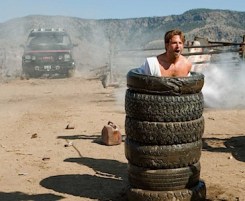 As much as I like serious action, I enjoy this kind of film too. I gave RED four stars; Shoot ‘Em Up the same. You may see where this is going. I am, once again, probably being too generous.
 if that doesn’t or didn’t interest you, there’s no need for it. That said, one scene is apparently “big and puts some drama and emotion into the movie, maybe a bit too much for a PG rating”. (In the UK, both cuts are rated 12, despite some additional bad language and the fact the theatrical version was cut for language to get said 12. Ah, the BBFC.) There’s a full list of changes here, if you’re interested.
 The directors of
  The music is by Atticus Ross, which was interesting because I’d thought it was reminiscent of
 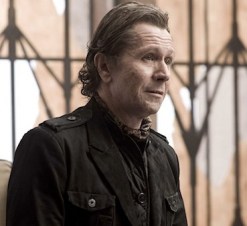 Late on the film pulls out surprise appearances from Michael Gambon and Frances de la Tour. Their roles aren’t even close to needing thesps of such calibre though — they appear fleetingly, the actors underused. Particularly Gambon, who really has nothing to do except fire a gun. I know it’s usually a joke to comment that a usually-better cast member must have needed the money, but that’s the only reason I can imagine he’s here.
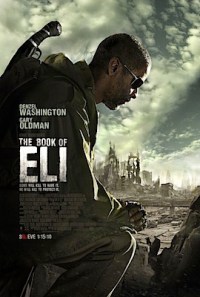
 Newman concludes that “you can’t help feel you were invited to a party with fizzy pop and cream cake and got suckered into a sermon instead.” I couldn’t have put it better. Eli starts off with the potential for an arty 5; slips slightly to a solid 4 when the standard post-apocalyptic trope of a gang fighting for local power comes in to play; unsteadies that 4 with an increasingly atonal second half; and quite frankly borders a 1 with its sickening ending.
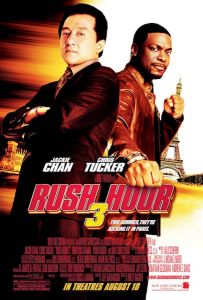 Belated sequels are often the worst kind, an actor/director/studio returning to past glories in the hope of creating new success. Even when they work, they’re not a patch on the original. (I’m sure there must be exceptions, but nothing comes to mind.) The third entry in the
  It’s ostensibly a thriller (albeit a comedy-action-thriller) and so there are plot twists, but they’re wholly predictable. It also lacks clarity in its villain, I felt — who it is, what they’re doing, why they’re doing it, and so on. It weakens the film, especially the ending: there’s the usual big action climax, followed by a little bit of business that dilutes the impact of the ending. It’s just badly structured.
 plus some sparing atop the Eiffel Tower (or, I presume, a surprisingly good set thereof) — is occasionally spectacular and single-handedly almost justifies the entire film’s existence. A car chase/fight through the streets of Paris is the other best bit, buoyed by both unusual choreography and Yvan Attal’s French taxi driver George, who’s probably the film’s best character.
 If 2009’s
  though perhaps not always as memorably, and Ritchie crafts an array of interesting action sequences. Some still accuse it of being a sub-
 Yet for all that, that climax is a game of chess: Sherlock and Moriarty come face to face while in the room next door Watson and gypsy Simza try to spot an assassin. It’s one of a couple of scenes where Downey Jr.’s hero comes face to face with his nemesis, played by Jared Harris, and these scenes are definitely some of the film’s high points. Harris makes a perfect addition to the cast, the only disappointment being that we don’t get to see even more of him. Downey Jr.’s become such a Movie Star recently that it’s easy to forget he’s a multiple Oscar-nominee, and he and Harris give as good a hero-villain act-off as you’re likely to find in a blockbuster.
 Better served is Stephen Fry as Mycroft, a role normally rendered as a brief cameo. And indeed it’s little more than that, but there’s more of him than I was expecting (certainly so in one (pointless aside of a) scene that I’m sure you’ve heard about), and Fry of course excels — it’s the kind of role he was made for. Meanwhile the award for best agent goes to Eddie Marsan’s: Lestrade appears late on for all of two shots, but Marsan is still billed high enough to be on the poster, above most of the cast.
 A Game of Shadows comes out as a fun ride with several stand-out moments, but not as a particularly exceptional version of Sherlock Holmes. It’s very enjoyable as a comedy-action movie with amusing characters and entertainingly-staged action sequences, but while my affection for the first has grown to make it one of my favourite movies, this is just an entertaining follow-up.
 RED here stands for “Retired, Extremely Dangerous”, a description bestowed by the CIA on a group of former agents who, for reasons I won’t go into — because, quite frankly, I can’t remember — fight back against the Agency when someone starts trying to kill them.
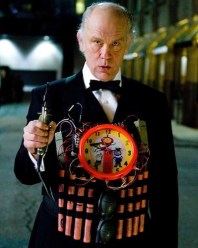 Naturally, considering the theme, the cast is made up of older actors — a neat twist on the usual action movie format of making people younger and younger. Expect this to spread, especially as anyone that could still just about be dubbed a movie star is ageing, replaced only by flash-in-the-pan teen idols. They’re all great because they’re all great actors. Well, Bruce Willis isn’t a Great Actor like Helen Mirren or Morgan Freeman, but he can do an action movie and he can do humour well enough. John Malkovich is as barmy as he always is, but here it works. Sometimes things just line up like that. Karl Urban also gives another solid supporting turn. I’m sure he’s had a few lead roles at this point, but maybe this autumn’s
 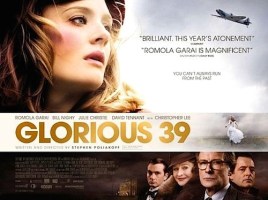 “This year’s
  I, however, thought it was rather good. I can see what turned some people off though. It’s a thriller, but it moves leisurely, especially early on. It’s also quite elliptical at times, not so much requiring you to pay attention as put the pieces together yourself. Plus it lacks a grand finale in which the hero triumphs, or at least loses in dramatic style — it’s quieter than that. Yet I liked the ending, finding it triumphant in a whole other way. But I won’t go spoiling that here.
 What’s better in a thriller than not actually knowing what will come? There should be twists in this genre — genuine twists when possible, not a stock array of “small character played by famous actor turns out to be vitally important” or ” good guy is actually bad guy” or what have you — and Glorious 39, with its balanced uncertainty, pulls some of those off.
 Part coincidence (in that I happened to notice it), part forced appropriateness (in that I then chose to post it now), 2000 AD was originally released in Hong Kong 12 years ago yesterday, tying in to Chinese New Year the last time it was (as it is now) the year of the Dragon.
 All that’s established in these parts could be done much more economically, which would result in far less viewer thumb-twiddling.
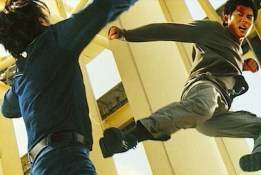 That might be being picky. The action feels slight at the time because it’s a good while coming, but in retrospect, considered on their own merits, there’s a lot of good stuff. There’s a good car chase, a couple of shoot-outs that err towards realism rather than balleticism (both have their merits, but something that feels realistically punchy is rarer), and a couple of solid punch-ups that play fairly nicely on the idea that our hero isn’t a martial arts expert. That concept isn’t mentioned in the film as much as it is in the DVD extras, but his style has a sort of scrambly feel that’s less honed than your usual kung fu bout; plus, as director Gordon Chan explains in the commentary, his apparent competency is how all kids fight in Hong Kong, because they’ve copied it from the movies!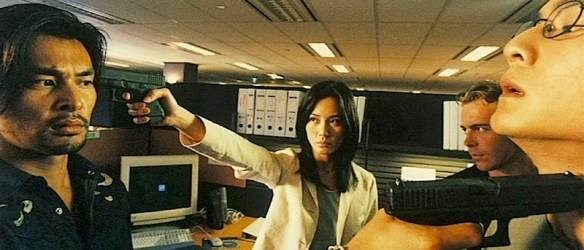
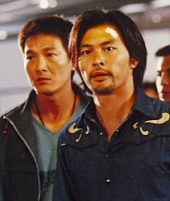 Talking of the action — it’s an 18? I know the BBFC used to be harsher, and particularly so on things featuring martial arts and whatnot, but I still don’t see how this makes an 18. A bit of swearing, a bit of blood — it’s a 15 surely? I watched this just days after
  As with any film heavily based in the realm of technology, certain things have dated. Two things work in its favour: one, as noted, it’s not actually got much to do with technology anyway; and two, it comes from the slightly later time when home computers were more commonplace, so it’s not as bad as those ’90s tech thrillers where computers could do pretty much anything a writer dreamed up. But there’s floppy discs, flight sims with flat graphics, and Magical Hacking Software that can Destroy Everything. An opening spiel about the future of warfare being cyber-attacks doesn’t feel like its quite come to pass (yet?), but then the film doesn’t wholly build on that. The computer software they’re chasing is as MacGuffiny a MacGuffin as they come — it may as well be a bomb or a file of information for all that would change the story.
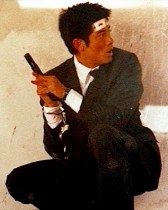 In the DVD’s special features, Chan notes that 2000 AD was an attempt to make an American-style action movie, to show there’s more to Hong Kong cinema than kung fu. Maybe that’s why it’s compromised at times — it’s an emulation of something else. It’s successful in places, but certainly not entirely. My score was awarded almost immediately after watching the film, but after looking back on it through the DVD extras I find I may have liked it a bit more. Am I being too harsh? Perhaps. But still, perhaps not.
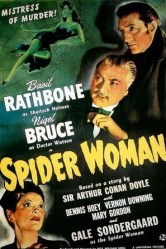 The seventh feature starring Basil Rathbone as Sherlock Holmes and Nigel Bruce as Dr John Watson is the first since
  Gale Sondergaard, is so good that they crafted a sequel around her, albeit Holmes-less. I’ve not seen it and don’t own it, so I’ve no idea what that does for its quality.
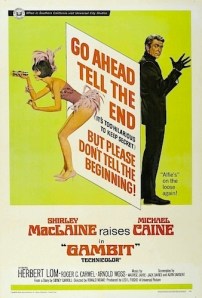 I decided to watch Gambit, which I’d never heard of, after it was recommended on twitter by
 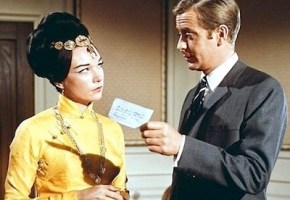 Twists in con movies are par for the course, of course, but here it’s not just the opening that has one: there’s also a salvo in the closing minutes, just to keep you on your toes. You may guess one or two as they rush up on you, but perhaps not all of them. Though as I’ve just warned you they’re coming you stand a better chance than me.
 100Films.co.uk