
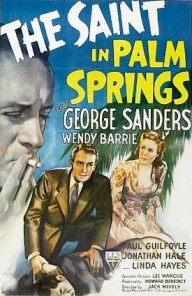
 George Sanders is the Saint for the final time in a film that isn’t the series’ best, nor its worst. It also marks the final appearance by Jonathan Hale as Inspector Fernack, and third-and-final turns from both Wendy Barrie and Paul Guilfoyle. For those keeping track (or not), that’s the same four leads as the last picture! Same director too, as Jack Hively helms his third (and, of course, final) Saint adventure.
By this point Fernack seems to have reconciled himself to Simon Templar being on the side of the angels (he is a Saint after all) and actually offers him a mission. A friend of Fernack’s needs some immensely valuable stamps escorted to Fernack’s friend’s daughter in Palm Springs, but being out of NYC that’s outside Fernack’s jurisdiction — but nowhere is beyond the reach of the Saint. Or something. Anyway, he agrees, but it goes quickly awry when Fernack’s friend’s brother is murdered; but the Saint, being the fundamentally decent adventure-seeker he is, agrees to take the stamps on to Fernack’s friend’s brother’s niece anyway.
Points are scored here for a change of format. Rather than racing back and forth around the same city, here the Saint sees action in New York, on a train, in a holiday resort in Palm Springs, and in the desert surrounding it. Somehow it feels different, more layered. That said, it gets a bit repetitive. The stamps are contained in a locket that is repeatedly stolen, recaptured, stolen-but-empty, recovered, rinse, repeat. Still, there are inventive spots along the way, and for once it manages to pull out a genuine twist — the culprit is obvious throughout, as per usual, but then… well, that would be spoiling it.
 Hale isn’t in it nearly enough unfortunately, especially considering this is his last outing. Guilfoyle has the sidekick role and at least his and Sanders’ relationship is a fun substitute. Barrie is, for once, simply the ingénue and not some form of criminal mastermind. Don’t worry, there’s another girl for that: Linda Hayes, who seems a promising match for the Saint but, though prominent early on, is ultimately disregarded. The highlight for both women comes when they get invited along for a horse ride with the Saint and have a good bitch at each other. It’s a pickle quite unlike the ones Templar usually finds himself in! I have nothing against Barrie, but quite why they sought to use her repeatedly I don’t know. And, to be frank, she worked best in her first appearance.
The Saint in Palm Springs isn’t a grand send-off for this repertory company of Saint series filmmakers, but then I don’t imagine it was ever intended to be. At least it still has most of the fun and charm that characterise this era of the Saint’s adventures, something that is sorely missing as the series continues under new leadership.

Read my thoughts on the four other films to star George Sanders as the Saint here and here.
* As with many of the Saint films, this has apparently not been passed by the BBFC since its release in 1941. Nonetheless, it’s available on DVD, rated PG. ^
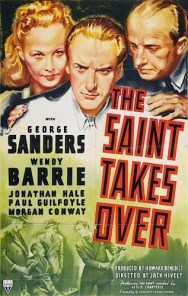 The first RKO Saint film to not be based on a story by the Saint’s creator, Leslie Charteris, is actually one of the better mysteries in the franchise. Sort of. The downside would be that the solution is glaringly obvious. For a mystery you might imagine that would be a major problem, but the process of investigating is nicely done. A bit more work might’ve been done to obscure the culprit, a character who we meet at the beginning and then more or less disappears and so will inevitably return somehow, but I had so much fun I don’t really care.
 One of the highlights of
 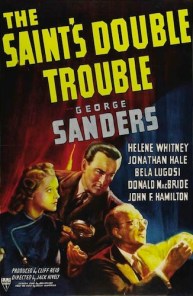 After two fun adventures, here RKO’s series turns in my least favourite film to star George Sanders as the Saint.
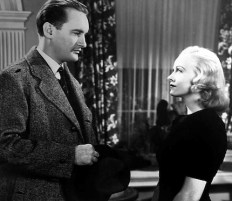 Helene Whitney is fine in this role, but her character’s not a patch on
 The third film in RKO’s Saint series is a bit of a mixed bag, from my point of view.
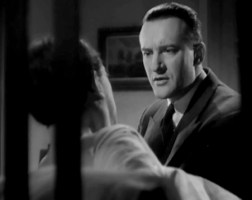 I bring up Bond again because this is perhaps the most proto-Bond of all the Saint films. Within the first few minutes we have a tuxedoed Saint introduce himself as “Templar, Simon Templar”, enter a fancy restaurant where he drinks a martini, and expertly orders a swish meal and the appropriate wine to go with it. Later, villain Bruno Lang (because yes, he is relevant in the end) is a somewhat Bondian villain, a powerful man with a grand plan who thinks he’s smarter than our hero. Which he isn’t, of course. Perhaps there was an abundance of these kind of heroes in the middle decades of the twentieth century, but as Bond is the only one that’s endured while retaining the same iconography, these similarities are striking.
 Best of all is Sally Gray as Penny Parker, a charming girl Templar bumps into — as he’s wont to do — who forcibly strings along for the ride. Every film in the series contains a pretty young thing who falls for the Saint, and who he seems to fall for back before casually disregarding at the end — at least Bond faded to black, leaving the inevitable parting off-screen, whereas Templar is almost callous-with-a-smile. Of all the girls the series offers, though, plucky Penny is the one you’d wish had stuck around. Even with that silly hat.
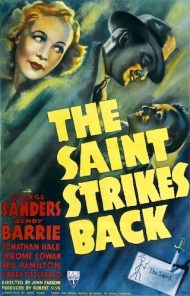 The first film to star the Roger Moore-ish George Sanders as Simon Templar, aka the titular Saint, is also one of the RKO series’ better entries.
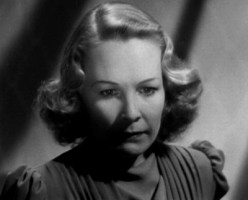 Nonetheless, it’s mostly a fun romp. Sanders’ portrayal of Templar is witty and enjoyably knowing, even more so than Louis Hayward in the previous film. He’s at once more laid-back and less self-certain; by which I mean you can sometimes see him working out his devilishly clever plans as he goes along, rather than floating through with invulnerability. This Saint is the kind of man who’ll bluff that a criminal’s house is surrounded by police so that he can escape, but then can’t resist phoning back to have a little gloat about how his bluff worked. Lighter, jokier — if Hayward was Sean Connery, Sanders is (as noted) Roger Moore. Though I’ve never seen
 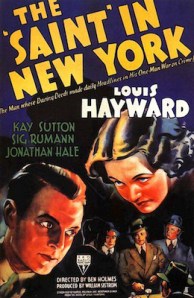 The Saint in New York is a B-movie in every sense of the term, but it’s certainly one of the fun kind.
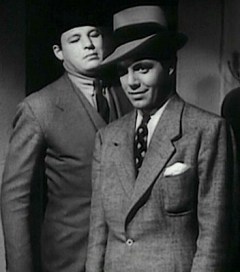 His habit of jumping into moving vehicles, much to the surprise of their drivers, is also fun. The other stand-out character is henchman Hymie, played by Paul Guilfoyle, who is enamoured of the Saint and constantly comments on his actions. Together they make the film a light, fun, amusing experience, with more memorable lines than a film of its stature deserves.
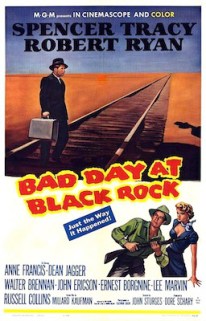 Bad Day at Black Rock comes with an air of the forgotten classic — or, at least, it did to me. I think that’s important to how I ultimately reacted to it. As is that wherever I first heard about it pitched it as a suspenseful mystery with a twist. I forget where that was now, but I remember consciously avoiding finding out the plot’s developments (more so than one naturally would anyway) before viewing.
 I missed the commentary. Indeed, in
  For a film so based in mystery and which has what I’d call a methodical pace (despite its short running time), there are surprisingly good action sequences to look out for: a car chase/battle along a thin path, a one-handed punch-up in a bar, and a climactic shoot-out that’s at its most tense once all the bullets have been fired. It’s not an action movie by any means, but these cinematic sequences stand out nonetheless.
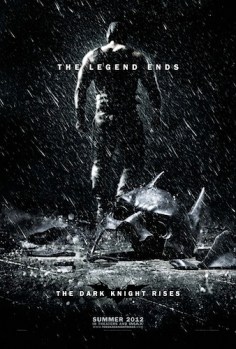 Everyone and their mother will be writing about The Dark Knight Rises over the next few days — I’m sure there’s already been an explosion in articles, blog posts and comments on both, not to mention various related terms trending on twitter almost constantly for most of the week already — so I figured I may as well add my voice to all the thousands shouting into the dark. But rather than a full review (which I’ll save for when things have quietened down a little, and perhaps there’s some kind of consensus or even just other reactions to respond too), here’s a couple of stray thoughts and paragraphs that immediately struck me.
 Remember when M. Night Shyamalan was the wunderkind of Hollywood? Seems so long ago, doesn’t it? But clearly someone somewhere is still invested in him — or he’s managed to limp on well enough that stuff he works on seems worth a punt — because a couple of years ago he was able to launch a series of films dubbed “The Night Chronicles”. I don’t remember the details and they’re not worth looking up, but as I recall the idea is they were a series of low-key/low-budget horror-thrillers conceived by Shyamalan (he has a Story and Producer credit here) but helmed by others. Devil is the first of these. I don’t recall a second turning up yet.
 not the best, but with enough action, intrigue and twists to fill its (admittedly very brief) running time. It comes to a head with a pretty good twist/reveal. Again, it’s kind of ironic that it’s the best twist in a Shyamalan film for years, but it comes in a movie he neither wrote nor directed. Maybe he should take another look at the kind of films he’s choosing to make. (I say “maybe”…)
 As an aside, in my occasional run of Comments Paying Too Much Attention To Certificates, it’s funny what Americans allow at what age rating. Here we have neck stabbing, hanging, creepy devil stuff… Seems a bit much for a PG-13, to me. The UK’s 15 is much more appropriate.
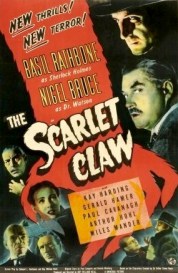 According to
  a properly chilling murder scene, quite out of step with the film’s age and PG certificate.
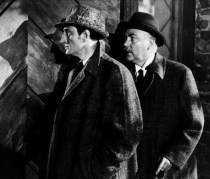 There’s also a hefty dose of coincidence that everyone involved, both on screen and off, conveniently ignores.
 100Films.co.uk