2012 #74
Rupert Wyatt | 145 mins | Blu-ray | 2.35:1 | USA / English | 12 / PG-13
 Prequels are far from a new concept (there are examples in ancient Greek literature; the OED dates the first use in print to 1958, though I swear I’ve heard mention of it being used even earlier), but in the past ten years or so they really seem to have come to prevalence in the movies. Perhaps we can trace this phenomenon back to The Phantom Menace, which saw massive hype and became the second highest grossing film of all time (it still resides in the top ten, albeit thanks to re-releases). In the years since we’ve seen any number of franchises go the prequel route, or in many cases what one might call a prequel-reboot (where we’re seeing the characters at an earlier point in their timeline, but it’s a reboot-style new ‘universe’). Since the mid ’00s we’ve had Batman Begins, Casino Royale, Hannibal Rising, Underworld: Rise of the Lycans, Star Trek, X-Men: First Class, The Thing, and Prometheus, with The Hobbit trilogy coming soon, not to mention cheapo direct-to-DVD ones for lesser wannabe-franchises.
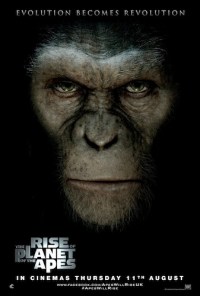
The obvious one I haven’t mentioned, of course, is Rise of the Planet of the Apes, last year’s prequel / prequel-reboot (there are nods to the 1968 original, though someone involved said it establishes a new continuity) of the perennially popular franchise Tim Burton killed last time they tried to restart it (infamously coining the phrase “re-imagining” in the process). That was ten years ago and, if extras on Rise‘s BD are to be believed, this relaunch came about not because of the usual studio-looking-to-exploit-a-recognisable-IP, but because a writer had a good idea. Perish the thought!
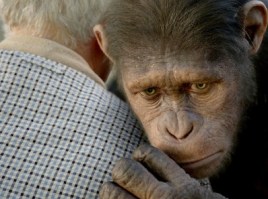 The screenwriters in question, Rick Jaffa and Amanda Silver (also producers), are due a lot of thanks for the quality of the final product. The story — about the son of a lab-tested chimpanzee, raised at home by a US scientist, who ultimately turns on humanity — was inspired by news stories of pet chimps attacking their owners, plus research into genetic modification. By taking these themes and issues and running with them, Jaffa and Silver have crafted a blockbuster that is both plausible and intelligent — a rare thing these days.
It’s also very well structured, for those that spot such technical things. It knows its own pace — not slow, but doesn’t rush to get to mass-audience-friendly action scenes either — but also, the layering of elements. There are numerous throwaway points that are picked up later; actions that have small significance but then return for bigger effect. None of this is played as over-emphasised “remember this for later” detail, as is often the case. Credit must also go to director Rupert Wyatt for his handling of these points. To put it succinctly, it’s just plain Good Writing.
Thematically it boils down to a man vs nature parable; about how we mistreat it, but also how we think we’re so far above it. Some of these themes may seem obvious, but they’re not overly spelt out — no one stands around bemoaning experimentation on animals, or lamenting man’s hubris in not taking the ape threat seriously enough.
 As with many prequels, the story itself may seem needless: we know where it ends up, and as various balls are put in play we can see their ultimate destination. But the important thing is that you can’t always see their trajectory, and as someone famous once said, sometimes the pleasure’s in the journey not the destination. Here we become invested in the characters, so we care about what will happen to them in the broader sweep of the Apes story, not to mention the intricacies of how things go from the opening status quo to the conclusion. Plus, with a prequel set so far before the original as this one is, one can always ponder the question of just how far they’ll go in this story (it doesn’t connect up to the start of Planet of the Apes, for instance).
The ape, Caesar, the Andy Serkis character you’ll surely have heard a lot of around the last Oscar race, is definitely the star of the film. As ever with all-CG characters based on an on-set performance, it’s nigh impossible to tell how much is Serkis and how much the undoubtedly talented animators at Weta. It’s even more prevalent for a role without dialogue. Great acting isn’t just about line delivery, obviously, but when you’re hidden beneath the post-production work of an entire team of CGI wizards, it would help. The ‘making of’ material in the special features helps enlighten Serkis’ key contribution some, but also reveals that for some bits other performers played Caesar. It’s no worse than a stunt double, I imagine, but it doesn’t necessarily help the cause of those desiring mo-cap actors get awards recognition. At the end of the day, the precise quality of his performance is a tough call. The film does a magnificent job of investing us in Caesar, making us really care about him, understand him, side with him over the human characters… but how much is that Serkis and how much the animators, the writers, the director?
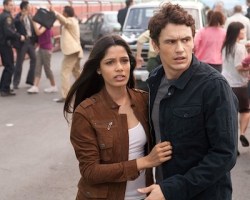 The rest of the cast are adequate but hardly register. James Franco is a solid lead but rarely called on to do much — Caesar is the protagonist, Franco’s human scientist just facilitates that. Frieda Pinto’s role is underwritten. Considering the film barely hits 100 minutes in an era when many blockbusters bloat to 140+, there’s room for her character to get a subplot objecting to the lab treatment of the apes. She’s awfully accepting of Franco’s line of work. As I noted though, perhaps they were trying to avoid being heavy-handed. Overall, John Lithgow is served best, his character slipping in and out of Alzheimer’s as Franco tries to develop a cure. It’s another in a line of recent fine supporting performances from him.
It’s a first Big Movie for Wyatt, having previously directed prison break thriller The Escapist, but he’s certainly up to the task. The dramatic scenes are handled with appropriate understatement, but there’s a flair to grander sequences — a single shot that shows Caesar ageing five years while climbing through trees is very well done, for instance. By contrast, his first three years commit the cardinal sin of screenwriting: a voiceover tells, not shows. But that’s a rare clunky moment. The final-act skirmish ultimately delivers on the customary blockbuster action front, offering a well choreographed and staged battle. This level of effort makes for an extended sequence that is infinitely more engrossing and exciting than any number of quick-cut close-up shakey-cam tussles of recent years.
I noted earlier that this doesn’t connect directly to the start of Planet of the Apes, and instead a sequel is well prepared for. There’s a satisfying climax and resolution to the main story, thankfully, 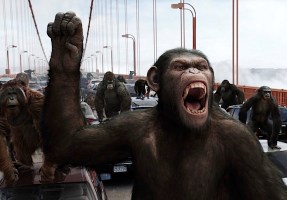 but there’s unquestionably still more that could come. There’s the newly intelligent apes, not yet ruling the planet; but also a mid-credit sequence that continues a significant subplot that’s clearly left hanging, closing the movie with a slight Part One-y tang. Still, I believe that if there wasn’t a sequel coming it would function satisfyingly as a standalone film.
But there is a sequel on its way (does that make it a sequel-prequel or a prequel-sequel?), and if this gang of filmmakers can pull off another intelligent sci-fi movie, with a continued broadly-plausible evolution of this story, then it will be one to look forward to.
Rise of the Planet of the Apes is on Sky Movies Premiere today, for the last time, at 10am and 8pm.
It placed 7th on my list of The Ten Best Films I Saw For the First Time in 2012, which can be read in full here.

 Following the surprise success of Taken, Liam Neeson again finds himself in action man mode as an American caught up in a Europe-set thriller. This time he’s some kind of scientist travelling to a conference with his wife, when he’s caught in a car accident. Managing to return to the hotel, he finds his wife doesn’t know him and there’s someone else who says they are him…
 Hitler (aka Bruno Ganz) and a cool exit; a really good car chase; and a couple of solid punch-ups, including a particularly good one at the climax.
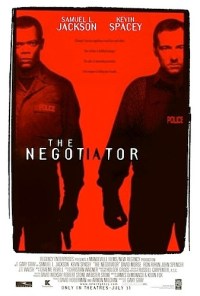 As premises go, “hostage negotiator turns hostage taker” is a doozy. You can immediately imagine all the drama to be had from pitting The Best Negotiator In The World (because it’s a movie — it’s going to be the best one that goes rogue, isn’t it) against The Second Best Negotiator In The World — he’ll know all the techniques! He’ll… well, mainly the techniques one. But also his colleagues will be working against him — will they be on his side? Or against him? It practically writes itself.
 but before that it sets up the characters and gets them on the bus, and the third act goes off-bus for a climax. Similarly, The Negotiator‘s first act gives us a day-in-the-life case for maverick negotiator Jackson, before putting him in his predicament; it toddles along, extending the hostage situation part with some tense and/or exciting sequences; and then the third act sees our hero set off to find the proof he needs.
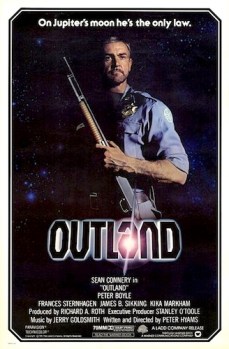 I first encountered Outland in a similar context to a lot of people, I think, based on reviews and whatnot I’ve read; that is, as “
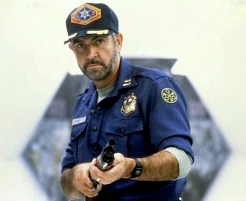 It works as well in space as it does anywhere else.
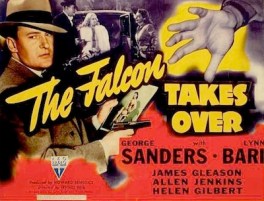 Quite outside of the Falcon film series, this third entry is notable for being the first screen adaptation of a Raymond Chandler novel. Ditching Chandler’s then-unknown Philip Marlowe in favour of the Falcon in the lead role, this is a version of the character’s second mystery, Farewell, My Lovely — which would be
  As usual, it doesn’t have the same je ne sais quoi that makes the Saint films particularly entertaining (yeah, you know I mean wit); and I can well believe it has “
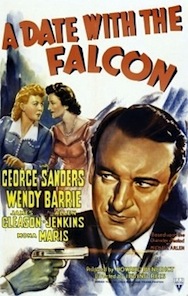 The second Falcon film sees George Sanders’ gentlemen detective investigate the disappearance of a scientist.
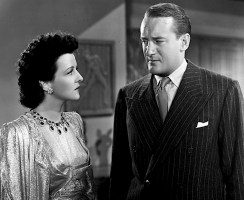 Anyway, aside from him there’s a ‘suicide’ bid and the crowd below’s reaction to it. Again it’s mostly comedy, but unlike some of the series’ DOA running gags it’s actually funny.
 A couple of years ago I discovered the ’40s Gothic noir thriller
  There are about three suspects in the entire tale. One is so clearly being set up from the off that you know it can’t be him; one barely even registers as a suspect; and it’s not the third one. But the film doesn’t pull off a twist because the attempt (by dragging that middle character back into it) comes so out of the blue as to make no sense. They don’t even bother to try to explain it properly! It’s about the only time the film holds back on painful over-exposition, and it’s about the only time it needs it. Either way, it’s not the same as the original film’s, and it’s not as good.
 The original story is clearly suited to a Gothic historical setting (the ’40s film didn’t keep the novel’s time period, but it chose one similar enough), but that doesn’t mean a modern-set rendition isn’t without potential. Or maybe it is — it’s hard to be certain from a movie that certainly doesn’t realise what potential there may be. Yet for all its countless weaknesses, I can’t quite bring myself to entirely despise it. Can I really give this wholly derivative remake 2 stars? It may be some kind of Stockholm Syndrome — after 90 minutes with it, I can’t help but find some point in it all; some thing to like.
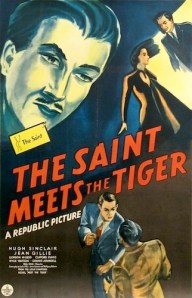 Produced in 1941 but not released until 1943, owing to Saint creator Leslie Charteris’ dispute with RKO over their new Falcon series (which is fairly unashamedly a rip-off of the successful Saint films), The Saint Meets the Tiger is a belated adaptation of Charteris’ first Saint tale, but was to be the series’ final film. Fortunately, it’s quite a good one.
 It still lacks the wit and light touch that make the Sanders films so entertaining, with only vague attempts at humour that generally raise little more than a smile. Sinclair doesn’t seem quite as wooden this time out, but he’s a straight-cut hero-type, not the kind of charmer this series really wants. In fact, one moment when he bursts into laughter, only to suddenly cut it short, is actually quite creepy. Perhaps he was trying to emulate Sanders more — the film does feel lighter than Vacation — but he still comes up short.
 The Saint’s gone on vacation indeed — with
  Apparently the villains are Nazis, though there’s absolutely nothing to suggest that here (again, that’s something I’ve since read online). The Saint knows both the villain and a Mysterious Woman of old, but it’s never explained how or why or what their relationships are. It’s like a set of stock adventure-story elements assembled without any understanding of how or why they should connect, which makes for an unsatisfying and unenthralling experience.
 The rest of the cast don’t offer much compensation. Arthur Macrae as the Saint’s cowardly friend Monty is no replacement for the parade of ex-cons he formerly hired as manservants, while Sally Gray of
 Tony Scott teams up with Denzel Washington for the fifth time to tell the (kinda) true story of a runaway train with the potential to cause massive destruction.
 are as stock as they come. Also look out for Kevin Dunn playing the kind of role (condescending middle-management ‘bad guy’) he always plays.
 100Films.co.uk