Preface
or: how I learned to stop worrying and post these damn reviews
(jump to Introduction)
My recent Week of the Living Dead has been the cause of a bit of personal reflection here at 100 Films Towers (I don’t know where I acquired a tower, but let’s just go with it). While I enjoyed all the films individually, I found the actual experience of watching one every night, reviewing it the next day, posting it that evening (you’d be surprised how much time I put into those photos), then repeat — times six — to be quite wearing. I know I didn’t have to do it — I could have delayed or spread out the viewing, and the same with the reviews, because it’s not as if anyone was depending or even anticipating them — but there’s an element of personal pride in setting out to do something and then doing it well… or if not well, then at least doing it right.
It’s a personal thing, too — I’m not one of those people who merrily watches a film every single day (or more, some people). I can barely stomach a double bill, unless it’s a not-very-long or single-story duology/trilogy watched back-to-back for good reason. That’s why watching 100 films in a year is a challenge to me. The fact I’ve not even managed it a third of the time attests to that. When I first started I got a few comments along the lines of, “but that’s only two a week? Not hard!” Well, clearly it is, so ner.
Anyway, one thing this means is I’m unlikely to attempt another Week of the Living Dead-style week of viewing and reviewing. I’ve managed them before (Silent Lubitsch; David Fincher), and part of the key is variety — for all that Romero pumps into his films, they’re still one zombie film after another; and I actually got a bit sick of silent films by the end of that Lubitsch week, so it’s not unprecedented. Watching one type of thing so intensively makes you want a change.
And that’s how we arrive at Bond. When the Bond 50 Blu-ray set came out, I set about watching them all from the start. The aim was one or two a week, then post reviews in decade-long clumps, in part to see the Bond films in a different way than sorted by actor (in reality, that’s not that great an idea: it’s the change of leading man that sparks changes in the series, not the change of decade; and actually, when you do cut it up by decade, you more or less get Connery in the ’60s, Moore in the ’70s and ’80s, Brosnan in the ’90s, and Craig in the ’00s, with only the odd scrap crossing over or other guy jumping in). This isn’t the first time I’ve tried it, but I always run out of steam at some point. I love Bond, but they get samey if you pack them too close together… and also, as we’ve seen, I’m just not cut out for that kind of scheduled viewing (I don’t even watch TV on schedule anymore — yay PVRs and iPlayer and box sets and piracy!)
But what I did manage during the viewing I did do was to write reviews; and because I happened to falter just before On Her Majesty’s Secret Service (no fault of that film, it’s one of my favourites), I have a neat Connery-shaped load to share. And because they’ve been sat on my hard drive for (in some cases) over a year now, I thought I’d share them. They were meant to be very short pieces that I’d share in one big long post (like, say, my Batman one), but they’re actually quite a bit longer and the whole thing seemed massively unwieldily (I think the Batman one’s awkward, and these reviews total about 1,000 words more), so I’ve separated them off.
With all that waffled through, let’s begin:
Introduction
Sean Connery was, of course, the first actor to play James Bond. Except he wasn’t: there was Barry Nelson on the telly (technically playing American agent Jimmy Bond), Bob Holness on the radio (in a live South African production), and stuntman Bob Simmons in the gun barrel opening sequence of the first Bond movie (the one pictured above is Connery, though). But Connery was the first to be noticed — and he really was noticed. With him as the star, what were a couple of relatively low-budget British spy movies somehow transformed into a global-box-office-dominating, decades-spanning, culture-influencing, mega-franchise. (It used to be the highest-grossing film series of all time. It’s been surpassed by the likes of Harry Potter now, but that will change: other series end, Bond keeps on going, probably forever.)
Connery starred in a total of five Bond films before he’d had enough… well, he starred in four before he’d had enough, but then he had to do a fifth anyway. He was recast, but when the new guy got too big for his boots, Connery was lured back… for one more film. Twelve years after that, he was lured back again, this time for an ‘unofficial’ rival Bond movie series… which managed one film.
Leaving those later returns to (possible) future reviews, here are the five initial Connery Bonds…
James Bond will return.

 Most action-thrillers are cast from the same mould; it’s the decoration which dictates whether the final product is a Steven Segal or a Jason Bourne.
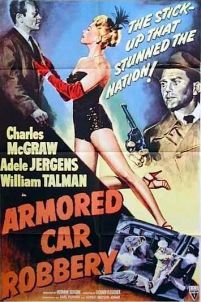 A B-picture from the middle of the classic film noir era, Armored Car Robbery is perhaps most notable today for being one of the first films directed by Richard Fleischer, who would later call the shots on




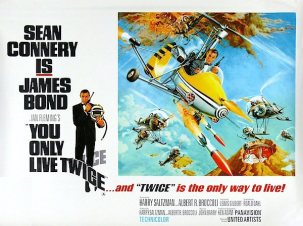 Everyone knows You Only Live Twice; if not from the film itself then from cliché and
  There’s that rooftop chase, where the camera just keeps pulling back and back and back to reveal the action. There’s Charles Gray’s cameo-sized but memorable role as MI6’s man in Japan, or Tetsuro Tamba’s loyal and capable Tiger Tanaka — why didn’t they bring him back? He’s better than any Leiter we’ve yet seen.
 There is, I think, a degree of consensus amongst Bond fans (both serious and casual) about a great number of things. Everyone has their personal favourites and dislikes that go against the norm, of course, but there are few things that are genuinely divisive on a large scale. It’s largely accepted that
  there’s an awful lot of grand, expensive-looking underwater stunt work; and it’s relatively long too, the first Bond to pass two hours (and, even in the nicest possible way, it feels it). Accompanying it was an array of merchandising that, at least as I understand it, wouldn’t be seen again for years (these days it’s par for the course, kicked off by
  but if you just accept a few of those, allow them to wash over you as it were, then it’s quite good fun. For all its flaws, it’s also packed with brilliant moments: the scene at the Kiss Kiss Club is arguably the best-directed bit in the series to date, and remains one of my favourite moments from any Bond; then there’s the jet pack, indeed the whole opening titles; almost any scene between Bond and one of the numerous females; “I think he got the point”; Domino’s (first) swimming costume… Um, where was I?
 It’s long been held as a truism that, though it’s the third film, Goldfinger really defined ‘the Bond formula’; and I’ve long argued against that, pointing to the elements that were ready-to-go in
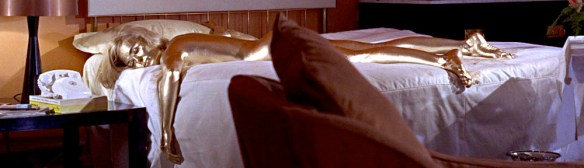
  However, I did also note that “those parts are mostly so excellent that its still a greatly entertaining film, and, I’m sure, not undeserving of the adulation lavished upon it by so many”, and that’s certainly true. You only have to list bits to bring back fond memories: the pre-titles (filled with multiple memorable moments, even if it’s completely unrelated to the rest of the story); the title song; the title sequence (by Robert Brownjohn, not Maurice Binder); the gold-painted girl; the gold game; Oddjob and the statue; the Q scene (despite Goldfinger’s Q-branch-tour being the archetype, it’s not repeated in a similar manner for decades); the gadget-laden car; the stunning Swiss locations; “no Mr Bond, I expect you to die”; Pussy Galore; the epic raid on Fort Knox; Oddjob and the electricity; the clock stopping at 007; Goldfinger being sucked out of the plane; hiding from rescue in the life raft… That’s quite a haul. Even the less feasible bits, like the cardboard-cut-out gangsters, have a certain charm.
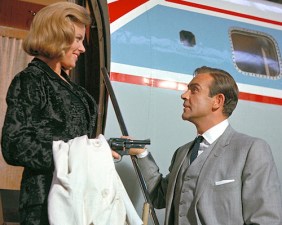 If you think about it too much then the plot is like a machine-gunned windscreen — spattered with holes. But they’re mostly minor niggles rather than glaring errors, and it’s more than covered by the fun you’re having. There are several films that would contend the top spot on my list of Favourite Bond Films and Goldfinger probably isn’t one of them, but that’s a personal thing and it’s surely destined for at least the top ten.
 If
If  She’s drugged so perhaps it’s not entirely uncalled for, especially by the era’s standards, but it still strikes the viewer. Plus he’s not throwing out puns at every opportunity, or quipping with every particularly notable dispatch of a villain, but instead tosses the odd line or even just glance. There’s a direct line between this and the Craig films, neither of which seemly hugely similar to the more comical Moore (or even Brosnan) era.
 directly from Dr. No to Goldfinger to hollowed out volcanoes in
 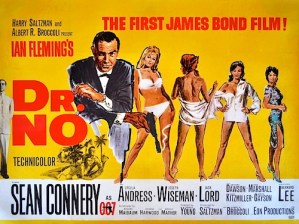 “Bond. James Bond.”
 Yet for that received wisdom about Goldfinger, ever so much of the familiar Bond recipe is here from the off: the gun barrel sequence, a dramatic pre-titles (albeit post-titles here), the music-driven silhouetted-girls-filled title sequence (even if they’re clothed here), Bond’s casual attitude towards women, his dry humour, his relationships with M and Moneypenny, his detective skills, his fighting skills, his driving skills, the megalomaniac villain, his extravagant lair, and of course the Bond girls — indeed, for all of the fame of Goldfinger’s gold-covered beauty on the bed, Honey emerging from the ocean is still the most iconic Bond girl of them all. And I imagine there’s more I’ve neglected to include.
 Plus, freed from the need to constantly Do Bond-Like Things, we get some solid detective work from our hero, rather than just turning up and saving the day. To put it another way, there’s a mystery and a story, not just a series of set pieces.
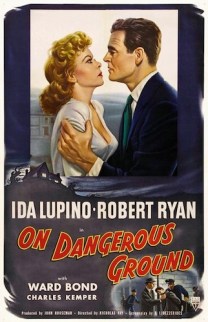 Helmed by acclaimed director Nicholas Ray (
 On the plus side, Bernard Herrmann’s score is unequivocally excellent, particularly the pulsating opening theme and the insistent action climax.
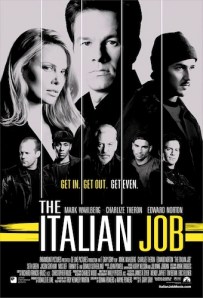 This came in for quite a bit of stick on release — how dare they re-make a British classic, etc etc. It didn’t help matters that one of the stars, Edward Norton, was apparently forced to appear against his will as part of his contract with the studio.
 and while Edward Norton’s performance is hardly remarkable, it doesn’t smack too much of being phoned in.
 100Films.co.uk