aka Moriarty
2014 #106
Albert Parker | 85 mins | streaming | 1.33:1 | USA / silent (English)
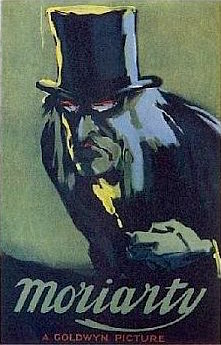 American actor William Gillette was the most iconic portrayer of Sherlock Holmes on stage, penning his own play (with permission from Conan Doyle) that he performed 1,300 times between 1899 and 1923. It was filmed in 1916, a feature long thought lost but announced as found in October 2014 (and to be released on disc by Flicker Alley this coming October — expect a review eventually). Before then, the only thing approaching a filmed record of that iconic interpretation of the Great Detective was this: a 1922 remake starring John Barrymore as the famed sleuth, originally released in the UK as Moriarty (possibly for legal reasons, possibly (according to David Stuart Davies in Holmes of the Movies) due to “the mediocrity of so many of the earlier Holmes films”).
This film was also considered lost, until elements were discovered in the ’70s — not the film itself, but original negatives “in which every take — not every sequence, but every take — were jumbled out of order” (as per William K. Everson’s programme notes for the Theodore Huff Memorial Film Society, via Wikipedia). These were painstakingly reassembled into something resembling the original film, although around 26 minutes are still missing. Nonetheless, the film remains completely followable: nothing important to our comprehension is missing, with some storytelling rough edges the only vague sign that anything may be amiss.
Said story diverges from the canon so much it’s liable to give any particularly canon-focused Sherlockians a conniption. It begins in Cambridge, with what many reviews call a “prologue”, usually preceded by an adjective such as “overlong”. I think it would be more accurate to describe it as the first act. There, a student, Prince Alexis (Reginald Denny), third in line to the throne of somewhere-or-other-in-Europe, has been accused of stealing from the university, but he claims innocence. His friend John Watson (Roland Young) recommends he seeks the assistance of a chap in his year, one Sherlock Holmes (Barrymore). 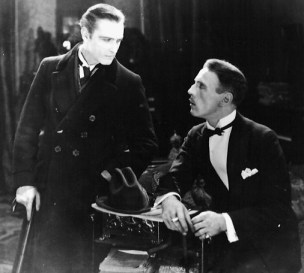 Yes, shades of 1985’s Young Sherlock Holmes. I’m sure you’ll be surprised to learn there are fewer CGI stained glass window knights here, though.
Holmes quickly uncovers the real culprit, another student by the name of Forman Wells (the screen debut of William “The Thin Man” Powell, looking ever so young). However, Wells is acting under duress, forced to commit the theft by Moriarty (Gustav von Seyffertitz), an obviously evil-looking fellow who sits at the centre of a spider’s web of criminal activity. Holmes confronts Moriarty in Wells’ stead, to little effect, the criminal genius swatting the student away as one would a fly. Undeterred, our young sleuth commits to stopping Moriarty as his life’s very purpose.
That and finding a girl he saw once and instantly fell in love with.
Meanwhile, Prince Alexis is informed that his two brothers have died in a car accident, making him heir to the throne, and so he can no longer marry Rose Faulkner, a British commoner he’d been courting. Rose is the sister of Alice Faulkner (Carol Dempster), who just so happens to be the girl Sherlock fell for. When she learns of the split, Rose commits suicide.
And that’s just the so-called prologue. I’m loath to explain the whole plot of a movie, but the tale spun here is actually somewhat intricate. Personally, I thought it was quite a good yarn. It’s flawed in the telling — it’s not particularly Holmesian, and there are far too many overlong title cards (Everson calls it “one of the ‘talkiest’ silents”) — but I don’t hold with criticisms that it’s slow paced, or that the lack of any real mystery is a problem. Sherlock Holmes tales are remembered as “detective stories” because that was his profession, 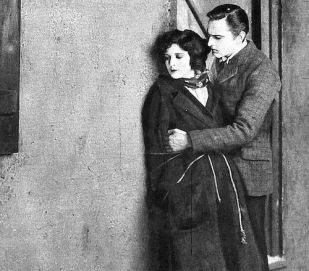 and in many respects they led to the abundance of crime-solving fiction that fills bookstores and TV schedules to this day, but there’s a reason most of Conan Doyle’s stories are prefixed with “The Adventure of” rather than “The Fiendishly Difficult to Solve Mystery of”.
Anyway, after the Cambridge to-do the film jumps forward some years, to find Holmes a respected detective residing at 221 Baker Street (I guess he also acquired 221a and knocked through or something). Moriarty has still eluded him, but the revival of some matters from his student days are about to change that. Turns out Alice has in her possession some letters from Alexis to Rose, which she intends to publish to ruin him in revenge for her sister’s death. Goodness knows what’s in these letters; the ’20s equivalent of sexting, presumably. Alexis attempts to hire Holmes to retrieve the letters, but Holmes isn’t particularly inclined to do so because he rather agrees with the position of the love of his life (not that he’s seen her since that one time they bumped into each other years earlier). However, Moriarty also wants the letters, in order to blackmail Alexis, so Holmes takes the case so as to get closer to his nemesis.
You’ll notice a lack of Watson in most of this outline. He’s rather sidelined, unfortunately. Some would prefer this to the comical treatment he suffered at the hands of Nigel Bruce, but your mileage may vary. I think Watson’s often one of the most undervalued characters in literature, a very capable fellow who’s usually overshadowed by his grandstanding friend. There’s nothing wrong with Young’s performance, there’s just not much of it.
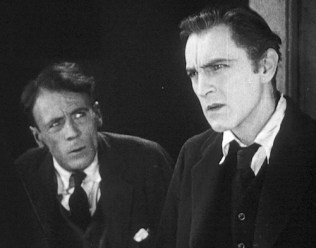 Barrymore makes for a solid, if perhaps unremarkable, Holmes. He has the right look for the role, and makes good use of the same staring-contemplatively-into-the-distance furrowed-brow expression that Basil Rathbone would employ a couple of decades later. He has down the precociousness of student Holmes, which develops into a kind of righteousness when older. He’s not as stand-offish and borderline unlikeable as some interpretations of the character, nor as affable as others. As I say, he sits in the middle, doing nothing wrong but not getting a chance to mark himself out either.
The thing that does go terribly wrong, however, is the romantic subplot. Even if you set aside that such palaver doesn’t fit with the traditional Holmes character, this version is unconvincingly handled. Not only has Holmes apparently spent years pining after a girl he met once (it’s unclear why the Great Detective hasn’t been able to find her in all that time), but when he does meet her there’s no chemistry whatsoever. According to Fritzi at Movies Silently in her review, we should attribute the fault here to Dempster. I see no reason to disagree. Apparently Barrymore so disliked his co-star that he refused to perform the final scene with her, which would certainly explain the none-too-subtle way the actress’ face goes unseen at that point.
Young Mr Powell probably gets the best part, in particular a scene in a cab on the way to Moriarty’s lair where we learn his tragic backstory.  He crops up in the years-later narrative too, used by Holmes to go undercover in the house where Alice is being held hostage by some of Moriarty’s many villainous associates. A major part of Holmes’ plan hinges on him turning up at these villains’ house, telling them what to do, and them obeying him. That this method succeeds is not due to Holmes’ considerable skill, but more due to the screenwriters’ lack of it.
Von Seyffertitz gives a very good Moriarty, though does err on the side of OTT. In part this is his look: I thought they had perhaps gone a little far with the make-up, turning him almost into a caricature of a villain, but having Googled the actor I think that it may mainly be his face… Still, what a perfect face for playing villains! Naming the film after him for the UK isn’t wholly inappropriate, especially as his role is expanded from Gillette’s play (the prologue confrontation being the main addition) and one of the throughlines is Holmes’ focus on apprehending him. It would certainly differentiate it from all of the other films called simply Sherlock Holmes.
The 1922 version isn’t the best film to bear that moniker, but nor is it the worst. I don’t think it’s a great interpretation of Holmes, but I found it to be a pretty entertaining adventure in its own right. I’d even quite like to see the plot rejigged (and the holes ironed out) to make it more truly Holmesian. Even having enjoyed the film, I must say how entertainingly dismissive I found Everson’s notes: he thinks that “one of the most painstaking recovery jobs ever […] quite overshadows the fact that the film itself 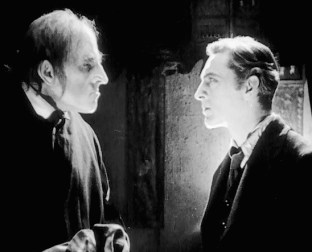 hardly seems worth such devotion except on a purely academic level.” He goes on to say that “it must be one of the blandest misuses of potentially exciting material ever,” that “it literally has no highlights,” that it “has no pictorial style of its own,” that Barrymore “clearly lends his profile to Holmes, and not much more,” that “if it is a major find, it is also a major disappointment.” Ooh, burn. (The whole thing is worth a read.)
Now, with the discovery of the Gillette film, one wonders if this Sherlock Holmes is destined to become even more of a curio than it already is. It’s not wholly undeserving of such a fate: it’s not bad and I found it solidly entertaining, but one for Barrymore fans and Holmes completists only.
Sherlock Holmes, aka Moriarty, is available on YouTube here.
This review is part of The Barrymore Trilogy Blogathon. Be sure to check out the many other fantastic contributions collated by host In the Good Old Days of Classic Hollywood.

 Louis Leterrier, helmer of the Clash of the Titans remake everyone would rather forget and the Marvel Cinematic Universe movie everyone does forget, directs this magic-inspired thriller — a film all about misdirection that pretty successfully pulls off one of its own.
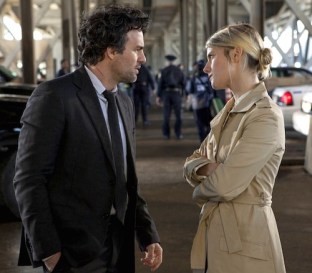 Their criticisms aren’t wholly unfounded: the characters are thin; at times it’s unclear which side we’re meant to be following or most invested in; the use of CGI in the magic somewhat undermines it; a good deal of the plot stretches credibility. Conversely, the credibility is questionable from very early on, so the counterargument goes that it’s the whole MO of the film — you don’t complain about Iron Man not being possible in real life, do you?
 Such a style certainly fits the magic world. I guess it’s just not to everyone’s taste.

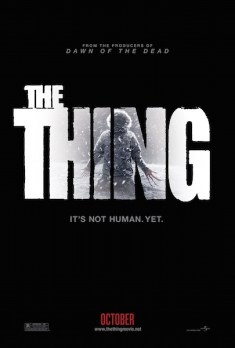 At some point during the process of remaking John Carpenter’s seminal 1982 sci-fi/horror
  Of course, it isn’t as good. There are many reasons for this, one of which is the fact that, because they haven’t just remade the other film, every homage/rip-off they come up with is inferior. So the blood testing scene from the ’82 film is replaced by shining a torch in someone’s mouth to see if they have fillings. God help you if you’ve taken care of your dental hygiene. The climax is typically overblown — this isn’t a spoiler, I’m preparing you if you’ve not seen it: the survivors venture into the alien’s spacecraft to stop it taking off. Some people get a kick out of getting to see inside the ship, and I suppose you could say that at least the remake-makers are trying to offer something new. Unfortunately, new is exactly what it’s not. The Thing is a bizarre creature, growing and morphing and warping in disgusting ways — what strange kind of spaceship would it call home? A bog-standard metal-corridors kind of one, apparently. The lack of imagination is staggering.
 The other element the making-of material is keen to underline is just how much effort was put in to make sure this ties back to its predecessor. Essentially, they looked at what was revealed about the Norwegian base in Carpenter’s film and used that to reverse engineer the events that had to occur in this film. However, the final result could’ve made some of these connections more explicit. For example, we don’t see when the guy who slit his throat performs that act. The moment is actually included among the disc’s deleted scenes, but why did they cut it?! The movie’s final scene, which directly links the two films, is intercut with the end credits — why?! It comes across as apologetic, like they’d rather it wasn’t there but feel it has to be. Either put the scene in the film proper, or put it as an after-credits easter egg for die hard fans; the halfway-house used in the final cut is just messy. If someone’s argument was, “casual viewers will find those linking scenes meaningless”, then watch your own movie! The helicopter being away for refuelling is referenced earlier in the film; Joel Edgerton’s character says they didn’t kill Lars but never says what they did do with him; and the last time we see Colin he’s alive (until a single shot of his frozen corpse, that is). To put it another way: they’ve done a bang-up job of making those things matter within the film itself, as well as in the context of linking up to the ’82 film, so why were they deleted or included only as an embarrassed afterthought?
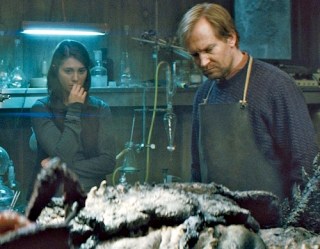 Or maybe they wouldn’t, because The Thing 2011 is a lesser film than the original. It does still offer some suitably gross effects work, albeit lessened by it being obvious CGI rather than gruesomely physical constructions, but there are still some resultantly tense sequences. Heck, it’s the first film in I-don’t-know-how-long that actually made me jump, once. Some viewers complain that there’s no “who might be an alien?”-type tension because the characters aren’t well-drawn enough, but I had that problem with Carpenter’s film too.
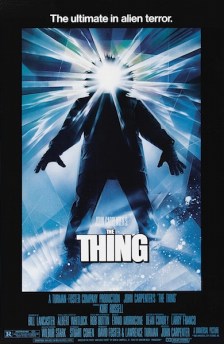 It’s just an ordinary day at the US Antarctic research base staffed by helicopter pilot MacReady (Kurt Russell) and his compatriots, until a helicopter buzzes overhead dropping grenades on a dog it’s pursued across the ice fields. The dog finds sanctuary in the US base; the helicopter and its crew are less fortunate. Realising it’s from a Norwegian facility an hour’s flight away, MacReady and the doctor brave inclement conditions to investigate. They find numerous corpses and the base burnt to ruins. What horrors befell the Norwegian base? And have they inadvertently brought them into their own…?
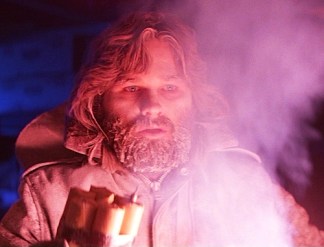 Even if you don’t want to get deep about it, The Thing has the “who’s human?” thrills to keep you engaged on that level. Accusations of boredom no doubt stem from the fact it’s a bit of a slow burn, the early acts building suspicion and unease as MacReady and co investigate. Even after the true nature of the threat is revealed, Carpenter paces himself, though the frequency of incidents begins to mount inexorably as we head towards the climax. Well, that’s just good structure.
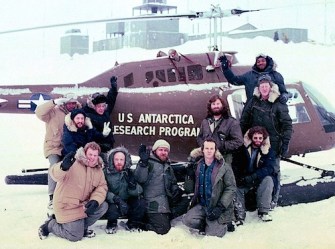 For me, it’s the psychological quandaries that are gripping and exciting, rather than any enjoyed disgust at the emetic special effects. However, knowing the characters a little better — thus caring if they’d been replaced or not, and also perhaps allowing us a chance to try to guess for ourselves — would have just made it that bit superior.
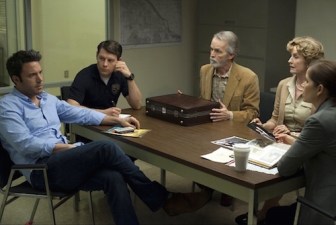
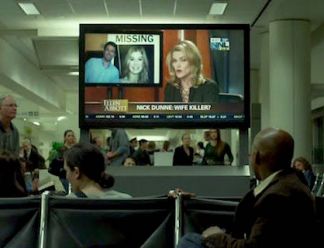
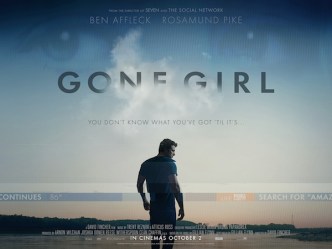 “Horrible people do horrible things to each other” is the Post-it Note summary of this dark drama-thriller from director David Fincher, adapted by screenwriter Gillian Flynn from her own novel, which is short on heroes and overloaded with villains. An alternative brief summation is, “modern society is shit.”
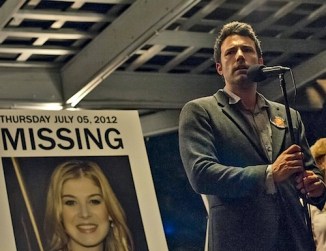 However, that opinion may stem from the same point as my view on the more praise-filled reactions: that Gone Girl is not a film as great as
  This is an argument for which I have a lot of time. The majority of Fincher’s filmography is made up of policiers and thrillers of one form or another, and even when he breaks out of that mould — in The Social Network, for instance — he often brings a similar perspective and toolset. Many of these films are borderline-rote, heavily-generic schedule-fillers at screenplay level, and would have been just that in the hands of a lesser director; in the hands of a master filmmaker, however, they become genre-transcending classics. I think that same sentence could be said about most (all?) of Hitchcock’s best films.
 Is it for the masses, too? Maybe. In his
  a lesser actress could’ve given a performance with fewer notes and the film still would’ve functioned; or they would have struggled to contain the numerous sides to Amy’s personality in the form of a plausible human being. Pike does that, and more. She goes on my list of “people who were robbed of an Oscar because it was someone else’s ‘time’” (alongside Paul Greengrass’
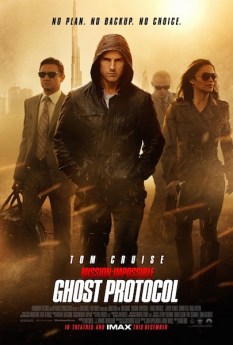 With Bond going “real world” and gadget-free in the Daniel Craig era, and the Bourne series having blazed a trail of “we shot it all handheld and shaky and grainy so it must be real” veracity, it seems the task of providing audiences with a contemporary version of the spy action, just-ahead-of-reality gadgets, and larger-than-life spectacle that the Bond movies specialised in during the ’60s and ’70s, has fallen upon the Mission: Impossible franchise. For my money, it’s taken the baton with aplomb.
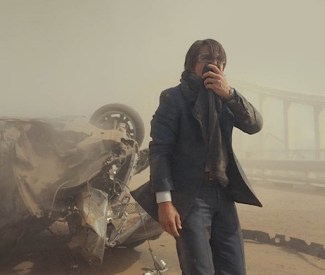 Somewhat unfortunately for pacing, they come halfway through. The climax is a mano-a-mano fight in an automated car park. It’s good, but feels underwhelming by comparison, with Michael “
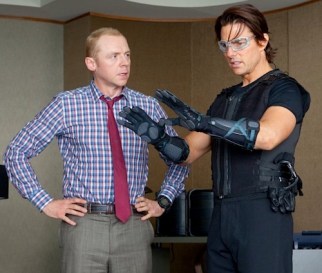 There’s a host of other gadgets to be going on with, though. It may be a side effect of having the writer-director of
  Still, that’s a fault of the home entertainment release, not the film itself. In all other respects, Bird’s work is first-rate. I like that the series consciously changes director with each new film to provide new ideas and voices, but if they were going to break the pattern then Bird would’ve been a good guy to allow back (certainly a superior pick than the third film’s J.J. Abrams, anyway, who was originally slated to tackle this sequel too).
 Jerry (Ryan Reynolds) is a nice guy living in the small town of Milton, working in shipping at Milton Fixtures and Fawcetts, where he fancies the English girl in accounts, Fiona (Gemma Arterton), and doesn’t notice how much another girl in accounts, Lisa (Anna Kendrick), likes him. He also talks to his dog, Bosco, and cat, Mr Whiskers, and they talk back. That’s why his psychiatrist (Jacki Weaver) encourages him to take his medication, but he doesn’t. When he accidentally murders Fiona (as you do), it’s Mr Whiskers that encourages him to cover up the crime.
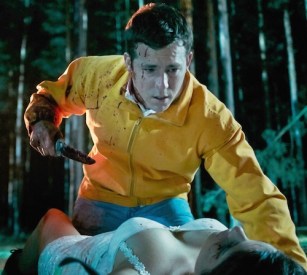 what happened in his past to make him this way (flashbacks and hints are scattered, leading to an eventual reveal), and how will it all end for him? We’re conflicted here, because he’s a nice guy who we like, but he’s also a murderer, in horrific fashion, and so surely justice is due. Screenwriter Michael R. Perry and director Marjane Satrapi (of
 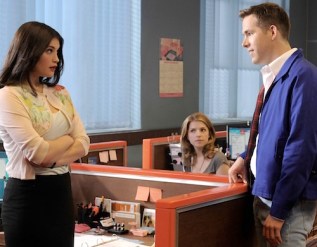 Able support comes in the form of three women in Jerry’s life. Gemma Arterton has a ball, first as a bit of a bitch, then as a ludicrously-chipper super-English talking head. Anna Kendrick, meanwhile, is sweet and likeable, and while we may be on Jerry’ side when he accidentally slides his knife into Fiona, we’re keen for him not to make the same mistake with Lisa. Whether he does or not is where the real battle for his sanity lies. The third is Jacki Weaver’s psychiatrist, who is central to the climax but also has the least to do of all three, really. Never mind.
 The Voices is the kind of film you say is “not for everyone”, which are often the best kind if they are for you. For me, it wasn’t quite funny enough — I’d’ve liked more of the dog and cat, who get the lion’s share of the best material. I also felt that Jerry’s backstory, the reasons for why he is how he is and does what he does, weren’t explored quite enough. The Blu-ray’s deleted scenes hint at more of this, particularly with an alternate climax, which was perhaps cut because there was too little material specifically building up to it. Rather than losing that ending, it would’ve been better to keep it and find more scenes that contributed to it.
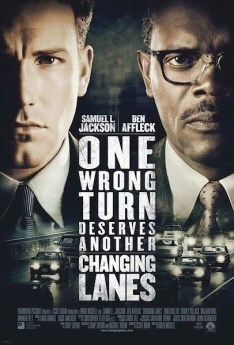 Hot-shot lawyer Ben Affleck and down-on-his-luck Samuel L. Jackson are involved in what Americans like to assonantly call a fender bender, making the latter miss a custody hearing and the former lose an important document worth millions… which Jackson happens to pick up. Cue a game of tit-for-tat retaliation, as Affleck tries to recover the file by ruining Jackson’s life further, and an increasingly-desperate Jackson enacts increasingly-violent revenge.
 I don’t know why they bothered). The worst offender is David Arnold’s score — all turn-of-the-millennium club-y electronic-drum-kit-y beats, for a character-driven drama/thriller? Ugh.
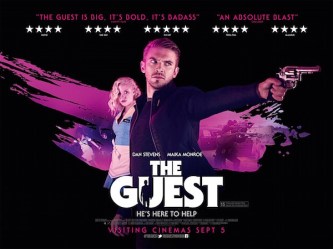 The writing-directing team behind
  The days of chubby Matthew Crawley long since banished, a buff Dan Stevens (there’s a reason his topless scene was also all over the marketing) is entirely convincing as the seemingly-nice-but-possibly-creepy army man who inveigles his way into the Petersons’ lives with pure charm before gradually revealing, both to them and (especially) us, that there’s a lot more to him than a nice guy who happened to kill people in the Middle East. For my money, he’s the best anti-hero in a long time. Occasional flashes of dry humour — a line here, a look there — make him likeable to the audience, more than the charm that persuades the other characters does, so that by the final act we’re still pretty much on his side, whatever else happens.
 but I know I’m not the only reviewer to feel it. Wingard evokes that era and the feel of those movies, without slipping into parody and without merely ripping-off familiar flicks. I think this especially comes to the fore in the final act — it’s arguably even most distilled in the very final scene — but, again, it’s a feeling, a sensation, a familiarity, not a blatant, I dunno, “look, now we’re in the ’80s!”-ness.
 Not everyone loves it — some people outright hate it, even. I suppose it’s a little bit idiosyncratic, in a similar way to something like
 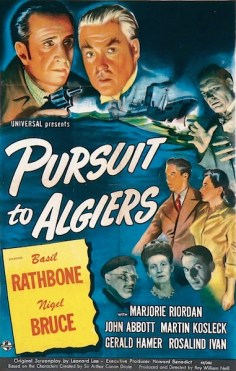 After a fun opening where Holmes and Watson have to solve the world’s most obvious riddle (naturally, Watson is completely oblivious to there even being a riddle), the original dynamic duo are tasked with escorting the heir to the throne of somewhere-or-other back to his homeland, thwarting assassination attempts as they go.
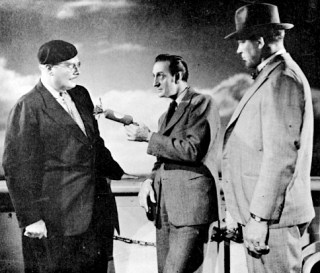 each of which he thwarts last-minute in sometimes amusing fashion. That’s not fundamentally a poor premise for an adventure comedy, I don’t think, but it doesn’t work for Sherlock Holmes. I mean, if you’re trying to prevent someone from being assassinated, why would you let the assassins carry on?! A last-minute twist reveals a sort of motivation, but it’s not a particularly convincing one in my book.
 100Films.co.uk