Country: USA
Language: English
Runtime: 107 minutes
BBFC: 15
MPAA: PG-13

Original Release: 6th August 1999 (USA)
UK Release: 5th November 1999
First Seen: DVD, c.2000
Stars
Bruce Willis (Pulp Fiction, Sin City)
Haley Joel Osment (Bogus, A.I. Artificial Intelligence)
Toni Collette (Muriel’s Wedding, Little Miss Sunshine)
Olivia Williams (Rushmore, The Ghost)
Director
M. Night Shyamalan (Unbreakable, Signs)
Screenwriter
M. Night Shyamalan (Wide Awake, The Village)
The Story
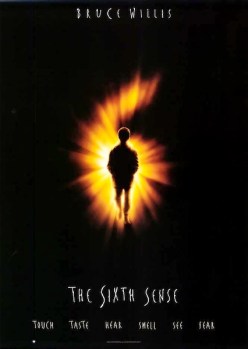
Child psychiatrist Dr Malcolm Crowe tries to help a new patient, Cole Sear, who claims he can see ghosts.
Our Heroes
Dr Malcolm Crowe doubts his abilities to help people after a former patient shot him before committing suicide, an event which has also left him distanced from his wife. But he may be the only person who’ll believe young Cole Sear, a reclusive child who’s struggling with delusions of seeing dead people… unless they’re not delusions…
Our Villains
Are the dead dangerous, or do they just need help?
Best Supporting Character
Cole’s mom, Lynn, who loves him a great deal and worries about him just as much, but has no idea what’s really wrong or how to help her son.
Memorable Quote
“I see dead people… Walking around like regular people. They don’t see each other. They only see what they want to see. They don’t know they’re dead.” — Cole
Memorable Scene
Stuck in traffic, Cole reveals his ability to his mother for the first time — that there’s been an accident ahead and someone died, which he knows because they’re stood at his window. Naturally Lynn doesn’t believe her son, but then he begins to talk about his grandmother…
Technical Wizardry
The twist ending is immaculately constructed. There are clues throughout the film, but, like all the best twist-ending clues, the vast majority of viewers will completely miss them first time through, even though they seem almost blatant when revisited.
Making of
The colour red is used only to indicate times and items where the worlds of the living and the dead have connected; if something red was present in a scene where this wasn’t relevant, Shyamalan had it changed. There’s a massive list of these moments here, but if you somehow haven’t seen The Sixth Sense yet, do beware of spoilers.
Next time…
There are no actual sequels to The Sixth Sense, but it kicked off M. Night Shyamalan as a kind of one-man genre, making supernatural thrillers with a twist ending — and decreasing critical acclaim with each new movie. It seemed to end with The Happening and he transitioned to be a director-for-hire, but he’s coming back somewhat with The Visit and next year’s Split.
Awards
6 Oscar nominations (Picture, Supporting Actor (Haley Joel Osment), Supporting Actress (Toni Collette), Director, Original Screenplay, Editing)
4 BAFTA nominations (Film, Director, Original Screenplay, Editing)
2 Saturn Awards (Horror Film, Performance by a Younger Actor/Actress (Haley Joel Osment))
2 Saturn nominations (Actor (Bruce Willis), Writer)
2 Teen Choice Awards (Choice Drama, Choice Breakout Performance (Haley Joel Osment))
1 Teen Choice nomination (Choice Sleazebag (Trevor Morgan))
Nominated for the Hugo for Best Dramatic Presentation
What the Critics Said
“the film eventually abandons the heroic-therapist model and ventures toward other ground, ever so gently tightening its squeeze. It seems really to achieve something that Stanley Kubrick was possibly groping after in Eyes Wide Shut, or that Nicolas Roeg achieved in Don’t Look Now, which might be called an extreme sense of the bizarre, not as invented by special-effects wizards with unlimited space on the hard drive but in the subtler ways of film craftsmanship. […] The movie is a maximum creep-out. It’s invasive. It’s like an enema to the soul as it probes the ways of death – some especially grotesque in a family setting. You leave slightly asquirm. You know it will linger. It becomes a clammy, chilly movie building toward a revelation that you cannot predict. As I say: I cannot tell you. You’d hate me if I did. I can only say, don’t look now, but look sometime.” — Stephen Hunter, Washington Post
 Score:
 85%
85%What the Public Say
“The film is rich in symbolism, and colour plays a large part in signifying spirits invading the real world. This is what makes The Sixth Sense so captivating. Watching the film for the first time, you don’t expect the ending, and so the shock of it tends to overshadow the subtlety of the beginning. It is only once you have re-watched the film, that you begin to notice little suggestions of what is to come. A success from start to end, this is at once an exercise in potent suspense, and a carefully crafted tale of child psychology.” — Cat Barnard, Screen Muse

M. Night Shyamalan gets such a bad rep these days, it’s easy to forget how great his breakthrough movie was. It flew completely under the radar back in 1999: the guy at Disney who bought the screenplay was fired for doing so without permission; Bruce Willis starred in it because he owed Disney two films, and was paid half his normal salary; Entertainment Weekly’s extensive summer preview detailed over 140 films, but The Sixth Sense wasn’t even mentioned. By coming out of the blue, and in an era before the internet was dominant (these days there’d be plot dissections and spoiler-filled director interviews online by the Monday after release, wouldn’t there?), the film obviously had surprise on its side, which is particularly effective when it has such a memorable twist. But even before that ending, it manages to mix plausible emotional drama with scenes of chilling everyday horror, crafting something that is undoubtedly a genre movie but also not out of place in a list of Best Picture nominees.

The Sixth Sense is on Film4 tomorrow night at 1am.
#86 will do… whatever a spider can.
 The directorial debut of uber-hearththrob movie star Ryan Gosling is not what you might expect someone of that particular adulation to produce. It’s not just that it has a dark heart, but that it’s slow, opaque, perverted, and not easily summarisable.
 It comes to a very cathartic ending, on multiple levels. I almost didn’t realise I needed that catharsis at the end — I knew I wanted certain characters to get their comeuppance, but the load that seems to lift at the end, with all the different climaxes combined, including parts that might not seem ‘good’… well, it’s almost like Rat is right about Bones’ actions lifting a bad spell.

 The director of minor horror
 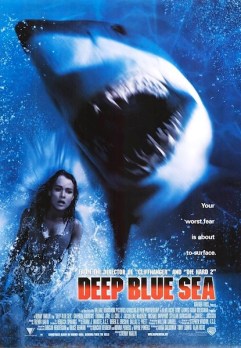 Deep Blue Sea is Terence Davies’ adaptation of Terence Rattigan’s play about the wife of a judge getting caught in a self-destructive love affair with an RAF pilot.

 Sometimes you have to wait to see a film because it’s not accessible for some reason (no one’s put it out yet, or it’s out of print and costs a fortune, or whatever). Other times… maybe it’s just me, but there are some films that I wait years to watch for no particular reason. Not wait in the sense of “drumming my fingers waiting for the chance”, but in the sense that I’ll get to it someday, it’s just not a priority, for whatever reason. And then one day, with nothing apparently having changed, the time comes when it’s that movie’s turn.
 If you’re a reader from outside the UK, I guess you’ve probably not heard of Tim Peake. He’s (quite rightly) been big news here for the last year or so because he was our first (official) astronaut. That it’s taken until now for there to be a British astronaut seems remarkable, but there you go. I guess we always let other people do the initial exploring, then come along later to own the place — I mean, that Columbus fella was Italian, and is Italian the official language of America? No it is not. Anyway, Peake is a qualified helicopter pilot and instructor, has a degree in Flight Dynamics and Evaluation, was selected to be an astronaut in a process that involved academic tests, fitness assessments, and several interviews, and then received six years of training, including a mission as an aquanaut, before he went into space. But no, you can totally train a group of drillers to do that in a fortnight.
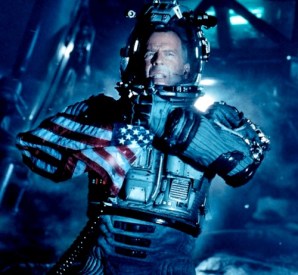 Apparently Michael Bay thinks it’s his worst film. In 2013, he said, “I will apologise for Armageddon, because we had to do the whole movie in 16 weeks. It was a massive undertaking. That was not fair to the movie. I would redo the entire third act if I could.” The problems stretch further than that, Michael.
 Maybe I’m wrong — it has a lower rating on IMDb. But then, that is IMDb. I should probably watch it again, but even without doing that I feel pretty confident saying it’s the better film.
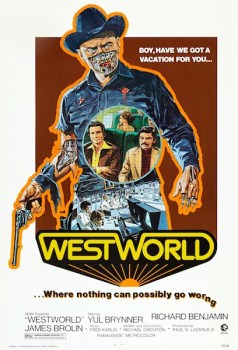 When writer-director Michael Crichton hit upon the notion of a theme park where the future-science star attractions broke free of their shackles and endangered the lives of the guests, it was so good it served him twice: he replaced the initial murderous AI-powered robot cowboys with rampaging genetically-engineered dinosaurs and sparked
 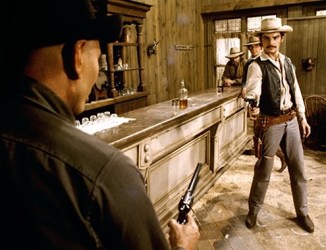 under $76,000, or about £58,200. The potential threat of the robots malfunctioning is built up gradually here and there, in asides from what our ostensible heroes are up to, and isn’t explained. There are nods to the fact the human staff don’t actually know how the robots work, but why should that be? Some of them were apparently designed by other robots, but how did the designing robots come about? Rather than explore any of its science fiction themes, the film just uses the basic idea to have the robots go on a killing spree right at the climax. This is something Crichton definitely turned around for
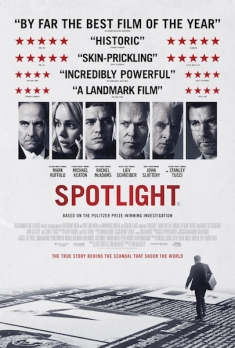 The most recent Best Picture Oscar winner tells of how the Boston Globe’s investigative journalism unit, the eponymous Spotlight team, exposed the widespread sexual abuse of children by the local Catholic Church — and, just as shockingly, the way the institution itself swept this under a rug for decades. As a film, this story is effectively a conspiracy thriller: a team of journalists expose a wide-reaching criminal cover-up within a respected and powerful institution. If it were fiction, you’d struggle to believe it, the scale of the conspiracy so vast that the very notion of it would be implausible. So it’s all the more astonishing — and horrifying — that it was real. And, as the closing title cards reveal, far larger than the Spotlight team realised even when they went to print.
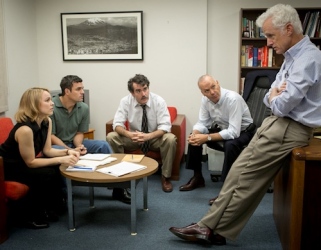 Instead, it lets the story and the events speak for themselves, with the screenplay being the real powerhouse here. On that scale the directing isn’t even in second place. That’d be the performances, as the actors carry the delivery of information while still feeling like human beings pursuing an investigation, rather than mere narrators of what they discovered. McCarthy’s work is therefore the kind of helmsmanship that wouldn’t attract awards attention, except maybe by association with the film’s overall acclaim (he did get nominations, but the cynical side of me doubts awards bodies genuinely appreciated the qualities of what they were watching). Nonetheless, awards are not the be-all-and-end-all, and the low-impact style was surely the right way to go. This is a tale bigger than auteurist showboating, and McCarthy handles it with appropriate respect.
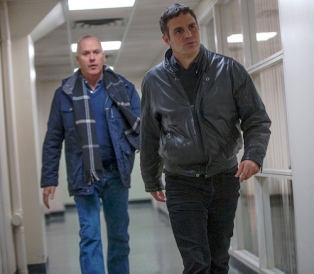 this is also perhaps where the film’s only egregious bum note comes in: Ruffalo’s shouty speech about how they need to go to press now, which was naturally used across all the trailers and clips. It feels like that is precisely what that speech was designed for — that it was written, directed, and acted with the “here’s our big dramatic trailer moment” in mind. It’s not entirely out of character in context, but it is a bit much.
 So was it the best film of last year? Perhaps that depends what you look for in movies. As much as I think the understatement fits, I also think it’s what stops it from being as cinematically exciting as, say, the visually-driven hyper-kinetic storytelling of
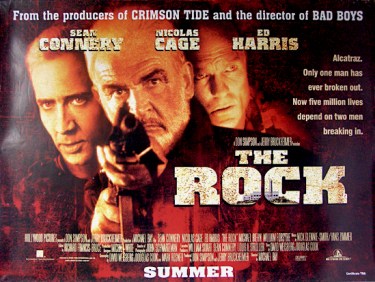
 Believing the mission lost, the military has launched its back-up plan: an airstrike that will destroy the poison gas but also kill everyone on the island. Naturally our heroes manage to complete their mission nonetheless, and as the jets streak across San Francisco Bay, Stanley attempts to signal abort with two green flares. In slow motion, of course.



 100Films.co.uk