The Hunt for Red October (1990)

The 100 Films Guide to…

The Hunt for Red October

The hunt is on.

Country: USA
Language: English & Russian
Runtime: 135 minutes
BBFC: PG
MPAA: PG

Original Release: 2nd March 1990 (USA)
UK Release: 20th April 1990
Budget: $30 million
Worldwide Gross: $200.5 million

Stars
Sean Connery (Goldfinger, The Rock)
Alec Baldwin (Beetlejuice, The Shadow)
Scott Glenn (The Right Stuff, The Bourne Ultimatum)
Sam Neill (Omen III: The Final Conflict, Jurassic Park)
James Earl Jones (Star Wars, The Lion King)

Director
John McTiernan (Die Hard, The Thomas Crown Affair)

Screenwriters
Larry Ferguson (Highlander, Alien³)
Donald Stewart (Missing, Patriot Games)

Based on
The Hunt for Red October, a novel by Tom Clancy, the first to star Jack Ryan.


The Story
After the USSR launches a new type of submarine with an almost undetectable engine, its veteran captain, Marko Ramius, ignores his orders and heads for the US. As the Russians hunt for him and the Americans try to intercept him, one question is on both sides’ minds: is Ramius intending to defect or start a war?

Our Hero
CIA analyst Jack Ryan is something of an expert on Ramius, and the main voice insisting the Russian intends to defect. With just days to prove his theory, the normally desk-bound Ryan must venture out into the field — the “field” in this case being the stormy waters of the Atlantic Ocean.

Our Villain
Submarine captain Marko Ramius, a hero in the USSR who trained most of their fleet, has been entrusted with their latest top-secret vessel, the Red October… but what is he intending to do with it? If Ryan’s right, he’s not such a villain after all.

Best Supporting Character
Commander Bart Mancuso is the captain of the US submarine USS Dallas, the first to encounter the Red October and, thanks to its genius sonar technician, the only one able to track it. Scott Glenn’s performance was based on a real sub captain the cast spent time with, Thomas B. Fargo, whose friendly but authoritative manner and relationship with his crew inspired Glenn.

Memorable Quote
“‘Ryan, some things in here don’t react well to bullets.’ Yeah, like me. I don’t react well to bullets.” — Jack Ryan

Memorable Scene
As the Red October navigates an underwater pass only traversable thanks to detailed maps and precise timings, the silent engine fails, forcing them to engage the regular motors — which attracts the attention of the Soviets hunting them. With a torpedo on their trail, Ramius takes the precarious navigation into his own hands…

Technical Wizardry
With much of the action taking place in the cramped confines of various submarines (the Red October, the USS Dallas, and another Soviet sub, the V.K. Konovalov), cinematographer Jan de Bont realised they would need a way for viewers to quickly determine which submarine they were on, especially when cutting between action on multiple vessels. He decide to subtly vary the colour of the lighting on each sub — blue for Red October, red for the Dallas, and green for the Konovalov — so that they would be distinguishable without belabouring the point. It works: while watching the film, it’s never confusing which sub we’re supposed to be on.

Truly Special Effect
Apparently director John McTiernan wanted to realise the underwater action with CGI, until ILM pointed out it was nowhere near that advanced yet. Instead, most of the underwater shots are models — and not shot underwater, but in a smoke-filled warehouse. They look fantastic, with small CG additions (like plankton or the wake of propellers) helping to sell the visuals. On the downside, some of the pre-digital compositing is now really showing its age — Alec Baldwin’s hair is see-through in the final shot!

Next time…
With the film a huge success, naturally more Jack Ryan adaptations followed. Technically the first two, Patriot Games and Clear and Present Danger, are sequels to Red October, but with Alec Baldwin busy the lead role was recast with Harrison Ford, so it feels more like the series starts over. For no apparent reason a fourth film in the series didn’t materialise, and so the series genuinely started over a decade later, with Ben Affleck playing a younger Ryan in The Sum of All Fears. That wasn’t a success, leading them to try again another decade later, with Chris Pine playing an even fresher Ryan in Jack Ryan: Shadow Recruit. That wasn’t a success either, which has led them down the path of adapting the character for television, with John Krasinski playing another young Ryan in Amazon’s Jack Ryan.

Awards
1 Oscar (Sound Effects Editing)
2 Oscar nominations (Sound, Editing)
3 BAFTA nominations (Actor (Sean Connery), Production Design, Sound)

Verdict

Everything ages: Tom Clancy’s debut novel was credited with helping start the techno-thriller genre in the ’80s, which I guess made this film adaptation cutting-edge when it followed shortly afterwards. Now, it’s the best part of 30 years old and, even if it’s not exactly looking dated, it certainly doesn’t look current — they don’t make big-budget spy thrillers like this anymore. But maybe they should, because Red October’s qualities stand the test of time: its story is driven by well-drawn, interesting characters (the committed everyman hero; the moral enemy submarine commander; and so on) and an overall sense of suspense (who will find the sub first? And how soon? And what will they do then?), rather than elaborate stunts or computer-generated effects. I like the latter too, but there’s room for variety in the cinematic landscape. Well, at least we’ll always have minor classics like this to watch again and again.

The latest screen iteration of Tom Clancy’s hero can be seen in the TV series Jack Ryan, available to stream on Amazon Prime from today.

Seoul Station (2016)

aka Seoulyeok

2018 #184
Yeon Sang-ho | 92 mins | streaming (HD) | 1.85:1 | South Korea / Korean | 15

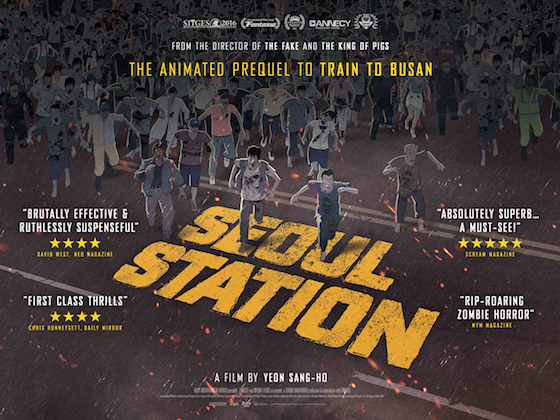
Seoul Station

Before he made zombie masterpiece Train to Busan, director Yeon Sang-ho was an animation director with several features to his name. So perhaps it’s not surprising that, to accompany his aforementioned live-action debut, he also helmed this animated prequel.

Apparently set one day before the events of Busan (there’s no obvious indication on screen of how the films’ timelines line up), Seoul Station depicts events as the zombie outbreak expands at the titular transportation hub. Through this we follow Hye-sun (Shim Eun-kyung), a young runaway struggling to make ends meet living with her good-for-nothing boyfriend, Ki-woong (Lee Joon). Hye-sun’s father, Suk-gyu (Ryu Seung-ryong), has finally tracked her down, but arrives just after his daughter and Ki-woong have an argument and she runs off — and then the zombie thing happens. As Hye-sun struggles to escape the undead hordes, Ki-woong and Suk-gyu team up to search for her.

Like Train to Busan, then, Seoul Station revolves around a struggling father-daughter relationship — though this one’s of a very different sort. That’s apparent from the off, but to say too much more would be a last-act spoiler. Suffice to say, it all comes to a very dark, grim ending, with none of the redemption or hopefulness of the main film. It also continues the live-actioner’s theme of other humans being the real villains, with the actions of selfish cowards being as much a threat to survival as the flesh-eating monsters. It feels like Yeon is being critical of Korean culture, taking potshots at the treatment of the homeless, the uselessness of the police, and more. Most of that stuff plays universally, mind, but the film hardly connects with it in a meaningful way. For example, we see one homeless guy struggle to get help for his injured and dying brother, as person after person either refuses help or begrudgingly does the least they can. “They should do more,” the film implies. But if they had, what would change? In this scenario, nothing — the guy’s been infected by zombie-disease; they’d all wind up undead too and it would spread faster.

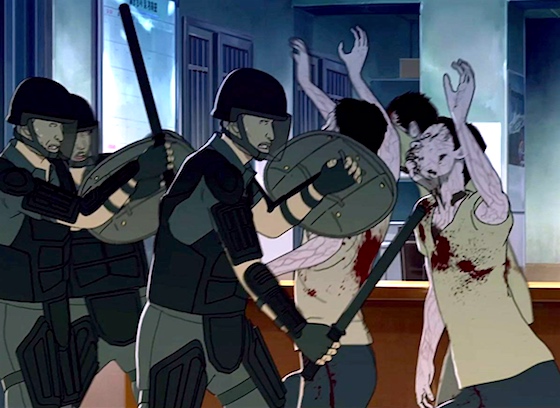
Police brutality

Half-assed social commentary aside, there are some really neat, original ideas in here, like a scene where Hye-sun must hold her nerve as she precariously tightrope-walks across the empty shell of a building, while behind her the mindless zombies throw themselves off the building onto the structure, their lack of dexterity leading most of them to plummet straight through it… but not all of them. Plus, as alluded above, there’s at least one solid twist. On the down side, it’s a bit slow — it takes 20 minutes for the zombie outbreak to start, for no particularly good reason; and though it mostly picks up after that, it occasionally loses focus again. The animation is of variable quality, too: some of it is very good, but at other times it feels kind of floaty, and there’s a very bizarre motion-blur effect applied to character movement.

Unlike Train to Busan, Seoul Station can’t quite coalesce its good ideas into anything more meaningful than a zombie thriller. Plus, the ultimate grimness of the finale feels almost mean-spirited and cruel rather than pointed. It’s not a bad zombie flick by any means, but there’s an even better movie waiting to be refined out of its best ideas, and so it’s not as transcendentally great as its live-action forebear.

3 out of 5

The UK TV premiere of Seoul Station is on Film4 tonight at 11:15pm.

A Quiet Place (2018)

2018 #177
John Krasinski | 90 mins | download (UHD) | 2.39:1 | USA / American Sign Language & English | 15 / PG-13

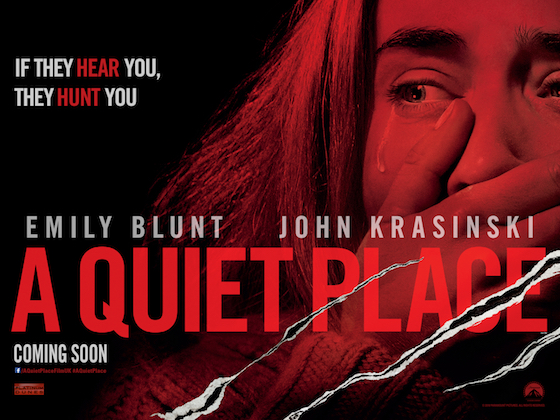
A Quiet Place

Not, in fact, the directorial debut of John Krasinski (aka Jim from the US remake of The Office, aka Mr Emily Blunt, aka Jack Ryan Mk.V later this month), but the first one that’s really gained any attention (to the tune of a sizeable $332.6 million off a budget of just $17 million), A Quiet Place is a post-apocalypse survival movie cum horror thriller. In the near future, the human race has been seemingly decimated by a race of aliens that hunt via sound. The film introduces us to a family — parents Emily Blunt and John Krasinski, kids Millicent Simmonds, Noah Jupe, and Cade Woodward — who have managed to survive by living on an isolated farm and communicating via sign language, which they’re fortunate to know thanks to a deaf daughter. Naturally, their carefully-constructed safety is threatened when Something Goes Wrong and the creatures are attracted to the farm.

A Quiet Place’s USP is the “must stay quiet” aspect, which reportedly led to less chatter and popcorn-munching during cinema screenings. If only all moviegoing experiences were so blessed. Of course, a similar conceit was only recently deployed in Don’t Breathe, but here the threat level is upped by the almost supernatural enemy. The film’s PG-13 rating in the US means it occasionally pulls its punches on going all-out terrifying, but, as the UK 15 certificate may indicate, it’s still loaded with sequences of tension and suspense.

Fingers on lips!

Some have questioned the film’s adherence to its own rules, or the practicalities of the characters’ decisions, or the ‘luck’ of them having a deaf child and so being able to communicate via sign language. I don’t hold much truck with any of those criticisms. In the latter case, is it not logical that those who already know non-verbal communication have an advantage when it comes to silent survival? Maybe everyone who didn’t know sign language just got killed already. In the first, I think the film sticks closely enough to its conceit: small or disguised noises can go unnoticed, but anything big or obviously human is going to attract attention. Besides, there are only two or three of the creatures in the area — even with their super-hearing, surely some stuff is going to pass them by.

The issue with the characters’ decisions perhaps comes down to the fact that the film leaves a lot unsaid (ho-ho) when it comes to their relationships and thought processes. Big events and the emotional fallout have occurred offscreen, leaving the family in the position we follow them for most of the film. Those viewers demanding 100% foolproof logic from every aspect of the movie are clearly left out in the cold by the lack of exposition, but more creative minds can fill in the blanks. Arguably it leaves the film wanting as a character drama, even as it strives for the kind of subtly and understatedness that is usually lauded in such a genre.

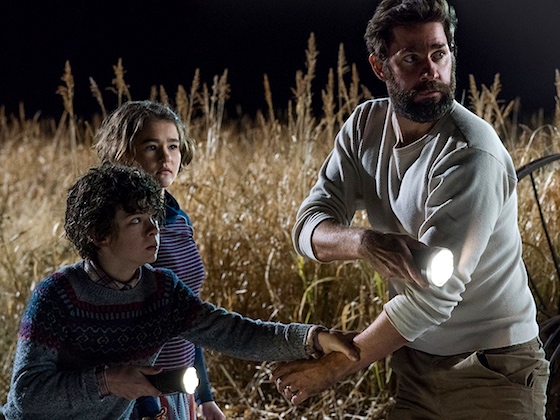
The family that stays together fights sound-hunting aliens together

But, really, it’s a horror-thriller, designed to have you biting your nails and on the edge of your seat as you wonder where the monster will spring from next and whether the characters can survive the assault. As a genre piece of that kind, half the running time is the film’s climax, and it’s an effective one at that.

4 out of 5

A Quiet Place is released on DVD, Blu-ray and UHD in the UK this week.

Train to Busan (2016)

aka Busanhaeng

2017 #140
Yeon Sang-ho | 118 mins | streaming (HD) | 1.85:1 | South Korea / Korean | 15

Train to Busan

Zombie movies have really risen to prominence this decade, for whatever reason (the success of The Walking Dead is an obvious culprit, though it would seem to have begun slightly before that, with Zombieland coming out in 2009, for example). You’d think that would result in the subgenre feeling played out, and there are certainly plenty of lesser efforts churned out, but films like the exceptional Train to Busan show there’s still quality to be found.

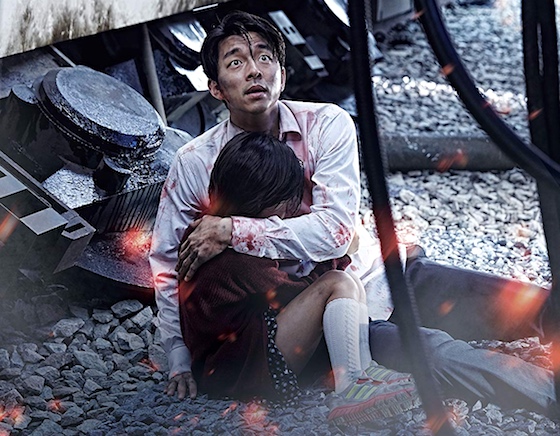
The film centres on Seok-woo (Gong Yoo), a fund manager living in Seoul with his young daughter, Soo-an (Kim Su-an). Seok-woo’s work-focused attitude has left his relationship with his daughter strained and distant, so he acquiesces when she requests to visit her mother in Busan. As they board the train — alongside other passengers that represent a cross-section of society, natch — a zombie apocalypse breaks out. Initially safe in their carriage, the passengers must hope they can make it to safety.

The family that fights zombies together...

As you might expect, the mismatched group of passengers fall prey as much to their own infighting and prejudices as they do to the zombie hordes, and the situation works wonders for the father-daughter relationship of the lead characters. Despite that apparent predictability, co-writer/director Sang-ho Yeon and his cast earn our sympathies and create an attachment to these characters, such that we’re along for the journey with them. Whether or not you guess the letter of the plot is beside the point if you feel it along with the characters — when you’re on edge to see if they can make it, upset by their failures, and cheered by their victories. This also contributes to some effective suspense sequences, and the film is also peppered with intense, pulse-racing action scenes that have been impressively mounted. World War Z may’ve seemed to corner the market for “zombie movie as action epic”, but there are sequences here that give it a run for its money.

Train to Busan shunts aside any tiredness you may feel about zombie flicks to demonstrate that, however overdone a genre may seem, there’s almost always room for fresh voices and creativity to produce remarkable work.

5 out of 5

Train to Busan placed 14th on my list of The 17 Best Films I Saw For the First Time in 2017, which can be read in full here.

And that completes the reviews of my 2017 viewing (at last!)

Mission: Impossible – Fallout (2018)

2018 #164
Christopher McQuarrie | 147 mins | cinema | 2.39:1 | USA & Hong Kong / English & French | 12A / PG-13

Mission: Impossible - Fallout

You can keep your Infinity Wars and your Incredibles 2sthis is the movie I’m most hyped for in 2018. I’ve been looking forward to it ever since it was announced we’d be getting another impossible mission from writer-director Christopher McQuarrie, who knocked it out of the park with the superb Rogue Nation. Anticipation only intensified with the fantastic trailers (that first one, scored to a Lalo Schifrined-up version of Imagine Dragons’ Friction, is a work of art in itself), and reached fever pitch with the influx of super-positive reviews in the past couple of weeks. Living up to the hype began to seem like an impossible mission all of its own.

Well, if there’s one thing Ethan Hunt and his IMF teammates can pull off, it’s… a rubber mask. But if there’s another, it’s the impossible — and how!

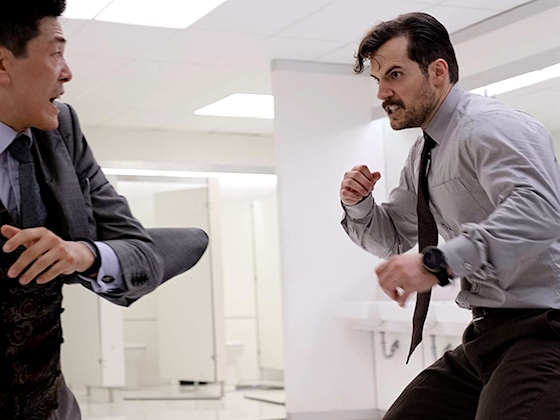
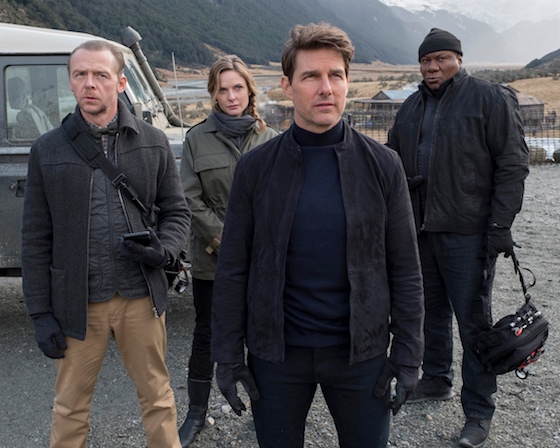
Two years after the events of Rogue Nation, Hunt (Tom Cruise, obv.) and his regular sidekicks Benji Dunn (Simon Pegg) and Luther Stickell (Ving Rhames) are after three stolen plutonium cores that could be used to make nuclear bombs. They must stop them falling into the hands of The Apostles, a radical group seeking to execute the manifesto of John Lark, a shadowy figure the intelligence services have been unable to identify, who seeks to bring about a seismic change in the world order. When the IMF’s attempt to acquire the plutonium goes sideways, Hunt is assigned a CIA minder, August Walker (Henry Cavill), with orders to let nothing get in his way of finding The Apostles — including Hunt.

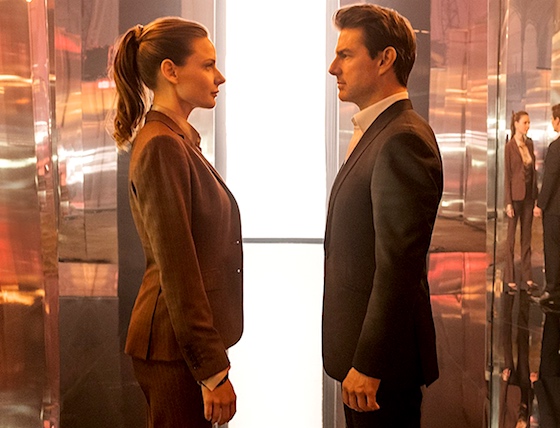
From there, we’re heading into proper spoiler territory (I already rewrote that last paragraph to avoid giving away an early twist. You’re welcome, readers). However, as the trailers have already revealed, the storyline brings back into action the last film’s antagonist, Solomon Lane (Sean Harris), as well as Ilsa Faust (Rebecca Ferguson), the MI6 agent whose allegiances were constantly under question in Rogue Nation. She was ultimately confirmed to be on the side of good, but was supposed to be leaving the game. Why is she back? And whose side is she on now?

Faust-Ethan pact (that's a pun, FYI)

The plot that mixes all of this together gets… complicated. In some respects there’s a clear throughline from one action set piece to the next, but in others it can leave you reeling as it rockets from twist to reveal to counter-twist to counter-reveal. Mostly I think you have to go with the flow and accept whatever’s happening in the moment — if you start to think about the bigger picture (how people knew what when, and how they planned for this, that, and the other), it’ll make your head spin. Naturally, I was trying to do the latter, and got completely lost at one point in the middle when there’s an assault of back-and-forth twists about who has the upper hand. Again, if you just accept it and go with it, it’s fine, but try and unpick the logic of the whole thing in the moment and, well, you’ll be so busy thinking that you’ll probably miss another twist. Personally, I have a lot of faith in McQuarrie as a screenwriter, and I have no doubt the whole thing does make sense (or enough of it, at any rate), but he’s too busy racing along to let the film stop and allow you to confirm it for yourself.

Fiddly plots are nothing new to the Mission franchise, of course: the very first one was (and often still is) criticised for having a story that’s more impossible to follow than a typical IMF mission is to execute. What is new to Fallout’s story is that it’s a sequel. Obviously, there are four other Mission: Impossible sequels, but they’re all standalone movies really. With the return of Lane and Faust, plus some of the baggage they had with them, a lot of Fallout spins out of Rogue Nation — it’s unquestionably a direct sequel. And, once again without wanting to get spoilery (though, again, this is partially given away in the trailers), it also picks up on hanging threads from movies even further back in the series. In this respect it’s a great film for certified Mission fans: there are a number of payoffs and answers to questions that are only still thought about by such devotees; but it’s also done in such a way that it never obstructs the fun for casual viewers. That goes for the whole sequel thing: although the storyline is grounded in the events of Rogue Nation, Fallout gives you enough info that you could watch it as a standalone.

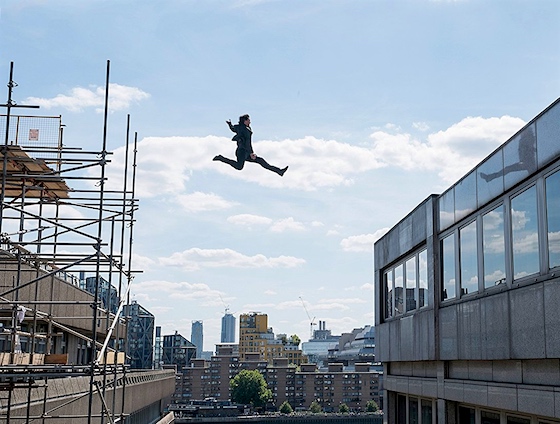
Long walk off a short aeroplane

Talking of Rogue Nation, about 24 hours before seeing Fallout I listened to Empire’s legendary three-hour Rogue Nation spoiler podcast, in which McQuarrie talks a lot about the writing process of a Mission movie, and what he learned about that during Rogue Nation. With his observations fresh in my mind, it shed an interesting light on Fallout — how and why it was doing certain things, as well as about when it chose to do them. Perhaps that’s why I was able to spot some of the reveals and stuff, because I knew the (self-imposed) rules McQuarrie was playing by. But there are some fascinating contrasts, too. For one not-really-spoilery example (because I’m going to talk about literally the first scene of the movie now), in the podcast he talks about how Mission films have to begin with a burst of action — no plot, no story, just straight into an action scene. It’s partly about giving the audience an instant thrill, but it’s more about letting them settle into watching the movie before you throw important information at them. But Fallout does literally the opposite: the first scene sees Hunt receive one of the series’ famous briefings (delivered, as always, in a completely different manner to how we’ve seen it done before), and that, as it’s precisely designed to do, delivers a massive infodump of plot. Now, how much of it you need to take in I’m not sure — various bits are explained again later as they become pertinent — but it certainly implies you should be paying attention. I’m in no way criticising this (I really liked everything in the pre-titles), it’s just an interesting contrast to how McQuarrie said things ‘needed’ to be done last time.

Another thing from the podcast: one rule they set themselves on Rogue Nation, which ended up being a massive thorn in their side, was that there had to be constant escalating tension, meaning the film had to end with the biggest action sequence of all. This was a self-imposed rule, but they struggled with it for ages before they finally realised it just wasn’t what the story demanded, which was when they alighted on the ending that saw Hunt outsmart Lane rather than engage in a massive action scene with him. Clearly McQuarrie came into Fallout more prepared, however, because while there are big stunts and action scenes throughout the film, the finale is the largest, most complicated, most dynamic, and most impressive sequence of the lot.

Watch that ankle...

And so we’ve come to the real point of the movie; the thing the trailers and posters and behind-the-scenes videos have all sold it on: the action sequences. Simply, they’re incredible. Cruise’s dedication to giving the audience something new and exciting and awe-inspiring to watch is second to none. He spent literally years preparing for this film, learning to fly a helicopter and perform HALO skydives. That’s him flying the helicopter. That’s him jumping out of a plane. That’s him doing all sorts of other stuff too, like riding against traffic on a speeding motorbike, or jumping across rooftops, or falling off the side of a mountain. The only effects work here is for the odd spot of safety-rig removal or, I presume, one or two moments that would be impossible to achieve safely in real life. And this dedication has paid off: it’s so much more thrilling when you know this has all been performed for real than it is to watch some pixels or someone on a green screen. Those kinds of effects have their place in other movies, and can provide a thrill within the context of the story, but they nonetheless lack the tangibility that doing it for real provides, and the knowledge it’s a genuine feat you’re watching adds a whole extra thrill of its own.

In filmmaking terms, McQuarrie does all he can to match Cruise’s drive to entertain us with his daring — not by being daring himself, but by showing off Cruise’s efforts in the best way possible. McQuarrie favours going without score for the action scenes, letting the sounds of revving engines, squealing brakes, thumping punches, and all kinds of crunching and smashing and thudding, be the only music you need. The tension and excitement comes purely from the physical feats on display, plus the camerawork and editing that showcase them. It works like a charm. I’ve seen music-less action sequences in the past where you feel the absence on the soundtrack; like something more is required. Early on in Fallout, I noticed the absence of music during these scenes only because I was aware McQuarrie favoured it that way, and because of how much it wasn’t needed. But by the end of the film, I was too hooked to care — I honestly can’t tell you if Fallout’s big finale sequence has music or not, because it grabs the attention so thoroughly that I’d just stopped being aware.

Arms fully loaded

Of course, other parts of the movie do have a score, provided by Lorne Balfe. Thanks to where it’s been applied, much of it is atmospheric rather than the pulse-racing theatrics you expect of an action movie score, though he makes nice use of Lalo Schifrin’s original themes — both the main one and The Plan — to provide grace notes where required. Plus there’s the big title sequence to really show off that iconic main number — and, like Rogue Nation, we’re treated to it twice. At my screening the houselights came up and people started walking out during the second one, which kind of bugged me — it’s not just names scrolling, it’s part of the movie, McQuarrie using it as a kind of final hurrah to send you away with (just as he did in Rogue Nation — he’s repeating the ‘trick’ because it works so damn well). Personally I prefer Joe Kraemer’s rendition of the title theme from last time, but Balfe’s is a worthy alternative.

Also new to the franchise is cinematographer Rob Hardy, who’s delivered some gorgeous photography here. Not in a showy way, but there’s a richness to some shots, plus consistently great choices of angles and camera moves. The entire thing is about forward momentum — from set piece to set piece to set piece — and that’s conveyed by the way the camera moves, too. Even, for example, when cars drive up to buildings: rather than just observe it, the camera’s behind them, low to the ground, speeding along. Rarely has some people arriving at a near-empty airfield to get on a plane felt so exciting. I believe the film was shot mostly on 35mm, and those who care about such things will surely notice the benefit in many sequences. The big exception is the couple of sequences that use an IMAX ratio if you attend such a screening, which were shot in digital 8K (the need for small, light cameras precluded the use of genuine IMAX ones). Long gone are the days when mixing film and digital would make the difference obvious, however, and the switch between formats is entirely unnoticeable.

IMF class of 2018

If there’s one disappointment, it’s that the trailers gave too much away. Technically there’s a shedload of plot stuff they didn’t reveal, but honestly, the plot’s not where the real entertainment value lies. For one thing, seasoned viewers will see most or all of the twists coming. Maybe they could’ve kept some returning characters a surprise, but they’re all in the trailer too. No, this film is all about the incredible action, and story context only adds so much to that. What it does add, at least, is tension: the “oh my God, Tom Cruise is doing what?” factor may’ve been burned up by the trailers, but the edge-of-your-seat suspense about whether Ethan Hunt can achieve his goals is still there. And while the mind-boggling-ness of a first impression may be gone, the stunts are still genuinely spectacular — so much so that you can watch them again and again and still be thrilled, which means they do survive being in the trailers. Of course, if you were lucky (or sensible) enough to avoid those advertisements… boy, are you in for a treat!

Even if you didn’t, I still think it’s a treat — they went and put all the best bits in the trailer and yet it’s still bloody spectacular. I think Rogue Nation may’ve had a better story, but nothing beats Fallout for adrenaline and spectacle. Well, every Mission movie is different in its own way, has its own strengths, and it’s clear what Fallout’s are. Personal preference will therefore dictate where you rank it next to the other movies, but what I’ll say is this: in a series where the level of consistency is so high that my personal favourite is usually whichever one I happen to be watching at the time, Fallout easily stands toe to toe with the rest.

5 out of 5

Mission: Impossible – Fallout is in UK cinemas now, and in the US from this evening.

It placed 1st on my list of The 26 Best Films I Saw For the First Time in 2018.

Mission: Impossible III (2006)

The 100 Films Guide to…

Mission: Impossible III

The Mission Begins

Also Known As: M:i:III

Country: USA, Germany, China & Italy
Language: English
Runtime: 126 minutes
BBFC: 12A
MPAA: PG-13

Original Release: 3rd May 2006 (11 countries)
UK Release: 4th May 2006
US Release: 5th May 2006
Budget: $150 million
Worldwide Gross: $397.85 million

Stars
Tom Cruise (A Few Good Men, Edge of Tomorrow)
Philip Seymour Hoffman (Capote, The Master)
Ving Rhames (Con Air, Piranha 3D)
Michelle Monaghan (Kiss Kiss Bang Bang, Source Code)
Billy Crudup (Almost Famous, Watchmen)
Laurence Fishburne (The Matrix, John Wick: Chapter 2)

Director
J.J. Abrams (Star Trek, Star Wars: The Force Awakens)

Screenwriters
J.J. Abrams (Armageddon, Super 8)
Alex Kurtzman (The Island, Transformers)
Roberto Orci (The Legend of Zorro, Star Trek)

Based on
Mission: Impossible, a TV series created by Bruce Geller.


The Story
Ethan Hunt and his IMF team must track down ruthless arms dealer Owen Davian before he can get his hands on the Rabbit’s Foot, a potentially catastrophic weapon.

Our Heroes
Ethan Hunt has semi-retired to a life of (to-be-)wedded bliss and training new recruits, until his protégé, Lindsey Farris, goes missing on an undercover op and Ethan is persuaded back into active duty to rescue her. For that he’ll need a team, including his regular partner, hacker Luther Stickell, plus pilot Declan Gormley, and Zhen Lei, whose particular skillset I’m not sure is clarified beyond being kick-ass and looking good in a dress. Back at IMF HQ, there’s also a helping hand from funny British tech whizz Benji Dunn.

Our Villain
Owen Davian is not a man to be messed with — and when Hunt and his team do, Davian is hellbent on revenge. As portrayed by the peerless Philip Seymour Hoffman, he’s the most genuinely threatening villain of the entire series.

Best Supporting Character
The head of the IMF, Theodore Brassel, is a superb turn from Laurence Fishburne — commanding and imposing, but also drily hilarious. It’s a shame they never had him back. Alec Baldwin has taken over basically the same role in Rogue Nation and Fallout, and he’s good, but Fishburne was really good too.

Memorable Quote
“It’s unacceptable that chocolate makes you fat, but I’ve eaten my share and guess what?” — Brassel

Memorable Scene
The IMF team’s unofficial mission to capture Davian from a party in Vatican City, which involves stopping traffic in central Rome, overleaping security walls, blowing up sports cars, and, most fundamentally, switching out Davian for Hunt — wearing one of the series’ trademark masks, natch.

Memorable Music
Nothing against Michael Giacchino’s original score, but there’s no besting Lalo Schifrin’s fantastic main theme.

Truly Special Effect
The movie actually has loads of model work and CGI, as the special features attest, but the vast majority of it is totally invisible — as is the single greatest effects moment. It comes when Hunt puts on a mask of Davian: as he slips the mask over his head, the camera tracks around behind Luther, briefly hiding Hunt from our view — we assume it’s for the sake of an invisible cut to switch Cruise for Hoffman, but no: as the camera emerges out the other side, it’s still Cruise + latex. Only then, as Luther attaches the mask properly, is there a completely unnoticeable transition to the real Hoffman. Not only is it a superb bit of work, but it helps sell the idea that these masks are plausible — we’ve just seen him put one on, so they must be!

Previously on…
Starting out as a ’60s TV series created in the wake of James Bond’s success, Mission: Impossible’s own popularity saw it run for seven seasons into the ’70s, before being revived in the ’80s for two more seasons, and then relaunched as a Tom Cruise film franchise in the ’90s. As this one has “III” in the title, you can probably deduce that it was preceded by two others.

Next time…
Ditching the numbering, the M:I films have continued with Ghost Protocol, Rogue Nation, and this week’s new release, Fallout. Already a huge critical success (scoring 97% on Rotten Tomatoes), there’s no reason to think we won’t be seeing more in the future.

Awards
1 Empire Award (Scene of the Year (the bridge attack))
1 Empire Award nomination (Best Thriller)
5 Saturn Award nominations (Action/Adventure/Thriller Film, Actor (Tom Cruise), Supporting Actor (Philip Seymour Hoffman), Director, Special Effects)
3 Teen Choice Awards nominations (Action Adventure, Actor: Drama/Action Adventure (Tom Cruise), Actress: Drama/Action Adventure (Keri Russell))
1 World Stunt Awards nomination (Best High Work)

Verdict

This is where the Mission: Impossible series as we know it today begins, both stylistically (although the series never adopts a house style, the pure individuality of Brian De Palma or John Woo won’t be seen again) and narratively (while most of the plot points from 1 and 2 are never referenced again (bar an Easter egg or two), there’s stuff introduced here that’s still a major part of the series in Fallout). That said, it’s still very much a standalone movie (the series has never become reliant on continuity, though it looks like Fallout may change that somewhat).

And what of it as a film in itself, then? Well, kind of ironically, it has more action than the John Woo movie — there’s set piece after set piece after set piece. And I don’t mean that in a bad way, because they’re almost all phenomenal examples of suspense or action filmmaking. Though, it must be said, a mite too much of it is enabled by green screen, lacking the done-for-real extravagance of the films that follow. And there are a couple of exceptions to that “phenomenal” assessment: the Shanghai skyscraper heist, which feels like they knew the film was going on too long and so what should be a huge section is rushed, with the middle chopped out; and the climax, which has its moments but is rather underpowered, just a runaround in some houses.

That said, the finale does keep the focus on Hunt and his new wife, which is only fitting. This is the series’ most emotional and human film — all the stuff with Ethan and his home life/relationship is absolutely central to the movie; and the villain chooses specifically to mess with both Ethan’s protégé and his missus, making this the most “this time it’s personal” of the Missions. It isn’t even that concerned about its own big threat, making the Rabbit’s Foot the most MacGuffin-y MacGuffin ever. It’s never explained what it is — in fact, that’s even made into a bit of a joke in the penultimate scene. But we get the stakes because they have Benji give a theory about what it could be, so we know its potential. It’s neatly managed so that we believe this thing matters, but we remain focused on the characters instead of “what happens if they use the Rabbit’s Foot?” (Well, some of us do: according to Christopher McQuarrie, the lack of explanation didn’t go down well with test audiences, since when Cruise has taken it to heart that audiences like things to be explained.)

All in all, whenever I watch M:i:III I end up loving it more than I think I will — it’s an incredibly proficient, entertaining action-thriller. That I’d still rank it near the bottom of the franchise says more about the quality of the other instalments than it does the film itself.

The new Mission: Impossible, Fallout, is released in the UK today and in the US on Friday.

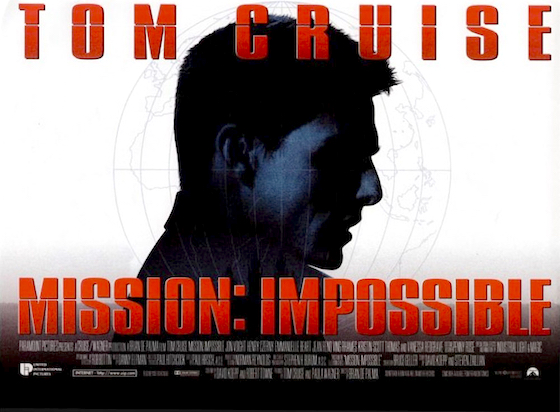
Mission: Impossible (1996)

The 100 Films Guide to…

Mission: Impossible

Expect the Impossible

Country: USA
Language: English
Runtime: 110 minutes
BBFC: PG
MPAA: PG-13

Original Release: 22nd May 1996 (USA & Canada)
UK Release: 5th July 1996
Budget: $80 million
Worldwide Gross: $457.7 million

Stars
Tom Cruise (Top Gun, Minority Report)
Jon Voigt (Midnight Cowboy, Superbabies: Baby Geniuses 2)
Emmanuelle Béart (Manon des Sources, 8 Women)
Henry Czerny (Clear and Present Danger, The Ice Storm)
Jean Reno (Léon, Ronin)
Ving Rhames (Pulp Fiction, Dawn of the Dead)

Director
Brian De Palma (The Untouchables, Snake Eyes)

Screenwriters
David Koepp (Jurassic Park, Spider-Man)
Robert Towne (Chinatown, Tequila Sunrise)

Story by
David Koepp (Death Becomes Her, Panic Room)
Steven Zaillian (Schindler’s List, Gangs of New York)

Based on
Mission: Impossible, a TV series created by Bruce Geller.


The Story
When a covert mission goes sideways and the rest of his team are killed, agent Ethan Hunt is blamed for their murder. On the run from his CIA employers, he sets out to prove his innocence and bring the real culprit to justice.

Our Hero
Mission: Impossible may be meant to be a team exercise, but as most of them get killed we’re focused on surviving member Ethan Hunt, an exemplary agent who must figure out what happened and track down who’s responsible.

Our Villain
The CIA man, Kittridge, who thinks Hunt is responsible for killing his team and is determined to bring him in. Of course, Hunt’s innocent — so is Kittridge really behind it all?

Best Supporting Character
Needing a new team, Hunt recruits a couple of disgraced IMF agents. One is Luther Stickell, a stylish computer expert and hacker. Despite his initial doubts, he’ll become one of Ethan’s loyalest team mates.

Memorable Quote
Kittridge: “I can understand you’re very upset.”
Ethan Hunt: “Kittridge, you’ve never seen me very upset.”

Memorable Scene
Ethan and his team need to retrieve a computer file from the only place it exists: a highly secure room in the centre of CIA headquarters. Access is controlled by voice print identification, a six-digit access code, a retinal scan, and a double electronic key card — none of which they have. In the vault itself, security measures include sensors for pressure (anything on the floor sets if off), noise (anything above a whisper sets it off), and temperature (a rise of a single degree sets it off). All of which leaves Ethan with only one option: to lower himself in from the ceiling, staying calm and cool enough not to raise the temperature, while not making any noise — all while hoping the guy who works in the room doesn’t come back. The resulting heist scene is a fabulous bit of suspense moviemaking.

Memorable Music
Danny Elfman provides a good score for the main body of the film, but the shining star remains Lalo Schifrin’s main theme, as iconic a piece of spy-fi music as the James Bond one. The new version featured here wasn’t produced by Elfman, however, but by the less famous half of U2, Adam Clayton and Larry Mullen. It was also released as a single and became a sizeable hit, reaching #7 in both the UK and US charts (where it received a gold certification) and even making it to #1 in some countries.

Technical Wizardry
The main title sequence is a modern do-over of elements from the TV series: a fast cut (even by today’s standards) montage of scenes from the film to come, plus a burning fuse, all scored by that updated version of the peerless theme music.

Making of
Jon Voigt, as pudgy “getting soft in his old age” Jim Phelps, was 57 years old when they made this film. For the new one, Tom Cruise learnt to fly a helicopter so he could do it all himself throughout a major stunt sequence, and actually performed hundreds of tricky HALO skydives for another major sequence, not to mention sundry other bits of running around and jumping off buildings — most of it while recovering from a serious leg injury. He is 55. How times change.

Previously on…
The original Mission: Impossible TV series was a popular and long-running part of the James Bond-provoked spy-fi craze of the ’60s. It was revived for two seasons in the ’80s. Although the film might look like a reboot, it kind of isn’t: there’s supporting material (such as the character bios on the film’s DVD and Blu-ray releases) that reconciles both TV series into the same continuity as the movie.

Next time…
Multiple never-less-than-entertaining sequels, starting with the standalone M:i-2, before becoming increasingly serialised through M:i:III, Ghost Protocol, and Rogue Nation. This summer’s sixth instalment, Fallout, promises to bring them all to some kind of head.

Awards
1 Saturn Award nomination (Action/Adventure/Thriller Film)
1 Kids’ Choice Award nominations (Favourite Movie Actor (Tom Cruise))
1 MTV Movie Award nomination (Action Sequence (for the train-helicopter chase) — it lost to Twister)
1 Razzie nomination (Worst Written Film Grossing Over $100 Million — it lost to Twister, again)

Verdict

Watching Mission: Impossible now, it’s funny that people used to regard it as unfollowably complex. I’m not saying the plot is straightforward, but if you pay attention then it’s all there. Obviously it can’t be that there were no complicated movies made before 1996, but I guess because at the time it was a summer blockbuster (not enough CGI or superpowers for that nowadays, of course) people didn’t expect to have to think about the story. Arguably it displays the kind of intricacy and complexity we specifically praise in spy thrillers, meaning the film has actually aged very well indeed. Well, it’s always been popular (it was the third highest grossing film of ’96), so I guess it just took a while for its reputation to catch on.

The world premiere of the new Mission: Impossible, Fallout, is in Paris today. It hits UK cinemas on 25th July and US theaters on July 27th. It’s not actually released in France until August 1st.

Red Sparrow (2018)

2018 #149
Francis Lawrence | 140 mins | download (UHD) | 2.40:1 | USA / English | 15 / R

Red Sparrow

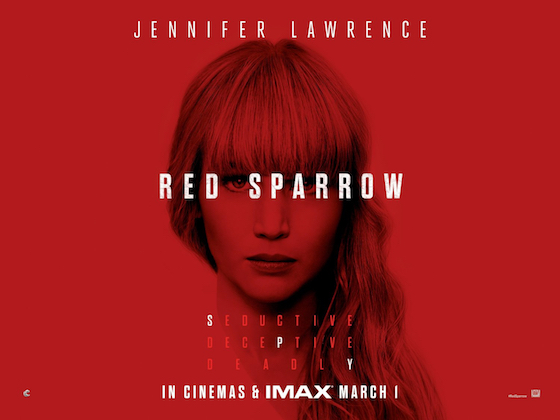
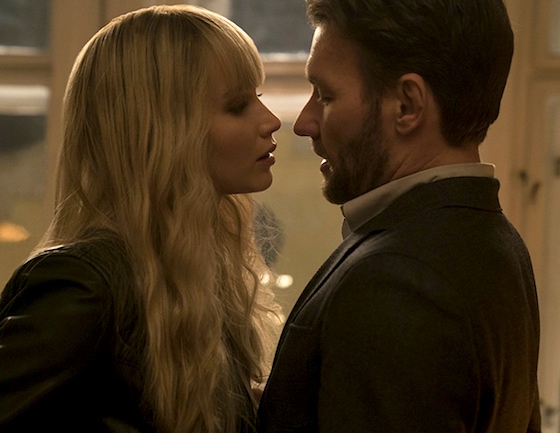
Jennifer Lawrence stars as Dominika, a Russian ballerina whose career-ending injury leads her down a path to becoming a “sparrow” — a highly-trained undercover operative for the Russian secret service. Used and abused throughout her training, when she’s sent after a CIA agent (Joel Edgerton) in order to find a mole within Russian intelligence, a series of double- and triple-crosses leave everyone in doubt about whose side she’s really on… including, er, us viewers.

Red Sparrow is set today. I think. It’s easy to forget. I had to check on a couple of occasions, including one final double-check before writing this review. The thing is, the politics of it all is very Cold War. Of course, given the current state of geopolitics, a neo-Cold War between Russian and the West is probably at its most believable since the ’80s, it’s just that this film’s handling of it doesn’t feel timely and modern, but like a Cold War story that someone decided should be set today. Partly that’s because a lot of the technology and tradecraft feels like it comes from a previous era too. I mean, one major sequence revolves around floppy disks. Floppy disks! I can’t even remember the last time I saw a floppy disk. Either that bit is based on something real-world (like, there’s a reason why someone stealing secrets would still be using floppies) — and, if it is, the film doesn’t bother to lay out why — or it’s the single most unrealistic thing in a movie that’s about a former ballerina being trained to be a Russian spy skilled in psychological influence and sexual manipulation in just three months — i.e. this is a pretty unrealistic movie all round.

Lady spy in red

Even if we ignore the inconsistencies of its temporal setting, it struggles with what else it has going for it. In its attempts to provide a twisty-turny plot, it’s not as clever as it thinks it is. As it flips and flops around about which side Dominika is supposed to be on really, clearly intending for us to feel wrong-footed every half-hour or so, the gears of how it’s setting up an inevitable final “reveal” begin to show through. Either that or I’m a genius for working it out ahead of time, whichever. One great well-disguised twist is better than endless back-and-forthing, but none of the filmmakers here seem to realise that, or don’t have the confidence to rely solely on that final reveal. Another side effect of this is it becomes hard to root for any particular character. Maybe this is the legacy of it being a US production: it can’t quite bring itself to ask us to fully invest in Dominika, a Russian spy, even as it tries to keep her the heroine. Plus the supposed twists wouldn’t work if we were actually let in on what she was plotting.

And away from the plot, the whole movie is sort of… seedy, but without owning it. It wants to be about sex and to somehow be honest about that, while also trying not to titillate in any way. It wants to be realistically violent, while merely being nasty in just one or two scenes. Conversely, it also wants to be a grown-up, labyrinthine Le Carré-esque thriller, but it’s so busy trying to repeatedly fool you that it forgets to properly engage you. It certainly doesn’t succeed in being plausible, with the elaborate plan Dominika supposedly concocted relying rather too much on crossed-fingers-type logic — or, I’m sure the filmmakers would say, her unparalleled ability to read people.

Sexy spy shenanigans

I’d rather it had picked a side: either go all out schlock — more violence, more tits — or go full intelligent thriller — rein in the seediness, rein in the superhuman foresight. As it is, Red Sparrow is not trashy enough to be titillating, certainly not clever enough to challenge Le Carré as the go-to example of intelligent spy thrills, and not stylish enough to get away with it either. It kind of sits in an awkward middle ground between all those things. I didn’t actually dislike it, but it didn’t thrill me either.

3 out of 5

Red Sparrow is released on DVD, Blu-ray, and UHD Blu-ray in the UK today.

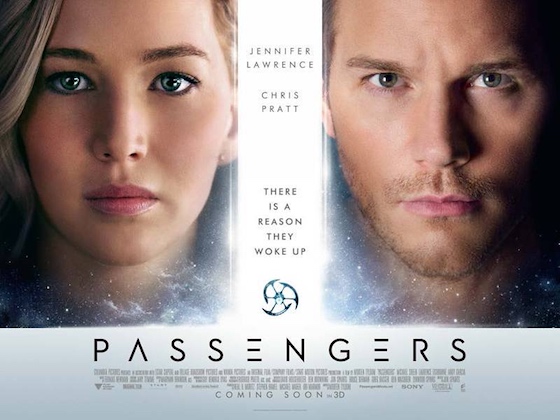
Passengers (2016)

2017 #156
Morten Tyldum | 116 mins | download (HD+3D) | 2.39:1 | USA / English | 12 / PG-13

Passengers

This review contains major spoilers.

I got the distinct impression everyone hated Passengers when it came out 18 months ago — it has a lowly 31% on Rotten Tomatoes, and most of the think-pieces penned in its wake seemed to be about how terrible one particular aspect was (I’ll come to that, hence the spoiler warning). It has a 7.0 on IMDb though, which might not sound great, but anything north of 7 isn’t bad on IMDb — there are plenty of popular movies languishing in the 6s. Personally, I rather enjoyed it.

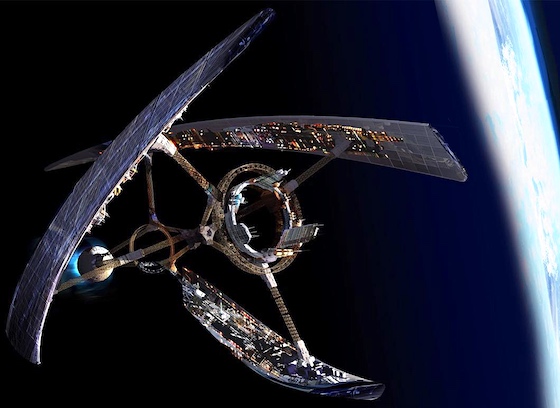
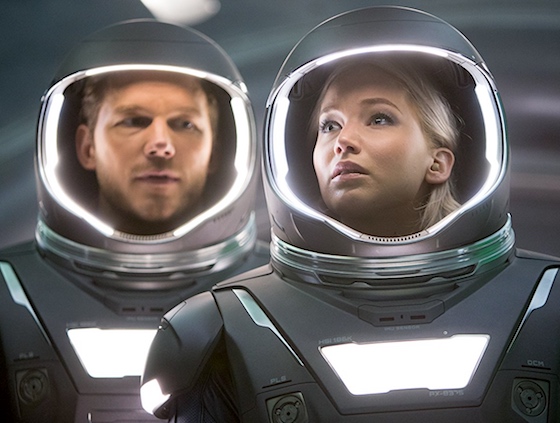
Sometime in the future, shortly after mankind has begun to colonise other worlds, the spaceship Avalon is on a 120-year journey to a new planet with thousands of colonist-to-be in hibernation onboard. Just 30 years into the trip, the Avalon strikes an asteroid field, causing a malfunction that wakes up just two passengers: Jim (Chris Pratt), a mechanical engineer, and Aurora (Jennifer Lawrence), a journalist. Faced with the prospect of never reaching the destination they’d set out for, the pair begin to develop a relationship.

Or so the trailer would have you believe (and this is where the spoilers come). In fact, the malfunction only awakens Jim. After a year alone on the ship, with his only company being a robot bartender called Arthur (the always excellent Michael Sheen), a suicidal Jim comes across Aurora’s pod. Smitten, he watches her video diary, struggles with the morality of awakening her… and eventually does, claiming her pod must’ve malfunctioned too. What a bastard, right? Eventually Aurora finds out and hates Jim for robbing her of the life she’d intended, but this is a romance movie so…

I C You

Obviously, this is the aspect that generated all those digital column inches. Having read some of them, I get the impression that the reason so many people were annoyed by Jim’s dick move is either, a) it wasn’t hinted at by the trailer (therefore people were too busy trying to read the film as a straight-up romance, because that’s what the ads promised, and didn’t consider the actual story it was telling), or b) people seem to really struggle with movies where the lead character makes bad decisions that are either unlikeable or amoral. That’s a general observation I have about audiences, but it seems applicable here. See the numerous “Star Lord is the real villain of Infinity War” hot takes for a similar Chris Pratt-related example.

One of the reasons people being angry about the film’s ethics bug me is that at no point does the movie try to argue that Jim waking up Aurora was a good decision — everyone knows it was a bad, selfish idea. What the film does do is try to make you see why he would make that choice (it takes him over a year to do it, remember), and then shows how everyone eventually deals with the fallout (which is just life — shit you don’t want happens and you have to find a way to handle it). In fact, buried underneath all the romancing and effects whizz-bangery of the film’s climax, maybe there are some decent life/moral lessons, about the need for forgiveness, and accepting, and making the most out of things we can’t change.

No! Bad Jim! Bad!

A lot of people seemed to jump on the idea the film would be better if acts one and two were flipped — if we woke up alongside Aurora, only later learning of Jim’s betrayal. It would certainly have been different. Better? I don’t know. It would shift the emphasis around a lot. Maybe it would’ve made him romancing her more palatable for those who found it objectionable to their core, because while watching it you wouldn’t know what he’d done — but it wouldn’t change what he did, just how you were presented with it. In some ways, then, the movie we have got is the more interesting version: we know what he did throughout their courtship and have to accept that fact.

Moral questionability aside, the romantic plot is actually traditionally shaped: there’s the meet-cute (it’s just a sci-fi’d-up one), the falling for each other, the disagreement and separation, and eventual reconciliation. Maybe such familiarity is fine when it’s being dressed up in shiny new sci-fi surroundings; maybe it was the problem, too: the massive betrayal at the film’s core gets in the way of a traditional happy-sappy arc; if you wanted to go all gooey over their burgeoning romance, it gets in your way. But it’s a more interesting story because of it. In real life, such a horrid act might prompt a definite “walk away and never see him again” response. Things aren’t so straightforward aboard the Avalon. If you wanted them to be… well, so did Aurora, and she didn’t have a choice either. Perhaps the film could’ve spent more time digging into the emotional impact and decision-making of that rather than faffing with a sci-fi-cum-disaster-movie action-packed climax, but when your movie’s this expensive (as much to do with the no-doubt-ginormous salaries of the two stars as it is the CGI, I expect) you need some money shots and jeopardy to draw the blokes in.

Sci-fi money shot

Taken as a sci-fi movie, I really liked it. The concepts are well considered and played out, from the big ideas of how colonisation might work to little touches of how the tech functions. Much of the ship and its interfaces are beautifully designed and realised — I don’t know how much of it was built for real, but I suspect a fair chunk of the main locations are practical, and I do love a big set. I liked Arthur too, partly because I like Michael Sheen, but also because of how he functions as a robot designed to be kind of your mate.

On the whole, I suspect the negative reaction to Passengers is more a case of mismanaged expectations for some audience members rather than it being an objectively bad movie. I guess a lot of critical viewers put themselves in Aurora’s position, but Jim’s dilemma is just as relatable — I mean, not in a literal sense (none of us are ever likely to wind up in such a situation), but in a “what would I do?” way. Clearly, everyone thinks he did the wrong thing, but can you blame him? Would you be able to withstand a life of total loneliness? Maybe you would. Maybe you think you would. Nonetheless, the romance plot is inevitable (because that’s how movie plots work, especially in expensive Hollywood blockbusters), so the time bomb of What He Did adds an uncommon frisson. And the big action climax isn’t bad for what it is.

It's full of stars!

That said, the more you think about it, the more you can dream up variations that would’ve been of even greater interest. Like, what if Jim wasn’t physically attractive? Would Aurora still have fallen in love with an ugly bloke just because he was the only fella there? Or what if he’d died, leaving her to face the same dilemma he had — would she in fact wake someone up too? But those kinds of alternatives are far too challenging for a Hollywood romantic blockbuster. Like, the only way you’d get a physically unattractive leading man would be if it was a comedy and he was funny, and then she’d fall for him in spite of his looks because he made her laugh. But hey, it’s Hollywood entertainment behaving like Hollywood entertainment — should we be surprised?

4 out of 5

The Snowman (2017)

2018 #84
Tomas Alfredson | 119 mins | streaming (UHD) | 1.85:1 | UK, USA & Sweden / English | 15 / R

The Snowman

I read a comment somewhere that said Tommy Wiseau’s notorious film The Room is like a movie made by someone who’s never seen one but has had the concept thoroughly explained. The Snowman is like that but with crime thrillers.

Michael Fassbender stars as Norwegian detective Harry Hole — I presume there’s been some kind of fault of culture or translation there because, in English, that’s pretty much the worst name for a detective ever conceived without deliberately trying to be awful. He’s kind of washed up, with a terrible private life, but he’s also an unassailably brilliant detective — oh yeah, the originality keeps on coming. Anyway, after a woman disappears, an ominous snowman built near the crime sets Hole and a younger cop (Rebecca Ferguson) on the trail of a serial killer who’s been active for decades.

All of which should make for at least a solid crime thriller, but it just doesn’t quite work. It’s like the whole thing has been almost-correctly-but-not-quite translated from another language. I’m not just talking about the dialogue (though that’s sometimes that way too), but the very essence of the movie — the character arcs, the storylines, even the construction of individual scenes. Like many a Google Translate offering, you can kinda tell what it’s meant to be, but it doesn’t actually make sense in itself. According to the director, around 15% of the screenplay was never even filmed due to a rushed production schedule, which perhaps explains some of these problems.

Mr and Ms Police

Said director is Tomas Alfredson, the man who gave us Let the Right One In and Tinker Tailor Soldier Spy, so you’d expect a lot better of him. Even the technical elements are mixed: there’s some stunning photography and scenery, contrasted with occasional bad green screen; and all of Val Kilmer’s lines had to be dubbed (due to his tongue being swollen from cancer, apparently), but it sounds like it. His performance on the whole is weird, just one more part of the film that doesn’t sit right. It all builds to a massively stupid, unremittingly nonsensical finale. It’s during the final act where things finally goes overboard from “not very good” to “irredeemably bad”.

Indeed, some of the The Snowman is so shockingly awful that I considered if it merited my rare one-star rating. It’s close, but a lot of the film is fine — it actually toddles along at a reasonable three-star level most of the time, before falling apart entirely towards the end. “It could be worse” may be the faintest of praise, but it certainly doesn’t deserve any more.

2 out of 5

The Snowman is available on Sky Cinema from midnight tonight.