2010 #118a
Stephen Cheung | 9 mins | streaming
 There’s probably a worthwhile biopic to be made about Verity Lambert. In 1963, she became not only the youngest-ever producer of a BBC television programme, but the first female one too; the programme she was charged with launching was Doctor Who, which she took from a short-commission no-hoper to a firm part of the national culture — and we all know what’s happened to it since she left in 1965. Her extensive career continued until her death in 2007, encompassing such televisual landmarks (for good or ill) as The Naked Civil Servant, Quatermass, Minder, G.B.H., Eldorado and Jonathan Creek.
This nine-minute effort from student screenwriters Thomas Cowell and Joey Guy is, unsurprisingly, not that biopic. Wisely, it focuses on the start of Lambert’s producing career, dramatising the events around her being chosen by Sydney Newman (then the BBC’s Head of Drama) to shepherd his idea for an educational science-fiction children’s drama, its initial ratings failure and, shortly after, its ratings success. The film’s tagline — “men, bitches and Daleks” — sums up its thematic concerns: Lambert argues with the man who hired her, faces animosity from other female members of staff, and saves the day by forcing the Daleks into the series despite Newman’s forbiddance.
 Before I set off really critiquing the film, let’s just remember this: it’s a student effort. In that context, I’ve seen far worse — heck, I’ve been involved in the production of worse. Cowell and Guy have set themselves an almost Herculean task by choosing a period tale, which obviously necessitates all sorts of extra effort in terms of costumes, locations, dialogue… And to make it worse, they’ve chosen the ’60s, evoked so faultlessly in almost 40 hours (and counting) of Mad Men. Of course a low/no-budget student film can’t compete with an expensive, acclaimed US TV series; and actually, Verity does a fair job of recreating its era… visually.
The comparison with Mad Men comes up in more than just the visuals though, because that also deals extensively with gender politics in the ’60s. Here, Verity can’t compete. Dialogue is too on the nose — some of the language they use freely is implausible for the era; the way they often bluntly state their point is implausible for any time. “I’m making history” is an unlikely thing for anyone to say ever.
In terms of these specific events, it doesn’t fare much better. Accuracy to facts can occasionally be ignored if it makes for a good story, and Verity’s outright rebellion against Newman’s “no bug-eyed monsters” mandate might appear to be that, but its execution is left wanting. She storms into his office and informs him the Daleks will be in the series,  which he accepts with merely a muttered “damn” when she leaves. Sorry, what? There’s nothing believable in that scene, never mind accurate.
After the ratings success of the Daleks’ first appearance, Newman can’t help but think of the “merchandising opportunities”. Really? A lot of stuff was indeed produced during Dalekmania in the mid-’60s, but this is still the state-funded BBC and 14 years before Star Wars — not to mention that Verity brandishes a Dalek toy, which wouldn’t be produced until 1965. (If you really want it rubbed in, the prop she’s holding is clearly a new series toy.)
Ten minutes isn’t much to play with, true, but I think it’s fine for a version of this story. Cowell and Guy have picked their scenes well, it’s just that the actions and words they’ve filled the scenes with don’t ring true. This is only partially the fault of the cast’s rampant overacting — though, in fairness, I think Rachel Watson is fighting against an affected southern/period accent as Verity, and Brian Clarke gives quite a good performance as Newman.
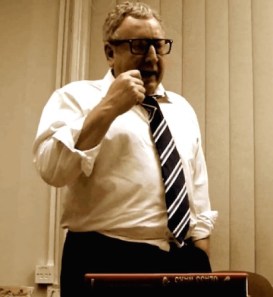 Technically, the piece is just as much a mixed bag. Stephen Cheung’s direction picks out some decent angles, avoiding the flat point-and-shoot trap some student filmmakers are apt to fall into, while the sepia-ish wash helps the period tone and adds a small amount of welcome gloss. The editing is a little rough around the edges, particularly at scene changes and toward the end. YouTube claims it’s viewable in 1080p — whether something went wrong in shooting, editing or at YouTube’s end I don’t know, but it isn’t that high quality. (This last point doesn’t impact on my score at all, it’s just an observation.)
I’d like to say Verity is a good effort, but though it has a few things going for it — and even allowing for the fact it’s a student film — it would clearly benefit from better research and greater subtlety in characters’ actions and dialogue. Must try harder.
Verity is available on YouTube.
Three years later, the BBC told the same story in Mark Gatiss’ TV movie An Adventure in Space and Time, which is properly brilliant.

 Pixar have always attached original short films to their feature releases. As part of what seems to be their increasing franchisation, however, they’re not always wholly original now: Hawaiian Vacation was the short attached to Cars 2. And it’s the first in a series of Toy Story shorts: the second, Small Fry, appeared in cinemas before The Muppets; the third, Partysaurus Rex, comes with Finding Nemo 3D later this year.
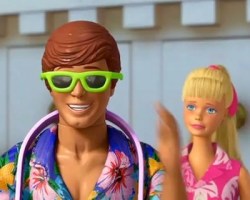 Hawaiian Vacation doesn’t exactly allay these fears — its very existence is proof of that — but at least it’s an entertaining piece in its own right. It succeeds partly by not overreaching itself — this isn’t Toy Story 4 and it doesn’t try to be. It reminds us of the characters and gives them each a story beat, while remaining funny, entertaining and sweet, all in under six minutes. Cars 2 can’t manage that in 106.
 Included on releases of
  The quality of the action sequences outweigh anything seen in the main Year One feature. They’re original, exciting and very fluidly animated. Apparently Montgomery is known in fan circles for liking a bit of violence and trying to add it to the action in DCU films she’s worked on, and that’s in evidence here too. It gives it an edge, I think.
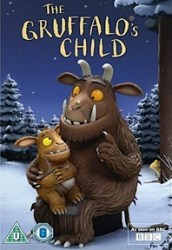 Shown on BBC One over Christmas, this animated adaptation of Julia Donaldson and Axel Scheffler’s The Gruffalo’s Child is the sequel to the Oscar-nominated adaptation of Julia Donaldson and Axel Scheffler’s The Gruffalo (of course). For my money, it’s every bit as good as the first film.
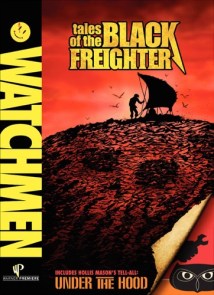 In the world of
  which could well have gone down a more modern-styled route.
 It’ll be interesting to see how it fits into the film when I finally get round to watching The Ultimate Cut — I already have some reservations waiting to be expressed in my review.

 The interest of the piece for us normal, sensible folk, then, lies in what it exposes about this world: the ludicrous lengths they go to; the shockingly inflated sense of self importance. As with The September Issue, it presents no narration and a lot of long takes of documentary footage, leaving the viewer to draw their own conclusions. But there are conclusions to be drawn. Wintour is as much a closed book here as in the main film, but there are moments — glances, affectations, turns of phrase — that reveal a little bit more of the truth behind her icy demeanour.
 Is 1945-1998 actually a film? Or is it a piece of video Art? Or just another online video?
 attention didn’t already wander, that is). There are ultimately so many flashes and bleeps, and the effect is so lulling, that I had to force myself to remember these represented Big Nasty Bombs that were Not A Good Thing. Perhaps something more aurally grating would’ve been appropriate; the counter argument going that this would cause even more viewers to abandon the work.
 100Films.co.uk