Cecil M. Hepworth shorts

I know I’m generally quite poor about posting reviews nowadays (“nowadays” being “for the past five years”, considering that’s roughly how long ago my backlog stretches), but I do have the Archive 5 to dig into that, and sometimes post reviews of newer watches too. What really suffers, however, are short films. I have no consistent plan to correct that, but here at least are reviews of three shorts I’ve watched this year with a simple connection: they were all directed by early British filmmaker Cecil M. Hepworth.

  • Alice in Wonderland (1903)
  • Explosion of a Motor Car (1900)
  • The Indian Chief and the Seidlitz Powder (1901)


    Alice in Wonderland

    (1903)

    Cecil M. Hepworth & Percy Stow | 9 mins | digital HD | 4:3 | UK / silent

    The first screen adaptation of Lewis Carroll’s beloved novel is a whistle-stop tour of some of its best-known moments. What it loses in not being able to retain any of Carroll’s memorable prose or dialogue, it makes up for by being a neat showcase for some early-cinema special effects — Alice shrinks and grows; a baby turns into a pig; and so on. There’s little doubt that this isn’t the best filmed version of the tale (unless you have a fondness for early cinema over anything made later), but it’s a valuable glimpse into the ambition and skill of the form’s pioneers.

    The only surviving print is in terrible shape and missing several minutes of footage (it was originally 12 minutes long), but at least we have some way of seeing this important bit of film history. Talking of which, you can watch it on the BFI’s official YouTube channel, although they only provide it in standard definition. Fortunately, there’s a full HD version here.

    3 out of 5


    Explosion of a Motor Car

    (1900)

    Cecil M. Hepworth | 2 mins | digital SD | 4:3 | UK / silent

    Cars randomly exploding for almost no reason is a hallmark of action cinema, but it begins even earlier than the codification of that genre, as this short from 1900 shows.

    We watch as a car full of people merrily trundles along a suburban street… then, suddenly, there’s a puff of smoke and the vehicle is reduced to a pile of parts. A policeman comes over to inspect, at which point body parts rain from the sky. It would be gruesome if it weren’t so obviously comical… especially when the policeman begins to casually pile them up. And that’s the end.

    Basically, it’s a comedy sketch à la 1900. I guess it was probably inspired by fears of this modern new invention, the motor car, but at least it plays those for laughs. There are worse ways to spend 90-or-so seconds (depending on the playback speed of the version you watch — the BFI version is here).

    3 out of 5


    The Indian Chief and
    the Seidlitz Powder

    (1901)

    Cecil M. Hepworth | 2 mins | digital SD | 4:3 | UK / silent

    So, I bought the 88 Films Blu-ray of ’70s British-produced Western Hannie Caulder (mentioned in my May failures), had a little look at the booklet and, for whatever reason, the opening paragraph of the essay by Lee Broughton caught my eye. To quote: “The British have been making Westerns since the early days of silent cinema (see The Indian Chief and the Seidlitz Powder [Cecil M. Hepworth, 1901]) and they continue to make Westerns today (see The English [Hugo Blick, 2022]).” This, first off, reminded me that I’d meant to watch The English (I find Blick’s work to be both fascinating and somehow off-putting, so I always feel I should watch them but, when there’s such a plethora of choice nowadays, it’s easier to go for something, well, easier). More relevantly, it sent me off to Google this short, having recognised the director’s name (partly from watching the above-reviewed shorts a couple of months earlier) and, more importantly, being interested in the early days of cinema — especially as shorts such as these can usually be found online, if they survive. You often end up with low-quality DVD rips on YouTube, but, thankfully, this one is available on the BFI for free.

    All of that said, it’s… not all that. It’s a Western in technicality only: the sole character is a Native American chief; though you’d only infer that from the title, because his costume is terrible. There are no other signifiers that this is a Western — the basic set could be a store or storeroom anywhere, and presumably Seidlitz Powder was a product sold in British shops. I presume that because the short is a one-gag comedy based around the effects of that product, and so British audiences must’ve known about it. As far as I’m aware, it’s not a product still in existence today, so thank goodness for the BFI’s explanatory notes (also at the link above) to illuminate the context of the joke.

    Other than that, the film is noteworthy for containing a sequence in slow motion. It’s an inherently cinematic effect, so it’s always interesting to see it deployed so early in the form’s history. Indeed, it stands at odds with how the other ‘effects’ in the film are achieved: the chief’s belly swells by the performer (Hepworth himself, possibly? I don’t know, but I believe he often appeared in his own films; equally, someone is operating the camera) fiddling around inside his costume and shaking it about until it inflates. Then he “bounce[s] around like a balloon”, says the BFI — rather overselling it, as he just kind of leaps about a bit. There is one more cinematic technique: a jump cut to allow for a puff of smoke when his stomach bursts… followed by the performer awkwardly folding up his now over-large costume before darting out the door.

    So, two minutes filled with casual racism, 120-year-old topical humour, and some weak theatrical ‘special’ effects. But hey, at least we can experience British cinema’s early forays into uniquely cinematic technique and a key genre.

    2 out of 5


  • Silent Shorts Summary

    As well as all the unreviewed feature films in my ridiculously-large backlog (see the Archive 5 series for more on that), there are also a load of short films from the past few years that I haven’t reviewed.

    Today, I’m taking a step towards putting that right, by bundling together all the silent shorts I watched between 2020 and today. In original chronological order, they are…

  • Sherlock Holmes Baffled (1900)
  • The One-Man Band (1900)
  • The Infernal Cauldron (1903)
  • Life of an American Fireman (1903)
  • The Consequences of Feminism (1906)
  • The Dancing Pig (1907)
  • Frankenstein (1910)
  • What! No Spinach? (1926)


    Sherlock Holmes Baffled

    (1900)

    Arthur Marvin | 1 min | digital (SD) | 4:3 | USA / silent

    Sherlock Holmes Baffled

    This is noteworthy for being the first film to star Arthur Conan Doyle’s immensely popular sleuth, but it’s an “in name only” appearance by the Great Detective. In fact, he’s not named on screen, so maybe “in costume only” (a dressing gown and pipe) would be more accurate. The actual film is nothing to write home about, either: it’s a 30-second skit, built around showing off then-cutting-edge filmmaking tricks, i.e. using editing to allow a burglar to disappear and reappear out of thin air. No wonder Holmes is baffled.

    It’s only really of interest as a curio to fans of early cinema or Sherlock Holmes on screen, even if the latter is only invoked as a hook to attract viewers. Although, I feel like the fact the first Sherlock Holmes film was basically a spoof is somehow significant…

    2 out of 5


    The One-Man Band

    (1900)

    aka L’Homme orchestre

    Georges Méliès | 2 mins | digital (SD) | 4:3 | France / silent

    The One-Man Band

    Using the magic of cinema to take the title literally, in this short director Georges Méliès clones himself seven times over to create a musical septet (plus conductor).

    Even having the idea to do this kind of visual stunt for the first time is obviously impressive — there’s no doubt that Méliès was an extraordinary innovator — but pulling it off with such technical competency… that could be tricky today, never mind in 1900, when you couldn’t check your footage lined up, nor just do another take if it didn’t, never mind the array of computer tricks (split screen, time ramping, reframing, etc) that could be deployed to make it work nowadays. Here, Méliès was doing multiple exposures on the same strip of film; the original negative — imagine if you messed up on the seventh go-round!

    And even with all that, it’s not just an exercise in technique; not just a technical demonstration for those interested in the possibilities of motion pictures. You can set all that aside and still find an entertaining and amusing short — with a couple of extra gags thrown in at the end for good measure. Genius.

    4 out of 5


    The Infernal Cauldron

    (1903)

    aka Le chaudron infernal

    Georges Méliès | 2 mins | digital (SD) | 4:3 | France / silent

    The Infernal Cauldron

    A few years later, and Méliès’s work is looking more extravagant — there are sets! Costumes! Props! Colour! Hand-coloured, of course, and the result is glorious. The colours are not only incredibly stable (you’d expect some flicker or judder on static elements from frame to frame, but nope), but they really add to the atmosphere. The sickly green demons and burning red & orange flames really leap off the screen, making the unreality of it that bit more tangible. This would be so much less effective in pure black-and-white. It’s less like a flickering clearly-fake old film, more like a nightmare. You can kinda see how people at the time might’ve believed stuff like this was real. I mean, how else do you explain those ghosts, hmm? (Okay, obviously they’re a double-exposure effect; but it holds up well. Certainly better than the cardboard-cut-out props.)
    Intriguingly, there’s a 3D version of the film — a real, authentic one! To quote wholesale from Wikipedia: “In order to combat piracy, Méliès … began producing two negatives of each film he made: one for domestic markets, and one for foreign release. To produce the two separate negatives, Méliès built a special camera that used two lenses and two reels of film simultaneously. In the 2000s, researchers at the French film company Lobster Films noticed that Méliès’s two-lens system was in effect an unintentional, but fully functional, stereo film camera, and therefore that 3D versions of Méliès films could be made simply by combining the domestic and foreign prints of the film. Serge Bromberg, the founder of Lobster Films, presented 3D versions of The Infernal Cauldron and another 1903 Méliès film, The Oracle of Delphi, in January 2010 at the Cinémathèque Française. According to film critic Kristin Thompson, ‘the effect of 3D was delightful … the films as synchronized by Lobster looked exactly as if Méliès had designed them for 3D.'” They were screened again in 2011 and, at least as far as Wikipedia can explain, that was the end of it. To which I say: argh! I really want to see them! A 3D Blu-ray release would be lovely; but, as these screenings happened over a decade ago, I can’t say I’m holding out much hope…

    4 out of 5


    Life of an American Fireman

    (1903)

    Edwin S. Porter | 6 mins | digital (SD) | 4:3 | USA / silent

    Life of an American Fireman

    Although fundamentally a remake (or ripoff, depending how you look at it) of the earlier British film Fire!, Life of an American Fireman has found a place in film history (it even merited coverage in Mark Cousins’s The Story of Film: An Odyssey) for two reasons: firstly, for pioneering the technique of cross-cutting, a major and significant development in film editing; secondly, for not actually having done that at all.

    “Huh?”, you may well exclaim. Well, although for a long time the short was admired for its innovation, research by the Library of Congress eventually revealed that the film was re-edited sometime after its release (possibly in the 1930s or ’40s), and the original version actually played the action out twice, without the all-important cutting back and forth. Viewed in that original version, I’d argue to a modern audience it’s more confusing having the same sequence twice back to back — nowadays we expect intercutting of action, so it’s initially disorientating when the film cuts to outside the house and starts the same sequence of events over again. Perhaps more importantly, watching it twice over feels redundant: the second version adds no new information; and, being outside the house, thus distanced from the threat of encroaching fire, it’s less dramatic than the inside sequence. And that’s not to mention that the timeline doesn’t add up: the fireman is in and out of the window much more quickly during the inside version than the outside version.

    Despite all that, this does remain one of the earliest American narrative films, bringing together various innovations that had occurred in the early years of film — primarily, constructing a continuous narrative across multiple shots and scenes. It just wasn’t the first film to do, well, anything.

    3 out of 5


    The Consequences of Feminism

    (1906)

    aka Les Résultats du féminisme

    Alice Guy | 7 mins | digital (SD) | 4:3 | France / silent

    The Consequences of Feminism

    Imagine a crazy world where men did housework and looked after the children, while women lazed around drinking, smoking, and cajoling innocent young men into the bedroom. What larks! But such horrors might come to pass if we let those pesky women have their way.

    Such once-implausible things are depicted in Alice Guy’s 1906 short. Consequently, this is the kind of film that might be described as “of it’s era” — although, said era probably extended another six or seven decades. I can’t cite any specific examples, but I feel like “wouldn’t it be hilarious if men behaved like women?” sketches were still being done in the ’60s and ’70s, if not even more recently. So, it’s less that it’s dated, more that it shows Guy was ahead of her time. I mean, the film dates from before women even had the vote, yet she has the chutzpah to imagine men taking on women’s roles and women enjoying leisure time. Scandalous!

    Considering the short was made by a pioneering female filmmaker, we can but assume it’s all satirical; that its very point is “the consequences of feminism” would not, in fact, be the ridiculous role-reversal presented here. But, in that context, the ending is quite interesting: the men force the women out of the bar and raise a toast. Are we supposed to read that as the natural order being restored? More likely, it’s meant to signify these men achieving equality with women; that Guy’s point is, “if men were in women’s situation, they’d want to change it, too.”

    4 out of 5


    The Dancing Pig

    (1907)

    aka Le cochon danseur

    4 mins | digital (HD) | 4:3 | France / silent

    The Dancing Pig

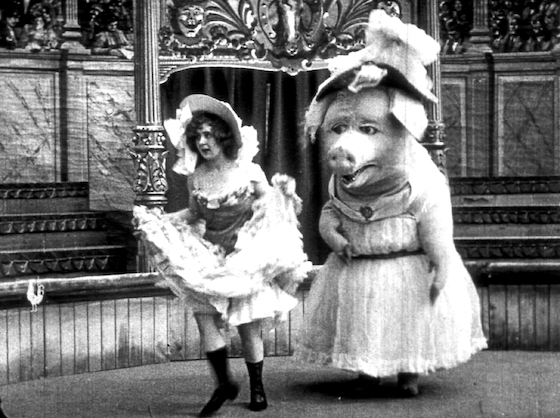
    Apparently this had fallen into obscurity for a century or so, when it was revived as an internet meme because of “its creepy atmosphere”. Certainly, stills from the final scene (a closeup of the pig’s head, with vicious teeth and an oscillating tongue) look weird and freaky; and I guess if you slapped an ominous horror-movie-esque score across the whole short then it would become freakish in its entirety. But it was originally a vaudeville act, and with the jaunty score that usually accompanies it, it remains just that: a couple of minutes of daftness.

    As such, I can hardly recommend it. It’s a curio of a past era, and while there’s undoubtedly value in preserving such things for historical interest, that’s still all it is.

    2 out of 5


    Frankenstein

    (1910)

    J. Searle Dawley | 13 mins | digital (HD) | 4:3 | USA / silent

    Frankenstein

    The first screen adaptation of Mary Shelley’s novel is such a thorough retelling in just 12 minutes, it almost makes you wonder what takes other versions so long. But what it gains in brevity, it loses somewhat in filmmaking craft: every scene is shown only in a theatrical static wide shot. It’s not entirely without interest, though: one setting places a full-height mirror screen right to enlarge the set by showing us what’s behind the camera to the left, and it’s surprisingly effective, especially when it’s used for a bit of fun cinematic trickery.

    The film’s big set piece is the creation of the Monster; not from stitched-together body parts, as is usually the case, but some kind of ‘magic potion’ that makes it emerge from a cauldron, growing and forming before our eyes. The effect was achieved by burning a puppet and then reversing the film, but, rather than presenting an unbroken take, instead the film cuts back and forth to Frankenstein observing and, frankly, skips over what I imagine were the most effective bits. For example, we see the vague outline of a human figure emerge, then cut to Frankenstein, then cut back to see it fully-formed. Would it not have been better to see the Monster’s features ‘melt’ into being amongst the flames? Oh well.

    Frankenstein was thought lost for decades, until a single print was found in the ’70s. Imperfect it may be, but it remains a significant milestone in the history of horror cinema.

    3 out of 5


    What! No Spinach?

    (1926)

    Harry Sweet | 19 mins | Blu-ray | 1.33 | USA / silent

    What! No Spinach?

    Included as a special feature on the Masters of Cinema Blu-ray of Buster Keaton’s Seven Chances, this little-seen* comedy short, directed by and starring Harry Sweet, “riffs on a number of elements from Seven Chances”, to quote MoC’s blurb. I’d say it’s less a riff on Seven Chances, more a brazen rip-off. It has moments of amusing physical comedy, but it lacks Keaton’s originality or heart. At least it’s brief, although that doesn’t mean it feels whole: rather than ending, per se, Sweet seems to run out of ideas and the film just stops.

    Also, it has nothing to do with spinach.

    3 out of 5

    * I couldn’t find a single photo or image from this short online. That there now are some on certain movie databases is because I uploaded screen grabs I took for this review (even editing some into a ‘poster’ for the sake of TMDB/Letterboxd). ^


  • 2023 | Weeks 3–4

    “Wait, did I miss Weeks 1 and 2?”, you may have asked yourself upon seeing this post pop up wherever you see my posts. And the answer is: no, I missed them, because I failed to watch a single film in either Week 1 or Week 2 of 2023. Most extraordinary.

    Anyway, I wrote about that in January’s monthly review, so let’s get on with reviewing. I will note that I’ve skipped a couple of films from these weeks. Normally I only do that when I’ve already written their review and it’s long enough I feel it should be posted solo. I haven’t formally started writing about either The Girl Who Knew Too Much or Black Girl yet, but I have an inkling they’re both going to be quite long (the latter, definitely), so I’ve set them aside for the time being. Which leaves us with…

  • The Magician (1926)
  • Glass Onion (2022)
  • My Year of Dicks (2022)
  • Shotgun Wedding (2022)
  • The Banshees of Inisherin (2022)


    The Magician

    (1926)

    Rex Ingram | 80 mins | Blu-ray | 1.33:1 | USA / silent

    The Magician

    Based on W. Somerset Maugham’s novel, itself inspired by the antics of real-life occultist Aleister Crowley, The Magician concerns a mad scientist, Oliver Haddo (Paul Wegener), trying to complete an alchemical spell to create life by kidnapping a pretty virginal sculptor, Margaret (Alice Terry), so he can cut out her heart and use her blood. But why just kidnap a young woman when you can hypnotise her into marrying you? And why just kill her when you can use your hypnotic control to, er, take her gambling in Monte Carlo and make lots of money?

    Wait, what?

    Yeah, The Magician is kind of an odd film. Whether that’s due to Maugham’s original work and his desire to write a takedown of Crawley, or if it was the impetus of director Rex Ingram fancying a jolly around Europe with his wife, who he’d cast in the lead female role, I don’t know. Either way, the varied asides (before the eponymous Haddo even turns up, Margaret is paralysed in a sculpting accident and goes for experimental surgery to get it fixed) slow the pace, possibly to pad out what is really quite a slight story. On the other hand, there are some atmospheric sequences scatted throughout, like a demonstration of Haddo’s powers at a snake charming show, or a devilish orgy (yes, you read that right; no, it’s not at all shocking by modern standards). Plus, as if to balance out all the stuff with dark magic, Ingram finds room for dashes of humour, giving a bit of texture and stopping the film from becoming too self-serious.

    However, The Magician remains most noteworthy today as a stylistic precursor to Universal’s initial run of horror movies in the early ’30s — James Whale’s Frankenstein, in particular, seems to have taken some cues from this film’s climax. It’s a fairly entertaining melodramatic fantasy-horror in its own right, but is primarily worth a look for those interested in the early development of the horror genre in Hollywood, or for silent movie fans who’d like something with a supernatural edge. General audiences are probably fine sticking to the established classics it influenced.

    3 out of 5

    The Magician is the 1st film in my 100 Films in a Year Challenge 2023.


    Glass Onion

    (2022)

    aka Glass Onion: A Knives Out Mystery

    Rian Johnson | 139 mins | digital (UHD) | 1.85:1 | USA / English | 12 / PG-13

    Glass Onion

    In some respects, Glass Onion delivered a movie closer to what I’d been expecting from the first Benoit Blanc mystery, Knives Out; that is to say, a proper murder mystery that is also unabashedly a comedy. Don’t get me wrong, I found Knives Out amusing — even more so with subsequent rewatches — but it has a kind of dry humour, with a wit more likely to raise a wry smile of acknowledgement than a guffaw. Glass Onion surely has such moments too, but it also has big, broad laughs that stand out more on a first viewing.

    The mystery at its core remains a true Christie-style puzzler, with enough about-turn twists to keep you off balance — you can try and guess what’s going on if you want, but it’s just as much fun to be swept along for the ride — but the surrounding material is satirical almost to the point of parody. Kate Hudson’s airhead influencer is more caricature than character, for example, while there’s no doubt that Edward Norton’s billionaire is a merciless pisstake of Elon Musk. That’s annoyed certain right-wing commentators. The rest of us can just enjoy the accurate pillorying.

    This overall shift in tone will, I think, dictate which of the two movies viewers prefer — i.e. whichever one hews closer to your personal taste. On the other hand, maybe you’ll be like me, and enjoy them both for their own particular quirks. I’ve already watched Knives Out three times, so I’ll have to watch Glass Onion a couple more to make any kind of fair comparison. Fortunately, I intend to.

    5 out of 5

    Glass Onion placed 1st on my list of The Best Films I Saw in 2023.


    My Year of Dicks

    (2022)

    Sara Gunnarsdóttir | 26 mins | digital (HD) | 1.78:1 | USA & Iceland / English

    My Year of Dicks

    One of the standout moments of this year’s Oscars nominations announcement was when Riz Ahmed read out the Best Short Animation nominees, thus having to proclaim “My Year of Dicks” to the world — especially as it was immediately followed by “An Ostrich Told Me the World Is Fake and I Think I Believe It”. Only one of those is currently available to watch online, so I did.

    The autobiographical story of screenwriter Pamela Ribon trying to lose her virginity in early-’90s Texas, My Year of Dicks unfolds across five vignettes, each telling a different (but connected) story of sexual misadventure. The chaptered structure gives away that this is kinda five short films strung together; but they’re also a series, with a definite through-narrative (if you’ve ever watched any narrative film before, you’ll easily spot the early supporting character who’s destined to have greater significance). So, while it doesn’t fully work as a single ‘film’ (it feels like binge-watching a series of short episodes), there is at least a reason to lump them all together as a unit.

    The parts are further differentiated by employing a variety of animation styles to depict Pam’s fantasies and inner feelings. It’s an effective use of the medium to help overcome the fact that the actual stories are relatively rote “coming of age” tales. The most successful of all is the excruciating “sex talk” with Pam’s dad, in which a bombardment of animated self destruction reflects the desire for escape we’re all feeling at that point.

    As a story based around female sexuality, My Year of Dicks has an air of timeliness about it. Equally, it feels like such barriers have been continually been being broken down for the past 20 or 30 years now; in which case, one does wonder if its success has as much to do with the amusement value in seeing that title on the Oscar short list as it does the film itself.

    3 out of 5

    You can watch My Year of Dicks for free on Vimeo.


    Shotgun Wedding

    (2022)

    Jason Moore | 101 mins | digital (UHD) | 2.39:1 | USA / English | 15 / R

    Shotgun Wedding

    Jennifer Lopez and Josh Duhamel are about to get married in front of their family and friends at a remote tropical resort when pirates turn up demanding a ransom. Action and hilarity ensue. How exciting the action and how hilarious the hilarity is where opinions may differ.

    For my money, the end result is a perfectly serviceable star-driven action-comedy. It’s the kind of middle-of-the-road, made-for-date-night fare that people keep bemoaning we’re losing thanks to Marvel’s box office dominance, even though Hollywood actually seems to keep making them (for another example from just last year, see The Lost City), and they get fairly widely slated every time one actually comes out.

    Okay, the vast majority of the film’s funniest ideas and moments were in the trailer (heck, the way the first promo was edited to make the film look like a rom-com, only to about-turn into an action movie, is probably the best gag associated with the entire project), but the film itself has held back a couple of laugh-worthy moments, and even a few plot twists. No wheels are reinvented, but it’s fine as bit of non-demanding, Friday-night, never-going-to-watch-it-again, easy viewing.

    3 out of 5

    Shotgun Wedding is the 5th film in my 100 Films in a Year Challenge 2023.


    The Banshees of Inisherin

    (2022)

    Martin McDonagh | 114 mins | digital (UHD) | 2.39:1 | Ireland, UK & USA / English | 15 / R

    The Banshees of Inisherin

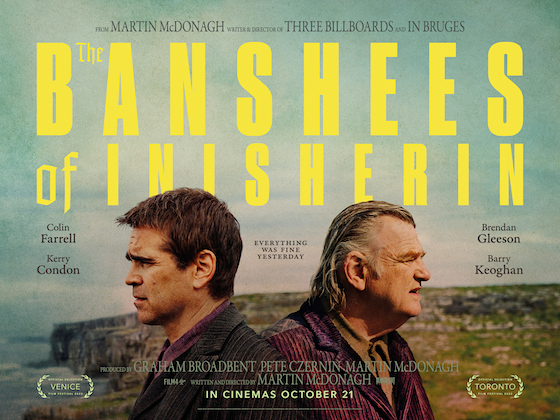
    The new film from the writer-director of Three Billboards reunites the star pairing from his first movie, In Bruges, for an altogether different — but equally as hilarious — tale of two Irishmen. Here, Colin Farrell and Brendan Gleeson play lifelong friends on a small island off the coast of Ireland in the 1920s; that is until one day Gleeson decides he just doesn’t like Farrell anymore. Cue a serious of escalating encounters as Gleeson tries to get his former mate to just leave him be.

    After the quite heavy, discourse-provoking narrative of Three Billboards, Banshees feels somewhat like McDonagh heading for smaller-scale, less contentious waters. Not that I think he’s running in fear — he doesn’t seem like one to avoid confrontation or provocation around his art — but I think that Banshees feels more of a piece with Bruges, in that it’s focused on just a handful of characters and their fairly everyday lives. That said, things do get a bit… outrageous; and the Irish civil war is ticking away on the mainland, suggesting at least one thematic interpretation of the friends’ fallout. That’s not to mention the subplots involving Farrell’s sister outgrowing her place on the island, or the woes of the local village idiot (played superbly by Barry Keoghan) and his abusive father, who happens to be the island’s policeman.

    All of which might begin to sound a bit serious. But then, juggling life-and-death issues and hilarity is almost McDonagh’s trademark. Indeed, the film’s biggest laugh is related to the story of a woman’s death; meanwhile, its saddest moment involves not the abuse or self-mutilation of any of the human characters, but rather the fate of a beloved animal (that might read as a spoiler, but I consider it fair warning for animal lovers). In viewing, it’s consistently very funny, but creeps up on you with Stuff To Think About, too. I enjoyed it a lot; maybe not as much has In Bruges or Glass Onion (no relatable comparison there other than I watched them both this month), but enough that my score rounds up.

    5 out of 5

    The Banshees of Inisherin is the 6th film in my 100 Films in a Year Challenge 2023.


  • Lupin the Third: Is Lupin Still Burning? (2018)

    aka Rupan sansei: Rupan wa imamo moeteiruka?

    Jun Kawagoe & Monkey Punch | 27 mins | Blu-ray | 16:9 | Japan / Japanese | 15

    Lupin the Third: Is Lupin Still Burning?

    Whether you want to call this a short film or a TV special or something else entirely (it was originally released straight to DVD as a special feature in Japan) is little more than a technicality, really. It’s a sub-40-minute standalone piece, and therefore I’m counting it as a short film (it also has been screened theatrically, so it’s not a totally ridiculous classification).

    What it definitely is is a 50th anniversary special for the Lupin the Third franchise. Best known in the West thanks to Hayao Miyazaki’s debut feature, The Castle of Cagliostro, Lupin III is actually a sprawling franchise. Beginning life in 1967 as a manga written and illustrated by a chap called Monkey Punch (I suspect not his birth name), an anime TV series followed in 1971, since when there have been multiple further series, dozens of films (both theatrical and TV specials), plus a couple of attempts at live-action movies, and a bunch of video games and stuff too.

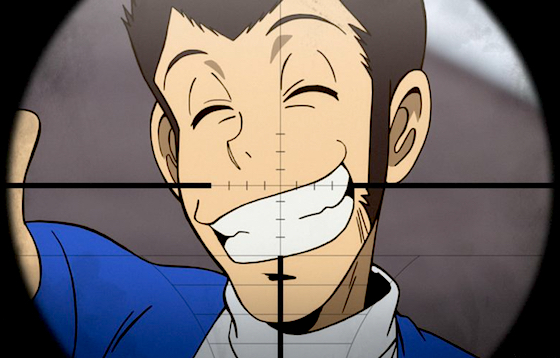
    Although this short was produced to mark the birthdate of the comics, it takes its cue from the anime series, the first episode of which was called Is Lupin Burning…?! and had the same setup: Lupin is to take part in a car race, but it’s actually a lethal trap set by his enemies. But from there, this version spins off into some wacky time-travel shenanigans — a way to send our hero back into key adventures and moments from his history, handily.

    50 years in the crosshairs

    Appropriately for a 50th anniversary special, Is Lupin Still Burning is loaded with references (both major and minor) for diehard fans to enjoy. As someone who has enjoyed a couple of Lupin’s adventures but is a long way from being well-versed in his world, I could tell a load of stuff was flying over my head — almost everything, in fact — which was unfortunate, but understandable. This is clearly a celebration that’s primarily aimed at dyed-in-the-wool fans rather than pleasing or initiating newcomers. That said, it still just about works as a madcap one-off adventure. It’s particularly enjoyable in the kinetic action sequences, like a destructive car race — being held in Nomaco (work out the ‘pun’ for yourself) — that plays out during the opening credits.

    The franchise’s only regular female cast member, Fujiko Mine, spends most of the film captured by the villains, strapped to a torture table with her clothing mostly torn off, being tickled by robot hands and stuff like that. Your feelings about all this are your own; I describe it merely for context. Put another way, not all of the “fan service” requires prior knowledge to be, er, serviceable.

    I expect if you’re a long-term fan of Lupin III, this fan-service-filled short is deserving of at least 4 stars. As someone without that depth of knowledge, it’s unmistakeable that you’re missing out on plenty. The callbacks aren’t little asides or background nods, but fundamental to the plot of the piece. Nonetheless, I’m giving it a positive score, because it is still enjoyable, even if it’s clearly not really made for the likes of me.

    3 out of 5

    The 100-Week Roundup XXVI

    The 100-Week Roundup covers films I still haven’t reviewed 100 weeks after watching them. Sometimes these are short ‘proper’ reviews; sometimes they’re only quick thoughts, or even just the notes I made while viewing.

    This week’s selection, the final two films from March 2019, includes a pair of awards-worthy short animations — the first won an Oscar, the second was nominated for one. I was going to include more films in this week’s roundup (effectively bundle two weeks into one), but it felt like a disservice to this pair.

  • Paperman (2012)
  • Waltz with Bashir (2008)


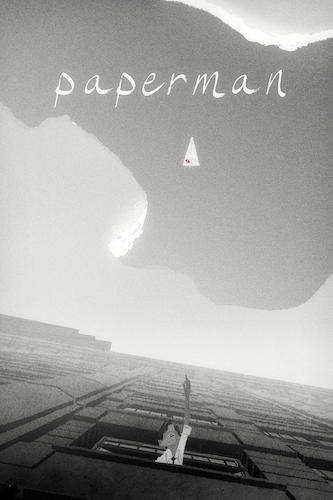
    Paperman
    (2012)

    2019 #48a
    John Kahrs | 7 mins | Blu-ray (3D) | 1.85:1 | USA / silent | U / G

    Paperman

    This Disney short was originally released alongside Wreck-It Ralph (and can now be found on that film’s Blu-ray; as well as on Disney+, I presume) and, as I recall, attracted a lot of praise at the time, primarily for its visual style. That was an innovation in creating 2D-looking animation via a 3D system — so it seems a bit daft that I watched it in 3D. I have to wonder if the added visual dimension highlights the underlying 3D animation, because it’s quite obviously been created in 3D with a 2D style over the top.

    That said, it look gorgeous, however you cut it. There’s an inherent beauty in how it’s executed, while the chosen black-and-white style emphasises the apparent setting (’40s New York) and also gives it a timeless quality. The 2D/3D combination works well, giving it the fluidity and dynamism of CG animation, but with a certain roughness — a hand-made-ness — that comes from 2D cel animation. Of course, that’s artificial, injected via design choices (like scruffy outlines on the characters), but it feels authentic.

    As for the actual story, it’s a charming little romantic number involving paper aeroplanes… until those sheets of folded paper become sentient and omniscient, at which point it lost me with its silliness. But as an exercise in style: lovely.

    4 out of 5

    Waltz with Bashir
    (2008)

    aka Vals Im Bashir

    2019 #49
    Ari Folman | 87 mins | TV | 16:9 | Israel, France, Germany, USA, Finland, Switzerland, Belgium & Australia / Hebrew, Arabic, German & English | 18 / R

    Waltz with Bashir

    One night at a bar, an old friend tells director Ari Folman about a recurring nightmare in which he is chased by vicious dogs. They conclude that there’s a connection to their Israeli Army service in the first Lebanon War of 1982. Ari can’t remember that period of his life, so he meets and interviews old friends and veterans, hoping to discover the truth about that time and reconstruct his own memories of the conflict. — adapted from IMDb

    This search for the truth has led Waltz with Bashir to be labelled an “animated documentary”, which sounds like an odd idea, almost oxymoronic — you can tell a true story with animation, of course, but can you document something? Well, yes. Rather than talking heads, what animation allows is the visualisation of the narrators’ memories and dreams alike, and means we can flow between them, too. On a practical level, it allows the film to stage scenes that would be impossible in live-action without a huge budget, meaning it doesn’t have to compromise on the stories it tells. More thematically, having a shared style between ‘reality’ and ‘dream’, plus the distancing effect of it being drawn, not ‘real’ — of being unequivocally created, not just filmed — helps to underscore larger points about the reliability (or otherwise) of memory. The dreams are connected to the memories; are the memories a kind of dream?

    Given the time period being remembered, of course the film is about war and how that affects the mind of its participants, but it’s also memory in general, I think. You’d think such extreme, unique experiences would be unforgettable, and yet the workings of the mind and memory aren’t that straightforward. One strand I found particularly fascinating was the way people are haunted by the suffering of animals in the conflict, perhaps more so than by the human-related atrocities they saw. Is this just a coincidence of the people Folman spoken to? Is it a particular interest of Folman himself? Or is it a genuine phenomenon? I don’t know the answer, but (outside of, say, War Horse) I don’t remember it being such a clear thread in a war-related film or documentary before.

    I’ve seen people say they couldn’t connect with Waltz with Bashir because they didn’t know the history of the period well enough. Conversely, I felt that was part of why the film was so effective: not really knowing what was going on or what was being referred to, I was discovering it as the character did. Some parts along the way could perhaps have used further clarity or explanation for those of us entirely unfamiliar with the conflict, but there’s enough information disclosed to be going on with. I found the film’s ending to be powerful beyond words, and part of what makes it so shocking and impactful is not knowing about it, of learning about it for the first time with the characters.

    5 out of 5

  • The 100-Week Roundup XXII

    The 100-Week Roundup covers films I still haven’t reviewed 100 weeks after watching them. Sometimes these are short ‘proper’ reviews; sometimes they’re only quick thoughts, or even just the notes I made while viewing. This week’s collection includes three more feature films and one short from February 2019

  • Hacksaw Ridge (2016)
  • Leave No Trace (2018)
  • Inception: The Cobol Job (2010)
  • Fences (2016)


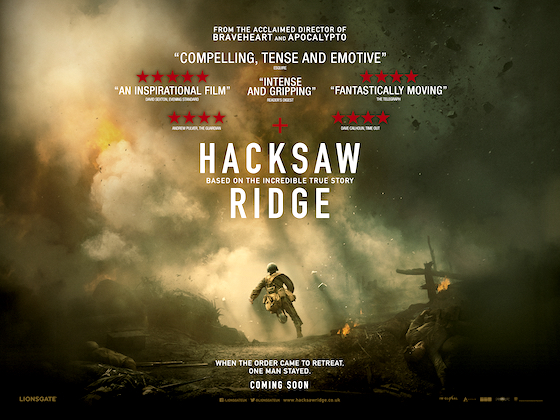
    Hacksaw Ridge
    (2016)

    2019 #17
    Mel Gibson | 139 mins | digital (HD) | 2.35:1 | Australia & USA / English | 15 / R

    Hacksaw Ridge

    Hacksaw Ridge tells the true story of Desmond T. Doss (Andrew Garfield), an American who believed that World War II was justified — so he joined the army to serve his country — but also that killing was wrong — so he refused to carry a weapon. Serving as a combat medic, Doss ended up at the bloody Battle of Okinawa, where he saved the lives of 75 men without firing a shot, and became the first conscientious objector to earn the Medal of Honor.

    It’s an extraordinary true story — the kind of thing that would seem ludicrous if someone made it up — so it earns its place on the screen. Unfortunately, I don’t think the best way to tell it was by letting Mel Gibson carve it from a block of cheese. When the film’s not wasting time on clichéd bootcamp stuff, it’s earnestly indulging in its subject matter to an eye-rolling degree. Indulgence is also the name of the game when it comes to the war, too: for a movie about a guy who wouldn’t kill, it certainly revels in its gory depictions of combat. Handled the right way, such grotesquery could have supported the point that Desmond is right, but Gibson seems to be enjoying the slaughter too much.

    And yet for all of Gibson’s amping it up, some of the real-life stories are even more incredible than what’s in the film — there are stories in IMDb’s Trivia section (here and here, for example) that stretch credulity so far it was decided to leave them out because audiences would never believe it. Considering how OTT the stuff left in is, it seems a shame to have left out something that could be backed up as a true account.

    3 out of 5

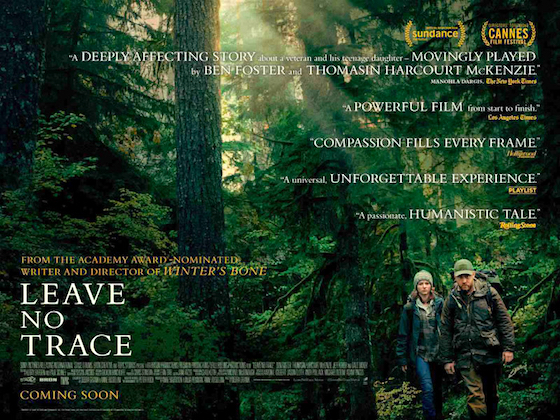
    Leave No Trace
    (2018)

    2019 #18
    Debra Granik | 109 mins | digital (HD) | 1.85:1 | USA & Canada / English | 12 / PG

    Leave No Trace

    Traumatised military veteran Will (Ben Foster) and his teenage daughter, Tom (Thomasin McKenzie), have lived in isolation for years in a public park outside Portland, Oregon, only occasionally venturing in to the city for food and supplies. But when they’re spotted by a jogger, they’re arrested and put into social services. Tom finally gets a sense of what it might be like to integrate with society, but Will clashes with his new surroundings, and soon they set off on a harrowing journey back to the wild. — adapted from IMDb

    I don’t like summarising too much of a film’s storyline at the start of a review, but Leave No Trace is one of those films where the character work is more important than the shifts of the plot. It’s a double portrait: that of a damaged man who can’t cope with society, and his loving daughter who he’s taken on the same path, for good or ill. Will’s lifestyle and parenting methods are entirely at odds with what’s seen as acceptable by society (hence the arrest and being placed in care), but does that make him wrong? The pair’s life in the woods is a “back to nature” approach, detached from technology and the hum of modernity, which many profess to strive for — he’s just actually gone and lived it. But Tom, as just a young teenager, has had this life thrust upon her — it’s what her dad wants, but she’s never known anything else to have the choice.

    So the film rests on the two lead performances. Ben Foster is reliably superb as a father doing his best for his daughter — and, actually, not doing a bad job — but struggling with his own issues and traumas. But the star is Thomasin McKenzie, in what’s proven (rightly) to be a breakout role (she quickly followed this with another leading role in Jojo Rabbit, and will next be seen in new movies from Edgar Wright, M. Night Shyamalan, and Jane Campion). She was just 17 when the film was shot, but is entirely convincing as a 13-year-old, and yet the character also seems old for her age. It’s a weird dichotomy, that. It never crossed my mind that the actress was any older than the character — it’s not just that she looks young, it’s a quality in the performance — and yet she also conveys that sense of being “wise beyond her years”. As if that wasn’t enough, the film’s emotional crux lies with her, delivered in a single emotional gut-punch of a line that’s liable to make you choke up just remembering it.

    4 out of 5

    Inception: The Cobol Job
    (2010)

    2019 #20a
    Ian Kirby | 15 mins | Blu-ray | 16:9 | USA / English | 12

    Inception: The Cobol Job

    Remember motion comics? They were a brief fad where comic books were adapted into movies/series by simply adding movement and sound to the original artwork. (I say “brief fad”, they may still make them for all I know, but there was a rash of them about ten years ago that seems to have abated.) That’s what this animated prequel to Christopher Nolan’s Inception is: a moving version of the one-shot comic (originally published online, but also included in print with some releases of the movie), written by Jordan Goldberg with art by Long Vo, Joe Ng, and Crystal Reid of Udon.

    As motion comics go, the animation here isn’t bad. It’s still clearly derived from a comic book rather than being born into animated form, but it’s got a decent amount of movement and dynamism. But its main fault is not having any voice actors. There’s music (taken from Hans Zimmer’s score for the feature) and sound effects, which complement the atmosphere and help connect it to the film proper, but having to read speech and thought bubbles really keeps it in “motion comic” rather than “animated short” territory. Were the producers at Warner really so cheap that they couldn’t’ve afforded a couple of voice actors for an afternoon’s work?

    As for the story, it’s a nice little prequel to Inception, more-or-less tonally in-keeping with Nolan’s work. It sets up the backstory behind the film’s opening heist and some of its subplots… though, kinda ironically, The Cobol Job also begins in media res, so you could do a prequel to the prequel to explain how they got there. Stories within stories within stories? How very Inception.

    3 out of 5

    Fences
    (2016)

    2019 #21
    Denzel Washington | 139 mins | digital (HD) | 2.39:1 | USA & Canada / English | 12 / PG-13

    Fences

    Troy Maxson (Denzel Washington) is a working-class African-American in 1950s Pittsburgh, doing his best to provide for his family: wife Rose (Viola Davis), teenage son Cory (Jovan Adepo), his son from a previous relationship (Russell Hornsby), and Troy’s mentally impaired brother, Gabe (Mykelti Williamson). But this seemingly-happy dynamic is tried when Troy’s secrets are forced to come to light, and his bitterness at the hand life dealt him threatens his family’s dreams. — adapted from IMDb

    Fences is adapted from a 1985 play by August Wilson, which was revived on Broadway in 2010, and many of the lead cast members from that award-winning production transfer to this film version, not least star (and now director, too) Denzel Washington. Perhaps that’s why the end result is so very stagey.

    It’s not just the limited locations or talky screenplay that give that away — there’s no reason you can’t make a film that’s set in limited locations or heavily based around dialogue, so it goes beyond that. The stage roots show through partly in that so much important stuff is kept offscreen and we’re only told about it through dialogue — I don’t think you’d tell this story this way if it originated for the screen, or indeed as a novel. Then there’s the way the actors move around, the way they come and go from the ‘stage’, the way scenes are blocked — it feels like it’s been lifted off a stage set, plonked on an equivalent real location, then filmed. Then there’s the style of the dialogue — it has a certain kind of familiar theatricality, which I can’t quite define but I always know when I hear it.

    All of which serves as a distraction from whatever Fences is meant to be about. And, frankly, it goes on a bit, with many scenes feeling in need of a massive tighten. It’s not that it’s bad, but it feels very worthy; very self consciously important. Perhaps for some people it is.

    3 out of 5

  • The 100-Week Roundup XX

    Maybe I should’ve gone out of sequence and numbered this one XXX, given the pornographic content of a couple of these films from January 2019

  • The Stewardesses 3D (1969)
  • Experiments in Love 3D (1977)
  • La jetée (1962)


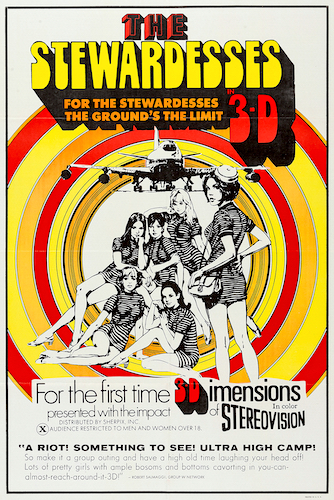
    The Stewardesses 3D
    (1969)

    2019 #6
    Alf Silliman Jr. | 93 mins | Blu-ray | 1.33:1 | USA / English | X* / R

    The Stewardesses in 3D

    If I asked you to guess the most profitable 3D movie ever made, what would you say? Avatar, probably. And, er, you’d be right (in terms of pure dollars earned, anyway). But what about before Avatar came along? You might opt for Jaws 3-D, or one of those ’80s horror franchise entries, like Friday the 13th Part III or Amityville 3-D. Or you might try Alfred Hitchcock’s shot at the format, Dial M for Murder; or perhaps the Universal horror classic Creature from the Black Lagoon. Well, all of those answers would be wrong. The correct answer — as you’ve no doubt guessed by now, because you’re not stupid — is The Stewardesses. Why?

    Boooobs.

    And, er, the rest of the female anatomy, quite frankly, because, yes, The Stewardesses is fundamentally a porno. Bow-chicka-wow-wow! Oh, but not, it would seem, one exclusively for the dirty mac brigade, as it had enough of a mainstream claim (it was advertised as being based on a novel. There was no novel) to be booked into regular cinemas as well as onto the grungy grindhouse and drive-in circuits. It ran repeatedly for decades, and was made for a pittance, so its cost-to-profit ratio just kept on going up. To be precise, off a budget of just $100,000 it’s reported to have grossed up to $30 million, a 30,000% return. (For comparison’s sake, Avatar’s return was 1,176%.) It was also technologically innovative: the director helped develop a simple and economical single-camera 3D system (the 3D films of the ’50s had been shot with two cameras and projected with two projectors), which was later used by major movies during the ’80s 3D boom, such as Jaws 3-D.

    But what of the film itself? It’s an odd mashup of porno and arthouse, with gratuitous sex and nudity bumping against mundane drama, sequences that seem more like an observational lifestyle documentary, and occasional experimental scenes. It’s hard to tell how much the film is aiming for realism and how much is just amateurish: there’s dodgy framing, weak performances, and Filmmaking 101 goofs (spot the mic), but something about the editing patterns, shot choices, and day-in-the-life subject matter feels influenced by cinéma vérité. But there are also random showcases of the 3D effect, including a game of pool and a fairground sequence, which includes point-of-view rides on a rollercoaster ride and ghost train.

    Sexy lamp

    The sex stuff is dropped in here and there around this. There’s a bit of fooling around in a cockpit at the start, although this is again played more for the 3D gimmick (some legs-akimbo feet protruding from the screen) and laughs (the old “someone left the mic on and everyone can hear” bit). But then it’s almost quarter-of-an-hour before there’s anything that could be genuinely described as pornographic (full frontal yoga); after that, it’s back to watching some of the girls go to a bar and another go on a dinner date. A surprising amount of time is spent watching girls brush their hair — sometimes topless, which makes sense in a laughably gratuitous way, but other times… not.

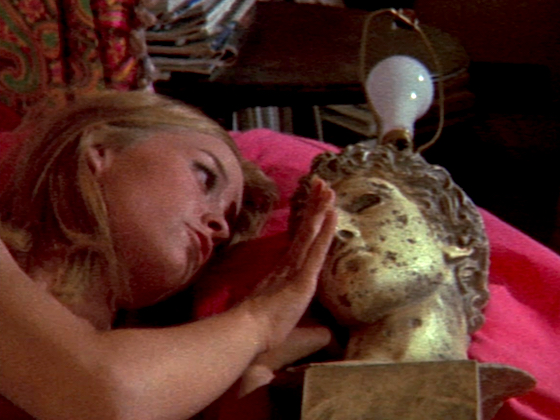
    The first truly explicit scene depicts a girl on an acid trip having sex with a lamp shaped like a classical bust, while superimposed inverted images show the body she’s imagining it has. I mean… you couldn’t make that shit up, right? It’s more like an experimental movie than a porno. Later sequences are more straightforward porn, not least a lengthy lesbian scene; but the final sex scene is far from titillating, returning to that odd artiness with shots of vases and statues, closeups of appendages and limbs, unhappy faces, and a disquieting score. It ends by taking an exceptionally dark turn, with a murder-suicide that seems almost entirely unmotivated by anything that’s come before. It’s certainly not how you expect them to wrap up a film aimed at titillation.

    It would seem The Stewardesses was a film of very mixed ambitions. The end result is objectively terrible, and yet also kind of fascinatingly enjoyable and thought-provoking. It’s certainly not dull, I’ll give it that.

    2 out of 5

    * It hasn’t been rated by the BBFC since a cut version received an X in 1973. ^

    Experiments in Love 3D
    (1977)

    2019 #6a
    Darrell Smith | 28 mins | Blu-ray | 1.20:1 | USA / English

    Experiments in Love

    Where The Stewardesses makes you wonder “is it porn or is it a drama with gratuitous sex?”, Experiments in Love prompts no such quandaries: it’s porn. And yet…

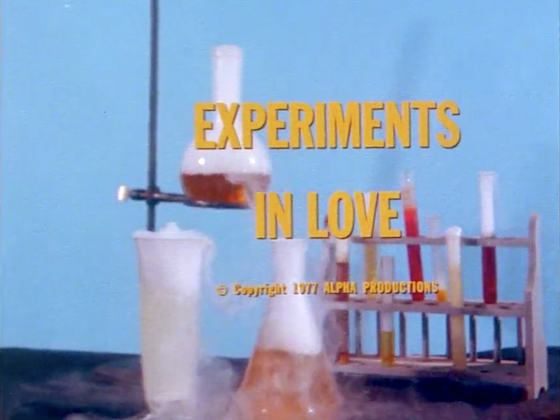
    A sci-fi comedy porno short, the plot (yes, there is a plot) sees a pair of “sexy scientists” experimenting with 3D cameras under instruction from a room-sized computer that speaks with a dodgy Japanese accent, so that they can use the cameras for a university project on human sexuality. In practice, it’s a bunch of 3D trick shots performed by a pair of women in very, very little clothing. Eventually, their sexy experiments overheat the system, which attracts the attention of a nearby handyman, and… well, I’m sure you can guess what goes on from there.

    While there’s no doubting the primary purpose of Experiments of Love, it has a knowing irreverence that makes it pretty funny, plus a cornucopia of great-looking 3D stunts, that make it worth watching for more than just the relatively explicit softcore sex and nudity. Whatever you want from it (based on reasonable expectations), you’re likely to get.

    3 out of 5

    La jetée
    (1962)

    2019 #6b
    Chris Marker | 28 mins | digital (HD) | 1.66:1 | France / French | PG

    La jetée

    And now for something completely different…

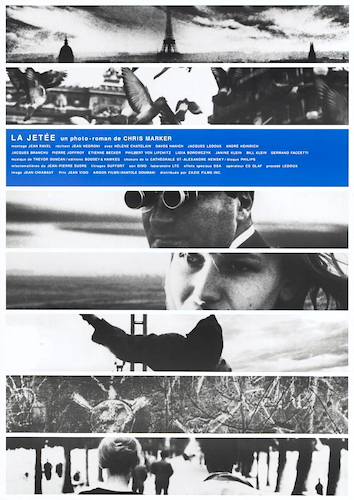
    Told via a series of still photos with voiceover narration, this is the story of a man in a post-World War III future who is subjected to a time travel experiment. While others have been unable to withstand the mental strain, scientists believe that the man’s obsession with a childhood memory will work in his favour if they send him back to near that moment. With the experiment a success, the man begins to develop a relationship with a woman in the past; but the scientists want him to find a solution for their post-apocalyptic woes…

    Probably most widely known as the work that inspired Terry Gilliam’s Twelve Monkeys, La jetée is a seminal piece of science fiction filmmaking in its own right. By limiting the visuals to photographs, writer-director Chris Marker creates an eerie, discomfiting atmosphere, wholly appropriate to a post-apocalyptic future of enforced experimentation. But it also fits thematically: this is a film very much about memory, and what is one of our primary prompters of memory if not photographs? “Nothing distinguishes memories from ordinary moments,” says the narrator at one point. “Only later do they become memorable by the scars they leave.” Genuinely, a pretty profound thought to chew over.

    La jetée is a film I definitely need to revisit: it’s one of those films that is preceded by such a reputation that one struggles to judge it fairly on a first viewing, when expectations are too high. Put another way: although I’m not giving it full marks, that is not to dispute its standing as a classic.

    4 out of 5

  • The IMDb New Filmmaker Award 2020

    Last night on AMPLIFY!, FilmBath presented the 9th annual IMDb New Filmmaker Award, in which a trio of industry judges choose the best short film by a new filmmaker (clue’s in the name). The winner gets £1,000 cash, £1,000 in gear hire for their next project, a natty trophy, and an IMDb pin badge (normally only given to IMDb employees). If you missed the evening, never fear: the whole 90-minute event is available to rewatch for free, worldwide, here.

    Why would you watch an awards show after it’s happened? Well, in this case, you get to hear the judges’ musings on what makes a good film — and when those judges are BAFTA-nominated director Coky Giedroyc (The Virgin Queen, How to Build a Girl), Oscar-nominated and BAFTA-winning producer Amanda Posey (An Education, Brooklyn), and the CEO of IMDb, Col Needham, those are opinions worth listening to. Even better, you get to watch the five nominated shorts in full, and they’re good a bunch.

    But don’t just take my word for it: take my, er, word for it, in the form of these reviews…

    If you do intend to watch the awards, fair warning: I’m going to ‘spoil’ who won.

    Under the Full Moon

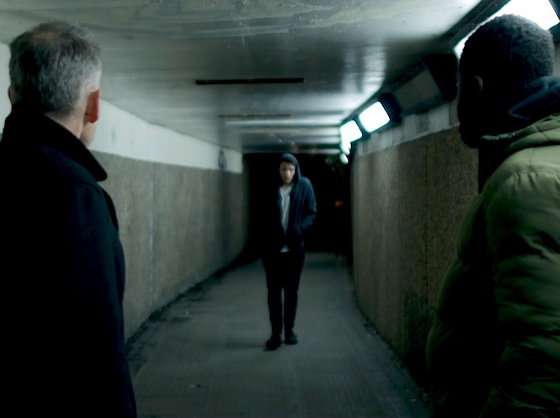
    Taking the films in the order they were shown, first up is Under the Full Moon (2020, Ziyang Liu, UK, English, 9 mins, ★★★★☆), about a guy who has his phone pickpocketed and decides to confront the mugger. The most noteworthy aspect here is the whole short is achieved in a single unbroken eight-minute take. I love stuff done in single long takes; at this point it’s a bit of a cliché to enjoy such things — a real film nerd kind of obsession — but, sod it, it’s still cool. To do a thriller storyline like that — something which requires management of tension and suspense, and of information being revealed at the right time in the right way — is even more impressive. You might say, “well, that’s what theatre is — a drama performed in ‘one take’”, but theatre doesn’t have to factor in camerawork; making sure we’re seeing the right stuff at the right time, framed in the right ways. Under the Full Moon manages every different element almost perfectly, the only real flaw coming right near the end, when the camera fails to clearly capture a phone screen with an incoming call, so the director resorts to a subtitle to make sure we get this final ironic twist. And that’s the other thing: this isn’t just a technical stunt, or an exercise in escalating suspense, but a dramatic work with some neatly-drawn character parts and a sense of dramatic irony. Really strong work.

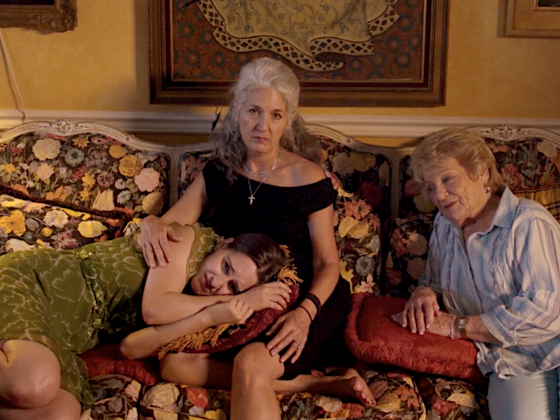
    The winner (told you I’d spoil it) was Flush Lou (2020, Madison Leonard, USA, English, 9 mins, ★★★★★), and I entirely agree. It’s a black comedy about the reaction of three women to the death of a man: his daughter (who narrates), his wife, and his mother. It’s got a quirkiness that could be inappropriate, but the tone is juggled just right that it remains hilarious rather than at all distasteful. It’s there in the performances, the shot choices, the editing — the piece really works as a whole to hit precisely the right note. It might call to mind the work of someone like Wes Anderson, but it’s far from a rip-off; it also reminded me of certain just-off-reality American-suburbia-skewering TV shows, like The Riches or Suburgatory (I’m sure there are some more mainstream examples that are eluding my reach right now). Also, it manages to pack eight chapters into its eight minutes, without ever feeling like that’s an unnecessary affectation; if anything, it helps clarify the structure, which is exactly the kind of thing chapters are good for. A huge success all round.

    Flush Lou

    At the other end of the seriousness spectrum was the winner of the audience vote, The Monkeys on Our Backs (2020, Hunter Williams, New Zealand, English, 8 mins, ★★★★★), a documentary about the mental health of farmers in New Zealand. I think we often have a very positive view of New Zealand — they seem like nice people; their government is doing awesomely well; they make great movies; they’re good at rugby; and so on. But the country has one of the highest suicide rates in the developed world, and mental health problems disproportionately affect those living and working in isolated rural communities. This is not only a succinct explanation of the problems, with real-life examples as well as expert opinions, but also talks about the solutions, what help is out there and how it’s working. Plus it’s a beautifully shot film (some outtakes in black & white at the beginning show the fundamental quality underlying the colour photography in the rest of the film), with lovely views of countryside life, as if to help remind you that the world is a wonderful place. A wholly different film to Flush Lou, but an equally deserving winner.

    The shortest of this year’s five is Players (2020, Ava Bounds, UK, English, 3 mins, ★★★★☆), but that’s not the most noteworthy thing about it. This is: it was made by a 14-year-old. But you’d never guess, because it has a competency and, more strikingly, a surrealism that belies someone much more experienced. Heck, the sound design most reminded me of David Lynch! And the comparison goes beyond the sound work, with an ending that calls to mind some of Lynch’s work where nature and technology clash. Subtitled “a clearly confused film”, I think that was somewhat how the judges felt about its mix of retro costumes and music, computer-generated vocals, and a sci-fi sting in the tail. It’s the kind of film that clearly doesn’t work for everyone — just another way it’s a natural successor to Lynch, then. A 14-year-old making a competition-worthy short film is incredible in itself, but that it also merits so many comparisons to David fucking Lynch? Remarkable.

    The Monkeys on Our Backs

    The final film was Home (2020, Hsieh Meng Han, UK, English, 10 mins, ★★★☆☆), in which a girl living with her mother in a single room in a dingy apartment block finds the communal toilet locked, but then hears music coming from a nearby ventilation grill. Climbing through, she finds herself in a brightly-lit world of opulence, with people in elegant clothes dancing to genteel music, and an array of luscious food on offer. She even makes a friend. But then uptight officiousness arrives in the form of a stuffy manager, who refuses to let her use the toilet. It’s like a modern socially-conscious take on Alice in Wonderland, though I’m not sure what point it was ultimately making — kindness is nice and everyone deserves to be allowed to use the toilet?

    If any of that tickles your fancy, don’t forget you can still watch the whole event, free, here.

    Disclosure: I’m working for AMPLIFY! as part of FilmBath. However, all opinions are my own, and I benefit in no way (financial or otherwise) from you following the links in this post or making purchases.

    The 100-Week Roundup III

    In this selection of films I watched back at the end of May / start of June 2018…

  • The Wild Bunch (1969)
  • The Wild Bunch: An Album in Montage (1996)
  • The Warriors (1979)
  • Power Rangers (2017)
  • Three Billboards Outside Ebbing, Missouri (2017)


    The Wild Bunch
    (1969)

    2018 #115
    Sam Peckinpah | 139 mins | streaming (HD) | 2.40:1 | USA / English | 18 / R

    The Wild Bunch

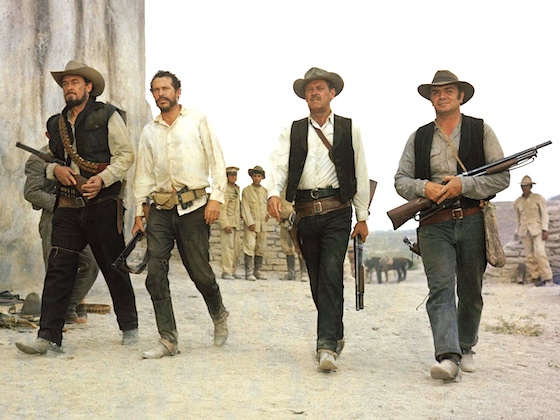
    After a gang of ageing crooks’ “one last job” goes sideways, they agree to rob a munitions train for a Mexican general, even as they’re hunted by a militia reluctantly headed by their leader’s former partner.

    The Wild Bunch is, of course, a Western, but it’s set in 1913 — not a time we particularly associate with “the Old West”. Well, change doesn’t happen overnight. And it certainly takes that “end of an era” thing to heart as a tale of old men, whose way of life is fading away. It’s also a ‘late Western’ in terms of when it was produced: this isn’t an old-fashioned “white hats vs black hats” kinda adventure, but one full of ultra-violence with a downbeat ending. The opening sequence gets pretty bloody, and then the climax is an absolute orgy of violence. It’s still almost shocking today, so you can see how it was controversial back in 1969.

    It’s not just the presence of violence and blood that’s remarkable, though, but how it’s presented, both in terms of filmmaking and morals. To the former, the speed of the cutting was groundbreaking at the time: reportedly it contains more cuts than any other Technicolor film, with 3,643 cuts in the original print. If that’s true, it gives it an average shot length of about 2.4 seconds. For comparison, the average in the ’60s was around 6 or 7 seconds, while even Moulin Rouge, a movie made decades later that was still notorious for its fast cutting, has an average shot length of 2.01 seconds. It’s not just speed that makes the editing so noteworthy, but its effectiveness, making juxtapositions and using shots to both tell the story and create the impression of being in the thick of it.

    Bad boys

    As for the morals, the film was all about showing these violent men as unheroic and unglamorous, setting out to “demystify the Western and the genre’s heroic and cavalier characters” (to quote IMDb). That piece goes on to say that screenwriters Sam Peckinpah and Walon Green “felt that this project required a realistic look at the characters of the Old West, whose actions on screen had rarely matched the violent and dastardly reality of the men on which they were based… Both Green and Peckinpah felt it was important to not only show that the film’s protagonists were violent men, but that they achieved their violence in unheroic and horrific ways, such as using people as human shields and killing unarmed bystanders during robberies.”

    Of course, antiheroes are ten-a-penny nowadays, so the idea that “men who commit violence are bad” doesn’t play as revolutionary anymore. Indeed, The Wild Bunch can be enjoyed as an action movie — there’s the opening and closing set pieces I’ve already mentioned, plus an excellent train robbery and ensuing chase in the middle too, and a couple of other bits. That said, the film has more on its mind than just adrenaline-generating thrills, and so (based on comments I’ve read elsewhere online) if you are watching just for action it can feel like a bit of a slog. While I wouldn’t be that critical, I did find it a bit slow at times. The original distributors must’ve felt the same, as the film was cut by ten minutes for its US release. (The version widely available today is the original 145-minute director’s cut. I watched a PAL copy, hence the 4% shorter running time.)

    4 out of 5

    The Wild Bunch was viewed as part of my Blindspot 2018 project.

    The Wild Bunch:
    An Album in Montage

    (1996)

    2018 #115a
    Paul Seydor | 33 mins | DVD | 4:3 | USA / English | 15

    Behind the scenes of The Wild Bunch

    This film came to exist because someone found 72 minutes of silent black-and-white behind-the-scenes footage shot during the filming of The Wild Bunch. No one knows why it was filmed — this was a long time before the era of EPKs and DVD special features. And, indeed, if it had been discovered just a couple of years later then a DVD special feature is exactly what it would’ve become; but, being just ahead of that, it ended up as a short film — an Oscar-nominated one at that, going up for the Best Documentary Short prize in 1997. Naturally, it has since found its rightful home as a special feature on DVD and Blu-ray releases of its subject matter.

    The silent film footage is accompanied by voice over of first-hand accounts from the people involved, either taken from recorded interviews (people like screenwriter Walon Green and actors Edmond O’Brien and Ernest Borgnine represent themselves) or actors reading out comments (Ed Harris is the voice of Sam Peckinpah, for example). From this we get not only making-of trivia and tales, but also discussion of the filmmakers’ intent and the film’s meaning. More material along the lines of the latter would’ve interested me.

    As it is, An Album in Montage feels very much at home in its current situation as a DVD extra. Fans of the film will certainly get something out of it, but I don’t think it’s insightful enough to stand independently. It’s by no means a bad little featurette, but it’s not worth seeking out outside of the context of the film itself.

    3 out of 5

    The Warriors
    (1979)

    2018 #123
    Walter Hill | 89 mins | streaming (HD) | 16:9 | USA / English | 18 / R

    The Warriors

    In the near future, a charismatic leader summons the street gangs of New York City in a bid to take it over. When he is killed, The Warriors are falsely blamed and now must fight their way home while every other gang is hunting them down.IMDb

    And that’s all you need to know, because The Warriors’ plot is really simple and straightforward, but that’s part of why it works. It doesn’t need dressing up; it’s got an almost an elegant directness, and it thrives off that. The action sequences feel unchoreographed, with a bruising realism in spite of their sometimes elaborate setups (duelling baseball bats!), and yet they carry an energy and impact that is wholly in keeping with something carefully designed and constructed. The characters are simply drawn, revealed through their actions rather than telegraphed Character Moments or heartfelt speeches. Similarly, the kind-of-romance between the Warriors’ leader and the girl they run into on the streets is so well handled — okay, there are some scenes where they almost talk about it directly, but mostly it’s just moments or lines that indicate a world of feeling. The way this character stuff is sketched in — subtly, sometimes in the background — is quite masterful, actually.

    Such skill extends throughout the film’s technical side. For all the film’s ’70s grit, there’s some beautiful stuff in the editing and shot choices, especially at the end on the beach. It’s not just beauty in an attractive sense, but meaningful, effective imagery, in a way that impresses without being slick or pretty. The music choices are bang-on too. The film intercuts to a radio station that functions like some kind of Greek chorus, linking the action and helping to create a heightened atmosphere — one that’s there in the whole film, incidentally, with its colourful gangs and detached police presence — without ever shattering the down-to-earth, gritty, almost-real feel the whole thing has.

    Gang wars

    I loved The Warriors, and I think that last point is a big part of why: it sits at an almost inexplicable point where it feels incredibly grounded, gritty and realistic, but at the same time a heightened fantasy kind of world. Here I’m trying to describe why I adored the film bu breaking it down into these constituent parts, but there’s something more to it than that — a kind of magic where it just… works.

    All of that said, it seems I was lucky to catch the original version (via Now TV / Sky Cinema), rather than the so-called Director’s Cut that seems to be the only version available on Blu-ray. Looking at the changes, they don’t seem particularly in keeping with the tone of the movie, smacking of decades-later revisionism. Apparently there’s also a TV version that includes 12 minutes of additional scenes, none of which are included on the film’s disc releases. I wish Paramount would license this out to someone like Arrow to do it properly…

    5 out of 5

    The Warriors placed 11th on my list of The 26 Best Films I Saw For the First Time in 2018.

    Power Rangers
    (2017)

    2018 #126
    Dean Israelite | 124 mins | streaming (HD) | 2.35:1 | USA, Hong Kong, Japan, Mexico, Canada & New Zealand / English & Mandarin | 12 / PG-13

    Power Rangers

    High school outcasts stumble upon an old alien ship, where they acquire superpowers and are dubbed the Power Rangers. Learning that an old enemy of the previous generation has returned to exact vengeance, the group must harness their powers and use them to work together and save the world.IMDb

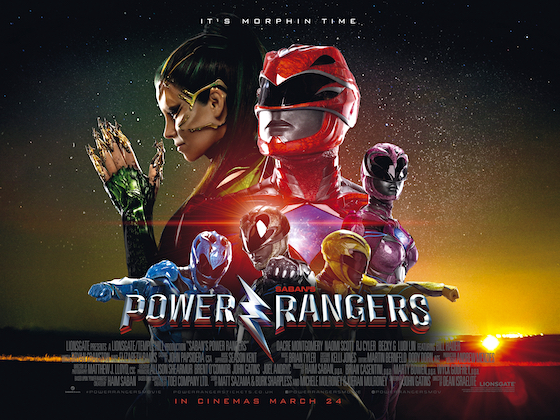
    Far from the cheesy TV series of old, this Power Rangers reboot clearly wants to be a somewhat gritty, largely realistic, socially conscious take on the concept. But it’s like it was written by people behind the original, because it’s still full of clunky dialogue, earnest characters (with a thin veneer of outsider ‘cool’), and nods to serious issues without having the time or interest to actually engage with them. Like, one of the kids is the sole carer for his sick mother, or another is on the autistic spectrum, but, beyond spending a line or two to tell us these things, those issues have no bearing on the plot or the characterisation. Plus, it can’t overcome some of the fundamental cheesiness of the original. And when it tries to give in to it, like by playing the Power Rangers theme the first time the giant “dinocars” run into action, it’s too late for such shenanigans and the tones clash horrendously. It wants to escape the tackiness of the original series, but simple can’t.

    And somehow it gets worse as it goes on. The early character stuff is derivative but alright. Then you begin to realise how shallow it is. You’re waiting for the super-suits to show up and the action to start. Then you have to wait some more while it works through plot beats so stale it can’t even be bothered to play them out fully. Then, when the suits finally arrive and the action starts, turns out it’s the worst part of the movie. Almost entirely CGI, under-choreographed, a mess of nothingness with little correlation from shot to shot, no sense of rhythm or construction. When their dinocars all merge into one giant dinocar, the villain screams “how?!”, and you will feel the same.

    Bryan Cranston (yes, Bryan Cranston is in this) tries to inject some character into his role, but it’s too underwritten and his screen time too slight to let him do much with his supposed arc. Elizabeth Banks, meanwhile, is barely in it and has no arc whatsoever, but she chews scenery like a pro. She seems to be aware it’s all stupid and over the top and plays it appropriately.

    2 out of 5

    Three Billboards Outside Ebbing, Missouri
    (2017)

    2018 #127
    Martin McDonagh | 115 mins | Blu-ray | 2.39:1 | UK & USA / English | 15 / R

    Three Billboards Outside Ebbing, Missouri

    a darkly comic drama from Academy Award nominee Martin McDonagh. After months have passed without a culprit in her daughter’s murder case, Mildred Hayes (Frances McDormand) makes a bold move, painting three signs leading into her town with a controversial message directed at William Willoughby (Woody Harrelson), the town’s revered chief of police. When his second-in-command, Officer Dixon (Sam Rockwell), an immature mother’s boy with a penchant for violence, gets involved, the battle between Mildred and Ebbing’s law enforcement is only exacerbated.IMDb

    As well as being as deathly serious and sometimes horrifying as the subject matter deserves, Three Billboards is also as funny as you’d expect from the writer-director of In Bruges. Not to the extent — the subject matter is far too serious for it to be an outright comedy like that — but in subplots and interludes it’s hilarious.

    It’s got a helluva cast, and all of the performances are excellent. Frances McDormand is so fucking good that she even manages to make talking to a badly CGI’d deer incredibly emotional. Apparently some people had a massive problem with the film’s treatment of Sam Rockwell’s character, I think because he was a bad guy who got redeemed. But, really, imagine thinking people who once did bad things can never turn themselves around and be better people. What a pessimistic way to view the world. And yet I guess that’s what today’s “cancel culture” is all about.

    Two outta three ain't bad

    It’s nicely shot by DP Ben Davis (except for that deer), while Carter Burwell’s Western-esque score has some really cool bits. It really emphasises the film’s formal overtures at being a revenge Western, even if the way it goes down in the end doesn’t necessarily support such a reading.

    There was a huge backlash to the film at some point; bring it up online and you’re likely to come across people who assume everyone hates it… but it’s got 90% on Rotten Tomatoes and is still ranked the 150th best film of all time on IMDb, so I think we know where the majority stand. I’m happy to stand with them.

    5 out of 5

    Three Billboards Outside Ebbing, Missouri placed 14th on my list of The 26 Best Films I Saw For the First Time in 2018.

  • Shorts of FilmBath Festival 2019

    Across the 2019 FilmBath Festival programme, 46 short films were screened — 23 attached to feature films, 17 at a dedicated ‘Shorts Showcase’, and six at the IMDb New Filmmaker Award ceremony (five in competition, one the film made from the winning screenplay of the IMDb Script to Screen Award). I saw 14 of these, one way or another, and have compiled my reviews into this (commensurately long) post.

    First, the five films that competed for the IMDb New Filmmaker Award.

    Gladiators on Wheels

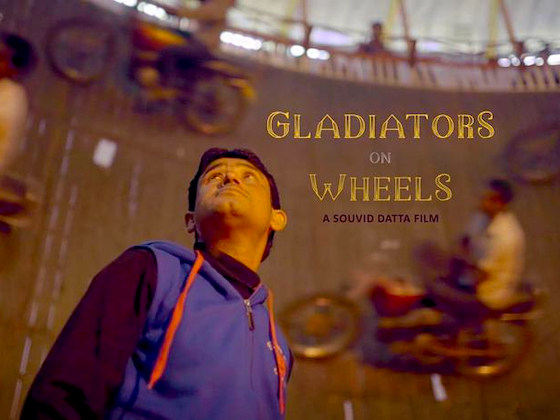
    The winner chosen by the judges was Gladiators on Wheels (2019, Souvid Datta, UK & India, Hindi, 6 mins, ★★★★☆), a documentary about the ‘Well of Death’ — an attraction at Indian circuses where daredevils ride motorbikes and drive cars around 60ft vertical walls, literally defying gravity. It’s both impressive and terrifying, especially considering they’re doing it without any kind of safety gear — no helmets or padded suits here, never mind nets or something. But the film isn’t just about the actual act, also touching on the way of life, and how it’s fading. It’s a well-shot bit of filmmaking, especially impressive when you learn it was all filmed in a single day. The script was compiled from interviews with the drivers, then voiced by actors, but if anything it’s a little cliché — lots of talk of “living on the edge” and how dangerous it is but how they wouldn’t have it any other way, etc. Still, like many of the best documentaries, it’s a fascinating glimpse at another world.

    The audience at the ceremony also got a say, favouring Hey You (2019, Jared Watmuff, UK, English, 5 mins, ★★★★★), which is about gay men hooking up via text messaging. At first it feels like a lightly comedic bit of fun, possibly with some drama in that one of the men is closeted, but then it develops into something more serious. It’s a very well made short, in particular the shot choices and editing at the climax, which combine to produce some incredibly striking imagery. It’s tricky to say why it’s such an effective and vital film without spoiling where it goes in that finale, but it’s a meaningful piece that’s worth seeing if you can. It would’ve been a worthy winner.

    Facing It

    The three other finalists were … Tight Spot (2018, Kevin Haefelin, USA & Switzerland, English, 4 mins, ★★★★☆), a comedy bit about a shoe shiner and a suspicious customer, which was amusing albeit a little predictable; although it did, again, look nice … When Voices Unite (2017, Lewis Coates, UK, English, 4 mins, ★★★☆☆), a mini tech thriller that was suitably tense in places, but really needed some kind of twist or final development to give it a reason to exist … and Facing It (2018, Sam Gainsborough, UK, 8 mins, ★★★★★), which presented an imaginative visualisation of a relatable social difficulty. Rendered in a mix of live-action and stop-motion animation, it’s by far the most technically impressive short here, but all in service of telling its story and conveying the requisite emotion. Another one that would’ve been a more than worthy winner.

    (You can watch Gladiators on Wheels and When Voices Unite on Vimeo. Sadly the others aren’t publicly available, although there is a short making-of for Facing It which I recommend for appreciating the filmmaking skill on display there.)

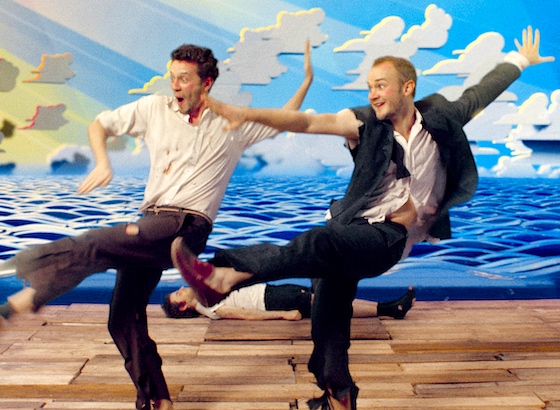
    Of the other shorts I saw, my favourite was definitely Pleased to Eat You! (2019, Adrian Hedgecock, UK, English, 7 mins, ★★★★★). It’s a beautifully designed and hilariously funny musical comedy short… about cannibalism! Its colourful and clever staging evokes the handmade movie-reality worlds seen in films by the likes of Michel Gondry or Charlie Kaufman, while the full-blown song-and-dance number is like the best of old-fashioned Hollywood musicals, albeit twinned with a pun-filled cheekiness in its subject matter. An absolute delight from beginning to end.

    Pleased to Eat You!

    If I were to rank all the other shorts too, I’d probably put Woman in Stall (2018, Dusty Mancinelli & Madeleine Sims-Fewer, Canada & UK, English, 10 mins, ★★★★☆) in second place. A very timely thriller, it sees a woman innocently enter a public bathroom cubicle to get changed, only for a man to turn up outside and start chatting, her wariness of him trapping her inside. Is he a predator she’s right to fear? Or is she just being paranoid? Part of the short’s cleverness lies in the way it plays with our emotions and expectations, swinging us back and forth into where our trust should lie. Working with a limited setting, it’s neatly shot — never dull, but without going OTT to try to jazz things up — and gets edge-of-your-seat tense as it goes on. Regular readers will know how much I love a “single location thriller”, and this is a perfect mini example of the form.

    Quince: Fifteen (2018, Peiman Zekavat, UK & Peru, Spanish, 10 mins, ★★★★☆) is a real-time single-shot drama about a 15-year-old Peruvian schoolgirl whose carefree PE lesson turns into a tumult of life-upending dismay in just a few minutes following an unexpected discovery on social media. It’s another timely issue, and this is mostly a well-made short — I do love a single take, and the real-time aspect puts you in her shoes quite effectively. Unfortunately, it’s a bit inconclusive — it just stops, with no hint of how she’s going to deal with her new problem longer term, or what’s going to happen to her beyond a handful of initial reactions. It’s not bad as it is, but there’s also more to be told here.

    Quince: Fifteen

    On a snowy winter’s day, a postie makes his rounds on a London estate. Meanwhile, one woman anxiously awaits his arrival… With its brief running time, Special Delivery (2018, Robert Hackett, UK, 4 mins, ★★★★☆) almost feels like an extended edit of one of those soppy commercials the big retailers always put out at Christmas — you know, the ones that have just started to pop up on the telly. Nicely shot in 2.35:1, it evokes a Christmassy feel without being overtly festive, and manages to avoid becoming quite as saccharine as those adverts, instead earning the story’s sentimentality. A sweet little slice of romance.

    Coming just behind those frontrunners would be Spooning (2019, Rebecca Applebaum, Canada, English, 6 mins, ★★★★☆), a one-woman-show of a mockumentary about a theatre actress who specialises in playing spoons. Not “playing the spoons”, like a musical instrument, but anthropomorphised spoons, like in Beauty and the Beast. It’s basically a comedy sketch as a short film, but it was largely funny so I don’t begrudge it that.

    I’m six films deep into this loose ranking now, but that’s not to discredit Allan + Waspy (2019, James Miller, UK, English, 8 mins, ★★★★☆). It’s about two working class schoolboys who hang out in the woods on their way to school each day, observing a bird’s nest full of chicks hatching and maturing — but one of the lads clearly has problems at home, and it all takes a very dark turn. Initially it’s a likeable slice-of-modern-life tale, managing to find an element of old-fashioned bucolic childhood even in a modern inner-city setting, and unfurling at a gentle pace by mixing shots of the surrounding world into the boys’ activities. But then there’s a thoroughly glum ending. It kinda ruined my day, but I liked it as a film nonetheless.

    Cumulus

    A young Welsh girl runs off from her dad and encounters a talking gull who’s worried about his kids leaving home in animation Cumulus (2018, Ioan Holland, UK, English, 9 mins, ★★★☆☆). Naturally, they both learn something from each other. It’s always nice to see 2D animation nowadays, especially when it’s as prettily designed as this, though it’s a shame that some of the movement is a little stilted and animatic-y. It’s also a bit longer/slower than it needs to be, but it’s still mostly charming.

    Perhaps the most disappointing short was My Theatre (2019, Kazuya Ashizawa, Japan, 5 mins, ★★★☆☆), a documentary about an 81-year-old in Fukushima who closed his cinema 55 years ago but keeps it alive as a kind of museum. That’s mainly what I gathered from reading blurbs before viewing, though, because the short itself lacks any real context or conclusion, just presenting vignettes of life in this rundown old movie house. It’s perfectly pleasant, but ultimately unenlightening. My Theatre is listed on other festivals’ websites as running 20 minutes, so perhaps the five-minute version submitted to FilmBath is just an excerpt — that’s certainly what it felt like. A longer edit, with more of a sense of why this is a place and person worth observing, would’ve been better.

    Finally, Terra (2019, Daniel Fickle, USA, English, 6 mins, ★★☆☆☆), which received some very negative feedback from a few audience members who didn’t feel it was appropriate for the film it was screened before, Honeyland. That’s a documentary about a traditional European way of beekeeping on the wane, whereas Terra is ostensibly about the tumultuous romantic relationship between two young Americans. The clue is in the title, though: it’s a metaphor for humankind’s relationship with Earth. Personally, I thought the analogy was a bit on the nose, but it seems others missed it entirely. The photography is quite pretty, in a no-budget-indie-drama kinda way, but other than that I didn’t think there was much to it. Other members of the FilmBath team were more impressed, so I think it’s fair to say it’s a divisive little number.

    Terra

    As I said at the start, there were 46 shorts screened at the festival, so this is just a small sampling of what was on offer (less than a third, to be precise). Although I didn’t love them all, I did enjoy most — and considering they would have entirely passed me by were it not for the festival, I’ll definitely take the handful of letdowns as part of the parcel for getting the good stuff.