
Ridley Scott | 124 mins | Blu-ray | 2.40:1 | UK & USA / English | 15 / R
With all the furore this week over the (supposed) behind-the-scenes problems with attempts to launch Prometheus 2, it’s about time I posted my review of last year’s intended franchise-starter…
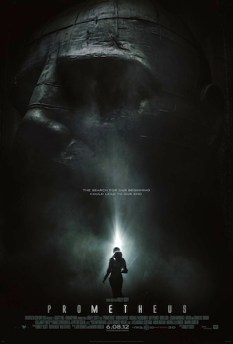 Ridley Scott’s not-an-Alien-prequel-honest Alien prequel is nothing if not divisive, with critics and fans alike declaring it to be a revelatory masterpiece, irredeemable faux-profound slop, and every point on the spectrum in between. I did my best to remain spoiler-free throughout the four months between its theatrical release and disc debut (crikey things reach DVD quickly these days!), though I did read a leaked plot description in advance that was reportedly decried as rubbish. I wish I could remember where I found it because I’d love to know if it matches up. Sadly I can’t remember the details, but obviously something stuck — and therefore it was right — because I was singularly unsurprised by the majority of Prometheus’ story. But that doesn’t necessarily matter if the film is any good, and Prometheus… well…
The first half is quite good, in a slow, meaningful kind of way. Even at that point there’s doubts: some of what occurs is just unnecessary detail; shots and scenes that seem consciously designed to give it a slow pace rather than stuff we actually need to see.
The second half is batshit crazy. It abandons the thoughtful Serious Science Fiction trappings for schlocky body/creature horror, and in the process abandons the semblance of making sense. Plot holes glare at you. Characters make unfounded leaps of logic. It feels like whole scenes or sequences are missing. Indeed, quickly scanning through the disc’s description of some of the deleted scenes, it looks like they might explain some of the film’s gaps. I presume there’s a good reason they were cut though… right…?
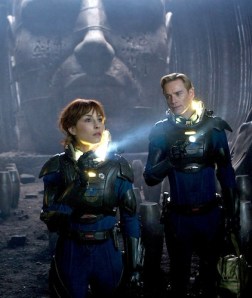 And then, to top it off, it doesn’t have a real ending! They may as well slap “to be continued” on screen, such is the obvious lack of conclusion. It’s immensely frustrating, only to be topped off with a “in case we don’t get the sequel” bit of connective tissue to the Alien series. Mysteries and unanswered questions aren’t a problem in and of themselves — there are plenty in Prometheus’ franchise forbears, the first in particular — but they’re not the kind that require answers: their stories work as a discrete unit; who the Space Jockey is, or how the aliens came to be, and so on, are set dressing. Conversely, the gaps in Prometheus are in the primary narrative. There would be an argument for it being a thematic point — a Bergman-esque ‘silence from the Gods’ — but the starkness of that ending, as clear a cliffhanger as either of the first two Lord of the Ringses, undermines that. It fairly screams, “there’s more to come! See the next film for the answers!” And that isn’t on, because that isn’t what we were promised — this isn’t Prometheus: The Fellowship of the Prometheus, with Prometheus: The Two Planets already shot and scheduled for next year, and the trilogy-forming conclusion Prometheus: The Return of the Alien for the year after that; it’s just Prometheus, full stop, the sole definitive article. But it isn’t.
The sense that everything’s been cobbled together in the current blockbuster fashion of “keep writing even while shooting” extends right down to things like character development; even to individual scenes. Take Holloway (Logan Marshall-Green), for instance. He’s a dick. I’ve no sympathy when it all goes wrong for him because he’s not at all likeable. What’s somewhat ironic is that the deleted scenes note at least one sequence was re-shot to try to make him more sympathetic. And, funnily enough, I remember during that scene in the film thinking it was about the only time he seemed even vaguely appealing (even then, only relatively). Just one of many such apparently-bungled elements in the film.
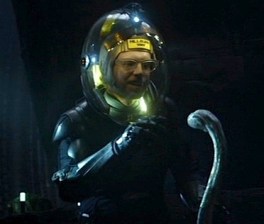 No character is fully developed. Some barely register, suggesting too big a cast, while others suffer from being plain stupid, or doing inexplicably stupid things, or just piss-poor acting. There’s some thing made about Shaw (Noomi Rapace) being religious or a true believer or something, but it’s not properly explained and doesn’t go anywhere. David (Michael Fassbender) and the way he’s treated by the other characters are both very interesting areas, and clearly of huge thematic resonance, but he acts inconsistently for no obvious reason, and despite the horrendous things he does to Shaw at one point, she just gets on with him again in the next scene, and… well, that’s far from being the film’s only plot hole or inconsistency.
At one point a character escapes a situation only to be killed off in a different one. If that sounds like a reasonable thing to do, that’s because I’m trying to avoid spoiling parts of the climax. It’s not a particularly reasonable thing to do, though; it plays as “here’s a cool death”. I’ve not read multiple versions of the script or read interviews with the writers or listened to their commentary (yet), but one does wonder if Damon Lindelof was brought in to pull back on some of the Science Fiction (with a capital SF) and build up the blockbuster-y elements, because that’s what said cool death feels like: a film constructed from “what would look cool? What haven’t we seen?” rather than “what are we trying to say?” I have no problem with the former in its rightful place (Tomorrow Never Dies has the awesome bike chase because it was the antithesis of GoldenEye’s tank chase, for one ready example), but a film that sets out its stall around Concepts is not the right place.
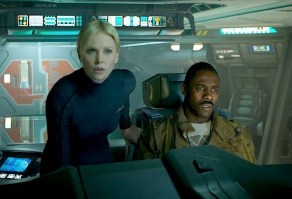 The daft thing is, I think a lot of people would’ve been happy if it had chosen to just go all-out as a schlocky alien horror movie. That’s what Alien is: an exceptionally well-made haunted house movie in space. There’s no shame in that (well, maybe in cinéaste circles, but pish.) But that’s not where Prometheus pitches itself. There’s too much other stuff for it to be just that; stuff that’s apparently aiming to be Profound. So when the horror does turn up, it doesn’t belong.
It does all look bloody gorgeous, from the real landscapes to the CGI. It was shot by Dariusz Wolski, whose previous credits include all four Pirateses and not much else that would suggest a remarkable skill. But sod a pixel-generated tiger, these vistas surely deserved recognition. (But then I’ve not seen the tiger movie, so…) I didn’t see it in 3D, obviously, but it certainly looks like it was shot for the format. Not because there’s stuff poking out at you, thank goodness, but look how light it all is, especially compared to the original Alien. I’m sure the scenery had lovely depth.
A side effect of such format-hopping is a debate on the correct aspect ratio: it was reportedly shown at 1.66:1 on IMAX, 2.00:1 on IMAX Digital, and 2.35:1 otherwise (the Blu-ray remains at 2.4:1 throughout). I have no idea whether the IMAX was opened out or cropped, though I’d imagine the former, which does make you ponder why they didn’t just use that everywhere, especially on home formats. I guess 2.4:1 must be Scott’s preferred ratio… but is that OK? Should we lament the missing top and bottom? I dunno. More interested parties than I have debated this at length, if you fancy scouring the web for it.
 Prometheus is a funny old beast, then. There’s lots of good stuff in there, but also lots of baffling decisions and confusing shifts of tone, emphasis, style… Considering it was made by an experienced master-filmmaker, who was presumably granted all the time, freedom and money he wanted to craft the film he desired, it’s baffling how it ended up feeling like such a hodge-podge. Many fans have blamed Lindelof, brought in late on to re-write the screenplay; but considering Scott ruined Robin Hood by ditching an innovative, exciting screenplay for a stock this-is-real-history re-telling of the legend, perhaps the blame lies at his door. He’s reached a point where he can order anyone to change anything and it will be done (writers have no power in Hollywood, after all). Perhaps, at 75 now, he’s lost the ability to spot a good script; or perhaps he just tinkers because he feels he must, because he’s the director and he’s in charge.
Whatever. Here he’s turned in a scrappy, confusing, but not meritless movie; one that will probably endure thanks to its franchise connections, its moments of clarity, and its intense controversy. It’s not a good film, but it’s kind of a fascinating one.

 Period sci-fi comedy/action/adventure Iron Sky is the 21st century answer to
 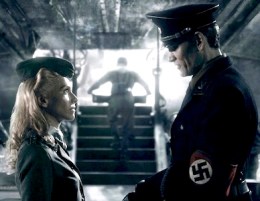 they’d be the gung-ho spotless heroes defeating that Natzees for a second time.
 Seen by some as a

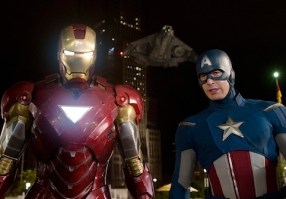 Coming to it for the first time on Blu-ray, then, there’s an even bigger level of expectation attached. Iron Man had much the same problem five years ago, and I felt that had been overrated too. I don’t think either are bad films — I very much enjoyed Iron Man, and I enjoyed The Avengers, albeit more intermittently — but I don’t think either are as good as mass opinion holds.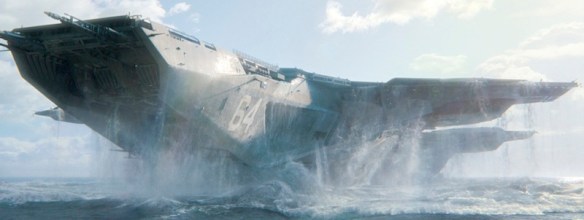
 Thor’s post-credits scenelet); plus numerous events from that film are mentioned and discussed, I’d say more so than any of the other four preceding films (scenes that would have more specifically related to the events of Captain America were cut for time and pace — yes, believe it or not, some stuff was left out).
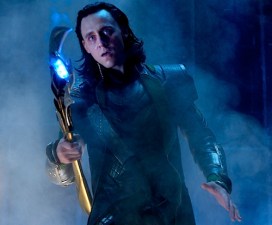 meaning Thor 2 is going to have to begin somewhere after what happened here, with very specific ramifications for its characters. Maybe they’ve got some damnably clever way around that. I doubt they think it matters any more anyway — who hasn’t seen The Avengers? And in the future, well, it’s up to the viewer to piece together which order all the disparate sequels and spin-offs go in.
 And the glaringly obvious thing I haven’t discussed is the title. Firstly, as you can see from all my akas at the top, no one can quite agree on what it’s meant to be. Secondly, there’s the highly contentious UK renaming. Did it need it? Patronised-feeling film and comic fans say “no”; but those aware of general public perception say that, either anecdotally or through research, normal Brits did report confusion with
 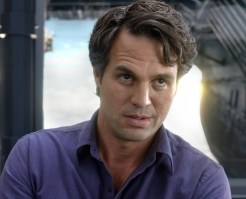 Amusingly, one of the few bits even those in implacable love with the film sometimes criticise is Banner’s “I’m always angry” moment, which I thought was an awesome perspective on the character. It’s not just convenience either — it was put it in for a specific reason. I’ve lost the quote, but it’s something to do with how Whedon always feels somewhat angry at various things. I could identify.
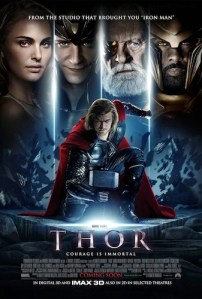 Director Kenneth Branagh brings all his Shakespearean know-how to one of the most innately successful of Marvel’s recent superhero movies. Perhaps lacking the mass appeal of
  The two-part animated adaptation of Frank Miller’s comic, regularly voted among the top three stories ever told in the medium, concludes here. If you’ve not seen
 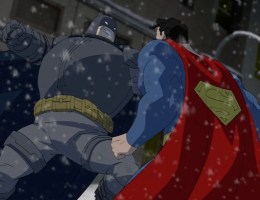 Nonetheless, a pair of big battles form the cruxes around which the story works: Batman vs the Joker, and Batman vs Superman. I won’t spoil the outcomes for those who’ve not read the book, but both are excellently realised on screen. Action can be tricky in comics — you’re stuck with a series of still images to convey fast-paced, often intricate movement. I also generally have the impression that action sequences are not 2D animation’s forte — too many frames need to be drawn, too many different angles to make it quick and exciting enough. The Dark Knight Returns is one of the exceptions, however, and the two big sequences in Part II — as well as a couple of smaller ones — outclass anything in Part I, which was good in the first place. I’d go so far as to say the Superman fight improves on the novel’s version, at least in a visceral sense — Miller delivers Batman’s internal monologue and a certain pleasing disregard of Supes, while Oliva wisely skips any kind of voice over and delivers the entire duel blow for blow. It’s a fantastic climax.
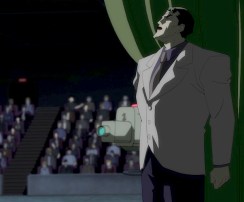 The story may provide some déjà vu for those only acquainted with live-action Batman, because Christopher Nolan borrowed liberally from Miller’s TDKR for his TDKR,
  There were many sceptics when DC first announced they were going to tackle such a sacred Bat-story, and not all were convinced by Part I. I don’t imagine Part II will change their minds, but for those of us who did enjoy the first animated interpretation of Miller’s seminal tale, this is even better. In fact, even without its first half, I’d say it joins the ranks of my very favourite Bat-films.
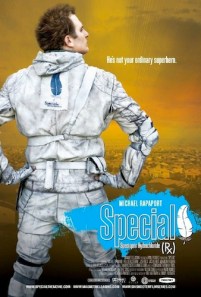 A lot of praise was slung
 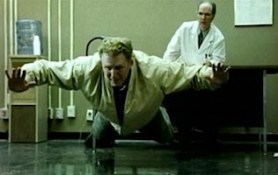 Those after a more genre-aware “real world superhero” movie would do better to stick with Kick-Ass or Super, but those who might embrace something a little different — especially something with an indie sensibility — would do well to take a look. Indeed, being a comic fan is certainly not a prerequisite for enjoyment here.
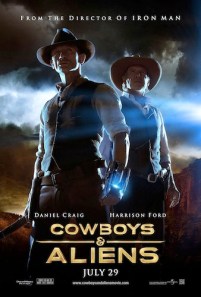 We all know the saying “too many cooks spoil the broth”, and it can’t help pop into one’s mind during the 85 seconds of company logos that kick off this genre mashup. Here the “cooks” are Paramount (serving non-US distribution only), Dreamworks, Universal and Imagine Entertainment — I can’t remember the last time I saw a Hollywood blockbuster begin with so many individual logo animations. It’s unsurprising that no one wanted to take a solo punt on a Western-with-a-twist after the failure of
 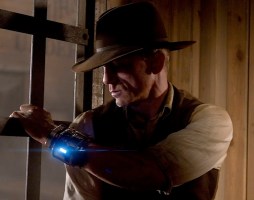 Thing is, what the film gives us doesn’t quite sit right, even if you’re expecting it to be non-pulpy. It’s still an action-adventure summer blockbuster, but with pretensions at times to be a Western drama. I think that’s the fundamental problem with the entire film, and probably why it feels slow, especially in the middle. A lot of that is character scenes, despite which the characters feel underdeveloped and under explored. One wonders if these particular writers, versed in the art of the blockbuster, don’t really know what they’re doing. Sometimes you can see what they were going for, for instance in how they set things up and pay them off (like the alien with a grudge against Craig), but somehow it doesn’t come off.
 Also note that this climax lasts a full 25 minutes. It may not sound a lot for the big finish — it’s the whole third act after all — but it felt it (especially as the build-up begins 40 minutes out), with constantly shifting goal posts and Favreau’s attempts at making a skirmish feel like an epic battle. Other parts are just straight wasted opportunities, like the extended sequence in an upturned riverboat. For one thing, no effort is made to explain its presence. For another, it’s all so darkly shot that you can’t get a real sense of it. Could have made for some impressive sets — heck, maybe they were impressive sets — but it’s not well utilised. Makes it harder to work out just what’s going on at times too. Thank goodness it wasn’t in 3D!
 I could go on. For example, Craig loses the love of his life to the aliens, then loses the new woman he seems to have quickly fallen for to them too… but it’s OK because he saw a hummingbird at the end, so he’s happy. Or there’s the fact that the town is called Absolution — I believe, anyway, because I think one of the three guys at the beginning mentions it and it’s the title of a featurette on the BD. Other than that, no mention is made in the film, despite it arguably being one of the key themes. We don’t need to be battered around the head with symbolism, but a bit more effort might’ve been nice.
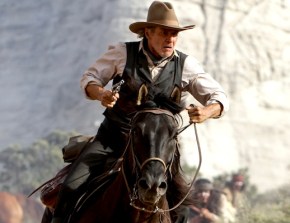 so maybe the theatrical version wouldn’t be much better pacing-wise after all. On balance this feels like an extended cut where someone decided to save a work-in-progress edit and later deem it an “extended cut”, then kept trimming to craft a more streamlined theatrical cut, as opposed to the filmmakers dropping missed elements back in post-release.
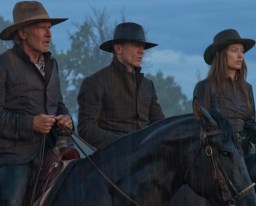 Sad, but true.
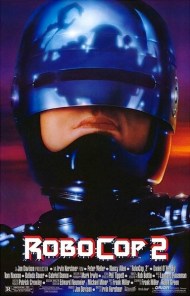 The consensus opinion seems to be that the RoboCop films exist on a steep downward trajectory of quality, starting with the pretty-good
 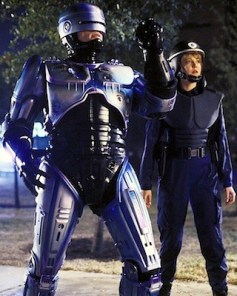 and though it was reportedly massively re-written after his work was done (to the extent that, decades later, there was a comic book miniseries that adapted his original version) I think his touch can still be felt at times.
 In a crime-addled future Detroit, cop Alex Murphy is gunned down by a gang of crooks, only to be resurrected by evil megacorporation OCP as the future of law enforcement: RoboCop. Obviously — that’s the title.
 100Films.co.uk