
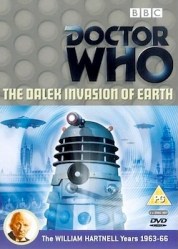
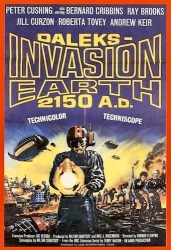
The Dalek Invasion of Earth
and
Daleks’ Invasion Earth 2150 A.D.
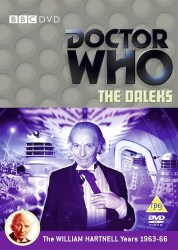
Doctor Who: The Dalek Invasion of Earth
1964 | Richard Martin | 149 mins | DVD | 4:3 | UK / English | PG
Daleks’ Invasion Earth 2150 A.D.
1966 | Gordon Flemyng | 84 mins | Blu-ray | 2.35:1 | UK / English | U
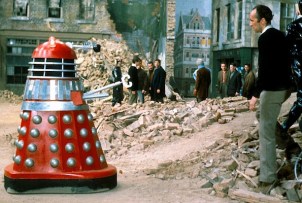 In a week’s time, on the 23rd of November 2013, Doctor Who will celebrate its golden anniversary — 50 years to the day since the premiere broadcast of its first episode, An Unearthly Child. (As part of the celebrations, BBC Four are showing that initial four-parter at 10:30pm on Thursday 21st. I heartily recommend it.) The programme’s success was cemented several weeks later, however, with the appearance of the Daleks — a race of xenophobic mutants hidden in metal machines from the planet Skaro. A wave of Dalekmania followed, leading to a boom in merchandising and, naturally, a sequel serial for the TV series, one year later.
It also led to a film adaptation, which I discussed last week. When that was a box office success, a sequel was greenlit. As with the first film, rather than construct an original tale starring the Daleks, the filmmakers turned to the TV series and adapted the aforementioned TV sequel. The story is set hundreds of years in the future (perhaps 10 years after 2164 in the TV series; 2150 in the film), when the Daleks have somehow left their homeworld and their city (which previously they’d needed to survive) and found their way to Earth. But this isn’t a Hollywood-style alien invasion battle: the Daleks have already occupied the planet, and Britain in particular (of course). The Doctor and his friends stumble into this situation and resolve to stop the evil invaders.
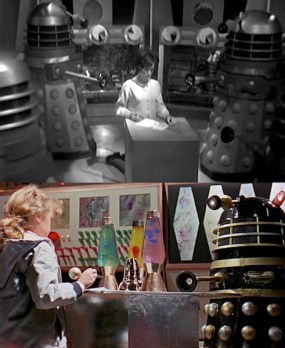
There’s little doubting that The Dalek Invasion of Earth is a minor epic. Where The Daleks struggled a bit to fill its seven-episode order, in six instalments writer Terry Nation takes us from an occupied, bomb-blasted London, to an attack on the Dalek spaceship, to a mine in Bedfordshire that’s digging to the centre of the Earth. Although made on Doctor Who’s typically tiny budget, the TV serial shines. 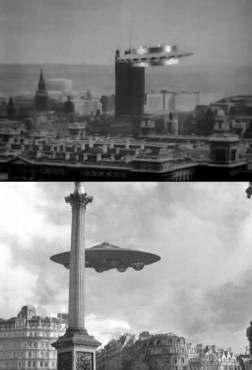 There are some fantastic sets, bolstered by peerless location filming of a deserted London (simply achieved by shooting very early in the morning), and the usual array of quality performances from the series’ regulars and guest cast. It’s only let down by the special effects. The Daleks are as great as ever, and a weird monster that turns up for a few minutes is passable (if you’re being kind), but shots of the Dalek saucer flying over London look like a pair of foil pie cases on some string in front of a photo. Even by the standards of the era it’s bad. The DVD release includes the option to watch the story with new (in 2003) CG effects in place of these sequences, and for once I’d actually recommend that.
The story once again trades on the Daleks’ clear Nazi undertones. Here they’ve occupied a bomb-blasted country where a small band of rebel fighters hold out against them, attempting small-scale attacks while trying to work out a bigger plan. It can only be deliberate that these parts — hidden workshops, missions in enemy uniform, even the fighter’s casual clothes — all trade on familiar imagery from World War 2 resistance movies. Here, at least, collaborators are men rendered brain-dead by Dalek machinery, controlled via radio waves directly into their heads, rather than those who have chosen to betray their people.
That said, this is not a cheery view of the world. We can see that right from the opening shot: a derelict stretch of urban river bank, overgrown and decrepit, and the caption “World’s End”. 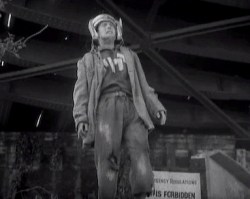 A man stumbles towards the steps, he screams in agony, battling with the strange machinery on his head. And then he hurls himself into the river, where he floats face down — dead. Beginning a kids’ programme with suicide? You wouldn’t do that today! We later learn that he’s a Roboman, controlled by the Daleks, essentially dead already… but it’s a bit late by then. Later, we meet unscrupulous country folk: a black marketeer who won’t give over food to the enslaved mine workers without payment, and won’t escort Ian out of the camp without payment either; and two women, employed by the Daleks to mend the workers’ clothes, who betray Barbara to get more food. There are heroes here, certainly — men and women who fight the Daleks, and some who give their lives for the cause — but not everyone’s doing the honourable thing.
The film is a bit less bleak in its outlook for humanity. The black marketeer remains, more treacherous than ever: he actively betrays the Doctor to the Daleks, though is killed for his troubles; the two women are there, too; but there’s no suicidal Roboman, and indeed the climax suggests the Robomen are able to return to being human just by taking their helmets off. 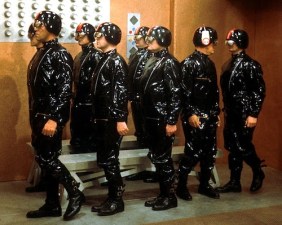 So that’s nice for them. There’s also some significant additions of humour, like when Tom is pretending to be a Roboman to stow away on the Dalek saucer and ends up in a mime act as he attempts to mimic a group of the real thing while they have lunch. Bless Bernard Cribbins. There aren’t too many of these almost-farcical bits, but the few there are lighten the general tone.
Overall, however, Daleks’ Invasion Earth 2150 A.D. (aka Daleks – Invasion Earth: 2150 A.D., and many other such punctuation-based variations, thanks to inconsistent spelling on posters and trailers) is, much like the the previous film, a strikingly faithful adaptation… at first. The running time is again a clue: while the TV serial takes two-and-a-half hours on its story (albeit with some subtractions for six sets of titles and five recaps), the movie rattles through it in 84 minutes. That’s with a new bookend sequence designed to establish the new character of PC Tom Campbell (Bernard Cribbins), leaving the film 75 minutes in which to condense Nation’s epic. Nonetheless, it’s scene-for-scene faithful, just picking the pace up with key actions and lines of dialogue rather than the comparatively-luxurious speed of the original.
As it goes on, though, things begin to diverge quite rapidly. Significant characters have been cut for time, while legacy changes from the first film also alter the plot — 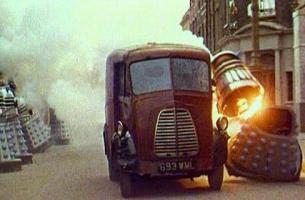 no burgeoning romance for Susan, here a small girl rather than TV’s young woman. Both stories split our leads into three groups following the assault on the Dalek saucer, but while the film retains the outline of these subplots, it rearranges which characters take which route. It’s a slightly bizarre turn of events, to be honest, and doesn’t always pay off: whereas the TV series manages to plausibly pace the various characters’ journeys from London to Bedfordshire, in the film the Doctor and his chum walk there in the same time it takes the Dalek saucer to fly it. Either that saucer’s underpowered or they’re impressive hikers.
Even with all these changes, the general shape of the story remains the same; yet the film feels less epic than the TV serial. It’s not just the length, but the sense of time passing: on TV the Doctor and co seem to be stuck on Earth for several days, while in the film it’s practically an afternoon’s work. And though the movie’s special effects are better (immeasurably so, in fact, because the model work in the film is fantastic), and there’s some great stunts too, the bigger-budget big-screen outing lacks the TV version’s London location filming. This makes a startling difference to the relative effectiveness of the story. On TV, you really feel like the Daleks have conquered Earth; in the film, it feels a little like they’ve conquered some expansive studio sets and impressive matte paintings. 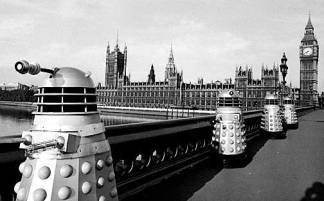 (Incidentally, perhaps the most striking thing about the serial’s location sequences are that they don’t include the iconic shot of the Daleks rolling across Westminster Bridge. That bit is in there, but it was filmed from an entirely different angle; I guess the famous image was just a unit photograph.)
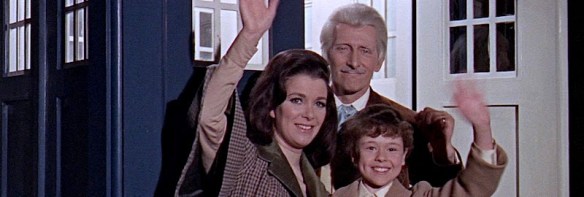
There are other bits that work less well on film. Dortmun’s sacrifice on TV makes sense, a bold character moment; in the film, he seems to do it for the hell of it. On TV, the Doctor commits himself to stopping the Daleks (in one of the series’ clunkiest bits of dialogue, to be honest), whereas in the film he just stumbles into things — which, funnily, is more like the Doctor of the time. Ian and Barbara have been replaced by the aforementioned PC Tom and the Doctor’s niece, Louise, because Dr. Who and the Daleks actors Roy Castle and Jennie Linden were unavailable. Not that it matters much — Bernard Cribbins is just as adept in the comedy role, and Jill Curzon’s Louise is just Barbara by any other name. Then there’s the music, which is often jauntily comedic rather than action-packed; and the ever-so-’60s main theme, as with the first film replacing the TV series’ iconic, groundbreaking, electronic howl with something altogether more forgettable. What the film most benefits from losing, however, is a couple of hilariously of-the-time lines from the Doctor — particularly one when he tells Susan she needs “a jolly good smacked bottom”!
That aside, perhaps the film’s biggest loss is in the age of Susan. Nothing against Roberta “One-Take” Tovey, who is fortunately much less irritating than your average child actor, 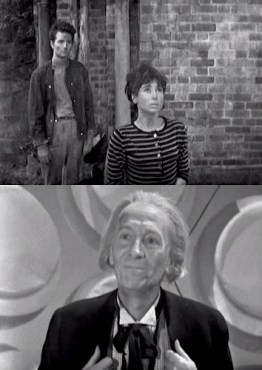 but the TV serial has a real advantage in this department. The original companion, this was Susan’s final story — the first companion departure in the series’ history. It handles it marvellously: rather than the final-minutes cut-and-run so many companions suffer, Susan’s growing sense of departure is built throughout the story… and then it’s the Doctor who realises it’s time for her to go, not her, and he leaves her behind. The speech he gives is one of the finest in the series’ history, beautifully and poignantly delivered by William Hartnell, and with a nicely under-played reaction from Carole Ann Ford. Doctor Who has had countless companion exits now, but this one still takes some beating.
Each version of The Dalek Invasion of Earth does something better than the other, but on balance the TV series is the clear victor. That said, the film is probably more entertaining than its big-screen predecessor; but that’s just the story itself, I guess, which I think is a more effective use of the villains. You could argue it ties into the fairly-modern idea of the first encounter being an establisher and the sequel a bigger, bolder, deeper, more exciting, experience. Both versions are certainly that.
Despite the enduring popularity of the titular villains, Daleks’ Invasion Earth 2150 A.D. wasn’t as much of a box office success as its predecessor. Combined with an overrunning schedule that led to a higher budget, its profitability was clearly lower. Production company AARU had the option to make a third film (presumably to be based on the third Dalek story, 1965’s The Chase), but the money-men passed. 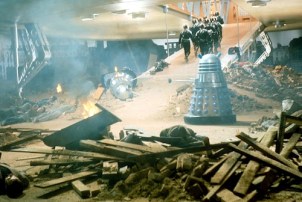 Most Doctor Who fans won’t lament that (especially as The Chase isn’t the most well-loved of Dalek adventures either), but, even though the TV series remains the superior product, I think the Dalek movies have their own merits and charm. I’m not suggesting we should be finding a way to write them into Doctor Who canon, but as an alternative to the norm, they’re a good bit of fun.
Tied in with Doctor Who’s 50th anniversary celebrations, Channel 5 are screening the Dalek movies next weekend. Dr. Who and the Daleks can be seen on the anniversary itself, Saturday 23rd November, at 10:05am. Daleks’ Invasion Earth 2150 A.D. is on Sunday 24th at 10am.

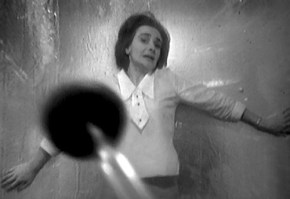 but that’s not what secured the chance to prove the series’ longevity. That would come a few weeks after the premiere, in the weeks before and after Christmas 1963, when producer Verity Lambert went against her boss’ specific orders and allowed “bug-eyed monsters” into the programme — in the shape of the Daleks.
 its inspiration comes both from the Nazis, not yet 20 years passed, and the threat of nuclear annihilation, at a time when the Cold War was at its peak. The film adaptation is so unremittingly faithful (little details have changed, but not the main sweep) that these themes remain, all be it subsumed by the COLOUR and ADVENTURE of the big-screen rendition.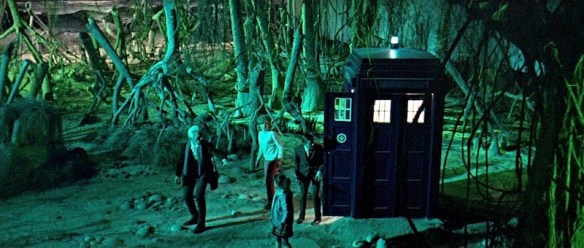
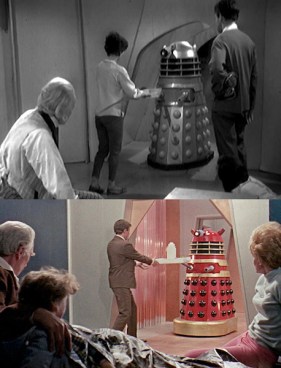 If the film’s rendering of the story and consequent themes is near-identical to its TV counterpart, plenty of other elements aren’t. The most obvious, in terms of adaptation, is that its 90 minutes shorter — roughly half the length. That’s not even the whole story, though: the film is newbie friendly, meaning it spends the first seven minutes introducing the Doctor and his friends. When we take out credits too, it spends 75 minutes on its actual adaption — or a little over 10 minutes for each of the original 25-minute episodes. And yet, I don’t think anything significant is cut. Even the three-episode trek across the planet that makes up so much of the serial’s back half is adapted in full, the only change being one character lives instead of dies (a change as weak as it sounds, in my view).
 The most obvious change — the one that gets the fans’ goat, and why so many dislike the film to this day — comes in those opening seven minutes. On TV, the Doctor (as he is known) is a mysterious alien time traveller, his mid-teen granddaughter Susan is also a bit odd, and Ian and Barbara are a pair of caring teachers who he kidnaps to maintain his own safety. In the film, the title character is Dr. Who — that’s the human Mr. Who with a doctorate — who has a pair of granddaughters, pre-teen Susan and twenty-ish Barbara, while Ian is the latter’s clumsy fancyman. They visit the time machine that Dr. Who has knocked up in his backyard, where clumsy old Ian sends them hurtling off to an alien world. In many respects this is once again the difference between TV and film: the former is an intriguing setup that takes time to explain and will play out over a long time (decades, as it’s turned out — the Doctor is still a mysterious figure, even if we know a helluva lot more about him now than we did at the start of The Daleks), while the latter gives us a quick sketch of some people for 80 minutes of entertainment. Plus, making Ian a bumbler adds some quick comedy, ‘essential’ for a kids’ film.
 (not to mention Peter Capaldi to come, a recast Hartnell in
 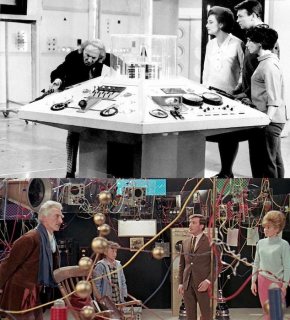 The console room in the TARDIS is another iconic piece of design, the six-sided central console and roundel-decorated walls having endured in one form or another throughout the show’s life (even if some of it’s become increasingly obscured in the iterations since
  Then there’s the way they glide, the screechy voice, the sink-plunger instead of some kind of hand or claw… It’s a triumph, and it works just as well in gaudy colours on film as it does in simple black and white.
 Whenever the series brings up past Doctors (and that’s surprisingly often, considering the “come on in, it’s brand new!” tone in 2005), Cushing isn’t among them. While he may once have been a prominent face associated with the show to non-fans, the ‘war’ has been ‘won’ — he’s become a footnote.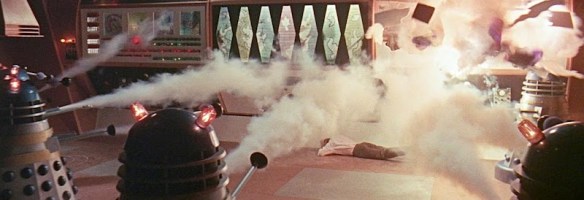
 While the first three ‘Dead’ films (or “the original trilogy”, to put it in
 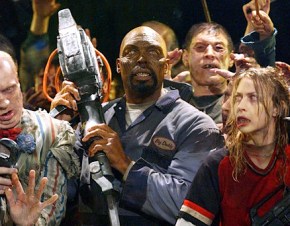 and then a desire for revenge, when he sees the glittering lights of the city in the distance. Lead he does, corralling the other zombies into a slow march towards their target.
 In the world of the humans, meanwhile, we also have an oppressed majority: the slum dwellers. Attempts at revolution there are soundly ignored, with the rich quietly taking the opposition out as ‘trash’ whenever able (which, I guess, is whenever they want). The people are controlled by drink, drugs, gambling, prostitution, and any other cheap entertainment you can imagine, all secretly managed from on-high to keep the general populace docile. And those entertainments are getting increasingly extreme, too: the zombie-on-zombie cage fights previously used cat or dog meat as motivation, but now they throw in Asia Argento. Again, Romero is holding a mirror up to present-day America, where the illusion of a ‘free society’ with easy social mobility is supported by the mega-rich in order to keep the poor down. It takes the zombie invasion for anything to change, which may be a case of Romero “following the story” rather than reflecting a political reality — who’s going to invade the US?
 Those commenters that do acknowledge these facets claim Romero’s just not as subtle as he used to be, which is also poppycock: Dawn’s criticism of consumerism is as blatant as anything listed here — perhaps even more so, because you can just watch Land as a near-future science-fiction humans-vs-humans-vs-zombies action flick, whereas I think Dawn’s ‘subtext’ is unmissable.
 If you want to see people getting ripped apart by zombies with their guts spilling out everywhere, in traditional Romero style, then… seriously, what’s wrong with you people?! But, erm, you should be satiated.
 The island town of Swallow Falls exists for one purpose: sardines; the fishing, packing, and distribution thereof. But when the world suddenly realises that sardines are gross, the town’s economy is left in tatters and the only foodstuff the islanders have is sardines. (While we’re on the glum bit, the location of Swallow Falls is identical to the real-world location of Bermuda, except in this reality almost every inhabitant is Caucasian and the island is indisputably part of the US. This is why you don’t scrutinise the geopolitics of kids’ movies, especially American ones.)
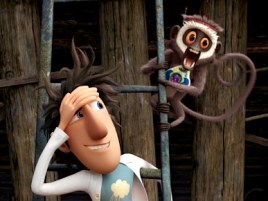 not an unworthy aim, and something Cloudy also achieves, but not a main consideration in my personal assessment of things. The main selling point is that it’s very funny. Of course there’s the slapstick cartoon humour, which is well done, but there’s also a lot of great one-liners, random asides, and the like. Not ‘adult jokes’ by any means, but I think it makes the film fun for grown-ups too.
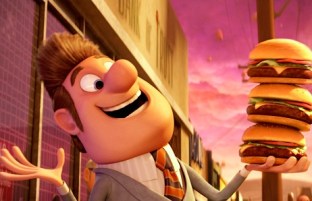 He’s a very funny character, but that’s in the writing, directing and animation — the voice work is spectacularly minimal. Apparently Harris was offered the lead but turned it down for the “more interesting” part of Steve. Nothing against Hader, but if I were the directors I’d have tried to persuade him to do both.
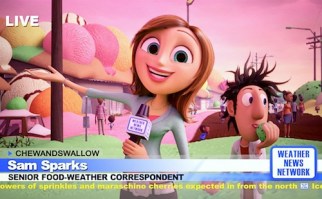 I should probably learn to stop writing off non-Pixar animated movies so readily (and, based on what I’ve heard and seen of their last few efforts, maybe slacken off on the Pixar love. I say that as if it’s news — plenty of people already have; and I’ve never been wholly on that bandwagon anyway. But I digress…) Big, bold, colourful, funny and exciting, Cloudy with a Chance of Meatballs is the kind of film I imagine a lot of kids love and watch on loop. In the process they may even be learning some Important Moral Lessons, which, crucially, aren’t too heavy-handed. Many of these aspects work for adults too. I don’t know if you’d want to watch it on loop, but you may certainly want to watch it again.
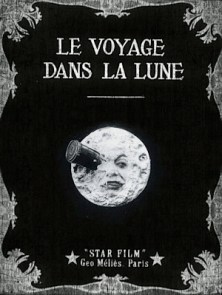 Of all the defining images of cinema — certainly of the silent era — the face on the Moon with a rocket in its eye must be one of the most recognised, though you have to wonder how many have actually seen Méliès’ full vision. More than it could have been, though, because A Trip to the Moon was so popular that, in the copyright-lax world of early cinema, it was widely copied and ripped-off; the kind of thing that destroyed Méliès’ career and, along with it, much of his work.
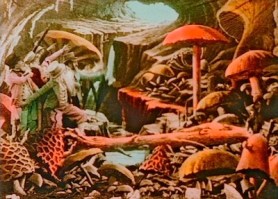 But Méliès wasn’t making a documentary, he was making an entertainment. Indeed, the analogy to a blockbuster is a good one, because this is essentially the turn-of-the-century equivalent. The fantastical sets, costumes and story are all designed to wow the viewer — and remember, we’re only a few years on from people diving out of the way of film of a train arriving in a station.
 Whatever it is, it’s certainly not period-authentic.
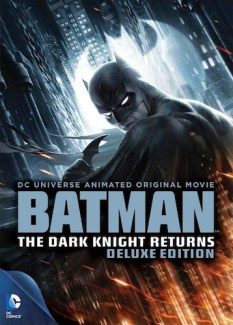 Warner Premiere’s $7 million animated adaptation of one of the seminal graphic novels is here rejigged from its original
 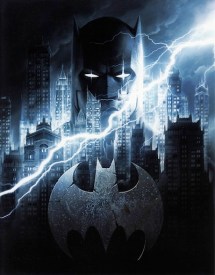 one of which is basically a climax before the halfway mark. Considering Miller’s original structure, that arguably leaves the film with a good three or four climaxes scattered throughout.
 and a feature-length documentary all about the original graphic novel,
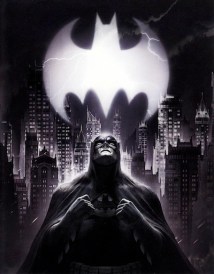
 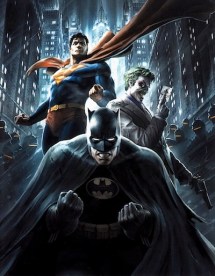 While I’ll continue to champion viewing the two halves of The Dark Knight Returns as separate movies, this single-film version is far from a travesty. If you’ve already got the separate releases, it definitely isn’t worth picking this up just for the film; so a purchase depends on how much value you place on the commentary and Masterpiece documentary (oh, and four art cards found in the box, which I’ve used to illustrate this review). If you don’t own the existing releases then whichever way works out as most cost-effective (bearing in mind which extras can be found where, of course) is the way to go.
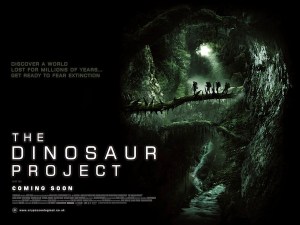 Found footage movies, eh? You either love them or hate them. Well, plenty of people hate them. I don’t mind them — it’s fast becoming an unoriginal idea (“existing genre + found footage = exciting new idea” is a sum that stopped working a couple of years ago), but if it’s done well, of course it still works.
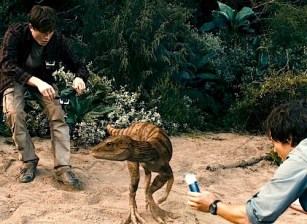 Essentially, then, it’s a cut-price
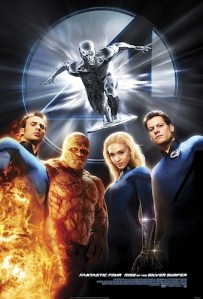 The Fantastic Four are the kind of superhero team that people in comics think are a big deal but the wider world aren’t so fussed about, as proven by the lack of success of their two film outings versus the likes of
 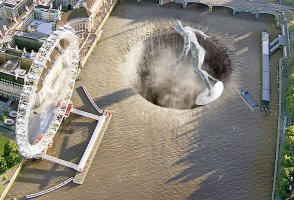 It’s also the kind of film where the US military have jurisdiction Everywhere In The World, which is again the kind of thing that used to just slide but doesn’t seem appropriate any more. Apparently the General character was originally meant to be Nick Fury — if it had been S.H.I.E.L.D., rather than the US military, at least that part might’ve made sense.

 A year after the end of
  100Films.co.uk