
Anthony & Joe Russo | 136 mins | Blu-ray | 2.40:1 | USA / English | 12 / PG-13
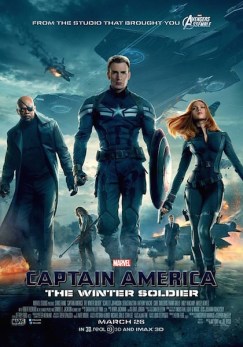 After the dullest, messiest movie of their first phase, and his goody-two-shoes depiction in The Avengers, Marvel finally nailed Captain America earlier this year with his second solo outing. Sadly, it’s still undermined by its share of niggles.
The Winter Soldier picks up two years after the Avengers assembled, with man-out-of-time Steve Rogers, aka Captain America (Chris Evans), a fully-fledged member of Team America: World Police S.H.I.E.L.D., working alongside Black Widow (Scarlett Johansson) to run all kinds of black ops missions. But when the life of director Nick Fury (Samuel L. Jackson) is threatened by a mysterious assassin known only as the Winter Soldier (Sebastian Stan), Cap begins to uncover a massive conspiracy of nefarious nastiness…
To say much more would be spoilerific, though chances are you’ve heard what happens even if you haven’t seen the film, because it’s had major implications for much of the rest of the Marvel Cinematic Universe. Still, I’ll assume you don’t know, just in case.
That said, the problem with Marvel’s massive shared universe (where the events of one film impact not only on future films but tie-in TV series, etc) is that, watching Cap 2 just seven months after its release, the film already feels like very old news. It was dissected into the ground by bloggers and commentators while it was still in cinemas; it had a huge effect on Agents of S.H.I.E.L.D., which by now has rolled past it into new territory; and it feels like 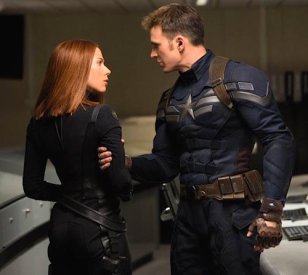 everybody moved on to being more excited about Marvel’s end-of-summer new-franchise-launcher, Guardians of the Galaxy. Cap 2 still has things to offer as a standalone film, but watching it now feels like watching a press conference after you’ve read a summary of the key points: there’s probably something to be gained from experiencing the whole thing, but it’s also like a slow-paced unveiling of surprises you already know.
It’s probably best to put aside the parts of Winter Soldier that have an impact beyond the film itself and just focus on it being a story in its own right, then. They promised us a ’70s-style conspiracy thriller, and there’s some of that DNA in there, although it’s been cleverly reworked to fit the slick CGI-filled world of the modern epic action blockbuster. So the conspiracy plot is actually not too complex, but there’s enough of it to give the film a different flavour. Many bonus points are earnt for trying to do more things with superhero narratives. It’s been widely noted that there are only about three or four superhero plotlines (and that’s if we’re being generous), so it’s good for Marvel — who are currently churning out two superheroic movies a year, and before long will be upping that to three — to be bringing something new to the table.
The style of story also becomes the springboard for a different tone to the action sequences: grounded, almost gritty, with practical effects and stuntwork — it could almost be a Bourne movie rather than a superhero one. They even manage to take a minor and silly Marvel villain, Batroc the Leaper, and turn him into a cool and worthwhile adversary. Until the climax, anyway, which is your usual CGI blow-out — an increasingly familiar pattern for Marvel films (and one we’ll come to again soon in Guardians of the Galaxy).
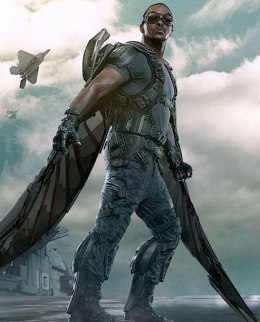 Also introduced is sidekick hero the Falcon (Anthony Mackie), who I have little to say about directly. He’s a sidekick who’s introduced fully-formed — he’s been using his ‘superpower’ for years as just part of the military; it’s not new or exciting to him, which lessens some of its power for the viewer too. “Origin story” may be the most over-used of all the superhero stock stories, but there’s a reason for that. If you skip it then you cut to the chase, that’s true, but does it also lessen the impact of characters to not see how they started? Maybe storytellers just need to come up with fresh ways of giving origins, rather than skipping them altogether.
Despite his presence in the title, the Winter Soldier also has a fairly small part to play in the final mix. He’s a henchman, not the main villain — but he’s an important character in the comics, so naming the film after him is really a signal to fans. Unfortunately, the Big Reveal of who he is has been a little bungled: comic book fans already know, so it doesn’t matter to them; and the element it ties back to in The First Avenger was so throwaway that casual viewers aren’t going to remember it. The Winter Soldier does its best to retrospectively big up the necessary elements, with callbacks to the first film and new flashbacks to bolster relationships. Whether it’s too little too late is perhaps a matter of personal preference.
Talking of that shared universe again — well, it’s hard to avoid, because Winter Soldier is every inch grounded in what has come before and what will come after. Mackie described the film as “Avengers 1.5”, and that’s pretty true. It picks up on events and characters from both The First Avenger and The Avengers, some of which have very significant roles to play in the film’s own storyline; 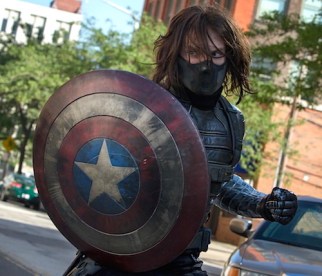 and then it refuses to wrap everything up, putting certain things in place ready for Age of Ultron and leaving still other doors open for Cap 3 — including the bloody Winter Soldier, despite his name being in the title! Goodness knows when or how they’re going to deal with that, considering the next Cap film is based on another highly significant comic book story arc, Civil War.
For me, however, the way it ties in to and impacts on the wider Marvel universe is when the film is at its weakest. There’s a benefit in utilising our relationships to these characters for emotional or dramatic effect, and at times it does that well, but when it’s raising more questions than answers, and when it can’t even complete the storyline that’s in its own title, is that a good thing? This isn’t part of a TV series, it’s a movie — is it so much to ask for a complete experience, one that builds on previous movies and has teases for the future (if it must), rather than just the latest segment of an apparently-never-ending story? Marvel’s shared universe is turning out to not be a group of films which happen to feature the same characters crossing over, but ones where the status quo between a film and its own sequel can be completely changed by events in a ‘separate’ series. Is that OK? It seems to work for them, and many people are getting a great amount of enjoyment from spotting the links and piecing together the arcing stories, so I guess it is.
The audacity of certain twists, plus the unusualness (for a superhero movie) and quality of the action sequences, is likely responsible for the massively positive reception that greeted The Winter Soldier on its cinematic release. With the surprise value of the former removed, and arguably exposed as just another round of questions to be answered in future instalments, 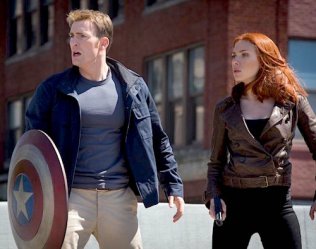 what’s left? There is strong action, albeit undermined by muddled character investment; and there is an interesting thriller/conspiracy story, albeit undermined by a feeling of “once you know it, you know it” — it’s not all that complicated or all that surprising, including the revelation that the one character significant enough to be behind it all is behind it all (gasp!)
Believe it or not, I did quite like The Winter Soldier while I was watching it; but the more I write, the more it frustrates me. There’s undoubtedly some quality filmmaking here (as far as superhero blockbusters go — it’s never going to please a sniffy cineaste), so perhaps I need to stop getting so hung up on its connections to other films. Or perhaps Marvel need to stop tying all their movies so tightly together. There’s surely a reason this doesn’t have a number in the title — it’s meant to be Captain America vs. the Winter Soldier, not Marvel’s Avengers Universe: Episode 9. But, however many borderline-unique elements it’s at pains to include, the latter is what it is.

Captain America: The Winter Soldier is on Sky Movies from Boxing Day.
This review is part of the 100 Films Advent Calendar 2014. Read more here.
 I think I’ve previously discussed my life-long love of the X-Men franchise, so I shan’t go into detail again, but suffice to say Days of Future Past has been one of my most-anticipated movies ever since the title (which is that of a classic and influential story from the comics) was announced. Thank goodness, then, that the final result doesn’t disappoint.
 Beyond that, there’s the characters: the younger versions are having to deal with the fall-out from
  Not everyone gets to shine in a cast this big, although pretty much everyone gets a moment. The future-set cast have the least to do, people like Halle Berry turning up to do little more than show their face, though Stewart and McKellen get a moment or two worthy of their talents. After he was the focus of the last film, Fassbender is slightly shortchanged here; but after McAvoy gave him essential support in First Class, Fassbender plays the same service here, informing Charles’ journey. Of the new additions, Evan Peters as Quicksilver (that’s the one who’ll also be played by Aaron Taylor-Johnson in
  Later, there’s the aforementioned ‘slow-mo’ sequence, and the grand climax, which offers more “fly something big around” antics a la First Class’ submarine, only considerably grander. Yet for all the spectacle, the final moments once again come down to character: what is Magneto prepared to do? What is Mystique prepared to do? Will anyone listen to Charles? And so on. Even the much-vaunted Marvel Studios movies tend to base their climaxes in slabs of ‘epic’ CGI crashing into each other; Days of Future Past does that for a bit, then brings the characters back into focus for the real final beats.
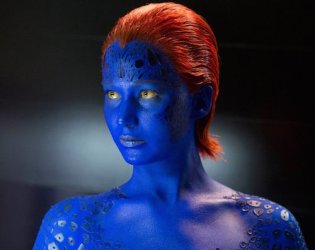 (Jennifer Lawrence being the third pillar of the past triumvirate, as they’ve already focused on Xavier and Magneto). While Days of Future Past does wrap up the majority of its threads (the open-ended ones are answered by previous films, if you want them to be), there’s plenty there to play with in the next film (and, perhaps, ones beyond that) if they want to… which they do.
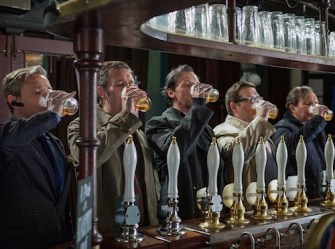 “zombie movie” or “Hollywood action movie”, and occasionally co-writers Pegg and Wright have substituted character development and thematic points for send-up. It may not play to the genre-loving fan-audience that the trio’s previous work has accumulated (demonstrably so, based on many a viewer review), but it does make for a more grown-up film.
 It will definitely reward multiple viewings: it’s littered with signs, omens and portents (in fairness, a good few can be grasped on an attentive first go). There’s a featurette on the BD (but not the DVD) which helps point out any major ones you may’ve missed; though I have to say, even at seven minutes long, and even with it pointing out some that felt too obvious to be worth mentioning, I swear it left some stuff out. That could be a deliberate decision of course, to leave some things for people to just spot.
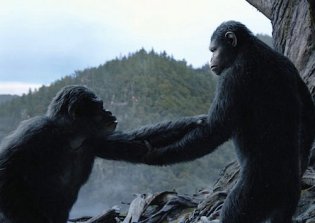 A heady mix of solid writing from Mark Bomback, Rick Jaffa and Amanda Silver, peerless motion-captured performances from the likes of Serkis and Toby Kebbell, and first-rate CG magic from Weta, brings us a set of characters who are compelling and believable. Here is a society trying to define what it wants to be, battling old prejudices in the hope of a peaceful, secure, happy future. If you want to draw analogies to almost any real-world political situation, I’m sure you could.
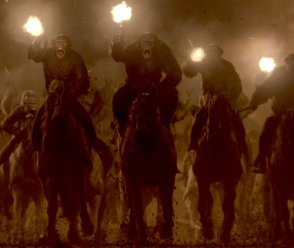 Lest you get the wrong impression, the film isn’t all talk. For various spoiler-y reasons, the fragile relationship between Man and Ape breaks down, and the apes stage an attack on humanity. Here we get perhaps one of the best siege action sequences I can think of, with mankind holed up in a half-constructed skyscraper that sits conveniently at the end of a long street for the apes to charge down. Reeves’ direction is virtuosic here, crafting an epic and exciting sequence even when most of the film’s major players are busy elsewhere. And it’s not even the climax.
 thanks to some surprisingly small-scale narrative choices (the whole thing with the dam doesn’t feel nearly as vital as it should) and Reeves’ direction sometimes being a little straightforward and almost TV-ish. I know I’ve said I hate when people use that as a derogatory comment nowadays, but some repeated locations and shot choices make the film feel cheaper than it was.
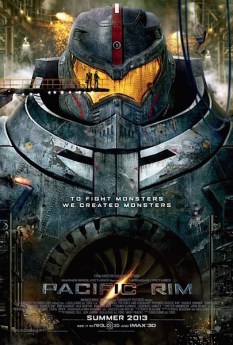 The names writers choose for their characters can sometimes tell you a lot about a movie. Pacific Rim is the kind of film that has characters called Raleigh Becket, Stacker Pentecost, and Hannibal Chau.
 — it was the 3D that added depth and height, and without that (or, as I said, an adjustment of focus to compensate) it’s all a bit… not flat, but not big either. That aside, it is beautifully shot, with excellent lighting.
 Of late there seems to have been a glut of sci-fi films with highly generic, near-meaningless titles —
 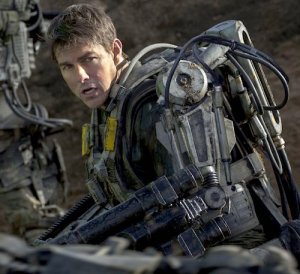 suitably exciting, surprisingly funny, and actually quite clever. It’s also boldly standalone. OK, so it’s an adaptation, but the book is hardly a
  Reflect too heavily and some bits may begin to crumble more but, for me, not too severely.
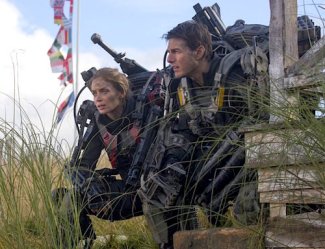 Edge of Tomorrow isn’t an unqualified success, but more than enough of it works to make for a well-above-average modern blockbuster. Excellent action sequences, plenty of amusing asides, and a couple of solid sci-fi concepts to chew on combine to render it quality entertainment. Bonus points for being a true original in a sea of remakes, sequels and spin-offs.
 Despite the fact that
  Then we have the much-maligned backstory about just what Peter Parker’s parents did all those years ago, before they abandoned him with Uncle Ben and Aunt May. There are pros and cons to this: it’s all new, which at least makes it interesting and unpredictable because it has no forebear in comics or films; but it’s also a pretty stock set of circumstances. Worse still, it robs Spidey of a major defining trait: Peter Parker is bitten by a spider by accident — it could’ve been anyone. In this version, it could only have been him. Boo. Sony clearly want an arc plot they can run across a trilogy (or more), so presumably this thread will rumble on… though whisperings that they’re considering some kind of soft-reboot may see it cut short. I wouldn’t complain.
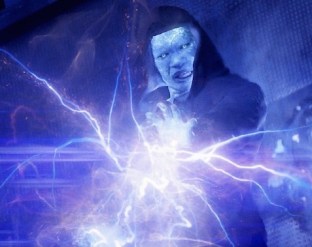 but it’s more textured, at least. Then there’s Electro, who (as mentioned) may have a familiar story, but is nonetheless perfectly pitched by Foxx. His powers lead to some excellent sequences, including but not limited to the aforementioned Times Square duel. He also contributes to the music, in a way, as Electro’s whispered/sung thoughts ‘bleed out’ into the score. It’s creepy, especially as it’s so subtle in the mix — I wondered what the hell was going on at first. I thought it was a fantastic score all round, in fact, bringing in a modern music element that fits the notion of Spidey as a young character perfectly.
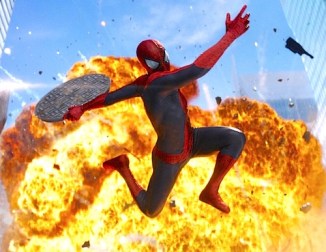 It lacks the confidence, heart and flair that mark out Spider-Man 2, and the bold originality and clarity of purpose that define
  Perhaps most discussed for the way it was released — at the same time as the film’s festival premiere, writer-producer Joss Whedon made it available to rent online — In Your Eyes is worthy of note on its own merits as a movie, too.
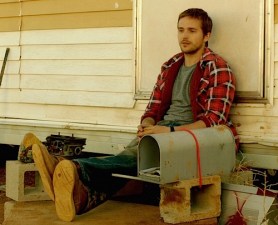 Secondly, their emotional connection means they begin to spend a lot of time in each other’s heads, distancing themselves from the world and, when they begin to be overheard talking to each other — or, as everyone else sees it, talking to themselves — people begin to get suspicious. And when you’ve got a controlling doctor for a husband, who knows about your history of mental health issues… well…
 A character-driven romance that will likely bore some, In Your Eyes weaved a spell on me. It’s beautifully, simply directed by Brin Hill, the focus lying heavily on the characters and performances of Stahl-David and Kazan. If you warm to them — and I think many will — then they’re a pleasure to spend time with, and you become invested in where events will take them. More magical realist than hard fantasy, this isn’t one for serious genre fans. Romantics, however, may fall in love.
 Jennifer Lawrence (who, depending on your mileage, is either “the most charming young movie star in, like, forever” or “actually kind of a little bit irritating”) returns as the totally-plausibly-named Katniss Everdeen in this super-successful follow-up to the super-successful
 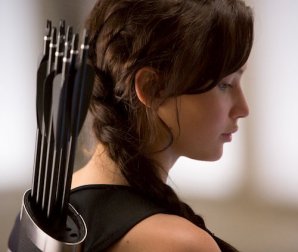 Tonally, however, it’s more similar to
 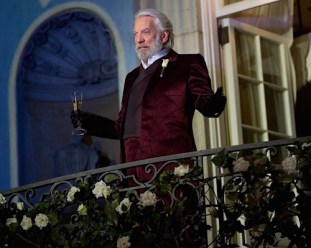 Of course, to an extent the tone of this ending comes from it being an adaptation: the filmmakers haven’t looked at the history of movie cliffhangers and chosen which to emulate, but instead brought someone else’s ending to the screen. Adapting doesn’t mean you have to take the original work faithfully, mind — you could go the
 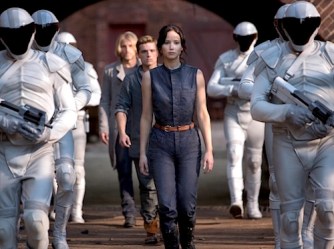 which seems richer, more detailed, despite no genuine increase in resolution. I guess it’s true what they say: if you start with a higher quality source, it filters all the way down. The “bigger screen” effect probably wouldn’t work for a film entirely shot on IMAX — it’d just fill your TV from the start — but, after an hour-or-so of black bars, it really feels like the screen has grown.
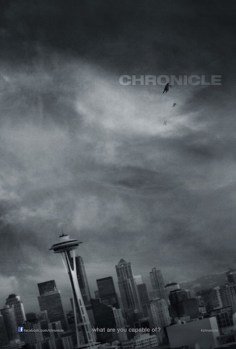 The birth of the “found footage” sub-genre and the resurgence of the superhero movie began around the same time, the former with
 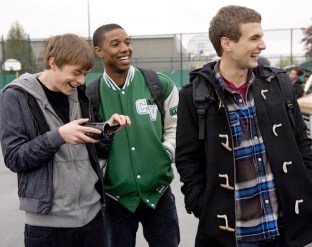 The story sees high school senior Andrew (Dane DeHaan) decide to start filming everything in his life, thanks to his borderline-abusive alcoholic father (Michael Kelly) and terminally ill mother (Bo Petersen). The same day (what a coincidence!), his cousin and only friend, Matt (Alex Russell), takes him to a party where, along with most-popular-kid-in-school Steve (Michael B. Jordan), they discover a hole in the woods with mysteries inside… Days later, all three begin to develop telekinetic powers, which they learn they can levy in various incredible ways — those ways being super, but largely without the heroic…
 This is even more pronounced in the extended version (“extended director’s cut” in the US), which includes over five minutes of extra bits that, in my opinion, make it a superior edit. Some are minor in impact, true, but there are a couple of short sequences with Andrew and Steve that deepen their relationship further, which enriches events at the end of act two. There’s also a moment that subtly prefigures the climax, and an extra bit in said finale that seems nigh-on essential to me. Considering the film still runs (just under) 90 minutes even with these additions, it’s difficult to see why they were cut in the first place. “Pace” is usually the rational for that, but if this is indeed a Director’s Cut then clearly Trank didn’t think they were an issue; equally, I can’t see why Fox would have objected. Still, they’re here to enjoy on Blu-ray…. though not on DVD… and I guess they’re not in TV screenings… Tsk.
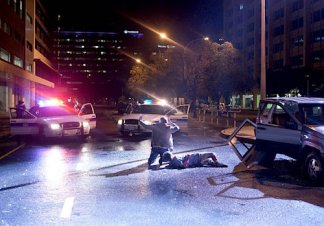 That said, spectacle it has. You wouldn’t expect that from a $12 million found-footage movie, but an epic duel through the streets of Seattle is one of the strongest climaxes to any superhero movie I can remember. It’s kind of like
  In the hands of many a desperate-to-get-noticed filmmaker, a found-footage superhero movie would likely have been a straight-to-DVD affair that could at best be described as “mediocre”. In Chronicle, however, Trank and co have crafted one of the best movies produced in either sub-genre. Most of the people involved — as well as the film they’ve all come from — can be classed as “one to watch”.
 100Films.co.uk